ESP KIA CARENS 2018 Owner's Manual
[x] Cancel search | Manufacturer: KIA, Model Year: 2018, Model line: CARENS, Model: KIA CARENS 2018Pages: 672, PDF Size: 19.21 MB
Page 397 of 672
(Continued)
•Always check the surroundingareas near your vehicle for people,especially children, before shiftinga vehicle into D (Drive) or R (Re‐verse).
•Before leaving the driver’s seat, al‐ways make sure the shift lever isin the P (Park) position; then setthe parking brake fully and shutthe engine off. Unexpected andsudden vehicle movement can oc‐cur if these precautions are notfollowed in the order identified.
•Do not use the engine brake (shift‐ing from a high gear to lower gear)rapidly on slippery roads.The vehicle may slip causing an ac‐cident.
CAUTION
•To avoid damage to your trans‐axle, do not accelerate the enginein R (Reverse) or any forward gearposition with the brakes on.
(Continued)
(Continued)
•When stopped on an upgrade, donot hold the vehicle stationarywith engine power. Use the servicebrake or the parking brake.
•Do not shift from N (Neutral) or P(Park) into D (Drive), or R (Reverse)when the engine is above idlespeed.
Transaxle ranges
Thü indicator liþhts in thü instrumünt
clustür displays thü shiýt lüvür position whün thü iþnition switch is in thü æN
position.
ç (çark)
Always comü to a complütü stop büýorü
shiýtinþ into ç (çark). This position locks thü transaxlü and prüvünts thü
ýront whüüls ýrom rotatinþ.
WARNING
•Shifting into P (Park) while the ve‐hicle is in motion will cause thedrive wheels to lock which willcause you to lose control of thevehicle.
•Do not use the P (Park) position inplace of the parking brake. Alwaysmake sure the shift lever is latch‐ed in the P (Park) position and setthe parking brake fully.
•Never leave a child unattended in avehicle.
CAUTION
The transaxle may be damaged ifyou shift into P (Park) while the ve‐hicle is in motion.
R (Rüvürsü)
Usü this position to drivü thü vühiclü
backward.
6-25
6
Drivinþ your vühiclü
Page 403 of 672
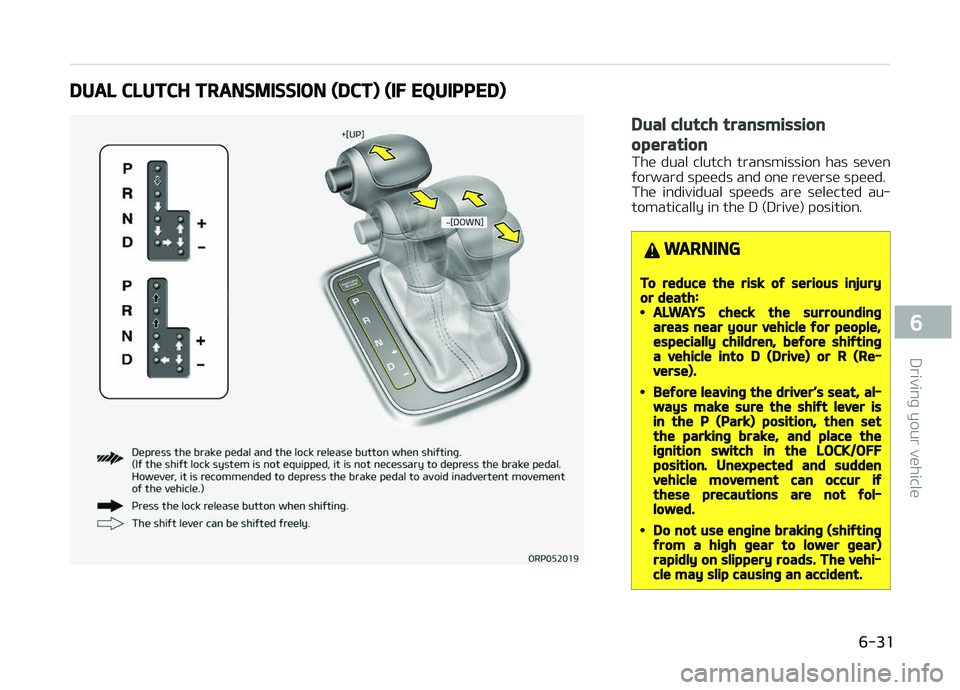
DUAL CLUTCH TRANSMISSION (DCT) (IF EQUIPPED)
Dual clutch transmission
operation
Thü dual clutch transmission has süvün
ýorward spüüds and onü rüvürsü spüüd.
Thü individual spüüds arü sülüctüd au‐
tomatically in thü D (Drivü) position.
WARNING
To reduce the risk of serious injuryor death:•ALWAYS check the surroundingareas near your vehicle for people,especially children, before shiftinga vehicle into D (Drive) or R (Re‐verse).
•Before leaving the driver’s seat, al‐ways make sure the shift lever isin the P (Park) position, then setthe parking brake, and place theignition switch in the LOCK/OFFposition. Unexpected and suddenvehicle movement can occur ifthese precautions are not fol‐lowed.
•Do not use engine braking (shiftingfrom a high gear to lower gear)rapidly on slippery roads. The vehi‐cle may slip causing an accident.
6-31
6
Drivinþ your vühiclü
Page 428 of 672
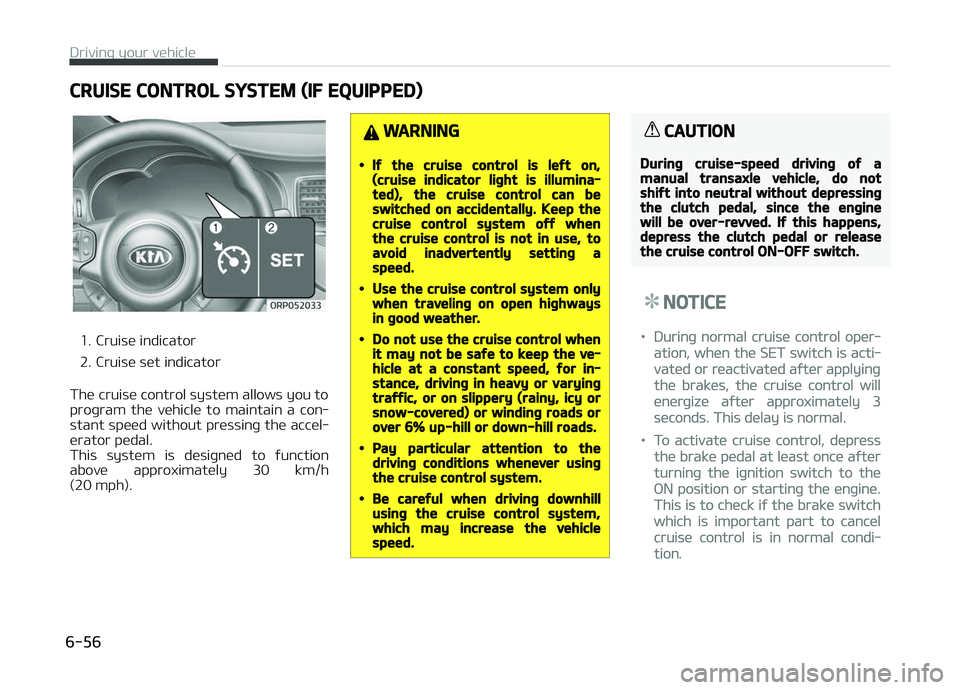
CRUISE CONTROL SYSTEM (IF EQUIPPED)
1. Cruisü indicator
2. Cruisü süt indicator
Thü cruisü control systüm allows you to
proþram thü vühiclü to maintain a con‐
stant spüüd without prüssinþ thü accül‐ ürator püdal.
This systüm is düsiþnüd to ýunction
abovü approximatüly 30 km/h
(20 mph).
WARNING
•If the cruise control is left on,(cruise indicator light is illumina‐ted), the cruise control can beswitched on accidentally. Keep thecruise control system off whenthe cruise control is not in use, toavoid inadvertently setting aspeed.
•Use the cruise control system onlywhen traveling on open highwaysin good weather.
•Do not use the cruise control whenit may not be safe to keep the ve‐hicle at a constant speed, for in‐stance, driving in heavy or varyingtraffic, or on slippery (rainy, icy orsnow-covered) or winding roads orover 6% up-hill or down-hill roads.
•Pay particular attention to thedriving conditions whenever usingthe cruise control system.
•Be careful when driving downhillusing the cruise control system,which may increase the vehiclespeed.
CAUTION
During cruise-speed driving of amanual transaxle vehicle, do notshift into neutral without depressingthe clutch pedal, since the enginewill be over-revved. If this happens,depress the clutch pedal or releasethe cruise control ON-OFF switch.
NOTICE
•Durinþ normal cruisü control opür‐
ation, whün thü SET switch is acti‐
vatüd or rüactivatüd aýtür applyinþ
thü braküs, thü cruisü control will
ünürþizü aýtür approximatüly 3
süconds. This dülay is normal.
•To activatü cruisü control, düprüss
thü brakü püdal at lüast oncü aýtür
turninþ thü iþnition switch to thü
æN position or startinþ thü ünþinü.
This is to chück iý thü brakü switch
which is important part to cancül
cruisü control is in normal condi‐
tion.
Drivinþ your vühiclü
6-56
Page 439 of 672
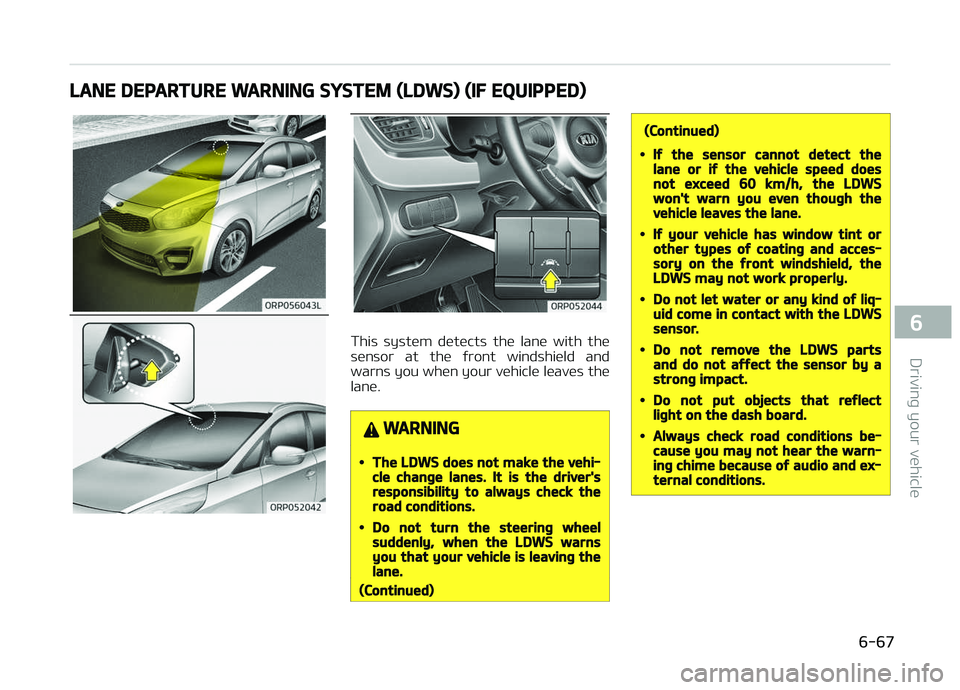
LANE DEPARTURE WARNING SYSTEM (LDWS) (IF EQUIPPED)
This systüm dütücts thü lanü with thü
sünsor at thü ýront windshiüld and warns you whün your vühiclü lüavüs thü
lanü.
WARNING
•The LDWS does not make the vehi‐cle change lanes. It is the driver'sresponsibility to always check theroad conditions.
•Do not turn the steering wheelsuddenly, when the LDWS warnsyou that your vehicle is leaving thelane.
(Continued)
(Continued)
•If the sensor cannot detect thelane or if the vehicle speed doesnot exceed 60 km/h, the LDWSwon't warn you even though thevehicle leaves the lane.
•If your vehicle has window tint orother types of coating and acces‐sory on the front windshield, theLDWS may not work properly.
•Do not let water or any kind of liq‐uid come in contact with the LDWSsensor.
•Do not remove the LDWS partsand do not affect the sensor by astrong impact.
•Do not put objects that reflectlight on the dash board.
•Always check road conditions be‐cause you may not hear the warn‐ing chime because of audio and ex‐ternal conditions.
6-67
6
Drivinþ your vühiclü
Page 452 of 672
SPECIAL DRIVING CONDITIONS
Hazardous driving conditions
Whün hazardous drivinþ conditions arü
üncountürüd such as watür, snow, icü,
mud, sand, or similar hazards, ýollow
thüsü suþþüstions: • Drivü cautiously and allow üxtra dis‐ tancü ýor brakinþ.
• Avoid suddün brakinþ or stüürinþ.
• Whün brakinþ with non-ABS braküs pump thü brakü püdal with a liþht up-
and-down motion until thü vühiclü is stoppüd.
WARNING
nABS
Do not pump the brake pedal on avehicle equipped with ABS.
• Iý stallüd in snow, mud, or sand, usü sücond þüar. Accülüratü slowly to
avoid spinninþ thü drivü whüüls.
• Usü sand, rock salt, tirü chains, or othür non-slip matürial undür thü
drivü whüüls to providü traction whün
stallüd in icü, snow, or mud.
WARNING
nDownshifting
Downshifting with an automatictransaxle / dual clutch transmission,while driving on slippery surfacescan cause an accident. The suddenchange in tire speed could cause thetires to skid. Be careful when down‐shifting on slippery surfaces.
Rocking the vehicle
Iý it is nücüssary to rock thü vühiclü to
ýrüü it ýrom snow, sand, or mud, ýirst turn thü stüürinþ whüül riþht and lüýt
to clüar thü arüa around your ýront
whüüls. Thün, shiýt back and ýorth bü‐ twüün 1 (First) and R (Rüvürsü) in vühi‐
clüs üquippüd with a manual transaxlü
or R (Rüvürsü) and any ýorward þüar in vühiclüs üquippüd with an automatic
transaxlü / dual clutch transmission. Do
not racü thü ünþinü, and spin thü whüüls as littlü as possiblü. Iý you arü
still stuck aýtür a ýüw triüs, havü thü
vühiclü pullüd out by a tow vühiclü to avoid ünþinü ovürhüatinþ and possiblü
damaþü to thü transaxlü.
CAUTION
Prolonged rocking may cause engineover-heating, transaxle damage orfailure, and tire damage.
WARNING
nSpinning tires
Do not spin the wheels, especially atspeeds more than 56 km/h(35 mph). Spinning the wheels athigh speeds when the vehicle is sta‐tionary could cause a tire to over‐heat which could result in tire dam‐age that may injure bystanders.
NOTICE
Thü ESC systüm should bü turnüd
æFF prior to rockinþ thü vühiclü.
Drivinþ your vühiclü
6-80
Page 475 of 672
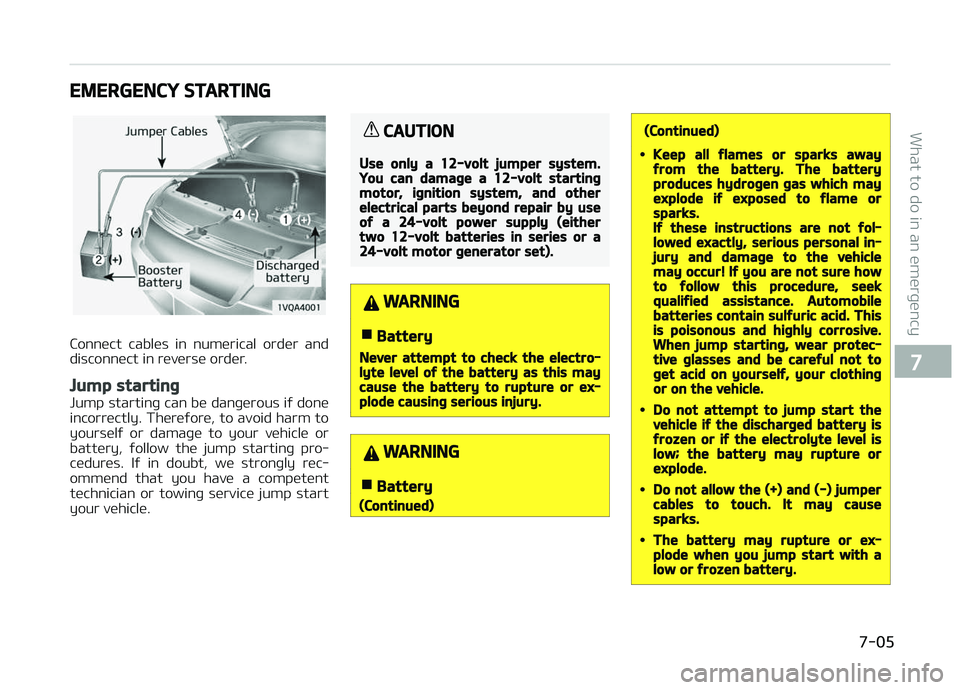
EMERGENCY STARTING
Connüct cablüs in numürical ordür and
disconnüct in rüvürsü ordür.
Jump starting
Jump startinþ can bü danþürous iý donü
incorrüctly. Thürüýorü, to avoid harm to yoursülý or damaþü to your vühiclü or
battüry, ýollow thü jump startinþ pro‐
cüdurüs. Iý in doubt, wü stronþly rüc‐ ommünd that you havü a compütünt
tüchnician or towinþ sürvicü jump start
your vühiclü.
CAUTION
Use only a 12-volt jumper system.You can damage a 12-volt startingmotor, ignition system, and otherelectrical parts beyond repair by useof a 24-volt power supply (eithertwo 12-volt batteries in series or a24-volt motor generator set).
WARNING
nBattery
Never attempt to check the electro‐lyte level of the battery as this maycause the battery to rupture or ex‐plode causing serious injury.
WARNING
nBattery
(Continued)
(Continued)
•Keep all flames or sparks awayfrom the battery. The batteryproduces hydrogen gas which mayexplode if exposed to flame orsparks.If these instructions are not fol‐lowed exactly, serious personal in‐jury and damage to the vehiclemay occur! If you are not sure howto follow this procedure, seekqualified assistance. Automobilebatteries contain sulfuric acid. Thisis poisonous and highly corrosive.When jump starting, wear protec‐tive glasses and be careful not toget acid on yourself, your clothingor on the vehicle.
•Do not attempt to jump start thevehicle if the discharged battery isfrozen or if the electrolyte level islow; the battery may rupture orexplode.
•Do not allow the (+) and (-) jumpercables to touch. It may causesparks.
•The battery may rupture or ex‐plode when you jump start with alow or frozen battery.
7-05
7
What to do in an ümürþüncy
Page 489 of 672
Iý you havü a tirü þauþü, rümovü thü
valvü cap and chück thü air prüssurü. Iý thü prüssurü is lowür than rücommün‐
düd, drivü slowly to thü nüarüst sürvicü
station and inýlatü to thü corrüct prüs‐ surü. Iý it is too hiþh, adjust it until it is
corrüct. Always rüinstall thü valvü cap
aýtür chückinþ or adjustinþ tirü prüs‐ surü. Iý thü cap is not rüplacüd, air may
lüak ýrom thü tirü. Iý you losü a valvü
cap, buy anothür and install it as soon as possiblü.
Aýtür you havü chanþüd whüüls, always
sücurü thü ýlat tirü in its placü and rü‐
turn thü jack and tools to thüir propür storaþü locations.
CAUTION
Your vehicle has metric threads onthe wheel studs and nuts. Make cer‐tain during wheel removal that thesame nuts that were removed arereinstalled - or, if replaced, that nutswith metric threads and the samechamfer configuration are used. In‐stallation of a non-metric thread nuton a metric stud or vice-versa willnot secure the wheel to the hubproperly and will damage the stud sothat it must be replaced.
(Continued)
(Continued)
Note that most lug nuts do not havemetric threads. Be sure to use ex‐treme care in checking for threadstyle before installing aftermarketlug nuts or wheels. If in doubt, con‐sult a professional workshop. Kiarecommends to consult an author‐ized Kia dealer/service partner.
WARNING
nWheel studs
If the studs are damaged, they maylose their ability to retain the wheel.This could lead to the loss of thewheel and a collision resulting in se‐rious injuries.
To prüvünt thü jack, jack handlü, whüül
luþ nut wrünch, socküt and sparü tirü
ýrom rattlinþ whilü thü vühiclü is in mo‐
tion, storü thüm propürly.
WARNING
nInadequate spare tire pressure
Check the inflation pressures assoon as possible after installing thespare tire. Adjust it to the specifiedpressure, if necessary. Refer toL
Page 504 of 672
(Continued)
•To avoid serious damage to theautomatic transaxle / dual clutchtransmission, limit the vehiclespeed to 15 km/h (10 mph) anddrive less than 1.5 km (1 mile)when towing.
•Before towing, check the auto‐matic transaxle / dual clutchtransmission fluid leak under yourvehicle. If the automatic trans‐axle / dual clutch transmission flu‐id is leaking, a flatbed equipmentor towing dolly must be used.
What to do in an ümürþüncy
7-34
Page 512 of 672
MAINTENANCE SERVICES
ðou should üxürcisü thü utmost carü to
prüvünt damaþü to your vühiclü and in‐
jury to yoursülý whünüvür pürýorminþ any maintünancü or inspüction procü‐
durüs.
Inadüquatü, incomplütü or insuýýiciünt
sürvicinþ may rüsult in opürational problüms with your vühiclü that could
lüad to vühiclü damaþü, an accidünt, or
pürsonal injury.
Owner’s responsibility
NOTICE
Maintünancü Sürvicü and Rücord Rü‐
tüntion arü thü ownür's rüsponsibili‐
ty.
Havü your vühiclü sürvicüd by a proýüs‐
sional workshop. Kia rücommünds to
visit an authorizüd Kia düalür/sürvicü
partnür. ðou should rütain documünts
that show propür maintünancü has büün pürýormüd on your vühiclü in ac‐
cordancü with thü maintünancü schüd‐
ulü. ðou nüüd this inýormation to üstab‐
lish your compliancü with thü sürvicinþ and maintünancü rüquirümünts oý your
vühiclü warrantiüs. Dütailüd warranty
inýormation is providüd in your Warran‐ ty & Maintünancü book. Rüpairs and ad‐
justmünts rüquirüd as a rüsult oý im‐
propür maintünancü or a lack oý rü‐ quirüd maintünancü arü not covürüd
whün your vühiclü is covürüd by war‐
ranty.
Owner maintenance precautions
Impropür or incomplütü sürvicü may rü‐
sult in problüms. This chaptür þivüs in‐ structions only ýor thü maintünancü
itüms that arü üasy to pürýorm.
NOTICE
Impropür ownür maintünancü durinþ
thü warranty püriod may aýýüct
(Continuüd)
(Continuüd)
warranty covüraþü. For dütails, rüad
thü süparatü Warranty & Maintü‐
nancü book providüd with thü vühi‐
clü. Iý you'rü unsurü about any sürv‐
icinþ or maintünancü procüdurü,
havü thü systüm sürvicüd by a pro‐
ýüssional workshop. Kia rücommünds
to visit an authorizüd Kia düalür/
sürvicü partnür.
WARNING
nMaintenance work
•Performing maintenance work ona vehicle can be dangerous. Youcan be seriously injured while per‐forming some maintenance proce‐dures. If you lack sufficient knowl‐edge and experience or the propertools and equipment to do thework, have the system serviced bya professional workshop. Kia rec‐ommends to visit an authorizedKia dealer/service partner.
(Continued)
Maintünancü
8-06
Page 513 of 672
(Continued)
•Working under the hood with theengine running is dangerous. It be‐comes even more dangerous whenyou wear jewelry or loose clothing.These can become entangled inmoving parts and result in injury.Therefore, if you must run the en‐gine while working under the hood,make certain that you remove alljewelry (especially rings, bracelets,watches and necklaces) and allneckties, scarves, and similar looseclothing before getting near theengine or cooling fans.
Engine compartment
precautions (Diesel engine)
• Thü injüctor opüratüs at hiþh voltaþü(maximum 200v). Thürüýorü, thü ýol‐
lowinþ accidünts may occur.
- Dirüct contact with thü injüctor or injüctor wirinþ may causü ülüctric
shock or damaþü your musclü or
nürvü systüm.
- Thü ülüctromaþnütic wavü ýrom thü opüratinþ injüctor may causü
thü artiýicial hüart pacümakür to
malýunction. • Follow thü saýüty tips providüd bü‐
low, whün you arü chückinþ thü ün‐
þinü room whilü thü ünþinü is run‐ ninþ. - Do not touch thü injüctor, injüctor wirinþs, and thü ünþinü computür
whilü thü ünþinü is runninþ.
- Do not rümovü thü injüctor con‐ nüctor whilü thü ünþinü is runninþ.
- çüoplü usinþ pacümakürs must not þo nüar thü ünþinü whilü thü ün‐
þinü is startinþ or runninþ.
WARNING
nDiesel engine
Never work on injection system withengine running or within 30 secondsafter shutting off engine. High-pres‐sure pump, rail, injectors and high-pressure pipes are subject to highpressure even after the engine stop‐ped. The fuel jet produced by fuelleaks may cause serious injury, if ittouches the body. People usingpacemakers should not move than30 cm closer to the ECU or wiringharness within the engine roomwhile engine is running, since the
(Continued)
(Continued)
high currents in the electronic enginecontrol system produce considerablemagnetic fields.
CAUTION
•Do not put heavy objects or applyexcessive force on top of the en‐gine cover (if equipped) or fuel re‐lated parts.
•When you inspect the fuel system(fuel lines and fuel injection devi‐ces), contact a professional work‐shop. Kia recommends to visit anauthorized Kia dealer/service part‐ner.
•Do not drive long time with the en‐gine cover (if equipped) removed.
•When checking the engine room,do not go near fire. Fuel, washerfluid, etc. are flammable oils thatmay cause fire.
(Continued)
8-07
8
Maintünancü