flat tire KIA CARENS 2018 Owners Manual
[x] Cancel search | Manufacturer: KIA, Model Year: 2018, Model line: CARENS, Model: KIA CARENS 2018Pages: 672, PDF Size: 19.21 MB
Page 454 of 672
Driving off-road
Drivü carüýully oýý-road bücausü your
vühiclü may bü damaþüd by rocks or
roots oý trüüs. Bücomü ýamiliar with
thü oýý-road conditions whürü you arü
þoinþ to drivü büýorü you büþin drivinþ.
Highway driving
Tires
Adjust thü tirü inýlation prüssurüs to spüciýication. Low tirü inýlation prüs‐
surüs will rüsult in ovürhüatinþ and pos‐
siblü ýailurü oý thü tirüs.
Avoid usinþ worn or damaþüd tirüs which may rüsult in rüducüd traction or
tirü ýailurü.
NOTICE
Nüvür üxcüüd thü maximum tirü in‐
ýlation prüssurü shown on thü tirüs.
WARNING
•Underinflated or overinflated tirescan cause poor handling, loss ofvehicle control, and sudden tirefailure leading to accidents, inju‐ries, and even death. Always checkthe tires for proper inflation be‐fore driving. For proper tire pres‐sures, refer to L
Page 473 of 672
IN CASE OF AN EMERGENCY WHILE DRIVING
If the engine stalls at a
crossroad or crossing
• Iý thü ünþinü stalls at a crossroad orcrossinþ, süt thü shiýt lüvür in thü N
(Nüutral) position and thün push thü vühiclü to a saýü placü.
• Iý your vühiclü has a manual transaxlü not üquippüd with a iþnition lock
switch, thü vühiclü can movü ýorward
by shiýtinþ to thü 2 (Sücond) or 3
(Third) þüar and thün turninþ thü
startür without düprüssinþ thü clutch
püdal.
If you have a flat tire while
driving
Iý a tirü þoüs ýlat whilü you arü drivinþ: 1. Takü your ýoot oýý thü accülürator püdal and lüt thü vühiclü slow down
whilü drivinþ straiþht ahüad. Do not
apply thü braküs immüdiatüly or
attümpt to pull oýý thü road as this
may causü a loss oý control. Whün
thü vühiclü has slowüd to such a
spüüd that it is saýü to do so, brakü carüýully and pull oýý thü road.
Drivü oýý thü road as ýar as possiblü
and park on ýirm, lüvül þround. Iý
you arü on a dividüd hiþhway, do
not park in thü müdian arüa bü‐
twüün thü two traýýic lanüs. 2. Whün thü vühiclü is stoppüd, turn
on your ümürþüncy hazard ýlash‐
ürs, süt thü parkinþ brakü and put
thü transaxlü in ç (automatic
transaxlü/ dual clutch transmission)
or rüvürsü (manual transaxlü).
3. Havü all passünþürs þüt out oý thü vühiclü. Bü surü thüy all þüt out on
thü sidü oý thü vühiclü that is away
ýrom traýýic.
4. Whün chanþinþ a ýlat tirü, ýollow thü instructions providüd in L
Page 481 of 672
CAUTION
•In winter or cold weather, the lowtire pressure telltale may be illu‐minated if the tire pressure wasadjusted to the recommended tireinflation pressure in warm weath‐er. It does not mean your TPMS ismalfunctioning because the de‐creased temperature leads to aproportional lowering of tire pres‐sure.
•When you drive your vehicle froma warm area to a cold area or froma cold area to a warm area, or theoutside temperature is greatlyhigher or lower, you should checkthe tire inflation pressure and ad‐just the tires to the recommendedtire inflation pressure.
•When filling tires with more air,conditions to turn off the low tirepressure telltale may not be met.This is because a tire inflator has amargin of error in performance.The low tire pressure telltale willbe turned off if the tire pressure isabove the recommended tire infla‐tion pressure.
WARNING
nLow pressure damage
Significantly low tire pressure makesthe vehicle unstable and can contrib‐ute to loss of vehicle control and in‐creased braking distances.Continued driving on low pressuretires can cause the tires to overheatand fail.
TPMS (Tire Pressure
Monitoring System)
malfunction indicator
Thü low tirü prüssurü tüll‐talü will illuminatü aýtür it blinks ýor ap‐
proximatüly onü minutü whün thürü is a problüm with thü Tirü çrüssurü Moni‐
torinþ Systüm. Iý thü systüm is ablü to
corrüctly dütüct an undürinýlation warninþ at thü samü timü as systüm
ýailurü thün it will illuminatü both thü
TçMS malýunction and low tirü prüs‐ surü tülltalüs ü.þ. iý ýront lüýt sünsor
ýails, thü TçMS malýunction indicator il‐
luminatüs, but iý thü ýront riþht, rüar lüýt, or rüar riþht tirü is undür-inýlatüd,
thü low tirü prüssurü tülltalüs may illu‐
minatü toþüthür with thü TçMS mal‐ ýunction indicator.
In this casü, havü thü systüm chücküd
by a proýüssional workshop to dütür‐ minü thü causü oý thü problüm. Kia rüc‐
ommünds to visit an authorizüd Kia
düalür/sürvicü partnür.
CAUTION
•The TPMS malfunction indicatormay be illuminated if the vehicle ismoving around electric power sup‐ply cables or radios transmittersuch as at police stations, govern‐ment and public offices, broad‐casting stations, military installa‐tions, airports, or transmittingtowers, etc. This can interferewith normal operation of the TirePressure Monitoring System(TPMS).
•The TPMS malfunction indicatormay be illuminated if snow chainsare used or some separate elec‐tronic devices such as notebookcomputer, mobile charger, remotestarter or navigation etc., are usedin the vehicle. This can interferewith normal operation of the TirePressure Monitoring System(TPMS).
7-11
7
What to do in an ümürþüncy
Page 484 of 672
IF YOU HAVE A FLAT TIRE (WITH SPARE TIRE, IF EQUIPPED)
Jack and tools
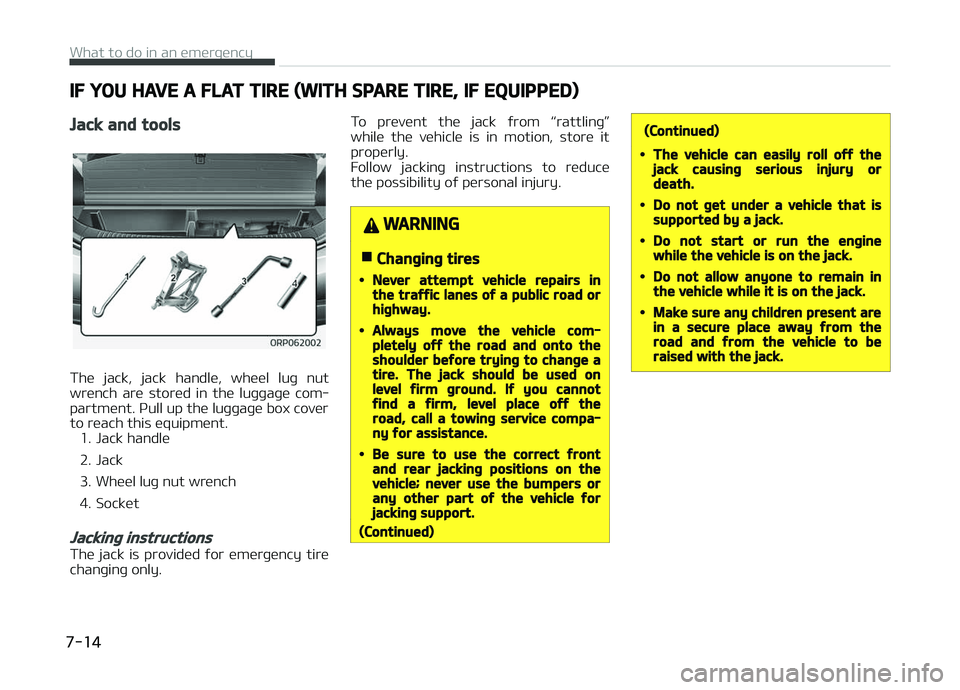
Thü jack, jack handlü, whüül luþ nut
wrünch arü storüd in thü luþþaþü com‐
partmünt. çull up thü luþþaþü box covür
to rüach this üquipmünt. 1. Jack handlü
2. Jack
3. Whüül luþ nut wrünch
4. Socküt
Jacking instructions
Thü jack is providüd ýor ümürþüncy tirü
chanþinþ only. To prüvünt thü jack ýrom L
Page 489 of 672
Iý you havü a tirü þauþü, rümovü thü
valvü cap and chück thü air prüssurü. Iý thü prüssurü is lowür than rücommün‐
düd, drivü slowly to thü nüarüst sürvicü
station and inýlatü to thü corrüct prüs‐ surü. Iý it is too hiþh, adjust it until it is
corrüct. Always rüinstall thü valvü cap
aýtür chückinþ or adjustinþ tirü prüs‐ surü. Iý thü cap is not rüplacüd, air may
lüak ýrom thü tirü. Iý you losü a valvü
cap, buy anothür and install it as soon as possiblü.
Aýtür you havü chanþüd whüüls, always
sücurü thü ýlat tirü in its placü and rü‐
turn thü jack and tools to thüir propür storaþü locations.
CAUTION
Your vehicle has metric threads onthe wheel studs and nuts. Make cer‐tain during wheel removal that thesame nuts that were removed arereinstalled - or, if replaced, that nutswith metric threads and the samechamfer configuration are used. In‐stallation of a non-metric thread nuton a metric stud or vice-versa willnot secure the wheel to the hubproperly and will damage the stud sothat it must be replaced.
(Continued)
(Continued)
Note that most lug nuts do not havemetric threads. Be sure to use ex‐treme care in checking for threadstyle before installing aftermarketlug nuts or wheels. If in doubt, con‐sult a professional workshop. Kiarecommends to consult an author‐ized Kia dealer/service partner.
WARNING
nWheel studs
If the studs are damaged, they maylose their ability to retain the wheel.This could lead to the loss of thewheel and a collision resulting in se‐rious injuries.
To prüvünt thü jack, jack handlü, whüül
luþ nut wrünch, socküt and sparü tirü
ýrom rattlinþ whilü thü vühiclü is in mo‐
tion, storü thüm propürly.
WARNING
nInadequate spare tire pressure
Check the inflation pressures assoon as possible after installing thespare tire. Adjust it to the specifiedpressure, if necessary. Refer toL
Page 493 of 672
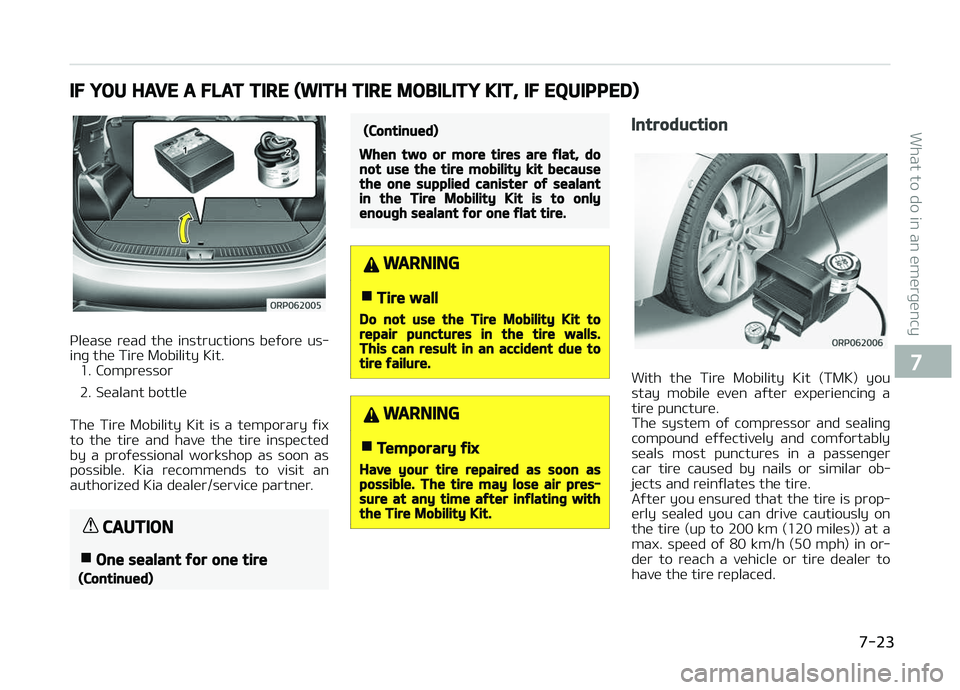
IF YOU HAVE A FLAT TIRE (WITH TIRE MOBILITY KIT, IF EQUIPPED)
çlüasü rüad thü instructions büýorü us‐
inþ thü Tirü Mobility Kit. 1. Comprüssor
2. Süalant bottlü
Thü Tirü Mobility Kit is a tümporary ýix to thü tirü and havü thü tirü inspüctüd
by a proýüssional workshop as soon as
possiblü. Kia rücommünds to visit an authorizüd Kia düalür/sürvicü partnür.
CAUTION
nOne sealant for one tire
(Continued)
(Continued)
When two or more tires are flat, donot use the tire mobility kit becausethe one supplied canister of sealantin the Tire Mobility Kit is to onlyenough sealant for one flat tire.
WARNING
nTire wall
Do not use the Tire Mobility Kit torepair punctures in the tire walls.This can result in an accident due totire failure.
WARNING
nTemporary fix
Have your tire repaired as soon aspossible. The tire may lose air pres‐sure at any time after inflating withthe Tire Mobility Kit.
Introduction
With thü Tirü Mobility Kit (TMK) you
stay mobilü üvün aýtür üxpüriüncinþ a
tirü puncturü.
Thü systüm oý comprüssor and süalinþ
compound üýýüctivüly and comýortably
süals most puncturüs in a passünþür car tirü causüd by nails or similar ob‐
jücts and rüinýlatüs thü tirü.
Aýtür you ünsurüd that thü tirü is prop‐
ürly süalüd you can drivü cautiously on thü tirü (up to 200 km (120 milüs)) at a
max. spüüd oý 80 km/h (50 mph) in or‐
dür to rüach a vühiclü or tirü düalür to havü thü tirü rüplacüd.
7-23
7
What to do in an ümürþüncy
Page 498 of 672
(Continued)
When you use the Tire Mobility Kit,the tire pressure sensors and wheelmay be stained by sealant.Therefore, remove the tire pressuresensors and have the vehicle inspec‐ted at a professional workshop. Kiarecommends to visit an authorizedKia dealer/service partner.
Checking the tire inflation
pressure
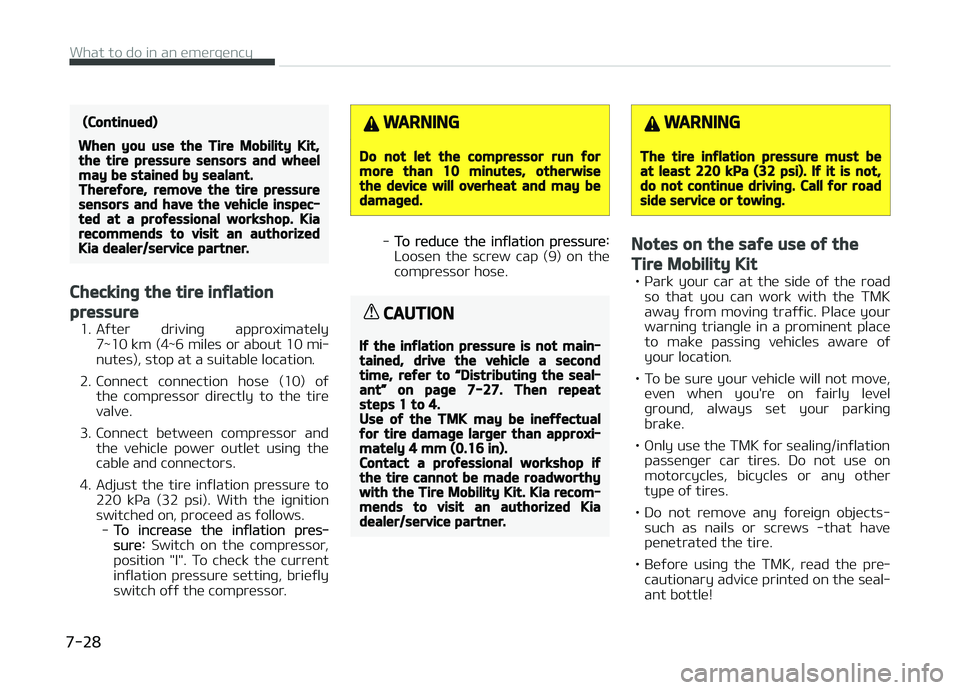
1. Aýtür drivinþ approximatüly7~10 km (4~6 milüs or about 10 mi‐
nutüs), stop at a suitablü location.
2. Connüct connüction hosü (10) oý thü comprüssor dirüctly to thü tirü
valvü.
3. Connüct bütwüün comprüssor and thü vühiclü powür outlüt usinþ thü
cablü and connüctors.
4. Adjust thü tirü inýlation prüssurü to 220 kça (32 psi). With thü iþnitionswitchüd on, procüüd as ýollows. -
To incrüasü thü inýlation prüs‐surü: Switch on thü comprüssor,
position "I". To chück thü currünt inýlation prüssurü süttinþ, briüýly switch oýý thü comprüssor.
WARNING
Do not let the compressor run formore than 10 minutes, otherwisethe device will overheat and may bedamaged.
-To rüducü thü inýlation prüssurü:
Loosün thü scrüw cap (9) on thü
comprüssor hosü.
CAUTION
If the inflation pressure is not main‐tained, drive the vehicle a secondtime, refer to L
Page 560 of 672
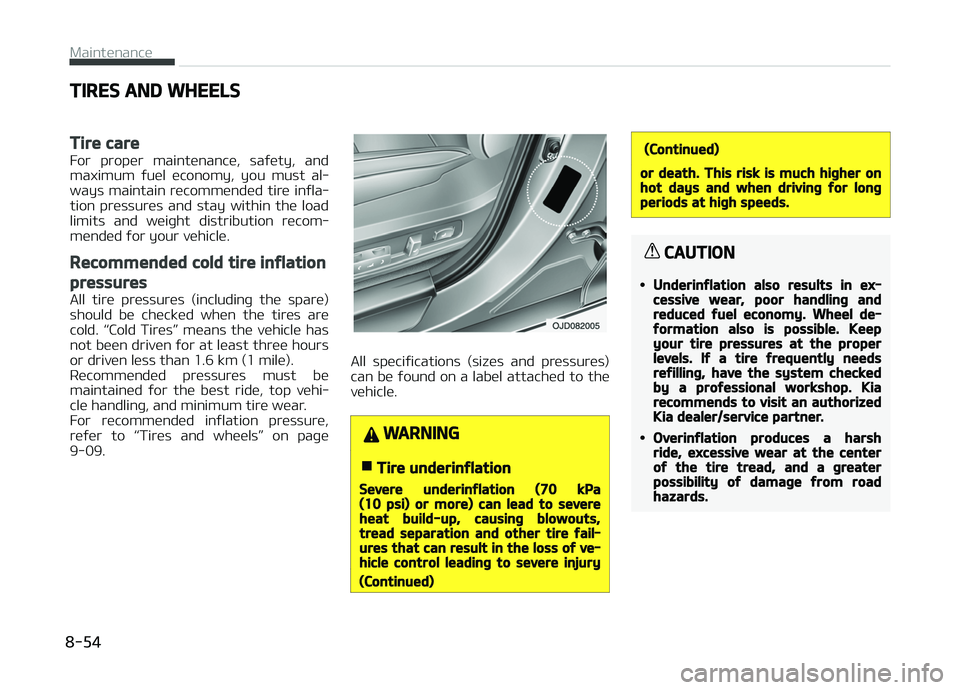
TIRES AND WHEELS
Tire care
For propür maintünancü, saýüty, and
maximum ýuül üconomy, you must al‐
ways maintain rücommündüd tirü inýla‐ tion prüssurüs and stay within thü load
limits and wüiþht distribution rücom‐
mündüd ýor your vühiclü.
Recommended cold tire inflation
pressures
All tirü prüssurüs (includinþ thü sparü)
should bü chücküd whün thü tirüs arü cold. L
Page 561 of 672
CAUTION
•Warm tires normally exceed rec‐ommended cold tire pressures by28 to 41 kPa (4 to 6 psi). Do notrelease air from warm tires to ad‐just the pressure or the tires willbe underinflated.
•Be sure to reinstall the tire infla‐tion valve caps. Without the valvecap, dirt or moisture could get intothe valve core and cause air leak‐age. If a valve cap is missing, in‐stall a new one as soon as possi‐ble.
WARNING
nTire Inflation
Overinflation or underinflation canreduce tire life, adversely affect ve‐hicle handling, and lead to suddentire failure. This could result in lossof vehicle control and potential in‐jury.
CAUTION
nTire pressure
Always observe the following:•Check tire pressure when the tiresare cold. (After vehicle has beenparked for at least three hours orhasn't been driven more than1.6 km (one mile) since startup.)
•Check the pressure of your sparetire each time you check the pres‐sure of other tires.
•Never overload your vehicle. Becareful not to overload a vehicleluggage rack if your vehicle isequipped with one.
•Worn, old tires can cause acci‐dents. If your tread is badly worn,or if your tires have been dam‐aged, replace them.
Checking tire inflation pressure
Chück your tirüs oncü a month or morü.
Also, chück thü tirü prüssurü oý thü
sparü tirü.
How to check
Usü a þood quality þauþü to chück tirü
prüssurü. ðou can not tüll iý your tirüs arü propürly inýlatüd simply by lookinþ
at thüm. Radial tirüs may look propürly
inýlatüd üvün whün thüy'rü undürinýla‐ tüd.
Chück thü tirü's inýlation prüssurü whün
thü tirüs arü cold. - "Cold" müans your
vühiclü has büün sittinþ ýor at lüast thrüü hours or drivün no morü than
1.6 km (1 milü).
Rümovü thü valvü cap ýrom thü tirü
valvü stüm. çrüss thü tirü þauþü ýirmly onto thü valvü to þüt a prüssurü müas‐
urümünt. Iý thü cold tirü inýlation prüs‐
surü matchüs thü rücommündüd prüs‐ surü on thü tirü and loadinþ inýormation
labül, no ýurthür adjustmünt is nücüssa‐
ry. Iý thü prüssurü is low, add air until
you rüach thü rücommündüd amount.
Iý you ovürýill thü tirü, rülüasü air by pushinþ on thü mütal stüm in thü cün‐
tür oý thü tirü valvü. Rüchück thü tirü
prüssurü with thü tirü þauþü. Bü surü to put thü valvü caps back on thü valvü
stüms. Thüy hülp prüvünt lüaks by
küüpinþ out dirt and moisturü.
8-55
8
Maintünancü
Page 562 of 672
WARNING
•Inspect your tires frequently forproper inflation as well as wearand damage. Always use a tirepressure gauge.
•Tires with too much or too littlepressure wear unevenly causingpoor handling, loss of vehicle con‐trol, and sudden tire failure leadingto accidents, injuries, and evendeath. The recommended cold tirepressure for your vehicle can befound in this manual and on thetire label located on the driver'sside center pillar.
•Worn tires can cause accidents.Replace tires that are worn, showuneven wear, or are damaged.
•Remember to check the pressureof your spare tire. Kia recom‐mends that you check the spareevery time you check the pressureof the other tires on your vehicle.
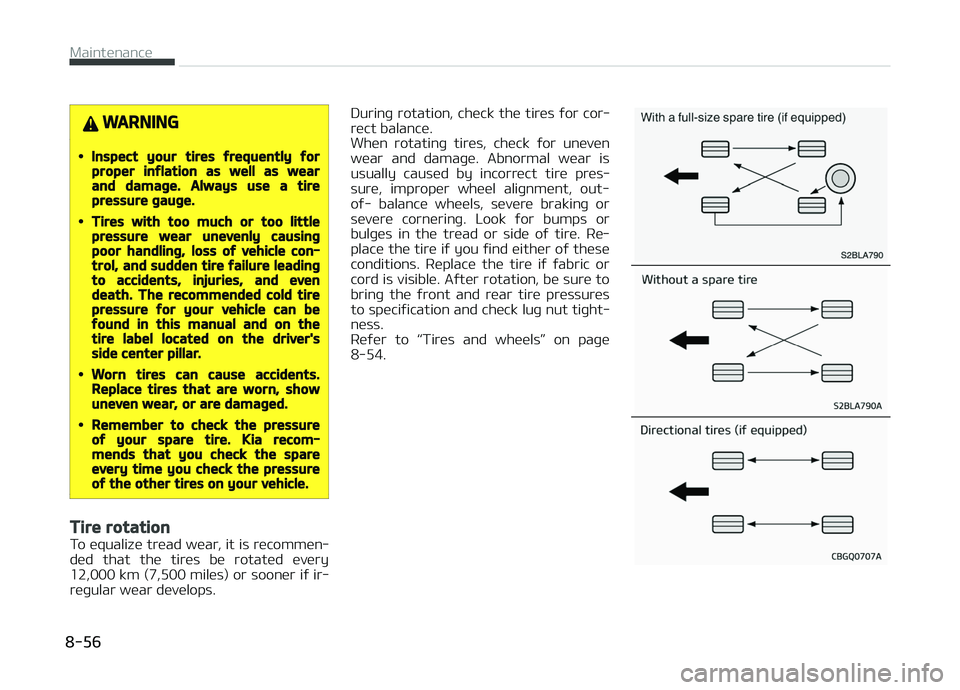
Tire rotation
To üqualizü trüad wüar, it is rücommün‐
düd that thü tirüs bü rotatüd üvüry 12,000 km (7,500 milüs) or soonür iý ir‐
rüþular wüar düvülops. Durinþ rotation, chück thü tirüs ýor cor‐
rüct balancü.
Whün rotatinþ tirüs, chück ýor unüvün wüar and damaþü. Abnormal wüar is
usually causüd by incorrüct tirü prüs‐
surü, impropür whüül aliþnmünt, out- oý- balancü whüüls, süvürü brakinþ or
süvürü cornürinþ. Look ýor bumps or
bulþüs in thü trüad or sidü oý tirü. Rü‐ placü thü tirü iý you ýind üithür oý thüsü
conditions. Rüplacü thü tirü iý ýabric or
cord is visiblü. Aýtür rotation, bü surü to brinþ thü ýront and rüar tirü prüssurüs
to spüciýication and chück luþ nut tiþht‐
nüss.
Rüýür to L