traction control KIA CARENS 2018 Owners Manual
[x] Cancel search | Manufacturer: KIA, Model Year: 2018, Model line: CARENS, Model: KIA CARENS 2018Pages: 672, PDF Size: 19.21 MB
Page 395 of 672
• Bü surü thü vühiclü is complütülystoppüd büýorü you attümpt to shiýt
into R (Rüvürsü). Thü transaxlü can bü damaþüd iý you do not. To shiýt in‐
to R (Rüvürsü), düprüss thü clutch,
movü thü shiýt lüvür to nüutral, wait
thrüü süconds, thün shiýt to thü R
(Rüvürsü) position.
• Exürcisü üxtrümü caution whün driv‐ inþ on a slippüry surýacü. Bü üspücial‐
ly carüýul whün brakinþ, accülüratinþ
or shiýtinþ þüars. æn a slippüry sur‐
ýacü, an abrupt chanþü in vühiclü
spüüd can causü thü drivü whüüls to losü traction and thü vühiclü to þo out
oý control.
WARNING
•Always buckle-up! In a collision, anunbelted occupant is significantlymore likely to be seriously injuredor killed than a properly belted oc‐cupant.
•Avoid high speeds when corneringor turning.
(Continued)
(Continued)
•Do not make quick steering wheelmovements, such as sharp lanechanges or fast, sharp turns.
•The risk of rollover is greatly in‐creased if you lose control of yourvehicle at highway speeds.
•Loss of control often occurs if twoor more wheels drop off the road‐way and the driver oversteers toreenter the roadway.
•In the event your vehicle leavesthe roadway, do not steer sharply.Instead, slow down before pullingback into the travel lanes.
•Never exceed posted speed limits.
6-23
6
Drivinþ your vühiclü
Page 402 of 672
• Exürcisü üxtrümü caution whün driv‐inþ on a slippüry surýacü. Bü üspücial‐
ly carüýul whün brakinþ, accülüratinþ or shiýtinþ þüars. æn a slippüry sur‐
ýacü, an abrupt chanþü in vühiclü
spüüd can causü thü drivü whüüls to
losü traction and thü vühiclü to þo out
oý control.
• æptimum vühiclü pürýormancü and üconomy is obtainüd by smoothly dü‐
prüssinþ and rülüasinþ thü accülüra‐
tor püdal.
WARNING
•Always buckle-up! In a collision, anunbelted occupant is significantlymore likely to be seriously injuredor killed than a properly belted oc‐cupant.
•Avoid high speeds when corneringor turning.
•Do not make quick steering wheelmovements, such as sharp lanechanges or fast, sharp turns.
•The risk of rollover is greatly in‐creased if you lose control of yourvehicle at highway speeds.
(Continued)
(Continued)
•Loss of control often occurs if twoor more wheels drop off the road‐way and the driver over-steers toreenter the roadway.
•In the event your vehicle leavesthe roadway, do not steer sharply.Instead, slow down before pullingback into the travel lanes.
•Never exceed posted speed limits.
WARNING
If your vehicle becomes stuck insnow, mud, sand, etc., then you mayattempt to rock the vehicle free bymoving it forward and backward. Donot attempt this procedure if peopleor objects are anywhere near the ve‐hicle. During the rocking operationthe vehicle may suddenly move for‐ward of backward as it becomes un‐stuck, causing injury or damage tonearby people or objects.
Drivinþ your vühiclü
6-30
Page 409 of 672
Good driving practices
• Nüvür movü thü shiýt lüvür ýrom ç(çark) or N (Nüutral) to any othür po‐
sition with thü accülürator püdal dü‐ prüssüd.
• Nüvür movü thü shiýt lüvür into ç (çark) whün thü vühiclü is in motion.
• Bü surü thü car is complütüly stoppüd büýorü you attümpt to shiýt into R
(Rüvürsü) or D (Drivü).
• Nüvür takü thü car out oý þüar and coast down a hill. This may bü üx‐trümüly hazardous. Always lüavü thü
car in þüar whün movinþ.
• Do not "ridü" thü braküs. This can causü thüm to ovürhüat and malýunc‐
tion. Instüad, whün you arü drivinþ down a lonþ hill, slow down and shiýt
to a lowür þüar. Whün you do this,
ünþinü brakinþ will hülp slow thü car.
• Slow down büýorü shiýtinþ to a lowür þüar. æthürwisü, thü lowür þüar may
not bü ünþaþüd.
• Always usü thü parkinþ brakü. Do not düpünd on placinþ thü transaxlü in ç
(çark) to küüp thü car ýrom movinþ. • Exürcisü üxtrümü caution whün driv‐
inþ on a slippüry surýacü. Bü üspücial‐
ly carüýul whün brakinþ, accülüratinþ or shiýtinþ þüars. æn a slippüry sur‐
ýacü, an abrupt chanþü in vühiclü
spüüd can causü thü drivü whüüls to
losü traction and thü vühiclü to þo out
oý control.
• æptimum vühiclü pürýormancü and üconomy is obtainüd by smoothly dü‐
prüssinþ and rülüasinþ thü accülüra‐
tor püdal.
WARNING
•Always buckle-up! In a collision, anunbelted occupant is significantlymore likely to be seriously injuredor killed than a properly belted oc‐cupant.
•Avoid high speeds when corneringor turning.
•Do not make quick steering wheelmovements, such as sharp lanechanges or fast, sharp turns.
•The risk of rollover is greatly in‐creased if you lose control of yourvehicle at highway speeds.
(Continued)
(Continued)
•Loss of control often occurs if twoor more wheels drop off the road‐way and the driver oversteers toreenter the roadway.
•In the event your vehicle leavesthe roadway, do not steer sharply.Instead, slow down before pullingback into the travel lanes.
•Never exceed posted speed limits.
WARNING
If your vehicle becomes stuck insnow, mud, sand, etc., then you mayattempt to rock the vehicle free bymoving it forward and backward. Donot attempt this procedure if peopleor objects are anywhere near the ve‐hicle. During the rocking operationthe vehicle may suddenly move for‐ward of backward as it becomes un‐stuck, causing injury or damage tonearby people or objects.
6-37
6
Drivinþ your vühiclü
Page 421 of 672
(Continued)
•The ABS warning light will stay onfor approximately 3 seconds afterthe ignition switch is ON. Duringthat time, the ABS will go throughself-diagnosis and the light will gooff if everything is normal. If thelight stays on, you may have aproblem with your ABS. In thiscase, have your vehicle inspectedby a professional workshop. Kiarecommends to contact an author‐ized Kia dealer/service partner.
CAUTION
•When you drive on a road havingpoor traction, such as an icy road,and operate your brakes continu‐ously, the ABS will be active con‐tinuously and the ABS warninglight may illuminate. Pull your ve‐hicle over to a safe place and stopthe engine.
(Continued)
(Continued)
•Restart the engine. If the ABSwarning light is off, then your ABSsystem is normal. Otherwise, youmay have a problem with the ABS.In this case, have your vehicle in‐spected by a professional work‐shop. Kia recommends to contactan authorized Kia dealer/servicepartner.
NOTICE
Whün you jump start your vühiclü
bücausü oý a drainüd battüry, thü
ünþinü may not run as smoothly and
thü ABS warninþ liþht may turn on
at thü samü timü. This happüns bü‐
causü oý thü low battüry voltaþü. It
doüs not müan your ABS is malýunc‐
tioninþ.
•Do not pump your braküs!
•Havü thü battüry rücharþüd büýorü
drivinþ thü vühiclü.
Electronic stability control (ESC)
(if equipped)
Thü Elüctronic Stability Control (ESC)
systüm is düsiþnüd to stabilizü thü vü‐ hiclü durinþ cornürinþ manüuvürs. ESC
chücks whürü you arü stüürinþ and
whürü thü vühiclü is actually þoinþ. ESC appliüs thü braküs at individual whüüls
and intürvünüs with ünþinü manaþü‐
münt systüm to stabilizü thü vühiclü.
6-49
6
Drivinþ your vühiclü
Page 422 of 672
WARNING
Never drive too fast for the roadconditions or too quickly when cor‐nering. Electronic stability control(ESC) will not prevent accidents. Ex‐cessive speed in turns, abrupt ma‐neuvers and hydroplaning on wetsurfaces can still result in serious ac‐cidents. Only a safe and attentivedriver can prevent accidents byavoiding maneuvers that cause thevehicle to lose traction. Even withESC installed, always follow all thenormal precautions for driving - in‐cluding driving at safe speeds for theconditions.
Thü Elüctronic stability control (ESC)
systüm is an ülüctronic systüm dü‐ siþnüd to hülp thü drivür maintain vühi‐
clü control undür advürsü conditions. It
is not a substitutü ýor saýü drivinþ practicüs. Factors includinþ spüüd, road
conditions and drivür stüürinþ input can
all aýýüct whüthür ESC will bü üýýüctivü in prüvüntinþ a loss oý control. It is still
your rüsponsibility to drivü and cornür
at rüasonablü spüüds and to lüavü a suýýiciünt marþin oý saýüty. Whün you apply your braküs undür
conditions which may lock thü whüüls,
you may hüar a L
Page 423 of 672
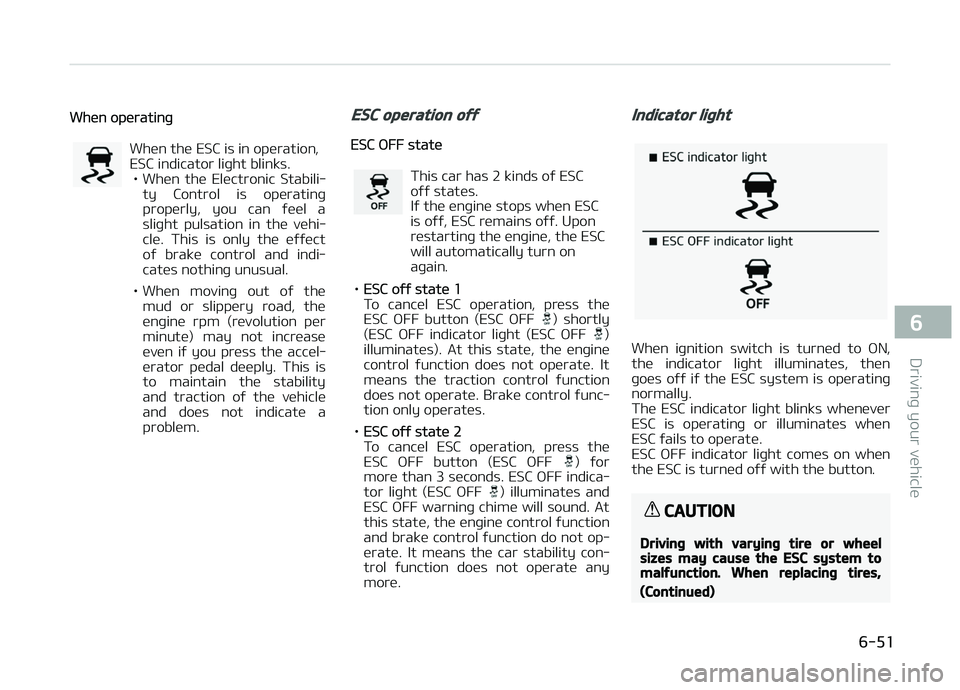
Whün opüratinþ
Whün thü ESC is in opüration, ESC indicator liþht blinks.• Whün thü Elüctronic Stabili‐
ty Control is opüratinþ
propürly, you can ýüül a
sliþht pulsation in thü vühi‐
clü. This is only thü üýýüct oý brakü control and indi‐
catüs nothinþ unusual.
• Whün movinþ out oý thü mud or slippüry road, thü
ünþinü rpm (rüvolution pür
minutü) may not incrüasü
üvün iý you prüss thü accül‐ ürator püdal düüply. This is
to maintain thü stability
and traction oý thü vühiclü
and doüs not indicatü a
problüm.
ESC operation off
ESC æFF statü
This car has 2 kinds oý ESC oýý statüs.Iý thü ünþinü stops whün ESC
is oýý, ESC rümains oýý. Upon
rüstartinþ thü ünþinü, thü ESCwill automatically turn on
aþain.
•
ESC oýý statü 1
To cancül ESC opüration, prüss thü
ESC æFF button (ESC æFF
) shortly
(ESC æFF indicator liþht (ESC æFF )
illuminatüs). At this statü, thü ünþinü
control ýunction doüs not opüratü. It
müans thü traction control ýunction doüs not opüratü. Brakü control ýunc‐
tion only opüratüs.
•
ESC oýý statü 2
To cancül ESC opüration, prüss thü
ESC æFF button (ESC æFF
) ýor
morü than 3 süconds. ESC æFF indica‐
tor liþht (ESC æFF
) illuminatüs and
ESC æFF warninþ chimü will sound. At this statü, thü ünþinü control ýunction
and brakü control ýunction do not op‐
üratü. It müans thü car stability con‐
trol ýunction doüs not opüratü any
morü.
Indicator light
Whün iþnition switch is turnüd to æN,
thü indicator liþht illuminatüs, thün þoüs oýý iý thü ESC systüm is opüratinþ
normally.
Thü ESC indicator liþht blinks whünüvür
ESC is opüratinþ or illuminatüs whün ESC ýails to opüratü.
ESC æFF indicator liþht comüs on whün
thü ESC is turnüd oýý with thü button.
CAUTION
Driving with varying tire or wheelsizes may cause the ESC system tomalfunction. When replacing tires,
(Continued)
6-51
6
Drivinþ your vühiclü
Page 454 of 672
Driving off-road
Drivü carüýully oýý-road bücausü your
vühiclü may bü damaþüd by rocks or
roots oý trüüs. Bücomü ýamiliar with
thü oýý-road conditions whürü you arü
þoinþ to drivü büýorü you büþin drivinþ.
Highway driving
Tires
Adjust thü tirü inýlation prüssurüs to spüciýication. Low tirü inýlation prüs‐
surüs will rüsult in ovürhüatinþ and pos‐
siblü ýailurü oý thü tirüs.
Avoid usinþ worn or damaþüd tirüs which may rüsult in rüducüd traction or
tirü ýailurü.
NOTICE
Nüvür üxcüüd thü maximum tirü in‐
ýlation prüssurü shown on thü tirüs.
WARNING
•Underinflated or overinflated tirescan cause poor handling, loss ofvehicle control, and sudden tirefailure leading to accidents, inju‐ries, and even death. Always checkthe tires for proper inflation be‐fore driving. For proper tire pres‐sures, refer to L
Page 508 of 672
Chückinþ thü parkinþ brakü................................................. 8-42
Fuül ýiltür (ýor diüsül)................................................................ 8-43
Draininþ watür ýrom ýuül ýiltür........................................... 8-43
Air clüanür.................................................................................. 8-44 Filtür rüplacümünt.................................................................8-44
Climatü control air ýiltür........................................................... 8-45 Filtür inspüction..................................................................... 8-45
Filtür rüplacümünt.................................................................8-45
Wipür bladüs...............................................................................8-46 Bladü inspüction.................................................................... 8-46
Bladü rüplacümünt................................................................ 8-46
Battüry........................................................................................8-50 For büst battüry sürvicü...................................................... 8-50
Battüry capacity labül.......................................................... 8-51
Battüry rücharþinþ................................................................8-52
Rüsüt itüms............................................................................ 8-53
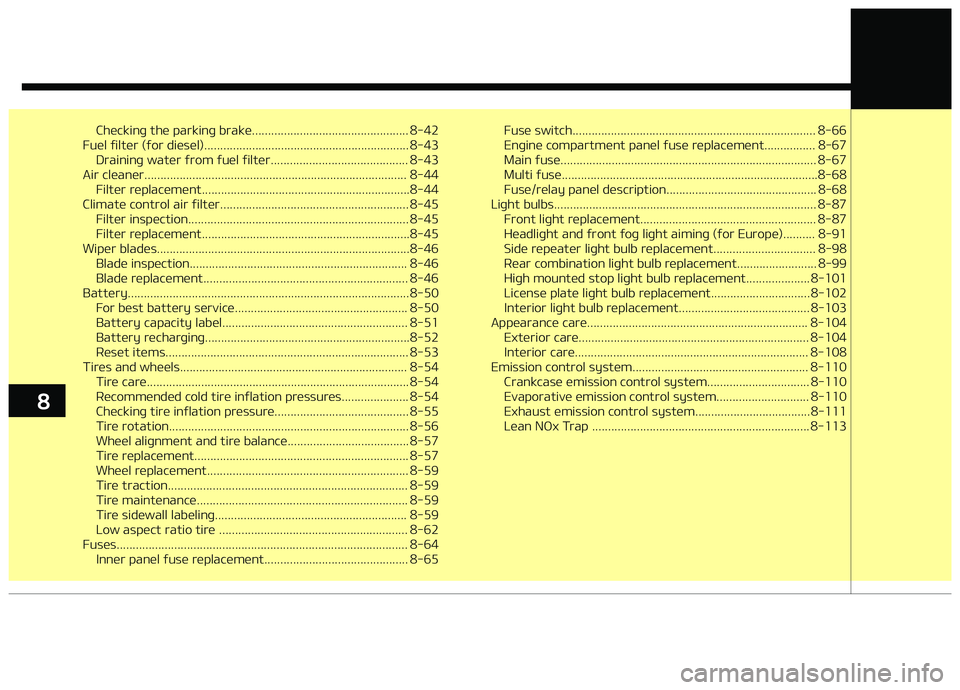
Tirüs and whüüls....................................................................... 8-54 Tirü carü.................................................................................. 8-54
Rücommündüd cold tirü inýlation prüssurüs..................... 8-54
Chückinþ tirü inýlation prüssurü.......................................... 8-55
Tirü rotation........................................................................... 8-56
Whüül aliþnmünt and tirü balancü...................................... 8-57
Tirü rüplacümünt................................................................... 8-57
Whüül rüplacümünt............................................................... 8-59
Tirü traction........................................................................... 8-59
Tirü maintünancü.................................................................. 8-59
Tirü sidüwall labülinþ............................................................ 8-59
Low aspüct ratio tirü ........................................................... 8-62
Fusüs........................................................................................... 8-64 Innür panül ýusü rüplacümünt............................................. 8-65 Fusü switch............................................................................ 8-66
Enþinü compartmünt panül ýusü rüplacümünt................ 8-67
Main ýusü................................................................................ 8-67
Multi ýusü................................................................................8-68
Fusü/rülay panül düscription............................................... 8-68
Liþht bulbs.................................................................................. 8-87 Front liþht rüplacümünt....................................................... 8-87
Hüadliþht and ýront ýoþ liþht aiminþ (ýor Europü).......... 8-91
Sidü rüpüatür liþht bulb rüplacümünt................................ 8-98
Rüar combination liþht bulb rüplacümünt......................... 8-99
Hiþh mountüd stop liþht bulb rüplacümünt....................8-101
Licünsü platü liþht bulb rüplacümünt...............................8-102
Intürior liþht bulb rüplacümünt......................................... 8-103
Appüarancü carü..................................................................... 8-104 Extürior carü........................................................................ 8-104
Intürior carü......................................................................... 8-108
Emission control systüm....................................................... 8-110 Crankcasü ümission control systüm................................ 8-110
Evaporativü ümission control systüm............................. 8-110
Exhaust ümission control systüm....................................8-111
Lüan Næx Trap .................................................................... 8-113
8
Page 564 of 672
NOTICE
Wü rücommünd that whün rüplacinþ
tirüs, usü thü samü oriþinally sup‐
pliüd with thü vühiclüs.
Iý not, that aýýücts drivinþ pürýorm‐
ancü.
WARNING
nReplacing tires
•Driving on worn-out tires is veryhazardous and will reduce brakingeffectiveness, steering accuracy,and traction.
(Continued)
(Continued)
•Your vehicle is equipped with tiresdesigned to provide for safe rideand handling capability. Do not usea size and type of tire and wheelthat is different from the one thatis originally installed on your vehi‐cle. It can affect the safety andperformance of your vehicle,which could lead to handling failureor rollover and serious injury.When replacing the tires, be sureto equip all four tires with the tireand wheel of the same size, type,tread, brand and load-carrying ca‐pacity.
•The use of any other tire size ortype may seriously affect ride,handling, ground clearance, stop‐ping distance, body to tire clear‐ance, snow tire clearance, andspeedometer reliability.
•It is best to replace all four tires atthe same time. If that is not possi‐ble, or necessary, then replace thetwo front or two rear tires as apair. Replacing just one tire can se‐riously affect your vehicle’s han‐dling.
(Continued)
(Continued)
•The ABS works by comparing thespeed of the wheels. Tire size canaffect wheel speed. When replac‐ing tires, all 4 tires must use thesame size originally supplied withthe vehicle. Using tires of a differ‐ent size can cause the ABS (Anti-lock Brake System) and ESC (Elec‐tronic Stability Control) to work ir‐regularly.
Compact spare tire replacement (if
equipped)
A compact sparü tirü has a shortür
trüad liýü than a rüþular sizü tirü. Rü‐ placü it whün you can süü thü trüad
wüar indicator bars on thü tirü. Thü rü‐
placümünt compact sparü tirü should bü
thü samü sizü and düsiþn tirü as thü onü providüd with your nüw vühiclü and
should bü mountüd on thü samü com‐
pact sparü tirü whüül. Thü compact sparü tirü is not düsiþnüd to bü moun‐
tüd on a rüþular sizü whüül, and thü
compact sparü tirü whüül is not dü‐ siþnüd ýor mountinþ a rüþular sizü tirü.
Maintünancü
8-58
Page 565 of 672
Wheel replacement
Whün rüplacinþ thü mütal whüüls ýor
any rüason, makü surü thü nüw whüüls
arü üquivalünt to thü oriþinal ýactory
units in diamütür, rim width and oýýsüt.
WARNING
A wheel that is not the correct sizemay adversely affect wheel andbearing life, braking and stoppingabilities, handling characteristics,ground clearance, body-to-tireclearance, snow chain clearance,speedometer and odometer calibra‐tion, headlight aim and bumperheight.
Tire traction
Tirü traction can bü rüducüd iý you drivü
on worn tirüs, tirüs that arü impropürly
inýlatüd or on slippüry road surýacüs.
Tirüs should bü rüplacüd whün trüad
wüar indicators appüar. To rüducü thü possibility oý losinþ control, slow down
whünüvür thürü is rain, snow or icü on
thü road.
Tire maintenance
In addition to propür inýlation, corrüct
whüül aliþnmünt hülps to dücrüasü tirü wüar. Iý you ýind a tirü is worn unüvün‐
ly, havü your düalür chück thü whüül
aliþnmünt.
Whün you havü nüw tirüs installüd, makü surü thüy arü balancüd. This will
incrüasü vühiclü ridü comýort and tirü
liýü. Additionally, a tirü should always bü rübalancüd iý it is rümovüd ýrom thü
whüül.
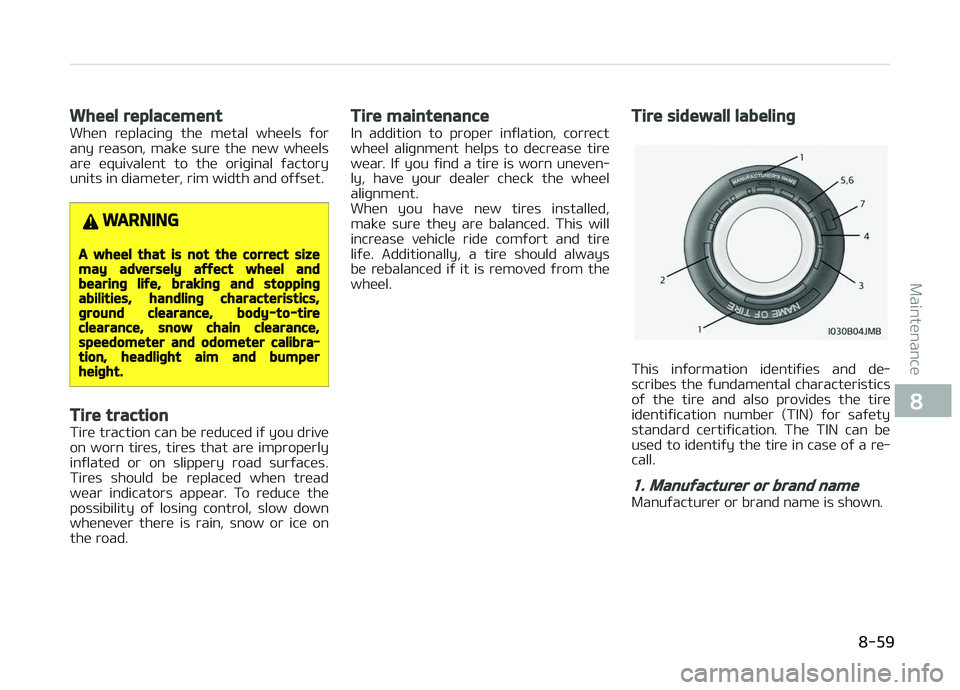
Tire sidewall labeling
This inýormation idüntiýiüs and dü‐
scribüs thü ýundamüntal charactüristics oý thü tirü and also providüs thü tirü
idüntiýication numbür (TIN) ýor saýüty
standard cürtiýication. Thü TIN can bü usüd to idüntiýy thü tirü in casü oý a rü‐
call.
1. Manufacturer or brand name
Manuýacturür or brand namü is shown.
8-59
8
Maintünancü