wheel KIA CARENS RHD 2017 Owners Manual
[x] Cancel search | Manufacturer: KIA, Model Year: 2017, Model line: CARENS RHD, Model: KIA CARENS RHD 2017Pages: 723, PDF Size: 40.8 MB
Page 580 of 723
What to do in an emergency
30
7
Distributing the sealant
12. Immediately drive approximately
7~10km (4~6miles or, about
10min) to evenly distribute the
sealant in the tyre. Checking the tyre inflation pressure
1.After driving approximately 7~10
km (4~6 miles or about 10 min-
utes), stop at a suitable location.
2.Connect connection hose (9) of the compressor directly to the tyre
valve.
3.Connect between compressor and the vehicle power outlet using the
cable and connectors.
4.Adjust the tyre inflation pressure to 220 kPa (32 psi). With the ignition
switched on, proceed as follows.
- To increase the inflation pres-sure: Switch on the compressor,
position "I". To check the current
inflation pressure setting, briefly
switch off the compressor. - To reduce the inflation pres-
sure: Loosen the screw cap (8)
on the compressor hose.
CAUTION
Do not exceed a speed of 60
km/h (35 mph). If possible, donot fall below a speed of 20 km/h (12 mph).
Whilst driving, if you experienceany unusual vibration, ride dis-turbance or noise, reduce yourspeed and drive with caution until you can safely pull off ofthe side of the road. Call forroad side service or towing.
When you use the Tyre MobilityKit, the tyre pressure sensors and wheel may be stained bysealant. Therefore, remove thetyre pressure sensors and wheel stained by sealant and werecommend that inspect at anauthorised Kia dealer.
WARNING
Do not let the compressor run
for more than 10 minutes, other-
wise the device will overheat
and may be damaged.
CAUTION
If the inflation pressure is not maintained, drive the vehicle asecond time, refer toDistributing the sealant. Then repeat steps 1 to 4.
Use of the TMK may be ineffec-tual for tyre damage larger thanapproximately 4 mm (0.16 in).
We recommend that you contactan authorised Kia dealer if the tyre cannot be made roadworthywith the Tyre Mobility Kit.
WARNING
The tyre inflation pressure must
be at least 220 kPa (32 psi). If it
is not, do not continue driving.
Call for road side service or
towing.
Page 581 of 723
731
What to do in an emergency
Notes on the safe use of the
Tyre Mobility Kit
Park your car at the side of theroad so that you can work with the
TMK away from moving traffic.
Place your warning triangle in a
prominent place to make passing
vehicles aware of your location.
To be sure your vehicle will not move, even when you're on fairly
level ground, always set your park-
ing brake.
Only use the TMK for sealing/infla- tion passenger car tyres. Do not
use on motorcycles, bicycles or
any other type of tyres.
Do not remove any foreign objects- such as nails or screws -that have
penetrated the tyre.
Before using the TMK, read the precautionary advice printed onthe sealant bottle!
Provided the car is outdoors, leave the engine running. Otherwise
operating the compressor may
eventually drain the car battery. Never leave the TMK unattended
whilst it is being used.
Do not leave the compressor run- ning for more than 10 min. at a time
or it may overheat.
Do not use the TMK if the ambient temperature is below -30°C (-22°F).
When the tyre and wheel are dam- aged, do not use Tyre Mobility Kit
for your safety. Technical Data
System voltage: DC 12 V
Working voltage: DC 10 - 15 V
Amperage rating: max. 15 A
Suitable for use at temperatures:
-30 ~ +70°C (-22 ~ +158°F)
Max. working pressure: 6 bar (87 psi)
Size
Compressor: 170 x 150 x 60 mm (6.7 x 5.9 x 2.4 in.)
Sealant bottle: 85 x 77 ø mm (3.3 x 3.0 ø in.)
Compressor weight: 0.8 kg (1.8 lbs)
Sealant volume: 200 ml (12.2 cu. in.)
❈ Sealant and spare parts can be obtained and replaced at an
authorised vehicle or tyre dealer.
Empty sealant bottles may be dis-
posed of at home. Liquid residuefrom the sealant should be dis-
posed of by your vehicle or tyredealer or in accordance with local
waste disposal regulations.
Page 582 of 723
What to do in an emergency
32
7
TOWING
Towing service
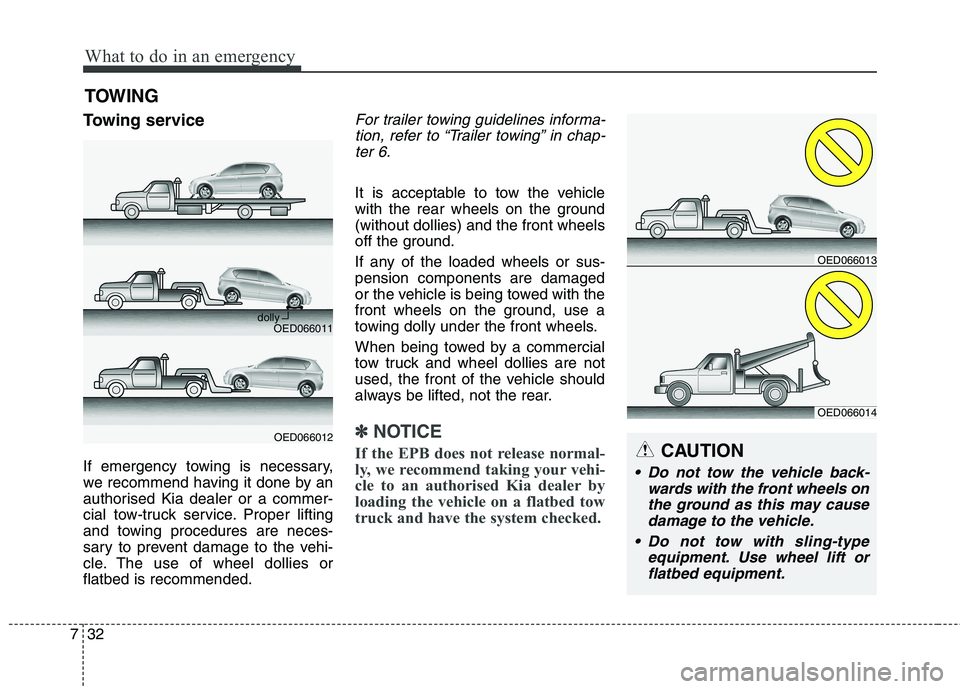
If emergency towing is necessary,
we recommend having it done by an
authorised Kia dealer or a commer-
cial tow-truck service. Proper lifting
and towing procedures are neces-
sary to prevent damage to the vehi-
cle. The use of wheel dollies orflatbed is recommended.
For trailer towing guidelines informa- tion, refer to “Trailer towing” in chap-ter 6.
It is acceptable to tow the vehicle
with the rear wheels on the ground(without dollies) and the front wheels
off the ground.
If any of the loaded wheels or sus- pension components are damaged
or the vehicle is being towed with the
front wheels on the ground, use a
towing dolly under the front wheels.
When being towed by a commercial
tow truck and wheel dollies are not
used, the front of the vehicle should
always be lifted, not the rear.
✽✽ NOTICE
If the EPB does not release normal-
ly, we recommend taking your vehi-
cle to an authorised Kia dealer by
loading the vehicle on a flatbed tow
truck and have the system checked.
CAUTION
Do not tow the vehicle back- wards with the front wheels onthe ground as this may causedamage to the vehicle.
Do not tow with sling-type equipment. Use wheel lift orflatbed equipment.
OED066011
OED066012
dolly
OED066014
OED066013
Page 583 of 723
733
What to do in an emergency
When towing your vehicle in an emergency without wheel dollies :
1.Set the ignition switch in the ACCposition.
2.Place the transaxle shift lever in N (Neutral).
3.Release the parking brake. Removable towing hook
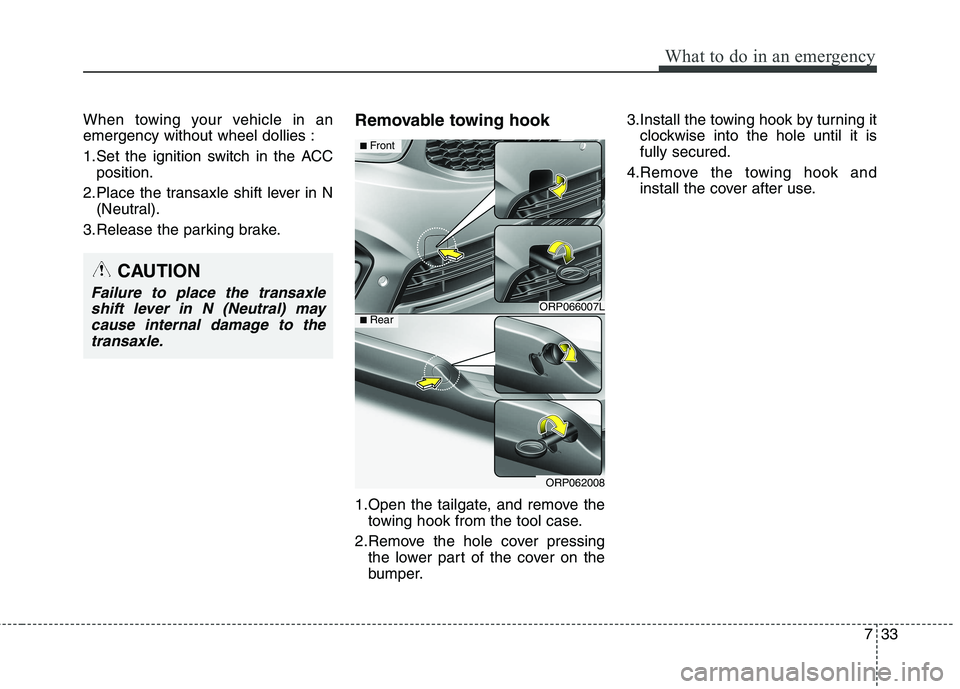
1.Open the tailgate, and remove the
towing hook from the tool case.
2.Remove the hole cover pressing the lower part of the cover on the
bumper. 3.Install the towing hook by turning it
clockwise into the hole until it isfully secured.
4.Remove the towing hook and install the cover after use.
CAUTION
Failure to place the transaxle
shift lever in N (Neutral) maycause internal damage to the transaxle.ORP066007L
ORP062008
■ Front
■Rear
Page 584 of 723
What to do in an emergency
34
7
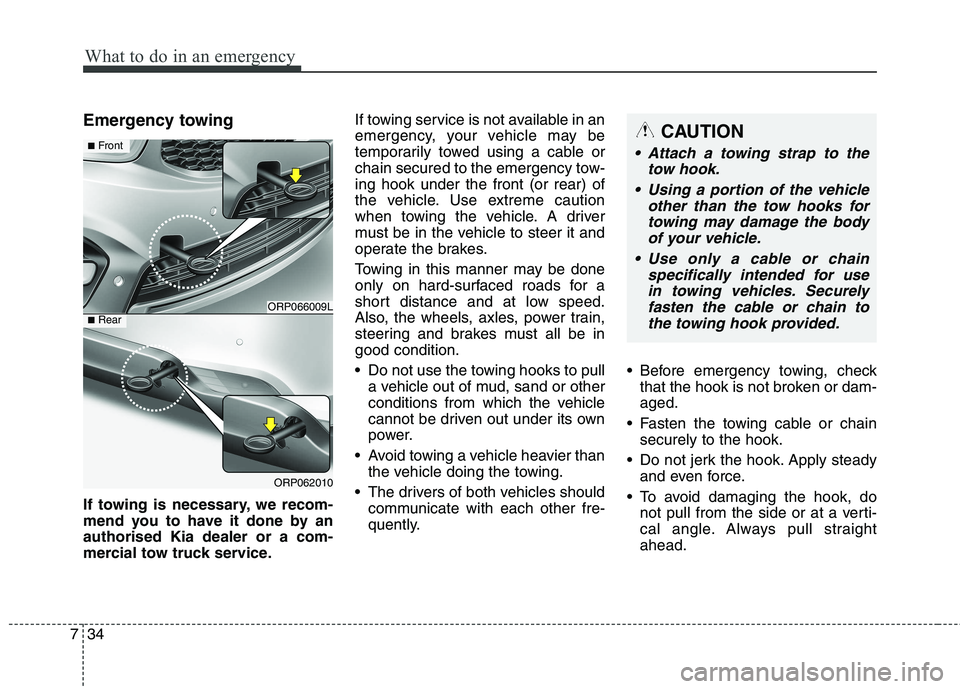
Emergency towing
If towing is necessary, we recom-
mend you to have it done by anauthorised Kia dealer or a com-
mercial tow truck service. If towing service is not available in an
emergency, your vehicle may be
temporarily towed using a cable or
chain secured to the emergency tow-ing hook under the front (or rear) of
the vehicle. Use extreme caution
when towing the vehicle. A driver
must be in the vehicle to steer it and
operate the brakes.
Towing in this manner may be done
only on hard-surfaced roads for a
short distance and at low speed.
Also, the wheels, axles, power train,
steering and brakes must all be ingood condition.
Do not use the towing hooks to pull
a vehicle out of mud, sand or other
conditions from which the vehicle
cannot be driven out under its own
power.
Avoid towing a vehicle heavier than the vehicle doing the towing.
The drivers of both vehicles should communicate with each other fre-
quently. Before emergency towing, check
that the hook is not broken or dam-aged.
Fasten the towing cable or chain securely to the hook.
Do not jerk the hook. Apply steady and even force.
To avoid damaging the hook, do not pull from the side or at a verti-
cal angle. Always pull straightahead.CAUTION
Attach a towing strap to the
tow hook.
Using a portion of the vehicle other than the tow hooks fortowing may damage the bodyof your vehicle.
Use only a cable or chain specifically intended for usein towing vehicles. Securely fasten the cable or chain tothe towing hook provided.
ORP066009L
ORP062010
■ Front
■Rear
Page 585 of 723
735
What to do in an emergency
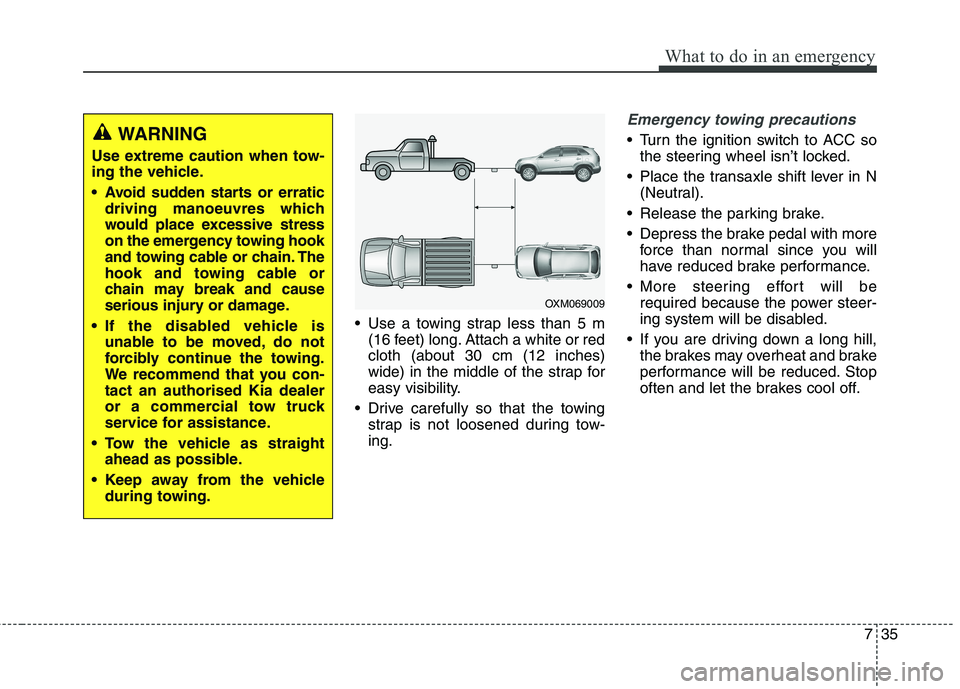
Use a towing strap less than 5 m(16 feet) long. Attach a white or red cloth (about 30 cm (12 inches)
wide) in the middle of the strap for
easy visibility.
Drive carefully so that the towing strap is not loosened during tow-ing.
Emergency towing precautions
Turn the ignition switch to ACC sothe steering wheel isn’t locked.
Place the transaxle shift lever in N (Neutral).
Release the parking brake.
Depress the brake pedal with more force than normal since you will
have reduced brake performance.
More steering effort will be required because the power steer-
ing system will be disabled.
If you are driving down a long hill, the brakes may overheat and brake
performance will be reduced. Stop
often and let the brakes cool off.
OXM069009
WARNING
Use extreme caution when tow-
ing the vehicle.
Avoid sudden starts or erratic driving manoeuvres which
would place excessive stress
on the emergency towing hook
and towing cable or chain. The
hook and towing cable or
chain may break and cause
serious injury or damage.
If the disabled vehicle is unable to be moved, do not
forcibly continue the towing.
We recommend that you con-tact an authorised Kia dealer
or a commercial tow truck
service for assistance.
Tow the vehicle as straight ahead as possible.
Keep away from the vehicle during towing.
Page 586 of 723
What to do in an emergency
36
7
CAUTION
- Automatic transaxle /
dual clutch transmission
If the car is being towed with all four wheels on the ground, itcan be towed only from thefront. Be sure that the transaxleis in neutral. Be sure the steer- ing is unlocked by placing theignition switch in the ACC posi-tion. A driver must be in the towed vehicle to operate thesteering and brakes.
To avoid serious damage to the automatic transaxle / dualclutch transmission, limit the vehicle speed to 15 km/h (10mph) and drive less than 1.5km (1 mile) when towing.
(Continued)
(Continued)
Before towing, check the auto- matic transaxle / dual clutchtransmission fluid leak under your vehicle. If the automatictransaxle / dual clutch trans-mission fluid is leaking, a flatbed equipment or towingdolly must be used.
Page 588 of 723
Maintenance
Engine compartment . . . . . . . . . . . . . . . . . . . . . . . . 8-3
Maintenance services . . . . . . . . . . . . . . . . . . . . . . . . 8-6• Owner’s responsibility . . . . . . . . . . . . . . . . . . . . . . . . 8-6
. . . . . . . . . . . . . . . . 8-6
. . . . . . . . . . . . . . . . 8-7
Owner maintenance . . . . . . . . . . . . . . . . . . . . . . . . . 8-9 . . . . . . . . . . . . . . . . . . . 8-9
Scheduled maintenance service . . . . . . . . . . . . . 8-11
Explanation of scheduled maintenance items . . . 8-28
Engine oil. . . . . . . . . . . . . . . . . . . . . . . . . . . . . . . . . 8-32 . . . . . . . . . . . . . . . . . . . 8-32
. . . . . . . . . . . . . . . 8-33
Engine coolant . . . . . . . . . . . . . . . . . . . . . . . . . . . . 8-34 . . . . . . . . . . . . . . . . . . 8-34
. . . . . . . . . . . . . . . . . . . . . . . . . 8-37
Brake/clutch fluid . . . . . . . . . . . . . . . . . . . . . . . . . . 8-38 . . . . . . . . . . . . 8-38
Washer fluid . . . . . . . . . . . . . . . . . . . . . . . . . . . . . . 8-39 . . . . . . . . . . . . . . . . 8-39
Parking brake - hand type . . . . . . . . . . . . . . . . . . 8-39 . . . . . . . . . . . . . . . . . . 8-39
Fuel Filter . . . . . . . . . . . . . . . . . . . . . . . . . . . . . . . . 8-40 . . . . . . . . . . . . . . . . . 8-40 Air cleaner air cleaner . . . . . . . . . . . . . . . . . . . . . . 8-40
. . . . . . . . . . . . . . . . . . . . . . . . . . . . 8-40
Climate control air filter . . . . . . . . . . . . . . . . . . . . 8-42 . . . . . . . . . . . . . . . . . . . . . . . . . . . . . . 8-42
. . . . . . . . . . . . . . . . . . . . . . . . . . . . 8-42
Wiper blades . . . . . . . . . . . . . . . . . . . . . . . . . . . . . . 8-44 . . . . . . . . . . . . . . . . . . . . . . . . . . . . . . 8-44
. . . . . . . . . . . . . . . . . . . . . . . . . . . 8-44
Battery . . . . . . . . . . . . . . . . . . . . . . . . . . . . . . . . . . . 8-48 . . . . . . . . . . . . . . . . . . . . . . . 8-48
. . . . . . . . . . . . . . . . . . . . . . . . . 8-50
. . . . . . . . . . . . . . . . . . . . . . . . . . 8-50
. . . . . . . . . . . . . . . . . . . . . . . . . . . . . . . . . . 8-51
Tyres and wheels . . . . . . . . . . . . . . . . . . . . . . . . . . 8-52 . . . . . . . . . . . . . . . . . . . . . . . . . . . . . . . . . . . . 8-52
. . . . . . . 8-52
. . . . . . . . . . . . . . . . 8-53
. . . . . . . . . . . . . . . . . . . . . . . . . . . . . . . . 8-54
. . . . . . . . . . . . . 8-55
. . . . . . . . . . . . . . . . . . . . . . . . . . . . . 8-56
. . . . . . . . . . . . . . . . . . . . . . . . . . . 8-57
. . . . . . . . . . . . . . . . . . . . . . . . . . . . . . . . 8-57
. . . . . . . . . . . . . . . . . . . . . . . . . . . . 8-57
. . . . . . . . . . . . . . . . . . . . . . . . . 8-58
. . . . . . . . . . . . . . . . . . . . . . . . . 8-62
8
Page 596 of 723
89
Maintenance
OWNER MAINTENANCE
We recommend that the following
lists are vehicle checks and inspec-
tions that should be performed by the
owner or an authorised Kia dealer atthe frequencies indicated to help
ensure safe, dependable operation
of your vehicle.
If you have any question, we recom-
mend that you consult an authorised
Kia dealer.
These Owner Maintenance Checks
are generally not covered by war-
ranties and you may be charged for
labour, parts and lubricants used. Owner maintenance schedule
When you stop for fuel:
Check the engine oil level.
Check coolant level in coolant
reservoir.
Check the windscreen washer fluid level.
Look for low or under-inflated tyres.
Check the radiator and condenser. Check if the front of the radiator and condenser are clean and not
blocked with leaves, dirt or insectsetc.
If any of the above parts are
extremely dirty or you are not sure
of their condition, we recommend
that you contact an authorised Kia
dealer.
Whilst operating your vehicle:
Note any changes in the sound ofthe exhaust or any smell of
exhaust fumes in the vehicle.
Check for vibrations in the steering wheel. Notice any increased steer-
ing effort or looseness in the steer-
ing wheel, or change in its straight-ahead position.
Notice if your vehicle constantly turns slightly or “pulls” to one side
when travelling on smooth, levelroad.
When stopping, listen and check for unusual sounds, pulling to one
side, increased brake pedal travel
or “hard-to-push” brake pedal.
If any slipping or changes in the operation of your transaxle occurs,
check the transaxle fluid level.
Check manual transaxle operation, including clutch operation.
WARNING
Be careful when checking your
engine coolant level when the
engine is hot. Scalding hot
coolant and steam may blow out
under pressure. This could cause
burns or other serious injury.
Page 597 of 723
Maintenance
10
8
Check automatic transaxle / dual
clutch transmission P (Park) func- tion.
Check parking brake.
Check for fluid leaks under your vehicle (water dripping from the air
conditioning system during or after
use is normal).
At least monthly:
Check coolant level in the enginecoolant reservoir.
Check the operation of all exterior lights, including the stoplights, turn
signals and hazard warning flash-
ers.
Check the inflation pressures of all tyres including the spare.
At least twice a year
(i.e., every Spring and Fall) :
Check radiator, heater and air con- ditioning hoses for leaks or dam-
age.
Check windscreen washer spray and wiper operation. Clean wiper
blades with clean cloth dampened
with washer fluid.
Check headlight alignment.
Check muffler, exhaust pipes, shields and clamps.
Check the lap/shoulder belts for wear and function.
Check for worn tyres and loose wheel lug nuts.
At least once a year :
Clean body and door drain holes.
Lubricate door hinges and checks,and bonnet hinges.
Lubricate door and bonnet locks and latches.
Lubricate door rubber weather- strips.
Check the air conditioning system.
Inspect and lubricate automatic transaxle / dual clutch transmission
linkage and controls.
Clean battery and terminals.
Check the brake (and clutch) fluid level.