lock KIA CARENS RHD 2017 User Guide
[x] Cancel search | Manufacturer: KIA, Model Year: 2017, Model line: CARENS RHD, Model: KIA CARENS RHD 2017Pages: 723, PDF Size: 40.8 MB
Page 32 of 723
Safety features of your vehicle
14
3
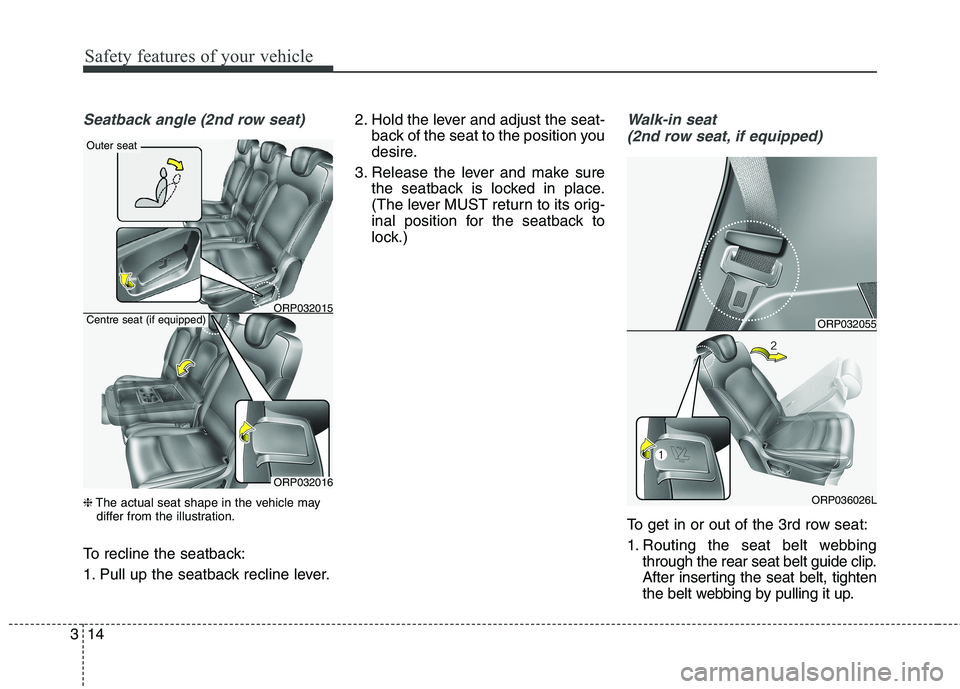
Seatback angle (2nd row seat)
❈ The actual seat shape in the vehicle may
differ from the illustration.
To recline the seatback:
1. Pull up the seatback recline lever. 2. Hold the lever and adjust the seat-
back of the seat to the position you
desire.
3. Release the lever and make sure the seatback is locked in place.
(The lever MUST return to its orig-
inal position for the seatback to
lock.)
Walk-in seat
(2nd row seat, if equipped)
To get in or out of the 3rd row seat:
1. Routing the seat belt webbing through the rear seat belt guide clip.
After inserting the seat belt, tighten
the belt webbing by pulling it up.
ORP032055
ORP036026L
ORP032016
ORP032015
Outer seat
Centre seat (if equipped)
Page 33 of 723
315
Safety features of your vehicle
2. Pull up the walk-in lever (1) on the2nd row seatback.
3.The 2nd row seatback will be fold- ed and push the seat to the far-
thest forward position (2). After getting in or out, slide the 2nd
row seat to the farthest rearward
position and pull the seatback firm-
ly backward until it clicks into
place. Make sure that the seat is
locked in place.Folding the rear seat
The rear seatbacks can be folded to
facilitate carrying long items or toincrease the luggage capacity of the
vehicle.
WARNING
The purpose of the fold-down
rear seatbacks is to allow you to
carry longer objects that couldnot be accommodated in the
cargo area.
Never allow passengers to sit
on top of the folded down seat-
back whilst the vehicle is mov-
ing. This is not a proper seatingposition and no seat belts are
available for use. This could
result in serious injury or deathin case of an accident or sud-
den stop. Objects carried on the
folded down seatback should
not extend higher than the top
of the front seatbacks. This
could allow cargo to slide for-
ward and cause injury or dam-
age during sudden stops.
WARNING
Never attempt to adjust whilst
the vehicle is moving or the 2nd
row seat is occupied as the seat
may suddenly move and cause
the passenger on the seat to beinjured.
Page 35 of 723
317
Safety features of your vehicle
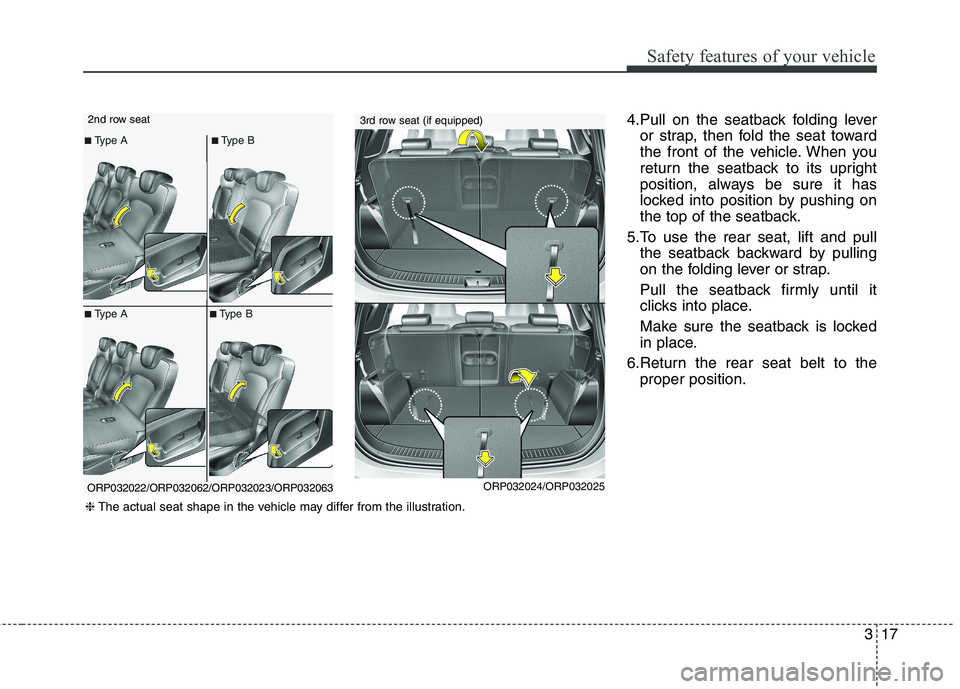
4.Pull on the seatback folding leveror strap, then fold the seat toward
the front of the vehicle. When you
return the seatback to its upright
position, always be sure it has
locked into position by pushing on
the top of the seatback.
5.To use the rear seat, lift and pull the seatback backward by pulling
on the folding lever or strap.
Pull the seatback firmly until it
clicks into place.
Make sure the seatback is locked
in place.
6.Return the rear seat belt to the proper position.2nd row seat
ORP032022/ORP032062/ORP032023/ORP032063
❈The actual seat shape in the vehicle may differ from the illustration.
■Type A■ Type B
3rd row seat (if equipped)
ORP032024/ORP032025
■Type A ■
Type B
Page 36 of 723
Safety features of your vehicle
18
3
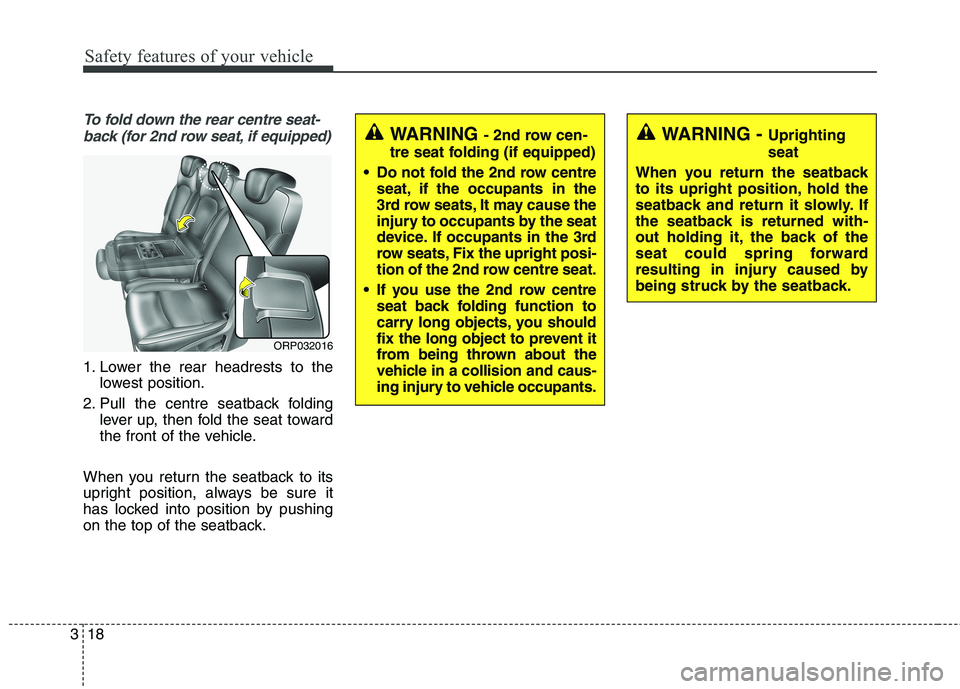
To fold down the rear centre seat-
back (for 2nd row seat, if equipped)
1. Lower the rear headrests to the lowest position.
2. Pull the centre seatback folding lever up, then fold the seat toward
the front of the vehicle.
When you return the seatback to its
upright position, always be sure it
has locked into position by pushing
on the top of the seatback.
ORP032016
WARNING - 2nd row cen-
tre seat folding (if equipped)
Do not fold the 2nd row centre seat, if the occupants in the
3rd row seats, It may cause the
injury to occupants by the seat
device. If occupants in the 3rd
row seats, Fix the upright posi-
tion of the 2nd row centre seat.
If you use the 2nd row centre seat back folding function to
carry long objects, you should
fix the long object to prevent it
from being thrown about the
vehicle in a collision and caus-
ing injury to vehicle occupants.WARNING - Uprighting seat
When you return the seatback
to its upright position, hold the
seatback and return it slowly. If
the seatback is returned with-
out holding it, the back of the
seat could spring forward
resulting in injury caused by
being struck by the seatback.
Page 39 of 723
321
Safety features of your vehicle
Adjusting the height up and down
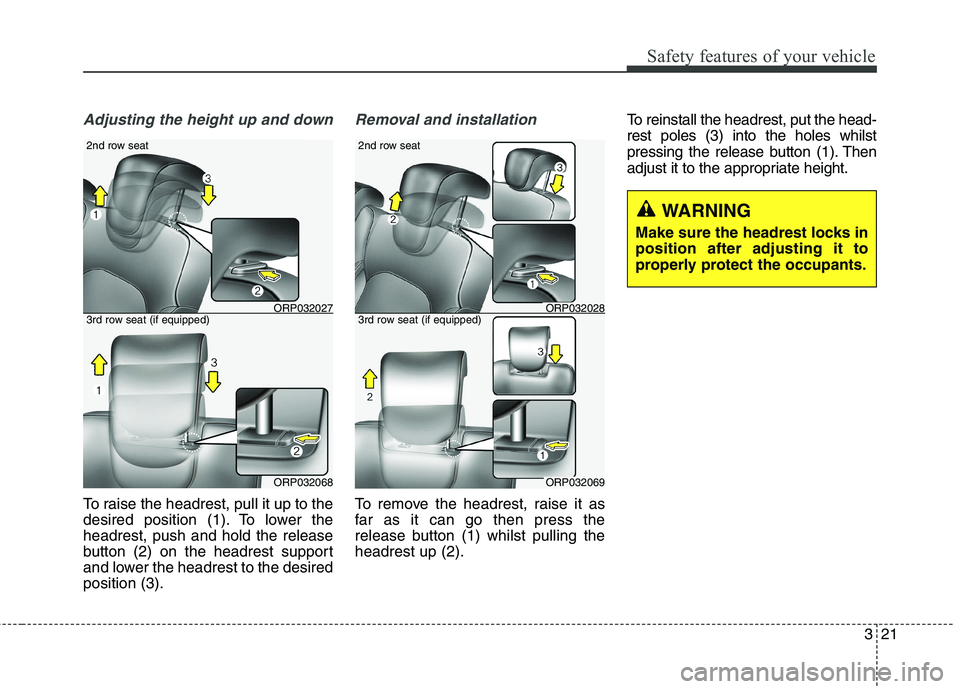
To raise the headrest, pull it up to the
desired position (1). To lower theheadrest, push and hold the release
button (2) on the headrest support
and lower the headrest to the desiredposition (3).
Removal and installation
To remove the headrest, raise it as
far as it can go then press the
release button (1) whilst pulling theheadrest up (2).To reinstall the headrest, put the head- rest poles (3) into the holes whilst
pressing the release button (1). Then
adjust it to the appropriate height.
WARNING
Make sure the headrest locks in position after adjusting it to
properly protect the occupants.
ORP032068
ORP032027
2nd row seat
3rd row seat (if equipped)
ORP032069
ORP032028
2nd row seat
3rd row seat (if equipped)
Page 44 of 723
Safety features of your vehicle
26
3
And then, the rear corresponding
seat belt warning light will illuminate
for approximately 35 seconds, if any
of following occurs;
- You start the engine when the rear
belt is not fastened.
- You drive over 9km/h when the rear belt is not fastened.
- The rear belt is disconnected when driving under 20km/h.
If the rear seat belt is fastened, the
warning light will turn off immediately. If the rear seat belt is disconnected
when you drive over the 20km/h, the
corresponding seat belt warning light
will blink and warning chime will
sound for 35 seconds. But, if the rear passenger's lap/shoul- der belt is/are connected and discon-nected twice within 9 seconds after
the belt is fastened, the correspon-
ding seat belt warning light will not
operate.Lap/shoulder belt
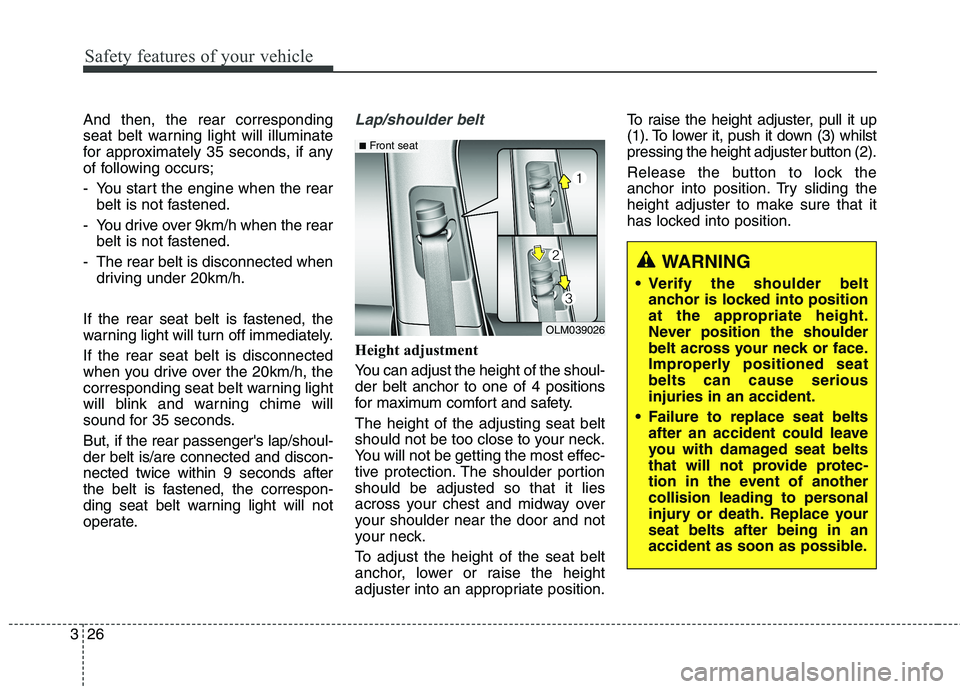
Height adjustment
You can adjust the height of the shoul- der belt anchor to one of 4 positions
for maximum comfort and safety. The height of the adjusting seat belt
should not be too close to your neck.
You will not be getting the most effec-
tive protection. The shoulder portionshould be adjusted so that it lies
across your chest and midway over
your shoulder near the door and not
your neck.
To adjust the height of the seat belt
anchor, lower or raise the height
adjuster into an appropriate position. To raise the height adjuster, pull it up
(1). To lower it, push it down (3) whilst
pressing the height adjuster button (2).
Release the button to lock the
anchor into position. Try sliding the
height adjuster to make sure that it
has locked into position.
OLM039026
■
Front seat
WARNING
Verify the shoulder belt anchor is locked into position
at the appropriate height.
Never position the shoulder
belt across your neck or face.
Improperly positioned seatbelts can cause seriousinjuries in an accident.
Failure to replace seat belts after an accident could leave
you with damaged seat belts
that will not provide protec-
tion in the event of another
collision leading to personal
injury or death. Replace yourseat belts after being in an
accident as soon as possible.
Page 45 of 723
327
Safety features of your vehicle
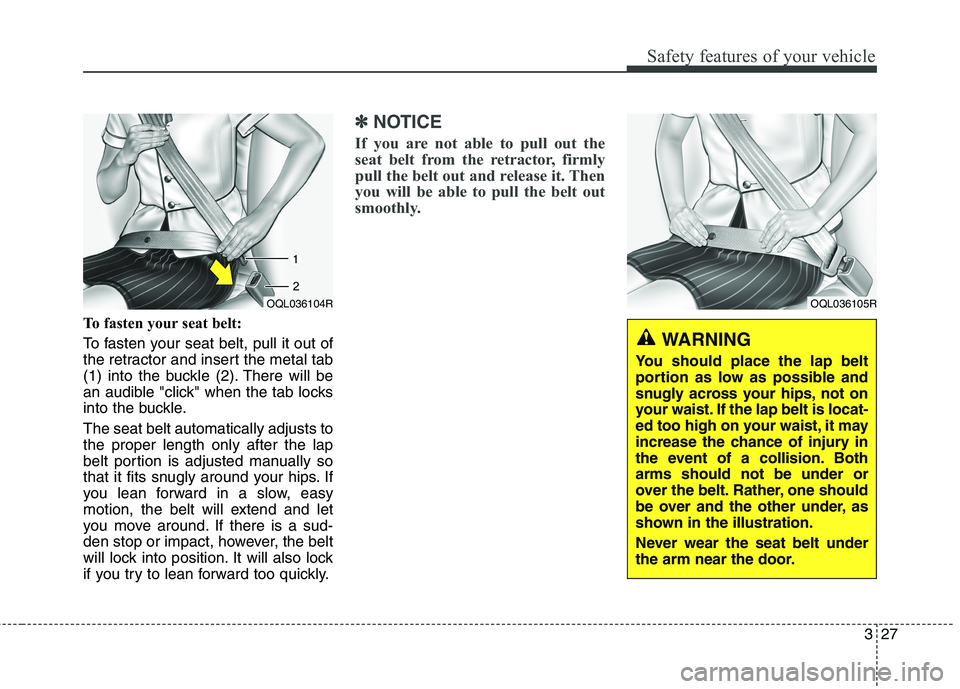
To fasten your seat belt:
To fasten your seat belt, pull it out of
the retractor and insert the metal tab
(1) into the buckle (2). There will be
an audible "click" when the tab locks
into the buckle. The seat belt automatically adjusts to the proper length only after the lap
belt portion is adjusted manually so
that it fits snugly around your hips. If
you lean forward in a slow, easy
motion, the belt will extend and let
you move around. If there is a sud-
den stop or impact, however, the belt
will lock into position. It will also lock
if you try to lean forward too quickly.
✽✽NOTICE
If you are not able to pull out the
seat belt from the retractor, firmly
pull the belt out and release it. Then
you will be able to pull the belt out
smoothly.
OQL036104R
WARNING
You should place the lap belt
portion as low as possible and
snugly across your hips, not on
your waist. If the lap belt is locat-
ed too high on your waist, it may
increase the chance of injury in
the event of a collision. Botharms should not be under or
over the belt. Rather, one should
be over and the other under, as
shown in the illustration.
Never wear the seat belt under
the arm near the door.
OQL036105R
Page 46 of 723
Safety features of your vehicle
28
3
To release the seat belt:
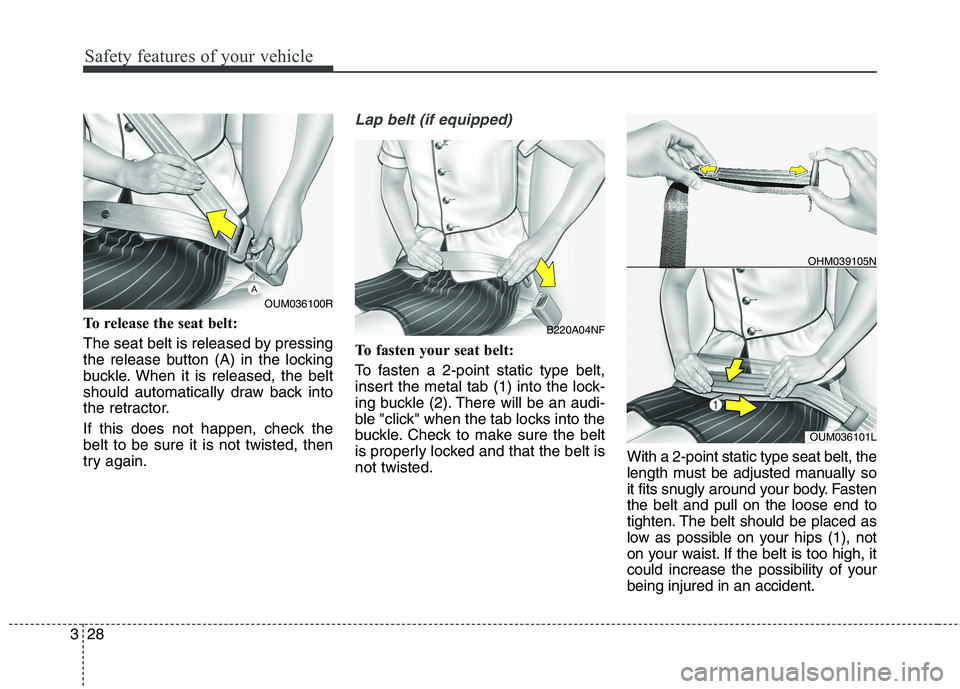
The seat belt is released by pressing
the release button (A) in the locking
buckle. When it is released, the belt
should automatically draw back into
the retractor.
If this does not happen, check the belt to be sure it is not twisted, then
try again.
Lap belt (if equipped)
To fasten your seat belt:
To fasten a 2-point static type belt,
insert the metal tab (1) into the lock-
ing buckle (2). There will be an audi-
ble "click" when the tab locks into the
buckle. Check to make sure the belt
is properly locked and that the belt isnot twisted. With a 2-point static type seat belt, the
length must be adjusted manually so
it fits snugly around your body. Fastenthe belt and pull on the loose end to
tighten. The belt should be placed as
low as possible on your hips (1), not
on your waist. If the belt is too high, it
could increase the possibility of yourbeing injured in an accident.
OUM036100R
B220A04NF
OHM039105N
OUM036101L
Page 47 of 723
329
Safety features of your vehicle
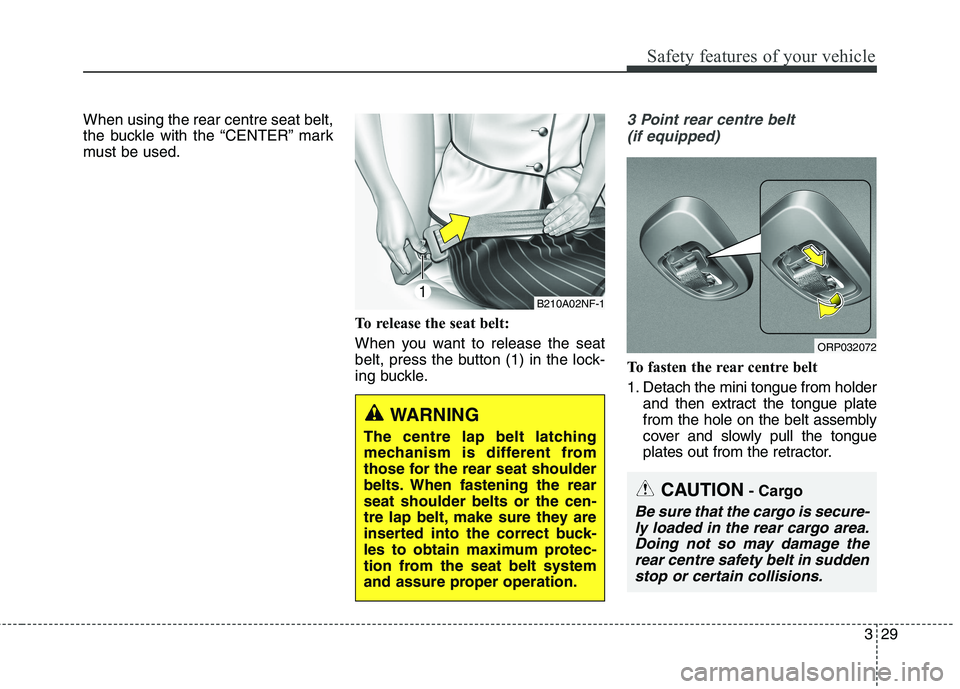
When using the rear centre seat belt,
the buckle with the “CENTER” mark
must be used.To release the seat belt:
When you want to release the seat
belt, press the button (1) in the lock-
ing buckle.3 Point rear centre belt (if equipped)
To fasten the rear centre belt
1. Detach the mini tongue from holder and then extract the tongue plate
from the hole on the belt assembly
cover and slowly pull the tongue
plates out from the retractor.
B210A02NF-1
WARNING
The centre lap belt latching
mechanism is different from
those for the rear seat shoulder
belts. When fastening the rearseat shoulder belts or the cen-
tre lap belt, make sure they are
inserted into the correct buck-
les to obtain maximum protec-
tion from the seat belt system
and assure proper operation.
ORP032072
CAUTION - Cargo
Be sure that the cargo is secure-
ly loaded in the rear cargo area.Doing not so may damage therear centre safety belt in sudden stop or certain collisions.
Page 48 of 723
Safety features of your vehicle
30
3
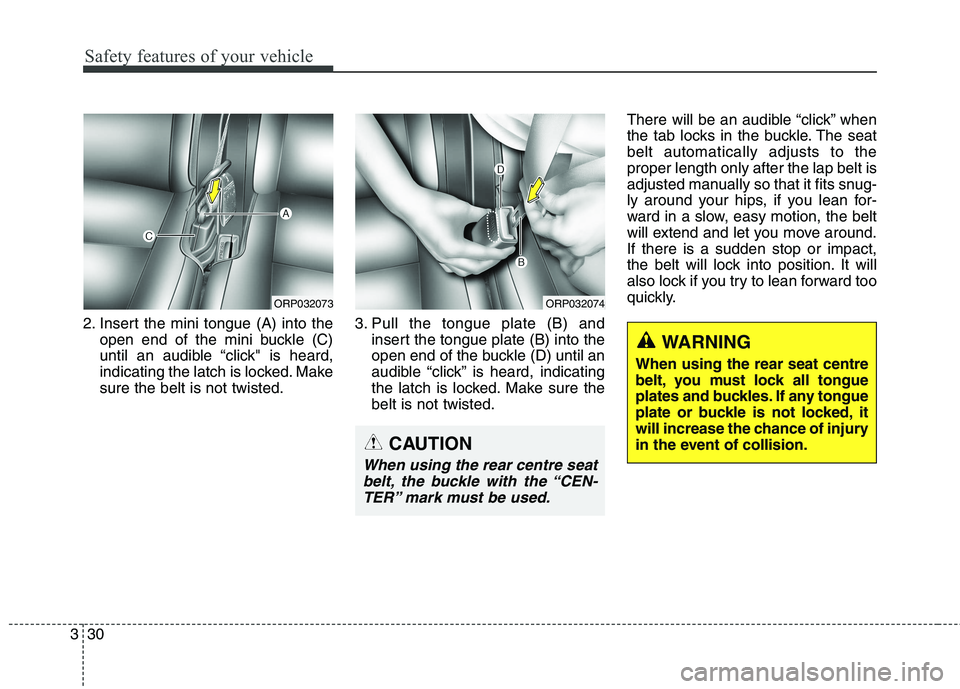
2. Insert the mini tongue (A) into the
open end of the mini buckle (C)
until an audible “click" is heard,
indicating the latch is locked. Makesure the belt is not twisted. 3. Pull the tongue plate (B) and
insert the tongue plate (B) into the
open end of the buckle (D) until an
audible “click” is heard, indicating
the latch is locked. Make sure thebelt is not twisted. There will be an audible “click” when
the tab locks in the buckle. The seatbelt automatically adjusts to theproper length only after the lap belt is
adjusted manually so that it fits snug-
ly around your hips, if you lean for-
ward in a slow, easy motion, the belt
will extend and let you move around.If there is a sudden stop or impact,
the belt will lock into position. It will
also lock if you try to lean forward too
quickly.
ORP032073ORP032074
CAUTION
When using the rear centre seat
belt, the buckle with the “CEN-TER” mark must be used.
WARNING
When using the rear seat centre
belt, you must lock all tongue
plates and buckles. If any tongue
plate or buckle is not locked, it
will increase the chance of injury
in the event of collision.