maintenance schedule KIA CARENS RHD 2017 Owner's Manual
[x] Cancel search | Manufacturer: KIA, Model Year: 2017, Model line: CARENS RHD, Model: KIA CARENS RHD 2017Pages: 723, PDF Size: 40.8 MB
Page 611 of 723
Maintenance
24
8
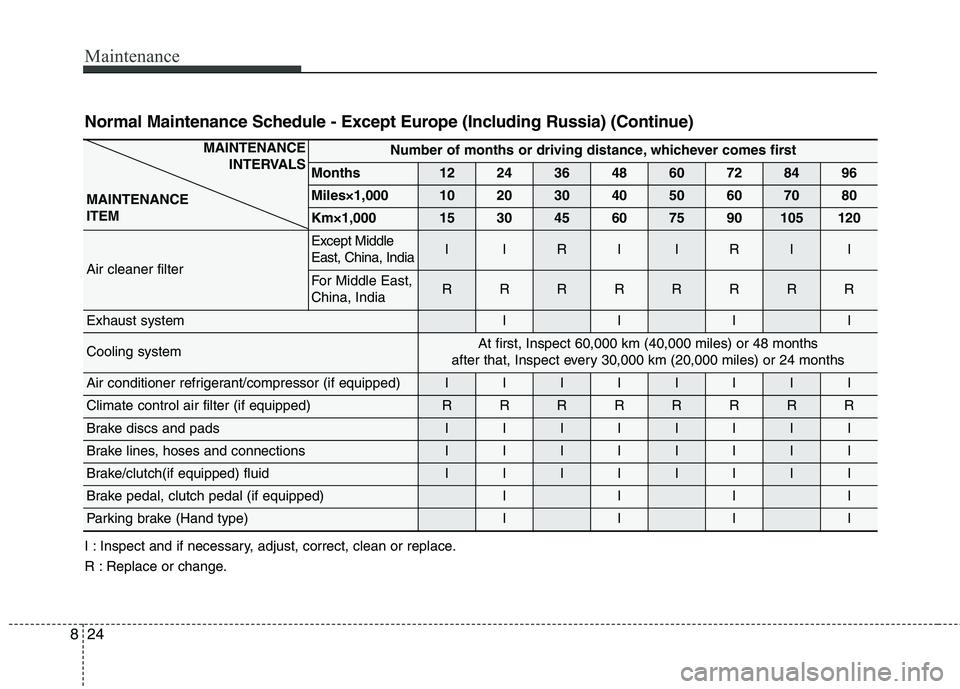
Normal Maintenance Schedule - Except Europe (Including Russia) (Continue)
MAINTENANCE
INTERVALS
MAINTENANCE ITEMNumber of months or driving distance, whichever comes first
Months1224364860728496
Miles×1,0001020304050607080
Km×1,000153045607590105120
Air cleaner filter
Except Middle East, China, IndiaIIRIIRII
For Middle East, China, IndiaRRRRRRRR
Exhaust systemIIII
Cooling systemAt first, Inspect 60,000 km (40,000 miles) or 48 months
after that, Inspect every 30,000 km (20,000 miles) or 24 months
Air conditioner refrigerant/compressor (if equipped)IIIIIIII
Climate control air filter (if equipped)RRRRRRRR
Brake discs and padsIIIIIIII
Brake lines, hoses and connectionsIIIIIIII
Brake/clutch(if equipped) fluidIIIIIIII
Brake pedal, clutch pedal (if equipped)IIII
Parking brake (Hand type)IIII
I : Inspect and if necessary, adjust, correct, clean or replace.
R : Replace or change.
Page 612 of 723
825
Maintenance
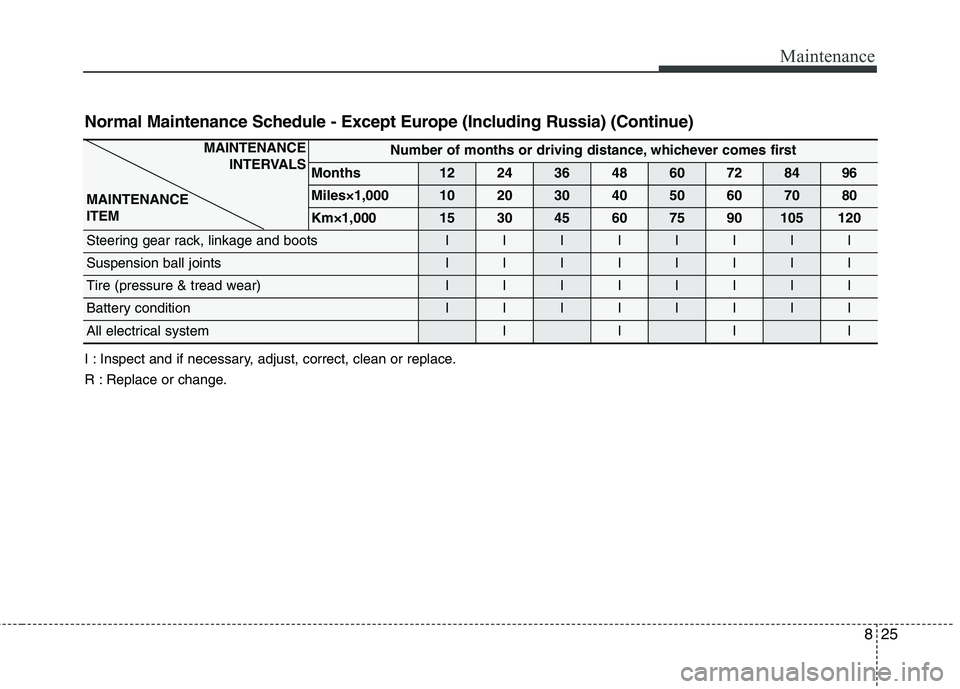
Normal Maintenance Schedule - Except Europe (Including Russia) (Continue)
MAINTENANCE INTERVALS
MAINTENANCE ITEMNumber of months or driving distance, whichever comes first
Months1224364860728496
Miles×1,0001020304050607080
Km×1,000153045607590105120
Steering gear rack, linkage and bootsIIIIIIII
Suspension ball jointsIIIIIIII
Tire (pressure & tread wear)IIIIIIII
Battery conditionIIIIIIII
All electrical systemIIII
I : Inspect and if necessary, adjust, correct, clean or replace.
R : Replace or change.
Page 615 of 723
Maintenance
28
8
EXPLANATION OF SCHEDULED MAINTENANCE ITEMS
Engine oil and filter The engine oil and filter should be
changed at the intervals specified in
the maintenance schedule. If the car
is being driven in severe conditions,more frequent oil and filter changesare required. Drive belts
Inspect all drive belts for evidence of
cuts, cracks, excessive wear or oil
saturation and replace if necessary.
Drive belts should be checked peri-
odically for proper tension and
adjusted as necessary. Fuel filter cartridge (for diesel) A clogged filter can limit the speed at
which the vehicle may be driven,damage the emission system and
cause multiple issues such as hard
starting. If an excessive amount of
foreign matter accumulates in the
fuel tank, the filter may require
replacement more frequently.
After installing a new filter, run the
engine for several minutes, and
check for leaks at the connections.
We recommend that the fuel filter be
replaced by an authorised Kia dealer.
Fuel filter (for petrol)
Kia petrol vehicle is equipped a life-
time fuel filter that integrated with the
fuel tank. Regular maintenance or
replacement is not needed but
depends on fuel quality. If there are
some important safety matters like
fuel flow restriction, surging, loss of
power, hard starting problem etc, fuelfilter inspection or replace is needed.
We recommend that the fuel filter be
Inspected or replaced by an autho-
rised Kia dealer.Fuel lines, fuel hoses and con- nections
Check the fuel lines, fuel hoses and
connections for leakage and dam-
age. We recommend that the fuel
lines, fuel hoses and connections be
replaced by an authorised Kia dealer.
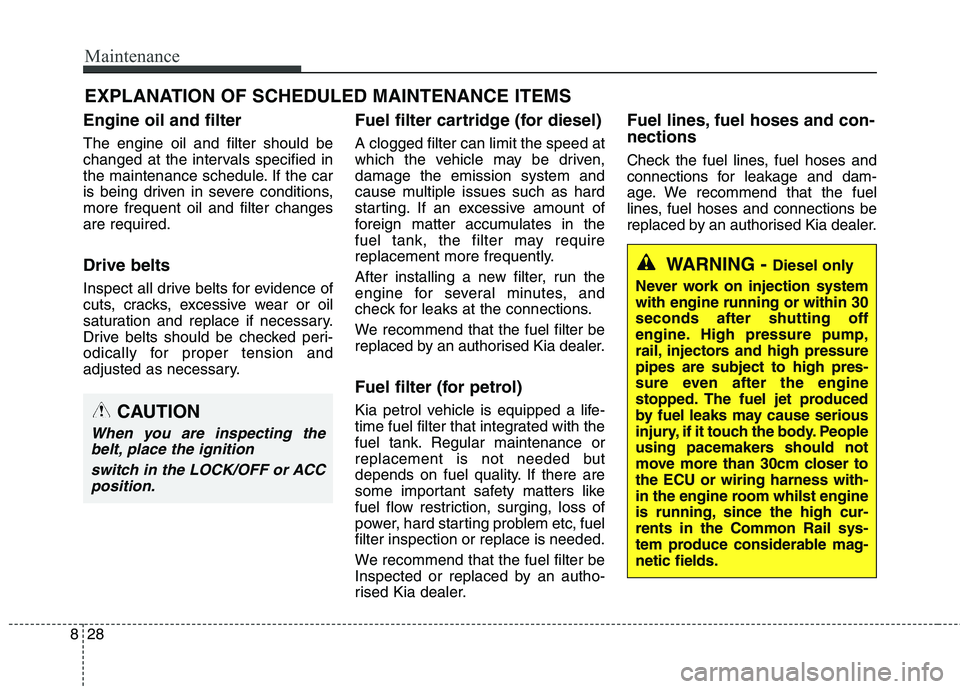
WARNING -
Diesel only
Never work on injection system with engine running or within 30seconds after shutting off
engine. High pressure pump,
rail, injectors and high pressurepipes are subject to high pres-
sure even after the engine
stopped. The fuel jet produced
by fuel leaks may cause serious
injury, if it touch the body. People
using pacemakers should not
move more than 30cm closer tothe ECU or wiring harness with-
in the engine room whilst engine
is running, since the high cur-rents in the Common Rail sys-
tem produce considerable mag-netic fields.
CAUTION
When you are inspecting the belt, place the ignition
switch in the LOCK/OFF or ACCposition.
Page 616 of 723
829
Maintenance
Vapour hose and fuel filler cap
The vapour hose and fuel filler cap should be inspected at those inter-
vals specified in the maintenance
schedule. Make sure that a new
vapour hose or fuel filler cap is cor-rectly replaced.Vacuum crankcase ventilation hoses (if equipped)
Inspect the surface of hoses for evi- dence of heat and/or mechanical
damage. Hard and brittle rubber,
cracking, tears, cuts, abrasions, and
excessive swelling indicate deterio-
ration. Particular attention should be
paid to examine those hose surfaces
nearest to high heat sources, such
as the exhaust manifold. Inspect the hose routing to assure that the hoses do not come in con-
tact with any heat source, sharp
edges or moving component whichmight cause heat damage or
mechanical wear. Inspect all hose
connections, such as clamps and
couplings, to make sure they are
secure, and that no leaks are pres-
ent. Hoses should be replaced
immediately if there is any evidence
of deterioration or damage.Air cleaner filter
We recommend that the air cleaner
filter be replaced by an authorised
Kia dealer. Spark plugs
(for petrol engine)
Make sure to install new spark plugs
of the correct heat range.
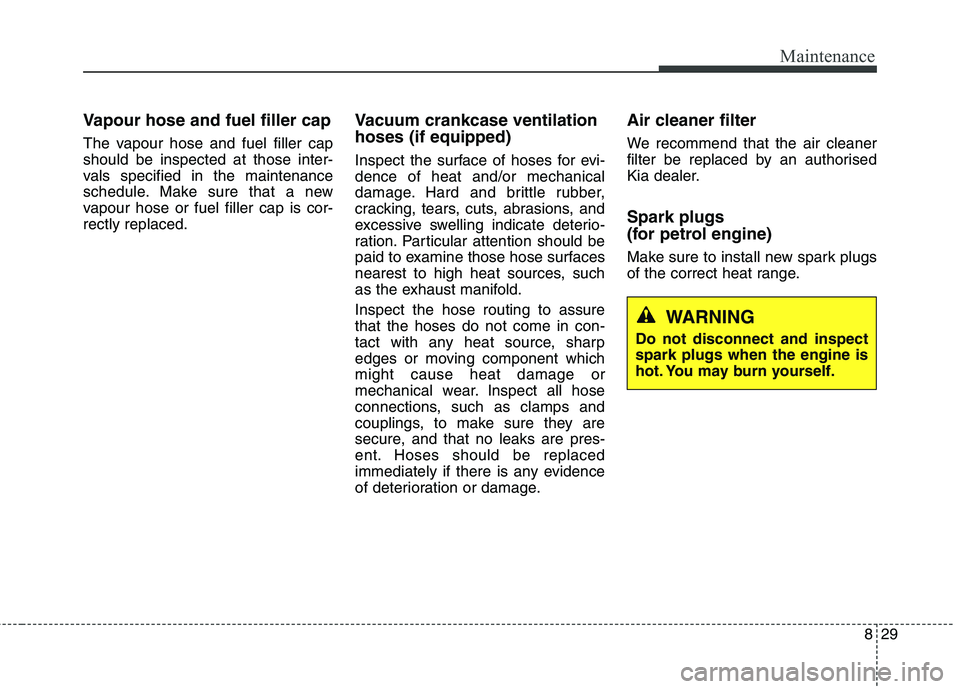
WARNING
Do not disconnect and inspect spark plugs when the engine is
hot. You may burn yourself.
Page 617 of 723
Maintenance
30
8
Valve clearance
(for petrol engine)
(Except for Nu 2.0 Engine)
Inspect excessive valve noise and/or
engine vibration and adjust if neces-
sary. We recommend that the valve
clearance be serviced by an autho-
rised Kia dealer. Cooling system
Check the cooling system parts, such
as radiator, coolant reservoir, hoses
and connections for leakage and dam-
age. Replace any damaged parts. Coolant The coolant should be changed at
the intervals specified in the mainte-
nance schedule.
Manual transaxle fluid (if equipped)
Inspect the manual transaxle fluid according to the maintenance sched-
ule. Automatic transaxle fluid (if equipped)
Automatic transaxle fluid should not
be checked under normal usage
conditions.
But in severe conditions, we recom-
mend that the system be serviced by
an authorised Kia dealer in accor-
dance to the maintenance schedule.
✽✽
NOTICE
Automatic transaxle fluid colour is
basically red.
As the vehicle is driven, the auto-
matic transaxle fluid will begin to
look darker.
It is normal condition and you should
not judge the need to replace the fluid
based upon the changed colour.Dual clutch transmission fluid (if equipped)
Inspect the dual clutch transmission fluid according to the maintenance
schedule.
CAUTION
The use of a non-specified fluid could result in transaxle mal-function and failure.
Use only specified automatictransaxle fluid. (Refer to “Recommended lubricants andcapacities” in chapter 9.)
Page 628 of 723
841
Maintenance
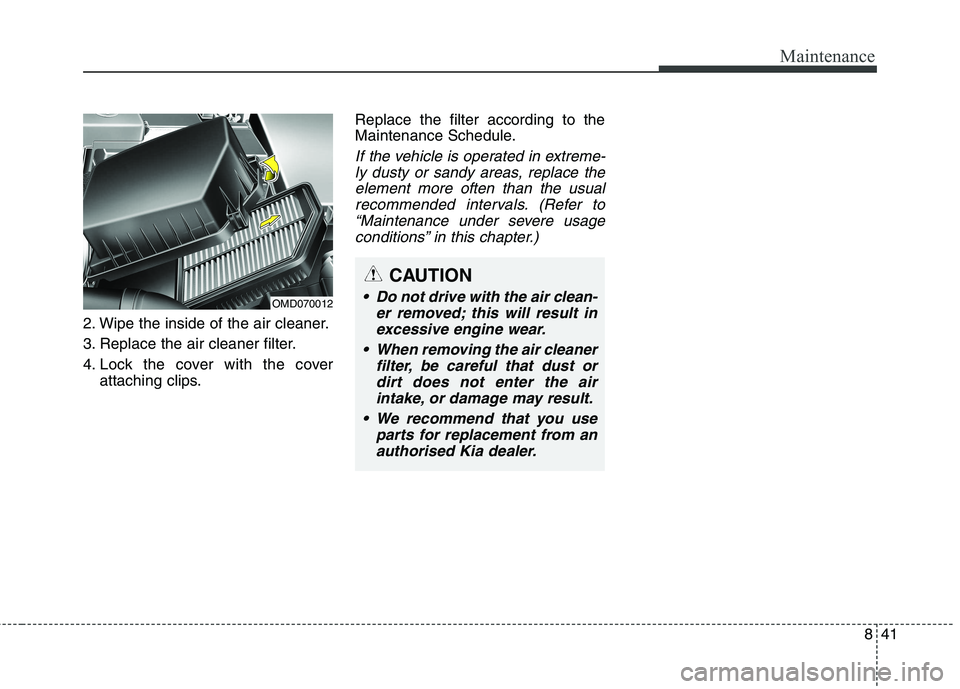
2. Wipe the inside of the air cleaner.
3. Replace the air cleaner filter.
4. Lock the cover with the coverattaching clips. Replace the filter according to the
Maintenance Schedule.
If the vehicle is operated in extreme-
ly dusty or sandy areas, replace theelement more often than the usual recommended intervals. (Refer to“Maintenance under severe usageconditions” in this chapter.)
OMD070012
CAUTION
Do not drive with the air clean- er removed; this will result inexcessive engine wear.
When removing the air cleaner filter, be careful that dust ordirt does not enter the airintake, or damage may result.
We recommend that you use parts for replacement from anauthorised Kia dealer.
Page 629 of 723
Maintenance
42
8
CLIMATE CONTROL AIR FILTER
Filter inspection
If the vehicle is operated in the
severely air-polluted cities or on
dusty rough roads for a long period,it should be inspected more fre-
quently and replaced earlier. When
you, the owner, replace the climate
control air filter, replace it performing
the following procedure, and be care-
ful to avoid damaging other compo-
nents. Replace the filter according to the
maintenance Schedule. Filter replacement
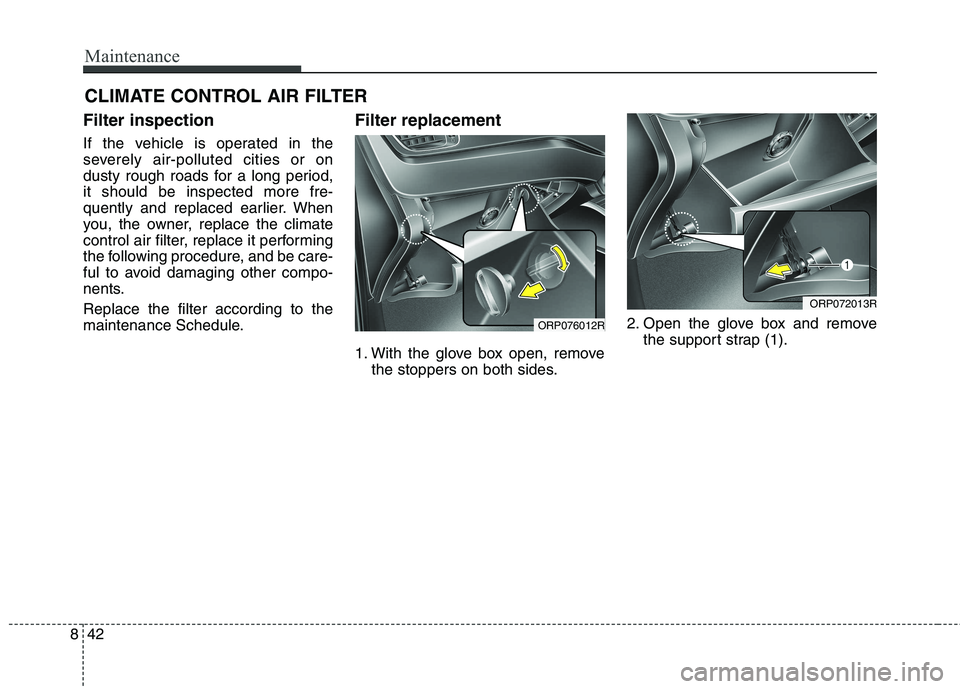
1. With the glove box open, remove
the stoppers on both sides. 2. Open the glove box and remove
the support strap (1).
ORP072013R
ORP076012R
Page 696 of 723
8109
Maintenance
EMISSION CONTROL SYSTEM
The emission control system of your
vehicle is covered by a written limited
warranty. Please see the warranty
information contained in the Service
Passport in your vehicle.
Your vehicle is equipped with an emission control system to meet all
emission regulations. There are three emission control
systems which are as follows.
(1) Crankcase emission control sys- tem
(2) Evaporative emission control sys- tem
(3) Exhaust emission control systemIn order to assure the proper function
of the emission control systems, it is
recommended that you have your
car inspected and maintained by an
authorised Kia dealer in accordance
with the maintenance schedule. Caution for the Inspection and
Maintenance Test (With Electronic
Stability Control (ESC) system)
To prevent the vehicle from mis-
firing during dynamometer test-
ing, turn the Electronic Stability
Control (ESC) system off by
pressing the ESC switch.
After dynamometer testing is completed, turn the ESC system
back on by pressing the ESC
switch again.
1. Crankcase emission control system
The positive crankcase ventilation
system is employed to prevent air
pollution caused by blow-by gases
being emitted from the crankcase.This system supplies fresh filtered air
to the crankcase through the air
intake hose. Inside the crankcase,
the fresh air mixes with blow-by
gases, which then pass through the
PCV valve into the induction system. 2. Evaporative emission con-
trol System
The Evaporative Emission Control
System is designed to prevent fuel
vapours from escaping into the
atmosphere.
Canister
Fuel vapours generated inside the fuel tank are absorbed and stored in
the onboard canister. When the
engine is running, the fuel vapours
absorbed in the canister are drawninto the surge tank through the purge
control solenoid valve.
Purge Control Solenoid Valve (PCSV)
The purge control solenoid valve is
controlled by the Engine Control
Module (ECM); when the engine
coolant temperature is low during
idling, the PCSV closes so that evap-
orated fuel is not taken into the
engine. After the engine warms-up
during ordinary driving, the PCSV
opens to introduce evaporated fuel to
the engine.
Page 716 of 723
Index
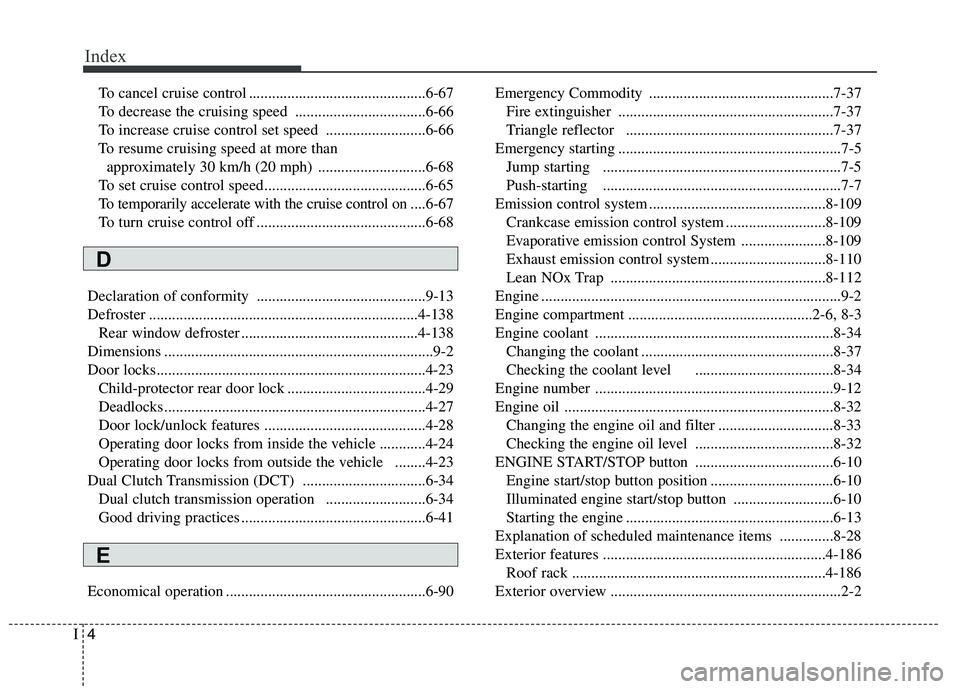
4
I
To cancel cruise control ..............................................6-67
To decrease the cruising speed ..................................6-66
To increase cruise control set speed ..........................6-66
To resume cruising speed at more than approximately 30 km/h (20 mph) ............................6-68
To set cruise control speed..........................................6-65
To temporarily accelerate with the cruise control on ....6-67
To turn cruise control off ............................................6-68
Declaration of conformity ............................................9-13
Defroster ......................................................................4-138 Rear window defroster ..............................................4-138
Dimensions ......................................................................9-2
Door locks......................................................................4-23 Child-protector rear door lock ....................................4-29
Deadlocks....................................................................4-27
Door lock/unlock features ..........................................4-28
Operating door locks from inside the vehicle ............4-24
Operating door locks from outside the vehicle ........4-23
Dual Clutch Transmission (DCT) ................................6-34 Dual clutch transmission operation ..........................6-34
Good driving practices ................................................6-41
Economical operation ....................................................6-90 Emergency Commodity ................................................7-37
Fire extinguisher ........................................................7-37
Triangle reflector ......................................................7-37
Emergency starting ..........................................................7-5 Jump starting ..............................................................7-5
Push-starting ..............................................................7-7
Emission control system ..............................................8-109 Crankcase emission control system ..........................8-109
Evaporative emission control System ......................8-109
Exhaust emission control system ..............................8-110
Lean NOx Trap ........................................................8-112
Engine ..............................................................................9-2
Engine compartment ................................................2-6, 8-3
Engine coolant ..............................................................8-34 Changing the coolant ..................................................8-37
Checking the coolant level ....................................8-34
Engine number ..............................................................9-12
Engine oil ......................................................................8-32 Changing the engine oil and filter ..............................8-33
Checking the engine oil level ....................................8-32
ENGINE START/STOP button ....................................6-10 Engine start/stop button position ................................6-10
Illuminated engine start/stop button ..........................6-10
Starting the engine ......................................................6-13
Explanation of scheduled maintenance items ..............8-28
Exterior features ..........................................................4-186 Roof rack ..................................................................4-186
Exterior overview ............................................................2-2
D
E
Page 719 of 723
I7
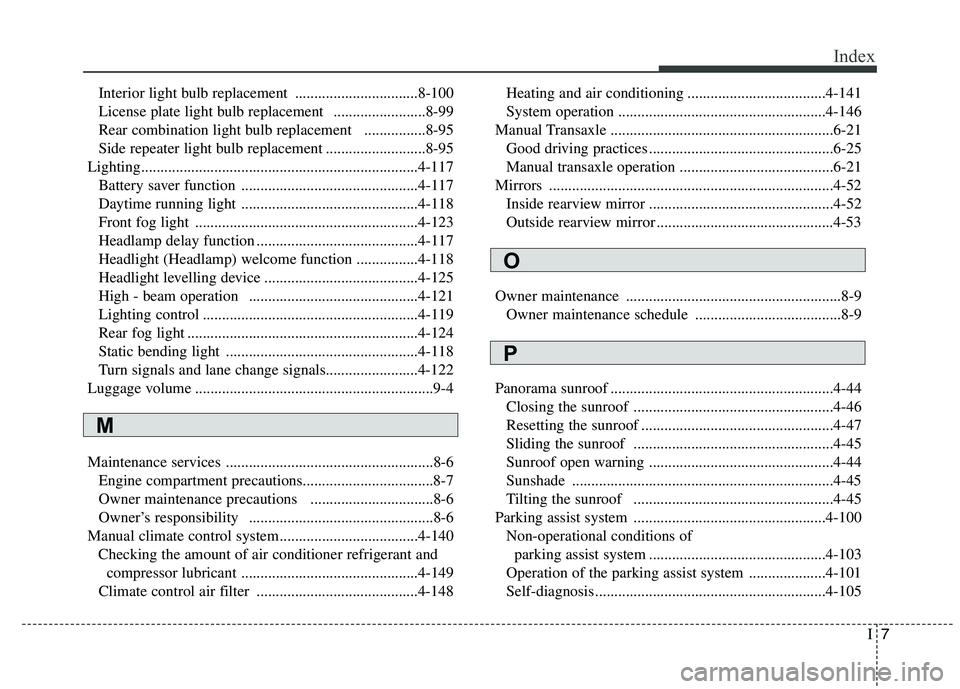
Index
Interior light bulb replacement ................................8-100
License plate light bulb replacement ........................8-99
Rear combination light bulb replacement ................8-95
Side repeater light bulb replacement ..........................8-95
Lighting........................................................................4-117 Battery saver function ..............................................4-117
Daytime running light ..............................................4-118
Front fog light ..........................................................4-123
Headlamp delay function ..........................................4-117
Headlight (Headlamp) welcome function ................4-118
Headlight levelling device ........................................4-125
High - beam operation ............................................4-121
Lighting control ........................................................4-119
Rear fog light ............................................................4-124
Static bending light ..................................................4-118
Turn signals and lane change signals........................4-122
Luggage volume ..............................................................9-4
Maintenance services ......................................................8-6 Engine compartment precautions..................................8-7
Owner maintenance precautions ................................8-6
Owner’s responsibility ................................................8-6
Manual climate control system....................................4-140 Checking the amount of air conditioner refrigerant and compressor lubricant ..............................................4-149
Climate control air filter ..........................................4-148 Heating and air conditioning ....................................4-141
System operation ......................................................4-146
Manual Transaxle ..........................................................6-21 Good driving practices ................................................6-25
Manual transaxle operation ........................................6-21
Mirrors ..........................................................................4-52 Inside rearview mirror ................................................4-52
Outside rearview mirror ..............................................4-53
Owner maintenance ........................................................8-9 Owner maintenance schedule ......................................8-9
Panorama sunroof ..........................................................4-44 Closing the sunroof ....................................................4-46
Resetting the sunroof ..................................................4-47
Sliding the sunroof ....................................................4-45
Sunroof open warning ................................................4-44
Sunshade ....................................................................4-45
Tilting the sunroof ....................................................4-45
Parking assist system ..................................................4-100 Non-operational conditions of parking assist system ..............................................4-103
Operation of the parking assist system ....................4-101
Self-diagnosis............................................................4-105
P
M
O