brake KIA CARENS RHD 2017 Owners Manual
[x] Cancel search | Manufacturer: KIA, Model Year: 2017, Model line: CARENS RHD, Model: KIA CARENS RHD 2017Pages: 723, PDF Size: 40.8 MB
Page 10 of 723
17
Introduction
Biodiesel
Commercially supplied Diesel blends of no more than 7% biodiesel, com-
monly known as "B7 Diesel" may be
used in your vehicle if Biodiesel meets
EN 14214 or equivalent specifications.
(EN stands for "European Norm"). The
use of biofuels exceeding 7% made
from rapeseed methyl ester (RME),
fatty acid methyl ester (FAME), veg-
etable oil methyl ester (VME) etc. or
mixing diesel exceeding 7% with
biodiesel will cause increased wear ordamage to the engine and fuel sys-
tem. Repair or replacement of worn ordamaged components due to the use
of non approved fuels will not be cov-
ered by the manufactures warranty.
Biodiesel (for New Zealand)
Commercially supplied Diesel blends of no more than 7% biodiesel, com-
monly known as "B7 Diesel" may be
used in your vehicle if Biodiesel
meets EN 14214 or equivalent spec-
ifications. (EN stands for "European
Norm"). The use of biofuels exceed-
ing 7%, made from rapeseed methyl
ester (RME), vegetable oil methyl
ester (VME) etc. or mixing diesel
exceeding 7% with biodiesel will
cause increased wear or damage to
the engine and fuel system. Repair
or replacement of worn or damagedcomponents due to the use of non
approved fuels will not be covered by
the manufactures warranty.No special break-in period is needed.
By following a few simple precautions
for the first 1,000 km (600 miles) you
may add to the performance, econo-
my and life of your vehicle.
Do not race the engine.
Whilst driving, keep your engine
speed (rpm, or revolutions per
minute) between 2,000 rpm and
4,000 rpm.
Do not maintain a single speed for long periods of time, either fast or
slow. Varying engine speed is need-
ed to properly break-in the engine.
Avoid hard stops, except in emer- gencies, to allow the brakes to seat
properly.
Don't tow a trailer during the first 2,000 km (1,200 miles) of operation.
CAUTION
Never use any fuel, whether
diesel, B7 biodiesel or other-wise, that fails to meet the lat-est petroleum industry speci-fication.
Never use any fuel additives or treatments that are not rec-ommended or approved by thevehicle manufacturer.
CAUTION
Never use any fuel, whether diesel or B7 biodiesel or oth-erwise, that fails to meet the latest petroleum industryspecification.
Never use any fuel additives or treatments that are not rec-ommended or approved by the vehicle manufacturer.
VEHICLE BREAK-IN PROCESS
Page 16 of 723
Your vehicle at a glance
6
2
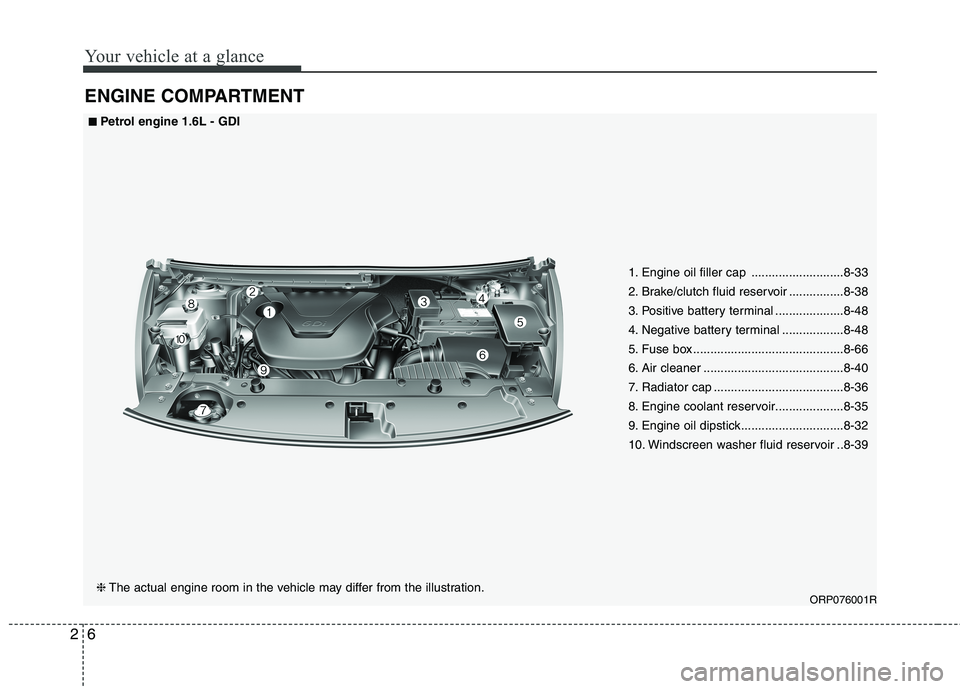
ENGINE COMPARTMENT
ORP076001R
■■
Petrol engine 1.6L - GDI
❈ The actual engine room in the vehicle may differ from the illustration. 1. Engine oil filler cap ...........................8-33
2. Brake/clutch fluid reservoir ................8-38
3. Positive battery terminal ....................8-48
4. Negative battery terminal ..................8-48
5. Fuse box ............................................8-66
6. Air cleaner .........................................8-40
7. Radiator cap ......................................8-36
8. Engine coolant reservoir....................8-35
9. Engine oil dipstick..............................8-32
10. Windscreen washer fluid reservoir ..8-39
Page 17 of 723
27
Your vehicle at a glance
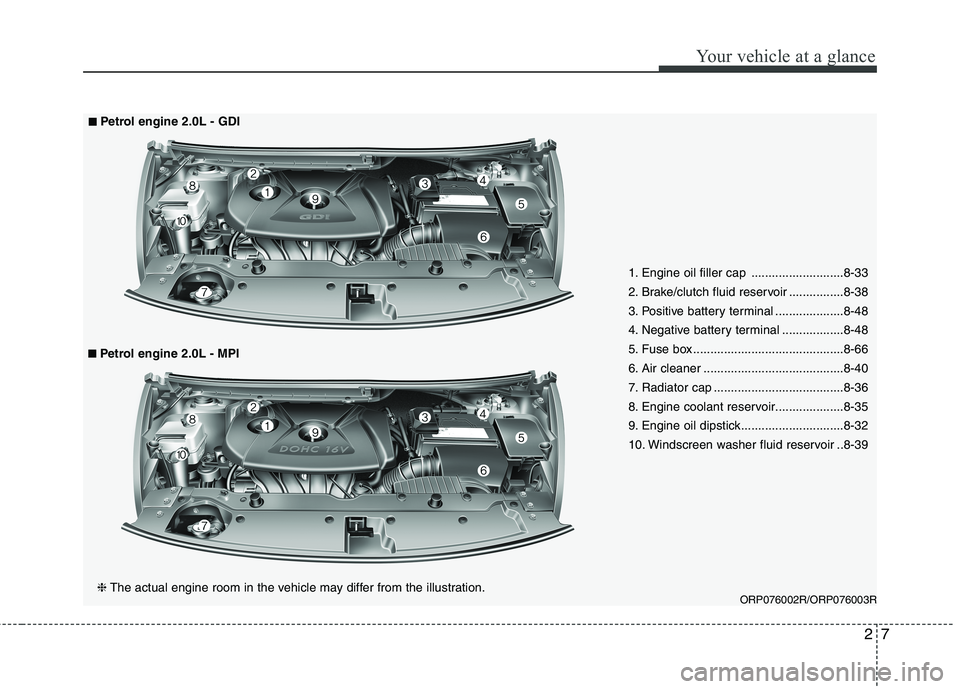
1. Engine oil filler cap ...........................8-33
2. Brake/clutch fluid reservoir ................8-38
3. Positive battery terminal ....................8-48
4. Negative battery terminal ..................8-48
5. Fuse box ............................................8-66
6. Air cleaner .........................................8-40
7. Radiator cap ......................................8-36
8. Engine coolant reservoir....................8-35
9. Engine oil dipstick..............................8-32
10. Windscreen washer fluid reservoir ..8-39ORP076002R/ORP076003R
■■Petrol engine 2.0L - MPI
❈ The actual engine room in the vehicle may differ from the illustration.
■■
Petrol engine 2.0L - GDI
Page 18 of 723
Your vehicle at a glance
8
2
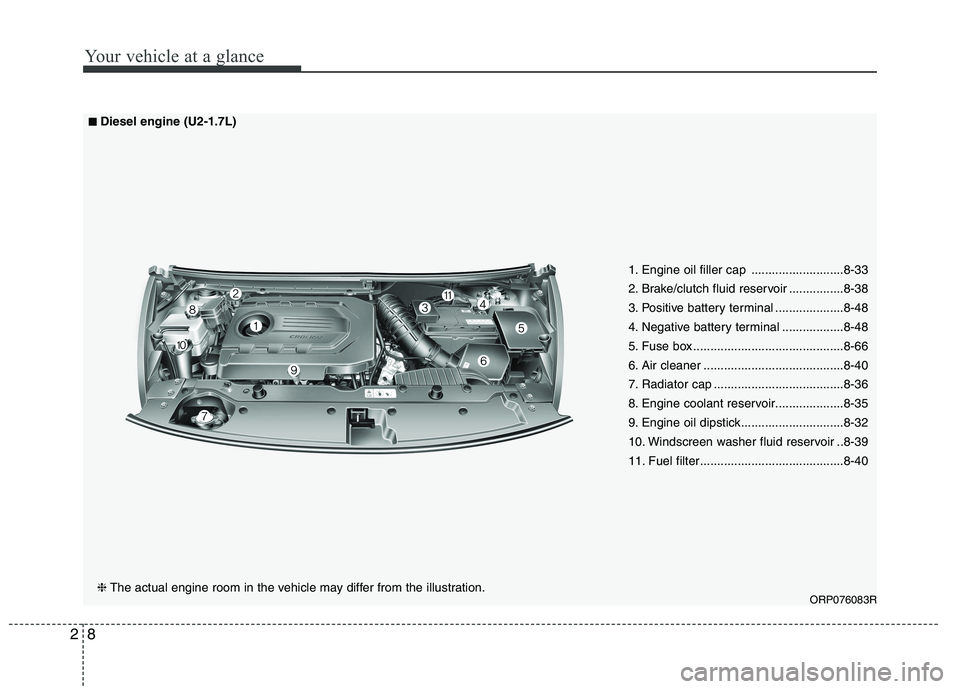
1. Engine oil filler cap ...........................8-33
2. Brake/clutch fluid reservoir ................8-38
3. Positive battery terminal ....................8-48
4. Negative battery terminal ..................8-48
5. Fuse box ............................................8-66
6. Air cleaner .........................................8-40
7. Radiator cap ......................................8-36
8. Engine coolant reservoir....................8-35
9. Engine oil dipstick..............................8-32
10. Windscreen washer fluid reservoir ..8-39
11. Fuel filter..........................................8-40
ORP076083R
❈
The actual engine room in the vehicle may differ from the illustration.
■■
Diesel engine (U2-1.7L)
Page 37 of 723
319
Safety features of your vehicle
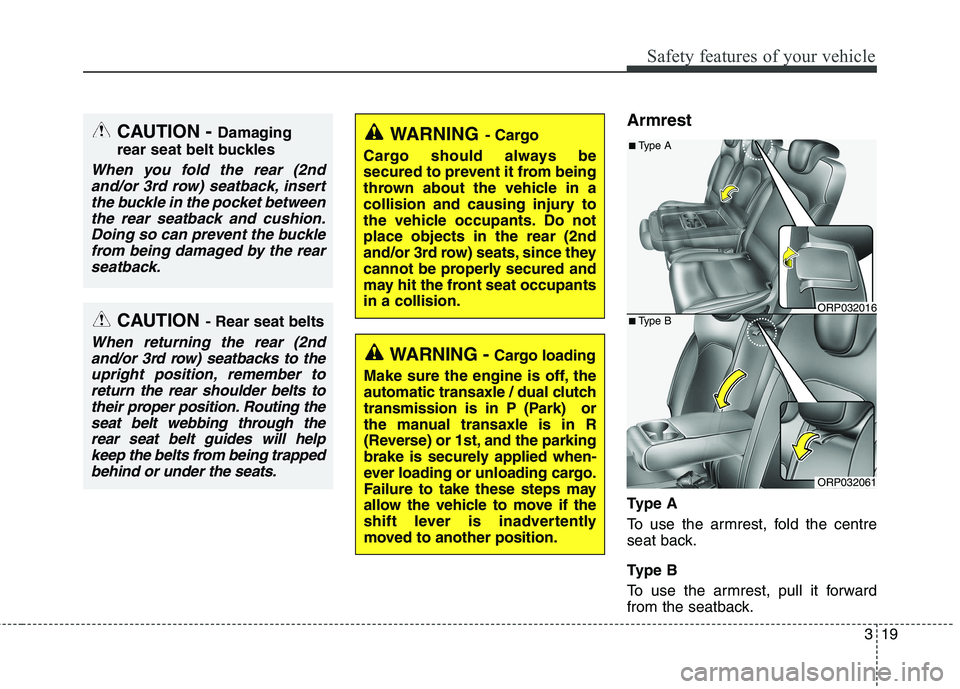
Armrest
Ty p e A
To use the armrest, fold the centre
seat back.
Ty p e B
To use the armrest, pull it forward
from the seatback.
CAUTION- Rear seat belts
When returning the rear (2nd
and/or 3rd row) seatbacks to theupright position, remember to return the rear shoulder belts totheir proper position. Routing theseat belt webbing through the rear seat belt guides will helpkeep the belts from being trappedbehind or under the seats.
CAUTION - Damaging
rear seat belt buckles
When you fold the rear (2nd and/or 3rd row) seatback, insertthe buckle in the pocket between the rear seatback and cushion.Doing so can prevent the bucklefrom being damaged by the rear seatback.
WARNING - Cargo
Cargo should always be
secured to prevent it from being
thrown about the vehicle in a
collision and causing injury to
the vehicle occupants. Do notplace objects in the rear (2nd
and/or 3rd row) seats, since they
cannot be properly secured and
may hit the front seat occupantsin a collision.
WARNING - Cargo loading
Make sure the engine is off, the
automatic transaxle / dual clutch
transmission is in P (Park) or
the manual transaxle is in R
(Reverse) or 1st, and the parking
brake is securely applied when-
ever loading or unloading cargo.
Failure to take these steps may
allow the vehicle to move if the
shift lever is inadvertently
moved to another position.
ORP032061
ORP032016
■ Type A
■Type B
Page 93 of 723

375
Safety features of your vehicle
Just before impact, drivers oftenbrake heavily Such heavy braking
lowers the front portion of the vehi-
cle causing it to “ride” under a vehi-
cle with a higher ground clearance.
Air bags may not inflate in this
"under-ride" situation because
deceleration forces that are detect-
ed by sensors may be significantly
replaced by such “under-ride” colli-
sions. Air bags may not inflate in rollover
accidents because the vehicle can
not detect rollover accident.
However, side and/or curtain air
bags may inflate when the vehicle
is rolled over following (or after)side impact collision. Air bags may not inflate if the vehi-
cle collides with objects such as util-
ity poles or trees, where the point of
impact is concentrated to one area
and the full force of the impact is not
delivered to the sensors.
OED036103OED0361041VQA2092
Page 123 of 723
427
Features of your vehicle
Deadlocks (if equipped)
Some vehicles are equipped with a
deadlock system. Deadlocks preventopening of a door from either inside
or outside the vehicle once the dead-
locks have been activated providing
an additional measure of vehicle
security.
To lock the vehicle using the deadlock
function, the doors must be locked by
using the transmitter or smart key. To
unlock the vehicle, the transmitter or
smart key must be used again.WARNING- Unlocked
vehicles
Leaving your vehicle unlocked
can invite theft or possible harm
to you or others from someone
hiding in your vehicle whilst you
are gone. Always remove the
ignition key, engage the parking
brake, close all windows and
lock all doors when leaving your
vehicle unattended.WARNING - Unattended
children
An enclosed vehicle can
become extremely hot, causing
death or severe injury to unat-
tended children or animals who
cannot escape the vehicle.
Furthermore, children might
operate features of the vehicle
that could injure them, or theycould encounter other harm,
possibly from someone gaining
entry to the vehicle. Never leave
children or animals unattended
in your vehicle.
WARNING
Do not lock the doors with the
transmitter or the smart key
with anybody left in the vehicle.
The passenger in the vehicle
cannot unlock the doors with
the door lock button. For exam-
ple, if the door is locked with
the transmitter, the passenger
in the vehicle cannot unlock the
door without the transmitter.
Page 134 of 723
Features of your vehicle
38
4
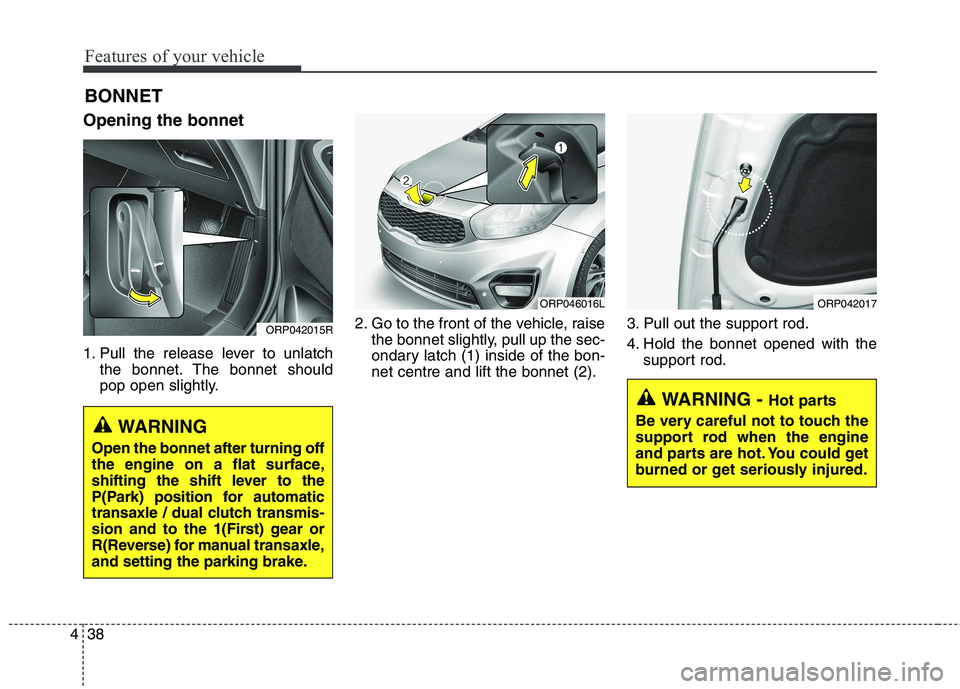
Opening the bonnet
1. Pull the release lever to unlatch
the bonnet. The bonnet should
pop open slightly. 2. Go to the front of the vehicle, raise
the bonnet slightly, pull up the sec-
ondary latch (1) inside of the bon-net centre and lift the bonnet (2). 3. Pull out the support rod.
4. Hold the bonnet opened with the
support rod.
BONNET
ORP042015R
WARNING
Open the bonnet after turning off
the engine on a flat surface,
shifting the shift lever to the
P(Park) position for automatic
transaxle / dual clutch transmis-
sion and to the 1(First) gear or
R(Reverse) for manual transaxle,
and setting the parking brake.
WARNING - Hot parts
Be very careful not to touch the
support rod when the engine
and parts are hot. You could get
burned or get seriously injured.
ORP046016LORP042017
Page 168 of 723
Features of your vehicle
72
4
Warning Messages (if equipped)
Shift to "P" position (for smart key
system and automatic transaxle / dual clutch transmission)
This warning message illuminates if you try to turn off the engine without
the shift lever in P (Park) position.
At this time, the Engine Start/Stop Button turns to the ACC position (If
you press the Engine Start/Stop
Button once more, it will turn to theON position).
Low Key Battery
(for smart key system)
This warning message illuminates if the battery of the smart key is discharged when the Engine
Start/Stop Button changes to theOFF position.
Press start button whilst turn
steering (for smart key system)
This warning message illuminates if the steering wheel does not
unlock normally when the Engine
Start/Stop Button is pressed.
It means that you should press the Engine Start/Stop Button whilst
turning the steering wheel rightand left.
Steering wheel unlocked
(for smart key system)
This warning message illuminates if the steering wheel does not lock
when the Engine Start/Stop Buttonchanges to the OFF position.
Check steering wheel lock
system (for smart key system)
This warning message illuminates if the steering wheel does not lock
normally when the Engine
Start/Stop Button changes to theOFF position.
Press brake pedal to start engine
(for smart key system and auto- matic transaxle / dual clutchtransmission)
This warning message illuminates if the Engine Start/Stop Button
changes to the ACC position twice
by pressing the button repeatedly
without depressing the brake pedal.
It means that you should depress the brake pedal to start the engine.
Page 169 of 723
473
Features of your vehicle
Press clutch pedal to start engine(for smart key system and manual transaxle)
This warning message illuminates if the Engine Start/Stop Button
changes to the ACC position twice
by pressing the button repeatedlywithout depressing the clutch pedal.
It means that you should depress the clutch pedal to start the engine.
Key not in vehicle
(for smart key system)
This warning message illuminates if the smart key is not in the vehicle
when you press the Engine
Start/Stop Button.
It means that you should always have the smart key with you.
Key not detected
(for smart key system)
This warning message illuminates if the smart key is not detected
when you press the Engine
Start/Stop Button.
Press start button again
(for smart key system)
This warning message illuminates if you can not operate the Engine
Start/Stop Button when there is a
problem with the Engine Start/StopButton system.
It means that you could start the engine by pressing the Engine
Start/ Stop Button once more.
If the warning illuminates each time you press the Engine
Start/Stop Button, we recommend
that you have the vehicle inspected
by an authorised Kia dealer.
Press start button with smart key
(for smart key system)
This warning message illuminates if you press the Engine Start/Stop
Button whilst the warning message
“Key not detected” is illuminating.
At this time, the immobiliser indica- tor light blinks.
Check fuse "Brake Switch"
(for smart key system and automatic transaxle / dual clutchtransmission)
This warning message illuminates if the brake switch fuse is discon- nected.
It means that you should replace the fuse with a new one. If that is
not possible, you can start the
engine by pressing the Engine
Start/Stop Button for 10 seconds in
the ACC position.