check oil KIA CARENS RHD 2017 Owners Manual
[x] Cancel search | Manufacturer: KIA, Model Year: 2017, Model line: CARENS RHD, Model: KIA CARENS RHD 2017Pages: 723, PDF Size: 40.8 MB
Page 183 of 723
487
Features of your vehicle
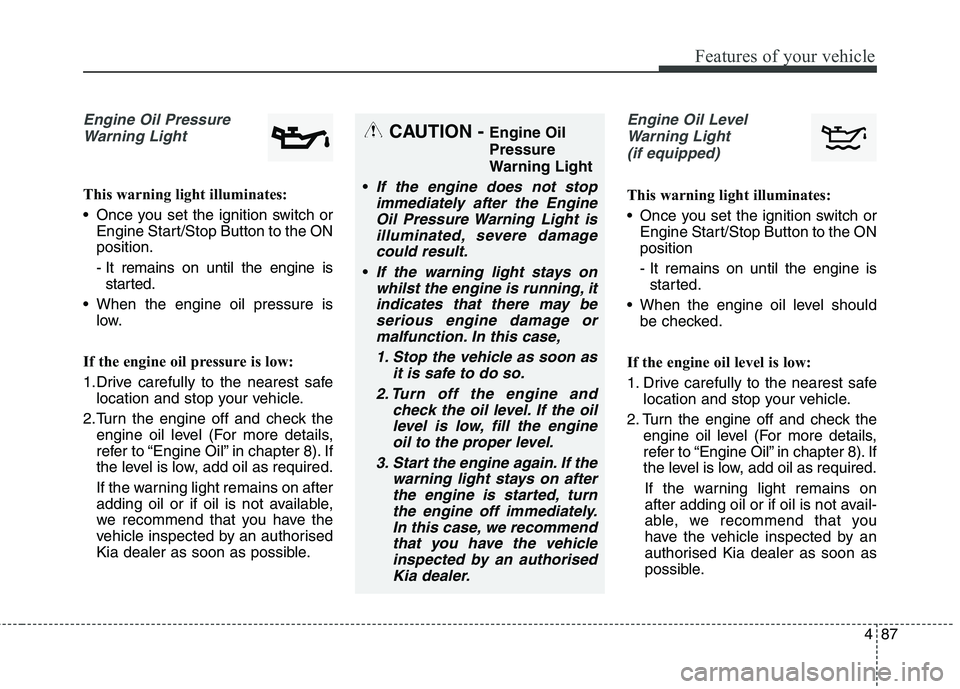
Engine Oil PressureWarning Light
This warning light illuminates:
Once you set the ignition switch or Engine Start/Stop Button to the ON position.
- It remains on until the engine isstarted.
When the engine oil pressure is low.
If the engine oil pressure is low:
1.Drive carefully to the nearest safe location and stop your vehicle.
2.Turn the engine off and check the engine oil level (For more details,
refer to “Engine Oil” in chapter 8). If
the level is low, add oil as required.
If the warning light remains on after
adding oil or if oil is not available,
we recommend that you have the
vehicle inspected by an authorised
Kia dealer as soon as possible.
Engine Oil Level
Warning Light (if equipped)
This warning light illuminates:
Once you set the ignition switch or Engine Start/Stop Button to the ON position
- It remains on until the engine isstarted.
When the engine oil level should be checked.
If the engine oil level is low:
1. Drive carefully to the nearest safe location and stop your vehicle.
2. Turn the engine off and check the engine oil level (For more details,
refer to “Engine Oil” in chapter 8). If
the level is low, add oil as required.
If the warning light remains on
after adding oil or if oil is not avail-
able, we recommend that you
have the vehicle inspected by an
authorised Kia dealer as soon as
possible.
CAUTION - Engine Oil Pressure
Warning Light
If the engine does not stop immediately after the Engine Oil Pressure Warning Light isilluminated, severe damagecould result.
If the warning light stays onwhilst the engine is running, it indicates that there may beserious engine damage ormalfunction. In this case,
1. Stop the vehicle as soon as it is safe to do so.
2. Turn off the engine and check the oil level. If the oillevel is low, fill the engine oil to the proper level.
3. Start the engine again. If the warning light stays on afterthe engine is started, turnthe engine off immediately. In this case, we recommendthat you have the vehicleinspected by an authorised Kia dealer.
Page 226 of 723
Features of your vehicle
130
4
When there is a problem with the
motor to operate the wiper blades,
the wiper blades will stop and acti-
vate the Fail Safety Function in the
ignition switch ON position or whilst
driving. Fail Safety Function will
operate as follows:
- HI or Mode 2 (5 minutes) LO or
Mode 1 (5 minutes) INT or Mode
--- (5 minutes) OFF or O (Stop) In a rainy day if the windscreen glass
gets dry when driving through a long
tunnel, the wiping velocity mayreduce to protect the motor and
blade. It will return to its normal state,after passing through the tunnel.
In case of overload the wiper motor that the function adjusts speed auto-
matically in vehicle. This feature pre-
vents damage to the wiper motor and
blade. In case of removal overload
conditions, it will return to its normal
position. By the pressure of the wind
at high speed wiper blades can be
moved upwards. This prevents dam-
age due to wiper motor overload bythe pressure of the wind.
Operating the wiper blade and wiper
switch operates normally, it will
return to its normal position.CAUTION
If wipers do not return to normal
position, you should remove thewax, water repellent, oil and other debris into S and then checkwiper operation again.
CAUTION
After remove the overload con-dition, if the problem of wiperblades or operating the motor remains, we recommend thatthe system be checked by anauthorised Kia dealer.
❈
❈ Overload condition
- In a rainy day when driving through a long tunnel
- When wax car wash
- Water-repellent coating (coated glass)
- Cleaning the windscreen cleaners
- Excessive blade wear etc.
Page 245 of 723
4149
Features of your vehicle
Checking the amount of air
conditioner refrigerant andcompressor lubricant
When the amount of refrigerant is
low, the performance of the air condi-
tioning is reduced. Overfilling alsohas a bad influence on the air condi-tioning system.
Therefore, if abnormal operation is
found, we recommend that the system
be inspected by an authorised Kia
dealer.*: Your vehicle is filled with R-134a orR-1234yf according to the regula-
tion in your country at the time of
producing. You can find out which
air conditioning refrigerant is
applied your vehicle at the label
inside of bonnet. Refer to chapter 9
for more detail location of air con-
ditioning refrigerant label.WARNING - Vehicles
equipped with R-1234yf*
Because the refriger-
ant is mildly inflam-
mable and at very
high pressure, the air
conditioning system
should only be serv-
iced by trained and
certified technicians.
It is important that the
correct type and amount of oil
and refrigerant is used.
Otherwise, it may cause damage
to the vehicle and personal
injury.
WARNING - Vehicles
equipped with R-134a*
Because the refriger-
ant is at very high
pressure, the air con-ditioning system
should only be serv-
iced by trained and certified
technicians. It is important thatthe correct type and amount of
oil and refrigerant is used.
Otherwise, it may cause dam-
age to the vehicle and personal
injury.
Page 258 of 723
Features of your vehicle
162
4
✽✽
NOTICE
Replace the filter according to the Maintenance Schedule.
If the vehicle is being driven in
severe conditions such as dusty,
rough roads, more frequent cli-
mate control air filter inspections
and changes are required.
When the air flow rate suddenly decreases, we recommend that the
system be checked by an autho-
rised Kia dealer.Checking the amount of air
conditioner refrigerant andcompressor lubricant
When the amount of refrigerant is
low, the performance of the air condi-
tioning is reduced. Overfilling alsohas a bad influence on the air condi-tioning system.
Therefore, if abnormal operation is
found, we recommend that the sys-
tem be inspected by an authorised
Kia dealer.
*: Your vehicle is filled with R-134a orR-1234yf according to the regula-
tion in your country at the time of
producing. You can find out which
air conditioning refrigerant is
applied your vehicle at the label
inside of bonnet. Refer to chapter 9
for more detail location of air con-
ditioning refrigerant label.
WARNING - Vehicles
equipped with R-134a*
Because the refriger-
ant is at very high
pressure, the air con-ditioning system
should only be serv-
iced by trained and certified
technicians. It is important thatthe correct type and amount of
oil and refrigerant is used.
Otherwise, it may cause dam-
age to the vehicle and personal
injury.
WARNING - Vehicles
equipped with R-1234yf*
Because the refriger-
ant is mildly inflam-
mable and at very
high pressure, the air
conditioning system
should only be serv-
iced by trained and
certified technicians.
It is important that the
correct type and amount of oil
and refrigerant is used.
Otherwise, it may cause damage
to the vehicle and personal
injury.
Page 438 of 723
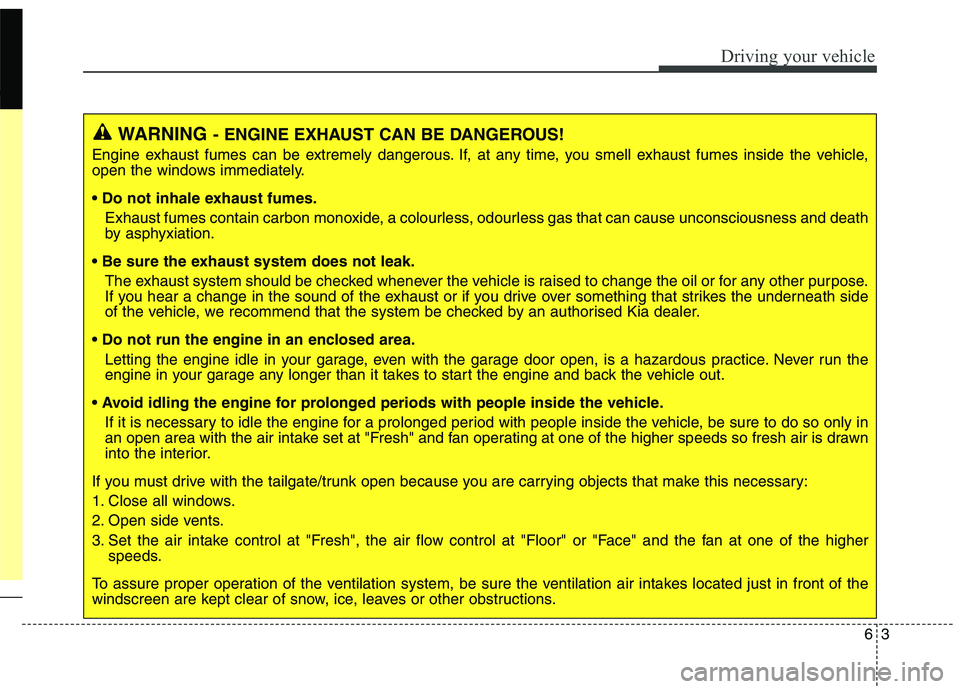
63
Driving your vehicle
WARNING- ENGINE EXHAUST CAN BE DANGEROUS!
Engine exhaust fumes can be extremely dangerous. If, at any time, you smell exhaust fumes inside the vehicle,
open the windows immediately.
• Do not inhale exhaust fumes.
Exhaust fumes contain carbon monoxide, a colourless, odourless gas that can cause unconsciousness and death
by asphyxiation.
The exhaust system should be checked whenever the vehicle is raised to change the oil or for any other purpose.
If you hear a change in the sound of the exhaust or if you drive over something that strikes the underneath side
of the vehicle, we recommend that the system be checked by an authorised Kia dealer.
Letting the engine idle in your garage, even with the garage door open, is a hazardous practice. Never run the
engine in your garage any longer than it takes to start the engine and back the vehicle out.
If it is necessary to idle the engine for a prolonged period with people inside the vehicle, be sure to do so only in
an open area with the air intake set at "Fresh" and fan operating at one of the higher speeds so fresh air is drawn
into the interior.
If you must drive with the tailgate/trunk open because you are carrying objects that make this necessary:
1. Close all windows.
2. Open side vents.
3. Set the air intake control at "Fresh", the air flow control at "Floor" or "Face" and the fan at one of the higher speeds.
To assure proper operation of the ventilation system, be sure the ventilation air intakes located just in front of the
windscreen are kept clear of snow, ice, leaves or other obstructions.
Page 439 of 723
Driving your vehicle
4
6
Before entering vehicle
• Be sure that all windows, outside
mirror(s), and outside lights are clean.
Check the condition of the tyres.
Check under the vehicle for any sign of leaks.
Be sure there are no obstacles behind you if you intend to back up. Necessary inspections
Fluid levels, such as engine oil,
engine coolant, brake fluid, and
washer fluid should be checked on a
regular basis, with the exact interval
depending on the fluid. Further
details are provided in chapter 8,“Maintenance”.
Before starting
Close and lock all doors.
Position the seat so that all con-
trols are easily reached.
Adjust the inside and outside rearview mirrors.
Be sure that all lights work.
Check all gauges.
Check the operation of warning lights when the ignition switch is
turned to the ON position.
Release the parking brake and make sure the brake warning lightgoes out.
For safe operation, be sure you are
familiar with your vehicle and itsequipment.
BEFORE DRIVING
WARNING
Driving whilst distracted can
result in a loss of vehicle con-
trol, that may lead to an acci-
dent, severe personal injury,
and death. The driver’s primary
responsibility is in the safe and
legal operation of a vehicle, and
use of any handheld devices,
other equipment, or vehicle sys-
tems which take the driver’s
eyes, attention and focus away
from the safe operation of a
vehicle or which are not permis-
sible by law should never beused during operation of the
vehicle.
Page 530 of 723
695
Driving your vehicle
Highway driving
Tyres
Adjust the tyre inflation pressures to
specification. Low tyre inflation pres-
sures will result in overheating and
possible failure of the tyres.
Avoid using worn or damaged tyres
which may result in reduced traction
or tyre failure.
✽✽NOTICE
Never exceed the maximum tyre
inflation pressure shown on the
tyres.
Fuel, engine coolant and engine oil
High speed travel consumes more
fuel than urban motoring. Do not for-
get to check both engine coolant andengine oil.
Drive belt
A loose or damaged drive belt may
result in overheating of the engine.
WARNING
Underinflated or overinflated tyres can cause poor han-
dling, loss of vehicle control,
and sudden tyre failure lead-
ing to accidents, injuries, and
even death. Always check the
tyres for proper inflation
before driving. For proper tyre
pressures, refer to chapter 9,
“Tyres and wheels”.
Driving on tyres with no or insufficient tread is danger-
ous. Worn-out tyres can
result in loss of vehicle con-
trol, collisions, injury, and
even death. Worn-out tyresshould be replaced as soon
as possible and should never
be used for driving. Always
check the tyre tread before
driving your vehicle. For fur-
ther information and tread
limits, refer to chapter 8,
“Tyres and wheels”.
Page 533 of 723
Driving your vehicle
98
6
Use high quality ethylene gly- col coolant
Your vehicle is delivered with high
quality ethylene glycol coolant in the
cooling system. It is the only type ofcoolant that should be used because
it helps prevent corrosion in the cool-
ing system, lubricates the water
pump and prevents freezing. Be sure
to replace or replenish your coolantin accordance with the maintenance
schedule. Before winter, have yourcoolant tested to assure that its
freezing point is sufficient for the
temperatures anticipated during the
winter.
Check battery and cables
Winter puts additional burdens on
the battery system. Visually inspect
the battery and cables as described
in chapter 8. We recommend that the
system be checked by an authorised
Kia dealer. Change to "winter weight" oil
if necessary In some climates it is recommended
that a lower viscosity "winter weight"
oil be used during cold weather. See
chapter 9 for recommendations. If
you aren't sure what weight oil you
should use, we recommend that you
consult an authorised Kia dealer.
Check spark plugs and igni- tion system
Inspect your spark plugs as
described in chapter 8 and replace
them if necessary. Also check all
ignition wiring and components to be
sure they are not cracked, worn or
damaged in any way.
CAUTION
Chains that are the wrong size
or improperly installed candamage your vehicle's brakelines, suspension, body andwheels.
Stop driving and retighten the chains any time you hear themhitting the vehicle.
WARNING - Tyre chains
The use of chains may adversely affect vehicle han- dling.
Do not exceed 30 km/h (20 mph) or the chain manufactur-
er’s recommended speed
limit, whichever is lower.
Drive carefully and avoid bumps, holes, sharp turns,
and other road hazards, which
may cause the vehicle to
bounce.
Avoid sharp turns or locked- wheel braking.
Page 542 of 723
6107
Driving your vehicle
When you are ready to leave after
parking on a hill
1.With the manual transaxle inNeutral or automatic transaxle /
dual clutch transmission in P
(Park), apply your brakes and hold
the brake pedal down whilst you:
and
2.Slowly remove your foot from the brake pedal.
3.Drive slowly until the trailer is clear of the chocks.
4.Stop and have someone pick up and store the chocks. Maintenance when trailer tow- ing
Your vehicle will need service more
often when you regularly pull a trail-
er. Important items to pay particularattention to include engine oil,
transaxle fluid, axle lubricant and
cooling system fluid. Brake condition
is another important item to frequent-
ly check. Each item is covered in this
manual, and the Index will help you
find them quickly. If you’re trailering, it
is a good idea to review these sec-
tions before you start your trip.
Do not forget to also maintain your
trailer and hitch. Follow the mainte-nance schedule that accompanied
your trailer and check it periodically.
Preferably, conduct the check at the
start of each day’s driving. Most
importantly, all hitch nuts and boltsshould be tight.CAUTION
Due to higher load during
trailer usage, overheatingmight occur in hot days or during uphill driving. If thecoolant gauge indicates over-heating, switch off the air con- ditioner and stop the vehiclein a safe area to cool down theengine.
When towing check transaxle fluid more frequently.
If your vehicle is not equipped with an air conditioner, youshould install a condenser fanto improve engine perform-ance when towing a trailer.
Page 554 of 723
What to do in an emergency
4
7
IF THE ENGINE DOES NOT START
If engine doesn't turn over or
turns over slowly
1.If your vehicle has an automatic transaxle / dual clutch transmis-
sion, be sure the shift lever is in N
(Neutral) or P (Park) and the emer-
gency brake is set.
2.Check the battery connections to be sure they are clean and tight.
3.Turn on the interior light. If the light dims or goes out when you operate
the starter, the battery is discharged.
4.Check the starter connections to be sure they are securely tightened.
5.Do not push or pull the vehicle to start it. See instructions for "Jump
starting". If engine turns over normally
but does not start
1.Check fuel level.
2.With the ignition switch in the
LOCK/ OFF position, check all connectors at ignition, coil and
spark plugs. Reconnect any that
may be disconnected or loose.
3.Check the fuel line in the engine compartment.
4.If the engine still does not start, we recommend that you call an autho-
rised Kia dealer.
WARNING
If the engine does not start, do
not push or pull the vehicle to
start it. This could result in a col-
lision or cause other damage. In
addition, push or pull starting
may cause the catalytic convert-
er (if equipped) to be overloaded
and create a fire hazard.