deactivate KIA CARENS RHD 2017 Owners Manual
[x] Cancel search | Manufacturer: KIA, Model Year: 2017, Model line: CARENS RHD, Model: KIA CARENS RHD 2017Pages: 723, PDF Size: 40.8 MB
Page 57 of 723
339
Safety features of your vehicle
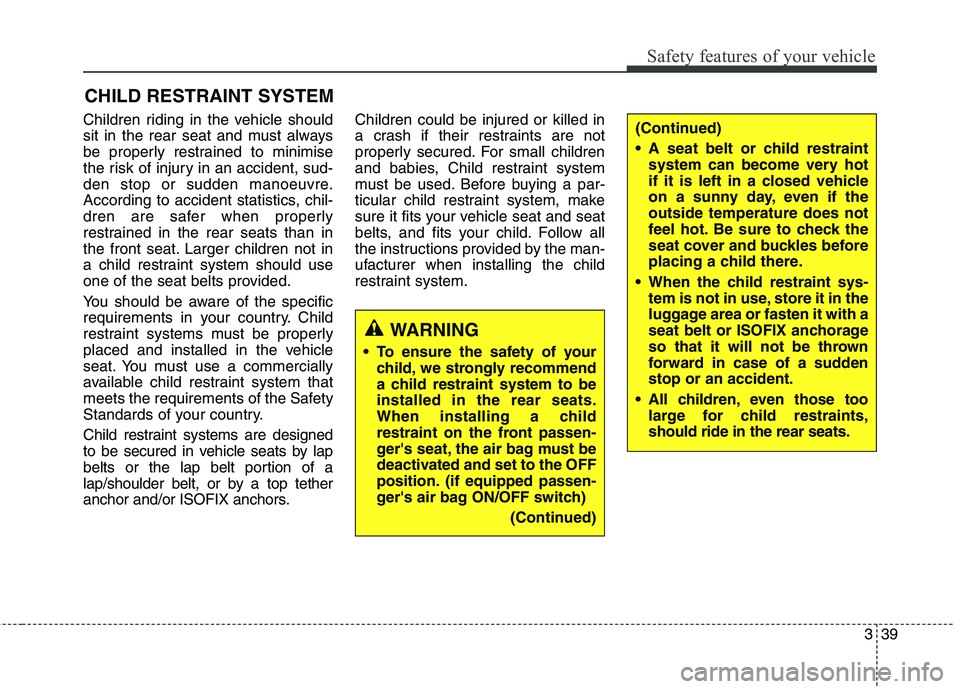
CHILD RESTRAINT SYSTEM
Children riding in the vehicle should
sit in the rear seat and must always
be properly restrained to minimise
the risk of injury in an accident, sud-
den stop or sudden manoeuvre.
According to accident statistics, chil-
dren are safer when properly
restrained in the rear seats than in
the front seat. Larger children not in
a child restraint system should use
one of the seat belts provided.
You should be aware of the specific
requirements in your country. Child
restraint systems must be properly
placed and installed in the vehicle
seat. You must use a commercially
available child restraint system that
meets the requirements of the Safety
Standards of your country.
Child restraint systems are designed
to be secured in vehicle seats by lap
belts or the lap belt portion of a
lap/shoulder belt, or by a top tether
anchor and/or ISOFIX anchors. Children could be injured or killed in
a crash if their restraints are not
properly secured. For small children
and babies, Child restraint system
must be used. Before buying a par-
ticular child restraint system, make
sure it fits your vehicle seat and seat
belts, and fits your child. Follow all
the instructions provided by the man-
ufacturer when installing the child
restraint system.
WARNING
To ensure the safety of your child, we strongly recommend
a child restraint system to beinstalled in the rear seats.
When installing a child
restraint on the front passen-
ger's seat, the air bag must be
deactivated and set to the OFF
position. (if equipped passen-
ger's air bag ON/OFF switch)
(Continued)
(Continued)
A seat belt or child restraintsystem can become very hot
if it is left in a closed vehicle
on a sunny day, even if theoutside temperature does not
feel hot. Be sure to check the
seat cover and buckles before
placing a child there.
When the child restraint sys- tem is not in use, store it in the
luggage area or fasten it with a
seat belt or ISOFIX anchorage
so that it will not be thrown
forward in case of a suddenstop or an accident.
All children, even those too large for child restraints,should ride in the rear seats.
Page 59 of 723

341
Safety features of your vehicle
Using a child restraint system
For small children and babies, the use
of a child restraint system is required.
The child restraint system should be
of appropriate size for the child andshould be installed in accordance with
the manufacturer's instructions.For safety reasons, we recommend
the child restraint system to be used
in the rear seats.
CRS09
OJD032027
Rearward-facing child restraint system
Forward-facing child restraint system
WARNING
Always remove floor under tray
cover when using a child
restraint seat with support leg
on second row outboard seat-ing position.
Support leg should have to con-
tact stably on the vehicle floor.
ORP042172
WARNING
Never place a rearward facing
child restraint system in the
front passenger seat, unless the
passenger frontal air bag is
deactivated. An inflating pas-
senger-side air bag could
impact the rear-facing child
restraint and kill the child.
Page 62 of 723
Safety features of your vehicle
44
3
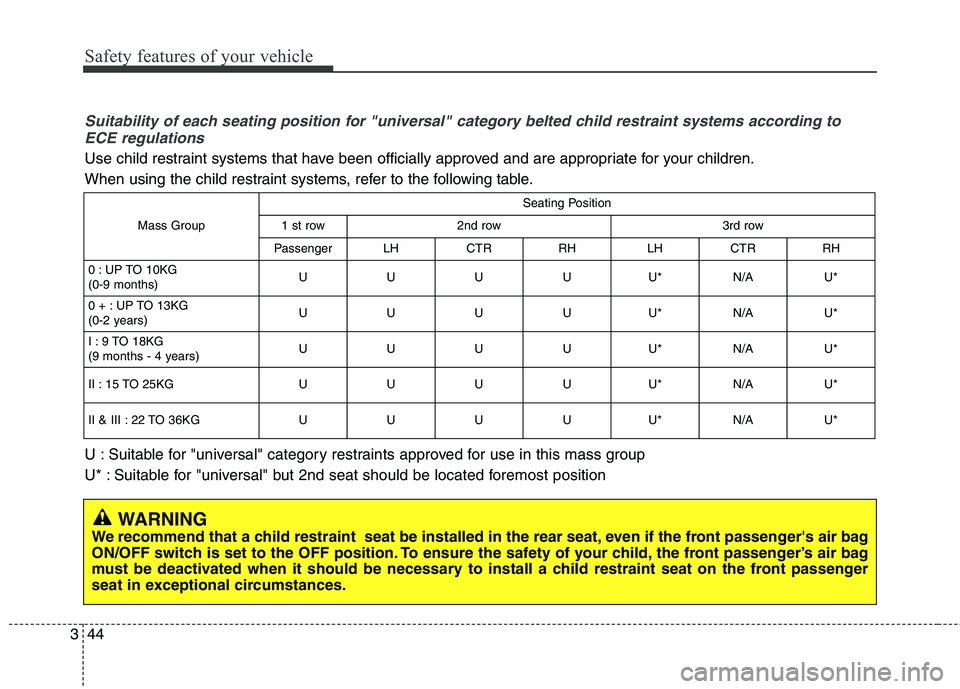
Suitability of each seating position for "universal" category belted child restraint systems according to
ECE regulations
Use child restraint systems that have been officially approved and are appropriate for your children.
When using the child restraint systems, refer to the following table.
Mass Group
Seating Position
1 st row2nd row3rd row
PassengerLHCTRRHLHCTRRH
0 : UP TO 10KG (0-9 months)UUUUU*N/AU*
0 + : UP TO 13KG
(0-2 years)UUUUU*N/AU*
I : 9 TO 18KG
(9 months - 4 years)UUUUU*N/AU*
II : 15 TO 25KGUUUUU*N/AU*
II & III : 22 TO 36KGUUUUU*N/AU*
WARNING
We recommend that a child restraint seat be installed in the rear seat, even if the front passenger's air bag
ON/OFF switch is set to the OFF position. To ensure the safety of your child, the front passenger’s air bag
must be deactivated when it should be necessary to install a child restraint seat on the front passenger
seat in exceptional circumstances.
U : Suitable for "universal" category restraints approved for use in this mass group
U* : Suitable for "universal" but 2nd seat should be located foremost position
Page 74 of 723

Safety features of your vehicle
56
3
Front passenger's air bag warn-
ing label for child seatIn addition, we recommend that you
do not place front-facing child
restraints in the front passenger’s
seat either. If the front passenger air
bag inflates, it could cause serious or
fatal injuries to the child.
If your vehicle is equipped with the
passenger’s front air bag ON/OFF
switch, you can activate or deactivate
the front passenger’s air bag when
necessary.
For more details, please refer to
"Passenger’s front air bag ON/OFF
switch" in this chapter. (if equipped)
OYDESA2042
OJD032059
■ Type A
■ Type B
WARNING
Never place a rear facing child
restraint in the front passenger
seat, unless the passenger-side
air bag is deactivated. An inflat-
ing passenger-side air bag
could impact the rear-facing
child restraint and kill the child.
Page 82 of 723

Safety features of your vehicle
64
3
Passenger’s front air bag ON/OFF
switch (if equipped)
The passenger’s front air bag can be
deactivated by the passenger’s front
air bag ON/OFF switch if a child
restraint is installed on the front pas-senger's seat or if the front passen-
ger's seat is unoccupied by a person.
To ensure the safety of your child,
the passenger’s front air bag must be
deactivated when it should be neces-
sary to install a rearward facing childseat on the front passenger seat in
exceptional circumstances.
(Continued)
Children age 12 and under must always be properly restrained in the rear seat.
Never allow children to ride in
the front passenger seat. If a
child over 12 must be seated
in the front seat, he or she
must be properly belted and
the seat should be moved as
far back as possible.
For maximum safety protec- tion in all types of crashes, all
occupants including the driver
should always wear their seat
belts whether or not an air bag
is also provided at their seat-ing position to minimise the
risk of severe injury or death
in the event of a crash. Do not
sit or lean unnecessarily close
to the air bag whilst the vehi-
cle is in motion.
(Continued)(Continued)
Sitting improperly or out ofposition can result in serious
or fatal injury in a crash. Alloccupants should sit upright
with the seat back in an upright
position, centred on the seatcushion with their seat belt on,
legs comfortably extended and
their feet on the floor until the
vehicle is parked and the igni-
tion key is removed.
The SRS air bag system must deploy very rapidly to provide
protection in a crash. If anoccupant is out of positionbecause of not wearing a seat
belt, the air bag may forcefullycontact the occupant causingserious or fatal injuries.
ORP032057R
Page 83 of 723

365
Safety features of your vehicle
❈The actual indicator in the vehicle may differ
from the illustration.
To deactivate or reactivate the passen-
ger’s front air bag: To deactivate the passenger’s front air
bag, insert the mechanical key into
the passenger’s front air bag ON/OFF
switch and turn it to the OFF position.
The passenger’s front air bag OFF
indicator ( ) will illuminate and stay
on until the passenger’s front air bag
is reactivated.
To reactivate the passenger’s front
air bag, insert the mechanical key
into the passenger’s front air bag
ON/OFF switch and turn it to the ON
position. The passenger’s front airbag OFF indicator will go out and the
passenger’s front air bag ON indica-
tor ( ) will illuminate for approxi-
mately 60 seconds.
✽✽
NOTICE
When the passenger’s front air bag ON/OFF switch is set to the
ON position, the passenger’s front
air bag is activated and child or
infant seat should not be installed
on the front passenger seat.
When the passenger’s front air bag ON/OFF switch is set to the
OFF position, the passenger’s
front air bag is deactivated.
ORP032041R
ORP032042R
WARNING
On some models, the front air
bag ON/OFF switch could turn
by using a similar small rigid
device. Always check the status
of the front air bag ON/OFF
switch and passenger's front air
bag ON/OFF indicator.
Page 84 of 723

Safety features of your vehicle
66
3
(Continued)
If the SRS air bag warning light blinks or does not illuminatewhen the ignition switch is turned to the ON position, or ifit illuminates whilst the vehicleis being driven, we recommendthat the system be inspected by an authorised Kia dealer.CAUTION
If the passenger’s front air bag ON/OFF switch is not workingproperly, the air bag warninglight ( )on the instrumentpanel will illuminate.
And, the passenger's front airbag OFF indicator ( ) will not illuminate (The passenger'sfront air bag ON indicatorcomes on and goes off after approximately 60 seconds),the SRS Control Module reac-tivates the passenger’s front air bag and the passenger’sfront air bag will inflate infrontal impact crashes even if the passenger’s front air bagON/OFF switch is set to theOFF position.
If this occurs, we recommendthat the system be inspected by an authorised Kia dealer.
(Continued)
WARNING
The driver is responsible for the proper position of the pas-
senger’s front air bag ON/OFF
switch.
Deactivate the passenger's front air bag only when the
ignition switch is switched off,
or the malfunction may occur
in the SRS Control Module.
And there may be a danger
that the driver's and/or front
passenger’s and/or side and
curtain air bag may fail to trig-
ger, or not trigger correctlyduring a collision.
Never install a rearward facing child seat on the front passen-
ger's seat unless the passen-
ger's front air bag has been
deactivated. The infant or child
could be severely injured or
killed by an air bag deploy-ment in case of an accident.
(Continued)
Page 102 of 723

Features of your vehicle
6
4
Immobiliser system (if equipped)
Your vehicle may be equipped with an electronic engine immobiliser sys-
tem to reduce the risk of unautho-
rised vehicle use.
Your immobiliser system is com-
prised of a small transponder in the
key and electronic devices inside the
vehicle.
Vehicles without smart key system
With the immobiliser system, when-
ever you insert your ignition key into
the ignition switch and turn it to ON,
it checks and determines and verifies
if the ignition key is valid or not.
If the key is valid, the engine will start.
If the key is invalid, the engine will
not start. To deactivate the immobiliser system:
Insert the ignition key into the key
cylinder and turn it to the ON position.
To activate the immobiliser system:
Turn the ignition key to the OFF posi-
tion. The immobiliser system acti-
vates automatically. Without a valid
ignition key for your vehicle, the
engine will not start.
Vehicles with smart key system
Whenever the engine start/stop but- ton is changed to the ON position,
the immobiliser system checks and
verifies if the key is valid or not.
If the key is valid, the engine will start.
If the key is invalid, the engine will
not start.
To deactivate the immobiliser system
Change the engine start/stop button to the ON position.
To activate the immobiliser system
Change the engine start/stop button
to the OFF position. The immobiliser
system activates automatically.
Without a valid smart key for your
vehicle, the engine will not start.
Page 116 of 723
Features of your vehicle
20
4
Do not arm the system until all
passengers have left the vehicle. Ifthe system is armed whilst a pas-
senger(s) remains in the vehicle,
the alarm may be activated when
the passenger(s) moves in the
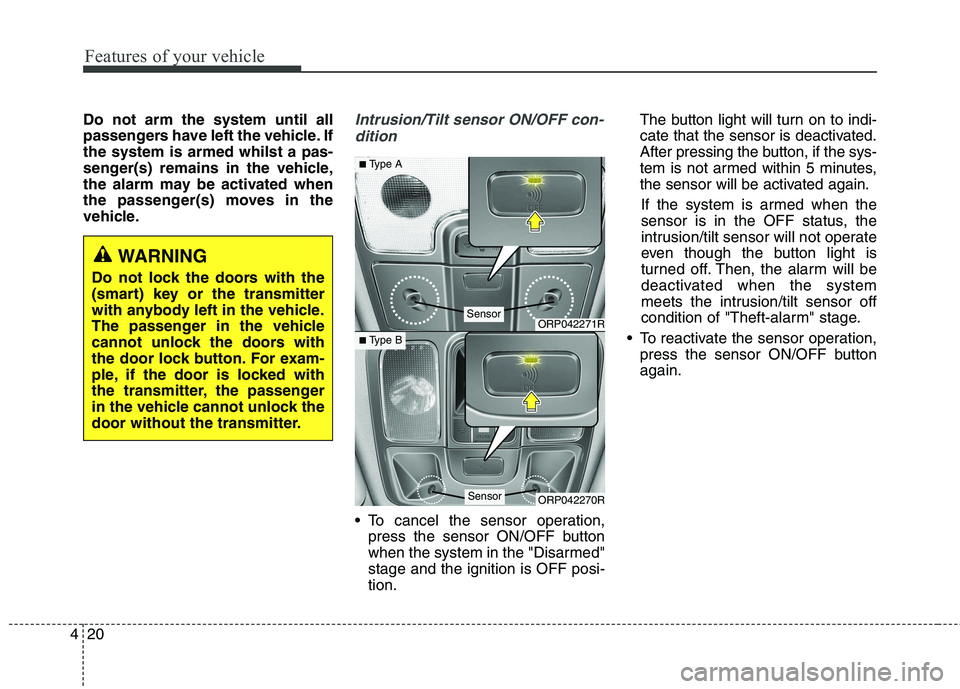
vehicle.Intrusion/Tilt sensor ON/OFF con-
dition
To cancel the sensor operation, press the sensor ON/OFF button
when the system in the "Disarmed"stage and the ignition is OFF posi-tion. The button light will turn on to indi-
cate that the sensor is deactivated.
After pressing the button, if the sys-
tem is not armed within 5 minutes,
the sensor will be activated again.
If the system is armed when the
sensor is in the OFF status, the
intrusion/tilt sensor will not operate
even though the button light is
turned off. Then, the alarm will be
deactivated when the system
meets the intrusion/tilt sensor off
condition of "Theft-alarm" stage.
To reactivate the sensor operation, press the sensor ON/OFF buttonagain.
WARNING
Do not lock the doors with the
(smart) key or the transmitter
with anybody left in the vehicle.
The passenger in the vehicle
cannot unlock the doors with
the door lock button. For exam-
ple, if the door is locked with
the transmitter, the passenger
in the vehicle cannot unlock the
door without the transmitter.
ORP042271R
ORP042270R
■ Type A
■ Type B
Sensor
Sensor
Page 124 of 723
Features of your vehicle
28
4
Door lock/unlock features
Impact sensing door unlock sys-
tem
All doors will automatically unlock when an impact causes the air bags
to deploy.
Speed sensing door lock system (if equipped)
All doors will automatically lock after
the vehicle speed exceeds 15 km/h.
Engine off door unlock system (if equipped)
All doors will automatically unlock:
Without smart key system
When the key is removed from the
ignition switch.
With smart key system
When the engine start/stop button is in the OFF position.
Shift lever door lock/unlock sys-tem
All doors will automatically lock when the shift lever is moved out of
P (Park).
All doors will automatically unlock when the shift lever is moved into P
(Park).
You can activate or deactivate the
auto door lock/unlock features in the
vehicle. Refer to "User setting" in this
chapter.