light KIA CARENS RHD 2018 Owners Manual
[x] Cancel search | Manufacturer: KIA, Model Year: 2018, Model line: CARENS RHD, Model: KIA CARENS RHD 2018Pages: 723, PDF Size: 40.94 MB
Page 452 of 723
617
Driving your vehicle
Your vehicle may be equipped with the ISG system, which reduces fuel
consumption by automatically shut-
ting down the engine, when the vehi-
cle is at a standstill. (For example :
red light, stop sign and traffic jam)
The engine starts automatically as
soon as the starting conditions aremet.
The ISG system is ON whenever the
engine is running.
✽✽NOTICE
When the engine automatically
starts by the ISG system, some
warning lights (ABS, ESC, ESC
OFF, EPS or Parking brake warn-
ing light) may turn on for a few sec-
onds.
This happens because of low battery
voltage. It does not mean the system
has malfunctioned.
Auto stop
To stop the engine in idle stop mode
With manual transaxle
1.Decrease the vehicle speed to less than 5 km/h (3 mph).
2.Shift into N (Neutral) position.
3.Release the clutch pedal. With dual clutch transmission
1. Decrease the vehicle speed to 0
km/h.
2. Shift into D (Drive) or N (Neutral) position.
3. Press the brake pedal.
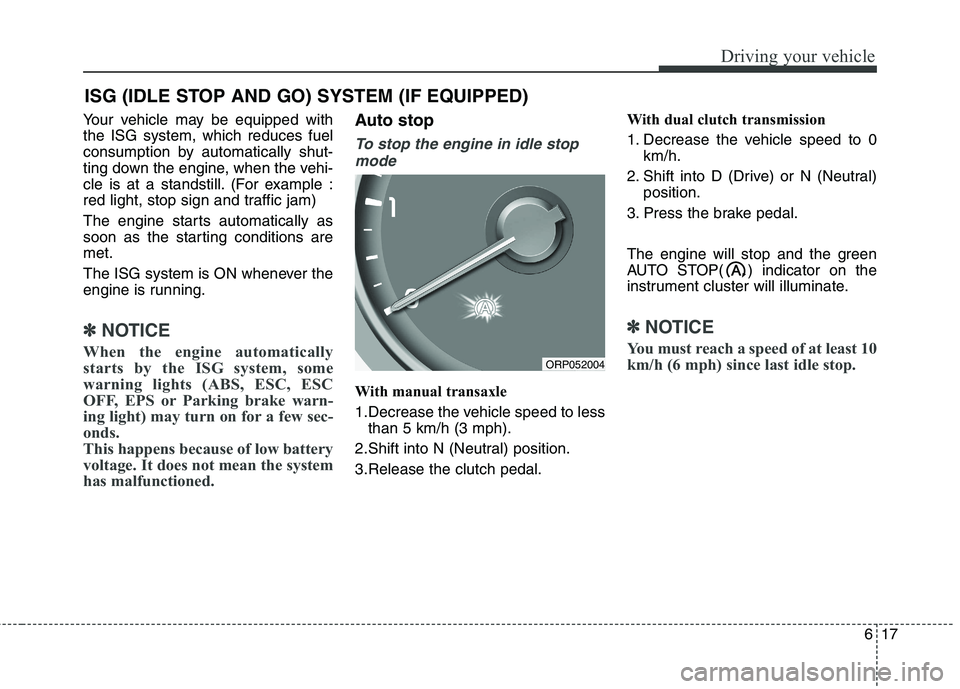
The engine will stop and the green
AUTO STOP( ) indicator on the
instrument cluster will illuminate.
✽✽ NOTICE
You must reach a speed of at least 10
km/h (6 mph) since last idle stop.
ISG (IDLE STOP AND GO) SYSTEM (IF EQUIPPED)
ORP052004
Page 453 of 723
Driving your vehicle
18
6
✽✽
NOTICE
If you unfasten the seatbelt or open
the driver's door (or engine bonnet)
in auto stop mode, the following will
happen:
The ISG system will deactivate (the light on the ISG OFF button
will illuminate).
A message "Auto Start deactivat- ed Start manually" will appear on
the LCD display.
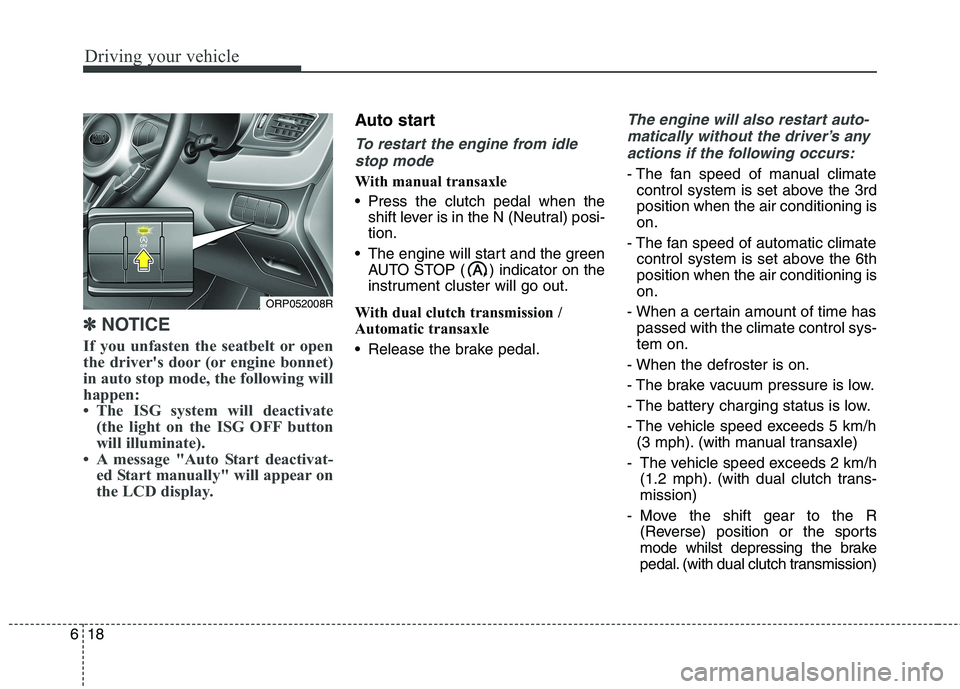
Auto start
To restart the engine from idle
stop mode
With manual transaxle
Press the clutch pedal when the shift lever is in the N (Neutral) posi- tion.
The engine will start and the green AUTO STOP ( ) indicator on the
instrument cluster will go out.
With dual clutch transmission /
Automatic transaxle
Release the brake pedal.
The engine will also restart auto- matically without the driver’s any actions if the following occurs:
- The fan speed of manual climate control system is set above the 3rd position when the air conditioning ison.
- The fan speed of automatic climate control system is set above the 6thposition when the air conditioning ison.
- When a certain amount of time has passed with the climate control sys-tem on.
- When the defroster is on.
- The brake vacuum pressure is low.
- The battery charging status is low.
- The vehicle speed exceeds 5 km/h (3 mph). (with manual transaxle)
- The vehicle speed exceeds 2 km/h (1.2 mph). (with dual clutch trans- mission)
- Move the shift gear to the R (Reverse) position or the sports
mode whilst depressing the brake
pedal. (with dual clutch transmission)
ORP052008R
Page 454 of 723
619
Driving your vehicle
The green AUTO STOP ( ) indica-
tor on the instrument cluster will blink
for 5 seconds for auto start. Condition of ISG system operation
The ISG system will operateunder the following condition:
- The driver’s seat belt is fastened.
- The driver’s door and engine bon- net are closed.
- The brake vacuum pressure is ade- quate.
- The battery is sufficiently charged.
- The engine coolant temperature is not too low.
- The slope way is gentle. (with dual clutch transmission)
✽✽ NOTICE
If the ISG system does not meet the operation condition, the ISG
system is deactivated. The light on
the ISG OFF button will illumi-
nate and a message “Auto Stop
deactivated. Start manually” will
appear on the LCD display.
If the light or notice comes on con- tinuously, please check the opera-
tion condition.
ISG system deactivation
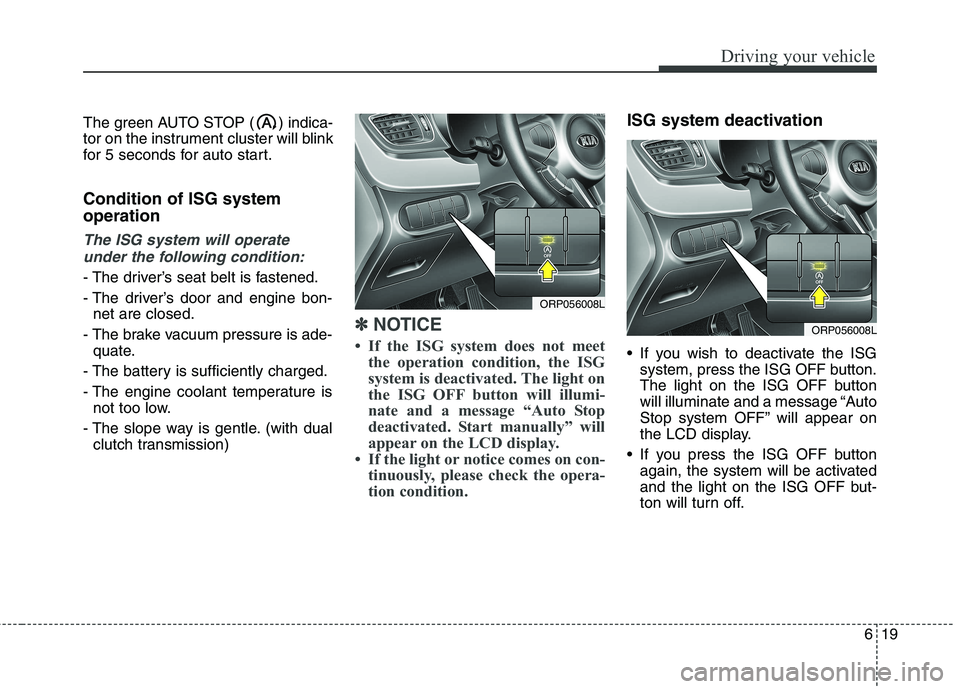
If you wish to deactivate the ISGsystem, press the ISG OFF button.
The light on the ISG OFF button
will illuminate and a message “Auto
Stop system OFF” will appear on
the LCD display.
If you press the ISG OFF button again, the system will be activated
and the light on the ISG OFF but-
ton will turn off.
ORP056008L
ORP056008L
Page 455 of 723
Driving your vehicle
20
6
ISG system malfunction
The system may not operate
when:
The ISG related sensors or system
error occurs.
The following will happen:
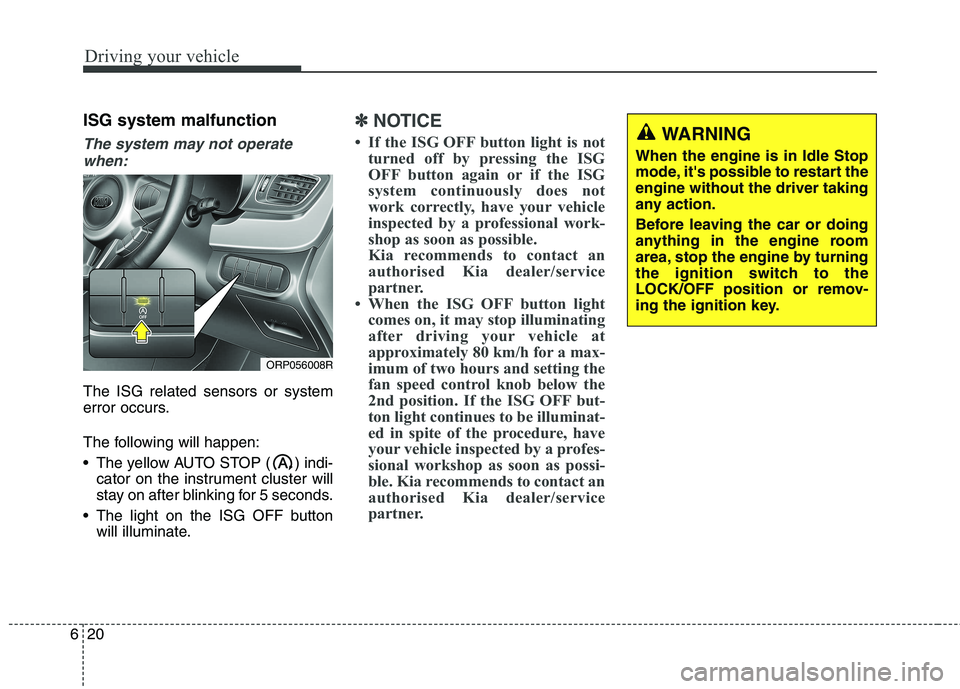
The yellow AUTO STOP ( ) indi- cator on the instrument cluster will
stay on after blinking for 5 seconds.
The light on the ISG OFF button will illuminate.
✽✽ NOTICE
If the ISG OFF button light is not turned off by pressing the ISG
OFF button again or if the ISG
system continuously does not
work correctly, have your vehicle
inspected by a professional work-
shop as soon as possible.
Kia recommends to contact an
authorised Kia dealer/service
partner.
When the ISG OFF button light comes on, it may stop illuminating
after driving your vehicle at
approximately 80 km/h for a max-
imum of two hours and setting the
fan speed control knob below the
2nd position. If the ISG OFF but-
ton light continues to be illuminat-
ed in spite of the procedure, have
your vehicle inspected by a profes-
sional workshop as soon as possi-
ble. Kia recommends to contact an
authorised Kia dealer/service
partner.
ORP056008R
WARNING
When the engine is in Idle Stop
mode, it's possible to restart theengine without the driver taking
any action.
Before leaving the car or doing
anything in the engine room
area, stop the engine by turning
the ignition switch to the
LOCK/OFF position or remov-
ing the ignition key.
Page 457 of 723
Driving your vehicle
22
6
During cold weather, shifting may
be difficult until the transaxle lubri-
cant has warmed up. This is normal
and not harmful to the transaxle.
If you've come to a complete stop and it's hard to shift into 1 (First) or
R (Reverse), put the shift lever in
neutral position and release the
clutch. Press the clutch pedal back
down, and then shift into 1 (First)
or R (Reverse) gear position.CAUTION
To avoid premature clutch
wear and damage, do notdrive with your foot resting on the clutch pedal. Also, don’tuse the clutch to hold thevehicle stopped on an uphill grade, whilst waiting for a traf-fic light, etc.
Do not use the shift lever as a handrest during driving, asthis can result in premature wear of the transaxle shiftforks.
To prevent possible damage to the clutch system, do notstart with the 2nd (second) gear engaged except whenyou start on a slippery road.
Do not exceed the maximum weight limits of the loadingweight.
Improper loading can result indamage to clutch system.
WARNING
Before leaving the driver’s seat, always set the parking
brake fully and shut the
engine off. Then make sure thetransaxle is shifted into 1
(First) gear when the vehicle is
parked on a level or uphill
grade, and shifted into R
(Reverse) on a downhill grade.
Unexpected and sudden vehi-
cle movement can occur if
these precautions are not fol-
lowed in the order identified.
If your vehicle has a manual transaxle not equipped with a
ignition lock switch, it may
move and cause a serious
accident when starting theengine without depressing
the clutch pedal whilst theparking brake is released and
the shift lever not in the neu-tral position.
(Continued)
Page 462 of 723
627
Driving your vehicle
For smooth operation, depress thebrake pedal when shifting from N(Neutral) to a forward or reverse gear.Transaxle ranges
The indicator lights in the instrument
cluster displays the shift lever posi-
tion when the ignition switch is in theON position.
P (Park)
Always come to a complete stop
before shifting into P (Park). This
position locks the transaxle and pre-
vents the front wheels from rotating.
WARNING - Automatic
transaxle
Always check the surrounding areas near your vehicle for
people, especially children,
before shifting a vehicle into
D (Drive) or R (Reverse).
Before leaving the driver’s seat, always make sure the
shift lever is in the P (Park)
position; then set the parking
brake fully and shut the engine
off. Unexpected and sudden
vehicle movement can occur if
these precautions are not fol-
lowed in the order identified.
Do not use the engine brake (shifting from a high gear to
lower gear) rapidly on slip-
pery roads.
The vehicle may slip causing an accident.
CAUTION
To avoid damage to your
transaxle, do not acceleratethe engine in R (Reverse) orany forward gear position withthe brakes on.
When stopped on an upgrade, do not hold the vehicle sta-tionary with engine power.Use the service brake or theparking brake.
Do not shift from N (Neutral) or P (Park) into D (Drive), or R(Reverse) when the engine isabove idle speed.
WARNING
Shifting into P (Park) whilst the vehicle is in motion will
cause the drive wheels to lock
which will cause you to lose
control of the vehicle.
Do not use the P (Park) posi- tion in place of the parking
brake. Always make sure the
shift lever is latched in the P
(Park) position and set the
parking brake fully.
Never leave a child unattend- ed in a vehicle.
Page 463 of 723
Driving your vehicle
28
6
R (Reverse)
Use this position to drive the vehicle
backward. N (Neutral)
The wheels and transaxle are not
engaged. The vehicle will roll freely
even on the slightest incline unless
the parking brake or service brakesare applied.
- Parking in N (Neutral) gear
Follow below steps when parking
and you want the vehicle to movewhen pushed.
1.After parking your vehicle, step on
the brake pedal and move the shift
lever to [P] with the ignition button in
[ON] or whilst the engine is running.
2.If the parking brake is applied unlock the parking brake.
- For EPB (Electronic ParkingBrake) equipped vehicles, push
the brake pedal with the ignition
button in [ON] or whilst the
engine is running to disengage
the parking brake. If [AUTOHOLD] function is used whilst
driving (If [AUTO HOLD] indicator
is on in the cluster), press [AUTO
HOLD] switch and [AUTO HOLD]
function should be turn off.
3.Whilst pressing the brake pedal, turn the ignition button [OFF].
- For smart key equipped vehicles,the ignition switch can be moved
to [OFF] only when the shift leveris in [P].
CAUTION
Always come to a complete stop
before shifting into or out of R(Reverse); you may damage the transaxle if you shift into R(Reverse) whilst the vehicle is inmotion, except as explained in “Rocking the vehicle”, in thismanual.
CAUTION
The transaxle may be damagedif you shift into P (Park) whilstthe vehicle is in motion.
WARNING
Do not drive with the shift lever in N (Neutral).
The engine brake will not work and lead to an accident.
Page 478 of 723
643
Driving your vehicle
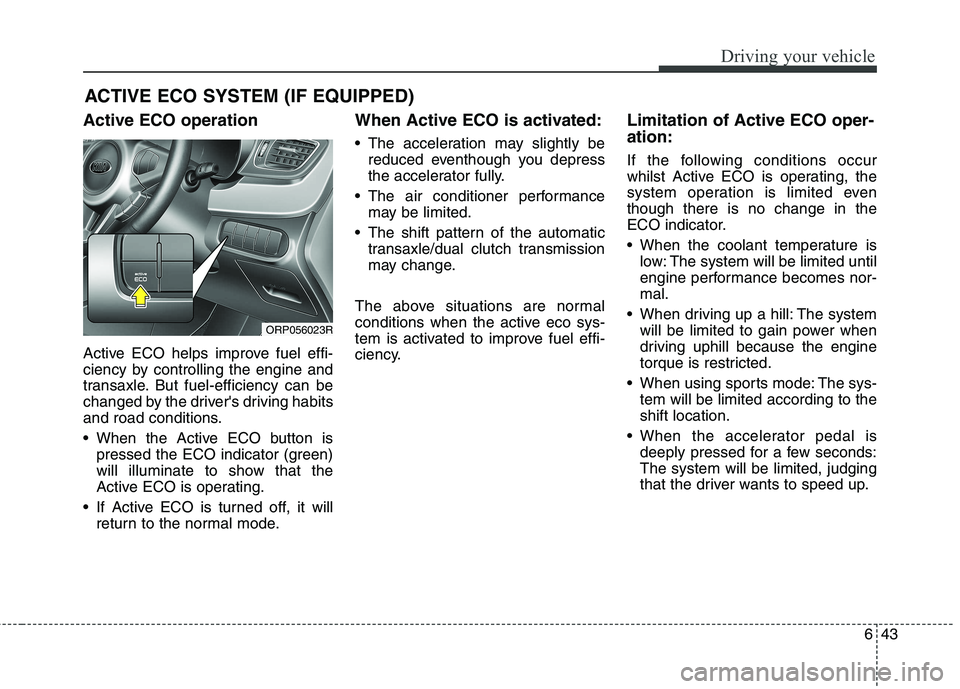
Active ECO operation
Active ECO helps improve fuel effi-
ciency by controlling the engine and
transaxle. But fuel-efficiency can be
changed by the driver's driving habits
and road conditions.
When the Active ECO button ispressed the ECO indicator (green)
will illuminate to show that the
Active ECO is operating.
If Active ECO is turned off, it will return to the normal mode. When Active ECO is activated:
The acceleration may slightly be
reduced eventhough you depress
the accelerator fully.
The air conditioner performance may be limited.
The shift pattern of the automatic transaxle/dual clutch transmission
may change.
The above situations are normal
conditions when the active eco sys-
tem is activated to improve fuel effi-
ciency. Limitation of Active ECO oper- ation:
If the following conditions occur
whilst Active ECO is operating, the
system operation is limited eventhough there is no change in the
ECO indicator.
When the coolant temperature is
low: The system will be limited until
engine performance becomes nor-mal.
When driving up a hill: The system will be limited to gain power when
driving uphill because the engine
torque is restricted.
When using sports mode: The sys- tem will be limited according to theshift location.
When the accelerator pedal is deeply pressed for a few seconds:The system will be limited, judging
that the driver wants to speed up.
ACTIVE ECO SYSTEM (IF EQUIPPED)
ORP056023R
Page 479 of 723
Driving your vehicle
44
6
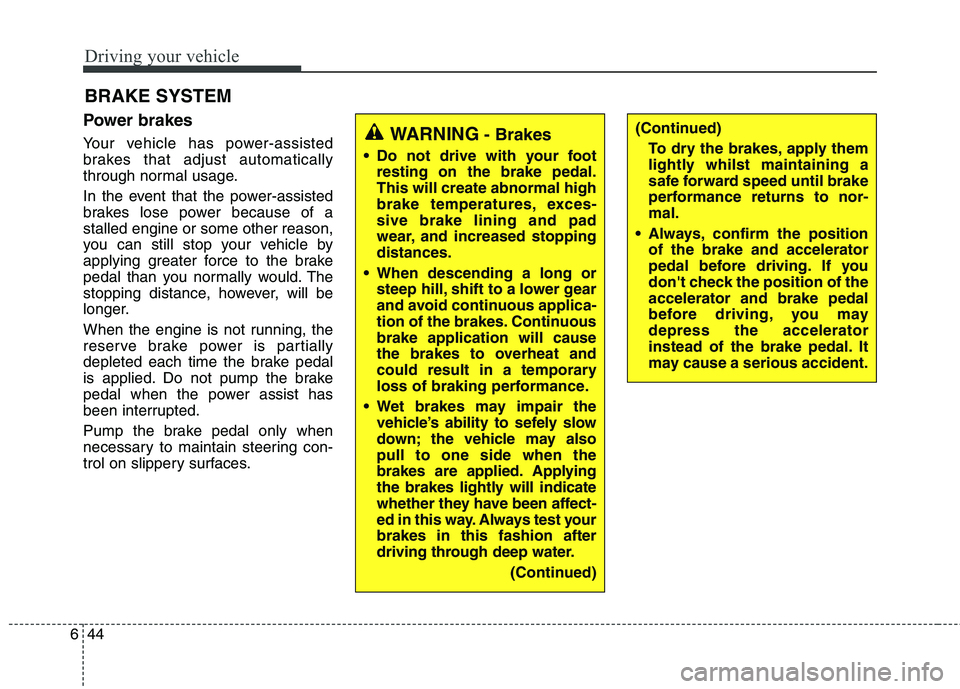
Power brakes
Your vehicle has power-assisted
brakes that adjust automatically
through normal usage.
In the event that the power-assisted
brakes lose power because of astalled engine or some other reason,
you can still stop your vehicle by
applying greater force to the brake
pedal than you normally would. The
stopping distance, however, will be
longer.
When the engine is not running, the
reserve brake power is partially
depleted each time the brake pedal
is applied. Do not pump the brake
pedal when the power assist has
been interrupted.
Pump the brake pedal only when
necessary to maintain steering con-
trol on slippery surfaces. BRAKE SYSTEM (Continued)
To dry the brakes, apply them
lightly whilst maintaining a
safe forward speed until brake
performance returns to nor-mal.
Always, confirm the position of the brake and accelerator
pedal before driving. If you
don't check the position of theaccelerator and brake pedal
before driving, you maydepress the accelerator
instead of the brake pedal. It
may cause a serious accident.WARNING - Brakes
Do not drive with your foot resting on the brake pedal. This will create abnormal high
brake temperatures, exces-sive brake lining and pad
wear, and increased stoppingdistances.
When descending a long or steep hill, shift to a lower gear
and avoid continuous applica-
tion of the brakes. Continuousbrake application will cause
the brakes to overheat and
could result in a temporary
loss of braking performance.
Wet brakes may impair the vehicle’s ability to sefely slow
down; the vehicle may alsopull to one side when the
brakes are applied. Applying
the brakes lightly will indicate
whether they have been affect-
ed in this way. Always test yourbrakes in this fashion after
driving through deep water.
(Continued)
Page 480 of 723
645
Driving your vehicle
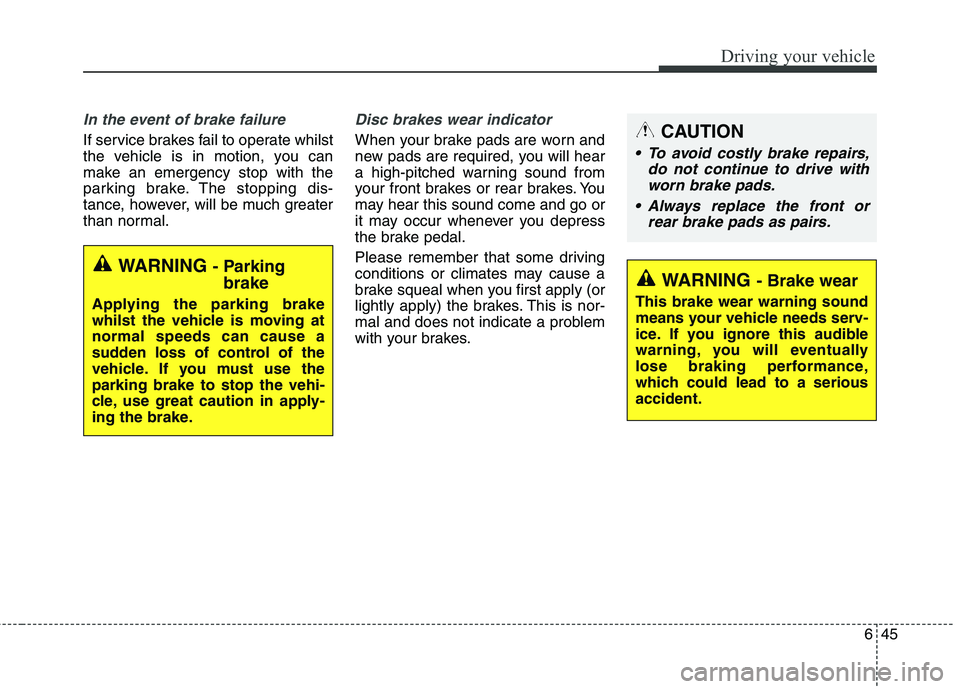
In the event of brake failure
If service brakes fail to operate whilst
the vehicle is in motion, you can
make an emergency stop with the
parking brake. The stopping dis-
tance, however, will be much greater
than normal.
Disc brakes wear indicator
When your brake pads are worn and
new pads are required, you will hear
a high-pitched warning sound from
your front brakes or rear brakes. You
may hear this sound come and go or
it may occur whenever you depress
the brake pedal.
Please remember that some driving
conditions or climates may cause a
brake squeal when you first apply (or
lightly apply) the brakes. This is nor-
mal and does not indicate a problem
with your brakes.
WARNING - Brake wear
This brake wear warning sound
means your vehicle needs serv-
ice. If you ignore this audible
warning, you will eventually
lose braking performance,
which could lead to a seriousaccident.
CAUTION
To avoid costly brake repairs, do not continue to drive withworn brake pads.
Always replace the front or rear brake pads as pairs.
WARNING - Parking
brake
Applying the parking brake
whilst the vehicle is moving atnormal speeds can cause a
sudden loss of control of the
vehicle. If you must use theparking brake to stop the vehi-
cle, use great caution in apply-
ing the brake.