cooling KIA CARENS RHD 2018 User Guide
[x] Cancel search | Manufacturer: KIA, Model Year: 2018, Model line: CARENS RHD, Model: KIA CARENS RHD 2018Pages: 723, PDF Size: 40.94 MB
Page 265 of 723
4169
Features of your vehicle
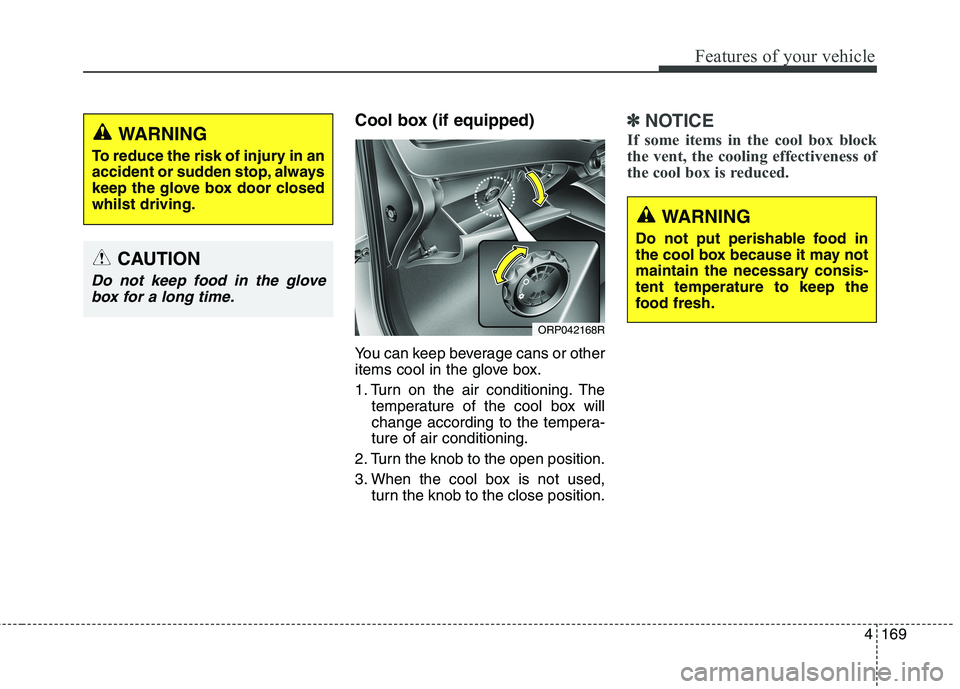
Cool box (if equipped)
You can keep beverage cans or other
items cool in the glove box.
1. Turn on the air conditioning. Thetemperature of the cool box will
change according to the tempera-ture of air conditioning.
2. Turn the knob to the open position.
3. When the cool box is not used, turn the knob to the close position.✽✽ NOTICE
If some items in the cool box block
the vent, the cooling effectiveness of
the cool box is reduced.
ORP042168R
WARNING
To reduce the risk of injury in an
accident or sudden stop, always
keep the glove box door closedwhilst driving.
CAUTION
Do not keep food in the glove box for a long time.
WARNING
Do not put perishable food in
the cool box because it may not
maintain the necessary consis-tent temperature to keep the
food fresh.
Page 273 of 723
4177
Features of your vehicle
When the operation of the air ventila-
tion is not needed, keep the switchesin the OFF position.
Each time you press the switch,the airflow will change as follows:
When pressing the switch for more than 1.5 seconds with the seat
cooler operating, the seat cooler
will turn OFF.
When the air ventilation seat is turned on, the seat may get cooler
after about 5 minutes.
Because the air ventilation uses the air in the vehicle, cooling effi-
ciency depends on the tempera-
ture of the air. In order to improve
cooling efficiency, use the air con-
ditioning system together.
The air ventilation seat defaults to the OFF position whenever the
ignition switch is turned to the ONposition. Sunvisor
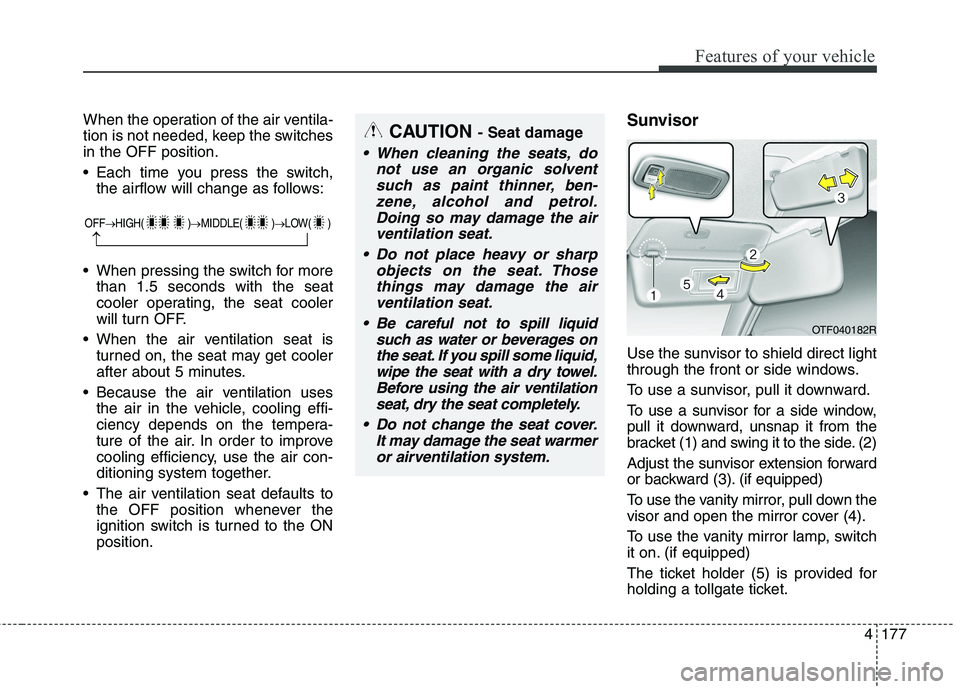
Use the sunvisor to shield direct light
through the front or side windows.
To use a sunvisor, pull it downward.
To use a sunvisor for a side window,
pull it downward, unsnap it from the
bracket (1) and swing it to the side. (2)
Adjust the sunvisor extension forward
or backward (3). (if equipped)
To use the vanity mirror, pull down the
visor and open the mirror cover (4).
To use the vanity mirror lamp, switch
it on. (if equipped)
The ticket holder (5) is provided for
holding a tollgate ticket.CAUTION
- Seat damage
When cleaning the seats, do
not use an organic solventsuch as paint thinner, ben-zene, alcohol and petrol.Doing so may damage the air ventilation seat.
Do not place heavy or sharp objects on the seat. Thosethings may damage the airventilation seat.
Be careful not to spill liquid such as water or beverages onthe seat. If you spill some liquid,wipe the seat with a dry towel.Before using the air ventilation seat, dry the seat completely.
Do not change the seat cover. It may damage the seat warmeror airventilation system.
OTF040182R
OFF HIGH( ) MIDDLE( ) LOW( )
Page 339 of 723
Audio system
56
5
✽✽
NOTICE - USING VOICE COM-
MAND
The voice recognition feature of this product supports recognition
of the commands listed within this
user’s manual.
Whilst using voice recognition, operating the steering remote con-
trol or the device will terminate
voice recognition and allow you to
manually operate desired func-
tions.
Position the microphone above the head of the driver’s seat. For supe-
rior performance, maintain good
posture when saying voice com-
mands. (Continued)(Continued)
Voice recognition may not func-
tion properly due to outside noise.
The following conditions can
affect the performance of Voice
Recognition:
- When the windows and sunroofare open
- When the heating/cooling system is on
- When passing a tunnel
- When driving on rugged and uneven roads
After downloading Bluetooth®
Wireless Technology phone book,
the system requires some times to
convert the phone book into voice
information. During this time,
voice recognition may not operate
properly.
Upon inputting your phone book, special symbols and numbers can-
not be recognized by voice. For
example, “# John Doe%&” will be
recognized as “John Doe”.
Page 408 of 723
5125
Audio system
✽✽NOTICE - USING THE
Voice Recognition
When using the voice recognition feature, only commands listed
within the user's manual are sup-
ported.
Be aware that during the opera- tion of the voice recognition sys-
tem, pressing any key other than
the key or touching the screen
will terminate voice recognition
mode.
For superior voice recognition performance, position the micro-
phone used for voice recognition
above the head of the driver’s seat
and maintain a proper position
when saying commands.
Within the following situations, voice recognition may not function
properly due to external sound.
- When the windows and sunroofare open
- When the wind of the cooling / heating device is strong
- When entering and passing through tunnels
- When driving on rugged and uneven roads (Continued)(Continued)
- During severe rain (heavy rains,windstorms)
Phone related voice commands can be used only when a
Bluetooth ®
Wireless Technology
device is connected.
When making calls by stating a name, the corresponding contact
must be downloaded and stored
within the audio system.
After downloading the Bluetooth®
Wireless Technology phone book,
it takes some times to convert the
phone book data into voice infor-
mation. During this time, voice
recognition may not properly
operate.
Pronounce the voice commands naturally and clearly as if in a nor-
mal conversation.
Page 471 of 723
Driving your vehicle
36
6
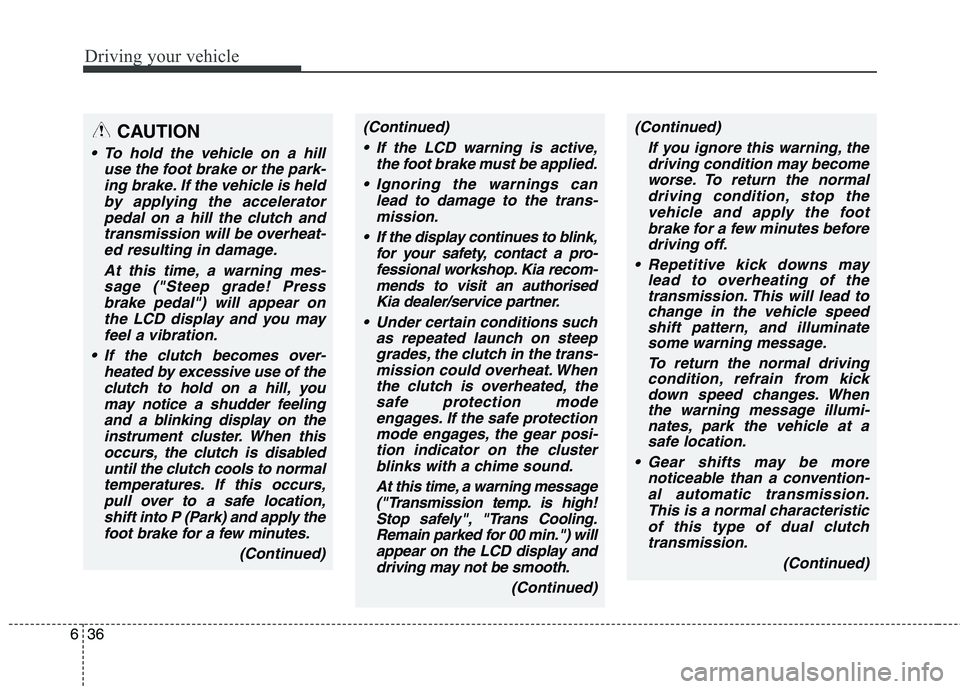
CAUTION
To hold the vehicle on a hill
use the foot brake or the park-ing brake. If the vehicle is heldby applying the acceleratorpedal on a hill the clutch and transmission will be overheat-ed resulting in damage.
At this time, a warning mes-sage ("Steep grade! Pressbrake pedal") will appear on the LCD display and you mayfeel a vibration.
If the clutch becomes over- heated by excessive use of theclutch to hold on a hill, you may notice a shudder feelingand a blinking display on theinstrument cluster. When this occurs, the clutch is disableduntil the clutch cools to normaltemperatures. If this occurs, pull over to a safe location,shift into P (Park) and apply thefoot brake for a few minutes.
(Continued)
(Continued)
If the LCD warning is active, the foot brake must be applied.
Ignoring the warnings can lead to damage to the trans-mission.
If the display continues to blink, for your safety, contact a pro-fessional workshop. Kia recom-mends to visit an authorisedKia dealer/service partner.
Under certain conditions such as repeated launch on steepgrades, the clutch in the trans-mission could overheat. Whenthe clutch is overheated, the
safe protection modeengages. If the safe protectionmode engages, the gear posi-tion indicator on the cluster blinks with a chime sound.
At this time, a warning message("Transmission temp. is high!Stop safely", "Trans Cooling.Remain parked for 00 min.") willappear on the LCD display and driving may not be smooth.
(Continued)(Continued)If you ignore this warning, thedriving condition may becomeworse. To return the normal driving condition, stop thevehicle and apply the footbrake for a few minutes before driving off.
Repetitive kick downs may lead to overheating of thetransmission. This will lead tochange in the vehicle speed shift pattern, and illuminatesome warning message.
To return the normal drivingcondition, refrain from kickdown speed changes. Whenthe warning message illumi- nates, park the vehicle at asafe location.
Gear shifts may be more noticeable than a convention-al automatic transmission.This is a normal characteristic of this type of dual clutchtransmission.
(Continued)
Page 533 of 723
Driving your vehicle
98
6
Use high quality ethylene gly- col coolant
Your vehicle is delivered with high
quality ethylene glycol coolant in the
cooling system. It is the only type ofcoolant that should be used because
it helps prevent corrosion in the cool-
ing system, lubricates the water
pump and prevents freezing. Be sure
to replace or replenish your coolantin accordance with the maintenance
schedule. Before winter, have yourcoolant tested to assure that its
freezing point is sufficient for the
temperatures anticipated during the
winter.
Check battery and cables
Winter puts additional burdens on
the battery system. Visually inspect
the battery and cables as described
in chapter 8. Have the level of charge
in your battery checked by a profes-
sional workshop. Kia recommends to
visit an authorised Kia dealer/service
partner. Change to "winter weight" oil
if necessary In some climates it is recommended
that a lower viscosity "winter weight"
oil be used during cold weather. See
chapter 9 for recommendations. If
you aren't sure what weight oil you
should use, Kia recommends to con-
sult an authorised Kia dealer/service
partner.
Check spark plugs and igni- tion system
Inspect your spark plugs as
described in chapter 8 and replace
them if necessary. Also check all
ignition wiring and components to be
sure they are not cracked, worn or
damaged in any way.
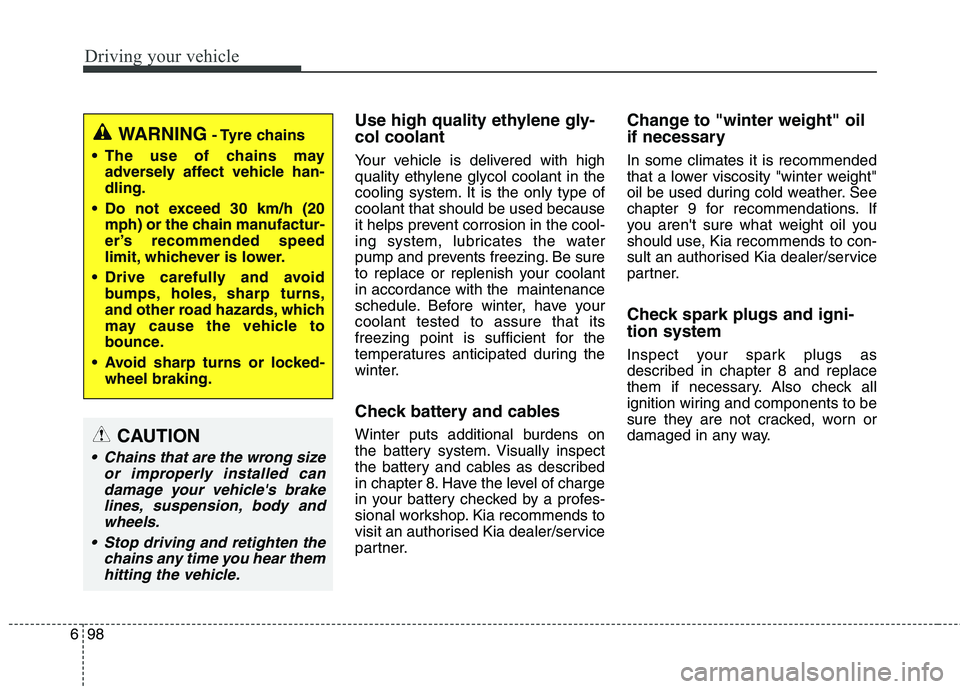
CAUTION
Chains that are the wrong size
or improperly installed candamage your vehicle's brakelines, suspension, body andwheels.
Stop driving and retighten the chains any time you hear themhitting the vehicle.
WARNING - Tyre chains
The use of chains may adversely affect vehicle han- dling.
Do not exceed 30 km/h (20 mph) or the chain manufactur-
er’s recommended speed
limit, whichever is lower.
Drive carefully and avoid bumps, holes, sharp turns,
and other road hazards, which
may cause the vehicle to
bounce.
Avoid sharp turns or locked- wheel braking.
Page 542 of 723
6107
Driving your vehicle
When you are ready to leave after
parking on a hill
1.With the manual transaxle inNeutral or automatic transaxle /
dual clutch transmission in P
(Park), apply your brakes and hold
the brake pedal down whilst you:
and
2.Slowly remove your foot from the brake pedal.
3.Drive slowly until the trailer is clear of the chocks.
4.Stop and have someone pick up and store the chocks. Maintenance when trailer tow- ing
Your vehicle will need service more
often when you regularly pull a trail-
er. Important items to pay particularattention to include engine oil,
transaxle fluid, axle lubricant and
cooling system fluid. Brake condition
is another important item to frequent-
ly check. Each item is covered in this
manual, and the Index will help you
find them quickly. If you’re trailering, it
is a good idea to review these sec-
tions before you start your trip.
Do not forget to also maintain your
trailer and hitch. Follow the mainte-nance schedule that accompanied
your trailer and check it periodically.
Preferably, conduct the check at the
start of each day’s driving. Most
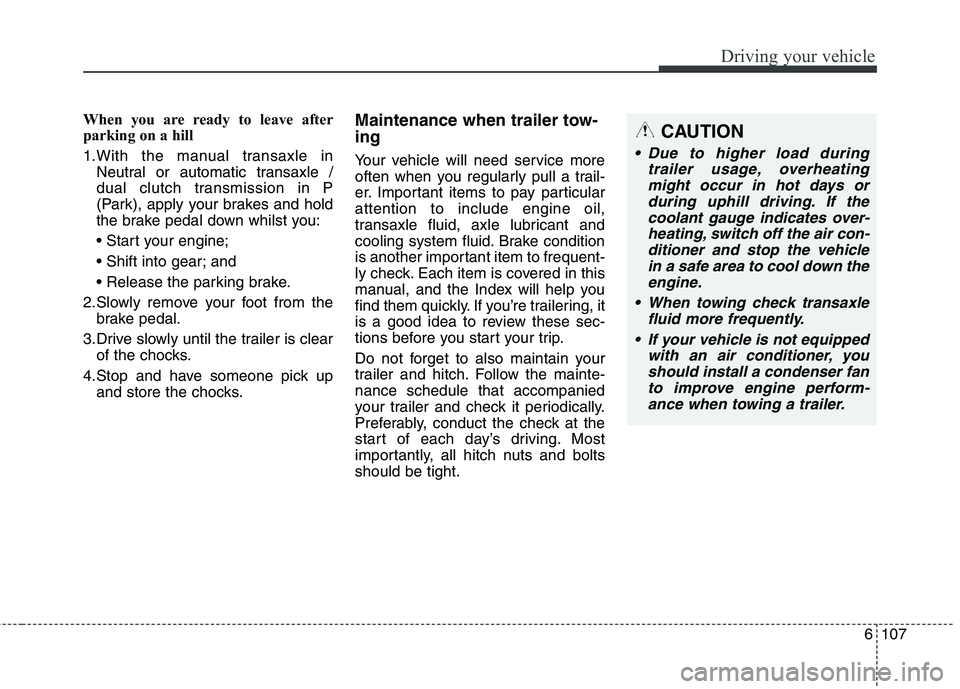
importantly, all hitch nuts and boltsshould be tight.CAUTION
Due to higher load during
trailer usage, overheatingmight occur in hot days or during uphill driving. If thecoolant gauge indicates over-heating, switch off the air con- ditioner and stop the vehiclein a safe area to cool down theengine.
When towing check transaxle fluid more frequently.
If your vehicle is not equipped with an air conditioner, youshould install a condenser fanto improve engine perform-ance when towing a trailer.
Page 558 of 723
What to do in an emergency
8
7
IF THE ENGINE OVERHEATS
If your temperature gauge indicates
overheating, you will experience a
loss of power, or hear loud pinging or
knocking, the engine is probably too
hot. If this happens, you should:
1.Pull off the road and stop as soon as it is safe to do so.
2.Place the shift lever in P (automat- ic transaxle / dual clutch transmis-
sion) or neutral (manual transaxle)
and set the parking brake. If the air
conditioning is on, turn it off.
3.If engine coolant is running out under the vehicle or steam is com-ing out from the bonnet, stop the
engine. Do not open the bonnet until
the coolant has stopped running or
the steaming has stopped. If there is
no visible loss of engine coolant and
no steam, leave the engine running
and check to be sure the engine
cooling fan is operating. If the fan is
not running, turn the engine off.
4.Check to see if the water pump drive belt is missing. If it is not miss-
ing, check to see that it is tight. If the drive belt seems to be satis-
factory, check for coolant leaking
from the radiator, hoses or under
the vehicle. (If the air conditioning
had been in use, it is normal for
cold water to be draining from it
when you stop).
5.If the water pump drive belt is bro- ken or engine coolant is leakingout, stop the engine immediately
and call a professional workshop.Kia recommends to call an autho-
rised Kia dealer/service partner. 6.If you cannot find the cause of the
overheating, wait until the engine
temperature has returned to nor-
mal. Then, if coolant has been lost,carefully add coolant to the reser-
voir to bring the fluid level in the
reservoir up to the halfway mark.
7.Proceed with caution, keeping alert for further signs of overheat-
ing. If overheating happens again,
call a professional workshop. Kia
recommends to call an authorised
Kia dealer/service partner.
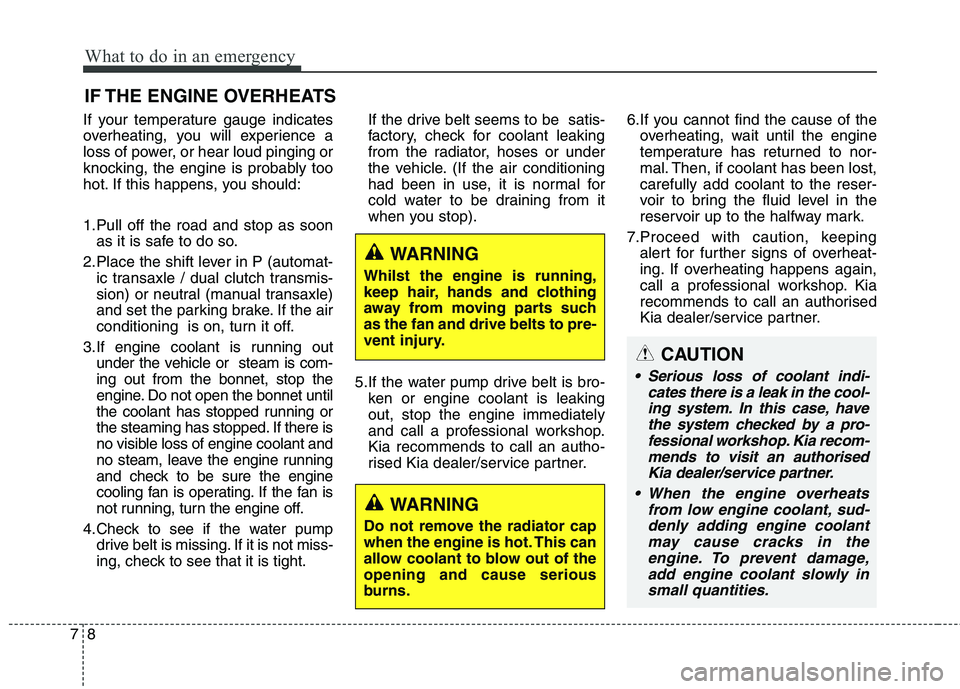
CAUTION
Serious loss of coolant indi-
cates there is a leak in the cool-ing system. In this case, have the system checked by a pro-fessional workshop. Kia recom-mends to visit an authorised Kia dealer/service partner.
When the engine overheats from low engine coolant, sud-denly adding engine coolantmay cause cracks in the engine. To prevent damage,add engine coolant slowly insmall quantities.
WARNING
Whilst the engine is running,
keep hair, hands and clothing
away from moving parts suchas the fan and drive belts to pre-
vent injury.
WARNING
Do not remove the radiator cap
when the engine is hot. This can
allow coolant to blow out of theopening and cause serious
burns.
Page 594 of 723
87
Maintenance
Engine compartment precau- tions (Diesel engine)
• The injector operates at high volt-age (maximum 200v). Therefore,
the following accidents may occur.
- Direct contact with the injector orinjector wiring may cause electric
shock or damage your muscle or
nerve system.
- The electromagnetic wave from the operating injector may cause
the artificial heart pacemaker tomalfunction.
Follow the safety tips provided below, when you are checking theengine room whilst the engine is
running.
- Do not touch the injector, injectorwirings, and the engine computer
whilst the engine is running.
- Do not remove the injector con- nector whilst the engine is run-ning.
- People using pacemakers must not go near the engine whilst the
engine is starting or running.WARNING - Maintenance
work
Performing maintenance work on a vehicle can be danger-
ous. You can be seriously
injured while performing
some maintenance proce-
dures. If you lack sufficient
knowledge and experience or
the proper tools and equip-
ment to do the work, have the
system serviced by a profes-
sional workshop. Kia recom-mends to visit an authorised
Kia dealer/service partner.
Working under the bonnet with the engine running is
dangerous. It becomes even
more dangerous when you
wear jewelry or loose cloth-
ing. These can become entan-
gled in moving parts and
result in injury.
(Continued)(Continued)
Therefore, if you must run the
engine whilst working under
the bonnet, make certain that
you remove all jewelry (espe-
cially rings, bracelets, watch-
es, and necklaces) and all
neckties, scarves, and similar
loose clothing before gettingnear the engine or coolingfans.
Page 602 of 723
815
Maintenance
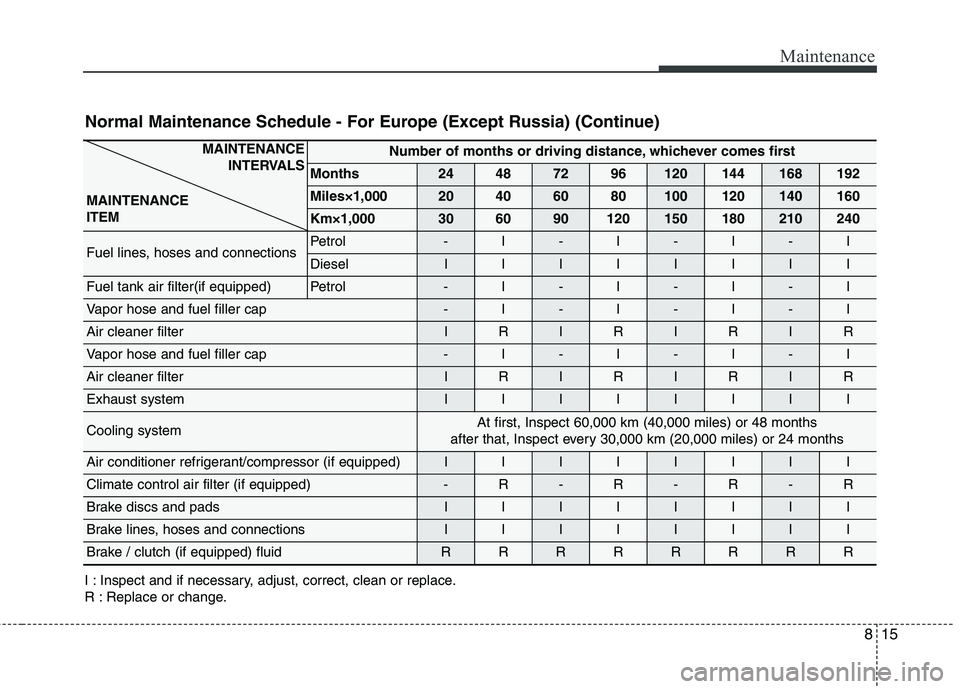
Normal Maintenance Schedule - For Europe (Except Russia) (Continue)
I : Inspect and if necessary, adjust, correct, clean or replace.
R : Replace or change.
MAINTENANCE INTERVALS
MAINTENANCE ITEMNumber of months or driving distance, whichever comes first
Months24487296120144168192
Miles×1,00020406080100120140160
Km×1,000306090120150180210240
Fuel lines, hoses and connectionsPetrol-I-I-I-I
DieselIIIIIIII
Fuel tank air filter(if equipped)Petrol-I-I-I-I
Vapor hose and fuel filler cap-I-I-I-I
Air cleaner filterIRIRIRIR
Vapor hose and fuel filler cap-I-I-I-I
Air cleaner filterIRIRIRIR
Exhaust systemIIIIIIII
Cooling system At first, Inspect 60,000 km (40,000 miles) or 48 months
after that, Inspect every 30,000 km (20,000 miles) or 24 months
Air conditioner refrigerant/compressor (if equipped)IIIIIIII
Climate control air filter (if equipped)-R-R-R-R
Brake discs and padsIIIIIIII
Brake lines, hoses and connectionsIIIIIIII
Brake / clutch (if equipped) fluidRRRRRRRR