seats KIA CARENS RHD 2018 User Guide
[x] Cancel search | Manufacturer: KIA, Model Year: 2018, Model line: CARENS RHD, Model: KIA CARENS RHD 2018Pages: 723, PDF Size: 40.94 MB
Page 57 of 723
339
Safety features of your vehicle
CHILD RESTRAINT SYSTEM
Children riding in the vehicle should
sit in the rear seat and must always
be properly restrained to minimise
the risk of injury in an accident, sud-
den stop or sudden manoeuvre.
According to accident statistics, chil-
dren are safer when properly
restrained in the rear seats than in
the front seat. Larger children not in
a child restraint system should use
one of the seat belts provided.
You should be aware of the specific
requirements in your country. Child
restraint systems must be properly
placed and installed in the vehicle
seat. You must use a commercially
available child restraint system that
meets the requirements of the Safety
Standards of your country.
Child restraint systems are designed
to be secured in vehicle seats by lap
belts or the lap belt portion of a
lap/shoulder belt, or by a top tether
anchor and/or ISOFIX anchors. Children could be injured or killed in
a crash if their restraints are not
properly secured. For small children
and babies, Child restraint system
must be used. Before buying a par-
ticular child restraint system, make
sure it fits your vehicle seat and seat
belts, and fits your child. Follow all
the instructions provided by the man-
ufacturer when installing the child
restraint system.
WARNING
To ensure the safety of your child, we strongly recommend
a child restraint system to beinstalled in the rear seats.
When installing a child
restraint on the front passen-
ger's seat, the air bag must be
deactivated and set to the OFF
position. (if equipped passen-
ger's air bag ON/OFF switch)
(Continued)
(Continued)
A seat belt or child restraintsystem can become very hot
if it is left in a closed vehicle
on a sunny day, even if theoutside temperature does not
feel hot. Be sure to check the
seat cover and buckles before
placing a child there.
When the child restraint sys- tem is not in use, store it in the
luggage area or fasten it with a
seat belt or ISOFIX anchorage
so that it will not be thrown
forward in case of a suddenstop or an accident.
All children, even those too large for child restraints,should ride in the rear seats.
Page 59 of 723
341
Safety features of your vehicle
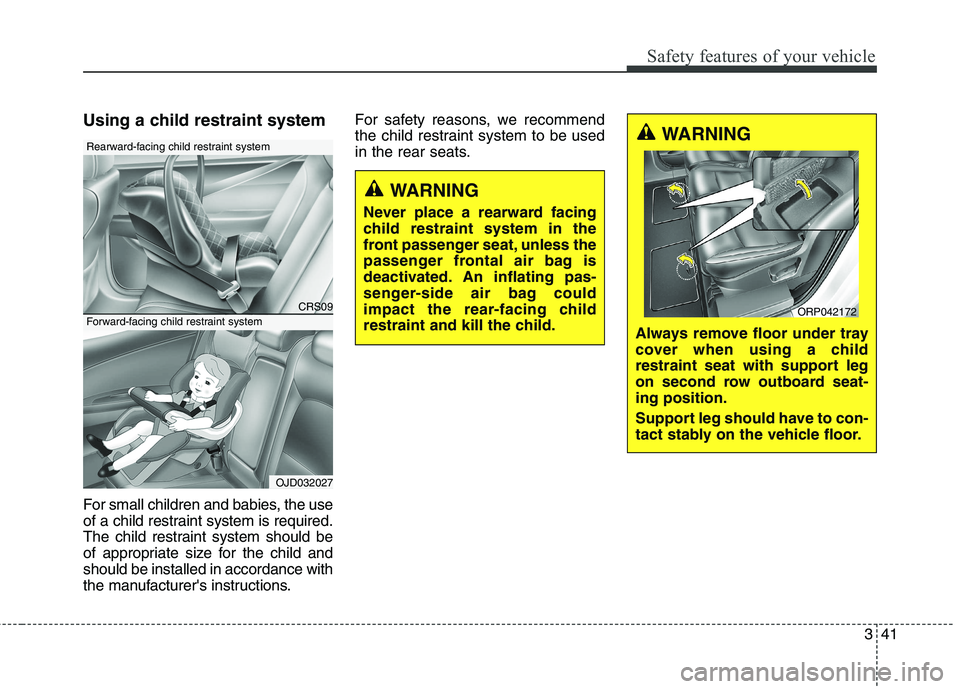
Using a child restraint system
For small children and babies, the use
of a child restraint system is required.
The child restraint system should be
of appropriate size for the child andshould be installed in accordance with
the manufacturer's instructions.For safety reasons, we recommend
the child restraint system to be used
in the rear seats.
CRS09
OJD032027
Rearward-facing child restraint system
Forward-facing child restraint system
WARNING
Always remove floor under tray
cover when using a child
restraint seat with support leg
on second row outboard seat-ing position.
Support leg should have to con-
tact stably on the vehicle floor.
ORP042172
WARNING
Never place a rearward facing
child restraint system in the
front passenger seat, unless the
passenger frontal air bag is
deactivated. An inflating pas-
senger-side air bag could
impact the rear-facing child
restraint and kill the child.
Page 67 of 723
349
Safety features of your vehicle
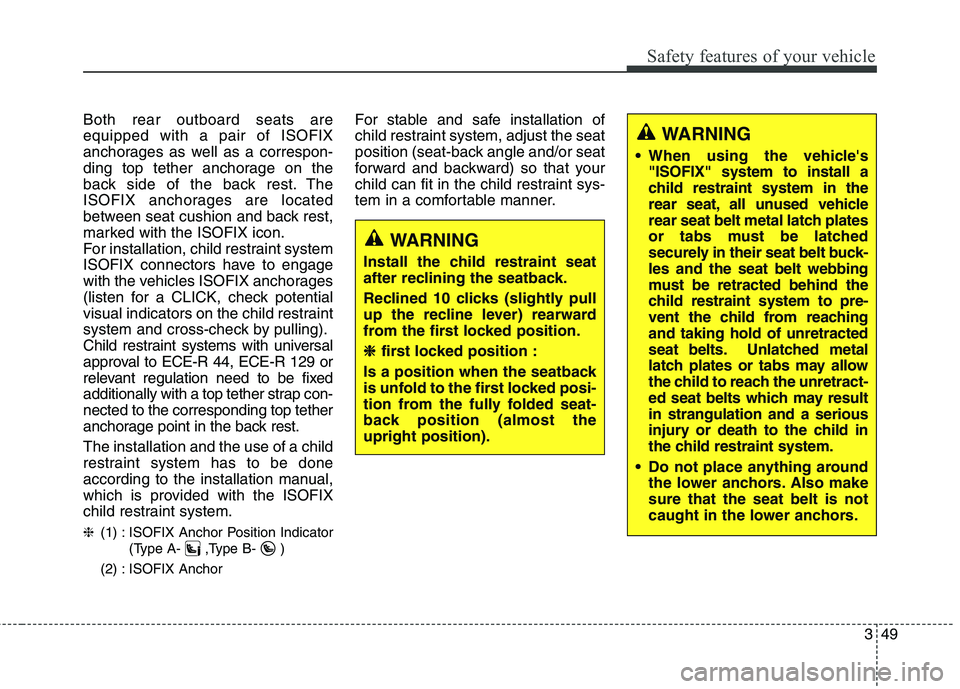
Both rear outboard seats are equipped with a pair of ISOFIX
anchorages as well as a correspon-
ding top tether anchorage on the
back side of the back rest. The
ISOFIX anchorages are located
between seat cushion and back rest,
marked with the ISOFIX icon.
For installation, child restraint system
ISOFIX connectors have to engage
with the vehicles ISOFIX anchorages
(listen for a CLICK, check potential
visual indicators on the child restraint
system and cross-check by pulling).
Child restraint systems with universal
approval to ECE-R 44, ECE-R 129 or
relevant regulation need to be fixed
additionally with a top tether strap con-nected to the corresponding top tether
anchorage point in the back rest. The installation and the use of a child
restraint system has to be done
according to the installation manual,
which is provided with the ISOFIX
child restraint system. ❈(1) : ISOFIX Anchor Position Indicator
(Type A- ,Type B- )
(2) : ISOFIX Anchor For stable and safe installation of
child restraint system, adjust the seat
position (seat-back angle and/or seat
forward and backward) so that your
child can fit in the child restraint sys-
tem in a comfortable manner.
WARNING
Install the child restraint seat
after reclining the seatback.
Reclined 10 clicks (slightly pull
up the recline lever) rearward
from the first locked position. ❈
❈ first locked position :
Is a position when the seatback
is unfold to the first locked posi-
tion from the fully folded seat-
back position (almost theupright position).
WARNING
When using the vehicle's "ISOFIX" system to install a
child restraint system in the
rear seat, all unused vehicle
rear seat belt metal latch plates
or tabs must be latched
securely in their seat belt buck-les and the seat belt webbing
must be retracted behind the
child restraint system to pre-
vent the child from reachingand taking hold of unretracted
seat belts. Unlatched metal
latch plates or tabs may allow
the child to reach the unretract-
ed seat belts which may resultin strangulation and a serious
injury or death to the child in
the child restraint system.
Do not place anything around the lower anchors. Also makesure that the seat belt is not
caught in the lower anchors.
Page 71 of 723
353
Safety features of your vehicle
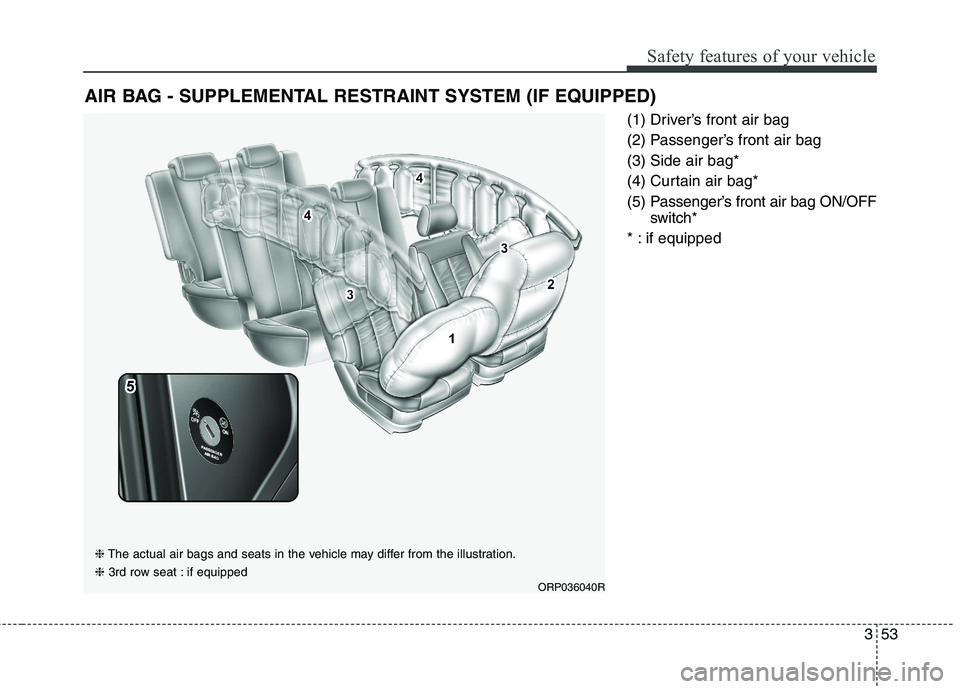
(1) Driver’s front air bag
(2) Passenger’s front air bag(3) Side air bag*
(4) Curtain air bag*
(5) Passenger’s front air bag ON/OFFswitch*
* : if equipped
AIR BAG - SUPPLEMENTAL RESTRAINT SYSTEM (IF EQUIPPED)
ORP036040R
❈
The actual air bags and seats in the vehicle may differ from the illustration.
❈ 3rd row seat : if equipped
Page 75 of 723
357
Safety features of your vehicle
Air bag warning and indicator
Air bag warning light
The purpose of the air bag warning
light in your instrument panel is to
alert you of a potential problem with
your air bag - Supplemental
Restraint System (SRS).When the ignition switch is turned
ON, the warning light should illumi-
nate for approximately 6 seconds,
then go off.
Have the system checked if:
The light does not turn on briefly
when you turn the ignition ON.
The light stays on after illuminating for approximately 6 seconds.
The light comes on whilst the vehi- cle is in motion.
The light blinks when the ignition switch is in ON position.
W7-147
WARNING
NEVER use a rearward facing child restraint on a seat pro-
tected by an ACTIVE AIR BAG
in front of it, DEATH or SERI-
OUS INJURY to the CHILD can
occur.
When children are seated in the rear outboard seats of a
vehicle equipped with side
and/or curtain air bags, be
sure to install the child
restraint system as far away
from the door side as possible,
and securely lock the childrestraint system in position.
Inflation of side and/or curtain
air bags could cause serious
injury or death to an infant or
child.
Page 81 of 723
363
Safety features of your vehicle
(Continued)
ABC – Always Buckle Childrenin the back seat. It is the safest
place for children of any age
to ride.
Front and side air bags can injure occupants improperly
positioned in the front seats.
Move your seat as far back as practical from the front air
bags, whilst still maintaining
control of the vehicle.
You and your passengers should never sit or lean
unnecessarily close to the air
bags. Improperly positioned
drivers and passengers can
be severely injured by inflat-
ing air bags.
Never lean against the door or centre console – always sit inan upright position.
(Continued)(Continued)
No objects should be placedover or near the air bag mod- ules on the steering wheel,
instrument panel, and the front
passenger's panel above the
glove box, because any suchobject could cause harm if the
vehicle is in a crash severe
enough to cause the air bags
to deploy.
Do not tamper with or discon- nect SRS wiring or other com-ponents of the SRS system.
Doing so could result in injury,
due to accidental deployment
of the air bags or by rendering
the SRS inoperative.
If the SRS air bag warning light remains illuminated
whilst the vehicle is being
driven, have the system
inspected by a professional
workshop. Kia recommendsto visit an authorised Kia deal-
er/service partner.
(Continued)(Continued)
Air bags can only be used once– have the system replaced by a
professional workshop. Kia rec-ommends to visit an authorised
Kia dealer/service partner.
The SRS is designed to deploy the front air bags only when an
impact is sufficiently severeand when the impact angle is
less than 30° from the forwardlongitudinal axis of the vehi-
cle. Additionally, the air bags
will only deploy once. Seat
belts must be worn at all times.
Front air bags are not intended to deploy in side-impact, rear-
impact or rollover crashes. In
addition, front air bags will not
deploy in frontal crashes below
the deployment threshold.
A child restraint system must never be placed in the front
seat. The infant or child could
be severely injured or killed by
an air bag deployment in caseof an accident.
(Continued)
Page 86 of 723
Safety features of your vehicle
68
3
The purpose of the air bag is to pro-
vide the vehicle's driver and/or thefront passenger with additional pro-
tection than that offered by the seat
belt alone. The side air bags are designed to
deploy only during certain side-
impact collisions, depending on the
crash severity, angle, speed and
point of impact. The side air bags are
not designed to deploy in all side
impact situations.
WARNING
Do not allow the passengers to lean their heads or bodies onto
doors, put their arms on the
doors, stretch their arms out of
the window, or place objects
between the doors and passen-
gers when they are seated onseats equipped with side and/or
curtain air bags.
WARNING
The side air bag is supplemen- tal to the driver's and the pas-
senger's seat belt systems and
is not a substitute for them.
Therefore your seat belts must
be worn at all times whilst the
vehicle is in motion. The air
bags deploy only in certain side
impact conditions severeenough to cause significant
injury to the vehicle occupants.
For best protection from the side air bag system and to
avoid being injured by the
deploying side air bag, both
front seat occupants should sitin an upright position with the
seat belt properly fastened. Thedriver's hands should beplaced on the steering wheel at
the 9:00 and 3:00 positions. The
passenger's arms and handsshould be placed on their laps.
(Continued)(Continued)
Do not use any accessory seatcovers.
Use of seat covers could reduce or prevent the effec- tiveness of the system.
To prevent unexpected deploy- ment of the side air bag that
may result in personal injury,
avoid impact to the sideimpact sensor when the igni-
tion key is on.
If the seat or seat cover is dam- aged, have the system serv-
iced by a professional work-shop. Kia recommends to visit an
authorised Kia dealer/service
partner.
Never place or insert any object into any small opening
near side airbag labels
attached to the vehicle seats.
When the air bag deploys, the
object may affect the deploy-
ment and result in unexpected
accident or bodily harm.
Page 88 of 723
Safety features of your vehicle
70
3
(Continued)
Do not allow the passengers to
lean their heads or bodies onto
doors, put their arms on the
doors, stretch their arms out of
the window, or place objects
between the doors and pas-
sengers when they are seatedon seats equipped with side
and/or curtain air bags.
Never try to open or repair any components of the curtain air
bag system. If necessary,
have the system serviced by a
professional workshop. Kiarecommends to visit an
authorised Kia dealer/service
partner.
Failure to follow the above men-tioned instructions can result in
injury or death to the vehicleoccupants in an accident.WARNING
In order for side and curtain air bags to provide the best pro-
tection, both front seat occu-
pants and both outboard rearoccupants should sit in anupright position with the seat
belts properly fastened.
Importantly, children should
sit in a proper child restraintsystem in the rear seat.
When children are seated in the rear outboard seats, they
must be seated in the proper
child restraint system.
Make sure to put the child
restraint system as far away
from the door side as possible,
and secure the child restraint
system in a locked position.
(Continued)WARNING - No attaching objects
Do not place any objects over the air bag. Also, do not attach
any objects around the area
the air bag inflates such as the
door, side door glass, front
and rear pillar, roof side rail.
objects on the coat hook.
Do not hang heavy items on the coat hooks for safety rea-sons.
Page 95 of 723
377
Safety features of your vehicle
Additional safety precautions Never let passengers ride in the
cargo area or on top of a folded-
down back seat. All occupants
should sit upright, fully back in theirseats with their seat belts on and
their feet on the floor.
Passengers should not move
out of or change seats whilst the
vehicle is moving. A passenger
who is not wearing a seat belt dur-
ing a crash or emergency stop can
be thrown against the inside of the
vehicle, against other occupants,
or out of the vehicle.
Each seat belt is designed torestrain one occupant. If more
than one person uses the same
seat belt, they could be seriouslyinjured or killed in a collision.
Do not use any accessories onseat belts. Devices claiming to
improve occupant comfort or repo-sition the seat belt can reduce the
protection provided by the seat belt
and increase the chance of serious
injury in a crash.
Passengers should not place
hard or sharp objects between
themselves and the air bags.
Carrying hard or sharp objects on
your lap or in your mouth can result
in injuries if an air bag inflates.
Keep occupants away from the
air bag covers. All occupants
should sit upright, fully back in theirseats with their seat belts on and
their feet on the floor. If occupants
are too close to the air bag covers,
they could be injured if the air bags
inflate.
Do not attach or place objects
on or near the air bag covers.
Any object attached to or placed
on the front or side air bag covers
could interfere with the proper
operation of the air bags.
Do not modify the front seats.Modification of the front seats
could interfere with the operation of
the supplemental restraint systemsensing components or side air
bags.
Do not place items under the
front seats. Placing items under
the front seats could interfere with
the operation of the supplemental
restraint system sensing compo-
nents and wiring harnesses.
Never hold an infant or child on
your lap. The infant or child could
be seriously injured or killed in the
event of a crash. All infants and chil-
dren should be properly restrained
in appropriate child safety seats orseat belts in the rear seat.
WARNING
Sitting improperly or out of position can cause occupants
to be shifted too close to a
deploying air bag, strike the
interior structure or be thrown
from the vehicle resulting in
serious injury or death.
Always sit upright with the seatback in an upright posi-
tion, centred on the seat cush-
ion with your seat belt on,
legs comfortably extended
and your feet on the floor.
Page 271 of 723
4175
Features of your vehicle
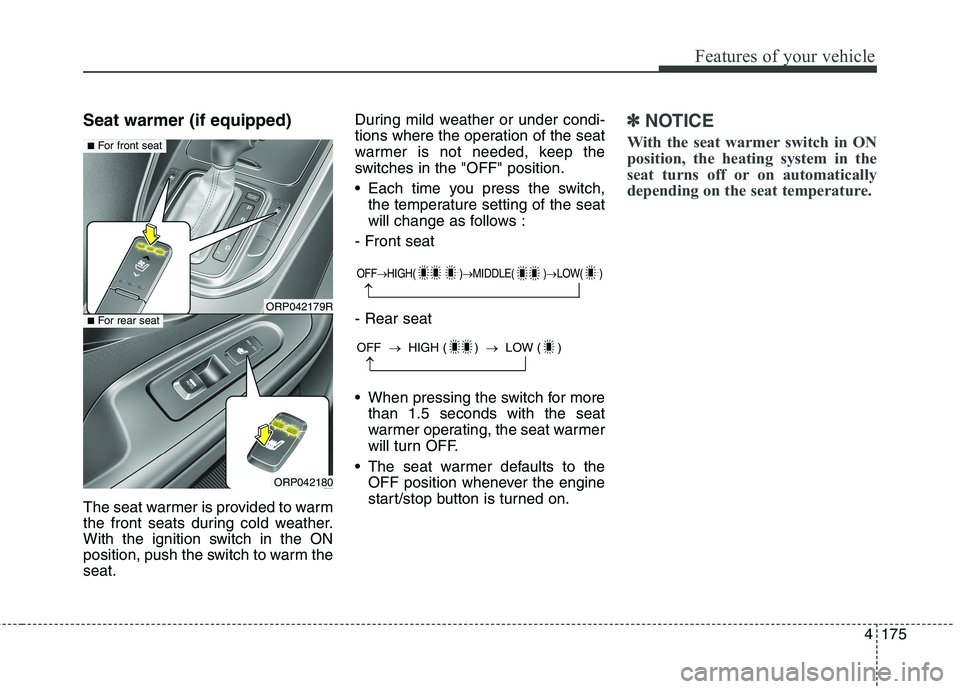
Seat warmer (if equipped)
The seat warmer is provided to warm
the front seats during cold weather.
With the ignition switch in the ON
position, push the switch to warm theseat.During mild weather or under condi-
tions where the operation of the seat
warmer is not needed, keep the
switches in the "OFF" position.
Each time you press the switch,
the temperature setting of the seat
will change as follows :
- Front seat - Rear seat
When pressing the switch for more than 1.5 seconds with the seat
warmer operating, the seat warmer
will turn OFF.
The seat warmer defaults to the OFF position whenever the engine
start/stop button is turned on.✽✽ NOTICE
With the seat warmer switch in ON
position, the heating system in the
seat turns off or on automatically
depending on the seat temperature.
OFF HIGH( ) MIDDLE( ) LOW( )
OFF HIGH ( ) LOW ( )
ORP042179R
ORP042180
■For front seat
■For rear seat