warning KIA CARENS RHD 2018 Owners Manual
[x] Cancel search | Manufacturer: KIA, Model Year: 2018, Model line: CARENS RHD, Model: KIA CARENS RHD 2018Pages: 723, PDF Size: 40.94 MB
Page 641 of 723
Maintenance
54
8
Remove the valve cap from the tyre
valve stem. Press the tyre gauge
firmly onto the valve to get a pres-
sure measurement. If the cold tyreinflation pressure matches the rec-ommended pressure on the tyre and
loading information label, no further
adjustment is necessary. If the pres-
sure is low, add air until you reachthe recommended amount.
If you overfill the tyre, release air by pushing on the metal stem in the
centre of the tyre valve. Recheck the
tyre pressure with the tyre gauge. Be
sure to put the valve caps back on
the valve stems. They help prevent
leaks by keeping out dirt and mois-
ture. Tyre rotation
To equalize tread wear, it is recom- mended that the tyres be rotated
every 12,000 km (7,500 miles) or
sooner if irregular wear develops.
During rotation, check the tyres for
correct balance.
When rotating tyres, check for
uneven wear and damage. Abnormal
wear is usually caused by incorrect
tyre pressure, improper wheel align-
ment, out-of-balance wheels, severe
braking or severe cornering. Look for
bumps or bulges in the tread or side
of tyre. Replace the tyre if you find
either of these conditions. Replace
the tyre if fabric or cord is visible.
After rotation, be sure to bring thefront and rear tyre pressures to spec-
ification and check lug nut tightness.
Refer to “Tyre and wheels” in chapter 9.
WARNING
Inspect your tyres frequently for proper inflation as well as
wear and damage. Always use
a tyre pressure gauge.
Tyres with too much or too lit- tle pressure wear unevenly
causing poor handling, loss of
vehicle control, and suddentyre failure leading to acci-
dents, injuries, and even death.The recommended cold tyre
pressure for your vehicle can
be found in this manual and onthe tyre label located on the
driver's side centre pillar.
Worn tyres can cause acci- dents. Replace tyres that are
worn, show uneven wear, or
are damaged.
Remember to check the pres- sure of your spare tyre. Kia
recommends that you check
the spare every time you
check the pressure of the
other tyres on your vehicle.
Page 642 of 723
855
Maintenance
Disc brake pads should be inspectedfor wear whenever tyres are rotated.
✽✽ NOTICE
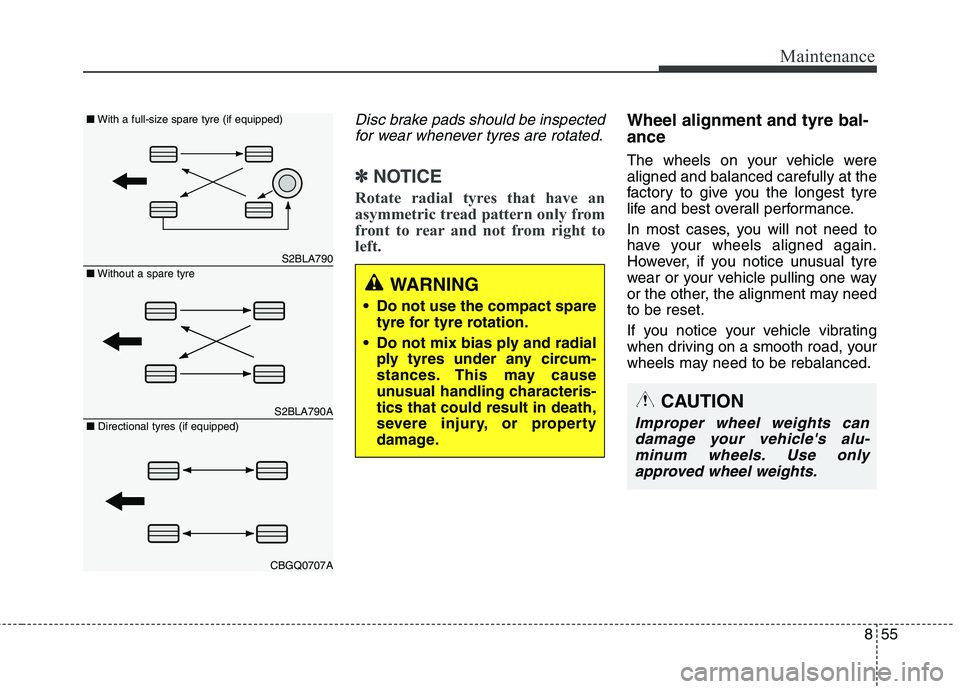
Rotate radial tyres that have an
asymmetric tread pattern only from
front to rear and not from right to
left.
Wheel alignment and tyre bal- ance
The wheels on your vehicle were aligned and balanced carefully at the
factory to give you the longest tyre
life and best overall performance.
In most cases, you will not need to
have your wheels aligned again.
However, if you notice unusual tyre
wear or your vehicle pulling one way
or the other, the alignment may needto be reset.
If you notice your vehicle vibrating
when driving on a smooth road, your
wheels may need to be rebalanced.
WARNING
Do not use the compact spare tyre for tyre rotation.
Do not mix bias ply and radial ply tyres under any circum-
stances. This may cause
unusual handling characteris-tics that could result in death,
severe injury, or property
damage.
S2BLA790
S2BLA790A
CBGQ0707A
■Without a spare tyre
■
With a full-size spare tyre (if equipped)
■ Directional tyres (if equipped)
CAUTION
Improper wheel weights can
damage your vehicle's alu-minum wheels. Use onlyapproved wheel weights.
Page 643 of 723
Maintenance
56
8
Tyre replacement
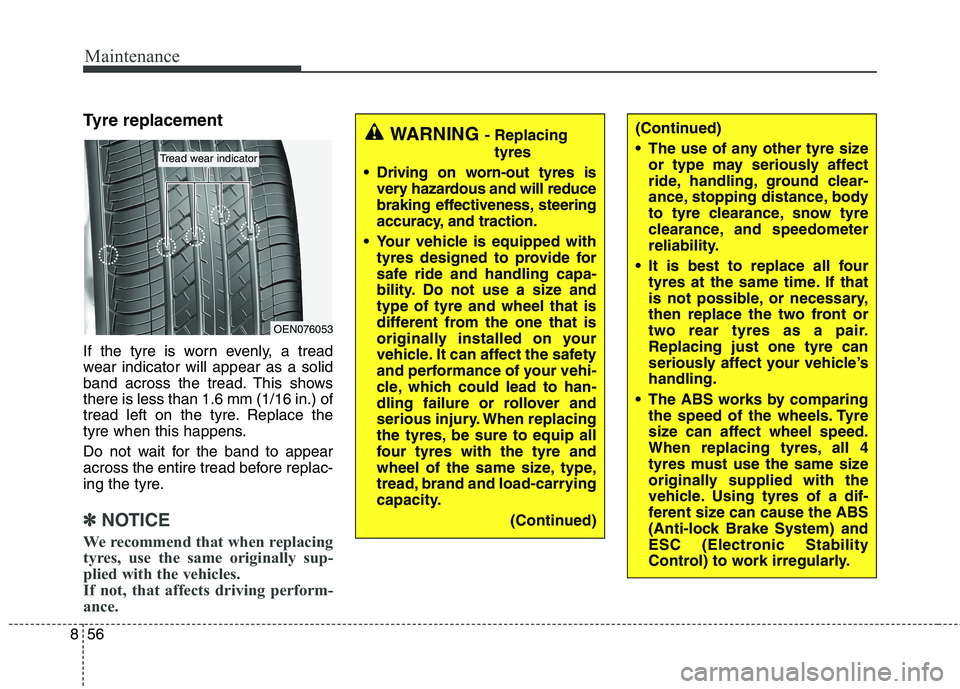
If the tyre is worn evenly, a tread
wear indicator will appear as a solid
band across the tread. This showsthere is less than 1.6 mm (1/16 in.) of
tread left on the tyre. Replace the
tyre when this happens.
Do not wait for the band to appear
across the entire tread before replac-
ing the tyre.
✽✽
NOTICE
We recommend that when replacing
tyres, use the same originally sup-
plied with the vehicles.
If not, that affects driving perform-
ance.
OEN076053
Tread wear indicator
WARNING - Replacing
tyres
Driving on worn-out tyres is very hazardous and will reduce
braking effectiveness, steering
accuracy, and traction.
Your vehicle is equipped with tyres designed to provide for
safe ride and handling capa-
bility. Do not use a size andtype of tyre and wheel that is
different from the one that is
originally installed on your
vehicle. It can affect the safety
and performance of your vehi-
cle, which could lead to han-
dling failure or rollover and
serious injury. When replacing
the tyres, be sure to equip all
four tyres with the tyre and
wheel of the same size, type,
tread, brand and load-carrying
capacity.
(Continued)(Continued)
The use of any other tyre sizeor type may seriously affect
ride, handling, ground clear-
ance, stopping distance, body
to tyre clearance, snow tyre
clearance, and speedometer
reliability.
It is best to replace all four tyres at the same time. If that
is not possible, or necessary,
then replace the two front or
two rear tyres as a pair.Replacing just one tyre can
seriously affect your vehicle’shandling.
The ABS works by comparing the speed of the wheels. Tyre
size can affect wheel speed.
When replacing tyres, all 4
tyres must use the same size
originally supplied with the
vehicle. Using tyres of a dif-
ferent size can cause the ABS
(Anti-lock Brake System) and
ESC (Electronic Stability
Control) to work irregularly.
Page 644 of 723
857
Maintenance
Compact spare tyre replacement (if equipped)
A compact spare tyre has a shorter
tread life than a regular size tyre.
Replace it when you can see the
tread wear indicator bars on the tyre.The replacement compact spare tyre
should be the same size and design
tyre as the one provided with your
new vehicle and should be mountedon the same compact spare tyre
wheel. The compact spare tyre is notdesigned to be mounted on a regular
size wheel, and the compact spare
tyre wheel is not designed for mount-
ing a regular size tyre. Wheel replacement
When replacing the metal wheels for
any reason, make sure the new
wheels are equivalent to the original
factory units in diameter, rim widthand offset.
Tyre traction
Tyre traction can be reduced if you
drive on worn tyres, tyres that are
improperly inflated or on slippery
road surfaces. Tyres should be
replaced when tread wear indicators
appear. To reduce the possibility of
losing control, slow down whenever
there is rain, snow or ice on the road.
Tyre maintenance In addition to proper inflation, correct wheel alignment helps to decrease
tyre wear. If you find a tyre is worn
unevenly, have a professional work-
shop check the wheel alignment. Kia
recommends to visit an authorised
Kia dealer/service partner.
When you have new tyres installed,
make sure they are balanced. This
will increase vehicle ride comfort and
tyre life. Additionally, a tyre should
always be rebalanced if it is removedfrom the wheel.
WARNING
A wheel that is not the correct
size may adversely affect wheel
and bearing life, braking and
stopping abilities, handling
characteristics, ground clear-
ance, body-to-tyre clearance,
snow chain clearance,speedometer and odometer cal-
ibration, headlight aim and
bumper height.
Page 646 of 723
859
Maintenance
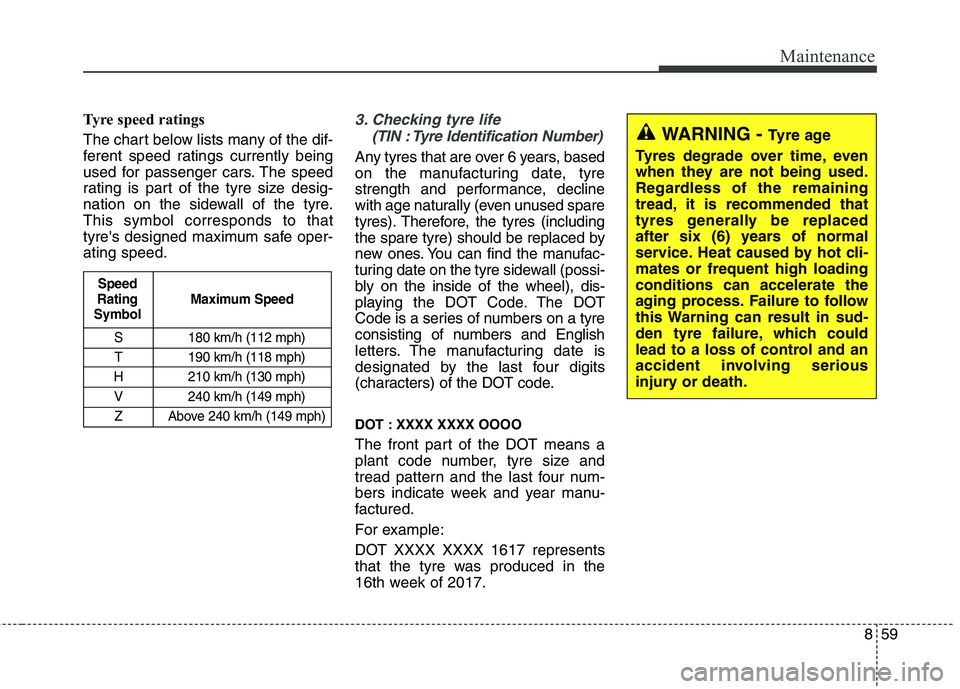
Tyre speed ratings
The chart below lists many of the dif-
ferent speed ratings currently being
used for passenger cars. The speed
rating is part of the tyre size desig-
nation on the sidewall of the tyre.This symbol corresponds to that
tyre's designed maximum safe oper-ating speed.3. Checking tyre life (TIN : Tyre Identification Number)
Any tyres that are over 6 years, based
on the manufacturing date, tyre
strength and performance, decline
with age naturally (even unused spare
tyres). Therefore, the tyres (including
the spare tyre) should be replaced by
new ones. You can find the manufac-
turing date on the tyre sidewall (possi-
bly on the inside of the wheel), dis-
playing the DOT Code. The DOT
Code is a series of numbers on a tyre
consisting of numbers and English
letters. The manufacturing date is
designated by the last four digits
(characters) of the DOT code.
DOT : XXXX XXXX OOOO
The front part of the DOT means a
plant code number, tyre size and
tread pattern and the last four num-
bers indicate week and year manu-
factured.
For example:
DOT XXXX XXXX 1617 represents
that the tyre was produced in the
16th week of 2017.
S 180 km/h (112 mph)
T 190 km/h (118 mph)
H 210 km/h (130 mph) V 240 km/h (149 mph) Z Above 240 km/h (149 mph)
Maximum Speed
Speed
Rating
Symbol
WARNING - Tyre age
Tyres degrade over time, even
when they are not being used.
Regardless of the remaining
tread, it is recommended that
tyres generally be replaced
after six (6) years of normal
service. Heat caused by hot cli-mates or frequent high loadingconditions can accelerate the
aging process. Failure to follow
this Warning can result in sud-
den tyre failure, which could
lead to a loss of control and an
accident involving serious
injury or death.
Page 648 of 723
861
Maintenance
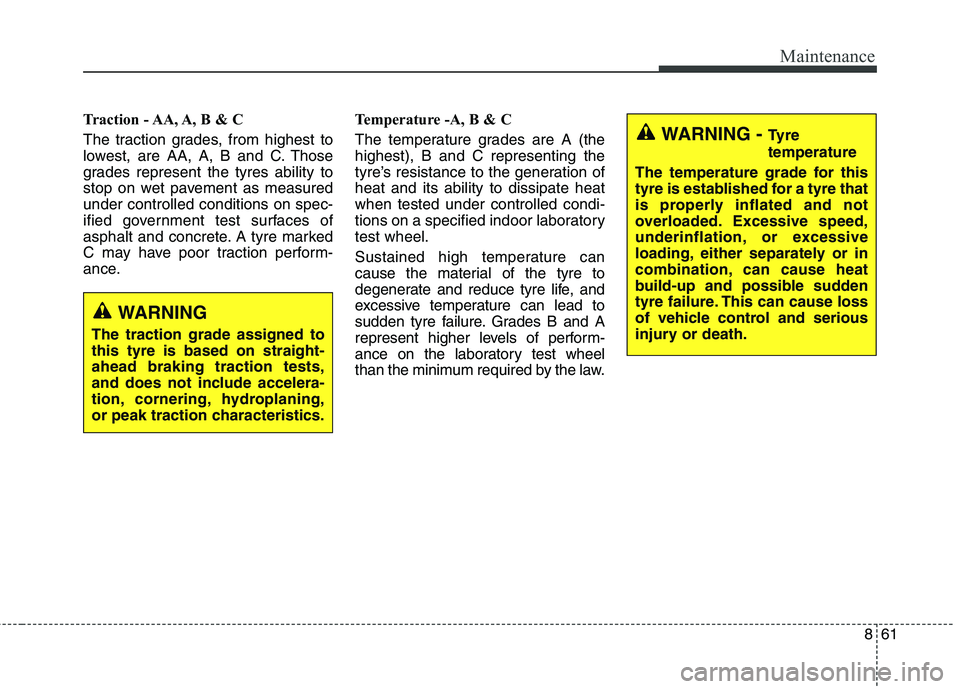
Traction - AA, A, B & C
The traction grades, from highest to
lowest, are AA, A, B and C. Those
grades represent the tyres ability to
stop on wet pavement as measuredunder controlled conditions on spec-
ified government test surfaces of
asphalt and concrete. A tyre marked
C may have poor traction perform-
ance.Temperature -A, B & C
The temperature grades are A (the highest), B and C representing the
tyre’s resistance to the generation ofheat and its ability to dissipate heatwhen tested under controlled condi-
tions on a specified indoor laboratorytest wheel.
Sustained high temperature can
cause the material of the tyre to
degenerate and reduce tyre life, and
excessive temperature can lead to
sudden tyre failure. Grades B and A
represent higher levels of perform-
ance on the laboratory test wheel
than the minimum required by the law.
WARNING -
Tyre temperature
The temperature grade for this
tyre is established for a tyre that
is properly inflated and not
overloaded. Excessive speed,
underinflation, or excessive
loading, either separately or in
combination, can cause heat
build-up and possible sudden
tyre failure. This can cause loss
of vehicle control and serious
injury or death.
WARNING
The traction grade assigned to this tyre is based on straight-ahead braking traction tests,
and does not include accelera-
tion, cornering, hydroplaning,
or peak traction characteristics.
Page 650 of 723
863
Maintenance
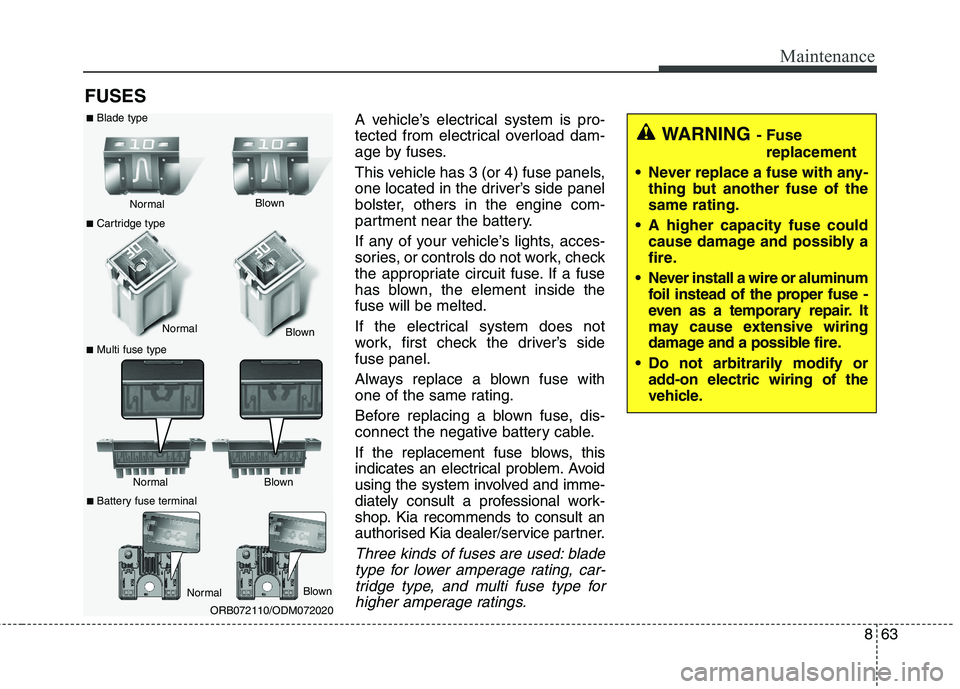
FUSESA vehicle’s electrical system is pro-
tected from electrical overload dam-
age by fuses.
This vehicle has 3 (or 4) fuse panels,
one located in the driver’s side panel
bolster, others in the engine com-
partment near the battery.
If any of your vehicle’s lights, acces-
sories, or controls do not work, check
the appropriate circuit fuse. If a fuse
has blown, the element inside thefuse will be melted.
If the electrical system does not
work, first check the driver’s sidefuse panel.
Always replace a blown fuse with
one of the same rating.
Before replacing a blown fuse, dis-
connect the negative battery cable.
If the replacement fuse blows, this
indicates an electrical problem. Avoid
using the system involved and imme-
diately consult a professional work-
shop. Kia recommends to consult an
authorised Kia dealer/service partner.
Three kinds of fuses are used: bladetype for lower amperage rating, car-tridge type, and multi fuse type for higher amperage ratings.
WARNING - Fuse
replacement
Never replace a fuse with any- thing but another fuse of the same rating.
A higher capacity fuse could cause damage and possibly a
fire.
Never install a wire or aluminum foil instead of the proper fuse -
even as a temporary repair. It
may cause extensive wiring
damage and a possible fire.
Do not arbitrarily modify or add-on electric wiring of the
vehicle.
Normal
Normal
■
Blade type
■ Cartridge type
■ Multi fuse type Blown
Blown
Normal Blown
ORB072110/ODM072020
Normal
Blown
■
Battery fuse terminal
Page 658 of 723
871
Maintenance
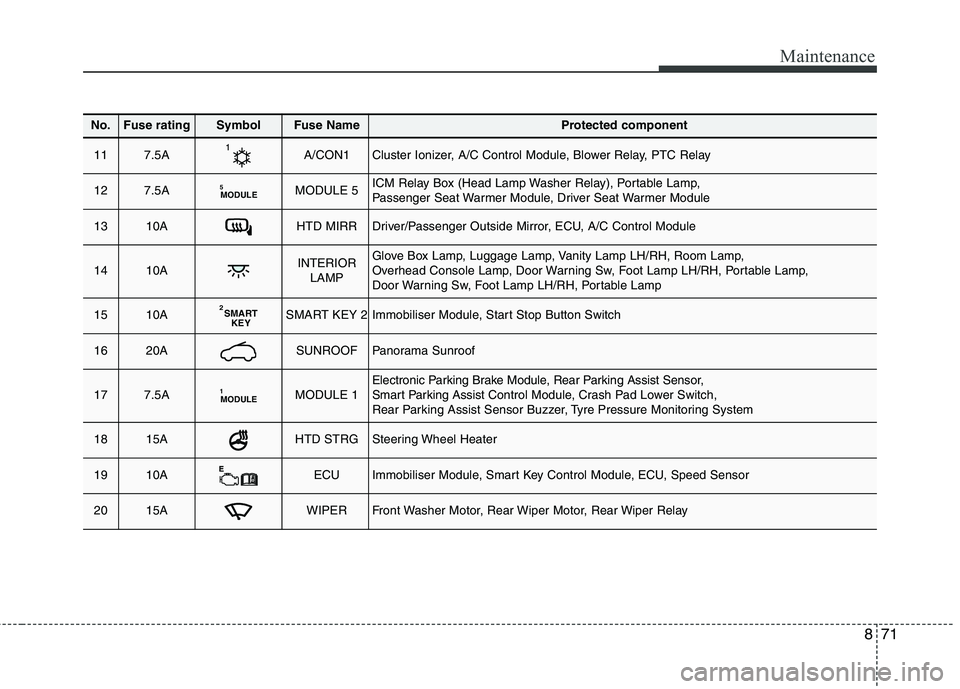
No.Fuse ratingSymbolFuse NameProtected component
117.5AA/CON1Cluster Ionizer, A/C Control Module, Blower Relay, PTC Relay
127.5AMODULE
5MODULE 5ICM Relay Box (Head Lamp Washer Relay), Portable Lamp,
Passenger Seat Warmer Module, Driver Seat Warmer Module
1310AHTD MIRRDriver/Passenger Outside Mirror, ECU, A/C Control Module
1410AINTERIOR
LAMPGlove Box Lamp, Luggage Lamp, Vanity Lamp LH/RH, Room Lamp,
Overhead Console Lamp, Door Warning Sw, Foot Lamp LH/RH, Portable Lamp,
Door Warning Sw, Foot Lamp LH/RH, Portable Lamp
1510ASMARTKEY
2SMART KEY 2Immobiliser Module, Start Stop Button Switch
1620ASUNROOFPanorama Sunroof
177.5AMODULE1MODULE 1Electronic Parking Brake Module, Rear Parking Assist Sensor,
Smart Parking Assist
Control Module, Crash Pad Lower Switch,
Rear Parking Assist Sensor Buzzer, Tyre Pressure Monitoring System
1815AHTD STRGSteering Wheel Heater
1910AECUImmobiliser Module, Smart Key Control Module, ECU, Speed Sensor
2015AWIPERFront Washer Motor, Rear Wiper Motor, Rear Wiper Relay
Page 659 of 723
Maintenance
72
8
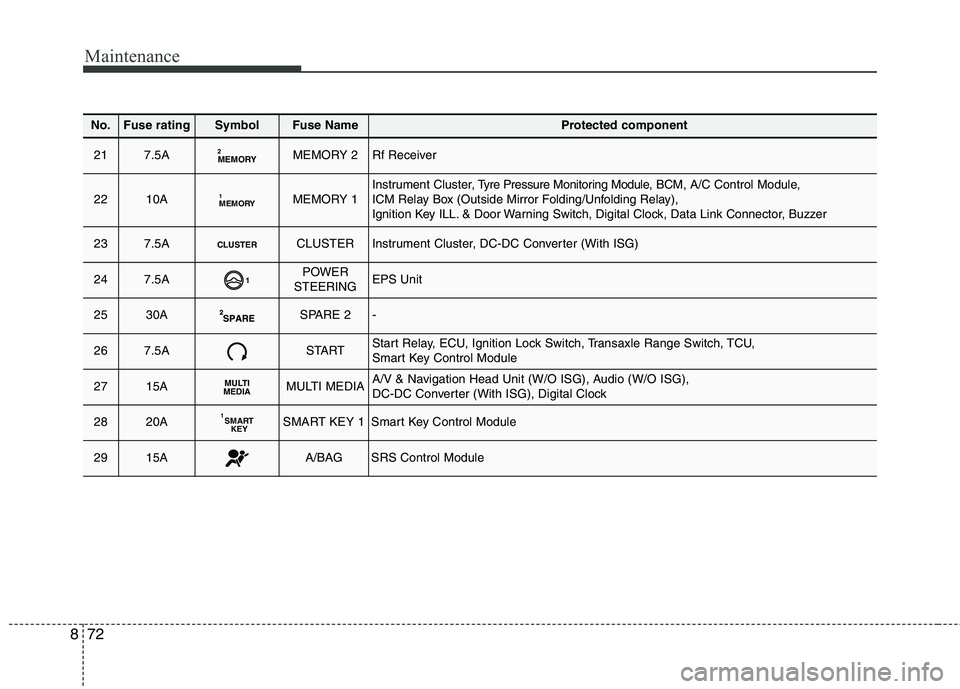
No.Fuse ratingSymbolFuse NameProtected component
217.5AMEMORY2MEMORY 2Rf Receiver
2210AMEMORY
1MEMORY 1Instrument Cluster, T
yre Pressure Monitoring Module, BCM, A/C Control Module,
ICM Relay Box (Outside Mirror Folding/Unfolding Relay),
Ignition Key ILL. & Door Warning Switch, Digital Clock, Data Link Connector, Buzzer
237.5ACLUSTERCLUSTERInstrument Cluster, DC-DC Converter (With ISG)
247.5A1POWER
STEERINGEPS Unit
2530ASPARE 2-
267.5ASTARTStart Relay, ECU, Ignition Lock Switch, Transaxle Range Switch, TCU,
Smart Key Control Module
2715AMULTI
MEDIAMULTI MEDIAA/V & Navigation Head Unit (W/O ISG), Audio (W/O ISG),
DC-DC Converter (With ISG), Digital Clock
2820ASMART KEY
1SMART KEY 1Smart Key Control Module
2915AA/BAGSRS Control Module
Page 671 of 723
Maintenance
84
8
LIGHT BULBS
Use only the bulbs of the specified
wattage.
✽✽ NOTICE
After driving in heavy rain or wash-
ing the vehicle, headlight and tail-
light lenses could appear foggy. This
condition is caused by the tempera-
ture difference between the lamp
inside and outside. This is similar to
the condensation on your windows
inside your vehicle during rain and
does not indicate a problem with
your vehicle. If the water leaks into
the lamp bulb circuitry, have the
vehicle checked by a professional
workshop. Kia recommends to visit
an authorised Kia dealer/service
partner.WARNING - Working on
the lights
Prior to working on the light,
firmly apply the parking brake,
ensure that the ignition switch
is turned to the “LOCK” position
(smart key: turn off the engine)
and turn off the lights to avoid
sudden movement of the vehi-
cle and burning your fingers or
getting an electric shock.
CAUTION
Be sure to replace the burned- out bulb with one of the samewattage rating. Otherwise, it may cause damage to the fuseor electric wiring system.
CAUTION
If you don’t have necessarytools, the correct bulbs and theexpertise, consult a profession- al workshop. Kia recommendsto consult an authorised Kiadealer/service partner.
In many cases, it is difficult toreplace vehicle light bulbs because other parts of the vehi-cle must be removed before youcan get to the bulb. This is espe-cially true if you have to remove the headlight assembly to get tothe bulb(s).
Removing/installing the head-light assembly can result indamage to the vehicle.