warning KIA CARENS RHD 2018 Owners Manual
[x] Cancel search | Manufacturer: KIA, Model Year: 2018, Model line: CARENS RHD, Model: KIA CARENS RHD 2018Pages: 723, PDF Size: 40.94 MB
Page 594 of 723
87
Maintenance
Engine compartment precau- tions (Diesel engine)
• The injector operates at high volt-age (maximum 200v). Therefore,
the following accidents may occur.
- Direct contact with the injector orinjector wiring may cause electric
shock or damage your muscle or
nerve system.
- The electromagnetic wave from the operating injector may cause
the artificial heart pacemaker tomalfunction.
Follow the safety tips provided below, when you are checking theengine room whilst the engine is
running.
- Do not touch the injector, injectorwirings, and the engine computer
whilst the engine is running.
- Do not remove the injector con- nector whilst the engine is run-ning.
- People using pacemakers must not go near the engine whilst the
engine is starting or running.WARNING - Maintenance
work
Performing maintenance work on a vehicle can be danger-
ous. You can be seriously
injured while performing
some maintenance proce-
dures. If you lack sufficient
knowledge and experience or
the proper tools and equip-
ment to do the work, have the
system serviced by a profes-
sional workshop. Kia recom-mends to visit an authorised
Kia dealer/service partner.
Working under the bonnet with the engine running is
dangerous. It becomes even
more dangerous when you
wear jewelry or loose cloth-
ing. These can become entan-
gled in moving parts and
result in injury.
(Continued)(Continued)
Therefore, if you must run the
engine whilst working under
the bonnet, make certain that
you remove all jewelry (espe-
cially rings, bracelets, watch-
es, and necklaces) and all
neckties, scarves, and similar
loose clothing before gettingnear the engine or coolingfans.
Page 595 of 723
Maintenance
8
8
WARNING - Diesel Engine
Never work on injection system with engine running or within 30seconds after shutting off
engine. High-pressure pump,
rail, injectors and high-pressurepipes are subject to high pres-
sure even after the engine
stopped. The fuel jet produced by
fuel leaks may cause serious
injury, if it touches the body.
People using pacemakers
should not move than 30cm clos-er to the ECU or wiring harness
within the engine room whilst
engine is running, since the high
currents in the electronic engine
control system produce consid-
erable magnetic fields.CAUTION
Do not put heavy objects or apply excessive force on top ofthe engine cover (if equipped)or fuel related parts.
When you inspect the fuel sys- tem (fuel lines and fuel injec-tion devices), contact a profes- sional workshop. Kia recom-mends to visit an authorisedKia dealer/service partner.
Do not drive long time with the engine cover (if equipped)removed.
When checking the engine room, do not go near fire.
Fuel, washer fluid, etc. areflammable oils that may causefire.
Before touching the battery, ignition cables and electricalwiring, you should disconnect the battery "-" terminal. Youmay get an electric shockfrom the electric current.
(Continued)
(Continued) When you remove the interior trim cover with a flat head (-)driver, be careful not to dam-age the cover.
Be careful when you replace and clean bulbs to avoidburns or electrical shock.
Page 596 of 723
89
Maintenance
OWNER MAINTENANCE
The following lists are vehicle checks and inspections that should be per-
formed at the frequencies indicated
to help ensure safe, dependable
operation of your vehicle.
Any adverse conditions should be
brought to the attention of your deal-
er as soon as possible.
These Owner Maintenance Checks
are generally not covered by war-
ranties and you may be charged for
labor, parts and lubricants used. Owner maintenance schedule
When you stop for fuel:
Check the engine oil level.
Check coolant level in coolant
reservoir.
Check the windscreen washer fluid level.
Look for low or under-inflated tyres.
Check the radiator and condenser. Check if the front of the radiator and condenser are clean and not
blocked with leaves, dirt or insectsetc.
If any of the above parts are
extremely dirty or you are not sure
of their condition, contact a profes-
sional workshop. Kia recommends
to visit an authorised Kia
dealer/service partner.
Whilst operating your vehicle:
Note any changes in the sound ofthe exhaust or any smell of
exhaust fumes in the vehicle.
Check for vibrations in the steering wheel. Notice any increased steer-
ing effort or looseness in the steer-
ing wheel, or change in its straight-ahead position.
Notice if your vehicle constantly turns slightly or “pulls” to one side
when travelling on smooth, levelroad.
When stopping, listen and check for unusual sounds, pulling to one
side, increased brake pedal travel
or “hard-to-push” brake pedal.
If any slipping or changes in the operation of your transaxle occurs,
check the transaxle fluid level.
Check manual transaxle operation, including clutch operation.
WARNING
Be careful when checking your
engine coolant level when the
engine is hot. Scalding hot
coolant and steam may blow out
under pressure. This could cause
burns or other serious injury.
Page 597 of 723
Maintenance
10
8
Check automatic transaxle / dual
clutch transmission P (Park) func- tion.
Check parking brake.
Check for fluid leaks under your vehicle (water dripping from the air
conditioning system during or after
use is normal).
At least monthly:
Check coolant level in the enginecoolant reservoir.
Check the operation of all exterior lights, including the stoplights, turn
signals and hazard warning flash-
ers.
Check the inflation pressures of all tyres including the spare.
At least twice a year
(i.e., every Spring and Fall) :
Check radiator, heater and air con- ditioning hoses for leaks or dam-
age.
Check windscreen washer spray and wiper operation. Clean wiper
blades with clean cloth dampened
with washer fluid.
Check headlight alignment.
Check muffler, exhaust pipes, shields and clamps.
Check the lap/shoulder belts for wear and function.
Check for worn tyres and loose wheel lug nuts.
At least once a year :
Clean body and door drain holes.
Lubricate door hinges and checks,and bonnet hinges.
Lubricate door and bonnet locks and latches.
Lubricate door rubber weather- strips.
Check the air conditioning system.
Inspect and lubricate automatic transaxle / dual clutch transmission
linkage and controls.
Clean battery and terminals.
Check the brake (and clutch) fluid level.
Page 615 of 723
Maintenance
28
8
EXPLANATION OF SCHEDULED MAINTENANCE ITEMS
Engine oil and filter The engine oil and filter should be
changed at the intervals specified in
the maintenance schedule. If the car
is being driven in severe conditions,more frequent oil and filter changesare required. Drive belts
Inspect all drive belts for evidence of
cuts, cracks, excessive wear or oil
saturation and replace if necessary.
Drive belts should be checked peri-
odically for proper tension and
adjusted as necessary. Fuel filter cartridge (for diesel) A clogged filter can limit the speed at
which the vehicle may be driven,damage the emission system and
cause multiple issues such as hard
starting. If an excessive amount of for-
eign matter accumulates in the fuel
tank, the filter may require replace-
ment more frequently. After installing
a new filter, run the engine for several
minutes, and check for leaks at the
connections. Have the fuel filter
replaced by a professional workshop.Kia recommends to visit an autho-
rised Kia dealer/service partner.
Fuel filter (for petrol)
Kia petrol vehicle is equipped a life-
time fuel filter that integrated with the
fuel tank. Regular maintenance or
replacement is not needed but
depends on fuel quality. If there are
some important safety matters like
fuel flow restriction, surging, loss of
power, hard starting problem etc, fuelfilter inspection or replace is needed.
Have the fuel filter inspected or
replaced by a professional workshop.Kia recommends to visit an autho-
rised Kia dealer/service partner.Fuel lines, fuel hoses and con- nections
Check the fuel lines, fuel hoses and
connections for leakage and dam-
age. Have the fuel lines, fuel hoses
and connections replaced by a pro-
fessional workshop. Kia recommends
to visit an authorised Kia dealer/serv-
ice partner.
WARNING -
Diesel only
Never work on injection system with engine running or within 30seconds after shutting off
engine. High pressure pump,
rail, injectors and high pressurepipes are subject to high pres-
sure even after the engine
stopped. The fuel jet produced
by fuel leaks may cause serious
injury, if it touch the body. People
using pacemakers should not
move more than 30cm closer tothe ECU or wiring harness with-
in the engine room whilst engine
is running, since the high cur-rents in the Common Rail sys-
tem produce considerable mag-netic fields.
CAUTION
When you are inspecting the belt, place the ignition
switch in the LOCK/OFF or ACCposition.
Page 616 of 723
829
Maintenance
Vapour hose and fuel filler cap
The vapour hose and fuel filler cap should be inspected at those inter-
vals specified in the maintenance
schedule. Make sure that a new
vapour hose or fuel filler cap is cor-rectly replaced.Vacuum crankcase ventilation hoses (if equipped)
Inspect the surface of hoses for evi- dence of heat and/or mechanical
damage. Hard and brittle rubber,
cracking, tears, cuts, abrasions, and
excessive swelling indicate deterio-
ration. Particular attention should be
paid to examine those hose surfaces
nearest to high heat sources, such
as the exhaust manifold. Inspect the hose routing to assure that the hoses do not come in con-
tact with any heat source, sharp
edges or moving component whichmight cause heat damage or
mechanical wear. Inspect all hose
connections, such as clamps and
couplings, to make sure they are
secure, and that no leaks are pres-
ent. Hoses should be replaced
immediately if there is any evidence
of deterioration or damage.Air cleaner filter
Have the air cleaner filter replaced by
a professional workshop. Kia recom-
mends to visit an authorised Kia
dealer/service partner. Spark plugs
(for petrol engine)
Make sure to install new spark plugs
of the correct heat range.
WARNING
Do not disconnect and inspect spark plugs when the engine is
hot. You may burn yourself.
Page 619 of 723
Maintenance
32
8
ENGINE OIL (PETROL)
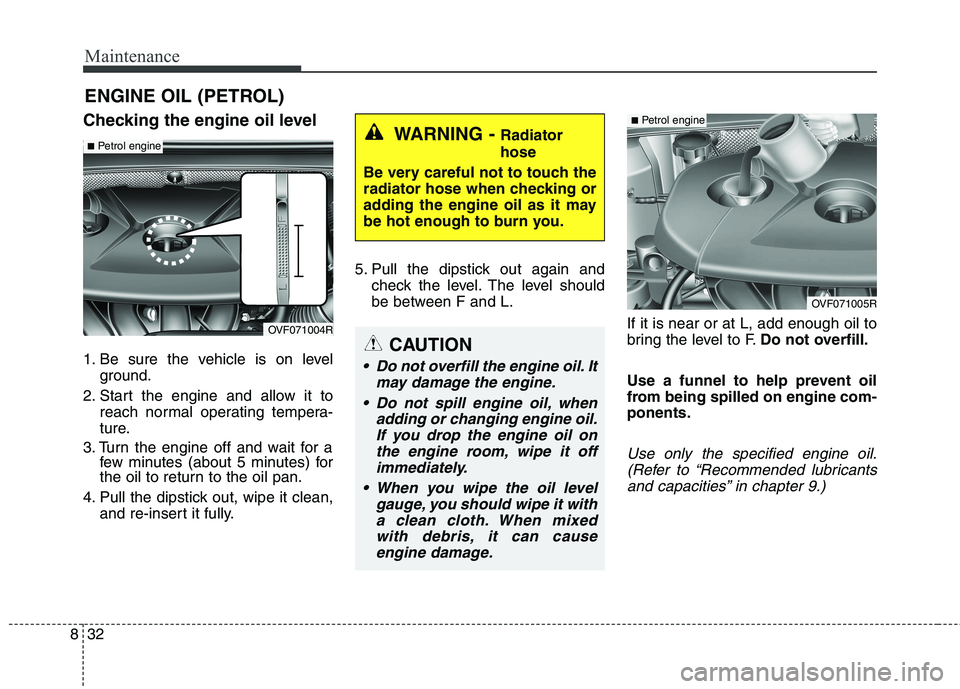
Checking the engine oil level
1. Be sure the vehicle is on level ground.
2. Start the engine and allow it to reach normal operating tempera-
ture.
3. Turn the engine off and wait for a few minutes (about 5 minutes) for
the oil to return to the oil pan.
4. Pull the dipstick out, wipe it clean, and re-insert it fully. 5. Pull the dipstick out again and
check the level. The level should
be between F and L.
If it is near or at L, add enough oil to
bring the level to F.Do not overfill.
Use a funnel to help prevent oil
from being spilled on engine com-ponents.
Use only the specified engine oil. (Refer to “Recommended lubricantsand capacities” in chapter 9.)
WARNING - Radiator
hose
Be very careful not to touch the
radiator hose when checking or
adding the engine oil as it may
be hot enough to burn you.
CAUTION
Do not overfill the engine oil. It may damage the engine.
Do not spill engine oil, when adding or changing engine oil.If you drop the engine oil onthe engine room, wipe it offimmediately.
When you wipe the oil level gauge, you should wipe it witha clean cloth. When mixedwith debris, it can causeengine damage.
OVF071004R
■ Petrol engine
OVF071005R
■Petrol engine
Page 620 of 723
833
Maintenance
ENGINE OIL (DIESEL)
Changing the engine oil and filter
Have the engine oil and filter
replaced by a professional workshop.Kia recommends to visit an autho-
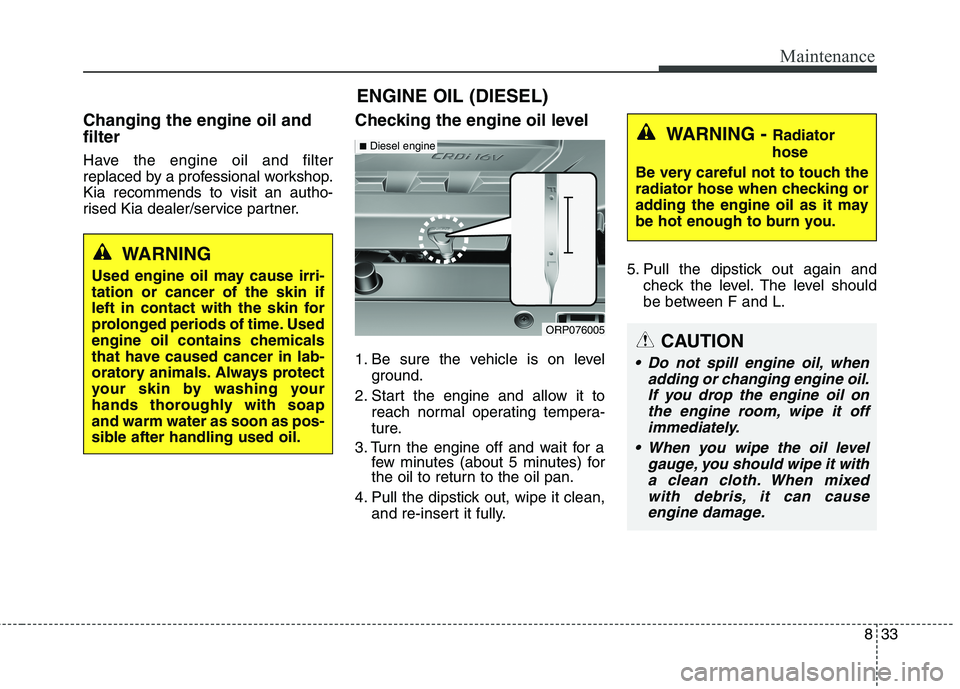
rised Kia dealer/service partner.Checking the engine oil level
1. Be sure the vehicle is on level
ground.
2. Start the engine and allow it to reach normal operating tempera-
ture.
3. Turn the engine off and wait for a few minutes (about 5 minutes) for
the oil to return to the oil pan.
4. Pull the dipstick out, wipe it clean, and re-insert it fully. 5. Pull the dipstick out again and
check the level. The level should
be between F and L.
WARNING
Used engine oil may cause irri- tation or cancer of the skin if
left in contact with the skin for
prolonged periods of time. Used
engine oil contains chemicals
that have caused cancer in lab-
oratory animals. Always protect
your skin by washing your
hands thoroughly with soapand warm water as soon as pos-
sible after handling used oil.
ORP076005
■ Diesel engineWARNING - Radiator
hose
Be very careful not to touch the
radiator hose when checking or
adding the engine oil as it may
be hot enough to burn you.
CAUTION
Do not spill engine oil, when adding or changing engine oil.If you drop the engine oil on the engine room, wipe it offimmediately.
When you wipe the oil level gauge, you should wipe it witha clean cloth. When mixed with debris, it can causeengine damage.
Page 621 of 723
Maintenance
34
8
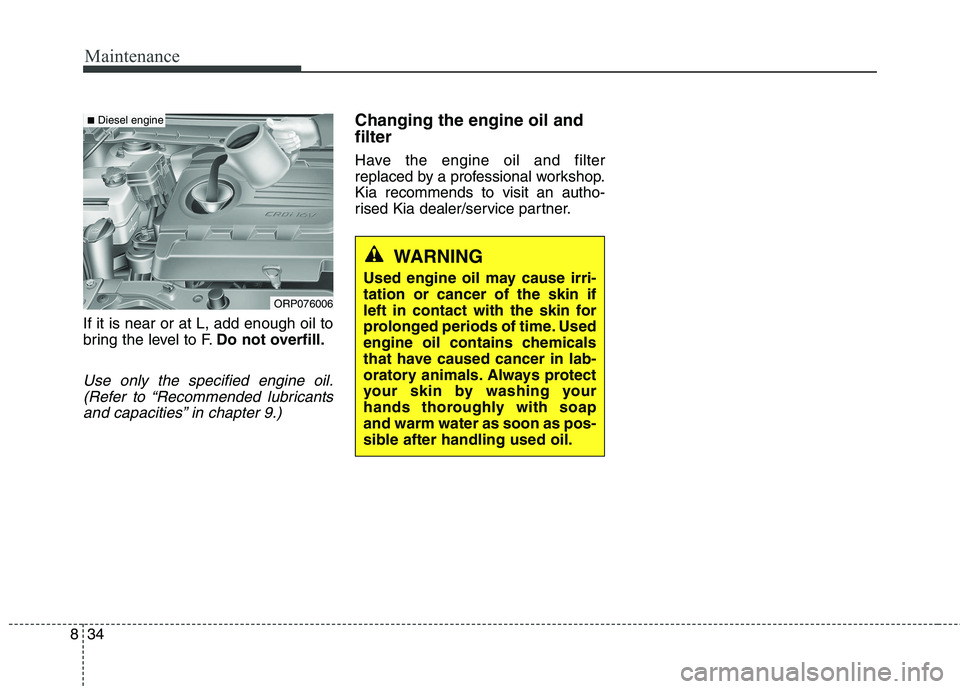
If it is near or at L, add enough oil to
bring the level to F. Do not overfill.
Use only the specified engine oil.
(Refer to “Recommended lubricantsand capacities” in chapter 9.)
Changing the engine oil and filter
Have the engine oil and filter
replaced by a professional workshop.Kia recommends to visit an autho-
rised Kia dealer/service partner.
ORP076006
■ Diesel engine
WARNING
Used engine oil may cause irri- tation or cancer of the skin if
left in contact with the skin for
prolonged periods of time. Used
engine oil contains chemicals
that have caused cancer in lab-
oratory animals. Always protect
your skin by washing your
hands thoroughly with soapand warm water as soon as pos-
sible after handling used oil.
Page 622 of 723
835
Maintenance
ENGINE COOLANT
The high-pressure cooling system
has a reservoir filled with year-round
antifreeze coolant. The reservoir is
filled at the factory.
Check the antifreeze protection and
coolant concentration level at least
once a year, at the beginning of the
winter season, and before travelling
to a colder climate. Checking the coolant level
(Continued)
When you are sure all the pressure has been released,
press down on the cap, using
a thick towel, and continue
turning counterclockwise to
remove it.
Even if the engine is not oper- ating, do not remove the radi-ator cap or the drain plugwhilst the engine and radiator
are hot. Hot coolant and
steam may still blow out
under pressure, causing seri-
ous injury.
WARNING
Removing radiatorcap
Never attempt to remove the radiator cap whilst the engine
is operating or hot. Doing somight lead to cooling system
and engine damage and could
result in serious personal
injury from escaping hotcoolant or steam.
Turn the engine off and wait until it cools down. Use
extreme care when removing
the radiator cap. Wrap a thick
towel around it, and turn it
counterclockwise slowly to
the first stop. Step back whilst
the pressure is released fromthe cooling system.
(Continued)
CAUTION
When the engine overheatsfrom low engine coolant, sud-denly adding engine coolantmay cause cracks in theengine. To prevent damage, add engine coolant slowly insmall quantities.
Do not drive with no engine coolant. It may cause waterpump failure and engine seizure, etc.