weight KIA CARENS RHD 2018 Owner's Manual
[x] Cancel search | Manufacturer: KIA, Model Year: 2018, Model line: CARENS RHD, Model: KIA CARENS RHD 2018Pages: 723, PDF Size: 40.94 MB
Page 547 of 723
Driving your vehicle
112
6
✽✽
NOTICE
With increasing altitude the engine
performance decreases. From 1,000
m above sea level and for every
1,000 m thereafter 10% of
vehicle/trailer weight (trailer
weighter + gross vehicle weight)
must be deducted.WARNING - Trailer
Never load a trailer with more weight in the rear than in the
front. The front should be
loaded with approximately60% of the total trailer load;the rear should be loaded with
approximately 40% of the totaltrailer load.
Never exceed the maximum weight limits of the trailer or
trailer towing equipment.
Improper loading can result in
damage to your vehicle and/or
personal injury. Checkweights and loading at a com-
mercial scale or highway
patrol office equipped withscales.
An improperly loaded trailer can cause loss of vehicle con-
trol.
Page 548 of 723
6113
Driving your vehicle
This section will guide you in the
proper loading of your vehicle and/or
trailer, to keep your loaded vehicle
weight within its design rating capa-
bility, with or without a trailer.
Properly loading your vehicle will
provide maximum return of the vehi-
cle design performance. Before load-
ing your vehicle, familiarize yourself
with the following terms for determin-
ing your vehicle's weight ratings, with
or without a trailer, from the vehicle's
specifications and the certificationlabel:Base kerb weight
This is the weight of the vehicle including a full tank of fuel and all
standard equipment. It does not
include passengers, cargo, or option-al equipment.
Vehicle kerb weight
This is the weight of your new vehicle
when you picked it up from your deal-
er plus any aftermarket equipment.
Cargo weight
This figure includes all weight added
to the Base Kerb Weight, includingcargo and optional equipment.GAW (Gross axle weight)
This is the total weight placed on each axle (front and rear) - including
vehicle kerb weight and all payload.
GAWR
(Gross axle weight rating)
This is the maximum allowable
weight that can be carried by a single
axle (front or rear). These numbers
are shown on the certification label.
The total load on each axle must
never exceed its GAWR.
GVW (Gross vehicle weight)
This is the Base Kerb Weight plus
actual Cargo Weight plus passen-
gers.
VEHICLE WEIGHT
Page 549 of 723
Driving your vehicle
114
6
GVWR
(Gross vehicle weight rating)
This is the maximum allowable
weight of the fully loaded vehicle
(including all options, equipment,
passengers and cargo). The GVWR
is shown on the certification label. Overloading Loading Your Vehicle
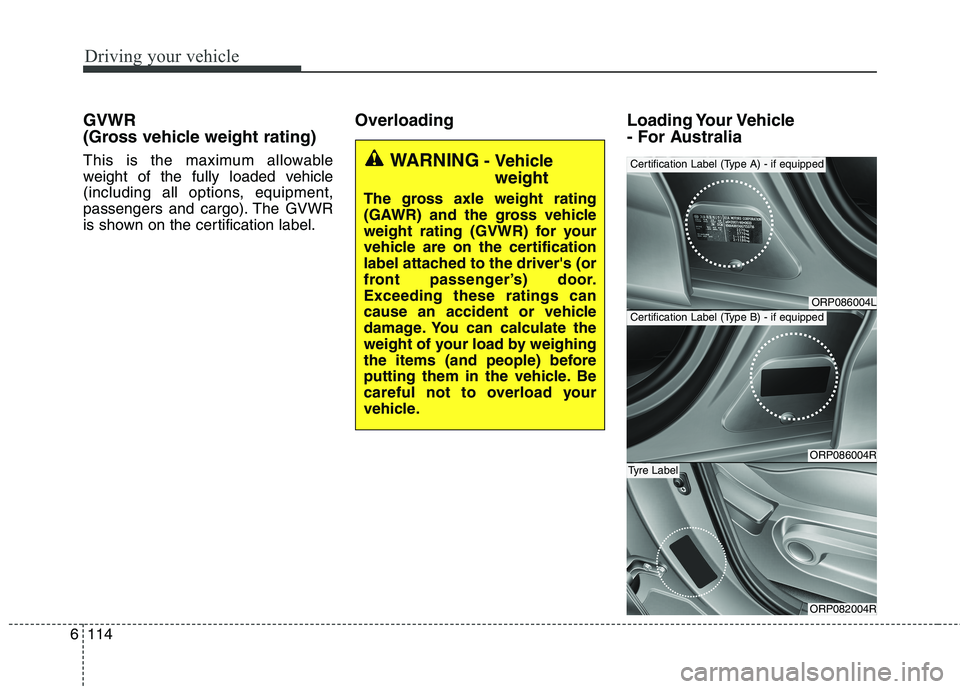
- For Australia
WARNING- Vehicle
weight
The gross axle weight rating
(GAWR) and the gross vehicle
weight rating (GVWR) for your
vehicle are on the certification
label attached to the driver's (or
front passenger’s) door.Exceeding these ratings can
cause an accident or vehicle
damage. You can calculate the
weight of your load by weighing
the items (and people) before
putting them in the vehicle. Be
careful not to overload your
vehicle.
ORP086004L
ORP086004R
Certification Label (Type B) - if equipped
Certification Label (Type A) - if equipped
Tyre Label
ORP082004R
Page 550 of 723
6115
Driving your vehicle
The Certification/Tyre label is found on the front edge of the RH (or LH)
“B” pillar. The label shows the size of
your original tyres and inflation pres-
sures needed to obtain the gross
weight capacity of your vehicle. This is called the GVWR (Gross
Vehicle Weight Rating). The GVWR
includes the weight of the vehicle, all
occupants, fuel and cargo. The
Certification/Tyre label also tells you
the maximum weights for the front
and rear axles, called Gross Axle
Weight Rating (GAWR).
Never exceed the GVWR for your
vehicle, or the Gross Axle Weight
Rating (GAWR) for either the front or
rear axle. And, if you do have a
heavy load, you should spread it out.
✽✽NOTICE
Your warranty does not cover parts
or components that fail because of
overloading.
CAUTION
Do not load your vehicle any heavier than the GVWR or themaximum front and rear GAWRs. If you do, change to the vehiclemay occur, or it can change theway your vehicle handles. These could cause you to lose control.Also, overloading can shortenthe life of your vehicle.
Page 581 of 723
731
What to do in an emergency
Notes on the safe use of the
Tyre Mobility Kit
Park your car at the side of theroad so that you can work with the
TMK away from moving traffic.
Place your warning triangle in a
prominent place to make passing
vehicles aware of your location.
To be sure your vehicle will not move, even when you're on fairly
level ground, always set your park-
ing brake.
Only use the TMK for sealing/infla- tion passenger car tyres. Do not
use on motorcycles, bicycles or
any other type of tyres.
Do not remove any foreign objects- such as nails or screws -that have
penetrated the tyre.
Before using the TMK, read the precautionary advice printed onthe sealant bottle!
Provided the car is outdoors, leave the engine running. Otherwise
operating the compressor may
eventually drain the car battery. Never leave the TMK unattended
whilst it is being used.
Do not leave the compressor run- ning for more than 10 min. at a time
or it may overheat.
Do not use the TMK if the ambient temperature is below -30°C (-22°F).
When the tyre and wheel are dam- aged, do not use Tyre Mobility Kit
for your safety. Technical Data
System voltage: DC 12 V
Working voltage: DC 10 - 15 V
Amperage rating: max. 15 A
Suitable for use at temperatures:
-30 ~ +70°C (-22 ~ +158°F)
Max. working pressure: 6 bar (87 psi)
Size
Compressor: 170 x 150 x 60 mm (6.7 x 5.9 x 2.4 in.)
Sealant bottle: 85 x 77 ø mm (3.3 x 3.0 ø in.)
Compressor weight: 0.8 kg (1.8 lbs)
Sealant volume: 200 ml (12.2 cu. in.)
❈ Sealant and spare parts can be obtained and replaced at an
authorised vehicle or tyre dealer.
Empty sealant bottles may be dis-
posed of at home. Liquid residuefrom the sealant should be dis-
posed of by your vehicle or tyredealer or in accordance with local
waste disposal regulations.
Page 639 of 723
Maintenance
52
8
TYRES AND WHEELS
Tyre care
For proper maintenance, safety, and
maximum fuel economy, you must
always maintain recommended tyre
inflation pressures and stay within
the load limits and weight distribution
recommended for your vehicle. Recommended cold tyre infla- tion pressures All tyre pressures (including the
spare) should be checked when the
tyres are cold. “Cold Tyres” means
the vehicle has not been driven for at
least three hours or driven less than1.6 km (1 mile).
Recommended pressures must be
maintained for the best ride, top vehi-
cle handling, and minimum tyre wear.
For recommended inflation pressure
refer to “Tyre and wheels” in chapter 9. All specifications (sizes and pres-
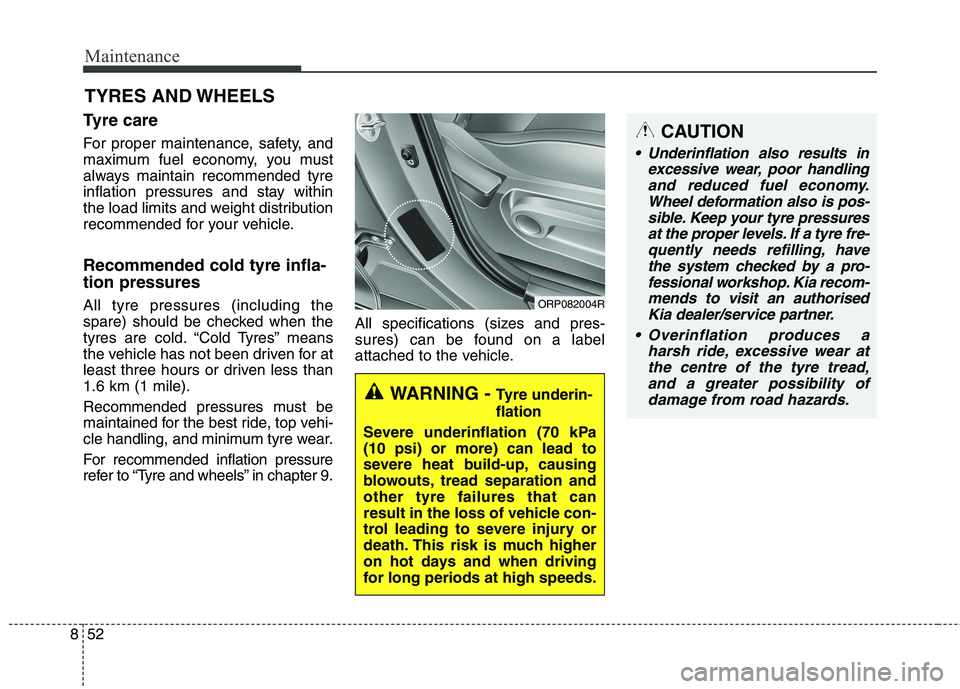
sures) can be found on a label
attached to the vehicle.
ORP082004R
WARNING -
Tyre underin- flation
Severe underinflation (70 kPa (10 psi) or more) can lead to
severe heat build-up, causing
blowouts, tread separation andother tyre failures that can
result in the loss of vehicle con-
trol leading to severe injury or
death. This risk is much higher
on hot days and when driving
for long periods at high speeds.
CAUTION
Underinflation also results in excessive wear, poor handlingand reduced fuel economy. Wheel deformation also is pos-sible. Keep your tyre pressuresat the proper levels. If a tyre fre- quently needs refilling, havethe system checked by a pro-fessional workshop. Kia recom- mends to visit an authorisedKia dealer/service partner.
Overinflation produces a harsh ride, excessive wear atthe centre of the tyre tread, and a greater possibility ofdamage from road hazards.
Page 642 of 723
855
Maintenance
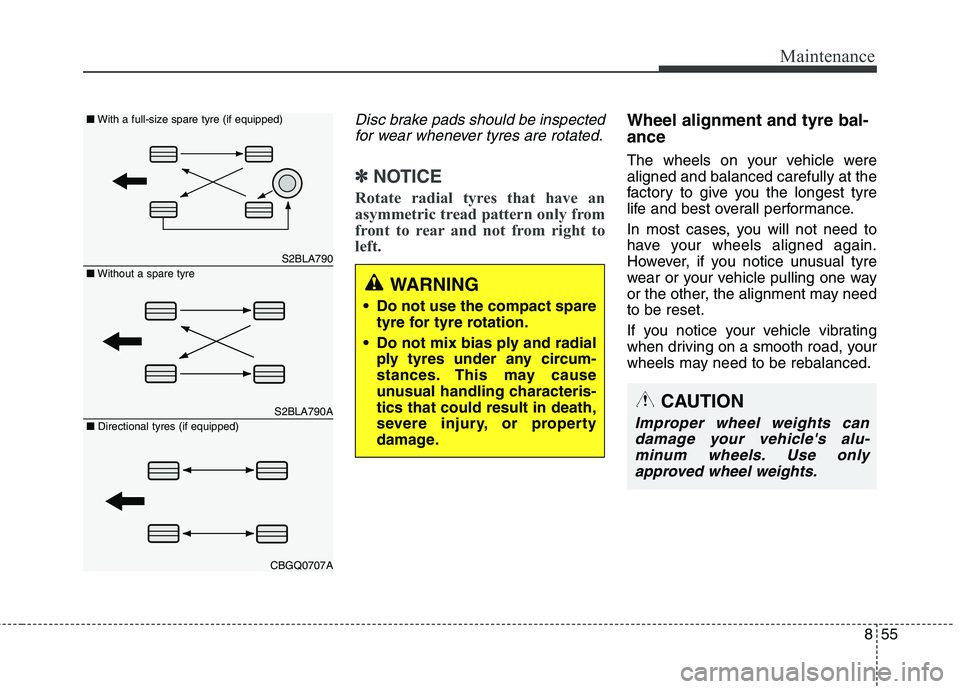
Disc brake pads should be inspectedfor wear whenever tyres are rotated.
✽✽ NOTICE
Rotate radial tyres that have an
asymmetric tread pattern only from
front to rear and not from right to
left.
Wheel alignment and tyre bal- ance
The wheels on your vehicle were aligned and balanced carefully at the
factory to give you the longest tyre
life and best overall performance.
In most cases, you will not need to
have your wheels aligned again.
However, if you notice unusual tyre
wear or your vehicle pulling one way
or the other, the alignment may needto be reset.
If you notice your vehicle vibrating
when driving on a smooth road, your
wheels may need to be rebalanced.
WARNING
Do not use the compact spare tyre for tyre rotation.
Do not mix bias ply and radial ply tyres under any circum-
stances. This may cause
unusual handling characteris-tics that could result in death,
severe injury, or property
damage.
S2BLA790
S2BLA790A
CBGQ0707A
■Without a spare tyre
■
With a full-size spare tyre (if equipped)
■ Directional tyres (if equipped)
CAUTION
Improper wheel weights can
damage your vehicle's alu-minum wheels. Use onlyapproved wheel weights.
Page 700 of 723
Specifications & Consumer information
Dimensions . . . . . . . . . . . . . . . . . . . . . . . . . . . . . . . . 9-2
Engine . . . . . . . . . . . . . . . . . . . . . . . . . . . . . . . . . . . . 9-2
Gross vehicle weight. . . . . . . . . . . . . . . . . . . . . . . . . 9-3
Luggage volume . . . . . . . . . . . . . . . . . . . . . . . . . . . . 9-4
bulb wattage . . . . . . . . . . . . . . . . . . . . . . . . . . . . . . . 9-5
Tyres and wheels . . . . . . . . . . . . . . . . . . . . . . . . . . . 9-6
Recommended lubricants and capacities . . . . . . . . 9-8• Recommends Engine Oil (For Europe) . . . . . . . . . . . . 9-9
Vehicle identification number (VIN) . . . . . . . . . . 9-11
Vehicle certification label. . . . . . . . . . . . . . . . . . . . 9-11
Tyre specification and pressure label . . . . . . . . . . 9-12
Engine number . . . . . . . . . . . . . . . . . . . . . . . . . . . . 9-12
Air conditioner compressor label . . . . . . . . . . . . . 9-13
Refrigerant label. . . . . . . . . . . . . . . . . . . . . . . . . . . 9-13
Declaration of conformity . . . . . . . . . . . . . . . . . . . 9-13
9
Page 702 of 723
93
Specifications & Consumer information
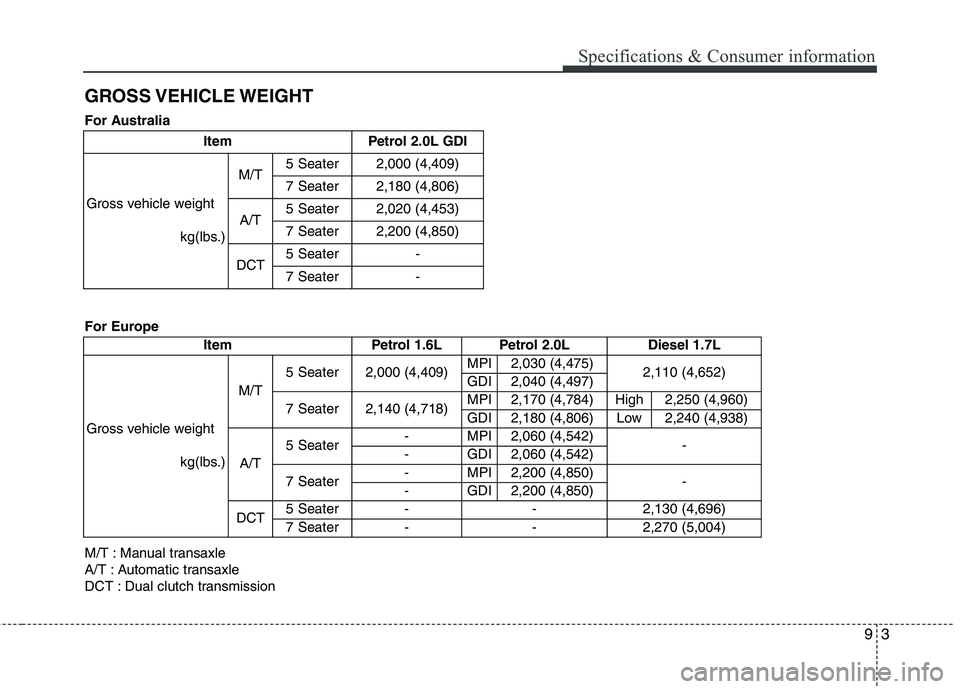
GROSS VEHICLE WEIGHT
Item Petrol 2.0L GDI
Gross vehicle weight kg(lbs.)M/T
5 Seater 2,000 (4,409)
7 Seater 2,180 (4,806)
A/T 5 Seater 2,020 (4,453)
7 Seater 2,200 (4,850)
DCT 5 Seater -
7 Seater -
For Australia
Item Petrol 1.6L Petrol 2.0L
Diesel 1.7L
Gross vehicle weight kg(lbs.)M/T
5 Seater 2,000 (4,409)
MPI 2,030 (4,475)
2,110 (4,652)
GDI 2,040 (4,497)
7 Seater 2,140 (4,718) MPI 2,170 (4,784)
High 2,250 (4,960)
GDI 2,180 (4,806)
Low 2,240 (4,938)
A/T 5 Seater
- MPI 2,060 (4,542)
-
- GDI 2,060 (4,542)
7 Seater - MPI 2,200 (4,850)
-
- GDI 2,200 (4,850)
DCT 5 Seater - -
2,130 (4,696)
7 Seater - -
2,270 (5,004)
For Europe
M/T : Manual transaxle
A/T : Automatic transaxle
DCT : Dual clutch transmission
Page 703 of 723
Specifications & Consumer information
4
9
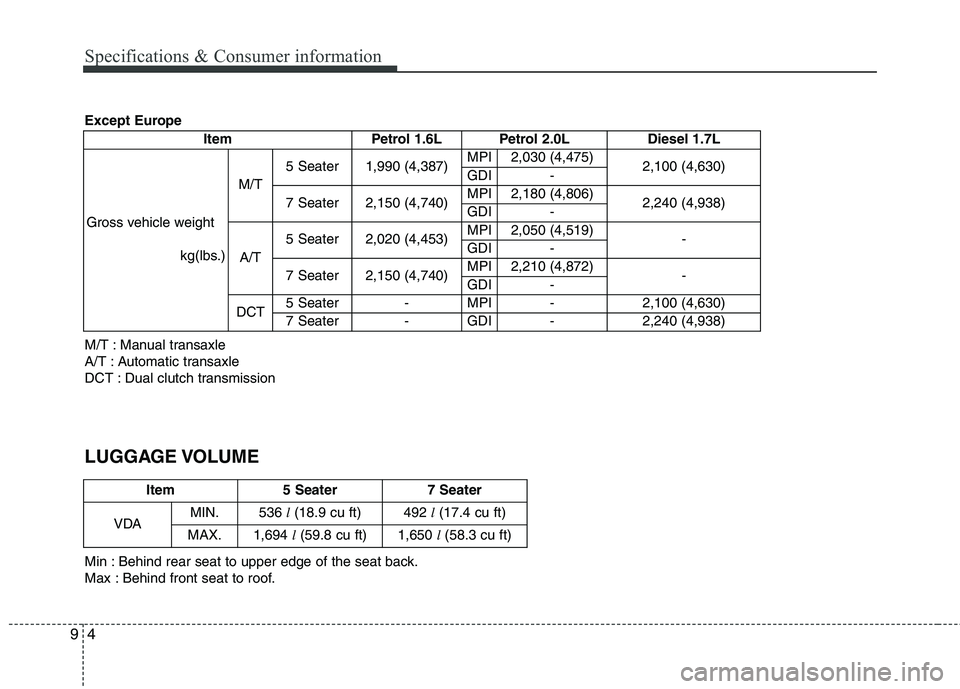
ltem 5 Seater 7 Seater
VDA MIN.
536
l(18.9 cu ft) 492 l(17.4 cu ft)
MAX. 1,694
l(59.8 cu ft) 1,650 l(58.3 cu ft)
Min : Behind rear seat to upper edge of the seat back.
Max : Behind front seat to roof. Item Petrol 1.6L Petrol 2.0L Diesel 1.7L
Gross vehicle weight kg(lbs.)M/T
5 Seater 1,990 (4,387)
MPI 2,030 (4,475)
2,100 (4,630)
GDI -
7 Seater 2,150 (4,740) MPI 2,180 (4,806)
2,240 (4,938)
GDI -
A/T 5 Seater 2,020 (4,453)
MPI 2,050 (4,519)
-
GDI -
7 Seater 2,150 (4,740) MPI 2,210 (4,872)
-
GDI -
DCT 5 Seater - MPI - 2,100 (4,630)
7 Seater - GDI - 2,240 (4,938)
Except Europe
LUGGAGE VOLUME
M/T : Manual transaxle
A/T : Automatic transaxle
DCT : Dual clutch transmission