clutch KIA CARENS RHD 2018 Owner's Guide
[x] Cancel search | Manufacturer: KIA, Model Year: 2018, Model line: CARENS RHD, Model: KIA CARENS RHD 2018Pages: 723, PDF Size: 40.94 MB
Page 459 of 723
Driving your vehicle
24
6
Downshifting
When you must slow down in heavy
traffic or whilst driving up steep hills,
downshift before the engine starts to
labour. Downshifting reduces the
chance of stalling and gives better
acceleration when you again need to
increase your speed. When the vehi-
cle is travelling down steep hills,
downshifting helps maintain safe
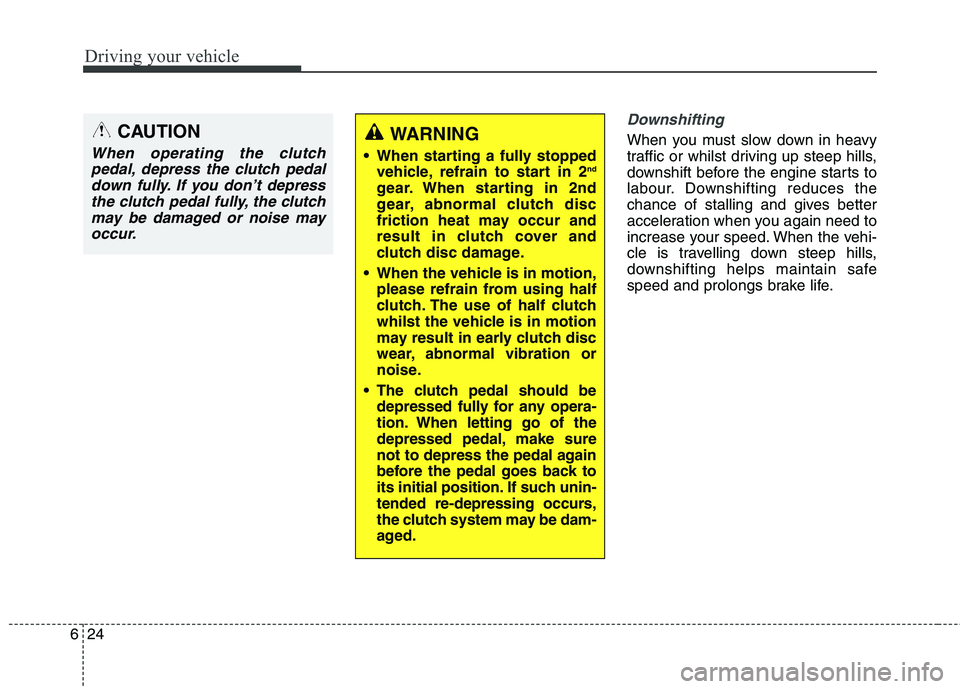
speed and prolongs brake life.CAUTION
When operating the clutch
pedal, depress the clutch pedaldown fully. If you don’t depress the clutch pedal fully, the clutchmay be damaged or noise mayoccur.
WARNING
When starting a fully stopped vehicle, refrain to start in 2 nd
gear. When starting in 2nd
gear, abnormal clutch disc
friction heat may occur and
result in clutch cover and
clutch disc damage.
When the vehicle is in motion, please refrain from using half
clutch. The use of half clutch
whilst the vehicle is in motion
may result in early clutch disc
wear, abnormal vibration or
noise.
The clutch pedal should be depressed fully for any opera-
tion. When letting go of the
depressed pedal, make sure
not to depress the pedal again
before the pedal goes back to
its initial position. If such unin-
tended re-depressing occurs,
the clutch system may be dam-
aged.
Page 460 of 723
625
Driving your vehicle
Good driving practices
Never take the vehicle out of gearand coast down a hill. This is
extremely hazardous. Always leave
the vehicle in gear.
Don't "ride" the brakes. This can cause them to overheat and mal-
function. Instead, when you are
driving down a long hill, slow down
and shift to a lower gear. When you
do this, engine braking will help
slow down the vehicle.
Slow down before shifting to a lower gear. This will help avoid
over-revving the engine, which can
cause damage.
Slow down when you encounter cross winds. This gives you much
better control of your vehicle.
Be sure the vehicle is completely stopped before you attempt to shift
into R (Reverse). The transaxle can
be damaged if you do not. To shift
into R (Reverse), depress the
clutch, move the shift lever to neu-
tral, wait three seconds, then shift
to the R (Reverse) position. Exercise extreme caution when
driving on a slippery surface. Be
especially careful when braking,
accelerating or shifting gears. On a
slippery surface, an abrupt change
in vehicle speed can cause the
drive wheels to lose traction and
the vehicle to go out of control.WARNING
Always buckle-up! In a colli- sion, an unbelted occupant is
significantly more likely to be
seriously injured or killed than
a properly belted occupant.
Avoid high speeds when cor- nering or turning.
Do not make quick steering wheel movements, such as
sharp lane changes or fast,sharp turns.
The risk of rollover is greatly increased if you lose control
of your vehicle at highwayspeeds.
Loss of control often occurs if two or more wheels drop off the
roadway and the driver over-
steers to reenter the roadway.
In the event your vehicle leaves the roadway, do not
steer sharply. Instead, slow
down before pulling back into
the travel lanes.
Never exceed posted speed limits.
Page 469 of 723
Driving your vehicle
34
6
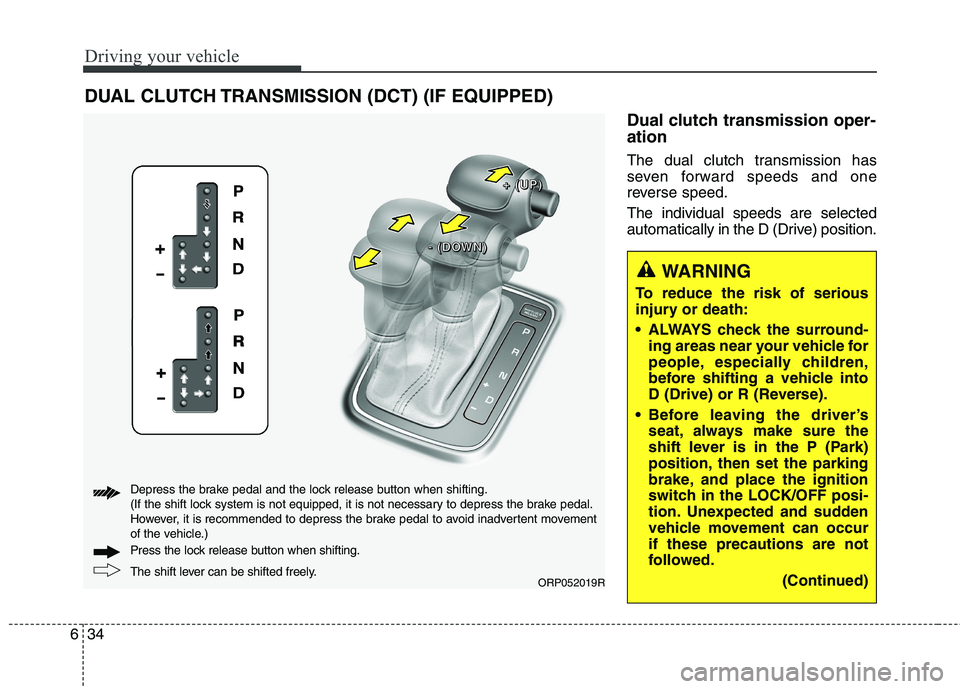
Dual clutch transmission oper- ation
The dual clutch transmission has
seven forward speeds and one
reverse speed. The individual speeds are selected
automatically in the D (Drive) position.
DUAL CLUTCH TRANSMISSION (DCT) (IF EQUIPPED)
ORP052019R
+
+++ ((((UUUUPPPP))))
---- ((((DDDDOOOOWWWWNNNN))))
The shift lever can be shifted freely.
Press the lock release button when shifting.
Depress the brake pedal and the lock release button when shifting.
(If the shift lock system is not equipped, it is not necessary to depress the brake pedal.
However, it is recommended to depress the brake pedal to avoid inadvertent movement
of the vehicle.)
WARNING
To reduce the risk of serious
injury or death:
ALWAYS check the surround- ing areas near your vehicle for
people, especially children,
before shifting a vehicle into
D (Drive) or R (Reverse).
Before leaving the driver’s seat, always make sure the
shift lever is in the P (Park)
position, then set the parking
brake, and place the ignition
switch in the LOCK/OFF posi-
tion. Unexpected and sudden
vehicle movement can occurif these precautions are not
followed.
(Continued)
Page 470 of 723
635
Driving your vehicle
The Dual Clutch Transmission givesthe driving feel of a manual transmis-
sion, yet provides the ease of a fully
automatic transmission. Unlike a tra-
ditional automatic transmission, the
gear shifting can be felt (and heard)
on the dual clutch transmission
- Think of it as an automaticallyshifting manual transmission.
- Shift into Drive range and get fully automatic shifting, similar to a con-
ventional automatic transmission.
Dual clutch transmission adopts dry-type dual clutch, which is dif-
ferent from torque converter of
automatic transmission, and
shows better acceleration perform-
ance during driving. But, initial
launch might be little bit slower
than Automatic Transmission. The dry-type clutch transfers torque
and provides a direct driving feeling
which may feel different from a con-
ventional automatic transmission
with a torque converter. This may be
more noticeable when starting from
a stop or low vehicle speed.
When rapidly accelerating at low vehicle speed, engine could rev at
high rpm depending on vehicle
drive condition.
For smooth launch uphill, press down the accelerator pedalsmoothly depending on the current
conditions.
If you release your foot from the accelerator pedal at low vehicle
speed, you may feel strong engine
brake, which is similar to manual
transmission.
When driving downhill, you may use Sports Mode and press the
paddle shifters to downshift to a
lower gear in order to control your
speed without using the brake
pedal excessively. When you turn the engine on and
off, you may hear clicking soundsas the system goes through a self
test. This is a normal sound for the
Dual Clutch Transmission.
(Continued)
Do not use engine braking(shifting from a high gear to
lower gear) rapidly on slip-
pery roads. The vehicle mayslip causing an accident.
WARNING
Due to transmission failure, the
vehicle may not move and the
position indicator (D, R) will
blink on the cluster. In this case,
have the system checked by a
professional workshop. Kia rec-ommends to visit an authorised
Kia dealer/service partner.
Page 471 of 723
Driving your vehicle
36
6
CAUTION
To hold the vehicle on a hill
use the foot brake or the park-ing brake. If the vehicle is heldby applying the acceleratorpedal on a hill the clutch and transmission will be overheat-ed resulting in damage.
At this time, a warning mes-sage ("Steep grade! Pressbrake pedal") will appear on the LCD display and you mayfeel a vibration.
If the clutch becomes over- heated by excessive use of theclutch to hold on a hill, you may notice a shudder feelingand a blinking display on theinstrument cluster. When this occurs, the clutch is disableduntil the clutch cools to normaltemperatures. If this occurs, pull over to a safe location,shift into P (Park) and apply thefoot brake for a few minutes.
(Continued)
(Continued)
If the LCD warning is active, the foot brake must be applied.
Ignoring the warnings can lead to damage to the trans-mission.
If the display continues to blink, for your safety, contact a pro-fessional workshop. Kia recom-mends to visit an authorisedKia dealer/service partner.
Under certain conditions such as repeated launch on steepgrades, the clutch in the trans-mission could overheat. Whenthe clutch is overheated, the
safe protection modeengages. If the safe protectionmode engages, the gear posi-tion indicator on the cluster blinks with a chime sound.
At this time, a warning message("Transmission temp. is high!Stop safely", "Trans Cooling.Remain parked for 00 min.") willappear on the LCD display and driving may not be smooth.
(Continued)(Continued)If you ignore this warning, thedriving condition may becomeworse. To return the normal driving condition, stop thevehicle and apply the footbrake for a few minutes before driving off.
Repetitive kick downs may lead to overheating of thetransmission. This will lead tochange in the vehicle speed shift pattern, and illuminatesome warning message.
To return the normal drivingcondition, refrain from kickdown speed changes. Whenthe warning message illumi- nates, park the vehicle at asafe location.
Gear shifts may be more noticeable than a convention-al automatic transmission.This is a normal characteristic of this type of dual clutchtransmission.
(Continued)
Page 475 of 723
Driving your vehicle
40
6
✽✽
NOTICE
Only the seven forward gears can be selected. To reverse or park the
vehicle, move the shift lever to the
R (Reverse) or P (Park) position as
required.
Downshifts are made automatical- ly when the vehicle slows down.
When the vehicle stops, 1st gear is
automatically selected.
When the engine rpm approaches the red zone the transmission will
upshift automatically.
If the driver presses the lever to + (Up) or - (Down) position, the
transmission may not make the
requested gear change if the next
gear is outside of the allowable
engine rpm range. The driver
must execute upshifts in accor-
dance with road conditions, taking
care to keep the engine rpms
below the red zone.Shift lock system (if equipped)
For your safety, the Dual clutch trans-
mission has a shift lock system which
prevents shifting the transaxle from P
(Park) or N (Neutral) into R (Reverse)
unless the brake pedal is depressed.
To shift the transaxle from P (Park) or
N (Neutral) into R (Reverse):
1. Depress and hold the brake pedal.
2. Start the engine or turn the ignition switch to the ON position.
3. Move the shift lever.
If the brake pedal is repeatedly depressed and released with the shift
lever in the P (Park) position, a chat-
tering noise near the shift lever may
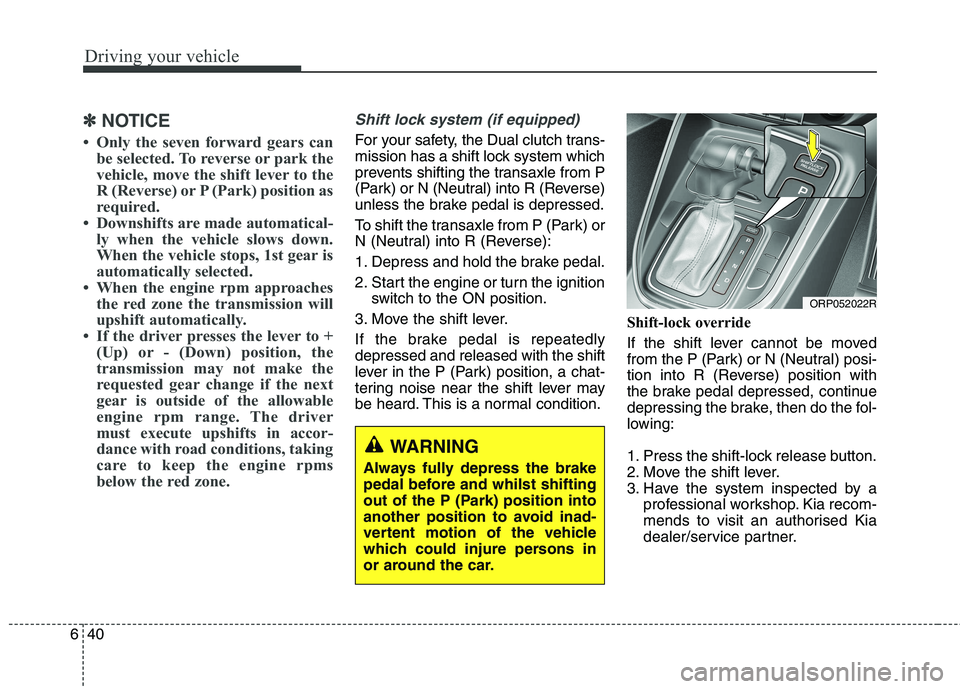
be heard. This is a normal condition. Shift-lock override
If the shift lever cannot be moved
from the P (Park) or N (Neutral) posi-
tion into R (Reverse) position with
the brake pedal depressed, continue
depressing the brake, then do the fol-
lowing:
1. Press the shift-lock release button.
2. Move the shift lever.
3. Have the system inspected by a
professional workshop. Kia recom-
mends to visit an authorised Kia
dealer/service partner.
ORP052022R
WARNING
Always fully depress the brake
pedal before and whilst shifting
out of the P (Park) position into
another position to avoid inad-
vertent motion of the vehicle
which could injure persons in
or around the car.
Page 478 of 723
643
Driving your vehicle
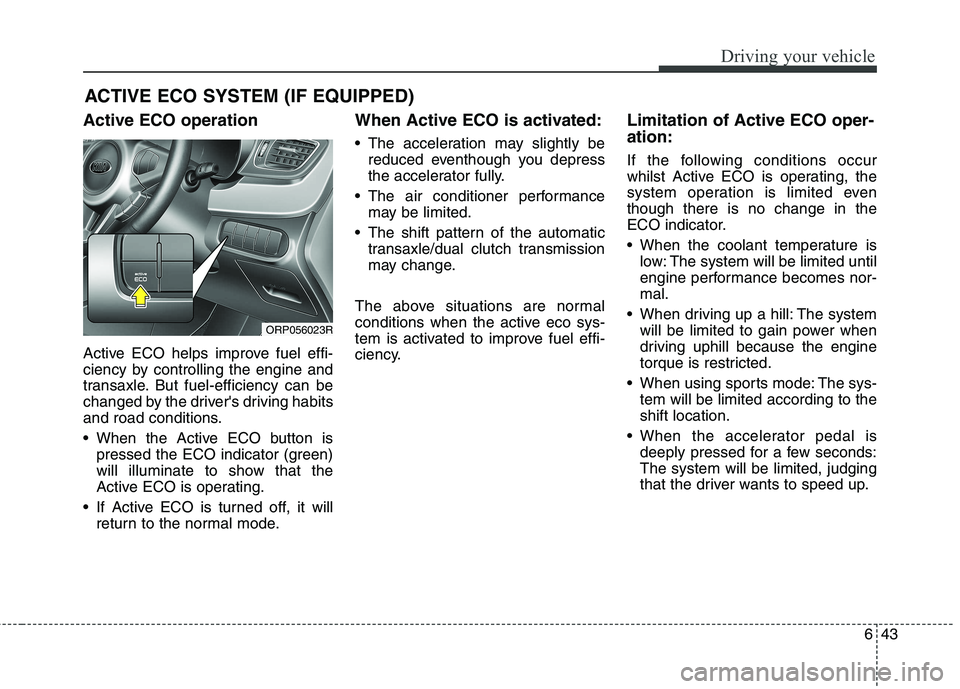
Active ECO operation
Active ECO helps improve fuel effi-
ciency by controlling the engine and
transaxle. But fuel-efficiency can be
changed by the driver's driving habits
and road conditions.
When the Active ECO button ispressed the ECO indicator (green)
will illuminate to show that the
Active ECO is operating.
If Active ECO is turned off, it will return to the normal mode. When Active ECO is activated:
The acceleration may slightly be
reduced eventhough you depress
the accelerator fully.
The air conditioner performance may be limited.
The shift pattern of the automatic transaxle/dual clutch transmission
may change.
The above situations are normal
conditions when the active eco sys-
tem is activated to improve fuel effi-
ciency. Limitation of Active ECO oper- ation:
If the following conditions occur
whilst Active ECO is operating, the
system operation is limited eventhough there is no change in the
ECO indicator.
When the coolant temperature is
low: The system will be limited until
engine performance becomes nor-mal.
When driving up a hill: The system will be limited to gain power when
driving uphill because the engine
torque is restricted.
When using sports mode: The sys- tem will be limited according to theshift location.
When the accelerator pedal is deeply pressed for a few seconds:The system will be limited, judging
that the driver wants to speed up.
ACTIVE ECO SYSTEM (IF EQUIPPED)
ORP056023R
Page 481 of 723
Driving your vehicle
46
6
Parking brake - Hand type
Applying the parking brake
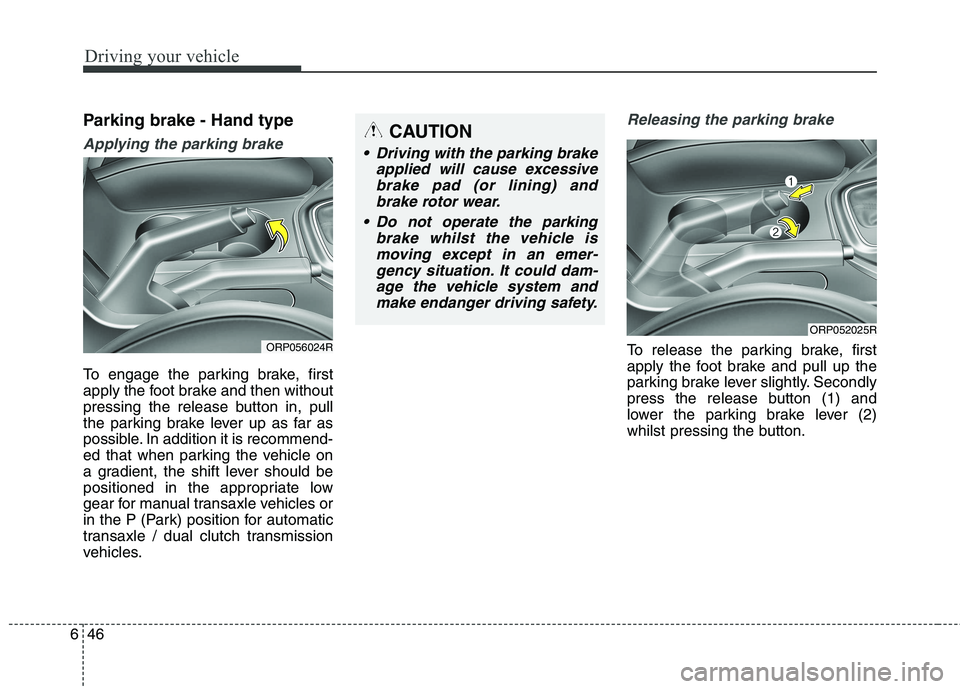
To engage the parking brake, first
apply the foot brake and then without
pressing the release button in, pull
the parking brake lever up as far as
possible. In addition it is recommend-
ed that when parking the vehicle on
a gradient, the shift lever should be
positioned in the appropriate low
gear for manual transaxle vehicles or
in the P (Park) position for automatic
transaxle / dual clutch transmission
vehicles.
Releasing the parking brake
To release the parking brake, first
apply the foot brake and pull up the
parking brake lever slightly. Secondly
press the release button (1) and
lower the parking brake lever (2)
whilst pressing the button.
ORP052025R
ORP056024R
CAUTION
Driving with the parking brake
applied will cause excessivebrake pad (or lining) and brake rotor wear.
Do not operate the parking brake whilst the vehicle ismoving except in an emer-gency situation. It could dam- age the vehicle system andmake endanger driving safety.
Page 482 of 723
647
Driving your vehicle
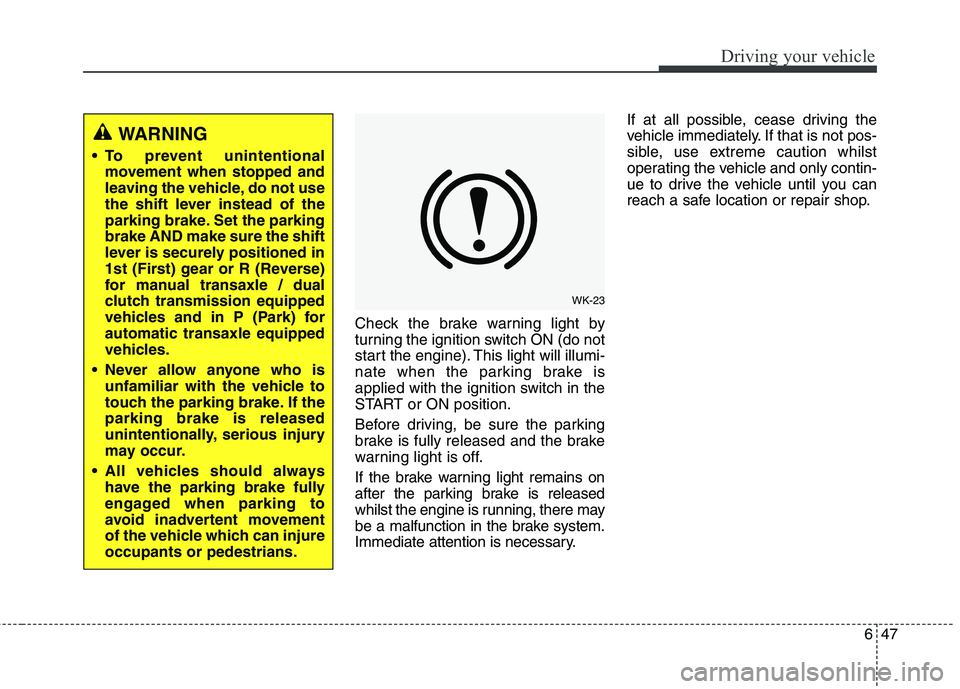
Check the brake warning light by
turning the ignition switch ON (do not
start the engine). This light will illumi-
nate when the parking brake is
applied with the ignition switch in the
START or ON position.
Before driving, be sure the parking
brake is fully released and the brake
warning light is off.
If the brake warning light remains on
after the parking brake is released
whilst the engine is running, there may
be a malfunction in the brake system.
Immediate attention is necessary.If at all possible, cease driving the
vehicle immediately. If that is not pos-
sible, use extreme caution whilst
operating the vehicle and only contin-
ue to drive the vehicle until you can
reach a safe location or repair shop.
WARNING
To prevent unintentional movement when stopped and
leaving the vehicle, do not use
the shift lever instead of the
parking brake. Set the parkingbrake AND make sure the shift
lever is securely positioned in
1st (First) gear or R (Reverse)
for manual transaxle / dual
clutch transmission equipped
vehicles and in P (Park) forautomatic transaxle equipped
vehicles.
Never allow anyone who is unfamiliar with the vehicle to
touch the parking brake. If theparking brake is released
unintentionally, serious injury
may occur.
All vehicles should always have the parking brake fully
engaged when parking to
avoid inadvertent movement
of the vehicle which can injureoccupants or pedestrians.
WK-23
Page 484 of 723
649
Driving your vehicle
To release EPB (Electronic parking
brake) automatically:
Manual transaxle vehicle1. Start the engine.
2. Fasten the driver's seat belt.
3. Close the driver's door, engine bonnet and tailgate.
4. Depress the clutch pedal with the gear engaged.
5. Depress the accelerator pedal whilst releasing the clutch pedal.
Automatic transaxle vehicle
1. Start the engine.
2. Fasten the driver's seat belt.
3. Close the driver's door, engine bonnet and tailgate.
4. Depress the accelerator pedal whilst the shift lever is in R
(Rear), D (Drive).
Shift lever in P (Park) With the engine running depress
the brake pedal and shift out of P
(Park) to R (Rear) or D (Drive). Shift lever in N (Neutral)
With the engine running depress
the brake pedal and shift out of N
(Neutral) to R (Rear) or D (Drive).
Make sure the brake warning light
goes off.
✽✽ NOTICE
For your safety, you can engage the EPB even though the ignition
switch or engine stop/start button
is in the OFF position, but you
cannot release it.
For your safety, depress the brake pedal and release the parking
brake manually with the EPB
switch when you drive downhill or
when backing up the vehicle. ✽
✽
NOTICE - Manual transaxle
A vehicle towing a trailer on a hill or
on an incline may slightly roll back-
wards when starting the vehicle. To
prevent the situation follow the
below instructions.
1. Depress the clutch pedal and select a gear.
2. Keep pulling up the EPB switch.
3. Depress the accelerator pedal and slowly release the clutch pedal.
4.If the vehicle starts off with enough driving power release the
EPB switch.
Do not follow the above procedure
when driving on a flat level ground.
The vehicle may suddenly move for-
ward.