belt KIA CARENS RHD 2018 Workshop Manual
[x] Cancel search | Manufacturer: KIA, Model Year: 2018, Model line: CARENS RHD, Model: KIA CARENS RHD 2018Pages: 723, PDF Size: 40.94 MB
Page 182 of 723
Features of your vehicle
86
4
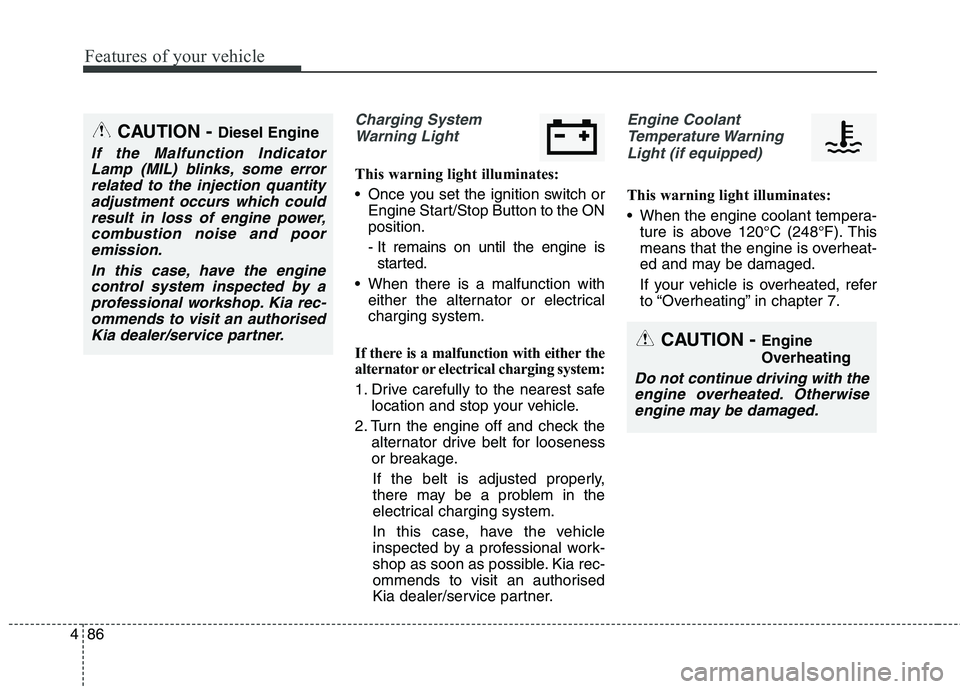
Charging System
Warning Light
This warning light illuminates:
Once you set the ignition switch or Engine Start/Stop Button to the ON position.
- It remains on until the engine isstarted.
When there is a malfunction with either the alternator or electrical charging system.
If there is a malfunction with either the
alternator or electrical charging system:
1. Drive carefully to the nearest safe location and stop your vehicle.
2. Turn the engine off and check the alternator drive belt for looseness
or breakage.
If the belt is adjusted properly,
there may be a problem in the
electrical charging system.
In this case, have the vehicle
inspected by a professional work-
shop as soon as possible. Kia rec-
ommends to visit an authorised
Kia dealer/service partner.
Engine Coolant Temperature Warning Light (if equipped)
This warning light illuminates:
When the engine coolant tempera- ture is above 120°C (248°F). This
means that the engine is overheat-
ed and may be damaged.
If your vehicle is overheated, refer
to “Overheating” in chapter 7.
CAUTION - Diesel Engine
If the Malfunction Indicator
Lamp (MIL) blinks, some errorrelated to the injection quantity adjustment occurs which couldresult in loss of engine power,combustion noise and poor emission.
In this case, have the enginecontrol system inspected by aprofessional workshop. Kia rec-ommends to visit an authorised Kia dealer/service partner.
CAUTION - Engine Overheating
Do not continue driving with the
engine overheated. Otherwiseengine may be damaged.
Page 440 of 723
65
Driving your vehicle
WARNING- Driving
under the influence of alcohol or drugs
Drinking and driving is danger-
ous. Drunk driving is the num-
ber one contributor to the high-
way death toll each year. Even asmall amount of alcohol will
affect your reflexes, percep-
tions and judgement. Drivingwhilst under the influence of
drugs is as dangerous or more
dangerous than driving drunk.
You are much more likely to
have a serious accident if you
drink or take drugs and drive.
If you are drinking or taking
drugs, don’t drive. Do not ridewith a driver who has beendrinking or taking drugs.Choose a designated driver orcall a cab.WARNING
When you intend to park or stop the vehicle with the
engine on, be careful not todepress the accelerator pedal
for a long period of time. It
may overheat the engine or
exhaust system and cause
fire.
When you make a sudden stop or turn the steering
wheel rapidly, loose objects
may drop on the floor and it
could interfere with the opera-
tion of the foot pedals, possi-
bly causing an accident. Keep
all things in the vehicle safelystored.
If you do not focus on driving, it may cause an accident. Becareful when operating what
may disturb driving such as
audio or heater. It is theresponsibility of the driver to
always drive safely.WARNING
All passengers must be proper-
ly belted whenever the vehicle
is moving. Refer to “Seat belts”
in chapter 3 for more informa-
tion on their proper use.
WARNING
Always check the surrounding
areas near your vehicle for peo-
ple, especially children, before
putting a vehicle into “D (Drive)”
or “R (Reverse)”.
Page 453 of 723
Driving your vehicle
18
6
✽✽
NOTICE
If you unfasten the seatbelt or open
the driver's door (or engine bonnet)
in auto stop mode, the following will
happen:
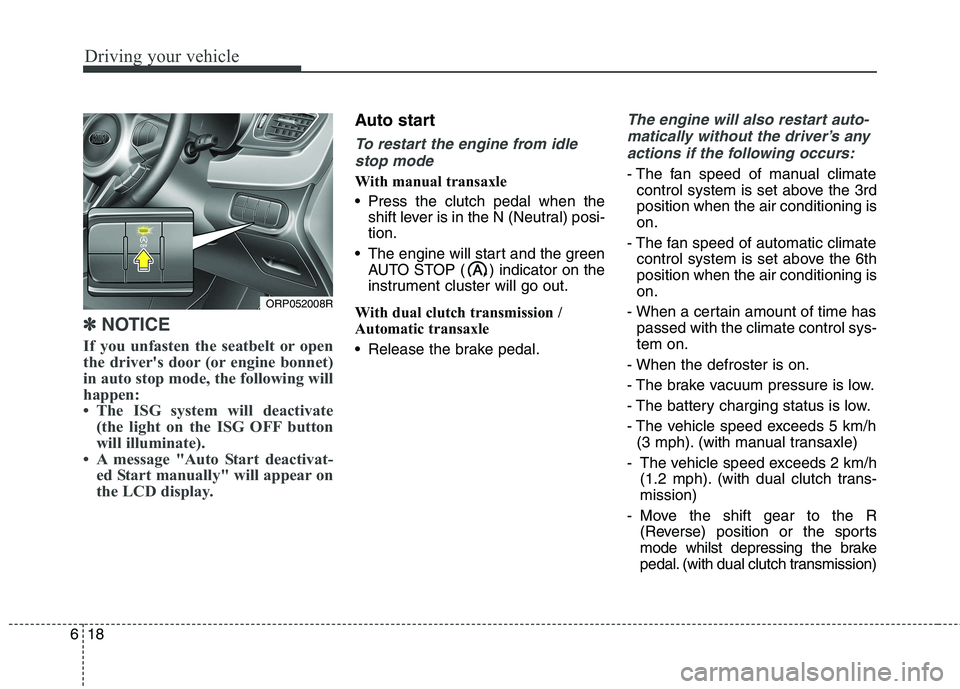
The ISG system will deactivate (the light on the ISG OFF button
will illuminate).
A message "Auto Start deactivat- ed Start manually" will appear on
the LCD display.
Auto start
To restart the engine from idle
stop mode
With manual transaxle
Press the clutch pedal when the shift lever is in the N (Neutral) posi- tion.
The engine will start and the green AUTO STOP ( ) indicator on the
instrument cluster will go out.
With dual clutch transmission /
Automatic transaxle
Release the brake pedal.
The engine will also restart auto- matically without the driver’s any actions if the following occurs:
- The fan speed of manual climate control system is set above the 3rd position when the air conditioning ison.
- The fan speed of automatic climate control system is set above the 6thposition when the air conditioning ison.
- When a certain amount of time has passed with the climate control sys-tem on.
- When the defroster is on.
- The brake vacuum pressure is low.
- The battery charging status is low.
- The vehicle speed exceeds 5 km/h (3 mph). (with manual transaxle)
- The vehicle speed exceeds 2 km/h (1.2 mph). (with dual clutch trans- mission)
- Move the shift gear to the R (Reverse) position or the sports
mode whilst depressing the brake
pedal. (with dual clutch transmission)
ORP052008R
Page 454 of 723
619
Driving your vehicle
The green AUTO STOP ( ) indica-
tor on the instrument cluster will blink
for 5 seconds for auto start. Condition of ISG system operation
The ISG system will operateunder the following condition:
- The driver’s seat belt is fastened.
- The driver’s door and engine bon- net are closed.
- The brake vacuum pressure is ade- quate.
- The battery is sufficiently charged.
- The engine coolant temperature is not too low.
- The slope way is gentle. (with dual clutch transmission)
✽✽ NOTICE
If the ISG system does not meet the operation condition, the ISG
system is deactivated. The light on
the ISG OFF button will illumi-
nate and a message “Auto Stop
deactivated. Start manually” will
appear on the LCD display.
If the light or notice comes on con- tinuously, please check the opera-
tion condition.
ISG system deactivation
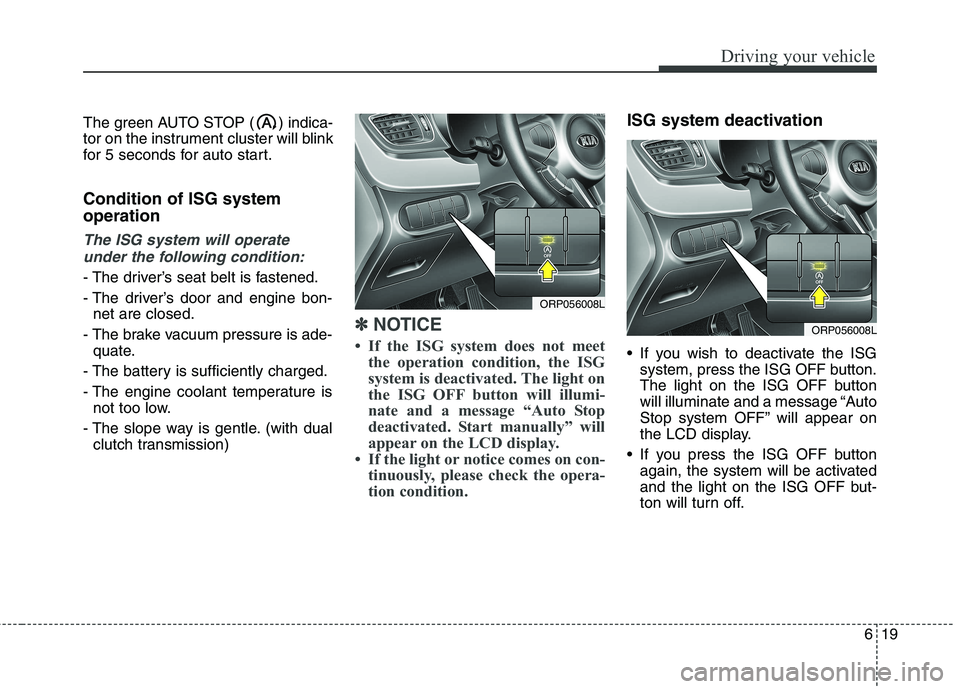
If you wish to deactivate the ISGsystem, press the ISG OFF button.
The light on the ISG OFF button
will illuminate and a message “Auto
Stop system OFF” will appear on
the LCD display.
If you press the ISG OFF button again, the system will be activated
and the light on the ISG OFF but-
ton will turn off.
ORP056008L
ORP056008L
Page 460 of 723
625
Driving your vehicle
Good driving practices
Never take the vehicle out of gearand coast down a hill. This is
extremely hazardous. Always leave
the vehicle in gear.
Don't "ride" the brakes. This can cause them to overheat and mal-
function. Instead, when you are
driving down a long hill, slow down
and shift to a lower gear. When you
do this, engine braking will help
slow down the vehicle.
Slow down before shifting to a lower gear. This will help avoid
over-revving the engine, which can
cause damage.
Slow down when you encounter cross winds. This gives you much
better control of your vehicle.
Be sure the vehicle is completely stopped before you attempt to shift
into R (Reverse). The transaxle can
be damaged if you do not. To shift
into R (Reverse), depress the
clutch, move the shift lever to neu-
tral, wait three seconds, then shift
to the R (Reverse) position. Exercise extreme caution when
driving on a slippery surface. Be
especially careful when braking,
accelerating or shifting gears. On a
slippery surface, an abrupt change
in vehicle speed can cause the
drive wheels to lose traction and
the vehicle to go out of control.WARNING
Always buckle-up! In a colli- sion, an unbelted occupant is
significantly more likely to be
seriously injured or killed than
a properly belted occupant.
Avoid high speeds when cor- nering or turning.
Do not make quick steering wheel movements, such as
sharp lane changes or fast,sharp turns.
The risk of rollover is greatly increased if you lose control
of your vehicle at highwayspeeds.
Loss of control often occurs if two or more wheels drop off the
roadway and the driver over-
steers to reenter the roadway.
In the event your vehicle leaves the roadway, do not
steer sharply. Instead, slow
down before pulling back into
the travel lanes.
Never exceed posted speed limits.
Page 468 of 723
633
Driving your vehicle
Always use the parking brake. Donot depend on placing the
transaxle in P (Park) to keep the
vehicle from moving.
Exercise extreme caution when driving on a slippery surface. Be
especially careful when braking,
accelerating or shifting gears. On a
slippery surface, an abrupt change
in vehicle speed can cause the
drive wheels to lose traction and
the vehicle to go out of control.
Optimum vehicle performance and economy is obtained by smoothlydepressing and releasing the
accelerator pedal.
WARNING
Always buckle-up! In a colli- sion, an unbelted occupant is
significantly more likely to be
seriously injured or killed than
a properly belted occupant.
Avoid high speeds when cor- nering or turning.
Do not make quick steering wheel movements, such as
sharp lane changes or fast,sharp turns.
The risk of rollover is greatly increased if you lose control of
your vehicle at highway speeds.
Loss of control often occurs if two or more wheels drop off the
roadway and the driver over-
steers to reenter the roadway.
In the event your vehicle leaves the roadway, do not
steer sharply. Instead, slow
down before pulling back into
the travel lanes.
Never exceed posted speed limits.WARNING
If your vehicle becomes stuck in
snow, mud, sand, etc., then you
may attempt to rock the vehicle
free by moving it forward and
backward. Do not attempt this
procedure if people or objects
are anywhere near the vehicle.
During the rocking operation
the vehicle may suddenly move
forward of backward as it
becomes unstuck, causing
injury or damage to nearby peo-ple or objects.
Page 477 of 723
Driving your vehicle
42
6
Moving up a steep grade from a
standing start
To move up a steep grade from a
standing start, depress the brake
pedal, shift the shift lever to D
(Drive). Select the appropriate gear
depending on load weight and steep-
ness of the grade, and release the
parking brake. Depress the accelera-
tor gradually whilst releasing the
service brakes.
WARNING
If your vehicle becomes stuck in
snow, mud, sand, etc., then you
may attempt to rock the vehicle
free by moving it forward and
backward. Do not attempt this
procedure if people or objects
are anywhere near the vehicle.
During the rocking operation
the vehicle may suddenly move
forward of backward as it
becomes unstuck, causing
injury or damage to nearby peo-ple or objects.
(Continued)
In the event your vehicle leaves the roadway, do not
steer sharply. Instead, slow
down before pulling back into
the travel lanes.
Never exceed posted speed limits.WARNING
Always buckle-up! In a colli- sion, an unbelted occupant is
significantly more likely to be
seriously injured or killed
than a properly belted occu-pant.
Avoid high speeds when cor- nering or turning.
Do not make quick steering wheel movements, such as
sharp lane changes or fast,sharp turns.
The risk of rollover is greatly increased if you lose control
of your vehicle at highwayspeeds.
Loss of control often occurs if two or more wheels drop off
the roadway and the driver
oversteers to reenter the road-
way.
(Continued)
Page 484 of 723
649
Driving your vehicle
To release EPB (Electronic parking
brake) automatically:
Manual transaxle vehicle1. Start the engine.
2. Fasten the driver's seat belt.
3. Close the driver's door, engine bonnet and tailgate.
4. Depress the clutch pedal with the gear engaged.
5. Depress the accelerator pedal whilst releasing the clutch pedal.
Automatic transaxle vehicle
1. Start the engine.
2. Fasten the driver's seat belt.
3. Close the driver's door, engine bonnet and tailgate.
4. Depress the accelerator pedal whilst the shift lever is in R
(Rear), D (Drive).
Shift lever in P (Park) With the engine running depress
the brake pedal and shift out of P
(Park) to R (Rear) or D (Drive). Shift lever in N (Neutral)
With the engine running depress
the brake pedal and shift out of N
(Neutral) to R (Rear) or D (Drive).
Make sure the brake warning light
goes off.
✽✽ NOTICE
For your safety, you can engage the EPB even though the ignition
switch or engine stop/start button
is in the OFF position, but you
cannot release it.
For your safety, depress the brake pedal and release the parking
brake manually with the EPB
switch when you drive downhill or
when backing up the vehicle. ✽
✽
NOTICE - Manual transaxle
A vehicle towing a trailer on a hill or
on an incline may slightly roll back-
wards when starting the vehicle. To
prevent the situation follow the
below instructions.
1. Depress the clutch pedal and select a gear.
2. Keep pulling up the EPB switch.
3. Depress the accelerator pedal and slowly release the clutch pedal.
4.If the vehicle starts off with enough driving power release the
EPB switch.
Do not follow the above procedure
when driving on a flat level ground.
The vehicle may suddenly move for-
ward.
Page 485 of 723
Driving your vehicle
50
6
EPB (Electronic parking brake) may
be automatically applied when:
The EPB is overheated
Requested by other systems
If you try to drive off depressing the
accelerator pedal with the EPB
applied, but doesn't release auto-
matically, a warning will sound and
a message ("Release parking
brake") will appear.
If the driver's seat belt is not fas- tened and any door, the enginebonnet or tailgate is opened, a
warning will sound and a message
will appear.
If there is a problem with the vehi- cle, a warning may sound and a
message may appear.
If the above situation occurs,
depress the brake pedal and release
EPB by pressing the EPB switch.
WARNING
To prevent unintentional movement when stopped and
leaving the vehicle, do not use
the shift lever in place of the
parking brake. Set the parkingbrake and make sure the shift
lever is securely positioned in
P (Park).
Never allow anyone who is unfamiliar with the vehicle to
touch the parking brake. If theparking brake is released
unintentionally, serious injury
may occur.
All vehicles should always have the parking brake fully
engaged when parking to
avoid inadvertent movement
of the car which can injureoccupants or pedestrians.CAUTION
If the parking brake warning
light is still on even though theEPB has been released, havethe system checked by a pro-fessional workshop. Kia recom- mends to visit an authorisedKia dealer/ service partner.
Do not drive your vehicle with the EPB applied. It may causeexcessive brake pad and brake rotor wear.
Page 530 of 723
695
Driving your vehicle
Highway driving
Tyres
Adjust the tyre inflation pressures to
specification. Low tyre inflation pres-
sures will result in overheating and
possible failure of the tyres.
Avoid using worn or damaged tyres
which may result in reduced traction
or tyre failure.
✽✽NOTICE
Never exceed the maximum tyre
inflation pressure shown on the
tyres.
Fuel, engine coolant and engine oil
High speed travel consumes more
fuel than urban motoring. Do not for-
get to check both engine coolant andengine oil.
Drive belt
A loose or damaged drive belt may
result in overheating of the engine.
WARNING
Underinflated or overinflated tyres can cause poor han-
dling, loss of vehicle control,
and sudden tyre failure lead-
ing to accidents, injuries, and
even death. Always check the
tyres for proper inflation
before driving. For proper tyre
pressures, refer to chapter 9,
“Tyres and wheels”.
Driving on tyres with no or insufficient tread is danger-
ous. Worn-out tyres can
result in loss of vehicle con-
trol, collisions, injury, and
even death. Worn-out tyresshould be replaced as soon
as possible and should never
be used for driving. Always
check the tyre tread before
driving your vehicle. For fur-
ther information and tread
limits, refer to chapter 8,
“Tyres and wheels”.