check engine KIA CARENS RHD 2018 Repair Manual
[x] Cancel search | Manufacturer: KIA, Model Year: 2018, Model line: CARENS RHD, Model: KIA CARENS RHD 2018Pages: 723, PDF Size: 40.94 MB
Page 617 of 723
Maintenance
30
8
Valve clearance
(for petrol engine)
(Except for Nu 2.0 Engine)
Inspect for excessive valve noise
and/or engine vibration and adjust if
necessary. In this case, have the sys-
tem serviced by a professional work-
shop. Kia recommends to visit an
authorised Kia dealer/service partner. Cooling system
Check the cooling system parts, such
as radiator, coolant reservoir, hoses
and connections for leakage and dam-
age. Replace any damaged parts. Coolant The coolant should be changed at
the intervals specified in the mainte-
nance schedule.
Manual transaxle fluid (if equipped)
Inspect the manual transaxle fluid according to the maintenance sched-
ule. Automatic transaxle fluid (if equipped)
Automatic transaxle fluid should not
be checked under normal usage
conditions.
But in severe conditions, have the
automatic transmission fluid changed
by a professional workshop accord-
ing to the maintenance schedule. Kia
recommends to visit an authorised
Kia dealer/service partner.
✽✽
NOTICE
Automatic transaxle fluid colour is
basically red.
As the vehicle is driven, the auto-
matic transaxle fluid will begin to
look darker.
It is normal condition and you should
not judge the need to replace the fluid
based upon the changed colour.
Dual clutch transmission fluid (if equipped)
Inspect the dual clutch transmission fluid according to the maintenance
schedule.
CAUTION
The use of a non-specified fluid could result in transaxle mal-function and failure.
Use only specified automatictransaxle fluid. (Refer to “Recommended lubricants andcapacities” in chapter 9.)
Page 618 of 723
831
Maintenance
Brake hoses and lines
Visually check for proper installation,
chafing, cracks, deterioration and
any leakage. Replace any deteriorat-
ed or damaged parts immediately. Brake fluid
Check brake fluid level in the brake
fluid reservoir. The level should be
between “MIN” and “MAX” marks on
the side of the reservoir. Use only
hydraulic brake fluid conforming to
DOT 3 or DOT 4 specification.
Brake pads, calipers and rotors
Check the pads for excessive wear,
discs for run out and wear, and
calipers for fluid leakage.
For more information on checking
the pads or lining wear limit, refer to
the Kia web site. (https://www
.kia-hotline.com)
Suspension mounting bolts
Check the suspension connections
for looseness or damage. Retighten
to the specified torque.
Parking brake
Inspect the parking brake system
including the EPB actuator, wiring
and connectors.
Steering gear box, linkage &
boots/lower arm ball joint
With the vehicle stopped and engine
off, check for excessive free-play in
the steering wheel.
Check the linkage for bends or dam-
age. Check the dust boots and ball
joints for deterioration, cracks, or
damage. Replace any damaged
parts.Drive shafts and boots
Check the drive shafts, boots and
clamps for cracks, deterioration, or
damage. Replace any damaged
parts and, if necessary, repack the
grease.
Air conditioning refrigerant/ compressor (if equipped)
Check the air conditioning lines and
connections for leakage and dam-
age.
Page 619 of 723
Maintenance
32
8
ENGINE OIL (PETROL)
Checking the engine oil level
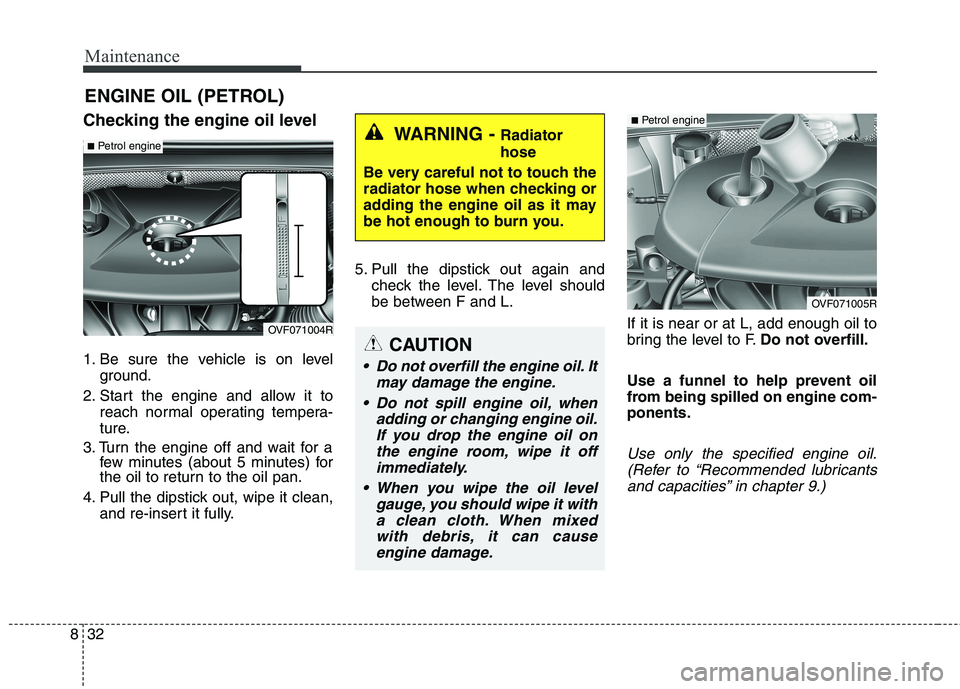
1. Be sure the vehicle is on level ground.
2. Start the engine and allow it to reach normal operating tempera-
ture.
3. Turn the engine off and wait for a few minutes (about 5 minutes) for
the oil to return to the oil pan.
4. Pull the dipstick out, wipe it clean, and re-insert it fully. 5. Pull the dipstick out again and
check the level. The level should
be between F and L.
If it is near or at L, add enough oil to
bring the level to F.Do not overfill.
Use a funnel to help prevent oil
from being spilled on engine com-ponents.
Use only the specified engine oil. (Refer to “Recommended lubricantsand capacities” in chapter 9.)
WARNING - Radiator
hose
Be very careful not to touch the
radiator hose when checking or
adding the engine oil as it may
be hot enough to burn you.
CAUTION
Do not overfill the engine oil. It may damage the engine.
Do not spill engine oil, when adding or changing engine oil.If you drop the engine oil onthe engine room, wipe it offimmediately.
When you wipe the oil level gauge, you should wipe it witha clean cloth. When mixedwith debris, it can causeengine damage.
OVF071004R
■ Petrol engine
OVF071005R
■Petrol engine
Page 620 of 723
833
Maintenance
ENGINE OIL (DIESEL)
Changing the engine oil and filter
Have the engine oil and filter
replaced by a professional workshop.Kia recommends to visit an autho-
rised Kia dealer/service partner.Checking the engine oil level
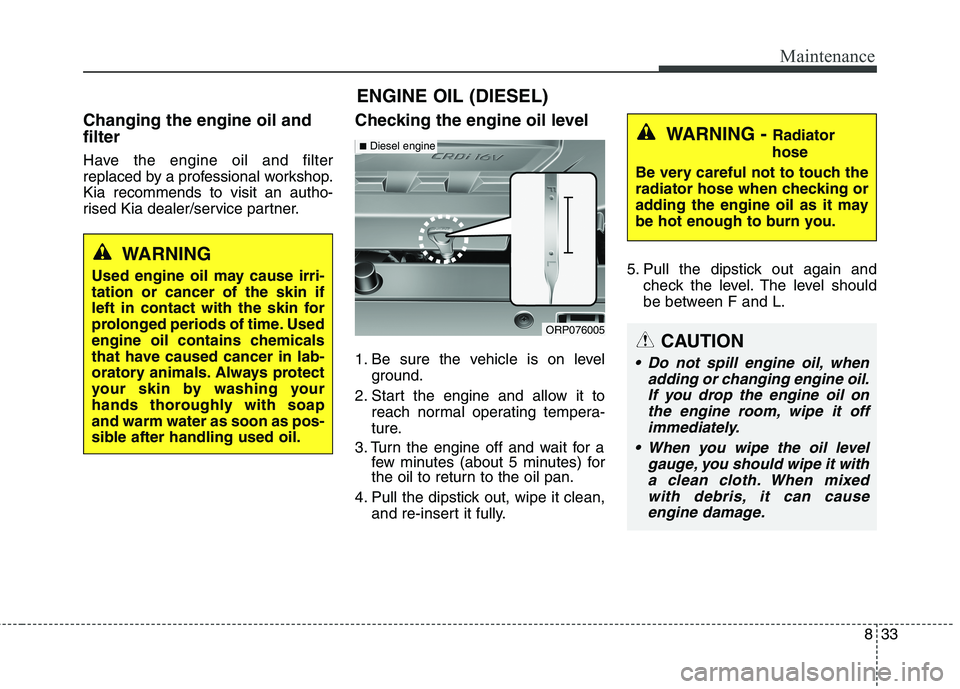
1. Be sure the vehicle is on level
ground.
2. Start the engine and allow it to reach normal operating tempera-
ture.
3. Turn the engine off and wait for a few minutes (about 5 minutes) for
the oil to return to the oil pan.
4. Pull the dipstick out, wipe it clean, and re-insert it fully. 5. Pull the dipstick out again and
check the level. The level should
be between F and L.
WARNING
Used engine oil may cause irri- tation or cancer of the skin if
left in contact with the skin for
prolonged periods of time. Used
engine oil contains chemicals
that have caused cancer in lab-
oratory animals. Always protect
your skin by washing your
hands thoroughly with soapand warm water as soon as pos-
sible after handling used oil.
ORP076005
■ Diesel engineWARNING - Radiator
hose
Be very careful not to touch the
radiator hose when checking or
adding the engine oil as it may
be hot enough to burn you.
CAUTION
Do not spill engine oil, when adding or changing engine oil.If you drop the engine oil on the engine room, wipe it offimmediately.
When you wipe the oil level gauge, you should wipe it witha clean cloth. When mixed with debris, it can causeengine damage.
Page 622 of 723
835
Maintenance
ENGINE COOLANT
The high-pressure cooling system
has a reservoir filled with year-round
antifreeze coolant. The reservoir is
filled at the factory.
Check the antifreeze protection and
coolant concentration level at least
once a year, at the beginning of the
winter season, and before travelling
to a colder climate. Checking the coolant level
(Continued)
When you are sure all the pressure has been released,
press down on the cap, using
a thick towel, and continue
turning counterclockwise to
remove it.
Even if the engine is not oper- ating, do not remove the radi-ator cap or the drain plugwhilst the engine and radiator
are hot. Hot coolant and
steam may still blow out
under pressure, causing seri-
ous injury.
WARNING
Removing radiatorcap
Never attempt to remove the radiator cap whilst the engine
is operating or hot. Doing somight lead to cooling system
and engine damage and could
result in serious personal
injury from escaping hotcoolant or steam.
Turn the engine off and wait until it cools down. Use
extreme care when removing
the radiator cap. Wrap a thick
towel around it, and turn it
counterclockwise slowly to
the first stop. Step back whilst
the pressure is released fromthe cooling system.
(Continued)
CAUTION
When the engine overheatsfrom low engine coolant, sud-denly adding engine coolantmay cause cracks in theengine. To prevent damage, add engine coolant slowly insmall quantities.
Do not drive with no engine coolant. It may cause waterpump failure and engine seizure, etc.
Page 623 of 723
Maintenance
36
8
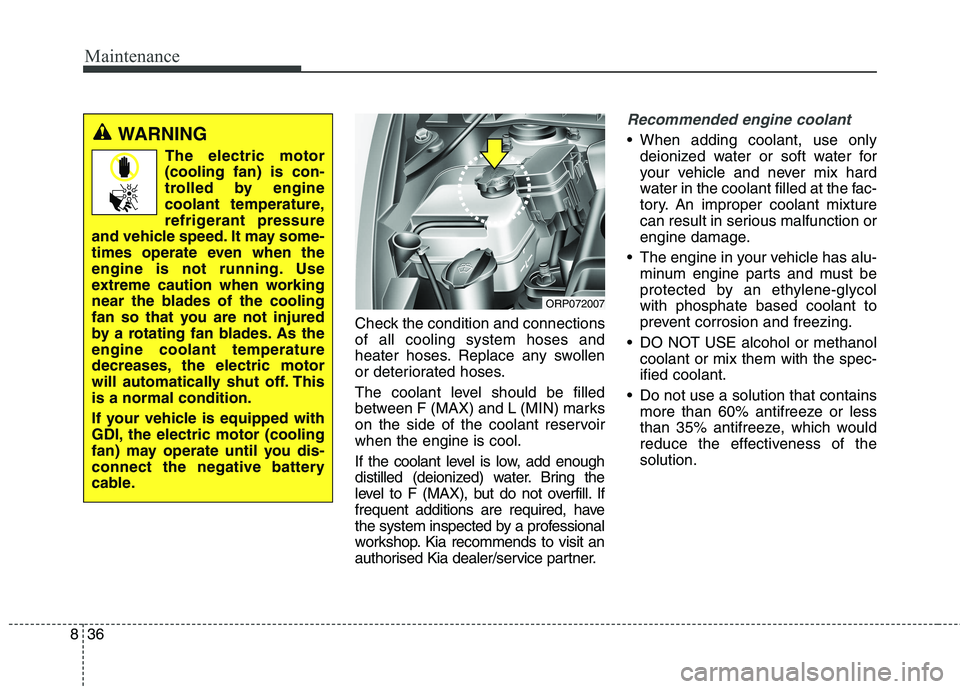
Check the condition and connections of all cooling system hoses and
heater hoses. Replace any swollen
or deteriorated hoses.
The coolant level should be filled
between F (MAX) and L (MIN) marks
on the side of the coolant reservoirwhen the engine is cool.
If the coolant level is low, add enough
distilled (deionized) water. Bring the
level to F (MAX), but do not overfill. If
frequent additions are required, have
the system inspected by a professional
workshop. Kia recommends to visit an
authorised Kia dealer/service partner.
Recommended engine coolant
When adding coolant, use only
deionized water or soft water for
your vehicle and never mix hard
water in the coolant filled at the fac-
tory. An improper coolant mixture
can result in serious malfunction or
engine damage.
The engine in your vehicle has alu- minum engine parts and must be
protected by an ethylene-glycolwith phosphate based coolant to
prevent corrosion and freezing.
DO NOT USE alcohol or methanol coolant or mix them with the spec-ified coolant.
Do not use a solution that contains more than 60% antifreeze or less
than 35% antifreeze, which would
reduce the effectiveness of thesolution.WARNING
The electric motor
(cooling fan) is con-
trolled by engine
coolant temperature,
refrigerant pressure
and vehicle speed. It may some-
times operate even when the
engine is not running. Use
extreme caution when working
near the blades of the cooling
fan so that you are not injured
by a rotating fan blades. As theengine coolant temperature
decreases, the electric motor
will automatically shut off. Thisis a normal condition.
If your vehicle is equipped with
GDI, the electric motor (cooling
fan) may operate until you dis-
connect the negative battery
cable.
ORP072007
Page 625 of 723
Maintenance
38
8
BRAKE/CLUTCH FLUID (IF EQUIPPED)
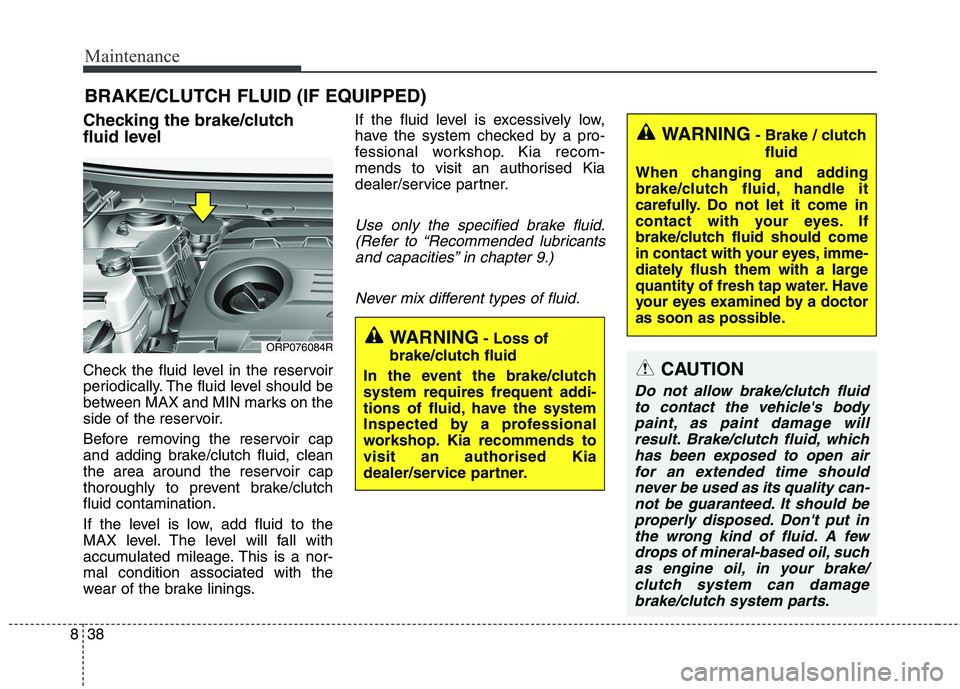
Checking the brake/clutch
fluid level
Check the fluid level in the reservoir
periodically. The fluid level should be
between MAX and MIN marks on the
side of the reservoir.
Before removing the reservoir cap
and adding brake/clutch fluid, clean
the area around the reservoir cap
thoroughly to prevent brake/clutchfluid contamination.
If the level is low, add fluid to the
MAX level. The level will fall with
accumulated mileage. This is a nor-mal condition associated with the
wear of the brake linings. If the fluid level is excessively low,
have the system checked by a pro-
fessional workshop. Kia recom-
mends to visit an authorised Kia
dealer/service partner.
Use only the specified brake fluid.
(Refer to “Recommended lubricantsand capacities” in chapter 9.)
Never mix different types of fluid.
ORP076084R
WARNING - Brake / clutch
fluid
When changing and adding
brake/clutch fluid, handle it
carefully. Do not let it come in
contact with your eyes. If
brake/clutch fluid should come
in contact with your eyes, imme-
diately flush them with a large
quantity of fresh tap water. Have
your eyes examined by a doctor
as soon as possible.
WARNING - Loss of
brake/clutch fluid
In the event the brake/clutch
system requires frequent addi-
tions of fluid, have the system
Inspected by a professional
workshop. Kia recommends tovisit an authorised Kia
dealer/service partner.
CAUTION
Do not allow brake/clutch fluid to contact the vehicle's bodypaint, as paint damage will result. Brake/clutch fluid, whichhas been exposed to open airfor an extended time should never be used as its quality can-not be guaranteed. It should beproperly disposed. Don't put in the wrong kind of fluid. A fewdrops of mineral-based oil, suchas engine oil, in your brake/ clutch system can damagebrake/clutch system parts.
Page 627 of 723
Maintenance
40
8
FUEL FILTER (FOR DIESEL)
Draining water from fuel filter
The fuel filter for diesel engine plays
an important role of separating water
from fuel and accumulating the waterin its bottom.
If water accumulates in the fuel filter,
the warning light comes on when the
ignition switch is in the ON position. If this warning light illumi-
nates, take your car to a
professional workshop and
have drain the water and
check the system. Kia rec-
ommends to visit an authorised Kia
dealer/service partner. Filter replacement
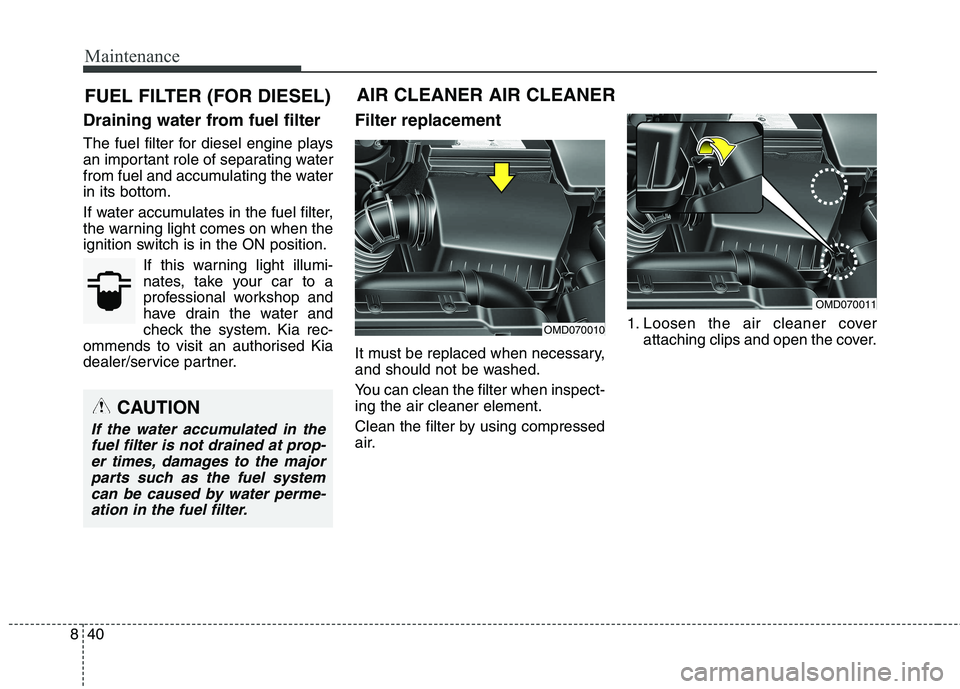
It must be replaced when necessary,
and should not be washed.
You can clean the filter when inspect- ing the air cleaner element.
Clean the filter by using compressed
air.
1. Loosen the air cleaner cover
attaching clips and open the cover.
CAUTION
If the water accumulated in the
fuel filter is not drained at prop-er times, damages to the major parts such as the fuel systemcan be caused by water perme-ation in the fuel filter.
AIR CLEANER AIR CLEANER
OMD070011
OMD070010
Page 638 of 723
851
Maintenance
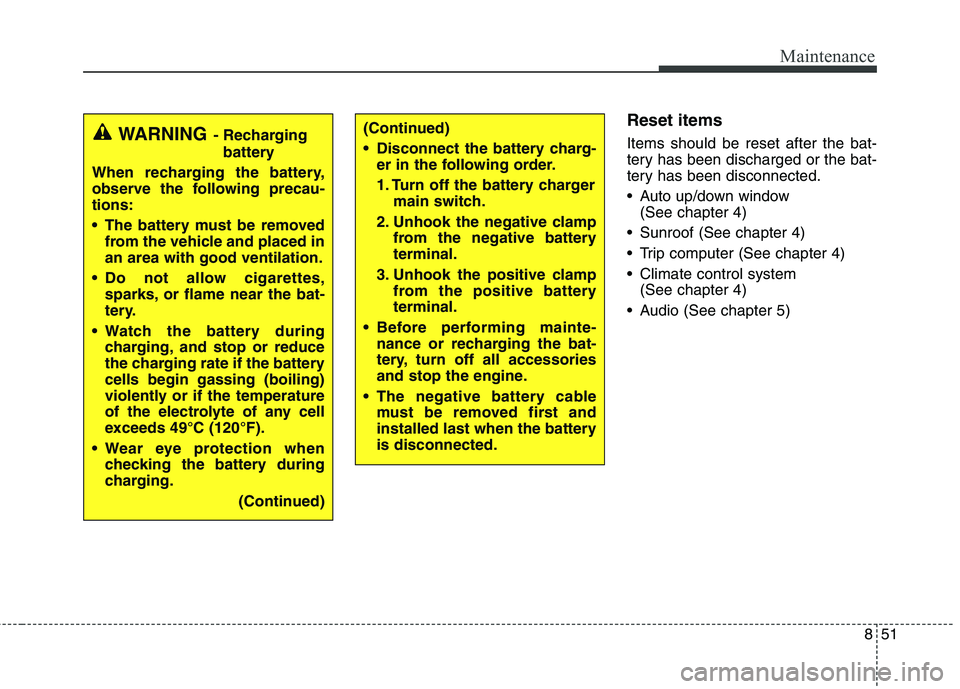
Reset items Items should be reset after the bat-
tery has been discharged or the bat-
tery has been disconnected.
Auto up/down window (See chapter 4)
Sunroof (See chapter 4)
Trip computer (See chapter 4)
Climate control system (See chapter 4)
Audio (See chapter 5)(Continued)
Disconnect the battery charg- er in the following order.
1. Turn off the battery charger main switch.
2. Unhook the negative clamp from the negative battery terminal.
3. Unhook the positive clamp from the positive batteryterminal.
Before performing mainte- nance or recharging the bat-
tery, turn off all accessories
and stop the engine.
The negative battery cable must be removed first and
installed last when the batteryis disconnected.WARNING - Recharging
battery
When recharging the battery,
observe the following precau-tions:
The battery must be removed from the vehicle and placed in an area with good ventilation.
Do not allow cigarettes, sparks, or flame near the bat-
tery.
Watch the battery during charging, and stop or reduce
the charging rate if the batterycells begin gassing (boiling)
violently or if the temperature
of the electrolyte of any cell
exceeds 49°C (120°F).
Wear eye protection when checking the battery during
charging.
(Continued)
Page 650 of 723
863
Maintenance
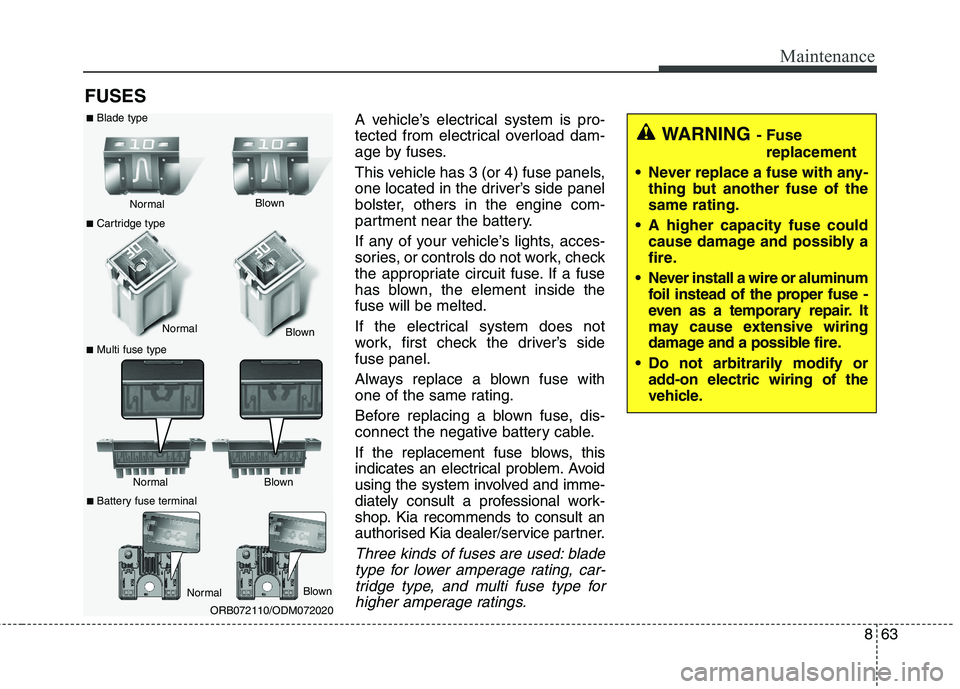
FUSESA vehicle’s electrical system is pro-
tected from electrical overload dam-
age by fuses.
This vehicle has 3 (or 4) fuse panels,
one located in the driver’s side panel
bolster, others in the engine com-
partment near the battery.
If any of your vehicle’s lights, acces-
sories, or controls do not work, check
the appropriate circuit fuse. If a fuse
has blown, the element inside thefuse will be melted.
If the electrical system does not
work, first check the driver’s sidefuse panel.
Always replace a blown fuse with
one of the same rating.
Before replacing a blown fuse, dis-
connect the negative battery cable.
If the replacement fuse blows, this
indicates an electrical problem. Avoid
using the system involved and imme-
diately consult a professional work-
shop. Kia recommends to consult an
authorised Kia dealer/service partner.
Three kinds of fuses are used: bladetype for lower amperage rating, car-tridge type, and multi fuse type for higher amperage ratings.
WARNING - Fuse
replacement
Never replace a fuse with any- thing but another fuse of the same rating.
A higher capacity fuse could cause damage and possibly a
fire.
Never install a wire or aluminum foil instead of the proper fuse -
even as a temporary repair. It
may cause extensive wiring
damage and a possible fire.
Do not arbitrarily modify or add-on electric wiring of the
vehicle.
Normal
Normal
■
Blade type
■ Cartridge type
■ Multi fuse type Blown
Blown
Normal Blown
ORB072110/ODM072020
Normal
Blown
■
Battery fuse terminal