petrol KIA CARENS RHD 2018 Owners Manual
[x] Cancel search | Manufacturer: KIA, Model Year: 2018, Model line: CARENS RHD, Model: KIA CARENS RHD 2018Pages: 723, PDF Size: 40.94 MB
Page 4 of 723
Introduction
How to use this manual . . . . . . . . . . . . . . . . . . . . . . 1-2
Fuel requirements . . . . . . . . . . . . . . . . . . . . . . . . . . 1-3• Petrol engine . . . . . . . . . . . . . . . . . . . . . . . . . . . . . . . . . 1-3
Vehicle break-in process . . . . . . . . . . . . . . . . . . . . . 1-71
Page 6 of 723
13
Introduction
Petrol engine
Unleaded
For Europe
For the optimal vehicle performance,
we recommend you use unleaded
petrol has an octane rating of RON(Research Octane Number) 95 / AKI
(Anti Knock Index) 91 or higher. (Do
not use methanol blended fuels.) You
may use unleaded petrol with an
octane rating of RON 91-94 / AKI 87-
90 but it may result in slight perform-
ance reduction of the vehicle.
Except Europe
Your new vehicle is designed to use
only unleaded fuel having an Octane
Rating of RON (Research Octane
Number) 91 / AKI (Anti-Knock Index)
87 or higher. (Do not use methanol
blended fuels.)
Your new vehicle is designed to
obtain maximum performance with
UNLEADED FUEL, as well as min-
imise exhaust emissions and spark
plug fouling.
Leaded (if equipped)
For some countries, your vehicle is
designed to use leaded petrol. When
you are going to use leaded petrol,Kia recommends to visit an autho-
rised Kia dealer/service partner and
ask whether leaded petrol in your
vehicle is available or not. Octane Rating of leaded petrol is
same with unleaded one.
FUEL REQUIREMENTSCAUTION
NEVER USE LEADED FUEL. The
use of leaded fuel is detrimentalto the catalytic converter and will damage the engine controlsystem’s oxygen sensor andaffect emission control.
Never add any fuel systemcleaning agents to the fuel tank other than what has been speci-fied. (Kia recommends to con-sult an authorised Kia dealer/service partner fordetails.)
WARNING
Do not "top off" after the noz- zle automatically shuts off when refuelling.
Always check that the fuel cap is installed securely to pre-
vent fuel spillage in the eventof an accident.
Page 7 of 723
Introduction
4
1
Petrol containing alcohol and
methanol
Gasohol, a mixture of petrol and
ethanol (also known as grain alco-hol), and petrol or gasohol containing
methanol (also known as wood alco-
hol) are being marketed along with orinstead of leaded or unleaded petrol. Do not use gasohol containing more than 10% ethanol, and do not use
petrol or gasohol containing any
methanol. Either of these fuels may
cause drivability problems and dam-age to the fuel system, engine controlsystem and emission control system.
Discontinue using gasohol of any
kind if drivability problems occur. Vehicle damage or driveability prob-
lems may not be covered by the
manufacturer’s warranty if they resultfrom the use of:
1. Gasohol containing more than
10% ethanol.
2. Petrol or gasohol containing methanol.
3. Leaded fuel or leaded gasohol.
Other fuels
Using fuels such as,
- Silicone (Si) contained fuel,
- MMT (Manganese, Mn) contained fuel,
- Ferrocene (Fe) contained fuel, and
- Other metallic additives contained fuels
may cause vehicle and engine dam-
age or cause plugging, misfiring,
poor acceleration, engine stalling,
catalyst melting, abnormal corrosion,
life cycle reduction, etc.
Also, the Malfunction Indicator Lamp
(MIL) may illuminate.
✽✽
NOTICE
Damage to the fuel system or per-
formance problem caused by the use
of these fuels may not be covered by
your New Vehicle Limited Warranty.
CAUTION
Never use gasohol which con- tains methanol. Discontinue useof any gasohol product which impairs drivability.
Page 8 of 723
15
Introduction
Use of MTBE
Kia recommends avoiding fuels con-
taining MTBE (Methyl Tertiary Butyl
Ether) over 15.0% vol. (Oxygen
Content 2.7% weight) in your vehicle.
Fuel containing MTBE over 15.0%
vol. (Oxygen Content 2.7% weight)
may reduce vehicle performance and
produce vapour lock or hard starting.
Do not use methanol
Fuels containing methanol (wood
alcohol) should not be used in your
vehicle. This type of fuel can reduce
vehicle performance and damagecomponents of the fuel system,engine control system and emissioncontrol system.
Fuel Additives
Kia recommends that you use unleaded petrol which has an octane
rating of RON (Research Octane
Number) 95/AKI (Anti Knock Index)
91 or higher (for Europe) or Octane
Rating of RON (Research Octane
Number) 91 / AKI (Anti-Knock Index)
87 or higher (except Europe).
For customers who do not use good quality petrols including fuel addi-
tives regularly, and have problems
starting or the engine does not run
smoothly, one bottle of additives
added to the fuel tank at every
15,000km (For Europe, Australia and
New Zealand)/10,000km (Except
Europe, Australia and New Zealand).
Additives are available from a profes-
sional workshop along with informa-
tion on how to use them. Kia recom-
mends to visit an authorised Kia
dealer/service partner. Do not mix
other additives.
CAUTION
Your New Vehicle LimitedWarranty may not cover damageto the fuel system and any per- formance problems that arecaused by the use of fuels con-taining methanol or fuels con- taining MTBE (Methyl TertiaryButyl Ether) over 15.0% vol.(Oxygen Content 2.7% weight.)
Page 9 of 723
Introduction
6
1
Operation in foreign countries
If you are going to drive your vehicle
in another country, be sure to:
Observe all regulations regarding
registration and insurance.
Determine that acceptable fuel is available. Diesel engineDiesel fuel
Diesel engine must be operated only
on commercially available diesel fuelthat complies with EN 590 or compa-
rable standard. (EN stands for
"European Norm"). Do not use
marine diesel fuel, heating oils, or
non-approved fuel additives, as this
will increase wear and cause dam-age to the engine and fuel system.
The use of non-approved fuels and /
or fuel additives will result in a limita-
tion of your warranty rights.
Diesel fuel of above cetane 51 is
used in your vehicle. If two types of
diesel fuel are available, use summer
or winter fuel properly according to
the following temperature conditions.
Above -5°C (23°F) ... Summer type
diesel fuel.
Below -5°C (23°F) ... Winter type diesel fuel.
Watch the fuel level in the tank very
carefully : If the engine stops through
fuel failure, the circuits must be com-
pletely purged to permit restarting.
CAUTION
Do not let any petrol or water enter the tank. This would makeit necessary to drain it out and to bleed the lines to avoid jam-ming the injection pump anddamaging the engine.
CAUTION - Diesel Fuel
(if equipped with DPF)
It is recommended to use the regulated automotive diesel fuelfor diesel vehicle equipped with the DPF system.
If you use diesel fuel includinghigh sulfur (more than 50 ppmsulfur) and unspecified addi-tives, it can cause the DPF sys- tem to be damaged and whitesmoke can be emitted.
Page 10 of 723
17
Introduction
Biodiesel
Commercially supplied Diesel blends of no more than 7% biodiesel, com-
monly known as "B7 Diesel" may be
used in your vehicle if Biodiesel meets
EN 14214 or equivalent specifications.
(EN stands for "European Norm"). The
use of biofuels exceeding 7% made
from rapeseed methyl ester (RME),
fatty acid methyl ester (FAME), veg-
etable oil methyl ester (VME) etc. or
mixing diesel exceeding 7% with
biodiesel will cause increased wear ordamage to the engine and fuel sys-
tem. Repair or replacement of worn ordamaged components due to the use
of non approved fuels will not be cov-
ered by the manufactures warranty.
Biodiesel (for New Zealand)
Commercially supplied Diesel blends of no more than 7% biodiesel, com-
monly known as "B7 Diesel" may be
used in your vehicle if Biodiesel
meets EN 14214 or equivalent spec-
ifications. (EN stands for "European
Norm"). The use of biofuels exceed-
ing 7%, made from rapeseed methyl
ester (RME), vegetable oil methyl
ester (VME) etc. or mixing diesel
exceeding 7% with biodiesel will
cause increased wear or damage to
the engine and fuel system. Repair
or replacement of worn or damagedcomponents due to the use of non
approved fuels will not be covered by
the manufactures warranty.No special break-in period is needed.
By following a few simple precautions
for the first 1,000 km (600 miles) you
may add to the performance, econo-
my and life of your vehicle.
Do not race the engine.
Whilst driving, keep your engine
speed (rpm, or revolutions per
minute) between 2,000 rpm and
4,000 rpm.
Do not maintain a single speed for long periods of time, either fast or
slow. Varying engine speed is need-
ed to properly break-in the engine.
Avoid hard stops, except in emer- gencies, to allow the brakes to seat
properly.
Don't tow a trailer during the first 2,000 km (1,200 miles) of operation.
CAUTION
Never use any fuel, whether
diesel, B7 biodiesel or other-wise, that fails to meet the lat-est petroleum industry speci-fication.
Never use any fuel additives or treatments that are not rec-ommended or approved by thevehicle manufacturer.
CAUTION
Never use any fuel, whether diesel or B7 biodiesel or oth-erwise, that fails to meet the latest petroleum industryspecification.
Never use any fuel additives or treatments that are not rec-ommended or approved by the vehicle manufacturer.
VEHICLE BREAK-IN PROCESS
Page 16 of 723
Your vehicle at a glance
6
2
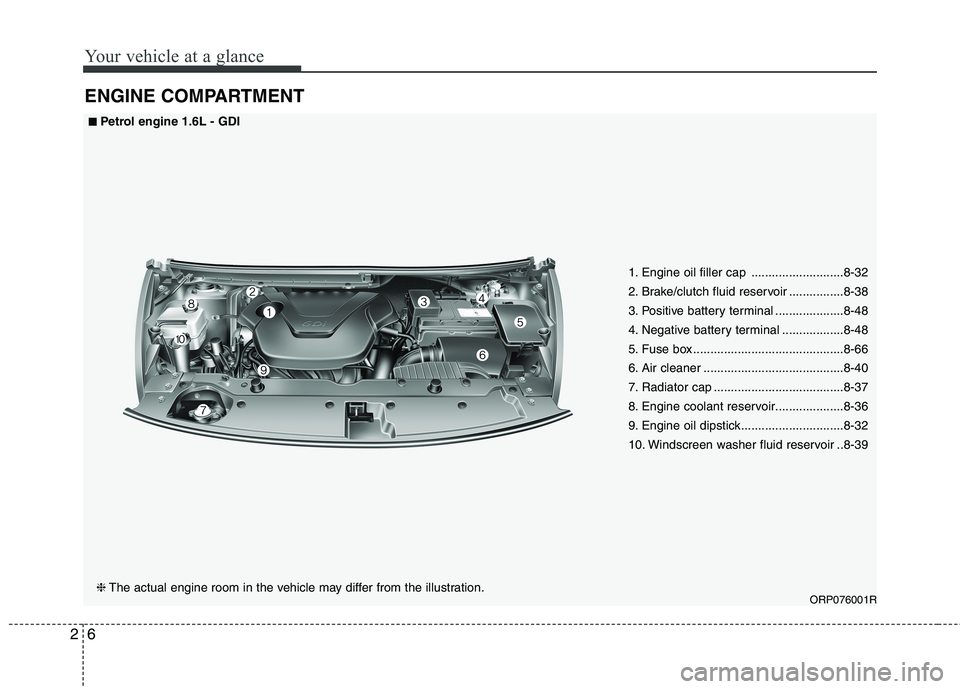
ENGINE COMPARTMENT
ORP076001R
■■
Petrol engine 1.6L - GDI
❈ The actual engine room in the vehicle may differ from the illustration. 1. Engine oil filler cap ...........................8-32
2. Brake/clutch fluid reservoir ................8-38
3. Positive battery terminal ....................8-48
4. Negative battery terminal ..................8-48
5. Fuse box ............................................8-66
6. Air cleaner .........................................8-40
7. Radiator cap ......................................8-37
8. Engine coolant reservoir....................8-36
9. Engine oil dipstick..............................8-32
10. Windscreen washer fluid reservoir ..8-39
Page 17 of 723
27
Your vehicle at a glance
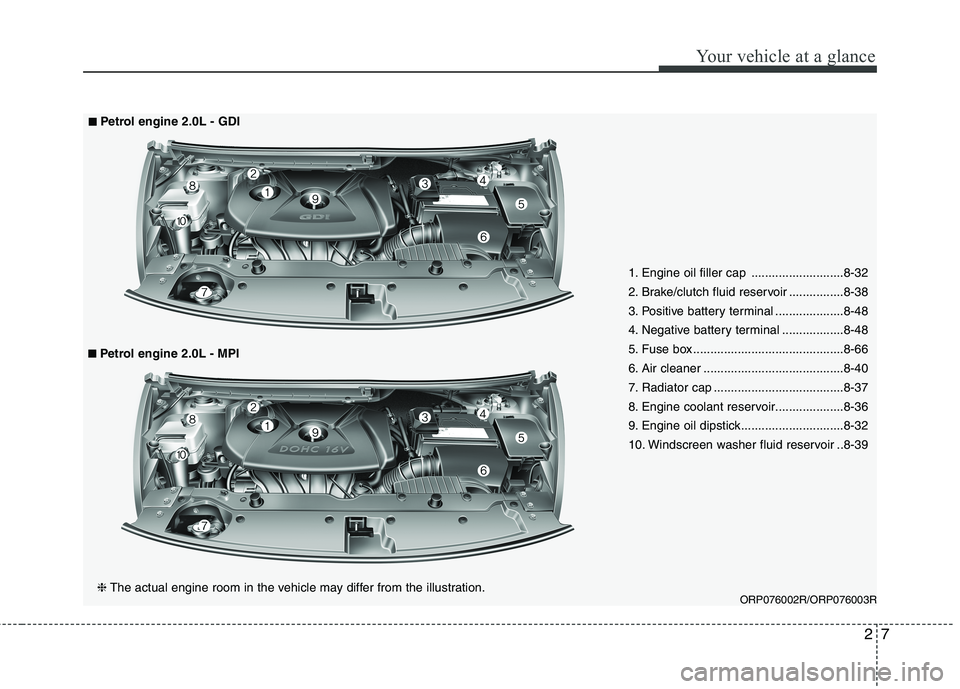
1. Engine oil filler cap ...........................8-32
2. Brake/clutch fluid reservoir ................8-38
3. Positive battery terminal ....................8-48
4. Negative battery terminal ..................8-48
5. Fuse box ............................................8-66
6. Air cleaner .........................................8-40
7. Radiator cap ......................................8-37
8. Engine coolant reservoir....................8-36
9. Engine oil dipstick..............................8-32
10. Windscreen washer fluid reservoir ..8-39ORP076002R/ORP076003R
■■Petrol engine 2.0L - MPI
❈ The actual engine room in the vehicle may differ from the illustration.
■■
Petrol engine 2.0L - GDI
Page 138 of 723
Features of your vehicle
42
4
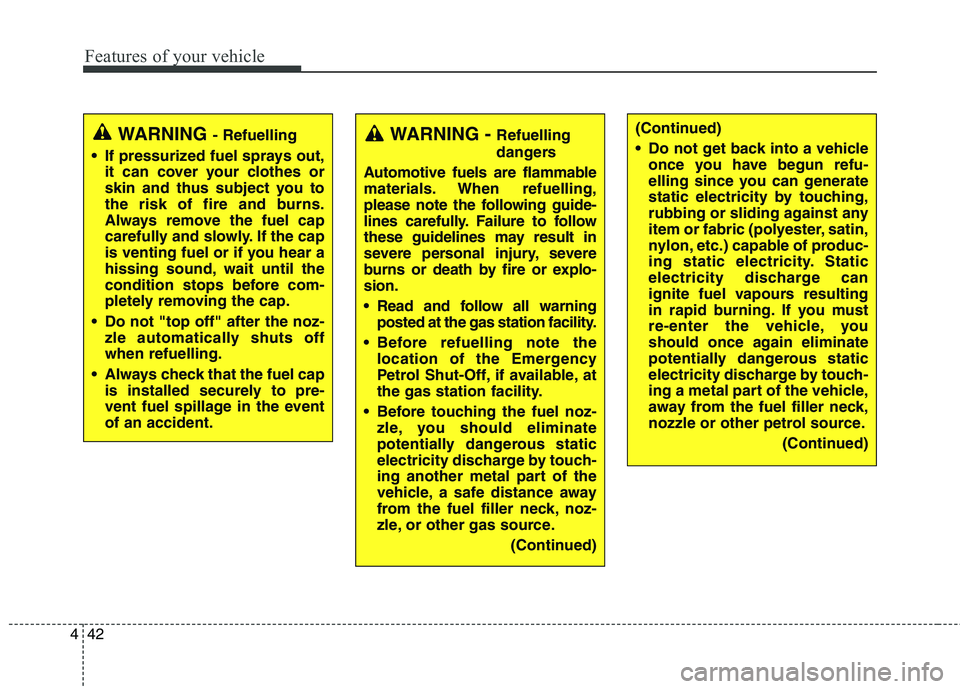
WARNING - Refuelling
If pressurized fuel sprays out, it can cover your clothes or
skin and thus subject you to
the risk of fire and burns.
Always remove the fuel cap
carefully and slowly. If the cap
is venting fuel or if you hear a
hissing sound, wait until the
condition stops before com-
pletely removing the cap.
Do not "top off" after the noz- zle automatically shuts offwhen refuelling.
Always check that the fuel cap is installed securely to pre-
vent fuel spillage in the eventof an accident.(Continued)
Do not get back into a vehicle once you have begun refu-
elling since you can generate
static electricity by touching,
rubbing or sliding against any
item or fabric (polyester, satin,
nylon, etc.) capable of produc-
ing static electricity. Static
electricity discharge can
ignite fuel vapours resulting
in rapid burning. If you must
re-enter the vehicle, you
should once again eliminate
potentially dangerous static
electricity discharge by touch-
ing a metal part of the vehicle,
away from the fuel filler neck,
nozzle or other petrol source.
(Continued)WARNING - Refuelling
dangers
Automotive fuels are flammable
materials. When refuelling,
please note the following guide-
lines carefully. Failure to follow
these guidelines may result in
severe personal injury, severe
burns or death by fire or explo-sion.
Read and follow all warning posted at the gas station facility.
Before refuelling note the location of the Emergency
Petrol Shut-Off, if available, at
the gas station facility.
Before touching the fuel noz- zle, you should eliminate
potentially dangerous static
electricity discharge by touch-
ing another metal part of the
vehicle, a safe distance away
from the fuel filler neck, noz-
zle, or other gas source.
(Continued)
Page 139 of 723
443
Features of your vehicle
(Continued)
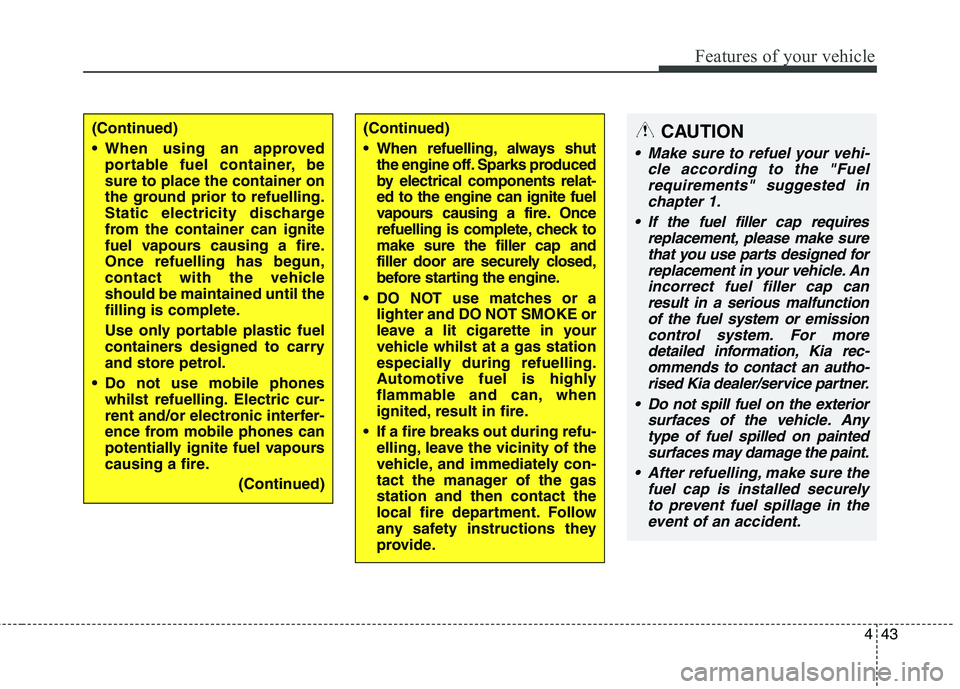
When using an approvedportable fuel container, be sure to place the container on
the ground prior to refuelling.
Static electricity discharge
from the container can ignite
fuel vapours causing a fire.Once refuelling has begun,
contact with the vehicleshould be maintained until the
filling is complete.
Use only portable plastic fuel
containers designed to carry
and store petrol.
Do not use mobile phones whilst refuelling. Electric cur-
rent and/or electronic interfer-
ence from mobile phones can
potentially ignite fuel vapours
causing a fire.
(Continued)(Continued)
When refuelling, always shutthe engine off. Sparks produced
by electrical components relat-ed to the engine can ignite fuel
vapours causing a fire. Once
refuelling is complete, check tomake sure the filler cap and
filler door are securely closed,
before starting the engine.
DO NOT use matches or a lighter and DO NOT SMOKE or
leave a lit cigarette in your
vehicle whilst at a gas station
especially during refuelling.
Automotive fuel is highly
flammable and can, when
ignited, result in fire.
If a fire breaks out during refu- elling, leave the vicinity of the
vehicle, and immediately con-
tact the manager of the gasstation and then contact the
local fire department. Follow
any safety instructions they
provide.CAUTION
Make sure to refuel your vehi-
cle according to the "Fuelrequirements" suggested in chapter 1.
If the fuel filler cap requires replacement, please make surethat you use parts designed forreplacement in your vehicle. An incorrect fuel filler cap canresult in a serious malfunctionof the fuel system or emission control system. For moredetailed information, Kia rec-ommends to contact an autho- rised Kia dealer/service partner.
Do not spill fuel on the exterior surfaces of the vehicle. Anytype of fuel spilled on paintedsurfaces may damage the paint.
After refuelling, make sure the fuel cap is installed securelyto prevent fuel spillage in theevent of an accident.