brake KIA CARNIVAL 2007 Owner's Guide
[x] Cancel search | Manufacturer: KIA, Model Year: 2007, Model line: CARNIVAL, Model: KIA CARNIVAL 2007Pages: 1575, PDF Size: 44.86 MB
Page 469 of 1575

2007 > 2.7L V6 GASOLINE >
REMOVAL
1.Raise the vehicle and remove the wheel & tire assembly (A) from the front hub assembly (B).
Tightening torque Nm (Kgf.m, lb - ft):
90 ~ 110 (9.0 ~ 11.0, 65 ~ 80)
2.Remove the wheel speed sensor & wire (A) by loosening the bolts.
3.Disconnect the brake hose (A) from the strut assembly.
4.Unstake the driveshaft lock nut using a chisel and hammer.
Page 472 of 1575
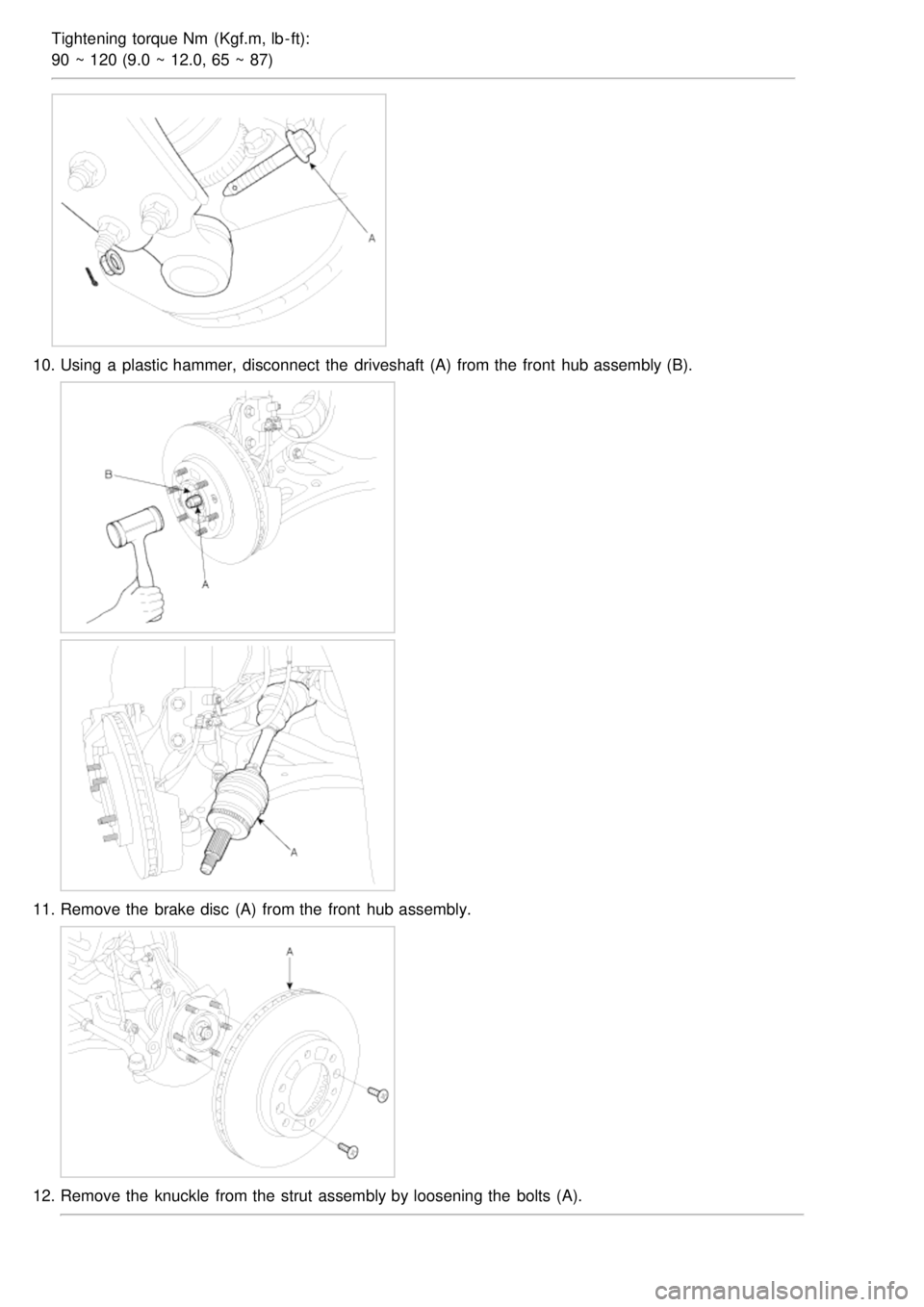
Tightening torque Nm (Kgf.m, lb - ft):
90 ~ 120 (9.0 ~ 12.0, 65 ~ 87)
10.Using a plastic hammer, disconnect the driveshaft (A) from the front hub assembly (B).
11.Remove the brake disc (A) from the front hub assembly.
12.Remove the knuckle from the strut assembly by loosening the bolts (A).
Page 474 of 1575
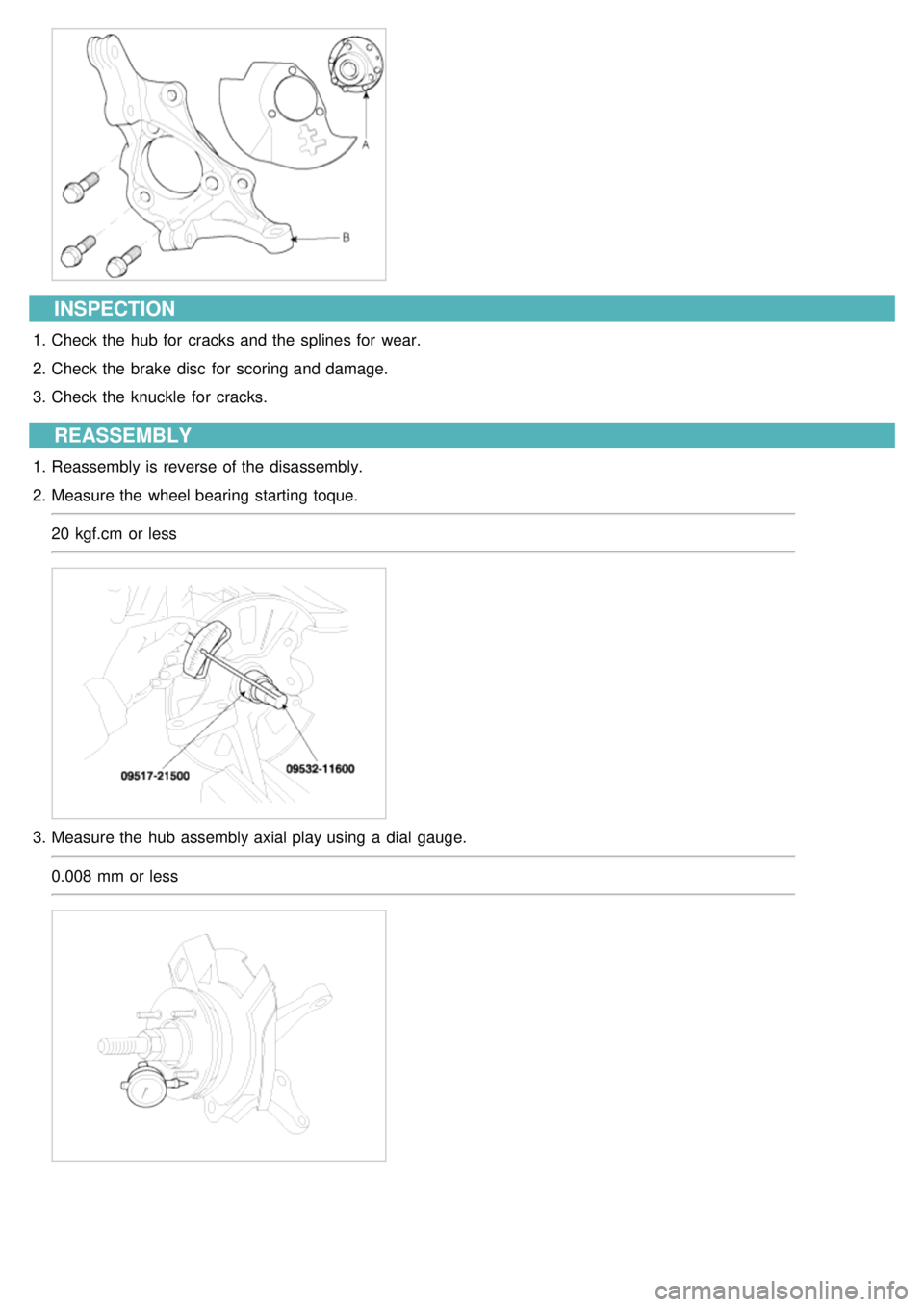
INSPECTION
1.Check the hub for cracks and the splines for wear.
2. Check the brake disc for scoring and damage.
3. Check the knuckle for cracks.
REASSEMBLY
1.Reassembly is reverse of the disassembly.
2. Measure the wheel bearing starting toque.
20 kgf.cm or less
3.Measure the hub assembly axial play using a dial gauge.
0.008 mm or less
Page 477 of 1575

2007 > 2.7L V6 GASOLINE >
REMOVAL
1.Release the parking brake.
2. Remove the wheel & tire assembly.
Tightening torque Nm (kgf.m, lb - ft):
90 ~ 110 (9.0 ~ 11.0, 65 ~ 80)
3.Support lower part of the lower arm (A) using a jack and remove the bolt & nut (B).
Tightening torque Nm (kgf.m, lb - ft):
160 ~ 180 (16.0 ~ 18.0, 116 ~ 130)
4.Remove the coil spring (A) and upper pad.
5.Remove the wheel speed sensor (A).
Page 478 of 1575
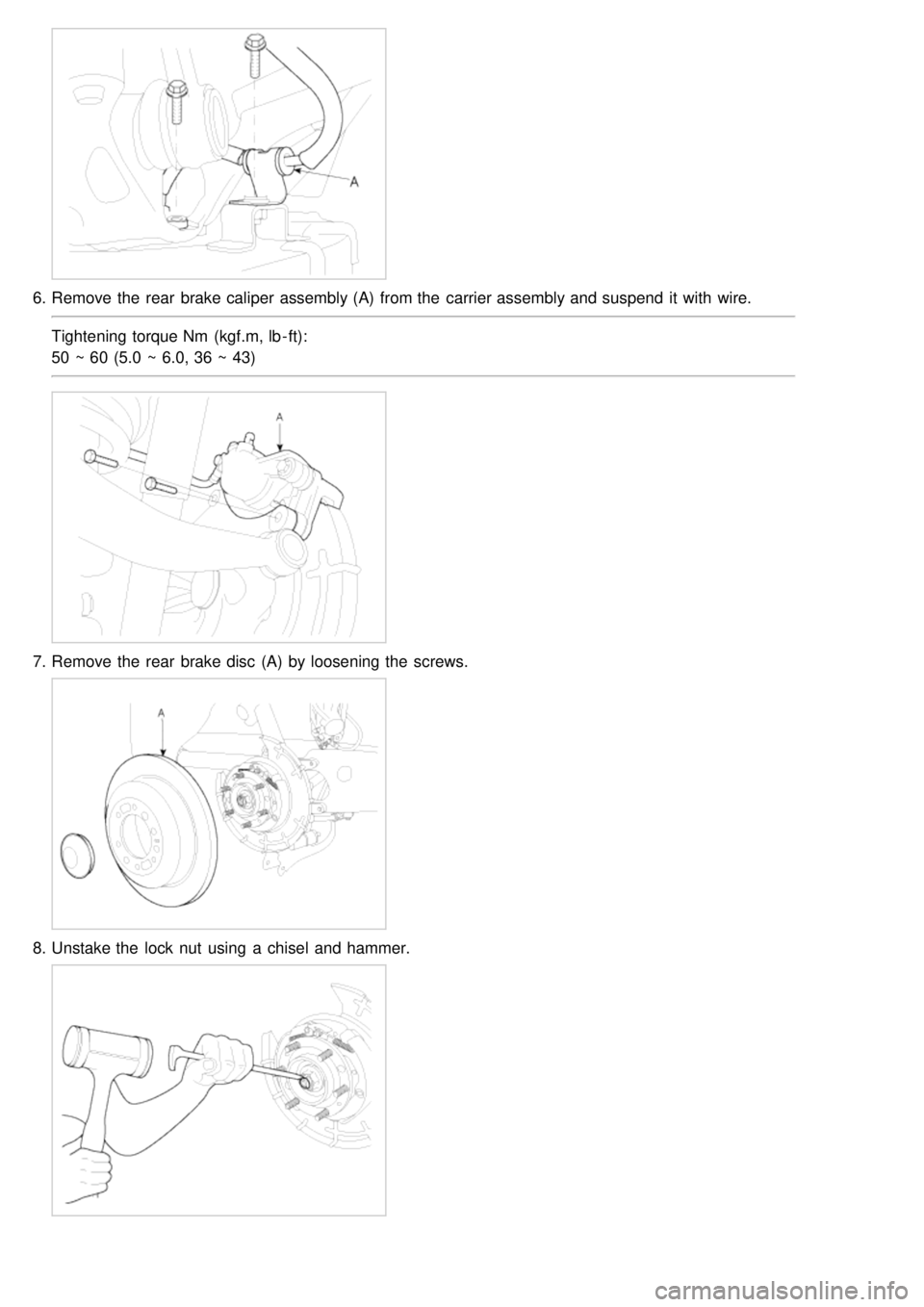
6.Remove the rear brake caliper assembly (A) from the carrier assembly and suspend it with wire.
Tightening torque Nm (kgf.m, lb - ft):
50 ~ 60 (5.0 ~ 6.0, 36 ~ 43)
7.Remove the rear brake disc (A) by loosening the screws.
8.Unstake the lock nut using a chisel and hammer.
Page 479 of 1575
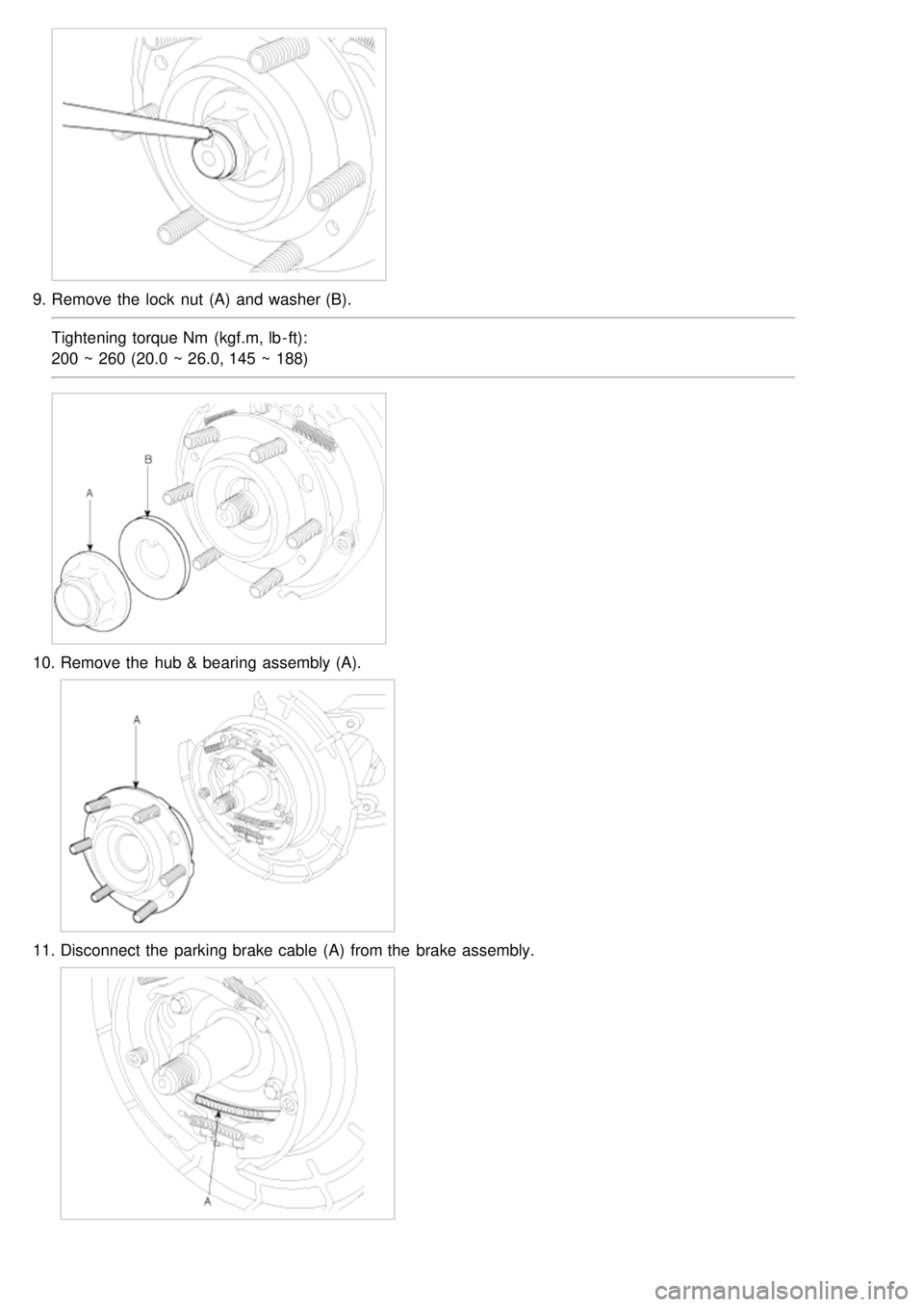
9.Remove the lock nut (A) and washer (B).
Tightening torque Nm (kgf.m, lb - ft):
200 ~ 260 (20.0 ~ 26.0, 145 ~ 188)
10. Remove the hub & bearing assembly (A).
11.Disconnect the parking brake cable (A) from the brake assembly.
Page 480 of 1575
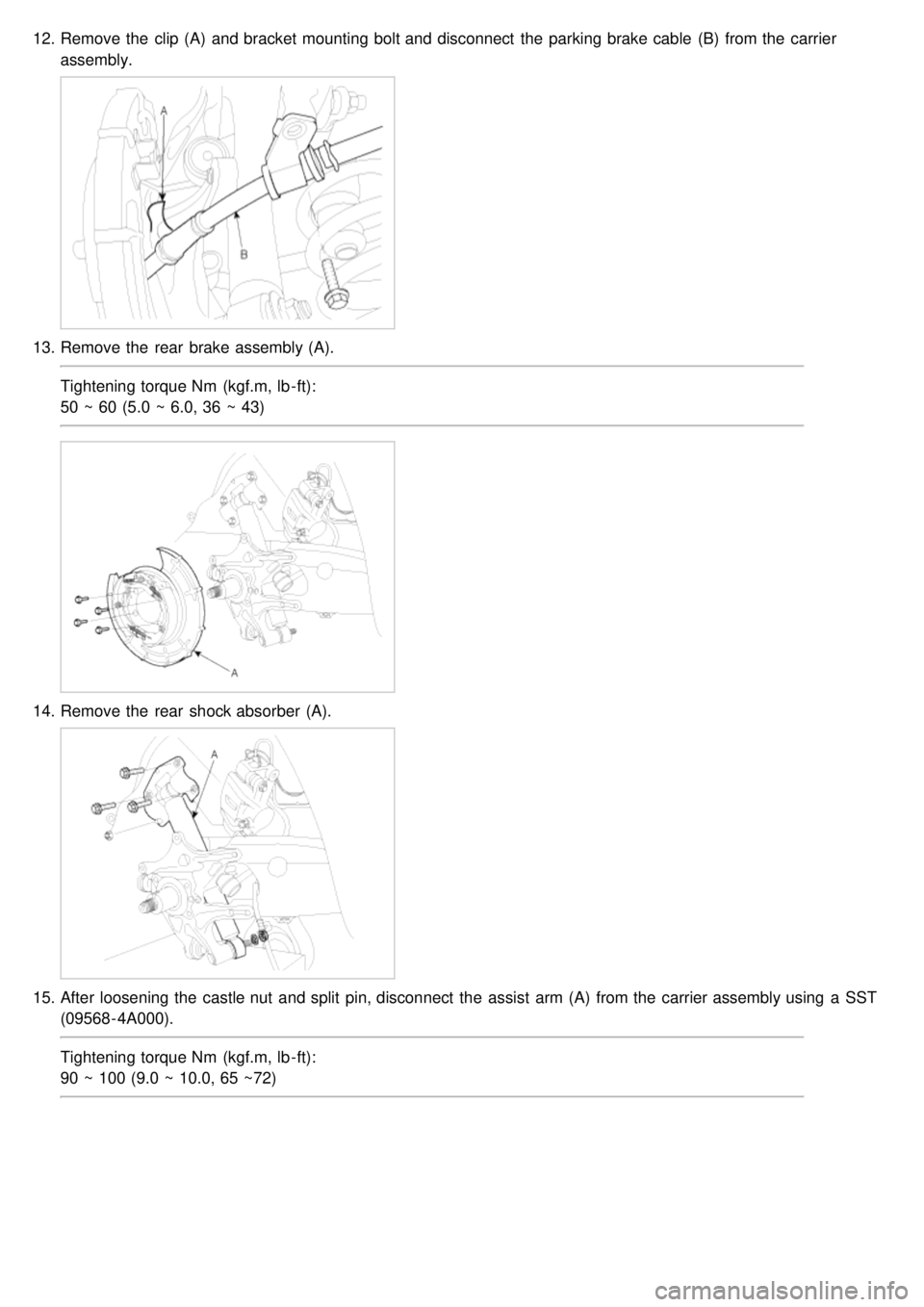
12.Remove the clip (A) and bracket mounting bolt and disconnect the parking brake cable (B) from the carrier
assembly.
13.Remove the rear brake assembly (A).
Tightening torque Nm (kgf.m, lb - ft):
50 ~ 60 (5.0 ~ 6.0, 36 ~ 43)
14.Remove the rear shock absorber (A).
15.After loosening the castle nut and split pin, disconnect the assist arm (A) from the carrier assembly using a SST
(09568- 4A000).
Tightening torque Nm (kgf.m, lb - ft):
90 ~ 100 (9.0 ~ 10.0, 65 ~72)
Page 482 of 1575
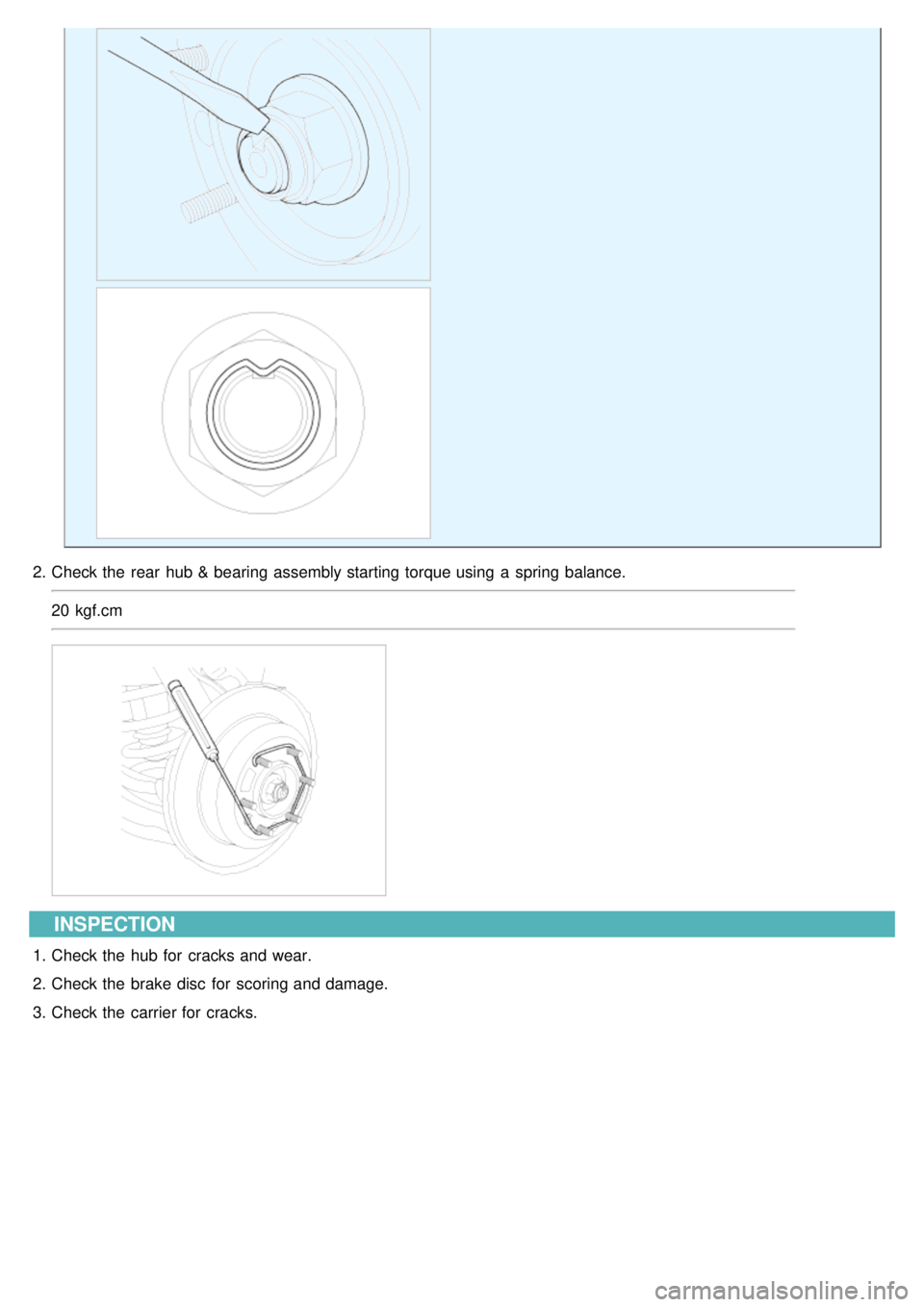
2.Check the rear hub & bearing assembly starting torque using a spring balance.
20 kgf.cm
INSPECTION
1.Check the hub for cracks and wear.
2. Check the brake disc for scoring and damage.
3. Check the carrier for cracks.
Page 489 of 1575
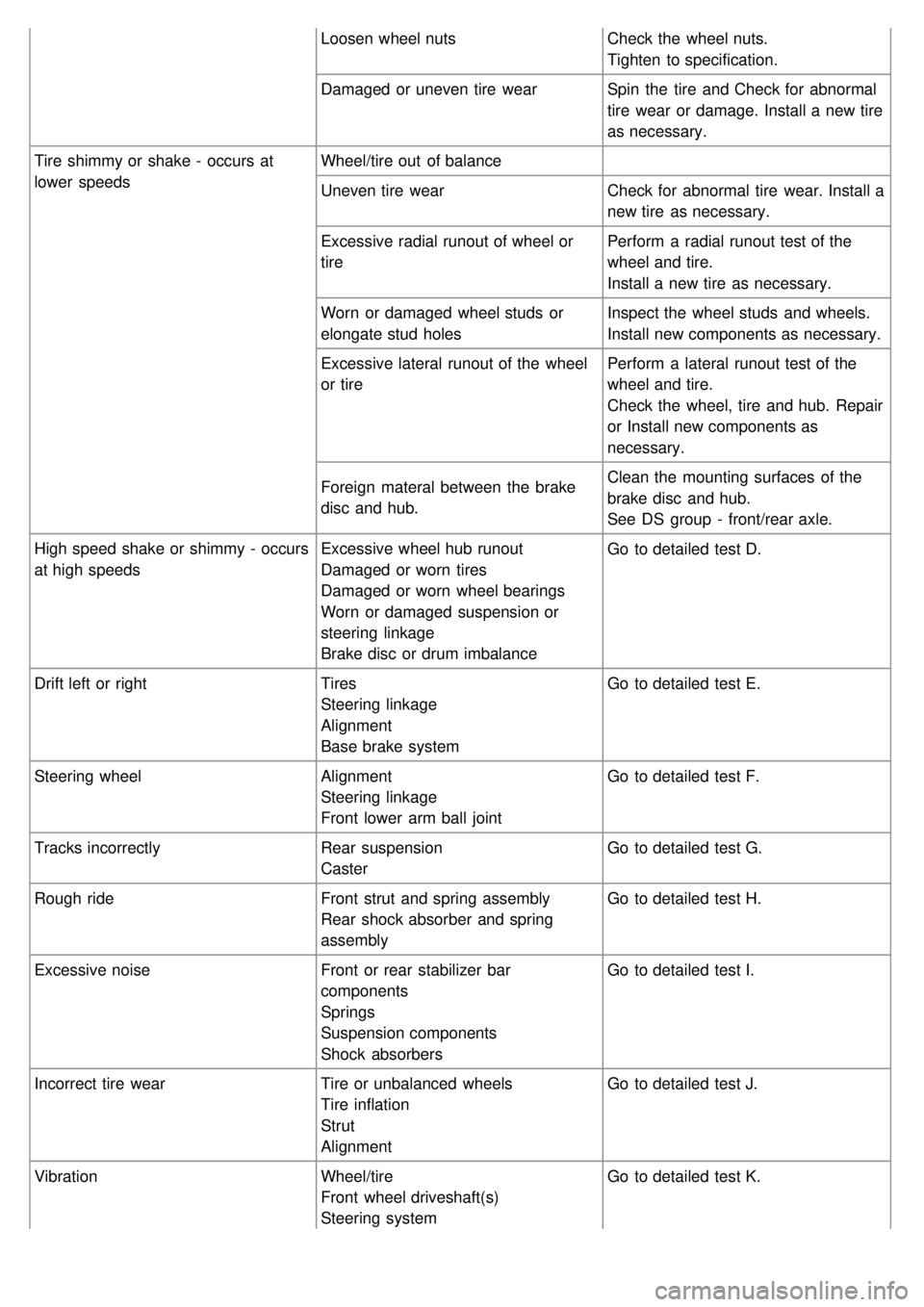
Loosen wheel nutsCheck the wheel nuts.
Tighten to specification.
Damaged or uneven tire wear Spin the tire and Check for abnormal
tire wear or damage. Install a new tire
as necessary.
Tire shimmy or shake - occurs at
lower speeds Wheel/tire out of balance
Uneven tire wear
Check for abnormal tire wear. Install a
new tire as necessary.
Excessive radial runout of wheel or
tire Perform a radial runout test of the
wheel and tire.
Install a new tire as necessary.
Worn or damaged wheel studs or
elongate stud holes Inspect the wheel studs and wheels.
Install new components as necessary.
Excessive lateral runout of the wheel
or tire Perform a lateral runout test of the
wheel and tire.
Check the wheel, tire and hub. Repair
or Install new components as
necessary.
Foreign materal between the brake
disc and hub. Clean the mounting surfaces of the
brake disc and hub.
See DS group - front/rear axle.
High speed shake or shimmy - occurs
at high speeds Excessive wheel hub runout
Damaged or worn tires
Damaged or worn wheel bearings
Worn or damaged suspension or
steering linkage
Brake disc or drum imbalanceGo to detailed test D.
Drift left or right Tires
Steering linkage
Alignment
Base brake systemGo to detailed test E.
Steering wheel Alignment
Steering linkage
Front lower arm ball jointGo to detailed test F.
Tracks incorrectly Rear suspension
CasterGo to detailed test G.
Rough ride Front strut and spring assembly
Rear shock absorber and spring
assemblyGo to detailed test H.
Excessive noise Front or rear stabilizer bar
components
Springs
Suspension components
Shock absorbersGo to detailed test I.
Incorrect tire wear Tire or unbalanced wheels
Tire inflation
Strut
AlignmentGo to detailed test J.
Vibration Wheel/tire
Front wheel driveshaft(s)
Steering system
Strut and spring assemblyGo to detailed test K.
Page 493 of 1575

c.Inspect the tire wear pattern.
● Do the tires have an abnormal wear pattern ?
→ YES
Correct the condition that caused the abnormal wear. Install new tire(s).
Test the system for normal operation.
→ NO
Go to
TIRE ROTATION DIAGNOSIS a.Spin the tires slowly and watch for signs of lateral runout.
b. Spin the tires slowly and watch for signs of radial runout.
● Are there signs of visual runout ?
→ YES
Go to
→ NO
Check the wheel and tire balance.
Correct as necessary. Test the system for normal operation.
RADIAL RUNOUT CHECK ON THE TIRE Measure the radial runout of the wheel and tire assembly. A typical
specification for total radial runout is 1.15mm (0.059 inch).
● Is the radial runout within specifications ?
→ YES
Go to C8.
→ NO
Go to C6.
RADIAL RUNOUT CHECK ON THE WHEEL Measure the radial runout of the wheel. A typical specification for total radial
runout is 1.14mm (0.045 inch.).
● Is the radial runout within specifications ?
→ YES
Install a new tire. Test the system for normal operation.
→ NO
Go to C7.
CHECK THE HUB/BRAKE DISC OR DRUM PILOT RUNOUT OR BOLT CIRCLE RUNOUT Measure the pilot or bolt circle runout. A typical specification for radial
runout is :
● pilot runout - less than 0.15mm (0.006 inch.)
● bolt circle runout - less than 0.38 mm (0.015 inch.)
● Is the radial runout within specification ?
→ YES
Install a new wheel. Test the system for normal operation.
→ NO
Repair or Install new components as necessary.
LATERAL RUNOUT CHECK ON THE TIRE Measure the lateral runout of the wheel and tire assembly. A typical
specification for total lateral runout is 2.5mm (0.098 inch).