brake KIA CARNIVAL 2007 User Guide
[x] Cancel search | Manufacturer: KIA, Model Year: 2007, Model line: CARNIVAL, Model: KIA CARNIVAL 2007Pages: 1575, PDF Size: 44.86 MB
Page 348 of 1575

2007 > 2.7L V6 GASOLINE >
Description
The automatic transmission is a combination of 3 - element 2 - phase 1 - stage torque converter and double shaft
electrocally - controlled unit which provides 4 speeds forward and 1 reverse. To improve the efficiency of power
transmission, the line pressure control was changed applying “Variable Force Solenoid (VFS) valve” on this model.
However, adopting VFS on this model, the line pressure is variably changed according to TPS and the vehicle speed,
this will enable more improved efficiency of power transmission and fuel consumption.
Characteristics
Some of the characteristics include:
▶Different power transfer
▶Different component layout
▶New shift logic(HIVEC) to improve shift feeling
▶Position of Valve Body
▶Variable shift pattern
▶Communication protocol and method
▶Step gate type shift lever.
Item Details
Weight Reduction 1. Aluminum oil pump
a. 2.3kg Approx
2. Pressed parts a. Retainer and hub of brakes and clutches
b. Carrier of planetary gear set
Better shift quality 1. Independent control of clutches and brakes enabled better control of
hydraulic pressure and skiped shifts (4 to 2, 3 to 1)
2. During N to D or N to R shift, feedback control adopted.
3. When starting from Creep condition, reduction of shock.(Creep condition is
controlled with 1st gear)
4. Solenoid valve frequency is increased for more accurate control. 35Hz to
61.3Hz except DCCSV that is 35Hz and VFS that is 600Hz.
5. HIVEC adoption for better shift feeling.
6. Variable shift pattern.
Increase in Power train efficiency 1. Fully Variable Line Pressure
2. VFS(Variable Force Solenoid)
- Manual shifting possible
- Step gate type shift lever
Page 351 of 1575
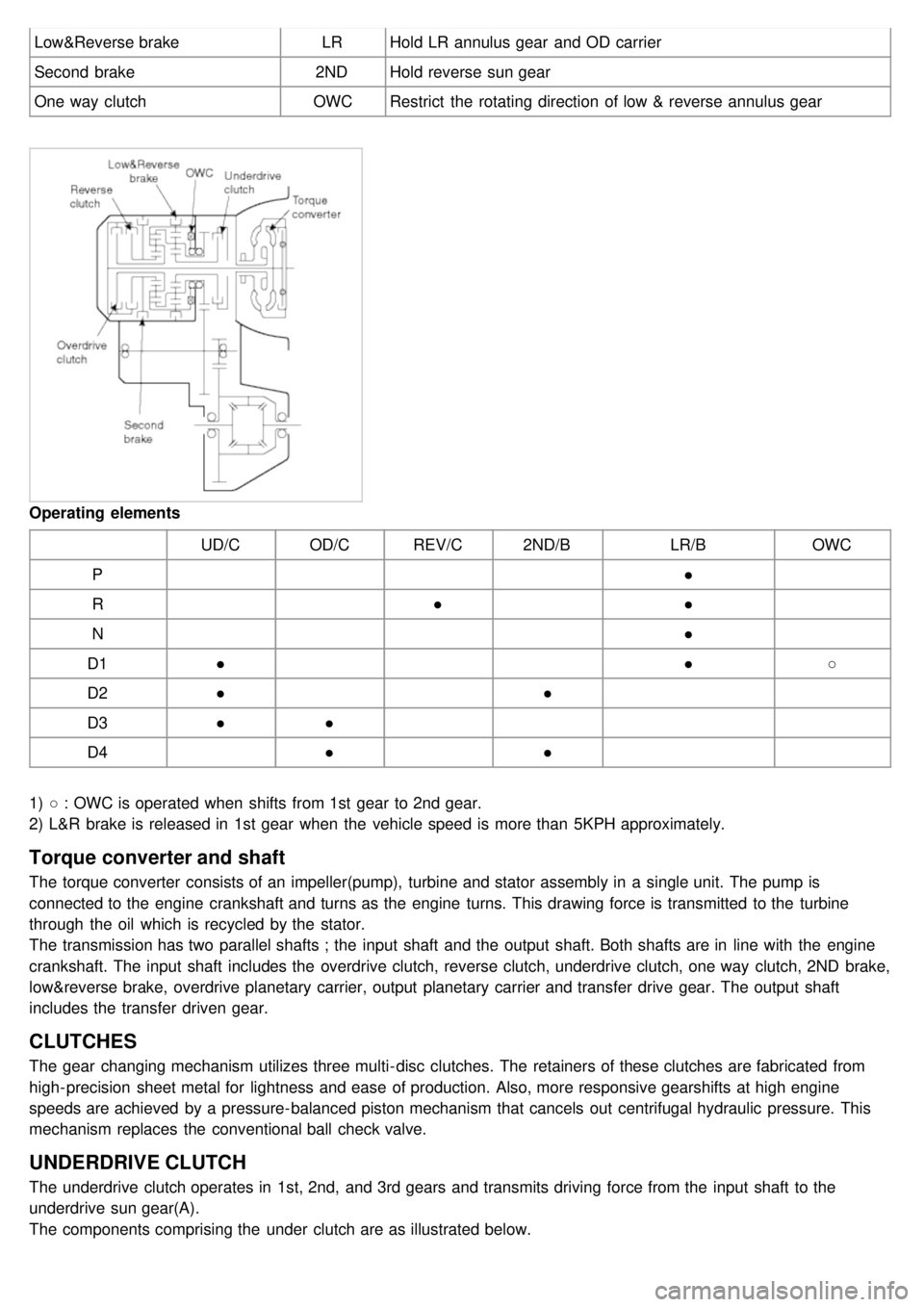
Low&Reverse brakeLRHold LR annulus gear and OD carrier
Second brake 2NDHold reverse sun gear
One way clutch OWCRestrict the rotating direction of low & reverse annulus gear
Operating elements
UD/COD/CREV/C 2ND/B LR/BOWC
P ●
R ●●
N ●
D1 ● ●○
D2 ● ●
D3 ●●
D4 ●●
1) ○ : OWC is operated when shifts from 1st gear to 2nd gear.
2) L&R brake is released in 1st gear when the vehicle speed is more than 5KPH approximately.
Torque converter and shaft
The torque converter consists of an impeller(pump), turbine and stator assembly in a single unit. The pump is
connected to the engine crankshaft and turns as the engine turns. This drawing force is transmitted to the turbine
through the oil which is recycled by the stator.
The transmission has two parallel shafts ; the input shaft and the output shaft. Both shafts are in line with the engine
crankshaft. The input shaft includes the overdrive clutch, reverse clutch, underdrive clutch, one way clutch, 2ND brake,
low&reverse brake, overdrive planetary carrier, output planetary carrier and transfer drive gear. The output shaft
includes the transfer driven gear.
CLUTCHES
The gear changing mechanism utilizes three multi- disc clutches. The retainers of these clutches are fabricated from
high- precision sheet metal for lightness and ease of production. Also, more responsive gearshifts at high engine
speeds are achieved by a pressure- balanced piston mechanism that cancels out centrifugal hydraulic pressure. This
mechanism replaces the conventional ball check valve.
UNDERDRIVE CLUTCH
The underdrive clutch operates in 1st, 2nd, and 3rd gears and transmits driving force from the input shaft to the
underdrive sun gear(A).
The components comprising the under clutch are as illustrated below.
Page 353 of 1575
BRAKES
The gear changing mechanism utilizes two multi- disc brakes.
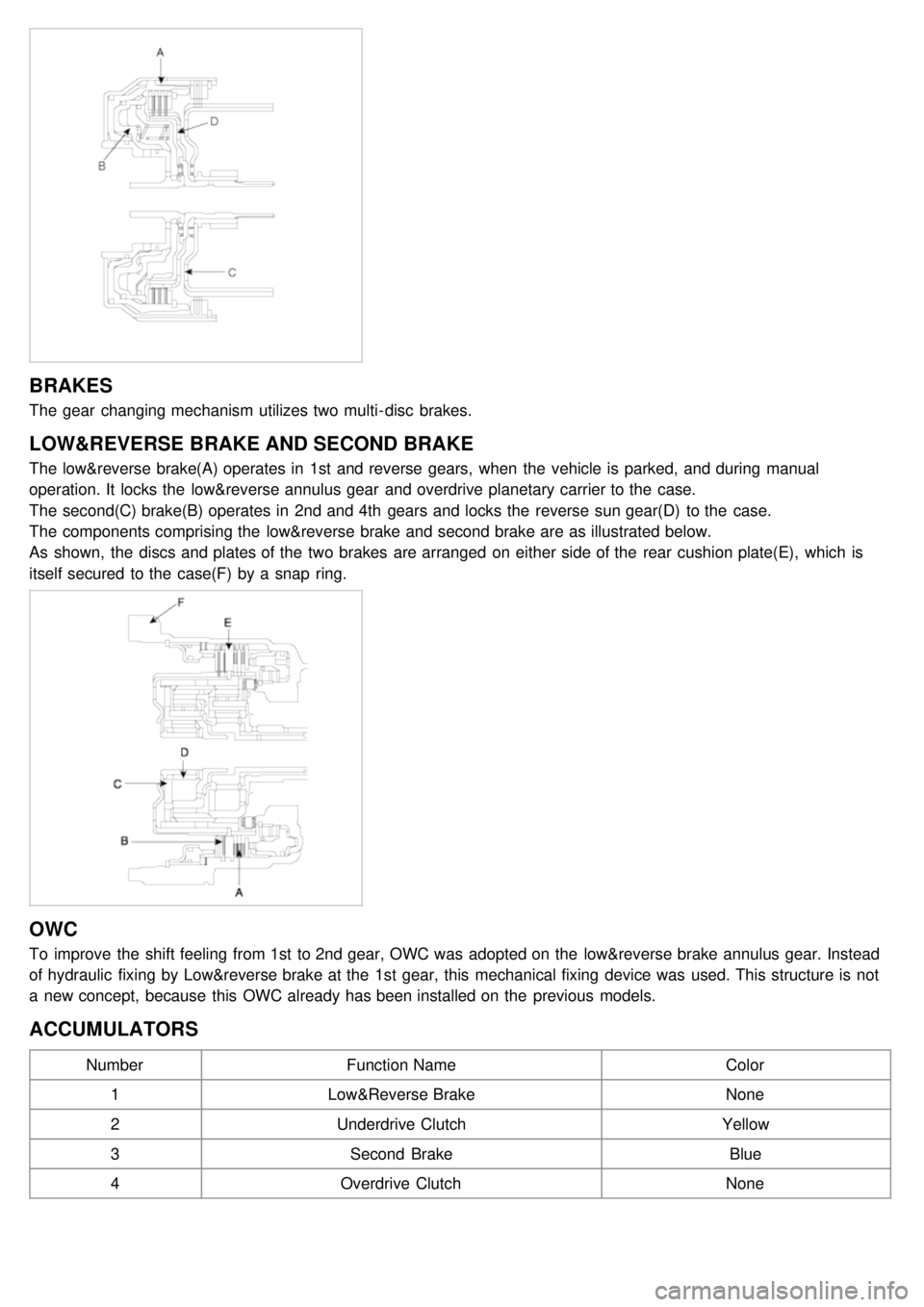
LOW&REVERSE BRAKE AND SECOND BRAKE
The low&reverse brake(A) operates in 1st and reverse gears, when the vehicle is parked, and during manual
operation. It locks the low&reverse annulus gear and overdrive planetary carrier to the case.
The second(C) brake(B) operates in 2nd and 4th gears and locks the reverse sun gear(D) to the case.
The components comprising the low&reverse brake and second brake are as illustrated below.
As shown, the discs and plates of the two brakes are arranged on either side of the rear cushion plate(E), which is
itself secured to the case(F) by a snap ring.
OWC
To improve the shift feeling from 1st to 2nd gear, OWC was adopted on the low&reverse brake annulus gear. Instead
of hydraulic fixing by Low&reverse brake at the 1st gear, this mechanical fixing device was used. This structure is not
a new concept, because this OWC already has been installed on the previous models.
ACCUMULATORS
NumberFunction Name Color
1 Low&Reverse Brake None
2 Underdrive Clutch Yellow
3 Second Brake Blue
4 Overdrive Clutch None
Page 354 of 1575
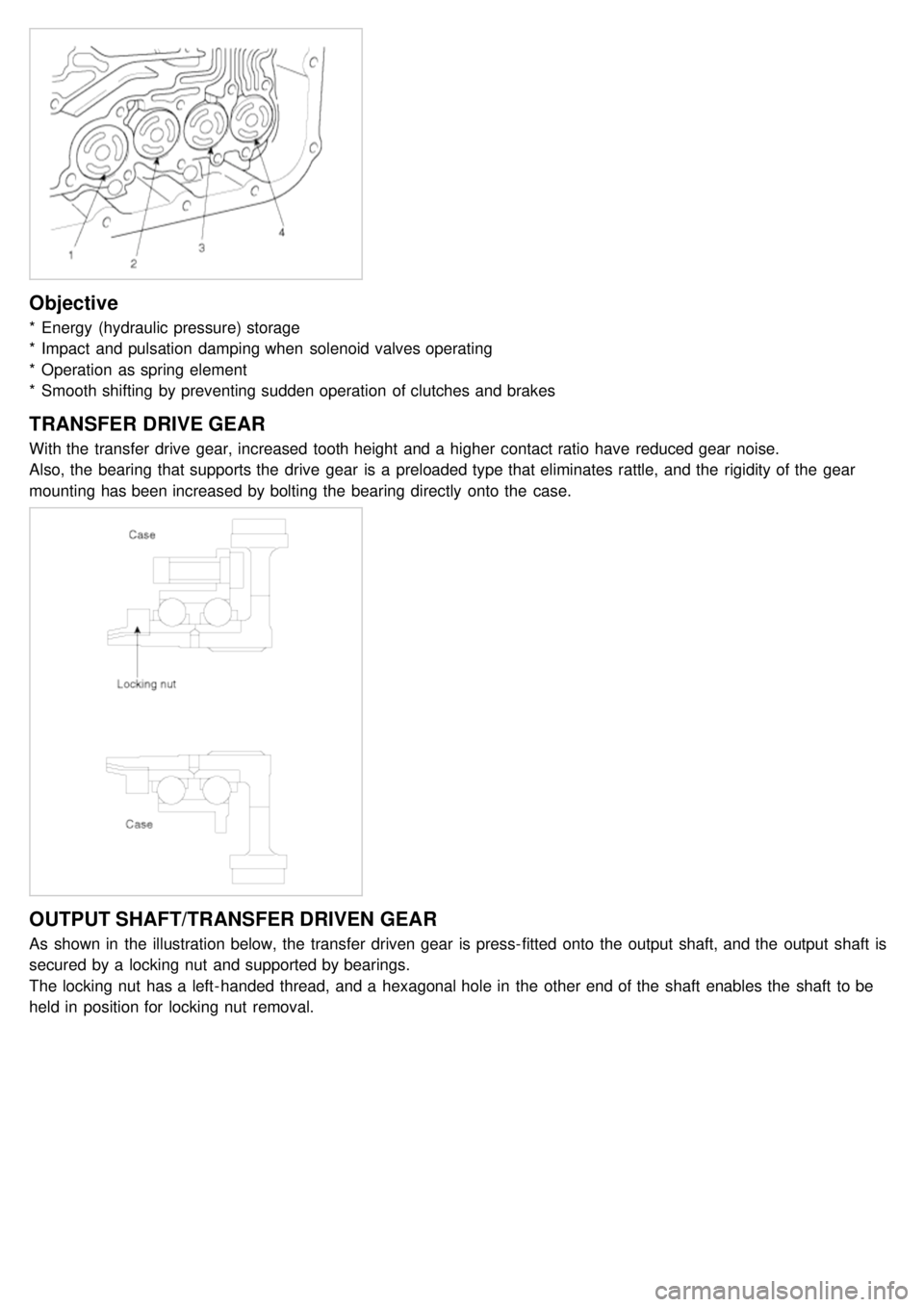
Objective
* Energy (hydraulic pressure) storage
* Impact and pulsation damping when solenoid valves operating
* Operation as spring element
* Smooth shifting by preventing sudden operation of clutches and brakes
TRANSFER DRIVE GEAR
With the transfer drive gear, increased tooth height and a higher contact ratio have reduced gear noise.
Also, the bearing that supports the drive gear is a preloaded type that eliminates rattle, and the rigidity of the gear
mounting has been increased by bolting the bearing directly onto the case.
OUTPUT SHAFT/TRANSFER DRIVEN GEAR
As shown in the illustration below, the transfer driven gear is press- fitted onto the output shaft, and the output shaft is
secured by a locking nut and supported by bearings.
The locking nut has a left- handed thread, and a hexagonal hole in the other end of the shaft enables the shaft to be
held in position for locking nut removal.
Page 355 of 1575
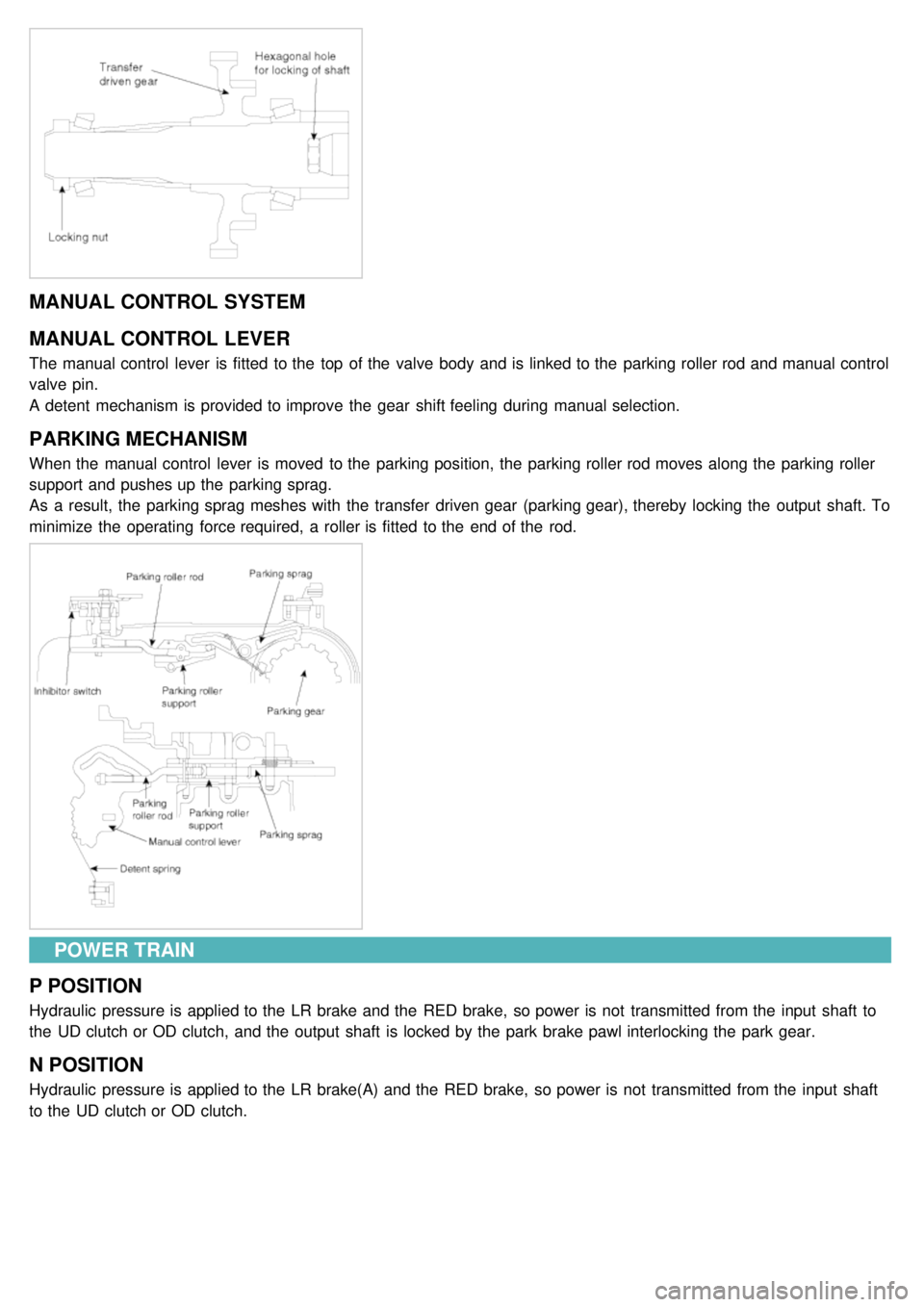
MANUAL CONTROL SYSTEM
MANUAL CONTROL LEVER
The manual control lever is fitted to the top of the valve body and is linked to the parking roller rod and manual control
valve pin.
A detent mechanism is provided to improve the gear shift feeling during manual selection.
PARKING MECHANISM
When the manual control lever is moved to the parking position, the parking roller rod moves along the parking roller
support and pushes up the parking sprag.
As a result, the parking sprag meshes with the transfer driven gear (parking gear), thereby locking the output shaft. To
minimize the operating force required, a roller is fitted to the end of the rod.
POWER TRAIN
P POSITION
Hydraulic pressure is applied to the LR brake and the RED brake, so power is not transmitted from the input shaft to
the UD clutch or OD clutch, and the output shaft is locked by the park brake pawl interlocking the park gear.
N POSITION
Hydraulic pressure is applied to the LR brake(A) and the RED brake, so power is not transmitted from the input shaft
to the UD clutch or OD clutch.
Page 356 of 1575
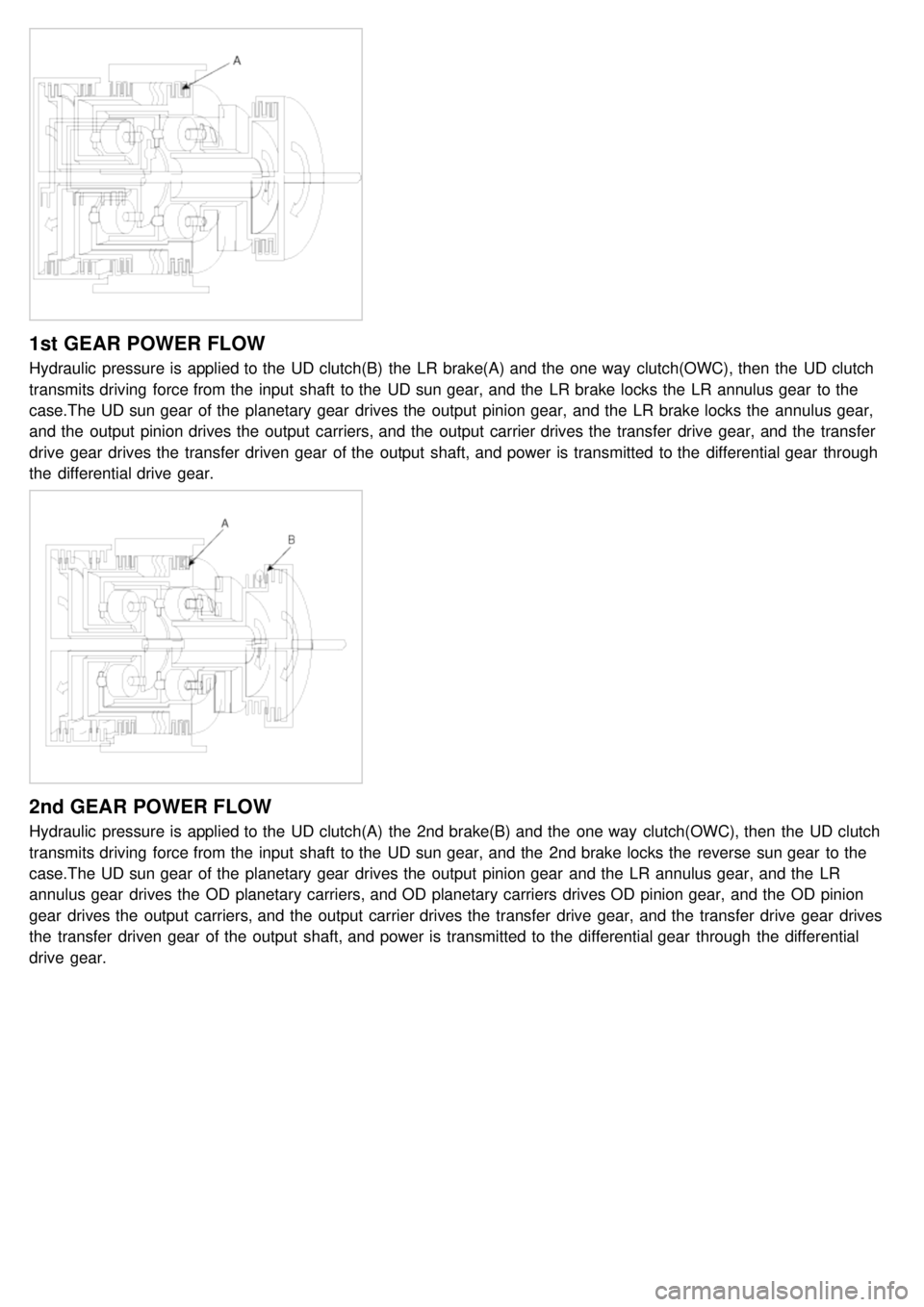
1st GEAR POWER FLOW
Hydraulic pressure is applied to the UD clutch(B) the LR brake(A) and the one way clutch(OWC), then the UD clutch
transmits driving force from the input shaft to the UD sun gear, and the LR brake locks the LR annulus gear to the
case.The UD sun gear of the planetary gear drives the output pinion gear, and the LR brake locks the annulus gear,
and the output pinion drives the output carriers, and the output carrier drives the transfer drive gear, and the transfer
drive gear drives the transfer driven gear of the output shaft, and power is transmitted to the differential gear through
the differential drive gear.
2nd GEAR POWER FLOW
Hydraulic pressure is applied to the UD clutch(A) the 2nd brake(B) and the one way clutch(OWC), then the UD clutch
transmits driving force from the input shaft to the UD sun gear, and the 2nd brake locks the reverse sun gear to the
case.The UD sun gear of the planetary gear drives the output pinion gear and the LR annulus gear, and the LR
annulus gear drives the OD planetary carriers, and OD planetary carriers drives OD pinion gear, and the OD pinion
gear drives the output carriers, and the output carrier drives the transfer drive gear, and the transfer drive gear drives
the transfer driven gear of the output shaft, and power is transmitted to the differential gear through the differential
drive gear.
Page 357 of 1575
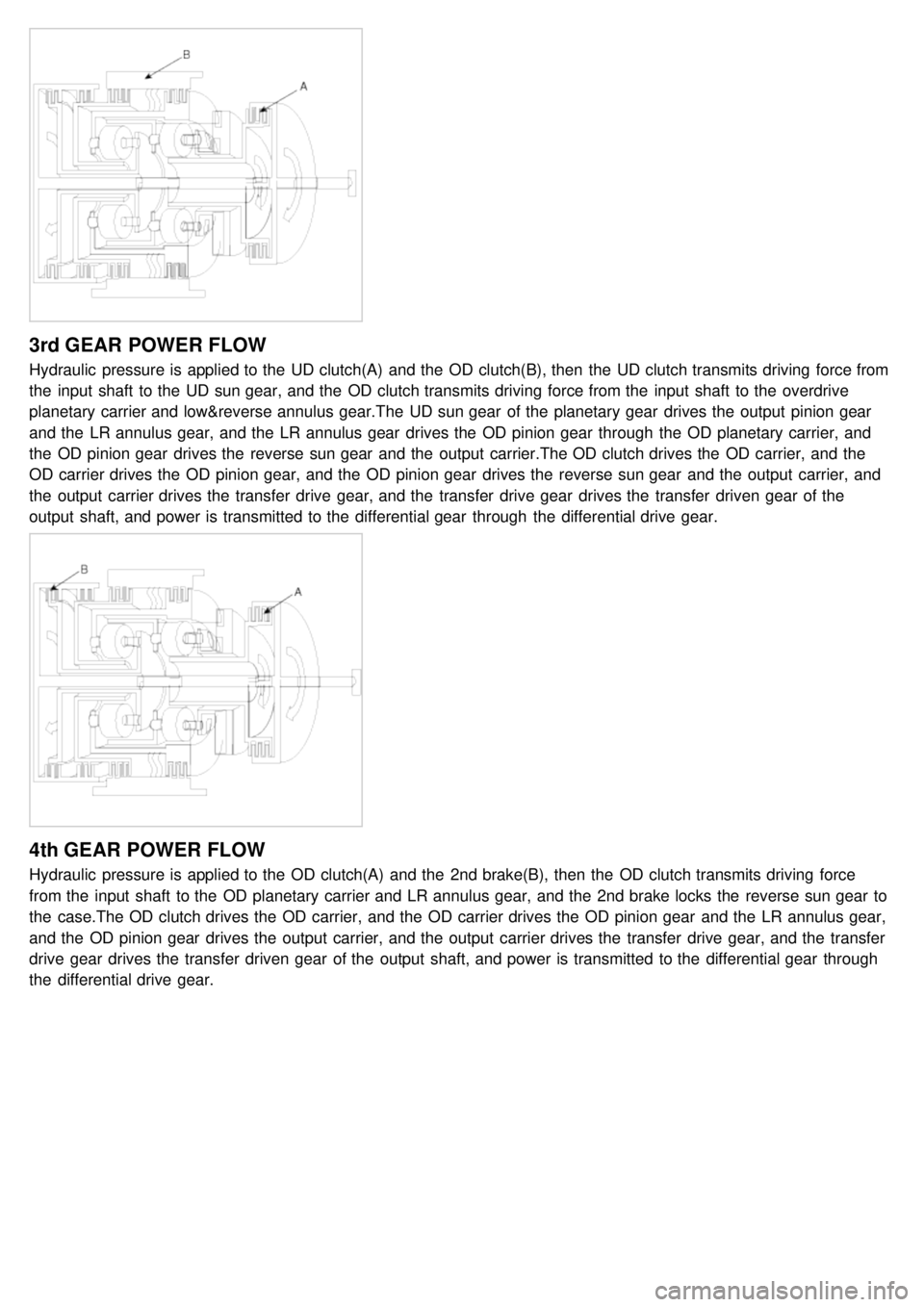
3rd GEAR POWER FLOW
Hydraulic pressure is applied to the UD clutch(A) and the OD clutch(B), then the UD clutch transmits driving force from
the input shaft to the UD sun gear, and the OD clutch transmits driving force from the input shaft to the overdrive
planetary carrier and low&reverse annulus gear.The UD sun gear of the planetary gear drives the output pinion gear
and the LR annulus gear, and the LR annulus gear drives the OD pinion gear through the OD planetary carrier, and
the OD pinion gear drives the reverse sun gear and the output carrier.The OD clutch drives the OD carrier, and the
OD carrier drives the OD pinion gear, and the OD pinion gear drives the reverse sun gear and the output carrier, and
the output carrier drives the transfer drive gear, and the transfer drive gear drives the transfer driven gear of the
output shaft, and power is transmitted to the differential gear through the differential drive gear.
4th GEAR POWER FLOW
Hydraulic pressure is applied to the OD clutch(A) and the 2nd brake(B), then the OD clutch transmits driving force
from the input shaft to the OD planetary carrier and LR annulus gear, and the 2nd brake locks the reverse sun gear to
the case.The OD clutch drives the OD carrier, and the OD carrier drives the OD pinion gear and the LR annulus gear,
and the OD pinion gear drives the output carrier, and the output carrier drives the transfer drive gear, and the transfer
drive gear drives the transfer driven gear of the output shaft, and power is transmitted to the differential gear through
the differential drive gear.
Page 358 of 1575
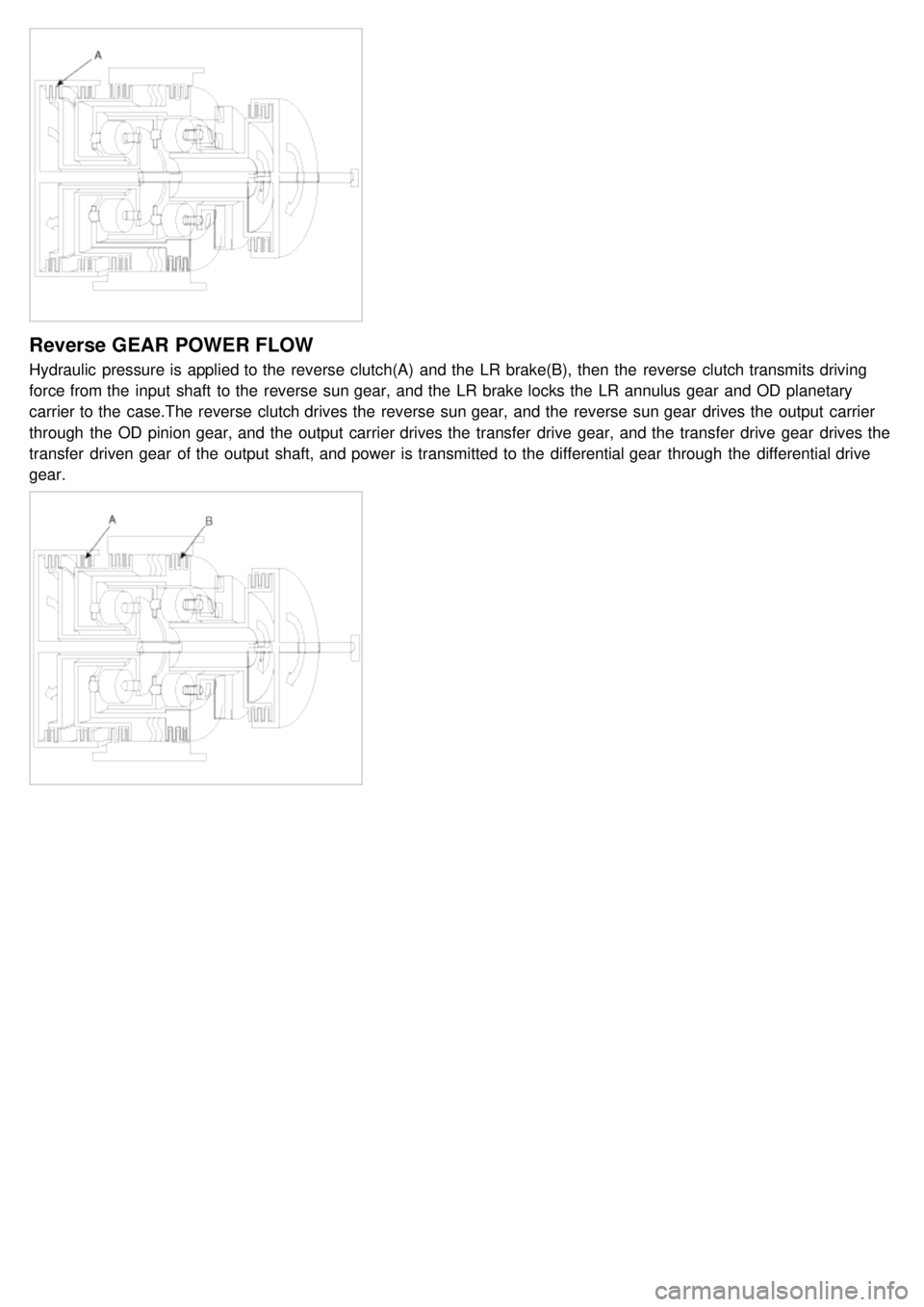
Reverse GEAR POWER FLOW
Hydraulic pressure is applied to the reverse clutch(A) and the LR brake(B), then the reverse clutch transmits driving
force from the input shaft to the reverse sun gear, and the LR brake locks the LR annulus gear and OD planetary
carrier to the case.The reverse clutch drives the reverse sun gear, and the reverse sun gear drives the output carrier
through the OD pinion gear, and the output carrier drives the transfer drive gear, and the transfer drive gear drives the
transfer driven gear of the output shaft, and power is transmitted to the differential gear through the differential drive
gear.
Page 360 of 1575
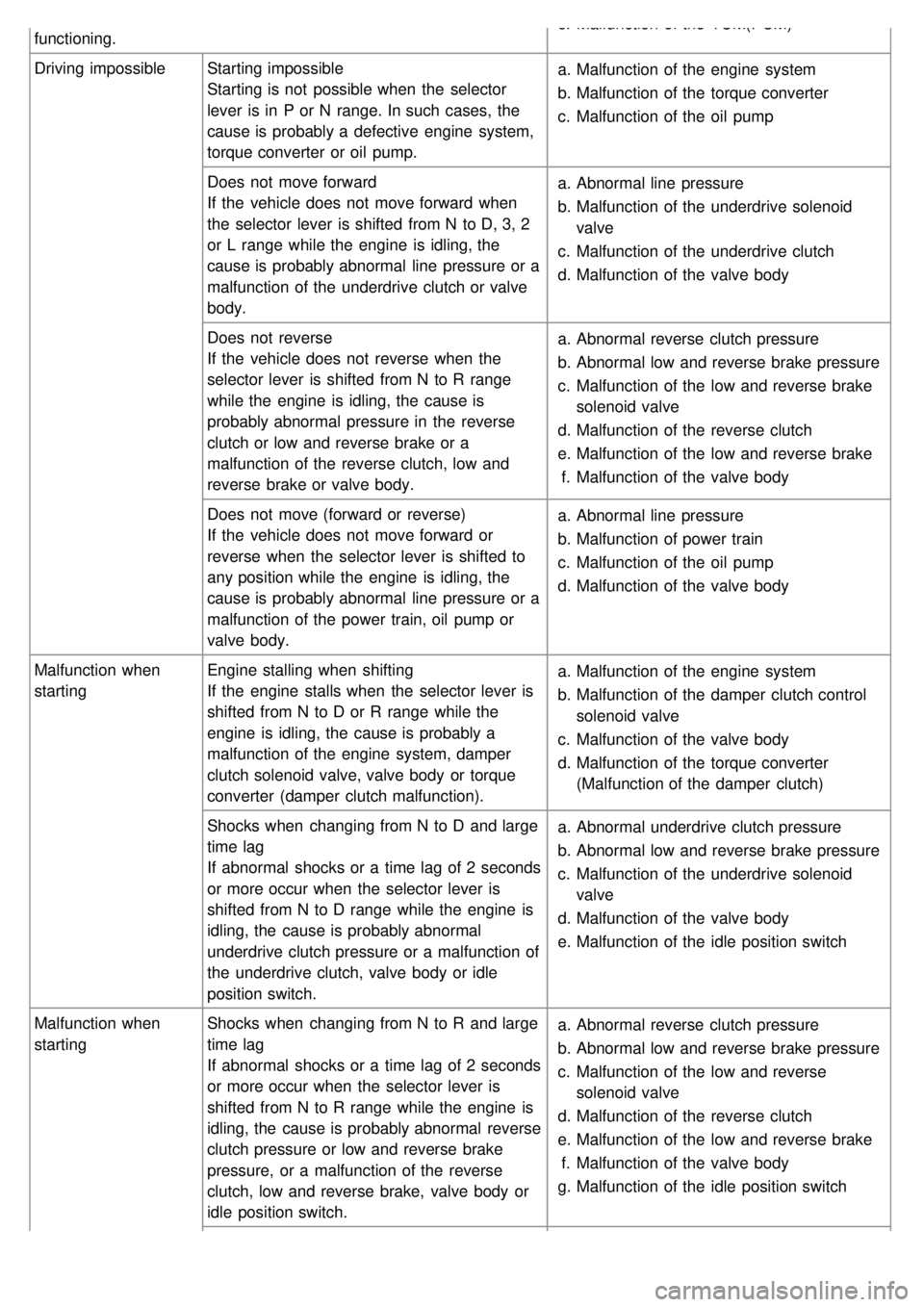
functioning.c.
Malfunction of the TCM(PCM)
Driving impossible Starting impossible
Starting is not possible when the selector
lever is in P or N range. In such cases, the
cause is probably a defective engine system,
torque converter or oil pump. a.
Malfunction of the engine system
b. Malfunction of the torque converter
c. Malfunction of the oil pump
Does not move forward
If the vehicle does not move forward when
the selector lever is shifted from N to D, 3, 2
or L range while the engine is idling, the
cause is probably abnormal line pressure or a
malfunction of the underdrive clutch or valve
body. a.
Abnormal line pressure
b. Malfunction of the underdrive solenoid
valve
c. Malfunction of the underdrive clutch
d. Malfunction of the valve body
Does not reverse
If the vehicle does not reverse when the
selector lever is shifted from N to R range
while the engine is idling, the cause is
probably abnormal pressure in the reverse
clutch or low and reverse brake or a
malfunction of the reverse clutch, low and
reverse brake or valve body. a.
Abnormal reverse clutch pressure
b. Abnormal low and reverse brake pressure
c. Malfunction of the low and reverse brake
solenoid valve
d. Malfunction of the reverse clutch
e. Malfunction of the low and reverse brake
f. Malfunction of the valve body
Does not move (forward or reverse)
If the vehicle does not move forward or
reverse when the selector lever is shifted to
any position while the engine is idling, the
cause is probably abnormal line pressure or a
malfunction of the power train, oil pump or
valve body. a.
Abnormal line pressure
b. Malfunction of power train
c. Malfunction of the oil pump
d. Malfunction of the valve body
Malfunction when
starting Engine stalling when shifting
If the engine stalls when the selector lever is
shifted from N to D or R range while the
engine is idling, the cause is probably a
malfunction of the engine system, damper
clutch solenoid valve, valve body or torque
converter (damper clutch malfunction). a.
Malfunction of the engine system
b. Malfunction of the damper clutch control
solenoid valve
c. Malfunction of the valve body
d. Malfunction of the torque converter
(Malfunction of the damper clutch)
Shocks when changing from N to D and large
time lag
If abnormal shocks or a time lag of 2 seconds
or more occur when the selector lever is
shifted from N to D range while the engine is
idling, the cause is probably abnormal
underdrive clutch pressure or a malfunction of
the underdrive clutch, valve body or idle
position switch. a.
Abnormal underdrive clutch pressure
b. Abnormal low and reverse brake pressure
c. Malfunction of the underdrive solenoid
valve
d. Malfunction of the valve body
e. Malfunction of the idle position switch
Malfunction when
starting Shocks when changing from N to R and large
time lag
If abnormal shocks or a time lag of 2 seconds
or more occur when the selector lever is
shifted from N to R range while the engine is
idling, the cause is probably abnormal reverse
clutch pressure or low and reverse brake
pressure, or a malfunction of the reverse
clutch, low and reverse brake, valve body or
idle position switch. a.
Abnormal reverse clutch pressure
b. Abnormal low and reverse brake pressure
c. Malfunction of the low and reverse
solenoid valve
d. Malfunction of the reverse clutch
e. Malfunction of the low and reverse brake
f. Malfunction of the valve body
g. Malfunction of the idle position switch
Page 361 of 1575
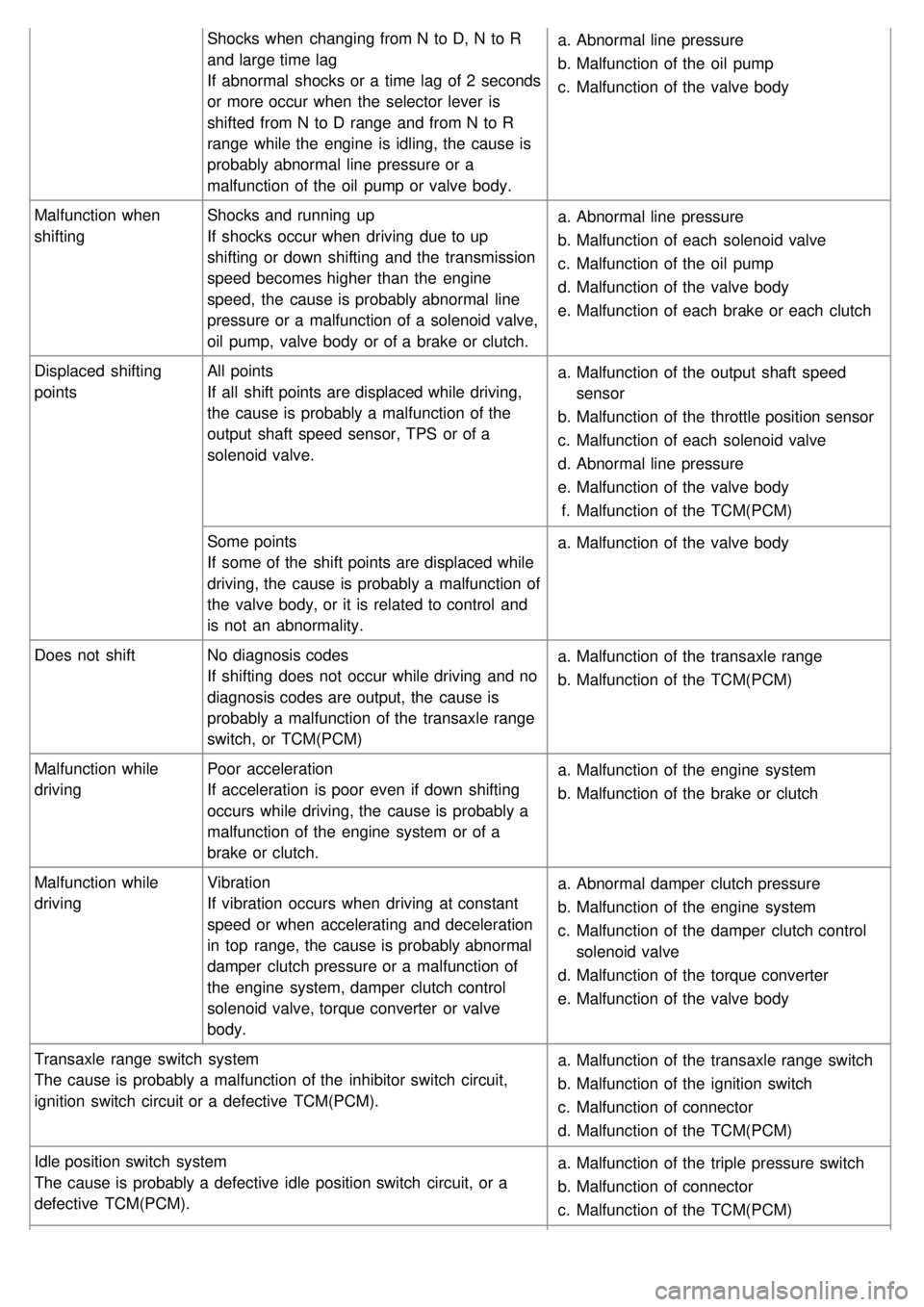
Shocks when changing from N to D, N to R
and large time lag
If abnormal shocks or a time lag of 2 seconds
or more occur when the selector lever is
shifted from N to D range and from N to R
range while the engine is idling, the cause is
probably abnormal line pressure or a
malfunction of the oil pump or valve body.a.
Abnormal line pressure
b. Malfunction of the oil pump
c. Malfunction of the valve body
Malfunction when
shifting Shocks and running up
If shocks occur when driving due to up
shifting or down shifting and the transmission
speed becomes higher than the engine
speed, the cause is probably abnormal line
pressure or a malfunction of a solenoid valve,
oil pump, valve body or of a brake or clutch. a.
Abnormal line pressure
b. Malfunction of each solenoid valve
c. Malfunction of the oil pump
d. Malfunction of the valve body
e. Malfunction of each brake or each clutch
Displaced shifting
points All points
If all shift points are displaced while driving,
the cause is probably a malfunction of the
output shaft speed sensor, TPS or of a
solenoid valve. a.
Malfunction of the output shaft speed
sensor
b. Malfunction of the throttle position sensor
c. Malfunction of each solenoid valve
d. Abnormal line pressure
e. Malfunction of the valve body
f. Malfunction of the TCM(PCM)
Some points
If some of the shift points are displaced while
driving, the cause is probably a malfunction of
the valve body, or it is related to control and
is not an abnormality. a.
Malfunction of the valve body
Does not shift No diagnosis codes
If shifting does not occur while driving and no
diagnosis codes are output, the cause is
probably a malfunction of the transaxle range
switch, or TCM(PCM) a.
Malfunction of the transaxle range
b. Malfunction of the TCM(PCM)
Malfunction while
driving Poor acceleration
If acceleration is poor even if down shifting
occurs while driving, the cause is probably a
malfunction of the engine system or of a
brake or clutch. a.
Malfunction of the engine system
b. Malfunction of the brake or clutch
Malfunction while
driving Vibration
If vibration occurs when driving at constant
speed or when accelerating and deceleration
in top range, the cause is probably abnormal
damper clutch pressure or a malfunction of
the engine system, damper clutch control
solenoid valve, torque converter or valve
body. a.
Abnormal damper clutch pressure
b. Malfunction of the engine system
c. Malfunction of the damper clutch control
solenoid valve
d. Malfunction of the torque converter
e. Malfunction of the valve body
Transaxle range switch system
The cause is probably a malfunction of the inhibitor switch circuit,
ignition switch circuit or a defective TCM(PCM). a.
Malfunction of the transaxle range switch
b. Malfunction of the ignition switch
c. Malfunction of connector
d. Malfunction of the TCM(PCM)
Idle position switch system
The cause is probably a defective idle position switch circuit, or a
defective TCM(PCM). a.
Malfunction of the triple pressure switch
b. Malfunction of connector
c. Malfunction of the TCM(PCM)