cooling KIA CARNIVAL 2007 Workshop Manual
[x] Cancel search | Manufacturer: KIA, Model Year: 2007, Model line: CARNIVAL, Model: KIA CARNIVAL 2007Pages: 1575, PDF Size: 44.86 MB
Page 4 of 1575
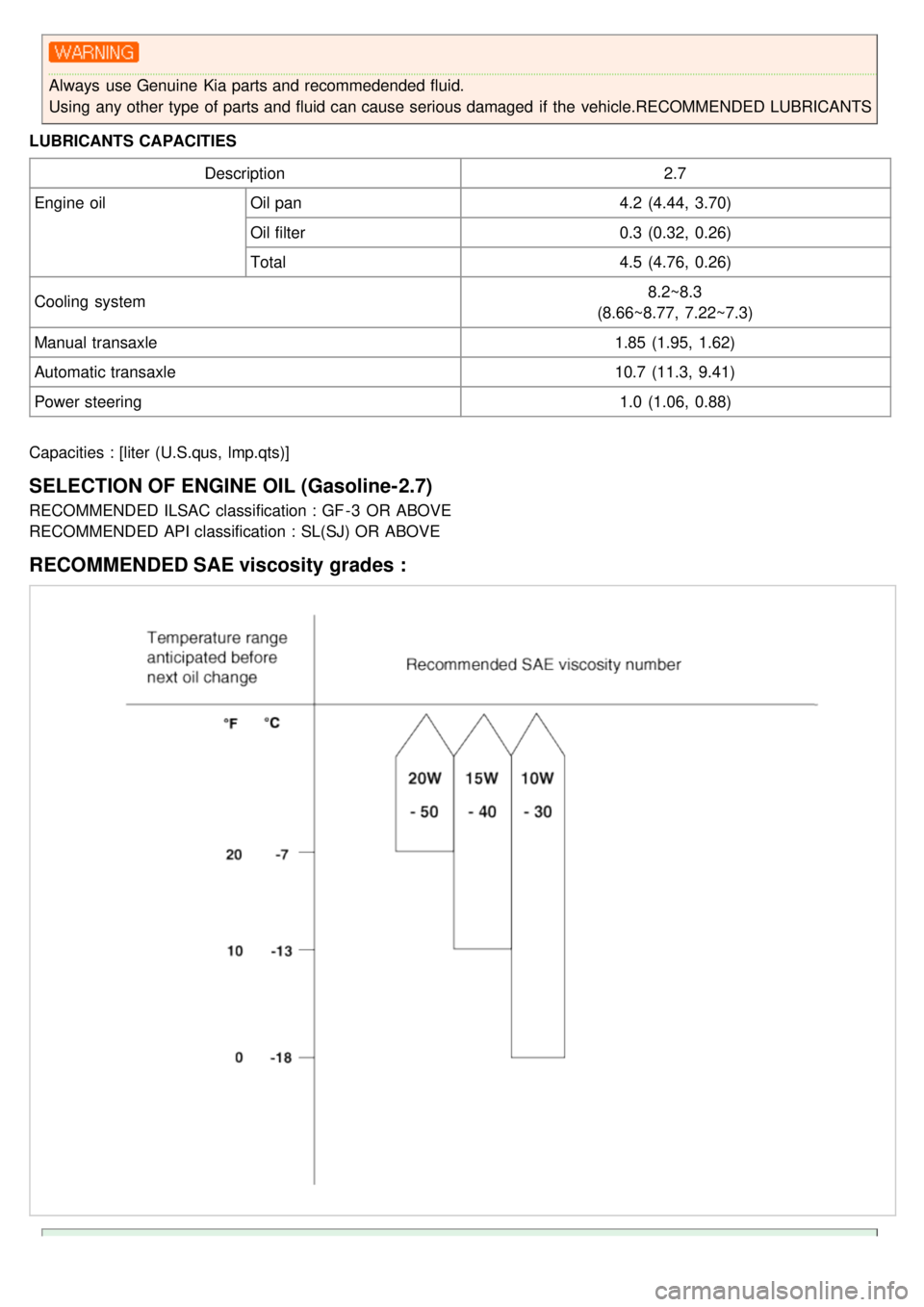
Always use Genuine Kia parts and recommedended fluid.
Using any other type of parts and fluid can cause serious damaged if the vehicle.RECOMMENDED LUBRICANTS
LUBRICANTS CAPACITIES Description 2.7
Engine oil Oil pan 4.2 (4.44, 3.70)
Oil filter 0.3 (0.32, 0.26)
Total 4.5 (4.76, 0.26)
Cooling system 8.2~8.3
(8.66~8.77, 7.22~7.3)
Manual transaxle 1.85 (1.95, 1.62)
Automatic transaxle 10.7 (11.3, 9.41)
Power steering 1.0 (1.06, 0.88)
Capacities : [liter (U.S.qus, lmp.qts)]
SELECTION OF ENGINE OIL (Gasoline-2.7)
RECOMMENDED ILSAC classification : GF - 3 OR ABOVE
RECOMMENDED API classification : SL(SJ) OR ABOVE
RECOMMENDED SAE viscosity grades :
Page 9 of 1575
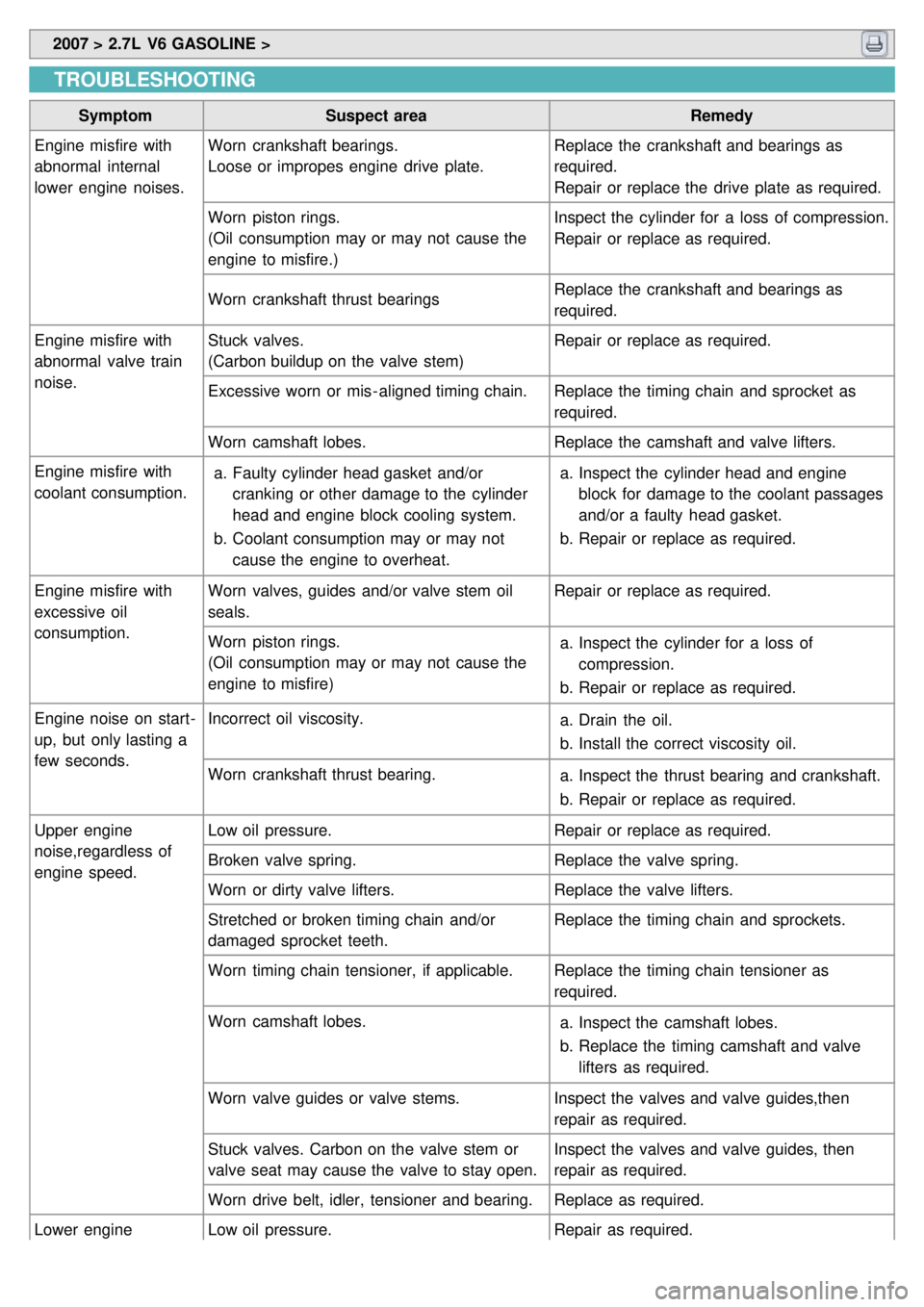
2007 > 2.7L V6 GASOLINE >
TROUBLESHOOTING
Symptom Suspect area Remedy
Engine misfire with
abnormal internal
lower engine noises. Worn crankshaft bearings.
Loose or impropes engine drive plate.
Replace the crankshaft and bearings as
required.
Repair or replace the drive plate as required.
Worn piston rings.
(Oil consumption may or may not cause the
engine to misfire.) Inspect the cylinder for a loss of compression.
Repair or replace as required.
Worn crankshaft thrust bearings Replace the crankshaft and bearings as
required.
Engine misfire with
abnormal valve train
noise. Stuck valves.
(Carbon buildup on the valve stem)
Repair or replace as required.
Excessive worn or mis - aligned timing chain. Replace the timing chain and sprocket as
required.
Worn camshaft lobes. Replace the camshaft and valve lifters.
Engine misfire with
coolant consumption. a.
Faulty cylinder head gasket and/or
cranking or other damage to the cylinder
head and engine block cooling system.
b. Coolant consumption may or may not
cause the engine to overheat. a.
Inspect the cylinder head and engine
block for damage to the coolant passages
and/or a faulty head gasket.
b. Repair or replace as required.
Engine misfire with
excessive oil
consumption. Worn valves, guides and/or valve stem oil
seals.
Repair or replace as required.
Worn piston rings.
(Oil consumption may or may not cause the
engine to misfire) a.
Inspect the cylinder for a loss of
compression.
b. Repair or replace as required.
Engine noise on start -
up, but only lasting a
few seconds. Incorrect oil viscosity.
a.Drain the oil.
b. Install the correct viscosity oil.
Worn crankshaft thrust bearing. a.Inspect the thrust bearing and crankshaft.
b. Repair or replace as required.
Upper engine
noise,regardless of
engine speed. Low oil pressure.
Repair or replace as required.
Broken valve spring. Replace the valve spring.
Worn or dirty valve lifters. Replace the valve lifters.
Stretched or broken timing chain and/or
damaged sprocket teeth. Replace the timing chain and sprockets.
Worn timing chain tensioner, if applicable. Replace the timing chain tensioner as
required.
Worn camshaft lobes. a.Inspect the camshaft lobes.
b. Replace the timing camshaft and valve
lifters as required.
Worn valve guides or valve stems. Inspect the valves and valve guides,then
repair as required.
Stuck valves. Carbon on the valve stem or
valve seat may cause the valve to stay open. Inspect the valves and valve guides, then
repair as required.
Worn drive belt, idler, tensioner and bearing. Replace as required.
Lower engine
noise,regardless of Low oil pressure.
Repair as required.
Page 18 of 1575
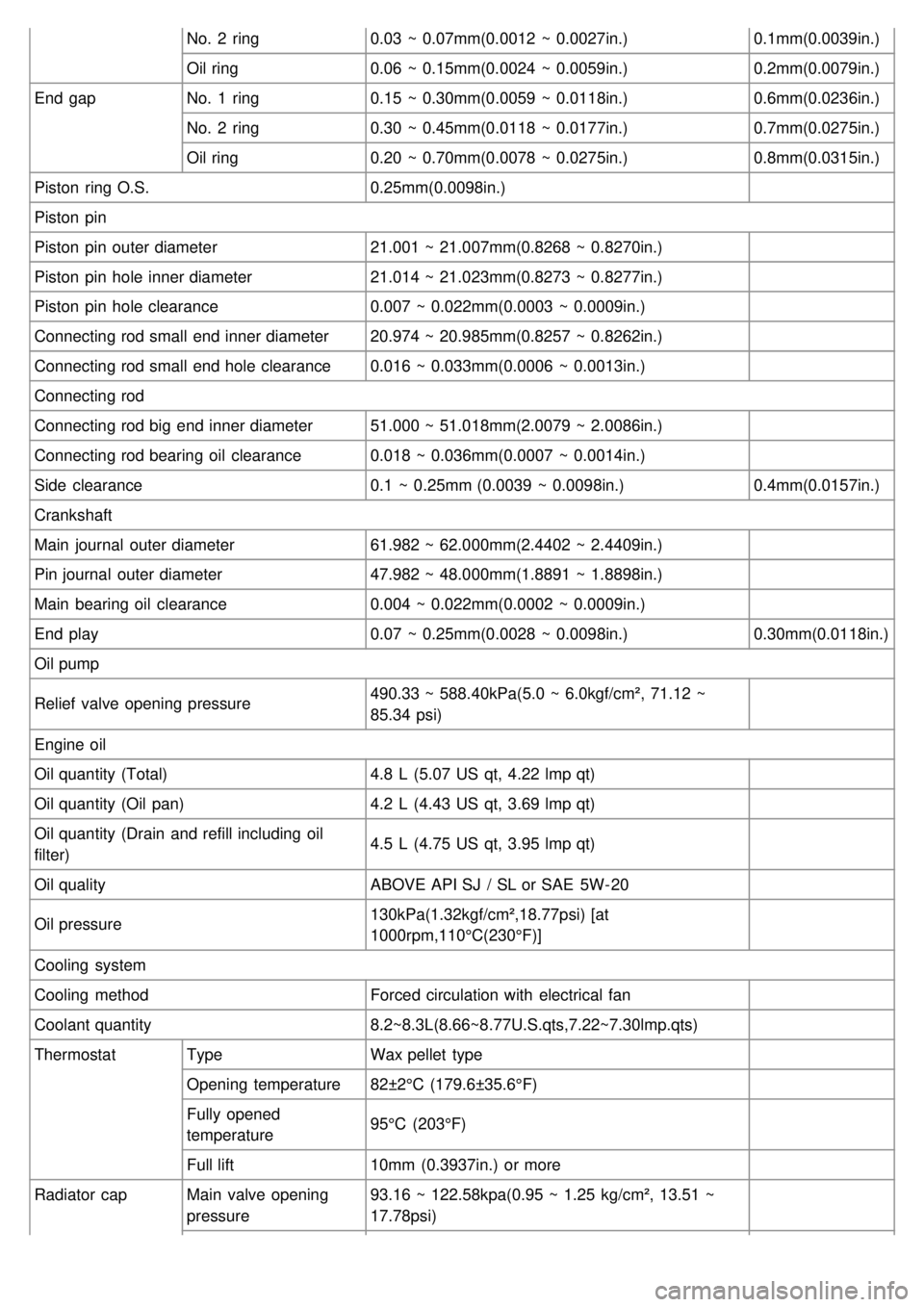
No. 2 ring0.03 ~ 0.07mm(0.0012 ~ 0.0027in.) 0.1mm(0.0039in.)
Oil ring 0.06 ~ 0.15mm(0.0024 ~ 0.0059in.) 0.2mm(0.0079in.)
End gap No. 1 ring 0.15 ~ 0.30mm(0.0059 ~ 0.0118in.) 0.6mm(0.0236in.)
No. 2 ring 0.30 ~ 0.45mm(0.0118 ~ 0.0177in.) 0.7mm(0.0275in.)
Oil ring 0.20 ~ 0.70mm(0.0078 ~ 0.0275in.) 0.8mm(0.0315in.)
Piston ring O.S. 0.25mm(0.0098in.)
Piston pin
Piston pin outer diameter 21.001 ~ 21.007mm(0.8268 ~ 0.8270in.)
Piston pin hole inner diameter 21.014 ~ 21.023mm(0.8273 ~ 0.8277in.)
Piston pin hole clearance 0.007 ~ 0.022mm(0.0003 ~ 0.0009in.)
Connecting rod small end inner diameter 20.974 ~ 20.985mm(0.8257 ~ 0.8262in.)
Connecting rod small end hole clearance 0.016 ~ 0.033mm(0.0006 ~ 0.0013in.)
Connecting rod
Connecting rod big end inner diameter 51.000 ~ 51.018mm(2.0079 ~ 2.0086in.)
Connecting rod bearing oil clearance 0.018 ~ 0.036mm(0.0007 ~ 0.0014in.)
Side clearance 0.1 ~ 0.25mm (0.0039 ~ 0.0098in.) 0.4mm(0.0157in.)
Crankshaft
Main journal outer diameter 61.982 ~ 62.000mm(2.4402 ~ 2.4409in.)
Pin journal outer diameter 47.982 ~ 48.000mm(1.8891 ~ 1.8898in.)
Main bearing oil clearance 0.004 ~ 0.022mm(0.0002 ~ 0.0009in.)
End play 0.07 ~ 0.25mm(0.0028 ~ 0.0098in.) 0.30mm(0.0118in.)
Oil pump
Relief valve opening pressure 490.33 ~ 588.40kPa(5.0 ~ 6.0kgf/cm², 71.12 ~
85.34 psi)
Engine oil
Oil quantity (Total) 4.8 L (5.07 US qt, 4.22 lmp qt)
Oil quantity (Oil pan) 4.2 L (4.43 US qt, 3.69 lmp qt)
Oil quantity (Drain and refill including oil
filter) 4.5 L (4.75 US qt, 3.95 lmp qt)
Oil quality ABOVE API SJ / SL or SAE 5W- 20
Oil pressure 130kPa(1.32kgf/cm²,18.77psi) [at
1000rpm,110°C(230°F)]
Cooling system
Cooling method Forced circulation with electrical fan
Coolant quantity 8.2~8.3L(8.66~8.77U.S.qts,7.22~7.30lmp.qts)
Thermostat Type Wax pellet type
Opening temperature 82±2°C (179.6±35.6°F)
Fully opened
temperature 95°C (203°F)
Full lift 10mm (0.3937in.) or more
Radiator cap Main valve opening
pressure 93.16 ~ 122.58kpa(0.95 ~ 1.25 kg/cm², 13.51 ~
17.78psi)
Page 66 of 1575

(5)Disconnect the MAPS(Manifold Absolute Pressure Sensor) connector(A), the ETC(Electronic Throttle Control)
connector(B) and the PCSV(Purge Control Solenoid Valve) connector(C).
(6)Remove the cooling fan relay cable(A).
(7)Disconnect the generator connector(A) and the air conditioning compressor connector(B).
(8)Disconnect the bank 2 CMP sensor connector(A) and the WTS(Water Temperature Sensor) connector(B).
(9)Disconnect the bank 2 front/rear O2 sensor connectors(A,B) and the CKP sensor connector(C).
Page 71 of 1575

INSTALLATION
Installation is in the reverse order of removal.
Perform the following :a. Adjust the shift cable.
b. Refill the engine with engine oil.
c. Refill the transaxle with fluid.
d. Refill the radiator with engine coolant.
e. Bleed air from the cooling system with the heater valve open.
f. Clean the battery posts and cable terminals with sandpaper assemble them, then apply grease to prevent
corrosion.
g. Inspect for fuel leakage.
After assembling the fuel line, turn on the ignition switch (do not operate the starter) so that the fuel pump runs for
approximately two seconds and fuel line pressurizes.
Repeat this operation two or three times, then check for fuel leakage at any point in the fuel line.
Page 100 of 1575
Cooling system
Page 104 of 1575
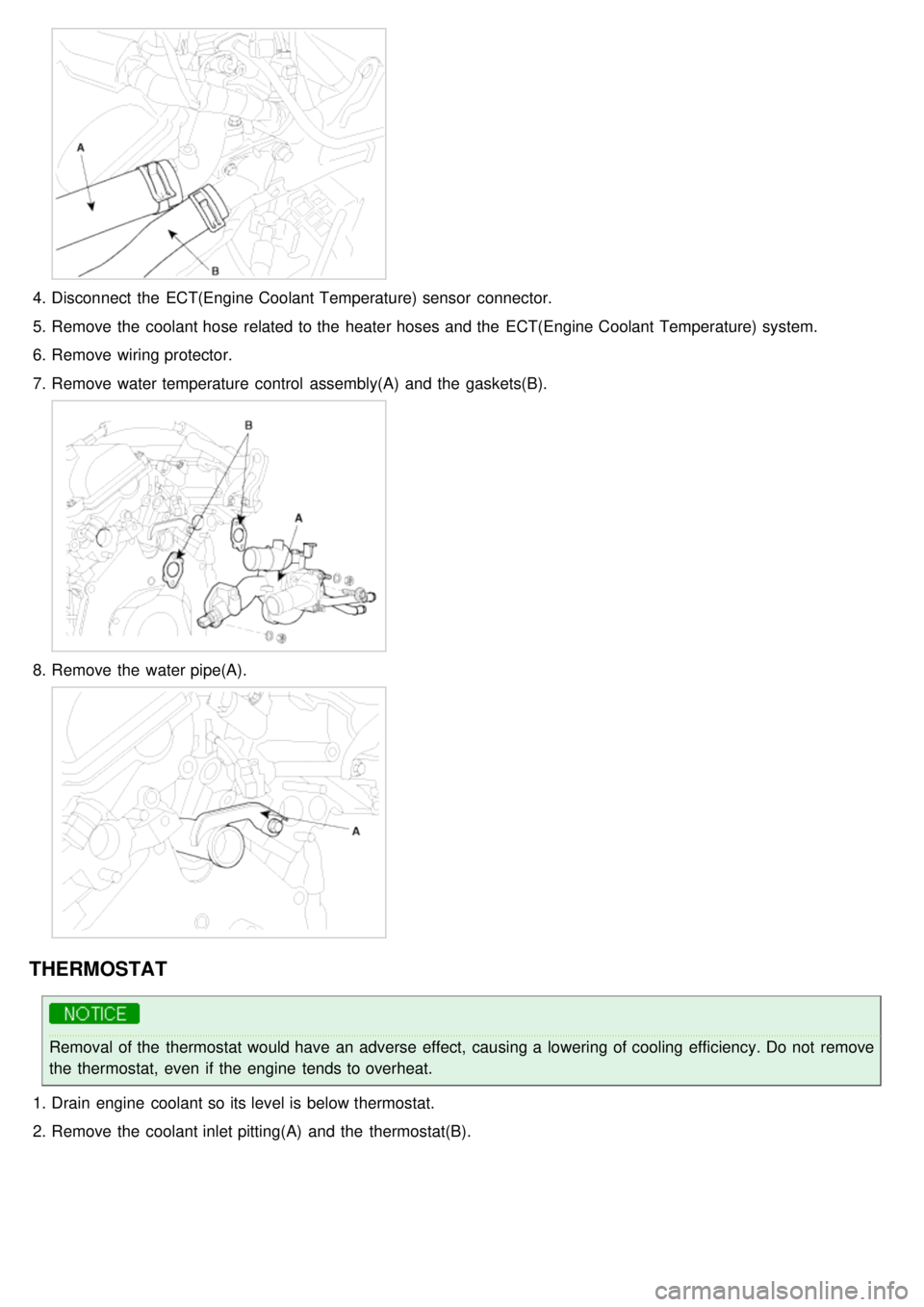
4.Disconnect the ECT(Engine Coolant Temperature) sensor connector.
5. Remove the coolant hose related to the heater hoses and the ECT(Engine Coolant Temperature) system.
6. Remove wiring protector.
7. Remove water temperature control assembly(A) and the gaskets(B).
8.Remove the water pipe(A).
THERMOSTAT
Removal of the thermostat would have an adverse effect, causing a lowering of cooling efficiency. Do not remove
the thermostat, even if the engine tends to overheat.
1. Drain engine coolant so its level is below thermostat.
2. Remove the coolant inlet pitting(A) and the thermostat(B).
Page 107 of 1575
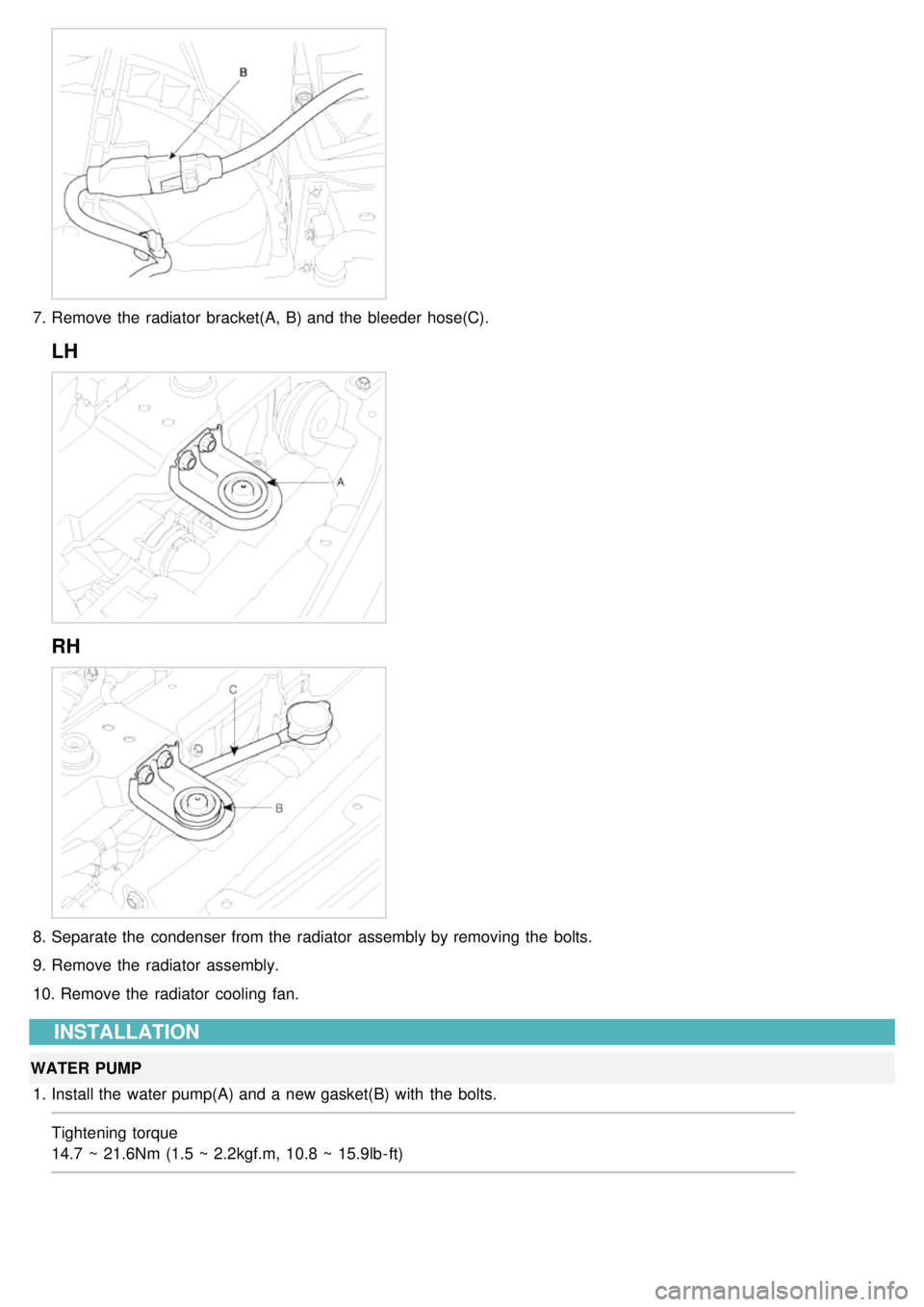
7.Remove the radiator bracket(A, B) and the bleeder hose(C).
LH
RH
8.Separate the condenser from the radiator assembly by removing the bolts.
9. Remove the radiator assembly.
10. Remove the radiator cooling fan.
INSTALLATION
WATER PUMP
1. Install the water pump(A) and a new gasket(B) with the bolts.
Tightening torque
14.7 ~ 21.6Nm (1.5 ~ 2.2kgf.m, 10.8 ~ 15.9lb- ft)
Page 113 of 1575

THERMOSTAT
1.Immerse the thermostat in water and gradually heat water.
2.Check the valve opening temperature.
Valve opening temperature : 82°C (177°F)
Full opening temperature : 95°C (205°F)
If the valve opening temperature is not as specified, replace the thermostat.
3. Check the valve lift.
Valve lift : Min. 10mm (0.4in.) at 95°C (205°F)
If the valve lift is not as specified, replace the thermostat.
ENGINE COOLANT REFILLING AND BLEEDING
Never remove the radiator cap when the engine is hot. Serious scalding could be caused by hot fluid under high
pressure escaping from the radiator.
When pouring engine coolant, be sure to shut the relay box lid and not to let coolant spill on the electrical parts or
the paint. If any coolant spills, rinse it off immediately.
1. Make sure the engine and radiator are cool to the touch.
2. Open the radiator cap.
3. Loosen the drain plug, and drain the coolant.
4. Tighten the radiator drain plug securely.
5. Remove, drain and clean the reservoir tank.
6. Fill water slowly through the radiator cap. Push the upper/lower hoses of the radiator so as to bleed air easily.
7. Warm the engine until the cooling fan operates 2~3 times.
Accelerate the engine 2~3 times without load.
8. Wait until the engine is cold.
9. Repeat the steps 1~8 until the water drained is clean.
10. Fill fluid mixture with coolant and water(4 : 6) slowly through the radiator cap. Push the upper/lower hoses of the
radiator so as to bleed air easily.
11. Start the engine and run so coolant circulates.
When the cooling fan operates and coolant circulates, refill coolant through the radiator cap.
12. Repeat 11 until the cooling fan cycles 3 ~ 5 times and bleed air sufficiently out of the cooling system.
Page 114 of 1575

13.Install the radiator cap and fill the reservoir tank to the "MAX"(or "F") line with coolant.
14. Run the vehicle under idle until the cooling fan operates 2 ~ 3 times.
15. Stop the engine and wait until coolant gets cool.
16. Repeat 10 to 15 until the coolant level doesn't fall any more, bleeding air out of the cooling system.
Check the coolant level again in the reservoir tank for 2 ~ 3 days after replacing coolant.
CAP TESTING
1.Remove the radiator cap, wet its seal with engine coolant, and install it to a pressure tester.
2.Apply a pressure of 93 ~ 123kPa (0.95 ~ 1.25kgf/cm², 14 ~ 19psi).
3. Check for a drop in pressure.
4. If the pressure drops, replace the cap.