oil change KIA CEED 2013 User Guide
[x] Cancel search | Manufacturer: KIA, Model Year: 2013, Model line: CEED, Model: KIA CEED 2013Pages: 1168, PDF Size: 48.01 MB
Page 1069 of 1168
Maintenance
32
7
EXPLANATION OF SCHEDULED MAINTENANCE ITEMS
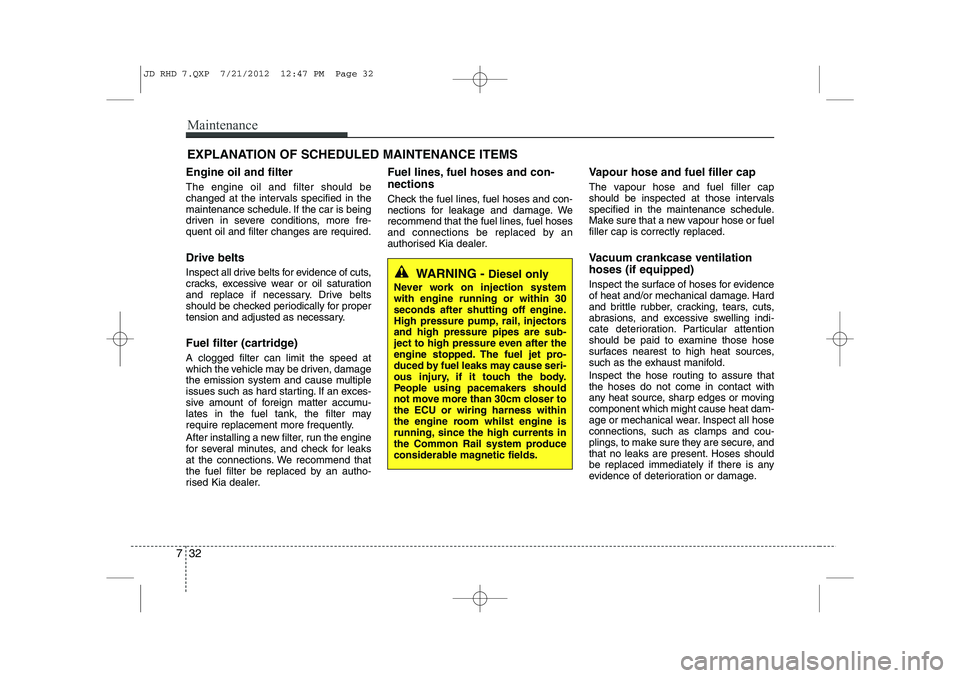
Engine oil and filter The engine oil and filter should be
changed at the intervals specified in the
maintenance schedule. If the car is being
driven in severe conditions, more fre-quent oil and filter changes are required. Drive belts
Inspect all drive belts for evidence of cuts,
cracks, excessive wear or oil saturation
and replace if necessary. Drive belts
should be checked periodically for proper
tension and adjusted as necessary.
Fuel filter (cartridge) A clogged filter can limit the speed at
which the vehicle may be driven, damage
the emission system and cause multiple
issues such as hard starting. If an exces-
sive amount of foreign matter accumu-
lates in the fuel tank, the filter may
require replacement more frequently.
After installing a new filter, run the engine
for several minutes, and check for leaks
at the connections. We recommend that
the fuel filter be replaced by an autho-
rised Kia dealer. Fuel lines, fuel hoses and con- nections
Check the fuel lines, fuel hoses and con-
nections for leakage and damage. We
recommend that the fuel lines, fuel hoses
and connections be replaced by an
authorised Kia dealer.
Vapour hose and fuel filler cap
The vapour hose and fuel filler cap
should be inspected at those intervals
specified in the maintenance schedule.
Make sure that a new vapour hose or fuelfiller cap is correctly replaced.
Vacuum crankcase ventilation hoses (if equipped)
Inspect the surface of hoses for evidence
of heat and/or mechanical damage. Hard
and brittle rubber, cracking, tears, cuts,
abrasions, and excessive swelling indi-
cate deterioration. Particular attention
should be paid to examine those hose
surfaces nearest to high heat sources,
such as the exhaust manifold. Inspect the hose routing to assure that the hoses do not come in contact with
any heat source, sharp edges or movingcomponent which might cause heat dam-
age or mechanical wear. Inspect all hose
connections, such as clamps and cou-
plings, to make sure they are secure, and
that no leaks are present. Hoses should
be replaced immediately if there is any
evidence of deterioration or damage.
WARNING -
Diesel only
Never work on injection system with engine running or within 30
seconds after shutting off engine.
High pressure pump, rail, injectorsand high pressure pipes are sub-
ject to high pressure even after the
engine stopped. The fuel jet pro-
duced by fuel leaks may cause seri-
ous injury, if it touch the body.
People using pacemakers should
not move more than 30cm closer tothe ECU or wiring harness within
the engine room whilst engine is
running, since the high currents in
the Common Rail system produce
considerable magnetic fields.
JD RHD 7.QXP 7/21/2012 12:47 PM Page 32
Page 1152 of 1168
Specifications & Consumer information
8
8
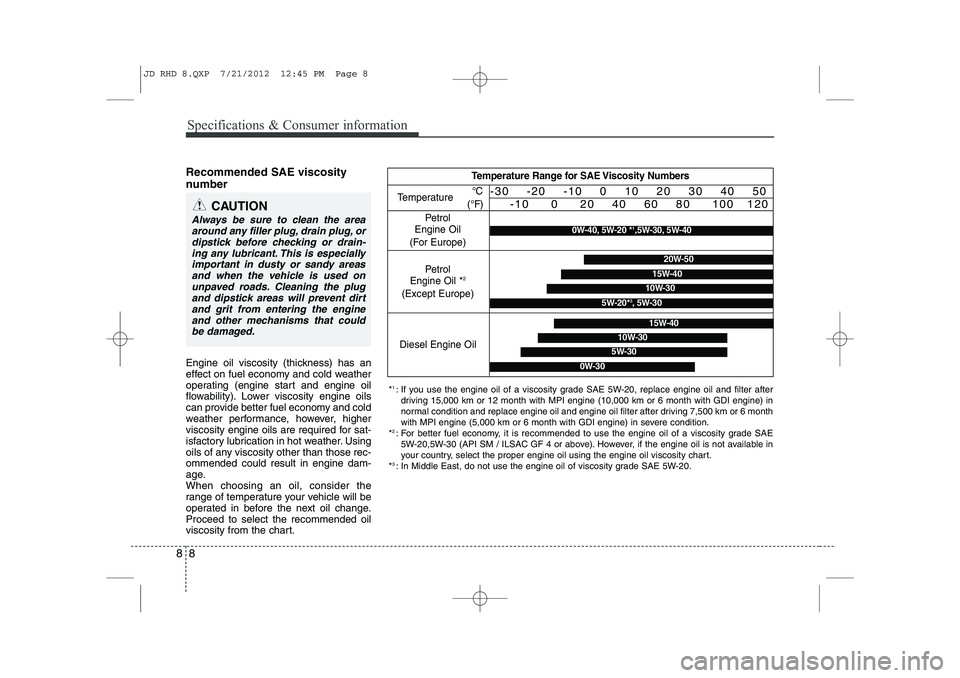
Recommended SAE viscosity
number
Engine oil viscosity (thickness) has an
effect on fuel economy and cold weather
operating (engine start and engine oil
flowability). Lower viscosity engine oils
can provide better fuel economy and cold
weather performance, however, higher
viscosity engine oils are required for sat-
isfactory lubrication in hot weather. Using
oils of any viscosity other than those rec-ommended could result in engine dam-
age.When choosing an oil, consider the
range of temperature your vehicle will be
operated in before the next oil change.Proceed to select the recommended oil
viscosity from the chart.
CAUTION
Always be sure to clean the area
around any filler plug, drain plug, or
dipstick before checking or drain-ing any lubricant. This is especiallyimportant in dusty or sandy areas
and when the vehicle is used onunpaved roads. Cleaning the plugand dipstick areas will prevent dirtand grit from entering the engine
and other mechanisms that couldbe damaged.
Temperature Range for SAE Viscosity Numbers
Temperature
Petrol
Engine Oil
(For Europe) °C
(°F)-30 -20 -10 0 10 20 30 40 50 -10 0 20 40 60 80 100 120
0W-40, 5W-20 * 1
,5W-30, 5W-40
Petrol
Engine Oil * 2
(Except Europe)20W-50
10W-30
15W-40
5W-20* 3
, 5W-30
* 1
: If you use the engine oil of a viscosity grade SAE 5W-20, replace engine oil and filter after
driving 15,000 km or 12 month with MPI engine (10,000 km or 6 month with GDI engine) in
normal condition and replace engine oil and engine oil filter after driving 7,500 km or 6 month
with MPI engine (5,000 km or 6 month with GDI engine) in severe condition.
* 2
: For better fuel economy, it is recommended to use the engine oil of a viscosity grade SAE
5W-20,5W-30 (API SM / ILSAC GF 4 or above). However, if the engine oil is not available in
your country, select the proper engine oil using the engine oil viscosity chart.
* 3
: In Middle East, do not use the engine oil of viscosity grade SAE 5W-20.
Diesel Engine Oil5W-30
15W-40
10W-30
0W-30
JD RHD 8.QXP 7/21/2012 12:45 PM Page 8