rds KIA CEED 2013 Manual PDF
[x] Cancel search | Manufacturer: KIA, Model Year: 2013, Model line: CEED, Model: KIA CEED 2013Pages: 1168, PDF Size: 48.01 MB
Page 1020 of 1168
615
What to do in an emergency
Important - use of compact sparetyre (if equipped)
Your vehicle is equipped with a com-
pact spare tyre. This compact spare
tyre takes up less space than a reg-
ular-size tyre. This tyre is smaller
than a conventional tyre and is
designed for temporary use only.
The compact spare should be inflat-
ed to 420 kPa (60 psi).
✽✽NOTICE
Check the inflation pressure after
installing the spare tyre. Adjust it to
the specified pressure, as necessary.
When using a compact spare tyre,
observe the following precautions:
Under no circumstances should you exceed 80 km/h (50 mph); a higher speed could damage the
tyre.
Ensure that you drive slowly enough to avoid all hazards. Anyroad hazard, such as a pothole or
debris, could seriously damage the
compact spare.
Any continuous road use of this tyre could result in tyre failure, loss
of vehicle control, and possible
personal injury.
Do not exceed the vehicle’s maxi- mum load rating or the load-carry-
ing capacity shown on the sidewall
of the compact spare tyre.
Avoid driving over obstacles. The compact spare tyre diameter issmaller than the diameter of a con-
ventional tyre and reduces the
ground clearance approximately25 mm (1 inch), which could result
in damage to the vehicle.
CAUTION
You should drive carefully
when the compact spare is inuse. The compact spareshould be replaced by theproper conventional tyre and rim at the first opportunity.
The operation of this vehicle is not recommended withmore than one compact spare tyre in use at the same time.
WARNING
The compact spare tyre is for
emergency use only. Do not
operate your vehicle on thiscompact spare at the speed
over 80 km/h (50 mph). Theoriginal tyre should be repaired
or replaced as soon as possible
to avoid failure of the spare
possibly leading to personal
injury or death.
JD RHD 6.QXP 7/21/2012 12:56 PM Page 15
Page 1033 of 1168
What to do in an emergency
28
6
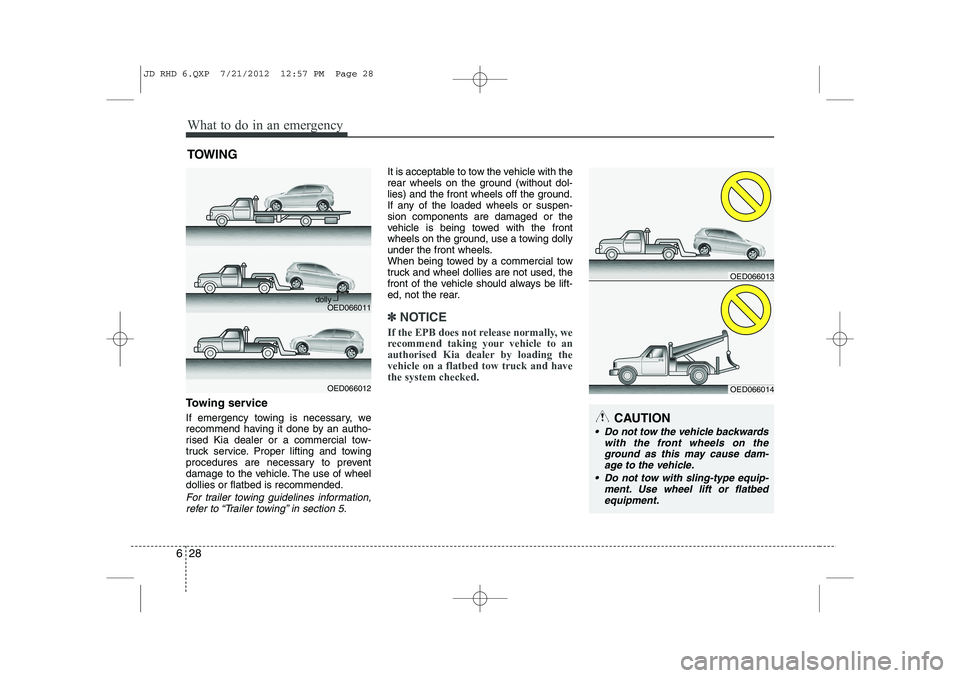
TOWING
Towing service
If emergency towing is necessary, we
recommend having it done by an autho-
rised Kia dealer or a commercial tow-
truck service. Proper lifting and towing
procedures are necessary to prevent
damage to the vehicle. The use of wheeldollies or flatbed is recommended.
For trailer towing guidelines information, refer to “Trailer towing” in section 5.
It is acceptable to tow the vehicle with the
rear wheels on the ground (without dol-
lies) and the front wheels off the ground.
If any of the loaded wheels or suspen-sion components are damaged or the
vehicle is being towed with the front
wheels on the ground, use a towing dolly
under the front wheels.
When being towed by a commercial tow
truck and wheel dollies are not used, the
front of the vehicle should always be lift-
ed, not the rear.
✽✽ NOTICE
If the EPB does not release normally, we
recommend taking your vehicle to an
authorised Kia dealer by loading thevehicle on a flatbed tow truck and havethe system checked.
CAUTION
Do not tow the vehicle backwards with the front wheels on the
ground as this may cause dam-age to the vehicle.
Do not tow with sling-type equip- ment. Use wheel lift or flatbedequipment.
OED066011
OED066012
dolly
OED066014
OED066013
JD RHD 6.QXP 7/21/2012 12:57 PM Page 28
Page 1047 of 1168
Maintenance
10
7
NORMAL MAINTENANCE SCHEDULE - FOR EUROPE, EXCEPT RUSSIA
The following maintenance services must be performed to ensure good emission control and performance. Keep receipts for all
vehicle emission services to protect your warranty. Where both mileage and time are shown, the frequency of service is deter-
mined by whichever occurs first. * 1
: Check the engine oil level and leak every 500 km (350
miles) or before starting a long trip.
* 2
: This maintenance schedule depends on fuel quality. It is
applicable only when using a qualified fuel <"EN590 or
equivalent">. If the diesel fuel specifications don't meet the
EN590, it must be replaced according to the severe mainte-
nance schedule.
* 3
: If the recommended oil is not available, replace engine oil
and engine oil filter every 20,000 km or 12 months.
* 4
: If the recommended oil is not available, replace engine oil
and filter every 15,000 km for MPI engine and replace
engine oil and filter every 10,000 km for GDI engine.
* 5
: The engine oil level should be checked regularly and main-
tained properly. Operating with an insufficient amount of oil
can damage the engine, and such damage is not covered
by warranty.
* 6
: This maintenance schedule depends on fuel quality. It is
applicable only when using a qualified fuel <"EN590 or
equivalent">. If the diesel fuel specifications don't meet the
EN590, it must be replaced more frequently. If there are
some important safety matters like fuel flow restriction,
surging, loss of power, hard starting problem etc., replacethe fuel filter immediately regardless of maintenance sched-
ule and we recommanded that you consult an authorised
Kia dealer for details. *
7
: The fuel filter is considered to be maintenance free but peri-
odic inspection is recommended for this maintenance
schedule depends on fuel quality. If there are some impor-
tant matters like fuel flow restriction, surging, loss of power,
hard starting problem etc, replace the fuel filter immediately
regardless of maintenance schedule and we recommanded
that you consult an authorised Kia dealer for details.
* 8
: Manual transaxle and double clutch transmission fluid
should be changed anytime they have been submerged in
water.
* 9
: Inspect drive belt tensioner, idler and alternator pulley and if
necessary correct or replace.
* 10
: When adding coolant, use only deionized water or soft
water for your vehicle and never mix hard water in the
coolant filled at the factory. An improper coolant mixture
can result in serious malfunction or engine damage.
* 11
: Inspect for excessive valve noise and/or engine vibration
and adjust if necessary. We recommended that the system
should be checked by an authorised Kia dealer.
* 12
: If good quality petrols that meet Europe Fuel standards
(EN228) or equivalents including fuel additives is not avail-
able, one bottle of additive is recommended. Additives are
available from your authorised Kia dealer along with infor-
mation on how to use them. Do not mix other additives.
JD RHD 7.QXP 7/21/2012 12:46 PM Page 10
Page 1058 of 1168
721
Maintenance
NORMAL MAINTENANCE SCHEDULE - EXCEPT EUROPE, FOR RUSSIA
The following maintenance services must be performed to ensure good emission control and performance. Keep receipts for all
vehicle emission services to protect your warranty. Where both mileage and time are shown, the frequency of service is deter-
mined by whichever occurs first. *1
: Inspect drive belt tensioner, idler and alternator pulley and
if necessary correct or replace.
* 2
: Check the engine oil level and leak every 500 km (350
miles) or before starting a long trip.
* 3
: The engine oil level should be checked regularly and main-
tained properly. Operating with an insufficient amount of oil
can damage the engine, and such damage is not covered
by warranty.
* 4
: This maintenance schedule depends on fuel quality. It is
applicable only when using a qualified fuel <"EN590 or
equivalent">. If the diesel fuel specifications don't meet the
EN590, it must be replaced more frequently.
If there are some important safety matters like fuel flow
restriction, surging, loss of power, hard starting problemetc., replace the fuel filter immediately regardless of main-
tenance schedule and we recommand that you consult an
authorised Kia dealer for details
* 5
: For your convenience, it can be replaced prior to it's interval
when you do maintenance of other items. *
6
: Inspect for excessive valve noise and/or engine vibration
and adjust if necessary. We recommended that the system
should be checked by an authorised Kia dealer.
* 7
: The fuel filter is considered to be maintenance free but peri-
odic inspection is recommended for this maintenance
schedule depends on fuel quality. If there are some impor-
tant matters like fuel flow restriction, surging, loss of power,
hard starting problem etc, replace the fuel filter immediate-
ly regardless of maintenance schedule and we recommand
that you consult an authorised Kia dealer for details.
* 8
: When adding coolant, use only deionized water or soft
water for your vehicle and never mix hard water in the
coolant filled at the factory. An improper coolant mixture can
result in serious malfunction or engine damage.
* 9
: If good quality petrols that meet Europe Fuel standards
(EN228) or equivalents including fuel additives is not avail-
able, one bottle of additive is recommended. Additives are
available from your authorised Kia dealer along with infor-
mation on how to use them. Do not mix other additives.
JD RHD 7.QXP 7/21/2012 12:46 PM Page 21
Page 1091 of 1168
Maintenance
54
7
WARNING - Tyre inflation
Overinflation or underinflation
can reduce tyre life, adversely
affect vehicle handling, and
lead to sudden tyre failure. This
could result in loss of vehicle
control and potential injury.
CAUTION - Tyre pressure
Always observe the following:
Check tyre pressure when the tyres are cold. (After vehiclehas been parked for at leastthree hours or hasn't been driven more than 1.6 km (1mile) since startup.)
Check the pressure of your spare tyre each time youcheck the pressure of other tyres.
Never overload your vehicle. Be careful not to overload avehicle luggage rack if yourvehicle is equipped with one.
Worn, old tyres can cause accidents. If your tread isbadly worn, or if your tyreshave been damaged, replacethem.
CAUTION
Underinflation also results in excessive wear, poor handlingand reduced fuel economy.Wheel deformation also ispossible. Keep your tyre pres- sures at the proper levels. If atyre frequently needs refilling,we recommend that the sys- tem be checked by an autho-rised Kia dealer.
Overinflation produces a harsh ride, excessive wear atthe centre of the tyre tread, and a greater possibility ofdamage from road hazards.
CAUTION
Warm tyres normally exceed recommended cold tyre pres-sures by 28 to 41 kPa (4 to 6 psi). Do not release air fromwarm tyres to adjust the pres-sure or the tyres will be under- inflated.
Be sure to reinstall the tyre inflation valve caps. Withoutthe valve cap, dirt or moisturecould get into the valve core and cause air leakage. If avalve cap is missing, install anew one as soon as possible.
JD RHD 7.QXP 7/21/2012 12:48 PM Page 54
Page 1143 of 1168
Maintenance
106
7
Operating precautions for catalytic
converters (if equipped)Your vehicle is equipped with a catalytic
converter emission control device.
Therefore, the following precautions
must be observed:
Make sure to refuel your vehicle according to the "Fuel requirements" suggested in section 1.
Do not operate the vehicle when there are signs of engine malfunction, such
as misfire or a noticeable loss of per-
formance.
Do not misuse or abuse the engine. Examples of misuse are coasting withthe ignition off and descending steep
grades in gear with the ignition off.
Do not operate the engine at high idle speed for extended periods (5 minutesor more).
Do not modify or tamper with any part of the engine or emission control sys-
tem. We recommend that the system be
inspected by an authorised Kia dealer.
Avoid driving with a extremely low fuel level. Running out of fuel cause the
engine to misfire, damaging the cat-
alytic converter.
Failure to observe these precautionscould result in damage to the catalytic
converter and to your vehicle.
Additionally, such actions could void your
warranties.Diesel Particulate Filter (if equipped)
The Diesel Particulate Filter (DPF) sys-
tem removes the soot emitted from the
vehicle.
Unlike a disposable air filter, the DPF
system automatically burns (oxidizes)
and removes the accumulated soot
according to the driving condition. In
other words, the active burning by engine
control system and high exhaust gas
temperature caused by normal/high driv-
ing condition burns and removes the
accumulated soot.
However, if the vehicle continues to be
driven at low speed for long time, the
accumulated soot may not be automati-
cally removed because of low exhaust
gas temperature. In this particular case,the amount of soot is out of detection
limit, the soot oxidation process by
engine control system may not happen
and the malfunction indicator light may
blink. When the malfunction indicator light
blinks, it may stop blinking by driving the
vehicle at more than 60km/h (37 mph) orat more than second gear with 1500 ~
2000 engine rpm for a certain time (for
about 25 minutes).
WARNING - Fire
A hot exhaust system can ignite flammable items under your vehi-
cle. Do not park, idle, or drive the
vehicle over or near flammable
objects, such as dry grass, paper,
leaves, etc.
The exhaust system and catalytic system are very hot whilst the
engine is running or immediately
after the engine is turned off.
Keep away from the exhaust sys-
tem and catalytic, you may get
burned.
Also, do not remove the heat sink
around the exhaust system, do
not seal the bottom of the vehicle
or do not coat the vehicle for cor-
rosion control. It may present a
fire risk under certain conditions.
JD RHD 7.QXP 7/21/2012 12:53 PM Page 106