Car seat KIA CEED 2013 Owners Manual
[x] Cancel search | Manufacturer: KIA, Model Year: 2013, Model line: CEED, Model: KIA CEED 2013Pages: 1168, PDF Size: 48.01 MB
Page 20 of 1168

Safety system of your vehicle
4
3
Front seat
Manual adjustment
Forward and backward
To move the seat forward or backward:
1. Pull the seat slide adjustment lever up
and hold it.
2. Slide the seat to the position you desire.
3. Release the lever and make sure the seat is locked in place.
Adjust the seat before driving, and make
sure the seat is locked securely by trying
to move forward and backward without
using the lever. If the seat moves, it is not
locked properly.
WARNING - Rear seatbacks
The rear seatback must be securely latched. If not, passen-
gers and objects could be thrown
forward resulting in serious
injury or death in the event of a
sudden stop or collision.
Luggage and other cargo should be laid flat in the cargo area. If
objects are large, heavy, or must
be piled, they must be secured.
Under no circumstances should
cargo be piled higher than the
seatbacks. Failure to follow thesewarnings could result in serious
injury or death in the event of a
sudden stop, collision or rollover.
No passenger should ride in the cargo area or sit or lie on folded
seatbacks while the vehicle is
moving. All passengers must be
properly seated in seats and
restrained properly while riding.
When resetting the seatback to the upright position, make sure it
is securely latched by pushing it
forward and backwards.WARNING
After adjusting the seat, always
check that it is securely locked into
place by attempting to move the
seat forward or backward without
using the lock release lever.
Sudden or unexpected movement
of the driver's seat could cause you
to lose control of the vehicle result-ing in an accident.
WARNING
Use extreme caution so that hands or other objects are not
caught in the seat mechanisms
while the seat is moving.
Do not put a cigarette lighter on the floor or seat. When you oper-
ate the seat, gas may gush out of
the lighter and cause fire.
OJD032002
JD eng 3.QXP 7/17/2012 11:06 AM Page 4
Page 22 of 1168
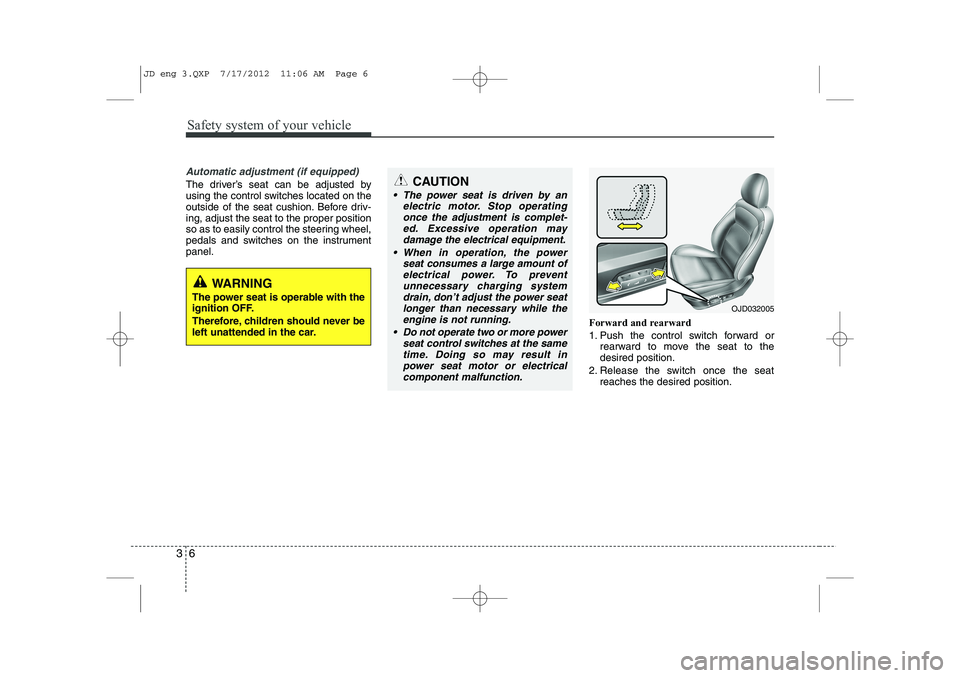
Safety system of your vehicle
6
3
Automatic adjustment (if equipped)
The driver’s seat can be adjusted by
using the control switches located on the
outside of the seat cushion. Before driv-ing, adjust the seat to the proper position
so as to easily control the steering wheel,
pedals and switches on the instrumentpanel.
Forward and rearward
1. Push the control switch forward orrearward to move the seat to the desired position.
2. Release the switch once the seat reaches the desired position.
WARNING
The power seat is operable with the
ignition OFF.
Therefore, children should never be
left unattended in the car.
CAUTION
The power seat is driven by an electric motor. Stop operating
once the adjustment is complet- ed. Excessive operation maydamage the electrical equipment.
When in operation, the power seat consumes a large amount ofelectrical power. To preventunnecessary charging system drain, don’t adjust the power seat
longer than necessary while the engine is not running.
Do not operate two or more power seat control switches at the same
time. Doing so may result inpower seat motor or electrical component malfunction.
OJD032005
JD eng 3.QXP 7/17/2012 11:06 AM Page 6
Page 28 of 1168

Safety system of your vehicle
12
3
Seat warmer (if equipped)
The seat warmer is provided to warm the
front seats during cold weather. With the
ignition switch in the ON position, push
either of the switches to warm the driver'sseat or the front passenger's seat.
During mild weather or under conditions
where the operation of the seat warmer
is not needed, keep the switches in the"OFF" position.
Each time you press the switch, the
temperature setting of the seat will
change as follows :
The seat warmer defaults to the OFF position whenever the ignition switch is
turned on.
✽✽ NOTICE
With the seat warmer switch in ON position, the heating system in the seat
turns off or on automatically depending
on the seat temperature.
OJD032012
OFF → HIGH ( ) → MID ( )
LOW ( )
→→
CAUTION - Seat damage
When cleaning the seats, do not
use an organic solvent such aspaint thinner, benzene, alcohol
and gasoline. Doing so may dam-age the surface of the heater or seats.
To prevent overheating the seat warmer, do not place anything on
the seats that insulates againstheat, such as blankets, cushions or seat covers on the seats while
the seat warmer is in operation.
Do not place heavy or sharp objects on seats equipped withseat warmers. Damage to the seat warming components could occur.
WARNING - Seat warmer
burns
Passengers should use extreme
caution when using seat warmers
due to the possibility of excess
heating or burns. The occupants
must be able to feel if the seat isbecoming too warm and to turn the
seat warmer off. The seat warmer
may cause burns even at low tem-
peratures, especially if used for
long periods of time.
In particular, the driver must exer-
cise extreme care for the following
types of passengers:
1. Infants, children, elderly or dis- abled persons, or hospital outpa- tients
2. Persons with sensitive skin or those that burn easily
3. Fatigued individuals
4. Intoxicated individuals
5. Individuals taking medication that can cause drowsiness or
sleepiness (sleeping pills, cold
tablets, etc.)
JD eng 3.QXP 7/17/2012 11:07 AM Page 12
Page 31 of 1168

315
Safety system of your vehicle
Folding the rear seat
The rear seatbacks (or cushions) may be
folded to facilitate carrying long items orto increase the luggage capacity of the
vehicle.To fold the rear seat cushion and back
1. Set the front seatback to the uprightposition and if necessary, slide the
front seat forward.
2. Lift the front portion of the seat cush- ion up.
3. Lift the rear portion of the seat cush-ion. Stand the rear seat cushion verti-
cally.
4. Pull the lock release lever (red visible).
OJD032018
OJD032019
OJD032017
WARNING
The purpose of the fold-down rear
seatbacks (or cushions) is to allow
you to carry longer objects thancould otherwise be accommodated.
Never allow passengers to sit on
top of the folded down seatback
while the car is moving as this is
not a proper seating position and
no seat belts are available for use.
This could result in serious injuryor death in case of an accident or
sudden stop. Objects carried on the
folded down seatback should not
extend higher than the top of the
front seats. This could allow cargo
to slide forward and cause injury or
damage during sudden stops.
JD eng 3.QXP 7/17/2012 11:07 AM Page 15
Page 33 of 1168

317
Safety system of your vehicle
10. Return the seat cushion to the origi-nal position by pushing down the rear
side of the seat cushion first. Make
sure the seat cushion is locked in
place.
11. Return the rear seat belt to the prop- er position.
WARNING
When you return the rear seatback to its upright position after being
folded down:
Be careful not to damage the seat
belt webbing or buckle. Do not
allow the seat belt webbing or
buckle to get caught or pinched in
the rear seat. Ensure that the seat-
back is completely locked into its
upright position by pushing on the
top of the seatback. Otherwise, in
an accident or sudden stop, the
seat could fold down and allow
cargo to enter the passenger com-
partment, which could result in
serious injury or death.
CAUTION - Rear seat belts
When returning the rear seatbacks
to the upright position, remember
to return the rear shoulder belts totheir proper position.
WARNING - Cargo
Cargo should always be secured to
prevent it from being thrown about
the vehicle in a collision and caus-
ing injury to the vehicle occupants.Special care should be taken ofobjects placed in the rear seats,
since those may hit the front seat
occupants in a frontal collision.
WARNING - Cargo loading
Make sure the engine is off, the
automatic transaxle is in P (Park)
or the manual transaxle is in R
(Reverse) or 1st, and the parking
brake is securely applied whenever
loading or unloading cargo. Failure
to take these steps may allow the
vehicle to move if the shift lever is
inadvertently moved to anotherposition.OJD032023
JD eng 3.QXP 7/17/2012 11:07 AM Page 17
Page 34 of 1168

Safety system of your vehicle
18
3
Seat belt restraint system SEAT BELTS(Continued)
Avoid wearing twisted seat belts.
A twisted belt can't do its job as
well. In a collision, it could even
cut into you. Be sure the belt web-bing is straight and not twisted.
Be careful not to damage the belt webbing or hardware. If the belt
webbing or hardware is dam-
aged, replace it.
WARNING
Seat belts are designed to bear
upon the bony structure of the
body, and should be worn low
across the front of the pelvis or the
pelvis, chest and shoulders, as
applicable; wearing the lap section
of the belt across the abdominal
area must be avoided. Seat belts should be adjusted as
firmly as possible, consistent with
comfort, to provide the protection
for which they have been designed.
A slack belt will greatly reduce the
protection afforded to the wearer.
(Continued)
WARNING
For maximum restraint system protection, the seat belts must
always be used whenever the car
is moving.
Seat belts are most effective when seatbacks are in theupright position.
Children age 12 and younger must always be properly restrained in
the rear seat. Never allow children
to ride in the front passenger seat.
If a child over 12 must be seated in
the front seat, he/she must be
properly belted and the seat
should be mo ved as far back as
possible.
Never wear the shoulder belt under your arm or behind your
back. An improperly positionedshoulder belt can cause serious
injuries in a crash. The shoulder
belt should be positioned midway
over your shoulder across your
collarbone.
(Continued)
(Continued)
Care should be taken to avoid con- tamination of the webbing with pol-
ishes, oils and chemicals, and par-
ticularly battery acid.
Cleaning may safely be carried out
using mild soap and water. The beltshould be replaced if webbing
becomes frayed, contaminated or
damaged. It is essential to replace
the entire assembly after it has
been worn in a severe impact even
if damage to the assembly is not
obvious. Belts should not be worn
with straps twisted. Each belt
assembly must only be used by one
occupant; it is dangerous to put a
belt around a child being carried onthe occupant's lap.
JD eng 3.QXP 7/17/2012 11:07 AM Page 18
Page 35 of 1168

319
Safety system of your vehicle
Seat belt warning
Driver’s seat belt warning (1)
As a reminder to the driver, the seat belt
warning light will illuminate for approxi-
mately 6 seconds each time you turn the
ignition switch ON regardless of belt fas-tening.
If the driver’s seat belt is unfastened after
the ignition switch is ON, the seat belt
warning light illuminates until the belt is
fastened.If you continue not to fasten the seat belt
and you drive over 9km/h, the illuminated
warning light will start to blink until you
drive under 6km/h. (if equipped)
If you continue not to fasten the seat belt
and you drive over 20km/h the seat belt
warning chime will sound for approxi-mately 100 seconds and the correspon-
ding warning light will blink. (if equipped)
WARNING
No modifications or additions should be made by the user
which will either prevent the seat
belt adjusting devices from oper-
ating to remove slack, or prevent
the seat belt assembly from being
adjusted to remove slack.
When you fasten the seat belt, be careful not to latch the seat belt in
buckles of other seat. It's very dan-
gerous and you may not be pro-
tected by the seat belt properly.
Do not unfasten the seat belt and do not fasten and unfasten the
seat belt repeatedly while driving.This could result in loss of con-
trol, and an accident causing
death, serious injury, or property
damage.
When fastening the seat belt, make sure that the seat belt does
not pass over objects that are
hard or can break easily.
Make sure there is nothing in the buckle. The seat belt may not be
fastened securely.
OAM032161L
JD eng 3.QXP 7/17/2012 11:07 AM Page 19
Page 41 of 1168

325
Safety system of your vehicle
Seat belt precautionsCAUTION
If the pre-tensioner seat belt is notworking properly, the SRS air bag
warning light will illuminate even ifthere is no malfunction of the SRSair bag. If the SRS air bag warning light does not illuminate when the
ignition key is turned to ON, or if itremains illuminated after illuminat-ing for approximately 6 seconds, or
if it illuminates while the vehicle isbeing driven, we recommend thatthe system be inspected by anauthorized Kia dealer.
WARNING
Pre-tensioners are designed to operate only one time. After acti-
vation, pre-tensioner seat belts
must be replaced. All seat belts,
of any type, should always be
replaced after they have been
worn during a collision.
(Continued)
WARNING
All occupants of the vehicle must wear their seat belts at all times.
Seat belts and child restraintsreduce the risk of serious or fatal
injuries for all occupants in the
event of a collision or sudden stop.
Without a seat belt, occupants
could be shifted too close to a
deploying air bag, strike the interior
structure or be thrown from the
vehicle. Properly worn seat belts
greatly reduce these hazards.
Always follow the precautions
about seat belts, air bags and occu-
pant seat contained in this manual.
(Continued)
The pre-tensioner seat belt assembly mechanisms become
hot during activation. Do not
touch the pre-tensioner seat belt
assemblies for several minutes
after they have been activated.
Do not attempt to inspect or replace the pre-tensioner seat
belts yourself. We recommend
that the system be inspected by
an authorized Kia dealer.
Do not attempt to service or repair the pre-tensioner seat belt
system in any manner.
Improper handling of the pre-ten- sioner seat belt assemblies, and failure to heed the warnings not
to strike, modify, inspect, replace,
service or repair the pre-tensioner
seat belt assemblies may lead to
improper operation or inadvertent
activation and serious injury.
Always wear the seat belts when driving or riding in a motor vehi-
cle.
If the vehicle or pre-tensioner seat belt must be discarded, we rec-
ommend that you contact an
authorized Kia dealer.
JD eng 3.QXP 7/17/2012 11:08 AM Page 25
Page 43 of 1168

327
Safety system of your vehicle
WARNING - Pregnant
women
Pregnant women must never place
the lap portion of the safety belt
over the area of the abdomen
where the fetus is located or abovethe abdomen where the belt could
crush the fetus during an impact.
If the shoulder belt portion slightly touch-
es the child’s neck or face, try placing the
child closer to the center of the vehicle. If
the shoulder belt still touches their face
or neck they need to be returned to a
child restraint system.Pregnant women
The use of a seat belt is recommended
for pregnant women to lessen the chance
of injury in an accident. When a seat belt
is used, the lap belt portion should be
placed as low and snugly as possible on
the hips, not across the abdomen. For
specific recommendations, consult a
physician.
Injured person
A seat belt should be used when an
injured person is being transported.
When this is necessary, you should con-
sult a physician for recommendations.
One person per belt
Two people (including children) should
never attempt to use a single seat belt.
This could increase the severity of
injuries in case of an accident.
Do not lie down
To reduce the chance of injuries in the
event of an accident and to achieve max-
imum effectiveness of the restraint sys-tem, all passengers should be sitting upand the front seats should be in an
upright position when the car is moving.
A seat belt cannot provide proper protec-
tion if the person is lying down in the rearseat or if the front seat is in a reclinedposition.
WARNING - Shoulder belts
on small children
Never allow a shoulder belt to be in contact with a child’s neck or
face while the vehicle is inmotion.
If seat belts are not properly worn and adjusted on children, there is
a risk of death or serious injury.
JD eng 3.QXP 7/17/2012 11:08 AM Page 27
Page 44 of 1168

Safety system of your vehicle
28
3
Care of seat belts
Seat belt systems should never be disas-
sembled or modified. In addition, care
should be taken to assure that seat belts
and belt hardware are not damaged by
seat hinges, doors or other abuse.Periodic inspection
It is recommended that all seat belts be
inspected periodically for wear or dam-
age of any kind. Any damaged parts
should be replaced as soon as possible.
Keep belts clean and dry
Seat belts should be kept clean and dry.
If belts become dirty, they can be
cleaned by using a mild soap solution
and warm water. Bleach, dye, strong
detergents or abrasives should not be
used because they may damage and
weaken the fabric.
When to replace seat belts
Entire in-use seat belt assembly or
assemblies should be replaced if the
vehicle has been involved in an accident.
This should be done even if no damage
is visible. We recommend that you con-
sult an authorized Kia dealer.
WARNING
Riding with a reclined seatback
increases your chance of serious
or fatal injuries in the event of a col-
lision or sudden stop. The protec-
tion of your restraint system (seat
belts and air bags) is greatly
reduced by reclining your seat.
Seat belts must be snug against
your hips and chest to work proper-
ly. The more the seatback is
reclined, the greater the chancethat an occupant's hips will slideunder the lap belt causing seriousinternal injuries or the occupant's
neck could strike the shoulder belt.
Drivers and passengers should
always sit well back in their seats,
properly belted, and with the seat-
backs upright.
WARNING
When you return the rear seatback to its upright position after the rear
seatback was folded down, be care-
ful not to damage the seat belt web-
bing or buckle. Be sure that the
webbing or buckle does not get
caught or pinched in the rear seat.
A seat belt with damaged webbing
or buckle will not be as strong and
could possibly fail during a colli-
sion or sudden stop, resulting in
serious injury. If the webbing or
buckles are damaged, get them
replaced immediately.
JD eng 3.QXP 7/17/2012 11:08 AM Page 28