fuel cap KIA CEED 2014 Owner's Manual
[x] Cancel search | Manufacturer: KIA, Model Year: 2014, Model line: CEED, Model: KIA CEED 2014Pages: 1206, PDF Size: 50.15 MB
Page 619 of 1206

OJD072003R
❈
The actual engine room in the vehicle may differ from the illustration. 1. Engine oil filler cap ............................7-37
2. Brake/clutch fluid reservoir ................7-42
3. Positive battery terminal ....................7-52
4. Negative battery terminal ..................7-52
5. Fuse box ............................................7-66
6. Air cleaner ........................................7-45
7. Radiator cap ......................................7-41
8. Engine coolant reservoir....................7-40
9. Engine oil dipstick..............................7-37
10. Windscreen washer fluid reservoir ..7-43
11. Fuel filter ........................................7-44
■■
Diesel engine
28
Your vehicle at a glance
JD RHD 2.QXP 4/30/2013 6:28 PM Page 8
Page 714 of 1206
Features of your vehicle
30
4
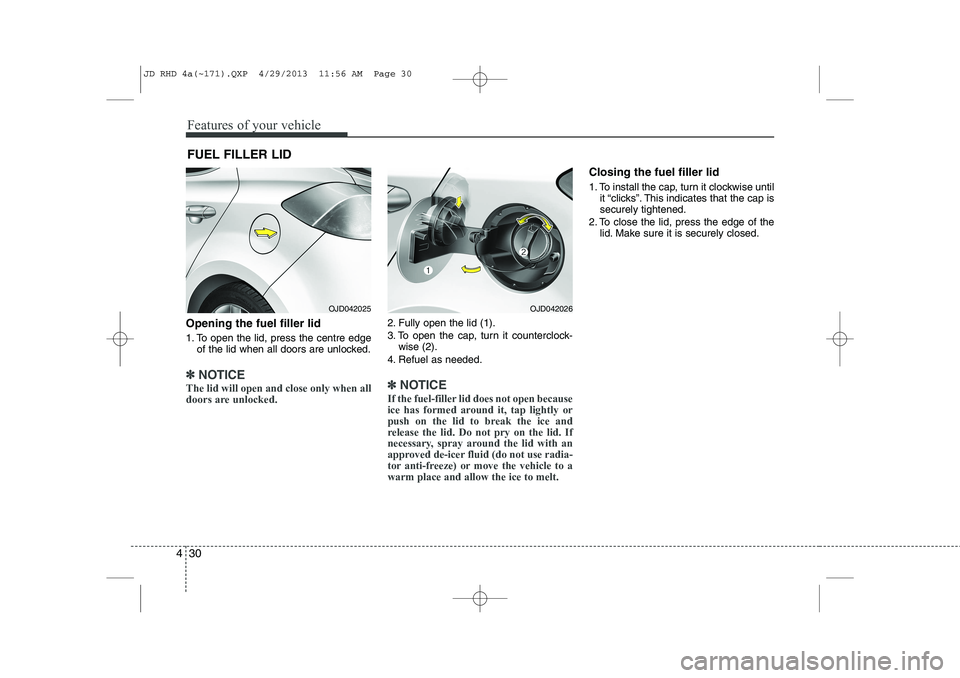
Opening the fuel filler lid
1. To open the lid, press the centre edge
of the lid when all doors are unlocked.
✽✽ NOTICE
The lid will open and close only when all
doors are unlocked.
2. Fully open the lid (1).
3. To open the cap, turn it counterclock- wise (2).
4. Refuel as needed.
✽✽ NOTICE
If the fuel-filler lid does not open because
ice has formed around it, tap lightly or
push on the lid to break the ice and
release the lid. Do not pry on the lid. If
necessary, spray around the lid with an
approved de-icer fluid (do not use radia-
tor anti-freeze) or move the vehicle to awarm place and allow the ice to melt.
Closing the fuel filler lid
1. To install the cap, turn it clockwise until it “clicks”. This indicates that the cap is securely tightened.
2. To close the lid, press the edge of the lid. Make sure it is securely closed.
FUEL FILLER LID
OJD042025OJD042026
JD RHD 4a(~171).QXP 4/29/2013 11:56 AM Page 30
Page 715 of 1206
431
Features of your vehicle
WARNING - Refueling
If pressurized fuel sprays out, it can cover your clothes or skin
and thus subject you to the risk
of fire and burns. Always remove
the fuel cap carefully and slowly.
If the cap is venting fuel or if you
hear a hissing sound, wait until
the condition stops before com-
pletely removing the cap.
Do not "top off" after the nozzle automatically shuts off whenrefueling.
Always check that the fuel cap is installed securely to prevent fuel
spillage in the event of an acci-dent.(Continued)
Do not get back into a vehicle once you have begun refueling
since you can generate static
electricity by touching, rubbing
or sliding against any item or fab-
ric (polyester, satin, nylon, etc.)
capable of producing static elec-
tricity. Static electricity discharge
can ignite fuel vapours resulting
in rapid burning. If you must re-
enter the vehicle, you should
once again eliminate potentially
dangerous static electricity dis-
charge by touching a metal part
of the vehicle, away from the fuel
filler neck, nozzle or other petrol
source.
When using an approved portable fuel container, be sure toplace the container on the
ground prior to refueling. Static
electricity discharge from the
container can ignite fuel vapours
causing a fire. Once refueling has
begun, contact with the vehicleshould be maintained until the
filling is complete.
(Continued)WARNING - Refueling dan-
gers
Automotive fuels are flammable
materials. When refueling, please
note the following guidelines care-
fully. Failure to follow these guide-
lines may result in severe personal
injury, severe burns or death by fire
or explosion.
Read and follow all warning post- ed at the gas station facility.
Before refueling note the location of the Emergency Petrol Shut-Off,
if available, at the gas station
facility.
Before touching the fuel nozzle, you should eliminate potentially
dangerous static electricity dis-
charge by touching another metal
part of the vehicle, a safe dis-
tance away from the fuel filler
neck, nozzle, or other gas source.
(Continued)
JD RHD 4a(~171).QXP 4/29/2013 11:56 AM Page 31
Page 716 of 1206
Features of your vehicle
32
4
(Continued)
Use only portable plastic fuel
containers designed to carry and
store petrol.
Do not use cellular phones whilst refueling. Electric current and/or
electronic interference from cel-
lular phones can potentially
ignite fuel vapours causing a fire.
When refueling, always shut the engine off. Sparks produced byelectrical components related tothe engine can ignite fuel
vapours causing a fire. Once
refueling is complete, check tomake sure the filler cap and filler
door are securely closed, before
starting the engine.
DO NOT use matches or a lighter and DO NOT SMOKE or leave a lit
cigarette in your vehicle whilst at
a gas station especially during
refueling. Automotive fuel is
highly flammable and can, when
ignited, result in fire.
(Continued)(Continued)
If a fire breaks out during refuel-ing, leave the vicinity of the vehi-
cle, and immediately contact the
manager of the gas station and
then contact the local fire depart-
ment. Follow any safety instruc-
tions they provide.CAUTION
Make sure to refuel your vehicle
according to the "Fuel require-
ments" suggested in section 1.
If the fuel filler cap requires replacement, please make surethat you use parts designed for
replacement in your vehicle. Anincorrect fuel filler cap can result in a serious malfunction of thefuel system or emission control
system. For more detailed infor-mation, we recommend that you contact an authorised Kia dealer.
Do not spill fuel on the exterior surfaces of the vehicle. Any typeof fuel spilled on painted surfacesmay damage the paint.
After refueling, make sure the fuel cap is installed securely to pre-
vent fuel spillage in the event ofan accident.
JD RHD 4a(~171).QXP 4/29/2013 11:56 AM Page 32
Page 733 of 1206
449
Features of your vehicle
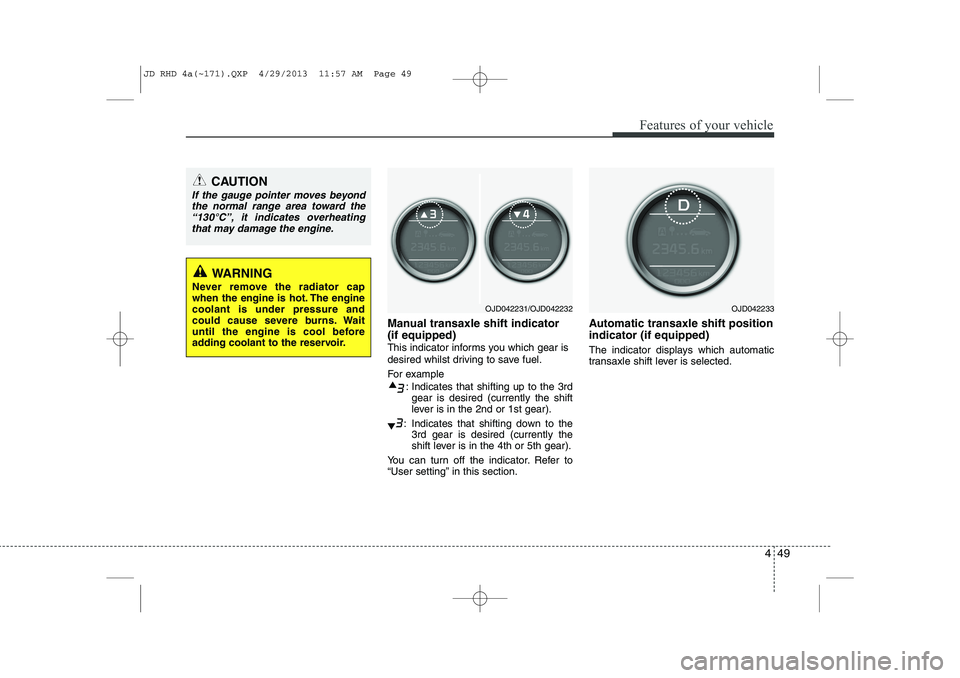
Manual transaxle shift indicator (if equipped)
This indicator informs you which gear is
desired whilst driving to save fuel.
For example: Indicates that shifting up to the 3rdgear is desired (currently the shift
lever is in the 2nd or 1st gear).
: Indicates that shifting down to the 3rd gear is desired (currently the
shift lever is in the 4th or 5th gear).
You can turn off the indicator. Refer to
“User setting” in this section. Automatic transaxle shift position indicator (if equipped)
The indicator displays which automatic
transaxle shift lever is selected.
OJD042233OJD042231/OJD042232
CAUTION
If the gauge pointer moves beyond
the normal range area toward the
“130°C”, it indicates overheatingthat may damage the engine.
WARNING
Never remove the radiator cap
when the engine is hot. The enginecoolant is under pressure and
could cause severe burns. Wait
until the engine is cool before
adding coolant to the reservoir.
JD RHD 4a(~171).QXP 4/29/2013 11:57 AM Page 49
Page 748 of 1206
Features of your vehicle
64
4
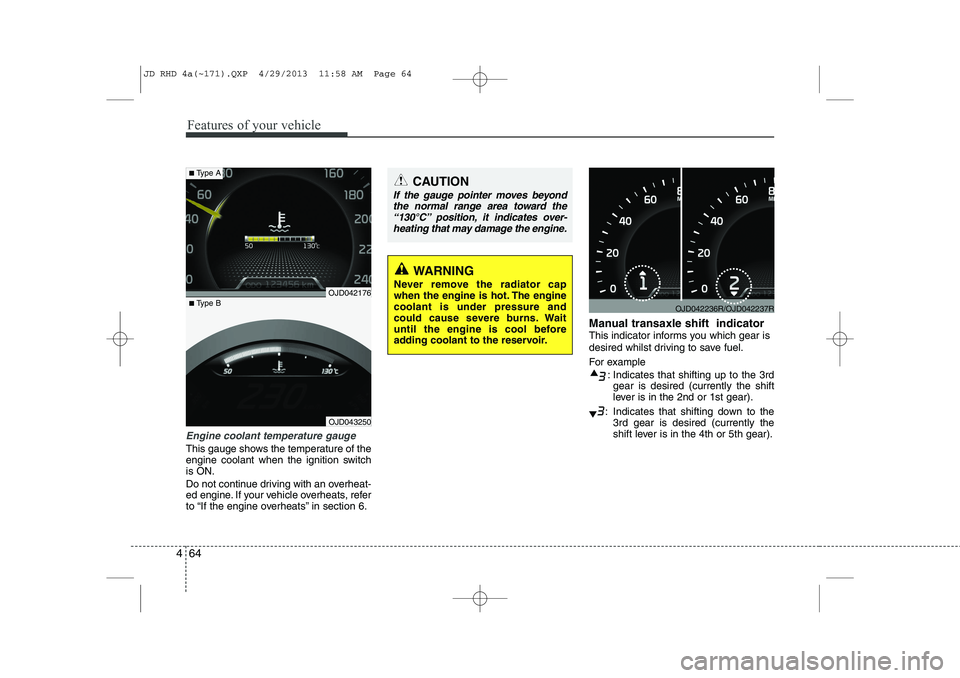
Engine coolant temperature gauge
This gauge shows the temperature of the
engine coolant when the ignition switchis ON.
Do not continue driving with an overheat-
ed engine. If your vehicle overheats, refer
to “If the engine overheats” in section 6. Manual transaxle shift indicator
This indicator informs you which gear is
desired whilst driving to save fuel.
For example
: Indicates that shifting up to the 3rdgear is desired (currently the shift
lever is in the 2nd or 1st gear).
: Indicates that shifting down to the 3rd gear is desired (currently the
shift lever is in the 4th or 5th gear).
OJD042236R/OJD042237R
CAUTION
If the gauge pointer moves beyond
the normal range area toward the
“130°C” position, it indicates over-heating that may damage the engine.
WARNING
Never remove the radiator cap
when the engine is hot. The enginecoolant is under pressure and
could cause severe burns. Wait
until the engine is cool before
adding coolant to the reservoir.
OJD043250
■ Type B
■Type A
OJD042176
JD RHD 4a(~171).QXP 4/29/2013 11:58 AM Page 64
Page 1029 of 1206
Driving your vehicle
80
5
This section will guide you in the proper
loading of your vehicle and/or trailer, to
keep your loaded vehicle weight within its
design rating capability, with or without a
trailer. Properly loading your vehicle will
provide maximum return of the vehicle
design performance. Before loading your
vehicle, familiarize yourself with the fol-
lowing terms for determining your vehi-
cle's weight ratings, with or without a
trailer, from the vehicle's specifications
and the certification label: Base curb weight
This is the weight of the vehicle including a full tank of fuel and all standard equip-
ment. It does not include passengers,
cargo, or optional equipment.
Vehicle curb weight
This is the weight of your new vehicle
when you picked it up from your dealer
plus any aftermarket equipment.
Cargo weight
This figure includes all weight added to
the Base Curb Weight, including cargoand optional equipment. GAW (Gross axle weight)
This is the total weight placed on each
axle (front and rear) - including vehicle
curb weight and all payload.
GAWR (Gross axle weight rating)
This is the maximum allowable weight
that can be carried by a single axle (front
or rear). These numbers are shown on
the certification label.
The total load on each axle must never
exceed its GAWR.
GVW (Gross vehicle weight)
This is the Base Curb Weight plus actual
Cargo Weight plus passengers.
GVWR (Gross vehicle weight rat- ing)
This is the maximum allowable weight of
the fully loaded vehicle (including all
options, equipment, passengers and
cargo). The GVWR is shown on the cer-tification label.
Overloading
VEHICLE WEIGHT
WARNING -
Vehicle weight
The gross axle weight rating
(GAWR) and the gross vehicle
weight rating (GVWR) for your vehi-
cle are on the certification label
attached to the driver's (or front
passenger’s) door. Exceedingthese ratings can cause an acci-
dent or vehicle damage. You can
calculate the weight of your load byweighing the items (and people)
before putting them in the vehicle.
Be careful not to overload your
vehicle.
JD RHD 5.QXP 4/29/2013 11:29 AM Page 80
Page 1066 of 1206

75
Maintenance
OJD072003R
❈
The actual engine room in the vehicle may differ from the illustration. 1. Engine oil filler cap
2. Brake/clutch fluid reservoir
3. Positive battery terminal
4. Negative battery terminal
5. Fuse box
6. Air cleaner
7. Radiator cap
8. Engine coolant reservoir
9. Engine oil dipstick
10. Windscreen washer fluid reservoir
11. Fuel filter
■■
Diesel engine
JD RHD 7.QXP 4/29/2013 11:32 AM Page 5
Page 1074 of 1206
713
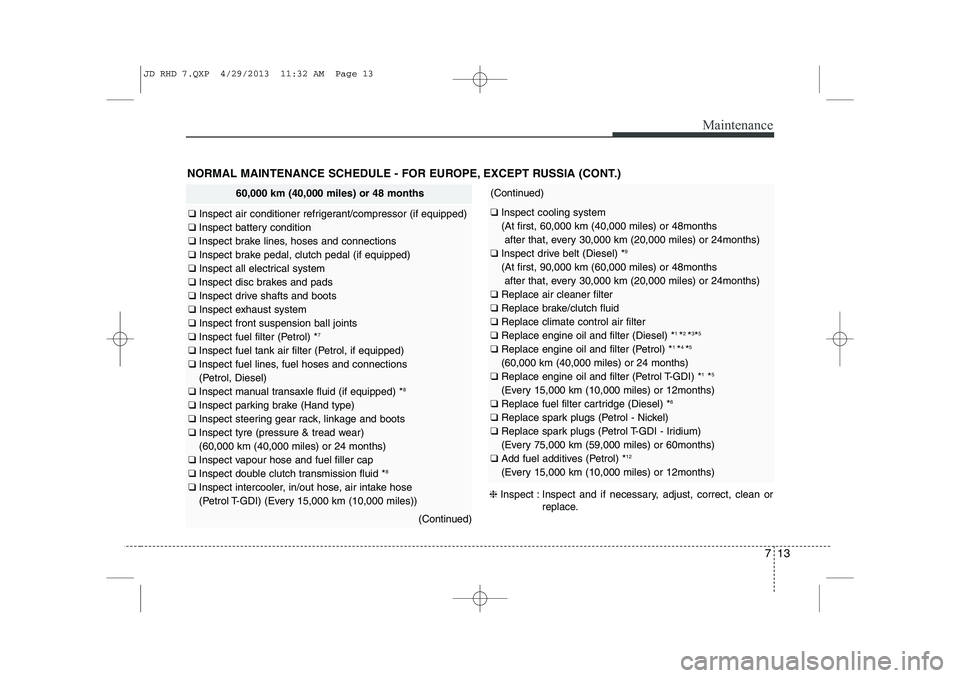
Maintenance
NORMAL MAINTENANCE SCHEDULE - FOR EUROPE, EXCEPT RUSSIA (CONT.)
60,000 km (40,000 miles) or 48 months
❑ Inspect air conditioner refrigerant/compressor (if equipped)
❑ Inspect battery condition
❑ Inspect brake lines, hoses and connections
❑ Inspect brake pedal, clutch pedal (if equipped)
❑ Inspect all electrical system
❑ Inspect disc brakes and pads
❑ Inspect drive shafts and boots
❑ Inspect exhaust system
❑ Inspect front suspension ball joints
❑ Inspect fuel filter (Petrol) * 7
❑ Inspect fuel tank air filter (Petrol, if equipped)
❑ Inspect fuel lines, fuel hoses and connections
(Petrol, Diesel)
❑ Inspect manual transaxle fluid (if equipped) * 8
❑ Inspect parking brake (Hand type)
❑ Inspect steering gear rack, linkage and boots
❑ Inspect tyre (pressure & tread wear)(60,000 km (40,000 miles) or 24 months)
❑ Inspect vapour hose and fuel filler cap
❑ Inspect double clutch transmission fluid * 8
❑ Inspect intercooler, in/out hose, air intake hose
(Petrol T-GDI) (Every 15,000 km (10,000 miles))
(Continued)
(Continued)
❑ Inspect cooling system
(At first, 60,000 km (40,000 miles) or 48months
after that, every 30,000 km (20,000 miles) or 24months)
❑ Inspect drive belt (Diesel) * 9
(At first, 90,000 km (60,000 miles) or 48months after that, every 30,000 km (20,000 miles) or 24months)
❑ Replace air cleaner filter
❑ Replace brake/clutch fluid
❑ Replace climate control air filter
❑ Replace engine oil and filter (Diesel) * 1
*2
*3
* 5
❑ Replace engine oil and filter (Petrol) * 1
*4
*5
(60,000 km (40,000 miles) or 24 months)
❑ Replace engine oil and filter (Petrol T-GDI) * 1
*5
(Every 15,000 km (10,000 miles) or 12months)
❑ Replace fuel filter cartridge (Diesel) * 6
❑ Replace spark plugs (Petrol - Nickel)
❑ Replace spark plugs (Petrol T-GDI - Iridium)
(Every 75,000 km (59,000 miles) or 60months)
❑ Add fuel additives (Petrol) * 12
(Every 15,000 km (10,000 miles) or 12months)
❈ Inspect : Inspect and if necessary, adjust, correct, clean or
replace.
JD RHD 7.QXP 4/29/2013 11:32 AM Page 13
Page 1076 of 1206
715
Maintenance
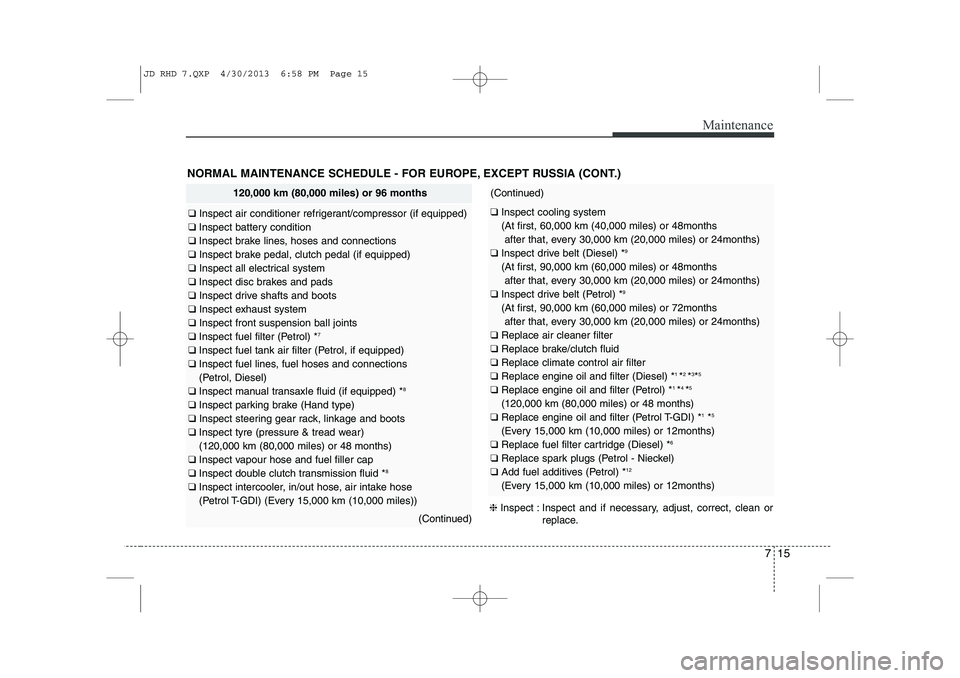
NORMAL MAINTENANCE SCHEDULE - FOR EUROPE, EXCEPT RUSSIA (CONT.)
120,000 km (80,000 miles) or 96 months
❑ Inspect air conditioner refrigerant/compressor (if equipped)
❑ Inspect battery condition
❑ Inspect brake lines, hoses and connections
❑ Inspect brake pedal, clutch pedal (if equipped)
❑ Inspect all electrical system
❑ Inspect disc brakes and pads
❑ Inspect drive shafts and boots
❑ Inspect exhaust system
❑ Inspect front suspension ball joints
❑ Inspect fuel filter (Petrol) * 7
❑ Inspect fuel tank air filter (Petrol, if equipped)
❑ Inspect fuel lines, fuel hoses and connections
(Petrol, Diesel)
❑ Inspect manual transaxle fluid (if equipped) * 8
❑ Inspect parking brake (Hand type)
❑ Inspect steering gear rack, linkage and boots
❑ Inspect tyre (pressure & tread wear)(120,000 km (80,000 miles) or 48 months)
❑ Inspect vapour hose and fuel filler cap
❑ Inspect double clutch transmission fluid * 8
❑ Inspect intercooler, in/out hose, air intake hose
(Petrol T-GDI) (Every 15,000 km (10,000 miles))
(Continued)
(Continued)
❑ Inspect cooling system
(At first, 60,000 km (40,000 miles) or 48months
after that, every 30,000 km (20,000 miles) or 24months)
❑ Inspect drive belt (Diesel) * 9
(At first, 90,000 km (60,000 miles) or 48months after that, every 30,000 km (20,000 miles) or 24months)
❑ Inspect drive belt (Petrol) * 9
(At first, 90,000 km (60,000 miles) or 72months after that, every 30,000 km (20,000 miles) or 24months)
❑ Replace air cleaner filter
❑ Replace brake/clutch fluid
❑ Replace climate control air filter
❑ Replace engine oil and filter (Diesel) * 1
*2
*3
* 5
❑ Replace engine oil and filter (Petrol) * 1
*4
*5
(120,000 km (80,000 miles) or 48 months)
❑ Replace engine oil and filter (Petrol T-GDI) * 1
*5
(Every 15,000 km (10,000 miles) or 12months)
❑ Replace fuel filter cartridge (Diesel) * 6
❑ Replace spark plugs (Petrol - Nieckel)
❑ Add fuel additives (Petrol) * 12
(Every 15,000 km (10,000 miles) or 12months)
❈ Inspect : Inspect and if necessary, adjust, correct, clean or
replace.
JD RHD 7.QXP 4/30/2013 6:58 PM Page 15