transmission KIA CEED 2014 Owner's Guide
[x] Cancel search | Manufacturer: KIA, Model Year: 2014, Model line: CEED, Model: KIA CEED 2014Pages: 1206, PDF Size: 50.15 MB
Page 961 of 1206
Driving your vehicle
12
5
Starting the engine
✽✽
NOTICE - Kick down mecha- nism (if equipped)
If your vehicle is equipped with a kick down mechanism in the accelerator
pedal, it prevents you from driving at
full throttle unintentionally by making
the driver require increased effort to
depress the accelerator pedal. However,
if you depress the pedal more than
approximately 80%, the vehicle can be
at full throttle and the accelerator pedal
will be easier to depress. This is not amalfunction but a normal condition.
Starting the petrol engine
1. Carry the smart key or leave it inside the vehicle.
2. Make sure the parking brake is firmly applied.
3. Manual Transaxle - Depress the
clutch pedal fully and shift the
transaxle into Neutral. Keep the clutch
pedal and brake pedal depressed
whilst starting the engine.
Automatic transaxle/DCT* - Place the
transaxle shift lever in P (Park).
Depress the brake pedal fully.
You can also start the engine when
the shift lever is in the N (Neutral) position.
* DCT: Double clutch transmission
4. Press the engine start/stop button.
5. In extremely cold weather (below -18°C / 0°F) or after the vehicle has
not been operated for several days, let
the engine warm up without depress-
ing the accelerator.
Whether the engine is cold or warm, it
should be started without depressing the
accelerator.
Starting the diesel engine
To start the diesel engine when the engine is cold, it has to be pre-heated
before starting the engine and then have
to be warmed up before starting to drive.
1. Make sure the parking brake is applied.
2. Manual Transaxle - Depress the
clutch pedal fully and shift the
transaxle into Neutral. Keep the clutch
pedal and brake pedal depressed
whilst pressing the engine start/stop
button to the START position.
Automatic Transaxle - Place the
transaxle shift lever in P (Park).
Depress the brake pedal fully.
You can also start the engine when the
shift lever is in the N (Neutral) position.
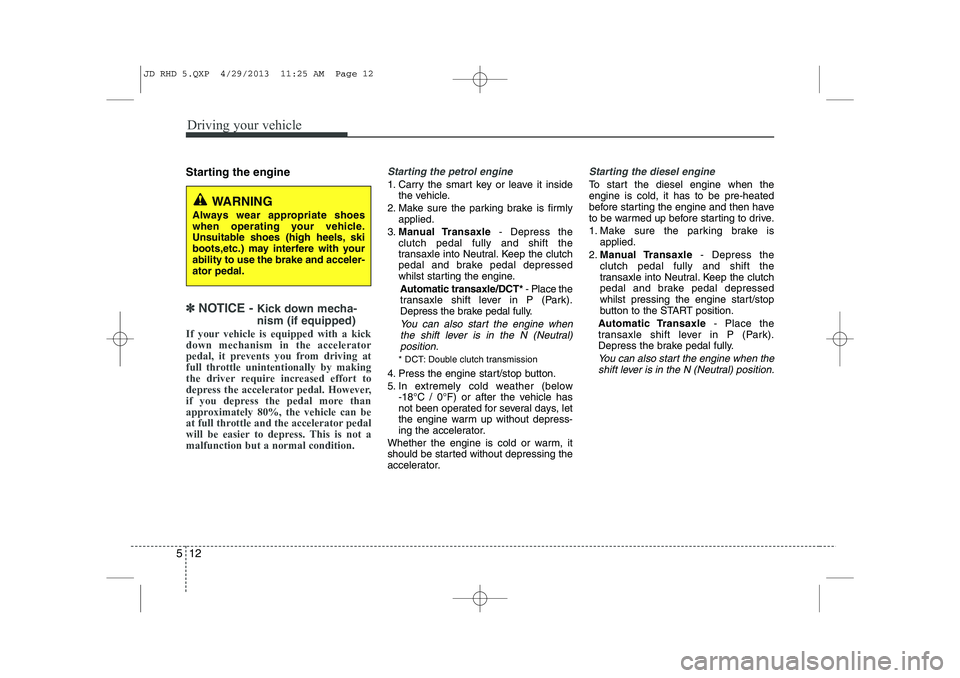
WARNING
Always wear appropriate shoes
when operating your vehicle.
Unsuitable shoes (high heels, ski
boots,etc.) may interfere with yourability to use the brake and acceler-ator pedal.
JD RHD 5.QXP 4/29/2013 11:25 AM Page 12
Page 972 of 1206
523
Driving your vehicle
Automatic transaxle/Double
clutch transmission operation
The automatic transaxle/Double clutch
transmission has 6 forward speeds and
one reverse speed. The individual speeds
are selected automatically, depending on
the position of the shift lever.
✽✽NOTICE
The first few shifts on a new vehicle, if the battery has been disconnected, may
be somewhat abrupt. This is a normalcondition, and the shifting sequence will
adjust after shifts are cycled a few times
by the TCM (Transaxle Control
Module) or PCM (Powertrain ControlModule).
AUTOMATIC TRANSAXLE/DOUBLE CLUTCH TRANSMISSION (IF EQUIPPED)
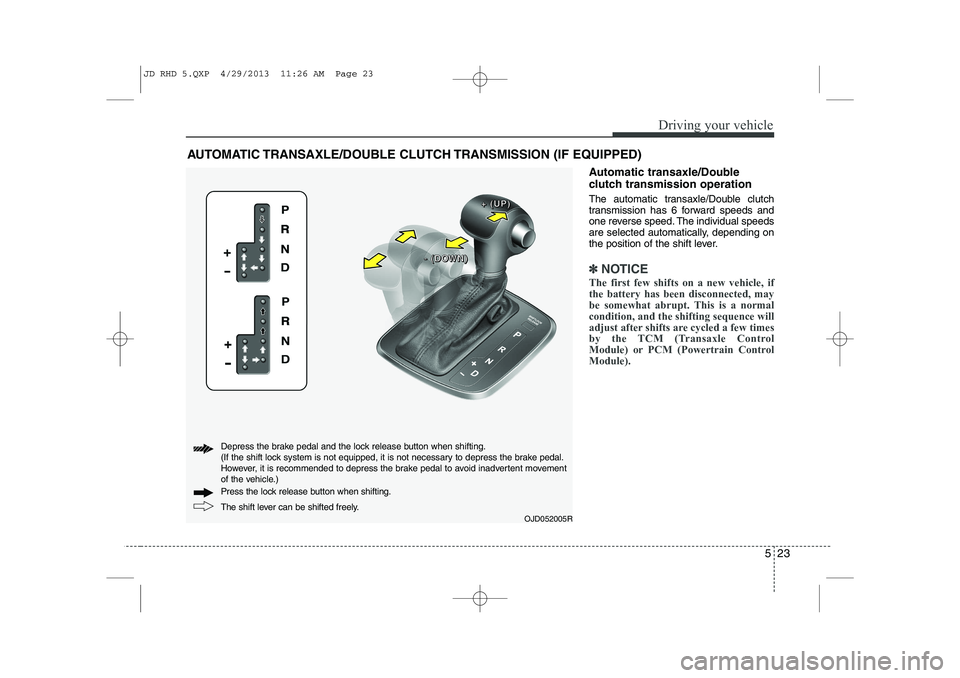
OJD052005R
+
+++ ((((UUUUPPPP))))
---- ((((DDDDOOOOWWWWNNNN))))
The shift lever can be shifted freely.
Press the lock release button when shifting.
Depress the brake pedal and the lock release button when shifting.
(If the shift lock system is not equipped, it is not necessary to depress the brake pedal.
However, it is recommended to depress the brake pedal to avoid inadvertent movement
of the vehicle.)
JD RHD 5.QXP 4/29/2013 11:26 AM Page 23
Page 974 of 1206
525
Driving your vehicle
CAUTION
To avoid damage to yourtransaxle, do not accelerate the
engine in R (Reverse) or any for- ward gear position with thebrakes on.
When stopped on an upgrade, do not hold the vehicle stationarywith engine power. Use the serv- ice brake or the parking brake.
Do not shift from N (Neutral) or P (Park) into D (Drive), or R
(Reverse) when the engine isabove idle speed.
CAUTION - DCT
If the vehicle is held by applying
accelerator pedal at the hill, the
transmission and clutch will be damaged. To hold at the hill, usethe parking brake or foot brake.
An overload of the clutch is indi- cated by a longitudinal judder anda blinking display. To exclude aclutch-damage, the clutch is opened and the torque flow inter-
rupted. If the clutch is opened, apply the foot brake and waitsome minutes before driving again.
Ignoring the warnings can lead to severe injuries and damage onthe car.
If the LCD warning is active, the foot brake has to be applied.
When the problem of gear system occurs, the transaxle indicatorwill blink. For your safety, we rec- ommend that you contact anauthorised Kia dealer and have
the system checked.
(Continued)
(Continued) When the clutch is overheated, the safe protection mode oper-ates. According to the safe pro-tection mode, the transaxle indi-
cator blinks with buzzer sound.The buzzer beeps 3 times.
In this time, the LCD warningabout safe protection mode also
displays. In this condition, thedriving may not be smoothly. Ifyou ignore this warning, the driv-ing condition is getting worse and
the system may have problem. Toreturn the normal driving condi- tion, apply the foot brake and
stop the vehicle for few minutes before driving off.
Whilst shifting the gear automati- cally, you may feel a correspon-ding shifting of gear. However, it
is not malfunction.
JD RHD 5.QXP 4/29/2013 11:27 AM Page 25
Page 976 of 1206
527
Driving your vehicle
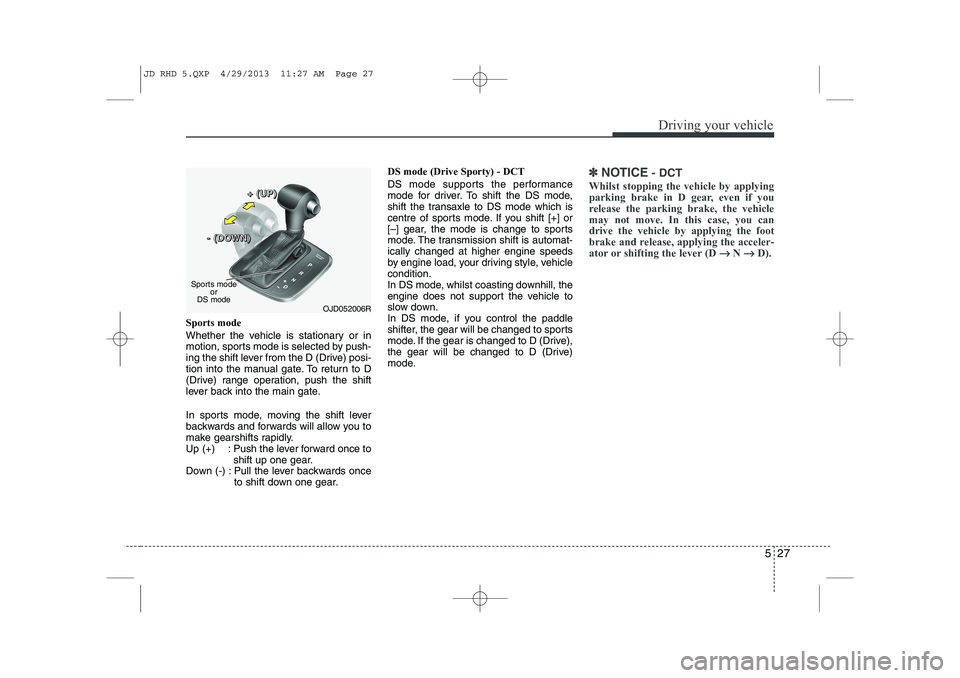
Sports mode
Whether the vehicle is stationary or in
motion, sports mode is selected by push-
ing the shift lever from the D (Drive) posi-
tion into the manual gate. To return to D
(Drive) range operation, push the shift
lever back into the main gate.
In sports mode, moving the shift lever
backwards and forwards will allow you to
make gearshifts rapidly.
Up (+) : Push the lever forward once toshift up one gear.
Down (-) : Pull the lever backwards once to shift down one gear. DS mode (Drive Sporty) - DCT
DS mode supports the performance
mode for driver. To shift the DS mode,
shift the transaxle to DS mode which is
centre of sports mode. If you shift [+] or
[–] gear, the mode is change to sports
mode. The transmission shift is automat-ically changed at higher engine speeds
by engine load, your driving style, vehiclecondition.
In DS mode, whilst coasting downhill, the
engine does not support the vehicle to
slow down.
In DS mode, if you control the paddle
shifter, the gear will be changed to sports
mode. If the gear is changed to D (Drive),
the gear will be changed to D (Drive)
mode.
✽✽
NOTICE - DCT
Whilst stopping the vehicle by applying
parking brake in D gear, even if you
release the parking brake, the vehiclemay not move. In this case, you candrive the vehicle by applying the foot
brake and release, applying the acceler-
ator or shifting the lever (D →
→
N →→
D).
OJD052006R
Sports mode
or
DS mode +
+++ ((((UUUUPPPP))))
---- ((((DDDDOOOOWWWWNNNN))))
JD RHD 5.QXP 4/29/2013 11:27 AM Page 27
Page 1026 of 1206

577
Driving your vehicle
If you do decide to pull a trailer
Here are some important points if you decide to pull a trailer:
Consider using a sway control. You can ask a towbar hitch dealer about sway control.
Do not do any towing with your car during its first 2,000 km (1,200 miles) in order to allow the engine to properly break in. Failure
to heed this caution may result in serious engine or transaxle damage.
When towing a trailer, we recommend that you consult an authorised Kia dealer on additional requirements such as a towing kit, etc.
Always drive your vehicle at a moderate speed (less than 100 km/h (60 mph)).
On a long uphill grade, do not exceed 70 km/h (45 mph) or the posted towing speed limit, whichever is lower.
The chart contains important considerations that have to do with weight:
For Europe
M/T : Manual transaxle
A/T : Automatic transaxle
DCT : Double clutch transmission Engine
Item
Petrol 1.4LPetrol
1.6L MPI Petrol
1.6L GDIPetrol
1.6L T-GDIDiesel 1.4L Diesel
1.6L
M/TM/TA/T M/T A/T
(DCT)M/TM/T M/T A/T
Maximum trailer
weight kg (Ibs.)
Without brakeSystem600
(1,323)600
(1,323)600
(1,323) 600
(1,323) 600
(1,323)600
(1,323)650
(1,433) 650
(1,433) 650
(1,433)
With brake System
1,200
(2,646)1,300
(2,866)1,200
(2,646) 1,400
(3,086) 1,300
(2,866)1,400
(3,086)1,500
(3,307) 1,500
(3,307) 1,300
(2,866)
Maximum permissible static
vertical load on the coupling device kg (Ibs.)
60
(132)60
(132)60
(132) 60
(132) 60
(132)60
(132)75
(165) 75
(165) 75
(165)
Recommended distance from rear wheel centre to coupling point mm (inch)
3 Door and 5 Door : 859 (33.8)Wagon : 1,055 (41.54)
JD RHD 5.QXP 4/29/2013 11:29 AM Page 77
Page 1069 of 1206

Maintenance
8
7
OWNER MAINTENANCE
We recommend that the following lists
are vehicle checks and inspections that
should be performed by the owner or an
authorised Kia dealer at the frequencies
indicated to help ensure safe, depend-
able operation of your vehicle.
If you have any question, we recommend
that you consult an authorised Kia deal-
er.
These Owner Maintenance Checks are
generally not covered by warranties and
you may be charged for labour, parts and
lubricants used. Owner maintenance schedule
When you stop for fuel:
Check the engine oil level.
Check coolant level in coolant reser-
voir.
Check the windscreen washer fluid level.
Look for low or under-inflated tyres.
Check the radiator and condenser. Check if the front of the radiator and
condenser are clean and not blocked
with leaves, dirt or insects etc.
If any of the above parts are extremely
dirty or you are not sure of their condi-
tion, we recommend that you contact
an authorised Kia dealer.
Whilst operating your vehicle:
Note any changes in the sound of theexhaust or any smell of exhaust fumes
in the vehicle.
Check for vibrations in the steering wheel. Notice any increased steering
effort or looseness in the steering
wheel, or change in its straight-aheadposition.
Notice if your vehicle constantly turns slightly or “pulls” to one side when trav-
elling on smooth, level road.
When stopping, listen and check for unusual sounds, pulling to one side,
increased brake pedal travel or “hard-
to-push” brake pedal.
If any slipping or changes in the oper- ation of your transaxle occurs, check
the transaxle fluid level.
Check manual transaxle operation, including clutch operation.
Check automatic transaxle/double clutch transmission P (Park) function.
Check parking brake.
Check for fluid leaks under your vehicle (water dripping from the air conditioning
system during or after use is normal).
WARNING
Be careful when checking your
engine coolant level when the
engine is hot. Scalding hot coolant
and steam may blow out under
pressure. This could cause burns
or other serious injury.
JD RHD 7.QXP 4/29/2013 11:32 AM Page 8
Page 1072 of 1206
711
Maintenance
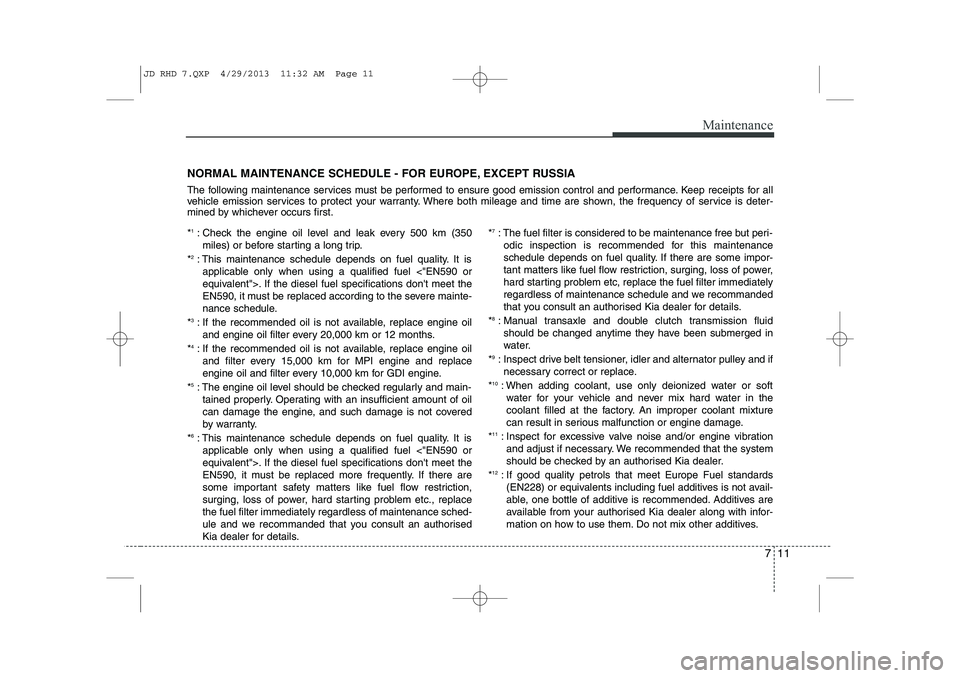
NORMAL MAINTENANCE SCHEDULE - FOR EUROPE, EXCEPT RUSSIA
The following maintenance services must be performed to ensure good emission control and performance. Keep receipts for all
vehicle emission services to protect your warranty. Where both mileage and time are shown, the frequency of service is deter-
mined by whichever occurs first. *1
: Check the engine oil level and leak every 500 km (350
miles) or before starting a long trip.
* 2
: This maintenance schedule depends on fuel quality. It is
applicable only when using a qualified fuel <"EN590 or
equivalent">. If the diesel fuel specifications don't meet the
EN590, it must be replaced according to the severe mainte-
nance schedule.
* 3
: If the recommended oil is not available, replace engine oil
and engine oil filter every 20,000 km or 12 months.
* 4
: If the recommended oil is not available, replace engine oil
and filter every 15,000 km for MPI engine and replace
engine oil and filter every 10,000 km for GDI engine.
* 5
: The engine oil level should be checked regularly and main-
tained properly. Operating with an insufficient amount of oil
can damage the engine, and such damage is not covered
by warranty.
* 6
: This maintenance schedule depends on fuel quality. It is
applicable only when using a qualified fuel <"EN590 or
equivalent">. If the diesel fuel specifications don't meet the
EN590, it must be replaced more frequently. If there are
some important safety matters like fuel flow restriction,
surging, loss of power, hard starting problem etc., replacethe fuel filter immediately regardless of maintenance sched-
ule and we recommanded that you consult an authorised
Kia dealer for details. *
7
: The fuel filter is considered to be maintenance free but peri-
odic inspection is recommended for this maintenance
schedule depends on fuel quality. If there are some impor-
tant matters like fuel flow restriction, surging, loss of power,
hard starting problem etc, replace the fuel filter immediately
regardless of maintenance schedule and we recommanded
that you consult an authorised Kia dealer for details.
* 8
: Manual transaxle and double clutch transmission fluid
should be changed anytime they have been submerged in
water.
* 9
: Inspect drive belt tensioner, idler and alternator pulley and if
necessary correct or replace.
* 10
: When adding coolant, use only deionized water or soft
water for your vehicle and never mix hard water in the
coolant filled at the factory. An improper coolant mixture
can result in serious malfunction or engine damage.
* 11
: Inspect for excessive valve noise and/or engine vibration
and adjust if necessary. We recommended that the system
should be checked by an authorised Kia dealer.
* 12
: If good quality petrols that meet Europe Fuel standards
(EN228) or equivalents including fuel additives is not avail-
able, one bottle of additive is recommended. Additives are
available from your authorised Kia dealer along with infor-
mation on how to use them. Do not mix other additives.
JD RHD 7.QXP 4/29/2013 11:32 AM Page 11
Page 1074 of 1206
713
Maintenance
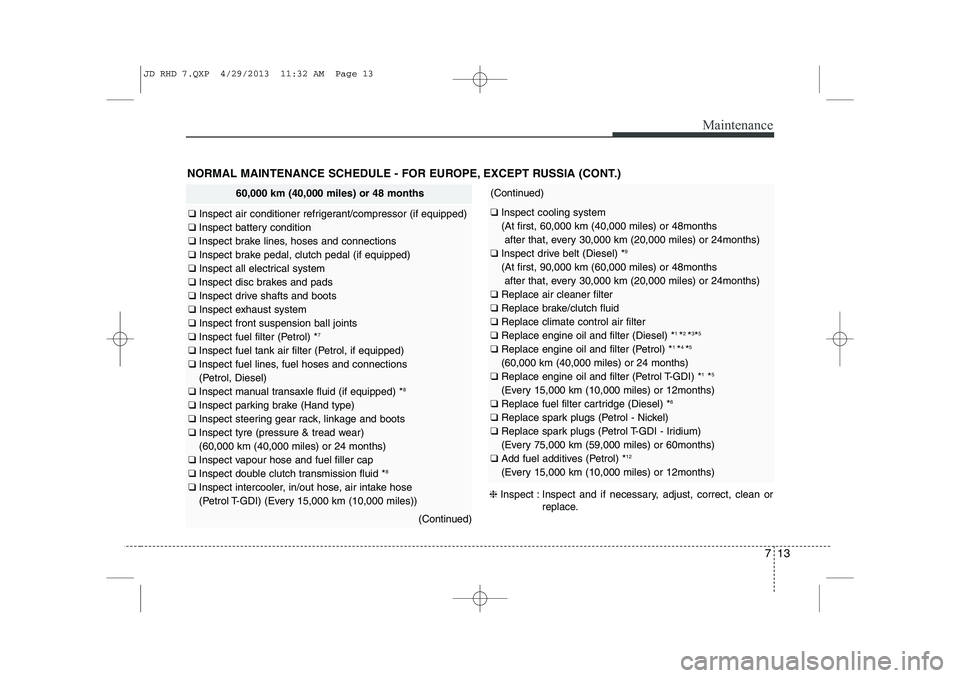
NORMAL MAINTENANCE SCHEDULE - FOR EUROPE, EXCEPT RUSSIA (CONT.)
60,000 km (40,000 miles) or 48 months
❑ Inspect air conditioner refrigerant/compressor (if equipped)
❑ Inspect battery condition
❑ Inspect brake lines, hoses and connections
❑ Inspect brake pedal, clutch pedal (if equipped)
❑ Inspect all electrical system
❑ Inspect disc brakes and pads
❑ Inspect drive shafts and boots
❑ Inspect exhaust system
❑ Inspect front suspension ball joints
❑ Inspect fuel filter (Petrol) * 7
❑ Inspect fuel tank air filter (Petrol, if equipped)
❑ Inspect fuel lines, fuel hoses and connections
(Petrol, Diesel)
❑ Inspect manual transaxle fluid (if equipped) * 8
❑ Inspect parking brake (Hand type)
❑ Inspect steering gear rack, linkage and boots
❑ Inspect tyre (pressure & tread wear)(60,000 km (40,000 miles) or 24 months)
❑ Inspect vapour hose and fuel filler cap
❑ Inspect double clutch transmission fluid * 8
❑ Inspect intercooler, in/out hose, air intake hose
(Petrol T-GDI) (Every 15,000 km (10,000 miles))
(Continued)
(Continued)
❑ Inspect cooling system
(At first, 60,000 km (40,000 miles) or 48months
after that, every 30,000 km (20,000 miles) or 24months)
❑ Inspect drive belt (Diesel) * 9
(At first, 90,000 km (60,000 miles) or 48months after that, every 30,000 km (20,000 miles) or 24months)
❑ Replace air cleaner filter
❑ Replace brake/clutch fluid
❑ Replace climate control air filter
❑ Replace engine oil and filter (Diesel) * 1
*2
*3
* 5
❑ Replace engine oil and filter (Petrol) * 1
*4
*5
(60,000 km (40,000 miles) or 24 months)
❑ Replace engine oil and filter (Petrol T-GDI) * 1
*5
(Every 15,000 km (10,000 miles) or 12months)
❑ Replace fuel filter cartridge (Diesel) * 6
❑ Replace spark plugs (Petrol - Nickel)
❑ Replace spark plugs (Petrol T-GDI - Iridium)
(Every 75,000 km (59,000 miles) or 60months)
❑ Add fuel additives (Petrol) * 12
(Every 15,000 km (10,000 miles) or 12months)
❈ Inspect : Inspect and if necessary, adjust, correct, clean or
replace.
JD RHD 7.QXP 4/29/2013 11:32 AM Page 13
Page 1076 of 1206
715
Maintenance
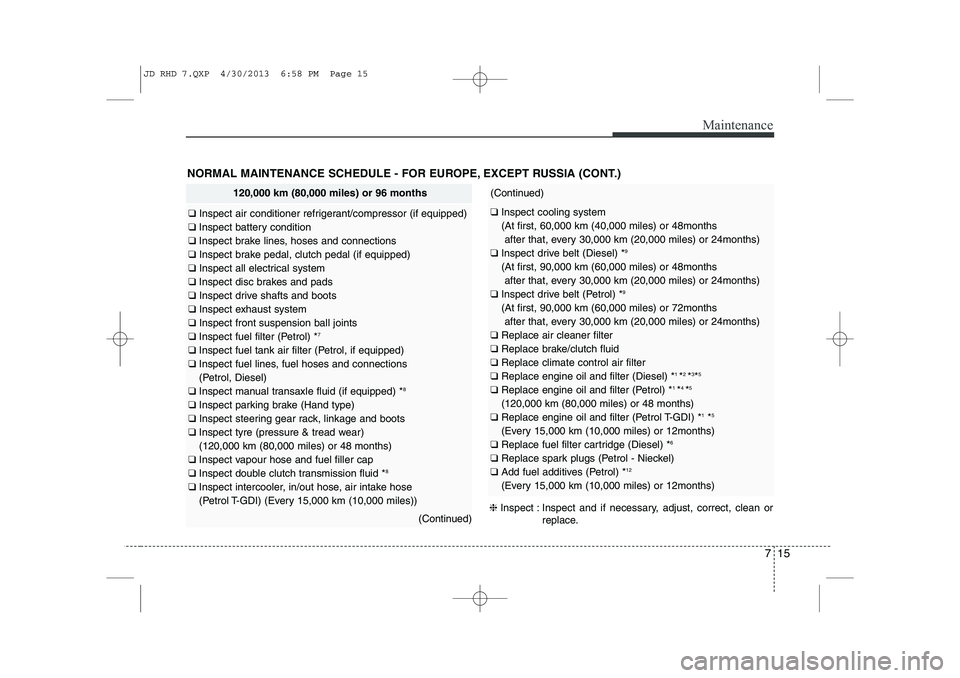
NORMAL MAINTENANCE SCHEDULE - FOR EUROPE, EXCEPT RUSSIA (CONT.)
120,000 km (80,000 miles) or 96 months
❑ Inspect air conditioner refrigerant/compressor (if equipped)
❑ Inspect battery condition
❑ Inspect brake lines, hoses and connections
❑ Inspect brake pedal, clutch pedal (if equipped)
❑ Inspect all electrical system
❑ Inspect disc brakes and pads
❑ Inspect drive shafts and boots
❑ Inspect exhaust system
❑ Inspect front suspension ball joints
❑ Inspect fuel filter (Petrol) * 7
❑ Inspect fuel tank air filter (Petrol, if equipped)
❑ Inspect fuel lines, fuel hoses and connections
(Petrol, Diesel)
❑ Inspect manual transaxle fluid (if equipped) * 8
❑ Inspect parking brake (Hand type)
❑ Inspect steering gear rack, linkage and boots
❑ Inspect tyre (pressure & tread wear)(120,000 km (80,000 miles) or 48 months)
❑ Inspect vapour hose and fuel filler cap
❑ Inspect double clutch transmission fluid * 8
❑ Inspect intercooler, in/out hose, air intake hose
(Petrol T-GDI) (Every 15,000 km (10,000 miles))
(Continued)
(Continued)
❑ Inspect cooling system
(At first, 60,000 km (40,000 miles) or 48months
after that, every 30,000 km (20,000 miles) or 24months)
❑ Inspect drive belt (Diesel) * 9
(At first, 90,000 km (60,000 miles) or 48months after that, every 30,000 km (20,000 miles) or 24months)
❑ Inspect drive belt (Petrol) * 9
(At first, 90,000 km (60,000 miles) or 72months after that, every 30,000 km (20,000 miles) or 24months)
❑ Replace air cleaner filter
❑ Replace brake/clutch fluid
❑ Replace climate control air filter
❑ Replace engine oil and filter (Diesel) * 1
*2
*3
* 5
❑ Replace engine oil and filter (Petrol) * 1
*4
*5
(120,000 km (80,000 miles) or 48 months)
❑ Replace engine oil and filter (Petrol T-GDI) * 1
*5
(Every 15,000 km (10,000 miles) or 12months)
❑ Replace fuel filter cartridge (Diesel) * 6
❑ Replace spark plugs (Petrol - Nieckel)
❑ Add fuel additives (Petrol) * 12
(Every 15,000 km (10,000 miles) or 12months)
❈ Inspect : Inspect and if necessary, adjust, correct, clean or
replace.
JD RHD 7.QXP 4/30/2013 6:58 PM Page 15
Page 1078 of 1206
717
Maintenance
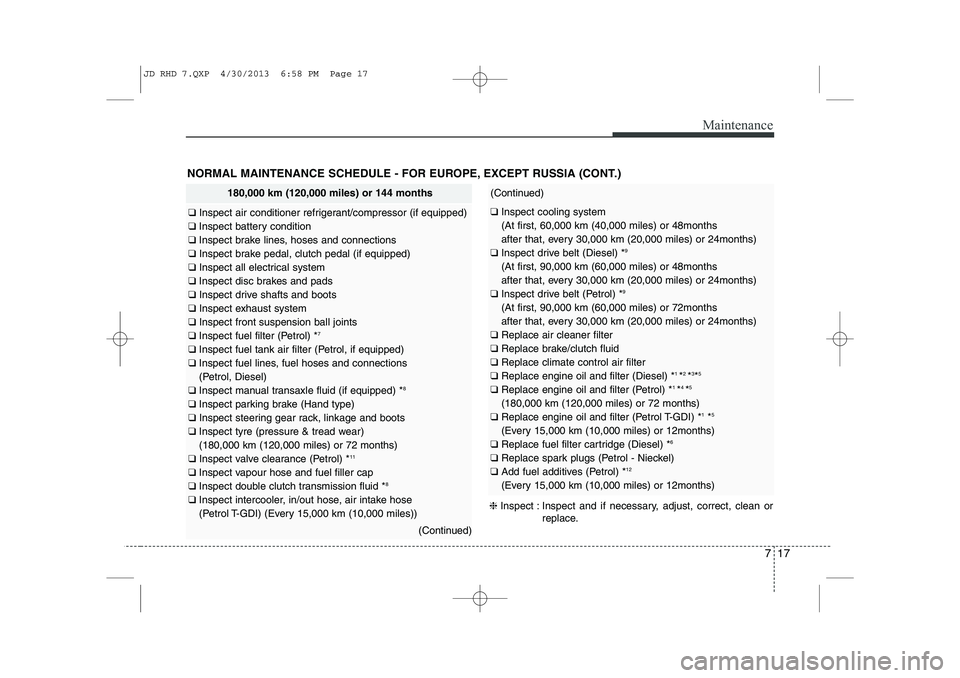
NORMAL MAINTENANCE SCHEDULE - FOR EUROPE, EXCEPT RUSSIA (CONT.)
180,000 km (120,000 miles) or 144 months
❑ Inspect air conditioner refrigerant/compressor (if equipped)
❑ Inspect battery condition
❑ Inspect brake lines, hoses and connections
❑ Inspect brake pedal, clutch pedal (if equipped)
❑ Inspect all electrical system
❑ Inspect disc brakes and pads
❑ Inspect drive shafts and boots
❑ Inspect exhaust system
❑ Inspect front suspension ball joints
❑ Inspect fuel filter (Petrol) * 7
❑ Inspect fuel tank air filter (Petrol, if equipped)
❑ Inspect fuel lines, fuel hoses and connections
(Petrol, Diesel)
❑ Inspect manual transaxle fluid (if equipped) * 8
❑ Inspect parking brake (Hand type)
❑ Inspect steering gear rack, linkage and boots
❑ Inspect tyre (pressure & tread wear)(180,000 km (120,000 miles) or 72 months)
❑ Inspect valve clearance (Petrol) * 11
❑ Inspect vapour hose and fuel filler cap
❑ Inspect double clutch transmission fluid * 8
❑ Inspect intercooler, in/out hose, air intake hose
(Petrol T-GDI) (Every 15,000 km (10,000 miles))
(Continued)
(Continued)
❑ Inspect cooling system (At first, 60,000 km (40,000 miles) or 48months
after that, every 30,000 km (20,000 miles) or 24months)
❑ Inspect drive belt (Diesel) * 9
(At first, 90,000 km (60,000 miles) or 48months
after that, every 30,000 km (20,000 miles) or 24months)
❑ Inspect drive belt (Petrol) * 9
(At first, 90,000 km (60,000 miles) or 72months
after that, every 30,000 km (20,000 miles) or 24months)
❑ Replace air cleaner filter
❑ Replace brake/clutch fluid
❑ Replace climate control air filter
❑ Replace engine oil and filter (Diesel) * 1
*2
*3
* 5
❑ Replace engine oil and filter (Petrol) * 1
*4
*5
(180,000 km (120,000 miles) or 72 months)
❑ Replace engine oil and filter (Petrol T-GDI) * 1
*5
(Every 15,000 km (10,000 miles) or 12months)
❑ Replace fuel filter cartridge (Diesel) * 6
❑ Replace spark plugs (Petrol - Nieckel)
❑ Add fuel additives (Petrol) * 12
(Every 15,000 km (10,000 miles) or 12months)
❈ Inspect : Inspect and if necessary, adjust, correct, clean or
replace.
JD RHD 7.QXP 4/30/2013 6:58 PM Page 17