service KIA CEED 2015 Owner's Guide
[x] Cancel search | Manufacturer: KIA, Model Year: 2015, Model line: CEED, Model: KIA CEED 2015Pages: 1210, PDF Size: 35.92 MB
Page 432 of 1210

What to do in an emergency
6
6
Jump starting procedure ✽✽
NOTICE
If the battery is discharged, the engine
can be started using a battery of anoth-
er vehicle and two jumper cables. Only
use jumper cables with fully insulated
clamp handles.
To prevent personal injury or damage to
both vehicles, adhere strictly to the fol-
lowing procedure.
1. Make sure the booster battery is 12- volt and that its negative terminal is
grounded.
2. If the booster battery is in another vehicle, do not allow the vehicles totouch.
3. Turn off all unnecessary electrical loads. 4. Connect the jumper cables in the exact
sequence shown in the illustration.First connect one end of a jumper
cable to the positive terminal of the
discharged battery (1), then connect
the other end to the positive terminal
on the booster battery (2). Proceed toconnect one end of the other jumper
cable to the negative terminal of the
booster battery (3), then the other end
to a solid, stationary, metallic point (for
example, the engine lifting bracket)
away from the battery (4). Do not con-
nect it to or near any part that moves
when the engine is cranked. Make
sure that there is no contact between
the bodywork of the two vehicles; oth-
erwise, there is the danger of short cir-
cuits.
Do not allow the jumper cables to con-
tact anything except the correct battery
terminals or the correct ground. Do not
lean over the battery when making
connections.
CAUTION - Battery cables
Do not connect the jumper cable from
the negative terminal of the booster battery to the negative terminal of thedischarged battery. This can cause
the discharged battery to overheat and crack, releasing battery acid.
CAUTION -AGM battery (if equipped)
Absorbent Glass Matt (AGM) bat-
teries are maintenance-free andwe recommend that the AGM bat-
teries be serviced by an author-ized Kia dealer. For charging yourAGM battery, use only fully auto-
matic battery chargers that arespecially developed for AGM bat-teries.
When replacing the AGM battery, we recommend that you use parts
for replacement from an author- ized Kia dealer.
Do not open or remove the cap on top of the battery. This may cause
leaks of internal electrolyte that could result in severe injury.
If the AGM battery is reconnected or replaced, ISG function will notoperate immediately.
If you want to use the ISG func-tion, the battery sensor needs to be calibrated for approximately 4hours with the ignition off.
JD eng 6.QXP 3/12/2015 3:05 PM Page 6
Page 435 of 1210
69
What to do in an emergency
IF YOU HAVE A FLAT TIRE (WITH SPARE TIRE, IF EQUIPPED)
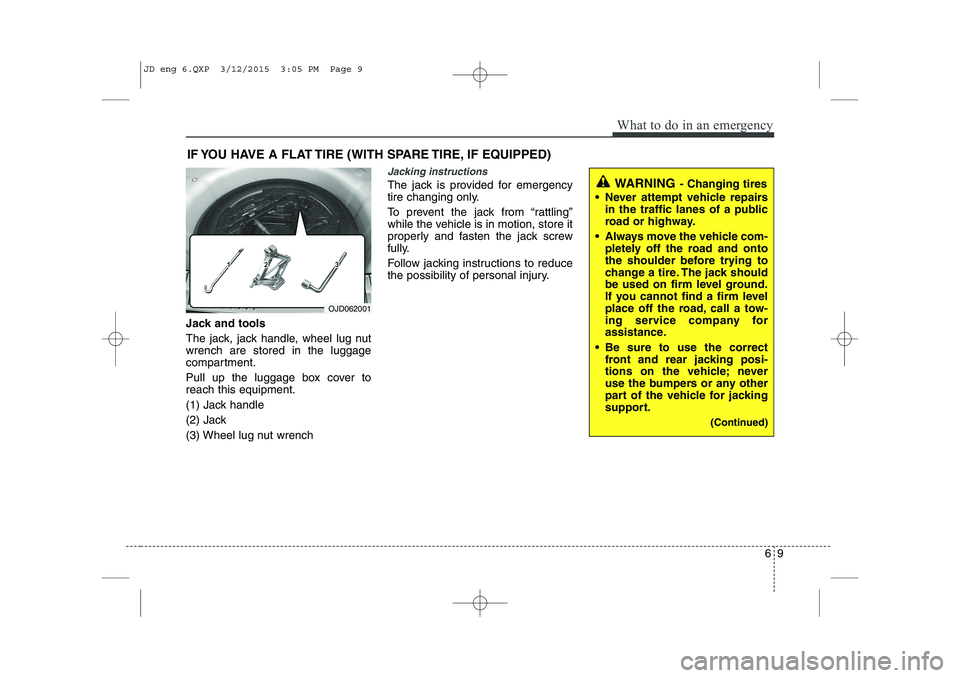
Jack and tools
The jack, jack handle, wheel lug nut wrench are stored in the luggage
compartment.
Pull up the luggage box cover to reach this equipment.
(1) Jack handle
(2) Jack
(3) Wheel lug nut wrench
Jacking instructions
The jack is provided for emergency
tire changing only.
To prevent the jack from “rattling”
while the vehicle is in motion, store it
properly and fasten the jack screw
fully.
Follow jacking instructions to reduce
the possibility of personal injury.
OJD062001
WARNING - Changing tires
Never attempt vehicle repairs in the traffic lanes of a public
road or highway.
Always move the vehicle com- pletely off the road and onto
the shoulder before trying to
change a tire. The jack should
be used on firm level ground.
If you cannot find a firm level
place off the road, call a tow-
ing service company for
assistance.
Be sure to use the correct front and rear jacking posi-
tions on the vehicle; never
use the bumpers or any other
part of the vehicle for jacking
support.
(Continued)
JD eng 6.QXP 3/12/2015 3:05 PM Page 9
Page 440 of 1210
What to do in an emergency
14
6
Wheel nut tightening torque:
Steel wheel & aluminium alloy wheel:
9~11 kg.m (65~79 lb.ft)
If you have a tire gauge, remove the
valve cap and check the air pressure.
If the pressure is lower than recom-
mended, drive slowly to the nearest
service station and inflate to the cor-
rect pressure. If it is too high, adjust it
until it is correct. Always reinstall the
valve cap after checking or adjusting
tire pressure. If the cap is not
replaced, air may leak from the tire. If
you lose a valve cap, buy another and
install it as soon as possible.
After you have changed wheels,
always secure the flat tire in its place
and return the jack and tools to their
proper storage locations. To prevent the jack, jack handle,
wheel lug nut wrench and spare tire
from rattling while the vehicle is in
motion, store them properly.CAUTION
Your vehicle has metric threads
on the wheel studs and nuts.Make certain during wheel removal that the same nuts thatwere removed are reinstalled -or, if replaced, that nuts with metric threads and the samechamfer configuration are used.Installation of a non-metric thread nut on a metric stud orvice-versa will not secure thewheel to the hub properly andwill damage the stud so that it must be replaced.
Note that most lug nuts do nothave metric threads. Be sure touse extreme care in checking for thread style before installingaftermarket lug nuts or wheels.If in doubt, we recommend thatyou consult an authorized Kia dealer.
WARNING - Wheel studs
If the studs are damaged, they
may lose their ability to retain
the wheel. This could lead to theloss of the wheel and a collisionresulting in serious injuries.
WARNING - Inadequate
spare tire pressure
Check the inflation pressures as
soon as possible after installing
the spare tire. Adjust it to the
specified pressure, if necessary.
Refer to “Tires and wheels” in
chapter 8.
JD eng 6.QXP 3/12/2015 3:05 PM Page 14
Page 448 of 1210
What to do in an emergency
22
6
Distributing the sealant
Immediately drive approximately 3 km
(2 miles) to evenly distribute the
sealant in the tire. Producing the tire inflation pres- sure
1) After driving approximately 3 km (2
miles), stop at a suitable location.
2) Connect the filling hose 2 of the compressor (clip mounted side) directly and then connect the fillinghose 2 (opposite side) to the tire
valve.
3) Connect between compressor and the vehicle power outlet using the
cable and connectors.
4) Adjust the tire inflation pressure to 220 kPa (32 psi). With the ignition
switched on, proceed as follows.
- To increase the inflation pres- sure: Switch on the compressor,
position I. To check the current
inflation pressure setting, briefly
switch off the compressor. - To reduce the inflation pres-
sure: Press the button 8 on the
compressor.
WARNING
Do not let the compressor run for
more than 10 minutes, otherwise
the device will overheat and may
be damaged.
WARNING
The tire inflation pressure must
be at least 220 kPa (32 psi). If it is
not, do not continue driving. Call
for road side service or towing.
CAUTION
Do not exceed a speed of 80 km/h (50 mph). If possible, donot fall below a speed of 20 km/h (12 mph).
While driving, if you experienceany unusual vibration, ride dis-turbance or noise, reduce yourspeed and drive with caution until you can safely pull off ofthe side of the road.
Call for road side service or tow-ing.
CAUTION
If the inflation pressure is notmaintained, drive the vehicle asecond time, refer to Distributing the sealant. Then repeat steps 1to 4.
Use of the TireMobilityKit maybe ineffectual for tire damagelarger than approximately 4 mm (0.16 in).
We recommend that you contactthe nearest Kia A/S center, or aworkshop that works accordingto Kia repair procedures with cor- respondingly trained personnel ifthe tire cannot be made roadwor-thy with the TireMobilityKit.
JD eng 6.QXP 3/12/2015 3:05 PM Page 22
Page 451 of 1210

625
What to do in an emergency
TPMS malfunctions may occur for a
variety of reasons, including theinstallation of replacement or alter-
nate tires or wheels on the vehicle
that prevent the TPMS from function-
ing properly. Always check the TPMSmalfunction telltale after replacing
one or more tires or wheels on your
vehicle to ensure that the replace-
ment or alternate tires and wheels
allow the TPMS to continue to func-
tion properly.
✽✽NOTICE
If any of the below happens, we rec-
ommend that the system be checked
by an authorized Kia dealer.
1.The low tire pressure telltale/ TPMS malfunction indicator do
not illuminate for 3 seconds when
the ignition switch is turned to the
ON position or engine is running.
2. The TPMS malfunction indicator remains illuminated after blinking
for approximately 1 minute.
3. The Low tire pressure position telltale remains illuminated.
Low tire pressure tell- tale
Low tire pressure posi- tion telltale
When the tire pressure monitoring
system warning indicators are illumi-
nated, one or more of your tires is
significantly under-inflated. The lowtire pressure position telltale light willindicate which tire is significantly
under-inflated by illuminating the cor-responding position light.
If either telltale illuminates, immedi-
ately reduce your speed, avoid hard
cornering and anticipate increased
stopping distances. You should stop
and check your tires as soon as pos-
sible. Inflate the tires to the proper
pressure as indicated on the vehicle’splacard or tire inflation pressure label
located on the driver’s side center pil-
lar outer panel. If you cannot reach a
service station or if the tire cannot
hold the newly added air, replace the
low pressure tire with a spare tire. If you drive the vehicle for about 10
minutes at speeds above 25 km/h
after replaceing the low pressure tire
with the spare tire, the below willhappen:
The TPMS malfunction indicator
may blink for approximately 1
minute and then remain continuous-
ly illuminated because the TPMSsensor is not mounted on the sparewheel.
JD eng 6.QXP 3/12/2015 3:05 PM Page 25
Page 453 of 1210

627
What to do in an emergency
Changing a tire with TPMS
If you have a flat tire, the low Tire
Pressure and Position telltales will
come on. We recommend that the
system be checked by an authorized
Kia dealer. Each wheel is equipped with a tire pressure sensor mounted inside the
tire behind the valve stem. You must
use TPMS specific wheels. It is rec-
ommended that you have your tires
serviced by an authorized Kia dealer.If you drive the vehicle for about 10
minutes at speeds above 25 km/h
after replaceing the low pressure tire
with the spare tire, the below willhappen:
The TPMS malfunction indicator
may blink for approximately 1
minute and then remain continuous-
ly illuminated because the TPMSsensor is not mounted on the
sparewheel.CAUTION
The TPMS malfunction indica-
tor may blink for approximate-ly 1 minute and then remaincontinuously illuminated if thevehicle is moving around elec- tric power supply cables orradios transmitter such as atpolice stations, government and public offices, broadcast-ing stations, military installa-tions, airports, or transmitting towers, etc. This can interferewith normal operation of theTire Pressure Monitoring System (TPMS).
The TPMS malfunction indica- tor may blink for approximate-ly 1 minute and then remaincontinuously illuminated if snow chains are used or someseparate electronic devicessuch as notebook computer, mobile charger, remote starteror navigation etc., are used inthe vehicle. This can interfere with normal operation of theTire Pressure MonitoringSystem (TPMS).
CAUTION
We recommend that you use thesealant approved by Kia.
The sealant on the tire pressuresensor and wheel shall be elem-inated when you replace the tire with a new one.
JD eng 6.QXP 3/12/2015 3:05 PM Page 27
Page 455 of 1210
629
What to do in an emergency
TOWING
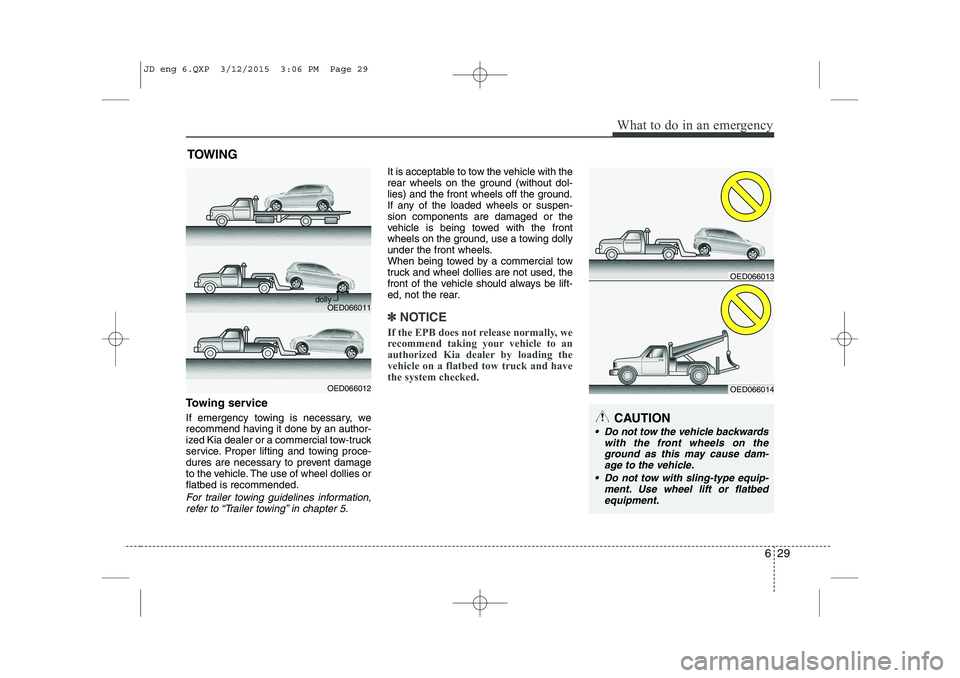
Towing service
If emergency towing is necessary, we
recommend having it done by an author-
ized Kia dealer or a commercial tow-truck
service. Proper lifting and towing proce-
dures are necessary to prevent damage
to the vehicle. The use of wheel dollies orflatbed is recommended.
For trailer towing guidelines information, refer to “Trailer towing” in chapter 5.
It is acceptable to tow the vehicle with the
rear wheels on the ground (without dol-
lies) and the front wheels off the ground.
If any of the loaded wheels or suspen-sion components are damaged or the
vehicle is being towed with the front
wheels on the ground, use a towing dolly
under the front wheels.
When being towed by a commercial tow
truck and wheel dollies are not used, the
front of the vehicle should always be lift-
ed, not the rear.
✽✽ NOTICE
If the EPB does not release normally, we
recommend taking your vehicle to an
authorized Kia dealer by loading the
vehicle on a flatbed tow truck and have
the system checked.
CAUTION
Do not tow the vehicle backwards with the front wheels on the
ground as this may cause dam-age to the vehicle.
Do not tow with sling-type equip- ment. Use wheel lift or flatbedequipment.
OED066011
OED066012
dolly
OED066014
OED066013
JD eng 6.QXP 3/12/2015 3:06 PM Page 29
Page 457 of 1210
631
What to do in an emergency
If towing is necessary, we recommend
you to have it done by an authorized
Kia dealer or a commercial tow truck
service.
If towing service is not available in an
emergency, your vehicle may be tem-
porarily towed using a cable or chain
secured to the emergency towing hook
under the front (or rear) of the vehicle.
Use extreme caution when towing the
vehicle. A driver must be in the vehicle to
steer it and operate the brakes.
Towing in this manner may be done only
on hard-surfaced roads for a short dis-
tance and at low speed. Also, the wheels,
axles, power train, steering and brakes
must all be in good condition.
Do not use the towing hooks to pull avehicle out of mud, sand or other con-
ditions from which the vehicle cannot
be driven out under its own power.
Avoid towing a vehicle heavier than the vehicle doing the towing.
The drivers of both vehicles should com- municate with each other frequently. Before emergency towing, check that
the hook is not broken or damaged.
Fasten the towing cable or chain securely to the hook.
Do not jerk the hook. Apply steady and even force.
To avoid damaging the hook, do not pull from the side or at a vertical angle.
Always pull straight ahead.CAUTION
Attach a towing strap to the tow
hook.
Using a portion of the vehicle other than the tow hooks for tow-ing may damage the body of yourvehicle.
Use only a cable or chain specifi- cally intended for use in towingvehicles. Securely fasten thecable or chain to the towing hookprovided.WARNING
Use extreme caution when towing
the vehicle.
Avoid sudden starts or erratic driving maneuvers which would
place excessive stress on the
emergency towing hook and tow-
ing cable or chain. The hook and
towing cable or chain may break
and cause serious injury or dam-
age.
If the disabled vehicle is unable to be moved, do not forcibly con-
tinue the towing. We recommend
that you contact an authorized
Kia dealer or a commercial tow
truck service for assistance.
Tow the vehicle as straight ahead as possible.
Keep away from the vehicle dur- ing towing.
JD eng 6.QXP 3/12/2015 3:06 PM Page 31
Page 460 of 1210
Maintenance
Engine compartment . . . . . . . . . . . . . . . . . . . . . . . . 7-3
Maintenance services . . . . . . . . . . . . . . . . . . . . . . . . 7-6 Owner’s responsibility . . . . . . . . . . . . . . . . . . . . . . . . . 7-6
Owner maintenance precautions . . . . . . . . . . . . . . . . 7-6
Engine compartment precautions (Diesel engine). . . 7-7
Owner maintenance . . . . . . . . . . . . . . . . . . . . . . . . . 7-8 Owner maintenance schedule . . . . . . . . . . . . . . . . . . . 7-8
Scheduled maintenance service . . . . . . . . . . . . . . . 7-10 For Europe, Except Russia . . . . . . . . . . . . . . . . . . . . . 7-11
Except Europe, For Russia . . . . . . . . . . . . . . . . . . . . . 7-22
Explanation of scheduled maintenance items . . . . 7-34
Engine oil . . . . . . . . . . . . . . . . . . . . . . . . . . . . . . . . . 7-37 Checking the engine oil level . . . . . . . . . . . . . . . . . . . . 7-37
Changing the engine oil and filter . . . . . . . . . . . . . . . 7-38
Engine coolant . . . . . . . . . . . . . . . . . . . . . . . . . . . . . 7-39 Checking the coolant level . . . . . . . . . . . . . . . . . . . . . . 7-39
Changing the coolant . . . . . . . . . . . . . . . . . . . . . . . . . . 7-41
Brake/clutch fluid . . . . . . . . . . . . . . . . . . . . . . . . . . 7-42 Checking the brake fluid level . . . . . . . . . . . . . . . . . . 7-42
Washer fluid . . . . . . . . . . . . . . . . . . . . . . . . . . . . . . . 7-43 Checking the washer fluid level . . . . . . . . . . . . . . . . . 7-43
Parking brake - hand type . . . . . . . . . . . . . . . . . . . 7-43 Checking the parking brake . . . . . . . . . . . . . . . . . . . . 7-43
Fuel filter (for Diesel) . . . . . . . . . . . . . . . . . . . . . . . 7-44 Draining water from fuel filter . . . . . . . . . . . . . . . . . . 7-44 Extracting air from the fuel filter . . . . . . . . . . . . . . . . 7-44
Air cleaner . . . . . . . . . . . . . . . . . . . . . . . . . . . . . . . . 7-45 Filter replacement . . . . . . . . . . . . . . . . . . . . . . . . . . . . 7-45
Climate control air filter . . . . . . . . . . . . . . . . . . . . . 7-47 Filter inspection . . . . . . . . . . . . . . . . . . . . . . . . . . . . . . 7-47
Filter replacement . . . . . . . . . . . . . . . . . . . . . . . . . . . . 7-47
Wiper blades . . . . . . . . . . . . . . . . . . . . . . . . . . . . . . . 7-49 Blade inspection . . . . . . . . . . . . . . . . . . . . . . . . . . . . . . 7-49
Blade replacement . . . . . . . . . . . . . . . . . . . . . . . . . . . . 7-49
Battery. . . . . . . . . . . . . . . . . . . . . . . . . . . . . . . . . . . . 7-52 For best battery service . . . . . . . . . . . . . . . . . . . . . . . . 7-52
Battery capacity label . . . . . . . . . . . . . . . . . . . . . . . . . 7-53
Battery recharging . . . . . . . . . . . . . . . . . . . . . . . . . . . . 7-53
Reset items . . . . . . . . . . . . . . . . . . . . . . . . . . . . . . . . . . 7-54
Tires and wheels . . . . . . . . . . . . . . . . . . . . . . . . . . . . 7-55 Tire care. . . . . . . . . . . . . . . . . . . . . . . . . . . . . . . . . . . . . 7-55
Recommended cold tire inflation pressures. . . . . . . . 7-55
Checking tire inflation pressure . . . . . . . . . . . . . . . . . 7-57
Tire rotation . . . . . . . . . . . . . . . . . . . . . . . . . . . . . . . . . 7-58
Wheel alignment and tire balance . . . . . . . . . . . . . . . 7-59
Tire replacement . . . . . . . . . . . . . . . . . . . . . . . . . . . . . . 7-59
Wheel replacement . . . . . . . . . . . . . . . . . . . . . . . . . . . . 7-61
Tire traction . . . . . . . . . . . . . . . . . . . . . . . . . . . . . . . . . 7-61
Tire maintenance . . . . . . . . . . . . . . . . . . . . . . . . . . . . . 7-61
Tire sidewall labeling . . . . . . . . . . . . . . . . . . . . . . . . . . 7-61
Low aspect ratio tire . . . . . . . . . . . . . . . . . . . . . . . . . . 7-65
7
JD eng 7.QXP 3/4/2015 3:29 PM Page 1
Page 465 of 1210
Maintenance
6
7
MAINTENANCE SERVICES
You should exercise the utmost care to
prevent damage to your vehicle and injury
to yourself whenever performing any
maintenance or inspection procedures.
Inadequate, incomplete or insufficient
servicing may result in operational prob-
lems with your vehicle that could lead to
vehicle damage, an accident, or person-
al injury.
Owner’s responsibility
✽✽ NOTICE
Maintenance Service and Record
Retention are the owner's responsibility.
We recommend in general that you have
your vehicle serviced by an authorized
Kia dealer. You should retain documents
that show proper maintenance has been
performed on your vehicle in accordance
with the maintenance schedule. You need
this information to establish your compli-
ance with the servicing and maintenance
requirements of your vehicle warranties.
Detailed warranty information is provided
in your Warranty & Maintenance book.Repairs and adjustments required as a
result of improper maintenance or a lack
of required maintenance are not covered
when your vehicle is covered by warranty. Owner maintenance precautions
Improper or incomplete service may
result in problems. This chapter gives
instructions only for the maintenance
items that are easy to perform.
✽✽
NOTICE
Improper owner maintenance during
the warranty period may affect warran-
ty coverage. For details, read the sepa-
rate Warranty & Maintenance book
provided with the vehicle. If you're
unsure about any servicing or mainte-
nance procedure, we recommend that
the system be checked by an authorized
Kia dealer.
CAUTION
Do not put heavy objects or apply excessive force on top of the
engine cover (if equipped) or fuelrelated parts.
When you inspect the fuel system (fuel lines and fuel injection
devices), we recommend that youcontact an authorized kia dealer.
Do not drive long time with the engine cover (if equipped)removed.
When checking the engine room, do not go near fire.
Fuel, washer fluid, etc. are flam-mable oils that may cause fire.
Before touching the battery, igni- tion cables and electrical wiring,
you should disconnect the battery "-" terminal. You may get an elec-tric shock from the electric current.
When you remove the interior trim cover with a flat bed (-) driver, be
careful not to damage the cover.
Be careful when you replace and clean bulbs to avoid burns orelectrical shock.
JD eng 7.QXP 3/4/2015 3:29 PM Page 6