warning KIA CEED 2015 Workshop Manual
[x] Cancel search | Manufacturer: KIA, Model Year: 2015, Model line: CEED, Model: KIA CEED 2015Pages: 1210, PDF Size: 35.92 MB
Page 79 of 1210
363
Safety features of your vehicle
SRS Care
The SRS is virtually maintenance-free
and so there are no parts you can safely
service by yourself. If the SRS air bag
warning light does not illuminate, or con-
tinuously remains on, we recommend
that the system be inspected by an
authorized Kia dealer.
WARNING
Modification to SRS components or wiring, including the addition
of any kind of badges to the pad
covers or modifications to the
body structure, can adversely
affect SRS performance and lead
to possible injury.
For cleaning the air bag pad cov- ers, use only a soft, dry cloth or
one which has been moistened
with plain water. Solvents or
cleaners could adversely affect
the air bag covers and proper
deployment of the system.
No objects should be placed over or near the air bag modules on
the steering wheel, instrument
panel, and the front passenger's
panel above the glove box,
because any such object could
cause harm if the vehicle is in a
crash severe enough to cause
the air bags to inflate.
(Continued)(Continued)
If the air bags inflate, we recom-mend that the system be replaced
by an authorized Kia dealer.
Do not tamper with or disconnect SRS wiring, or other components
of the SRS system. Doing so
could result in injury, due to acci-
dental inflation of the air bags or
by rendering the SRS inopera-
tive.
If components of the air bag sys- tem must be discarded, or if the
vehicle must be scrapped, certain
safety precautions must be
observed. An authorized Kia
dealer knows these precautions
and can give you the necessary
information. Failure to follow
these precautions and proce-dures could increase the risk of
personal injury.
If your car was flooded and has soaked carpeting or water on floor-
ing, you shouldn't try to start the
engine; we recommend that you
contact an authorized Kia dealer.
JD eng 3.QXP 3/4/2015 2:41 PM Page 63
Page 80 of 1210
Safety features of your vehicle
64
3
Additional safety precautions Never let passengers ride in the
cargo area or on top of a folded-
down back seat. All occupants should
sit upright, fully back in their seats with
their seat belts on and their feet on the
floor.
Passengers should not move out of
or change seats while the vehicle is
moving. A passenger who is not wear-
ing a seat belt during a crash or emer-
gency stop can be thrown against the
inside of the vehicle, against other
occupants, or out of the vehicle.
Each seat belt is designed torestrain one occupant. If more than
one person uses the same seat belt,
they could be seriously injured or killedin a collision.
Do not use any accessories on seatbelts. Devices claiming to improve
occupant comfort or reposition the seat
belt can reduce the protection provided
by the seat belt and increase the
chance of serious injury in a crash.
Passengers should not place hardor sharp objects between them-
selves and the air bags. Carrying
hard or sharp objects on your lap or in
your mouth can result in injuries if an
air bag inflates.
Keep occupants away from the air
bag covers. All occupants should sit
upright, fully back in their seats with
their seat belts on and their feet on the
floor. If occupants are too close to the
air bag covers, they could be injured if
the air bags inflate.
Do not attach or place objects on or
near the air bag covers. Any object
attached to or placed on the front or
side impact air bag covers could inter-
fere with the proper operation of the air
bags.
Do not modify the front seats.Modification of the front seats could
interfere with the operation of the sup-
plemental restraint system sensing
components or side air bags.
Do not place items under the frontseats. Placing items under the front
seats could interfere with the operation
of the supplemental restraint system
sensing components and wiring har-
nesses.
Never hold an infant or child on yourlap. The infant or child could be seri-
ously injured or killed in the event of a
crash. All infants and children should
be properly restrained in appropriate
child safety seats or seat belts in therear seat.
WARNING
Sitting improperly or out of posi- tion can cause occupants to be
shifted too close to a deploying
air bag, strike the interior struc-
ture or be thrown from the vehicle
resulting in serious injury ordeath.
Always sit upright with the seat- back in an upright position, cen-tered on the seat cushion with
your seat belt on, legs comfort-
ably extended and your feet on
the floor.
JD eng 3.QXP 3/4/2015 2:41 PM Page 64
Page 81 of 1210
365
Safety features of your vehicle
Adding equipment to or modify-
ing your air bag-equipped vehicle
If you modify your vehicle by changing
your vehicle's frame, bumper system,
front end or side sheet metal or ride
height, this may affect the operation of
your vehicle's air bag system.Air bag warning label (if equipped)
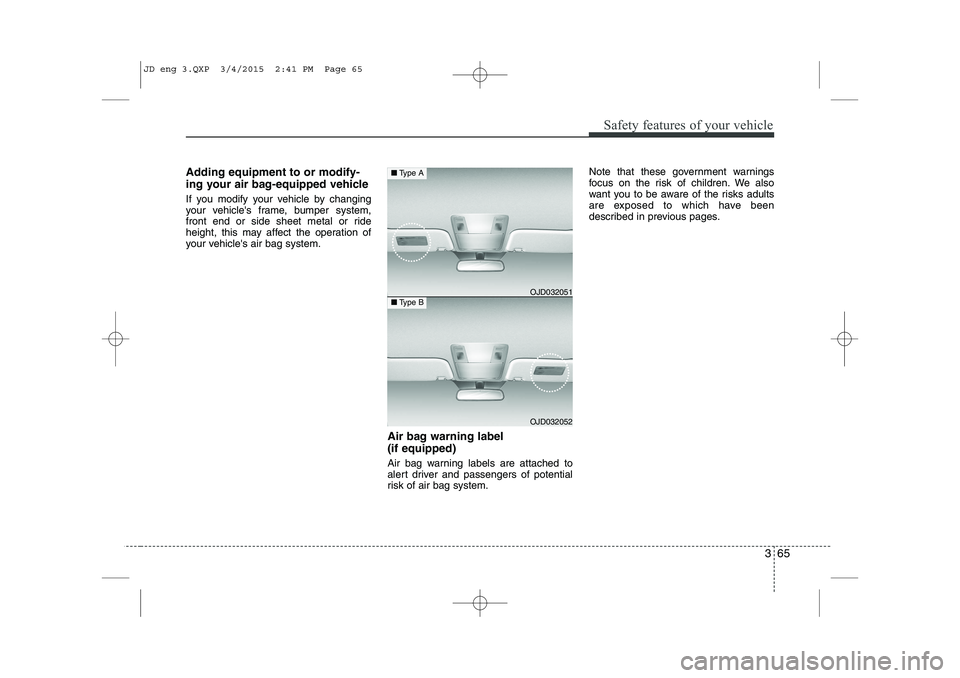
Air bag warning labels are attached to
alert driver and passengers of potential
risk of air bag system.Note that these government warnings
focus on the risk of children. We also
want you to be aware of the risks adults
are exposed to which have been
described in previous pages.
■
Type B OJD032051
■
Type A
OJD032052
JD eng 3.QXP 3/4/2015 2:41 PM Page 65
Page 82 of 1210
Features of your vehicle
Keys . . . . . . . . . . . . . . . . . . . . . . . . . . . . . . . . . . . . . 4-4• Record your key number . . . . . . . . . . . . . . . . . . . . . 4-4
• Key operations . . . . . . . . . . . . . . . . . . . . . . . . . . . . . . 4-4
• Immobilizer system . . . . . . . . . . . . . . . . . . . . . . . . . . 4-4
Remote keyless entry . . . . . . . . . . . . . . . . . . . . . . . 4-6 • Remote keyless entry system operations . . . . . . . . . 4-6
• Transmitter precautions . . . . . . . . . . . . . . . . . . . . . . 4-8
• Battery replacement . . . . . . . . . . . . . . . . . . . . . . . . . 4-9
Smart key . . . . . . . . . . . . . . . . . . . . . . . . . . . . . . . . 4-11 • Smart key function . . . . . . . . . . . . . . . . . . . . . . . . . . 4-11
• Smart key precautions. . . . . . . . . . . . . . . . . . . . . . . . 4-13
• Door lock/unlock in an emergency situation . . . . . . 4-13
Theft-alarm system . . . . . . . . . . . . . . . . . . . . . . . . 4-14 • Armed stage . . . . . . . . . . . . . . . . . . . . . . . . . . . . . . . . 4-14
• Theft-alarm stage . . . . . . . . . . . . . . . . . . . . . . . . . . . . 4-15
• Disarmed stage . . . . . . . . . . . . . . . . . . . . . . . . . . . . . . 4-16
Door locks . . . . . . . . . . . . . . . . . . . . . . . . . . . . . . . . 4-17 • From outside. . . . . . . . . . . . . . . . . . . . . . . . . . . . . . . . 4-17
• From inside . . . . . . . . . . . . . . . . . . . . . . . . . . . . . . . . . 4-18
• Deadlocks . . . . . . . . . . . . . . . . . . . . . . . . . . . . . . . . . . 4-20
• Door lock/unlock features . . . . . . . . . . . . . . . . . . . . . 4-20
• Child-protector rear door lock . . . . . . . . . . . . . . . . . 4-21
Tailgate . . . . . . . . . . . . . . . . . . . . . . . . . . . . . . . . . . 4-22 • Opening the tailgate. . . . . . . . . . . . . . . . . . . . . . . . . . 4-22
• Closing the tailgate . . . . . . . . . . . . . . . . . . . . . . . . . . 4-22
• Emergency tailgate safety release . . . . . . . . . . . . . . 4-23
Windows . . . . . . . . . . . . . . . . . . . . . . . . . . . . . . . . . 4-24 • Power windows. . . . . . . . . . . . . . . . . . . . . . . . . . . . . . 4-25
• Manual windows . . . . . . . . . . . . . . . . . . . . . . . . . . . . 4-27 Hood . . . . . . . . . . . . . . . . . . . . . . . . . . . . . . . . . . . . 4-28
• Opening the hood . . . . . . . . . . . . . . . . . . . . . . . . . . . . 4-28
• Closing the hood. . . . . . . . . . . . . . . . . . . . . . . . . . . . . 4-29
Fuel filler lid . . . . . . . . . . . . . . . . . . . . . . . . . . . . . . 4-30 • Opening the fuel filler lid . . . . . . . . . . . . . . . . . . . . . 4-30
• Closing the fuel filler lid . . . . . . . . . . . . . . . . . . . . . . 4-30
Panorama sunroof . . . . . . . . . . . . . . . . . . . . . . . . . 4-33 • Sunroof open warning . . . . . . . . . . . . . . . . . . . . . . . . 4-33
• Sunshade . . . . . . . . . . . . . . . . . . . . . . . . . . . . . . . . . . . 4-34
• Sliding the sunroof . . . . . . . . . . . . . . . . . . . . . . . . . . . 4-34
• Tilting the sunroof . . . . . . . . . . . . . . . . . . . . . . . . . . . 4-34
• Closing the sunroof . . . . . . . . . . . . . . . . . . . . . . . . . . 4-35
• Resetting the sunroof . . . . . . . . . . . . . . . . . . . . . . . . . 4-36
Steering wheel . . . . . . . . . . . . . . . . . . . . . . . . . . . . 4-37 • Electronic power steering . . . . . . . . . . . . . . . . . . . . . 4-37
• Tilt and telescopic steering . . . . . . . . . . . . . . . . . . . . 4-38
• Heated steering wheel . . . . . . . . . . . . . . . . . . . . . . . . 4-38
• Horn . . . . . . . . . . . . . . . . . . . . . . . . . . . . . . . . . . . . . . 4-39
• Flex steering wheel. . . . . . . . . . . . . . . . . . . . . . . . . . . 4-40
Mirrors . . . . . . . . . . . . . . . . . . . . . . . . . . . . . . . . . . 4-42 • Inside rearview mirror . . . . . . . . . . . . . . . . . . . . . . . 4-42
• Outside rearview mirror . . . . . . . . . . . . . . . . . . . . . . 4-43
Instrument cluster (Normal vision) . . . . . . . . . . . 4-46 • Instrument panel illumination . . . . . . . . . . . . . . . . . 4-47
• Gauges . . . . . . . . . . . . . . . . . . . . . . . . . . . . . . . . . . . . . 4-47
• Manual transaxle shift indicator . . . . . . . . . . . . . . . 4-49
• Automatic transaxle shift position indicator . . . . . . 4-49
• Double clutch transmission shift indicator . . . . . . . 4-50
• Speed limiter indicator . . . . . . . . . . . . . . . . . . . . . . . 4-51
4
JD eng 4a.QXP 3/4/2015 4:21 PM Page 1
Page 83 of 1210
• Odometer . . . . . . . . . . . . . . . . . . . . . . . . . . . . . . . . . . 4-51
• Trip computer . . . . . . . . . . . . . . . . . . . . . . . . . . . . . . 4-51
• LCD display information . . . . . . . . . . . . . . . . . . . . . 4-73
• Warnings and indicators . . . . . . . . . . . . . . . . . . . . . . 4-79
Instrument cluster (Super vision) . . . . . . . . . . . . 4-59 • Instrument panel illumination . . . . . . . . . . . . . . . . . 4-61
• Cluster display mode conversion . . . . . . . . . . . . . . . 4-61
• Gauges . . . . . . . . . . . . . . . . . . . . . . . . . . . . . . . . . . . . . 4-61
• Manual transaxle shift indicator . . . . . . . . . . . . . . . 4-64
• Automatic transaxle shift position indicator . . . . . . 4-65
• Double clutch transmission shift indicator . . . . . . . 4-65
• Speed limiter indicator . . . . . . . . . . . . . . . . . . . . . . . 4-66
• Odometer . . . . . . . . . . . . . . . . . . . . . . . . . . . . . . . . . . 4-66
• Trip computer . . . . . . . . . . . . . . . . . . . . . . . . . . . . . . 4-67
• LCD display information . . . . . . . . . . . . . . . . . . . . . 4-73
• Warnings and indicators . . . . . . . . . . . . . . . . . . . . . . 4-79
LCD display warnings and indicators (instrument panel display) . . . . . . . . . . . . . . . . . 4-90
Rear parking assist system . . . . . . . . . . . . . . . . . . 4-92 • Operation . . . . . . . . . . . . . . . . . . . . . . . . . . . . . . . . . . 4-92
• Non-operational conditions . . . . . . . . . . . . . . . . . . . . 4-94
• Precautions . . . . . . . . . . . . . . . . . . . . . . . . . . . . . . . . . 4-94
• Self-diagnosis . . . . . . . . . . . . . . . . . . . . . . . . . . . . . . . 4-95
Parking assist system. . . . . . . . . . . . . . . . . . . . . . . 4-96 • Operation . . . . . . . . . . . . . . . . . . . . . . . . . . . . . . . . . . 4-96
• Non-operational conditions . . . . . . . . . . . . . . . . . . . . 4-98
• Self-diagnosis . . . . . . . . . . . . . . . . . . . . . . . . . . . . . . . 4-99
Smart Parking Assist System(SPAS) . . . . . . . . . . 4-100 • Operating condition . . . . . . . . . . . . . . . . . . . . . . . . . . 4-101 • Non-operating condition . . . . . . . . . . . . . . . . . . . . . . 4-101
• How the system works . . . . . . . . . . . . . . . . . . . . . . . . 4-104
• Additional instructions(messages) . . . . . . . . . . . . . . 4-109
• System malfunction . . . . . . . . . . . . . . . . . . . . . . . . . . 4-109
Rearview camera . . . . . . . . . . . . . . . . . . . . . . . . . . 4-110
Hazard warning flasher . . . . . . . . . . . . . . . . . . . . 4-110
Lighting. . . . . . . . . . . . . . . . . . . . . . . . . . . . . . . . . . 4-111 • Battery saver function . . . . . . . . . . . . . . . . . . . . . . . . 4-111
• Headlamp delay function . . . . . . . . . . . . . . . . . . . . . 4-111
• Headlight (Headlamp) welcome function . . . . . . . . 4-111
• Static bending light . . . . . . . . . . . . . . . . . . . . . . . . . . 4-112
• Lighting control . . . . . . . . . . . . . . . . . . . . . . . . . . . . . 4-112
• High - beam operation. . . . . . . . . . . . . . . . . . . . . . . . 4-114
• Turn signals and lane change signals . . . . . . . . . . . . 4-115
• Front fog light . . . . . . . . . . . . . . . . . . . . . . . . . . . . . . 4-116
• Rear fog light . . . . . . . . . . . . . . . . . . . . . . . . . . . . . . . 4-116
• Daytime running light . . . . . . . . . . . . . . . . . . . . . . . . 4-116
• Headlight leveling device. . . . . . . . . . . . . . . . . . . . . . 4-117
• Adaptive Front Lighting System (AFLS) . . . . . . . . 4-118
Wipers and washers . . . . . . . . . . . . . . . . . . . . . . . 4-119 • Windshield wipers (front) . . . . . . . . . . . . . . . . . . . . . 4-119
• Windshield washers (front) . . . . . . . . . . . . . . . . . . . . 4-121
• Rear window wiper and washer switch . . . . . . . . . . 4-122
Interior light . . . . . . . . . . . . . . . . . . . . . . . . . . . . . . 4-123 • Interior lamp AUTO cut . . . . . . . . . . . . . . . . . . . . . . 4-123
• Map lamp . . . . . . . . . . . . . . . . . . . . . . . . . . . . . . . . . . 4-123
• Room lamp . . . . . . . . . . . . . . . . . . . . . . . . . . . . . . . . . 4-124
• Vanity mirror lamp . . . . . . . . . . . . . . . . . . . . . . . . . . 4-124
• Luggage room lamp . . . . . . . . . . . . . . . . . . . . . . . . . . 4-125
4
JD eng 4a.QXP 3/4/2015 4:21 PM Page 2
Page 85 of 1210

Features of your vehicle
4
4
Record your key number
The key code number is
stamped on the keycode tag attached to the
key set. Should you lose
your keys, we recom-
mend that you contact an authorized Kia
dealer. Remove the key code tag and
store it in a safe place. Also, record the
code number and keep it in a safe and
handy place, but not in the vehicle.
Key operations
• Used to start the engine.
• Used to lock and unlock the doors. Immobilizer system
Your vehicle may be equipped with an
electronic engine immobilizer system to
reduce the risk of unauthorized vehicle
use.
Your immobilizer system is comprised of
a small transponder in the key and elec-
tronic devices inside the vehicle.
Vehicles without smart key system
With the immobilizer system, whenever
you insert your ignition key into the igni-
tion switch and turn it to ON, it checks
and determines and verifies if the ignition
key is valid or not.
If the key is valid, the engine will start.
If the key is invalid, the engine will not
start.
To deactivate the immobilizer system:
Insert the ignition key into the key cylin-
der and turn it to the ON position.
To activate the immobilizer system:
Turn the ignition key to the OFF position.
The immobilizer system activates auto-
matically. Without a valid ignition key for
your vehicle, the engine will not start.
KEYS
WARNING
- Ignition key
(Smart key)
Leaving children unattended in a
vehicle with the ignition key (Smart
key) is dangerous even if the key is
not in the ignition or start button is
ACC or ON position. Children copy
adults and they could place the key
in the ignition or press the start but-
ton. The ignition key (Smart key)
would enable children to operate
power windows or other controls, or
even make the vehicle move, which
could result in serious bodily injury
or even death. Never leave the keys
in your vehicle with unsupervised
children, when the engine is running.
WARNING
We recommend that you use parts
for replacement from an authorized
Kia dealer. If an aftermarket key is
used, the ignition switch may not
return to ON after START. If this
happens, the starter will continue
to operate causing damage to the
starter motor and possible fire due
to excessive current in the wiring.
JD eng 4a.QXP 3/4/2015 4:21 PM Page 4
Page 86 of 1210

45
Features of your vehicle
Vehicles with smart key system
Whenever the engine start/stop button is changed to the ON position, the immobi-
lizer system checks and verifies if the key
is valid or not.
If the key is valid, the engine will start.
If the key is invalid, the engine will not
start.
To deactivate the immobilizer system
Change the engine start/stop button to the ON position.
To activate the immobilizer system
Change the engine start/stop button to
the OFF position. The immobilizer sys-
tem activates automatically. Without a
valid smart key for your vehicle, the
engine will not start.
✽NOTICE
When starting the engine, do not use the
key with other immobilizer keys around.
Otherwise the engine may not start or
may stop soon after it starts. Keep each
key separate in order to avoid a starting
malfuntioin.
✽NOTICE
If you need additional keys or lose your
keys, we recommend that you consult an
authorized Kia dealer.
CAUTION
The transponder in your ignition key is an important part of the immobilizer system. It is designed
to give years of trouble-free service,however you should avoid expo-sure to moisture, static electricity and rough handling. Immobilizer
system malfunction could occur.
CAUTION
Do not change, alter or adjust theimmobilizer system because it could cause the immobilizer sys-
tem to malfunction. We recommend that the system be serviced by anauthorized Kia dealer.
Malfunctions caused by improperalterations, adjustments or modifi-
cations to the immobilizer system are not covered by your vehiclemanufacturer warranty.
WARNING
In order to prevent theft of your vehi-
cle, do not leave spare keys any-
where in your vehicle. Your immobi-
lizer password is a customer unique
password and should be kept confi-
dential. Do not leave this number
anywhere in your vehicle.
CAUTION
Do not put metal accessories near the ignition switch.
The engine may not start becausethe metal accessories may interrupt the transponder signal from nor-mally transmitting.
JD eng 4a.QXP 3/4/2015 4:21 PM Page 5
Page 88 of 1210
47
Features of your vehicle
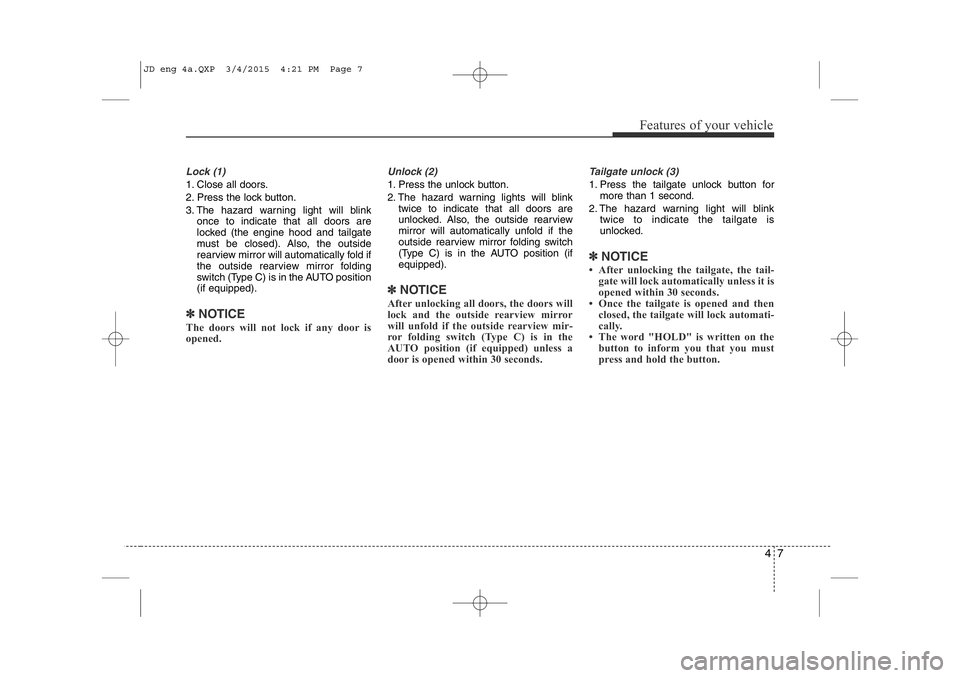
Lock (1)
1. Close all doors.
2. Press the lock button.
3. The hazard warning light will blinkonce to indicate that all doors are
locked (the engine hood and tailgate
must be closed). Also, the outside
rearview mirror will automatically fold if
the outside rearview mirror folding
switch (Type C) is in the AUTO position(if equipped).
✽NOTICE
The doors will not lock if any door is
opened.
Unlock (2)
1. Press the unlock button.
2. The hazard warning lights will blink twice to indicate that all doors are
unlocked. Also, the outside rearview
mirror will automatically unfold if the
outside rearview mirror folding switch
(Type C) is in the AUTO position (ifequipped).
✽NOTICE
After unlocking all doors, the doors will
lock and the outside rearview mirror
will unfold if the outside rearview mir-
ror folding switch (Type C) is in the
AUTO position (if equipped) unless a
door is opened within 30 seconds.
Tailgate unlock (3)
1. Press the tailgate unlock button for more than 1 second.
2. The hazard warning light will blink twice to indicate the tailgate is
unlocked.
✽NOTICE
• After unlocking the tailgate, the tail- gate will lock automatically unless it is
opened within 30 seconds.
• Once the tailgate is opened and then closed, the tailgate will lock automati-
cally.
• The word "HOLD" is written on the button to inform you that you must
press and hold the button.
JD eng 4a.QXP 3/4/2015 4:21 PM Page 7
Page 92 of 1210
411
Features of your vehicle
SMART KEY (IF EQUIPPED)
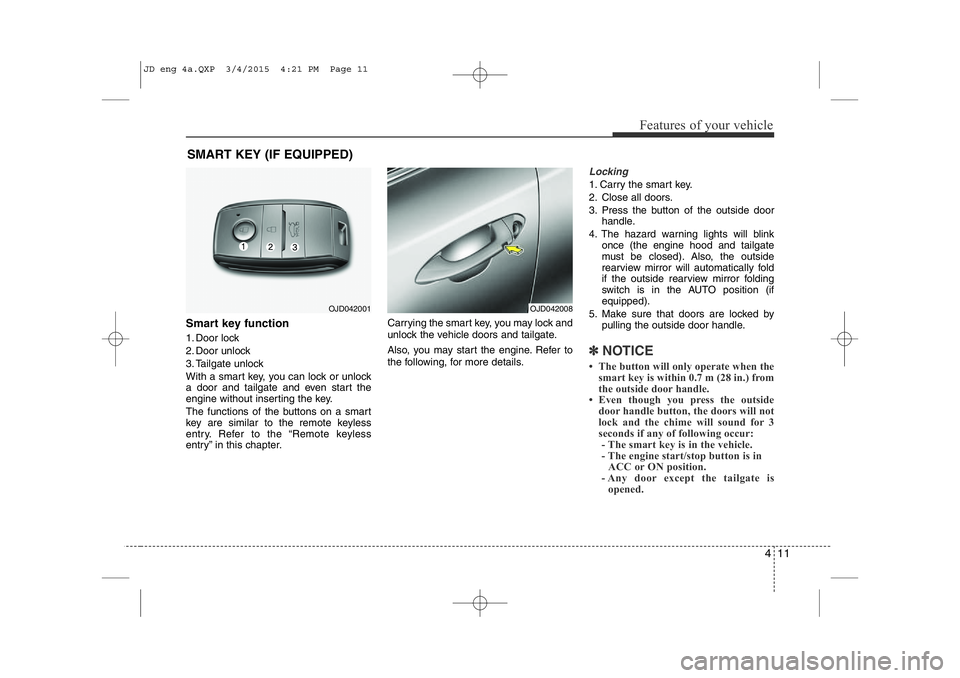
Smart key function
1. Door lock
2. Door unlock
3. Tailgate unlock
With a smart key, you can lock or unlock
a door and tailgate and even start the
engine without inserting the key.
The functions of the buttons on a smart
key are similar to the remote keyless
entry. Refer to the “Remote keyless
entry” in this chapter. Carrying the smart key, you may lock and
unlock the vehicle doors and tailgate.
Also, you may start the engine. Refer to
the following, for more details.
Locking
1. Carry the smart key.
2. Close all doors.
3. Press the button of the outside door
handle.
4. The hazard warning lights will blink once (the engine hood and tailgate
must be closed). Also, the outside
rearview mirror will automatically fold
if the outside rearview mirror folding
switch is in the AUTO position (if equipped).
5. Make sure that doors are locked by pulling the outside door handle.
✽NOTICE
• The button will only operate when the smart key is within 0.7 m (28 in.) from
the outside door handle.
• Even though you press the outside
door handle button, the doors will not
lock and the chime will sound for 3
seconds if any of following occur:- The smart key is in the vehicle.
- The engine start/stop button is in ACC or ON position.
- Any door except the tailgate is opened.
OJD042001OJD042008
JD eng 4a.QXP 3/4/2015 4:21 PM Page 11
Page 93 of 1210
Features of your vehicle
12
4
Unlocking
1. Carry the smart key.
2. Press the button of the front outside
door handle.
3. All doors will unlock and the hazard warning lights will blink twice. Also, the
outside rearview mirror will automati-
cally unfold if the outside rearview mir-
ror folding switch is in the AUTO posi-tion (if equipped).
✽NOTICE
• The button will only operate when the smart key is within 0.7 m (28 in.) from
the outside door handle.
• When the smart key is recognized in
the area of 0.7 m (28 in.) from the
front outside door handle, other peo-
ple can also open the doors.
• After unlocking all doors, the doors
will lock and the outside rearview
mirror will unfold if the outside
rearview mirror folding switch (Type
B) is in the AUTO position (if
equipped) unless a door is opened
within 30 seconds.
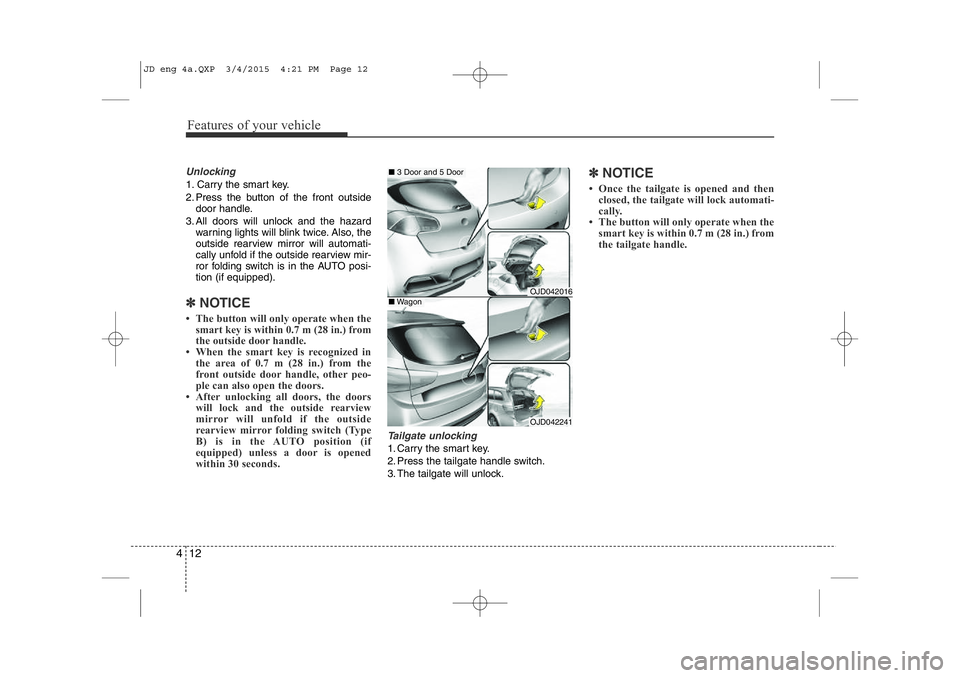
Tailgate unlocking
1. Carry the smart key.
2. Press the tailgate handle switch.
3. The tailgate will unlock.
✽NOTICE
• Once the tailgate is opened and then closed, the tailgate will lock automati-
cally.
• The button will only operate when the
smart key is within 0.7 m (28 in.) from
the tailgate handle.
OJD042016
OJD042241
■3 Door and 5 Door
■Wagon
JD eng 4a.QXP 3/4/2015 4:21 PM Page 12