tyre KIA CEED 2015 Manual PDF
[x] Cancel search | Manufacturer: KIA, Model Year: 2015, Model line: CEED, Model: KIA CEED 2015Pages: 1210, PDF Size: 35.92 MB
Page 1126 of 1210
763
Maintenance
2. Tyre size designation
A tyre’s sidewall is marked with a tyre
size designation. You will need this
information when selecting replace-
ment tyres for your car. The following
explains what the letters and num-
bers in the tyre size designationmean.
Example tyre size designation:
(These numbers are provided as an
example only; your tyre size designa-
tor could vary depending on your
vehicle.) 195/65R15 91H
P - Applicable vehicle type (tyresmarked with the prefix “P’’ are
intended for use on passenger
vehicles or light trucks; however,
not all tyres have this marking).
195 - Tyre width in millimeters.
65 - Aspect ratio. The tyre’s section height as a percentage of its width.
R - Tyre construction code (Radial).
15 - Rim diameter in inches. 91 - Load Index, a numerical code
associated with the maximum
load the tyre can carry.
H - Speed Rating Symbol. See the speed rating chart in this section
for additional information.
Wheel size designation
Wheels are also marked with impor-
tant information that you need if you
ever have to replace one. The follow-
ing explains what the letters and
numbers in the wheel size designa-tion mean.
Example wheel size designation: 6.0JX15
6.0 - Rim width in inches. J - Rim contour designation.
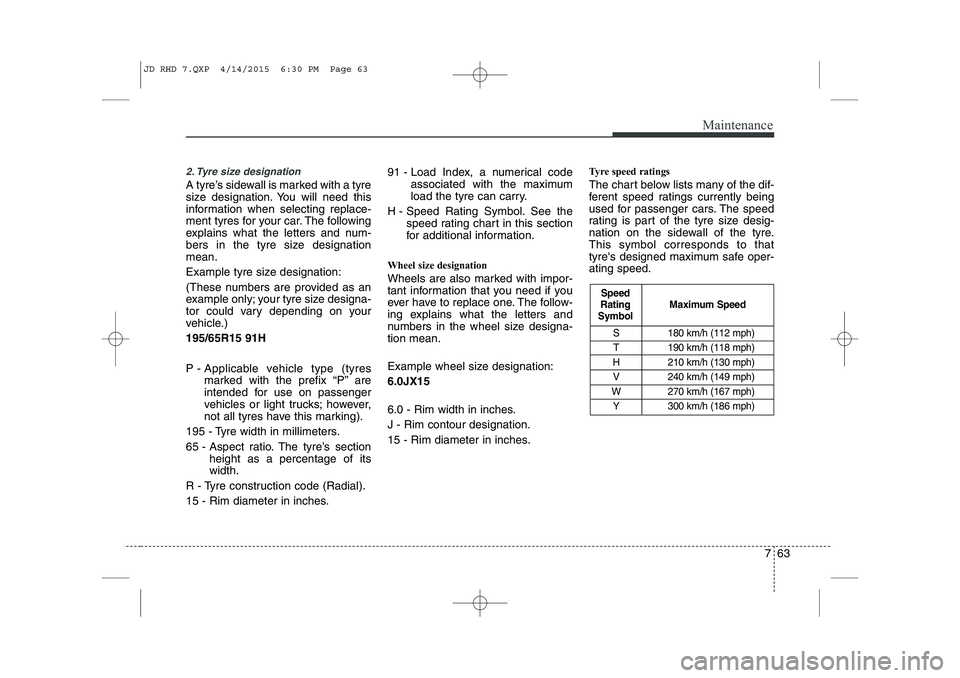
15 - Rim diameter in inches. Tyre speed ratings
The chart below lists many of the dif-
ferent speed ratings currently being
used for passenger cars. The speed
rating is part of the tyre size desig-
nation on the sidewall of the tyre.This symbol corresponds to that
tyre's designed maximum safe oper-ating speed.
S 180 km/h (112 mph)
T 190 km/h (118 mph)
H 210 km/h (130 mph)
V 240 km/h (149 mph)
W 270 km/h (167 mph) Y 300 km/h (186 mph)
Maximum Speed
Speed
Rating
Symbol
JD RHD 7.QXP 4/14/2015 6:30 PM Page 63
Page 1127 of 1210
Maintenance
64
7
WARNING - Tyre age
Tyres degrade over time, even
when they are not being used.
Regardless of the remaining
tread, it is recommended that
tyres generally be replaced
after six (6) years of normal
service. Heat caused by hot cli-mates or frequent high loadingconditions can accelerate the
aging process. Failure to follow
this Warning can result in sud-
den tyre failure, which could
lead to a loss of control and an
accident involving serious
injury or death.
3. Checking tyre life (TIN : Tyre Identification Number)
Any tyres that are over 6 years,
based on the manufacturing date,
tyre strength and performance,
decline with age naturally (even
unused spare tyres). Therefore, thetyres (including the spare tyre)
should be replaced by new ones. You
can find the manufacturing date on
the tyre sidewall (possibly on the
inside of the wheel), displaying the
DOT Code. The DOT Code is a
series of numbers on a tyre consist-
ing of numbers and English letters.
The manufacturing date is designat-
ed by the last four digits (characters)
of the DOT code.
DOT : XXXX XXXX OOOO
The front part of the DOT means a
plant code number, tyre size and
tread pattern and the last four num-
bers indicate week and year manu-
factured.
For example:
DOT XXXX XXXX 1615 represents
that the tyre was produced in the
16th week of 2015.
4. Tyre ply composition and material
The number of layers or plies of rub-
ber-coated fabric are in the tyre. Tyre
manufacturers also must indicate the
materials in the tyre, which include
steel, nylon, polyester, and others.
The letter "R" means radial ply con-
struction; the letter "D" means diago-
nal or bias ply construction; and theletter "B" means belted-bias ply con-
struction.
5. Maximum permissible inflationpressure
This number is the greatest amount of air pressure that should be put in
the tyre. Do not exceed the maximum
permissible inflation pressure. Refer
to the Tyre and Loading Information
label for recommended inflation
pressure.
6. Maximum load rating
This number indicates the maximum
load in kilograms and pounds that
can be carried by the tyre. When
replacing the tyres on the vehicle,
always use a tyre that has the same
load rating as the factory installed
tyre.
JD RHD 7.QXP 4/14/2015 6:30 PM Page 64
Page 1128 of 1210
765
Maintenance
7. Uniform tyre quality grading
Quality grades can be found where
applicable on the tyre sidewall
between tread shoulder and maxi-
mum section width.
For example:
TREADWEAR 200
TRACTION AA
TEMPERATURE A
Tread wear
The tread wear grade is a compara-
tive rating based on the wear rate ofthe tyre when tested under controlled
conditions on a specified govern-
ment test course. For example, a tyre
graded 150 would wear one-and-a-
half times (1½) as well on the gov-
ernment course as a tyre graded100.
The relative performance of tyres depends upon the actual conditions
of their use, however, and may
depart significantly from the norm
because of variations in driving
habits, service practices and differ-
ences in road characteristics and cli-
mate.These grades are molded on the
side-walls of passenger vehicle
tyres. The tyres available as standard
or optional equipment on your vehi-
cles may vary with respect to grade.
Traction - AA, A, B & C
The traction grades, from highest to
lowest, are AA, A, B and C. Those
grades represent the tyres ability to
stop on wet pavement as measuredunder controlled conditions on spec-
ified government test surfaces of
asphalt and concrete. A tyre marked
C may have poor traction perform-
ance.
Temperature -A, B & C
The temperature grades are A (the highest), B and C representing the
tyre’s resistance to the generation ofheat and its ability to dissipate heatwhen tested under controlled condi-
tions on a specified indoor laboratorytest wheel.
Sustained high temperature can
cause the material of the tyre to
degenerate and reduce tyre life, and
excessive temperature can lead to
sudden tyre failure. Grades B and A
represent higher levels of perform-
ance on the laboratory test wheel
than the minimum required by the
law.
WARNING
The traction grade assigned to this tyre is based on straight-ahead braking traction tests,
and does not include accelera-
tion, cornering, hydroplaning,
or peak traction characteristics.
JD RHD 7.QXP 4/14/2015 6:30 PM Page 65
Page 1129 of 1210
Maintenance
66
7
CAUTION
Because the sidewall of the low
aspect ratio tyre is shorter thanthe normal, the wheel and tyre of the low aspect ratio tyre iseasier to be damaged. So, followthe instructions below.
- When driving on a rough road or off road, drive cautiouslybecause tyres and wheels maybe damaged. And after driving,inspect tyres and wheels.
- When passing over a pothole, speed bump, manhole, or kerbstone, drive slowly so that thetyres and wheels are not dam-aged.
- If the tyre is impacted, we rec- ommend that you inspect thetyre condition or contact an authorised Kia dealer.
- To prevent damage to the tyre, inspect the tyre condition andpressure every 3,000km.
Low aspect ratio tyre (if equipped)
Low aspect ratio tyres, whose aspect
ratio is lower than 50, are provided
for sporty looks.
Because the low aspect ratio tyres
are optimized for handling and brak-
ing, it may be more uncomfortable to
ride in and there is more noise com-
pare with normal tyres.WARNING - Tyre temperature
The temperature grade for this
tyre is established for a tyre that
is properly inflated and not
overloaded. Excessive speed,
underinflation, or excessive
loading, either separately or in
combination, can cause heat
build-up and possible sudden
tyre failure. This can cause loss
of vehicle control and serious
injury or death.
JD RHD 7.QXP 4/14/2015 6:30 PM Page 66
Page 1130 of 1210
767
Maintenance
CAUTION
It is not easy to recognize thetyre damage with your owneyes. But if there is the slight-est hint of tyre damage, eventhough you cannot see the tyre damage with your owneyes, have the tyre checked orreplaced because the tyre damage may cause air leak-age from the tyre.
If the tyre is damaged by driv- ing on a rough road, off road,pothole, manhole, or kerb stone, it will not be covered bythe warranty.
You can find out the tyre infor- mation on the tyre sidewall.
JD RHD 7.QXP 4/14/2015 6:30 PM Page 67
Page 1140 of 1210
777
Maintenance
No.Fuse ratingSymbolFuse NameProtected component
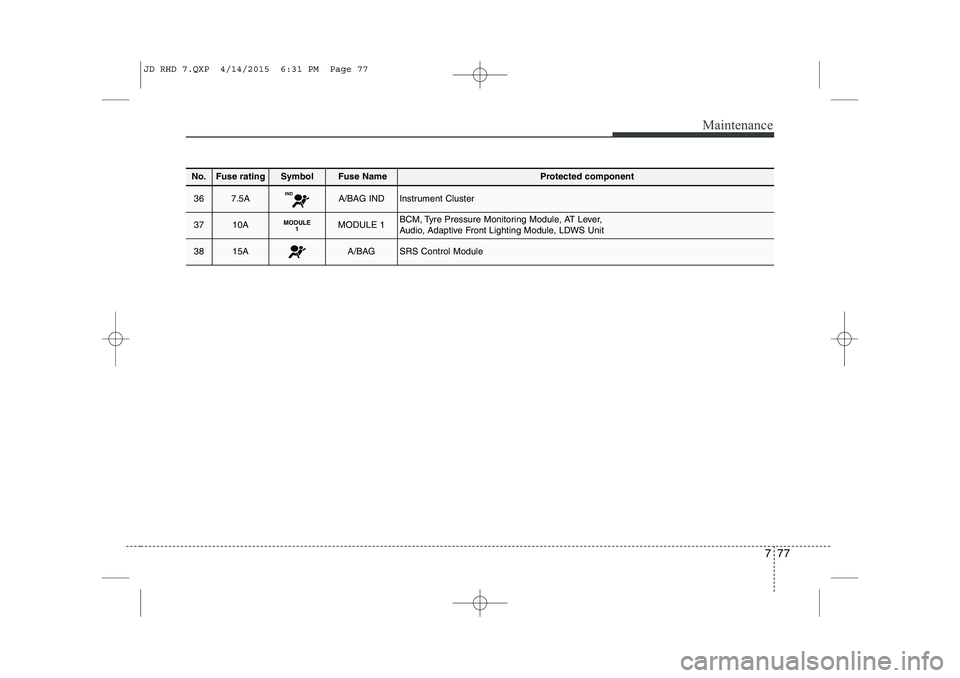
367.5AINDA/BAG INDInstrument Cluster
3710AMODULE1MODULE 1BCM, Tyre Pressure Monitoring Module, AT Lever,
Audio, Adaptive Front Lighting Module, LDWS Unit
3815AA/BAGSRS Control Module
JD RHD 7.QXP 4/14/2015 6:31 PM Page 77
Page 1160 of 1210
797
Maintenance
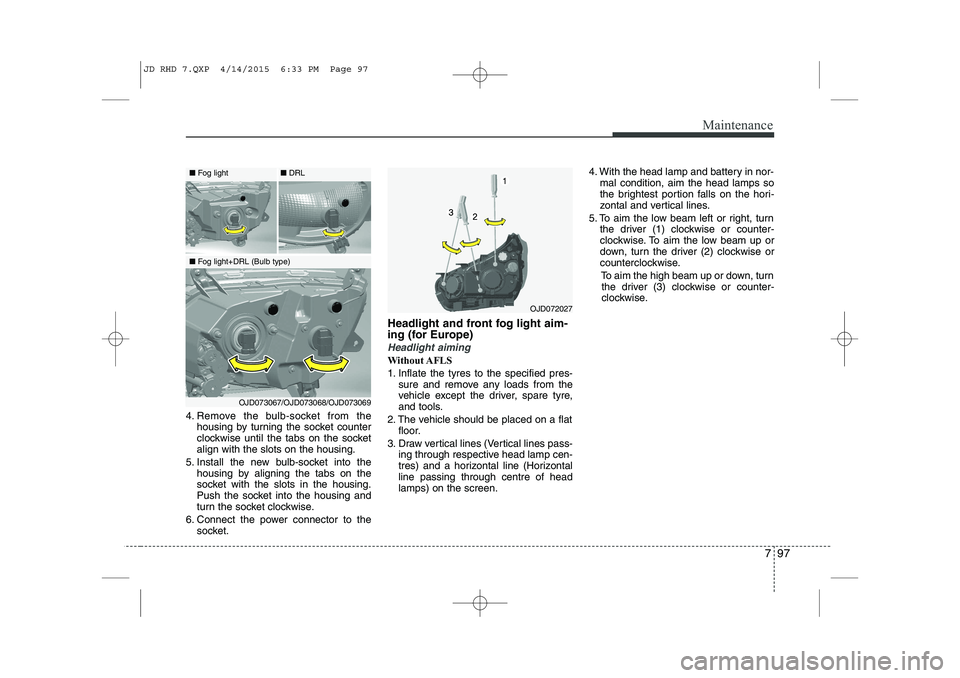
4. Remove the bulb-socket from thehousing by turning the socket counter
clockwise until the tabs on the socketalign with the slots on the housing.
5. Install the new bulb-socket into the housing by aligning the tabs on the
socket with the slots in the housing.
Push the socket into the housing and
turn the socket clockwise.
6. Connect the power connector to the socket. Headlight and front fog light aim-
ing (for Europe)
Headlight aiming
Without AFLS
1. Inflate the tyres to the specified pres-
sure and remove any loads from the
vehicle except the driver, spare tyre,
and tools.
2. The vehicle should be placed on a flat floor.
3. Draw vertical lines (Vertical lines pass- ing through respective head lamp cen-
tres) and a horizontal line (Horizontalline passing through centre of headlamps) on the screen. 4. With the head lamp and battery in nor-
mal condition, aim the head lamps so
the brightest portion falls on the hori-
zontal and vertical lines.
5. To aim the low beam left or right, turn the driver (1) clockwise or counter-
clockwise. To aim the low beam up or
down, turn the driver (2) clockwise or
counterclockwise.
To aim the high beam up or down, turnthe driver (3) clockwise or counter-
clockwise.
OJD072027
■ Fog light
■Fog light+DRL (Bulb type) ■
DRL
OJD073067/OJD073068/OJD073069
JD RHD 7.QXP 4/14/2015 6:33 PM Page 97
Page 1161 of 1210
Maintenance
98
7
With AFLS
1. Turn off the engine
2. Turn the light switch to the low beam
position.
3. Position the tyres straight ahead with the steering wheel.
4. Turn on the engine.
5. Inflate the tyres to the specified pres- sure and remove any loads from the
vehicle except the driver, spare tyre,
and tools.
6. The vehicle should be placed on a flat floor.
7. Draw vertical lines (Vertical lines pass- ing through respective head lamp cen-
tres) and a horizontal line (Horizontalline passing through centre of headlamps) on the screen.
8. With the head lamp and battery in nor- mal condition, aim the head lamps so
the brightest portion falls on the hori-
zontal and vertical lines.
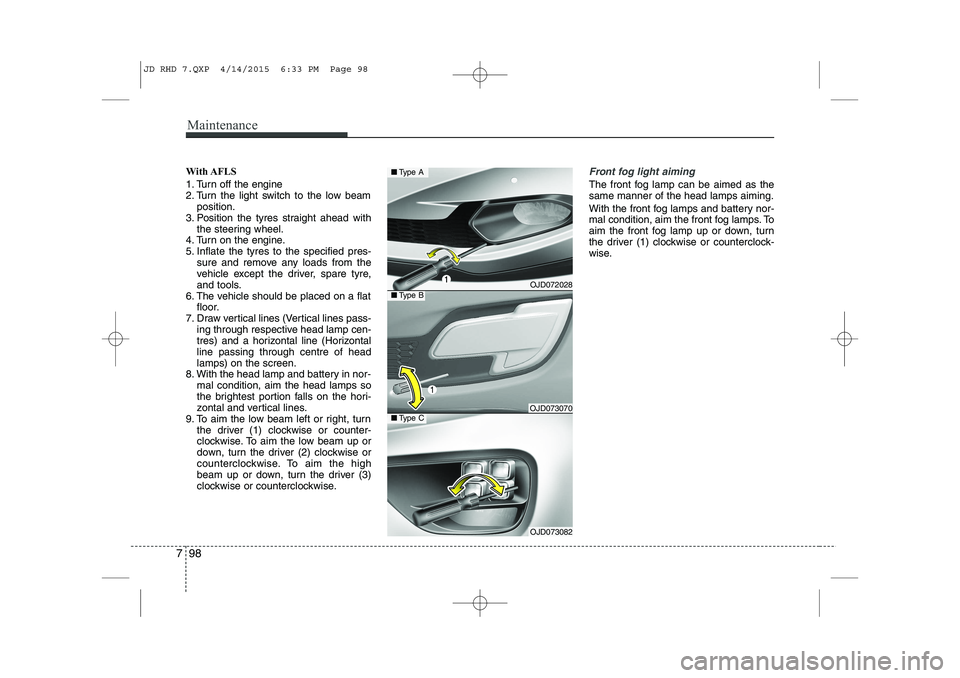
9. To aim the low beam left or right, turn the driver (1) clockwise or counter-
clockwise. To aim the low beam up or
down, turn the driver (2) clockwise or
counterclockwise. To aim the high
beam up or down, turn the driver (3)
clockwise or counterclockwise.Front fog light aiming
The front fog lamp can be aimed as the same manner of the head lamps aiming.
With the front fog lamps and battery nor-
mal condition, aim the front fog lamps. To
aim the front fog lamp up or down, turn
the driver (1) clockwise or counterclock-
wise.
OJD072028
OJD073070
OJD073082
■Type A
■Type B
■Type C
JD RHD 7.QXP 4/14/2015 6:33 PM Page 98
Page 1185 of 1210
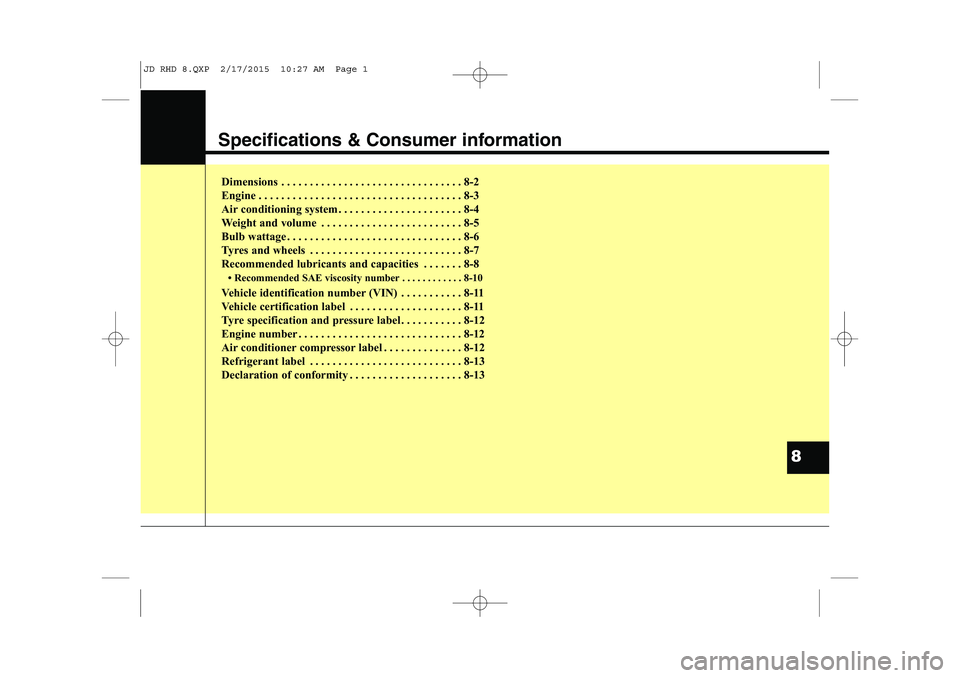
Specifications & Consumer information
Dimensions . . . . . . . . . . . . . . . . . . . . . . . . . . . . . . . . 8-2
Engine . . . . . . . . . . . . . . . . . . . . . . . . . . . . . . . . . . . . 8-3
Air conditioning system . . . . . . . . . . . . . . . . . . . . . . 8-4
Weight and volume . . . . . . . . . . . . . . . . . . . . . . . . . 8-5
Bulb wattage . . . . . . . . . . . . . . . . . . . . . . . . . . . . . . . 8-6
Tyres and wheels . . . . . . . . . . . . . . . . . . . . . . . . . . . 8-7
Recommended lubricants and capacities . . . . . . . 8-8 Recommended SAE viscosity number . . . . . . . . . . . . 8-10
Vehicle identification number (VIN) . . . . . . . . . . . 8-11
Vehicle certification label . . . . . . . . . . . . . . . . . . . . 8-11
Tyre specification and pressure label . . . . . . . . . . . 8-12
Engine number . . . . . . . . . . . . . . . . . . . . . . . . . . . . . 8-12
Air conditioner compressor label . . . . . . . . . . . . . . 8-12
Refrigerant label . . . . . . . . . . . . . . . . . . . . . . . . . . . 8-13
Declaration of conformity . . . . . . . . . . . . . . . . . . . . 8-13
8
JD RHD 8.QXP 2/17/2015 10:27 AM Page 1
Page 1191 of 1210

87
Specifications & Consumer information
✽✽NOTICE
We recommend that when replacing tyres, use the same originally supplied with the veh icles.
If not, that affects driving performance.
TYRES AND WHEELS * 1
: Load Index
* 2
: Speed Symbol
* 3
: For eco dynamics trim
ItemTyre sizeWheel
sizeLoad CapacitySpeed capacityInflation pressure bar(psi, kPa)Wheel lug nuttorque Kgf·m (lb·ft, N·m)
Normal loadMaximum load
LI * 1KgSS * 2Km/hFrontRear FrontRear
Full size
tyre
195/65R15* 36.0J×15 91615H2102.5
(36,250)2.5
(36,250)2.5
(36,250)2.5
(36,250)
9~11 (65~79, 88~107)
195/65R156.0J×15 91615H2102.2
(32,220)2.2
(32,220)2.2
(32,220)2.2
(32,220)
205/55R166.5J×1691615H2102.2
(32,220)2.2
(32,220)2.2
(32,220)2.2
(32,220)
225/45R177.0J×1791615V2402.2
(32,220)2.2
(32,220)2.2
(32,220)2.2
(32,220)
225/40ZR187.5J×1892630Y3002.2
(32,220)2.2
(32,220)2.2
(32,220)2.2
(32,220)
Compact
spare tyreT125/80D154.0T×1595690M1304.2
(60, 420)4.2
(60, 420)4.2
(60, 420)4.2
(60, 420)
T125/80D164.0T×1697730M1304.2
(60, 420)4.2
(60, 420)4.2
(60, 420)4.2
(60, 420)
JD RHD 8.QXP 2/17/2015 10:27 AM Page 7