oil level warning light KIA CEED 2015 Owners Manual
[x] Cancel search | Manufacturer: KIA, Model Year: 2015, Model line: CEED, Model: KIA CEED 2015Pages: 1210, PDF Size: 35.92 MB
Page 167 of 1210
Features of your vehicle
86
4
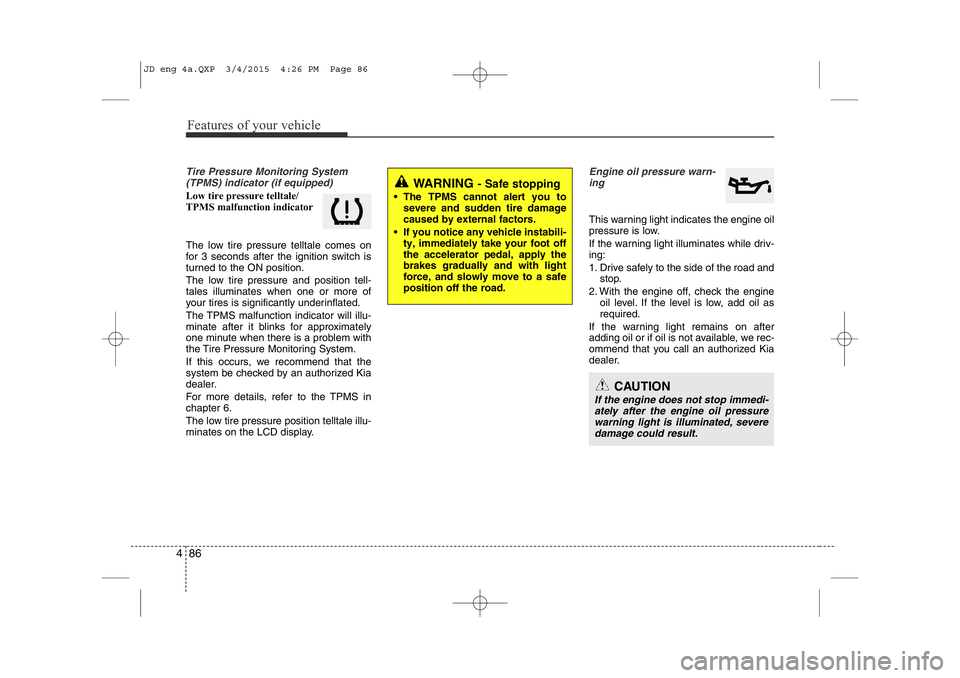
Tire Pressure Monitoring System
(TPMS) indicator (if equipped)
Low tire pressure telltale/
TPMS malfunction indicator
The low tire pressure telltale comes on
for 3 seconds after the ignition switch is
turned to the ON position.
The low tire pressure and position tell- tales illuminates when one or more of
your tires is significantly underinflated.
The TPMS malfunction indicator will illu-
minate after it blinks for approximately
one minute when there is a problem with
the Tire Pressure Monitoring System.
If this occurs, we recommend that the
system be checked by an authorized Kia
dealer.
For more details, refer to the TPMS in chapter 6.
The low tire pressure position telltale illu-
minates on the LCD display.
Engine oil pressure warn-ing
This warning light indicates the engine oil
pressure is low.
If the warning light illuminates while driv- ing:
1. Drive safely to the side of the road and stop.
2. With the engine off, check the engine oil level. If the level is low, add oil as required.
If the warning light remains on after
adding oil or if oil is not available, we rec-
ommend that you call an authorized Kia
dealer.
WARNING - Safe stopping
• The TPMS cannot alert you to severe and sudden tire damage caused by external factors.
• If you notice any vehicle instabili- ty, immediately take your foot offthe accelerator pedal, apply thebrakes gradually and with lightforce, and slowly move to a safeposition off the road.
CAUTION
If the engine does not stop immedi-
ately after the engine oil pressurewarning light is illuminated, severe
damage could result.
JD eng 4a.QXP 3/4/2015 4:26 PM Page 86
Page 168 of 1210
487
Features of your vehicle
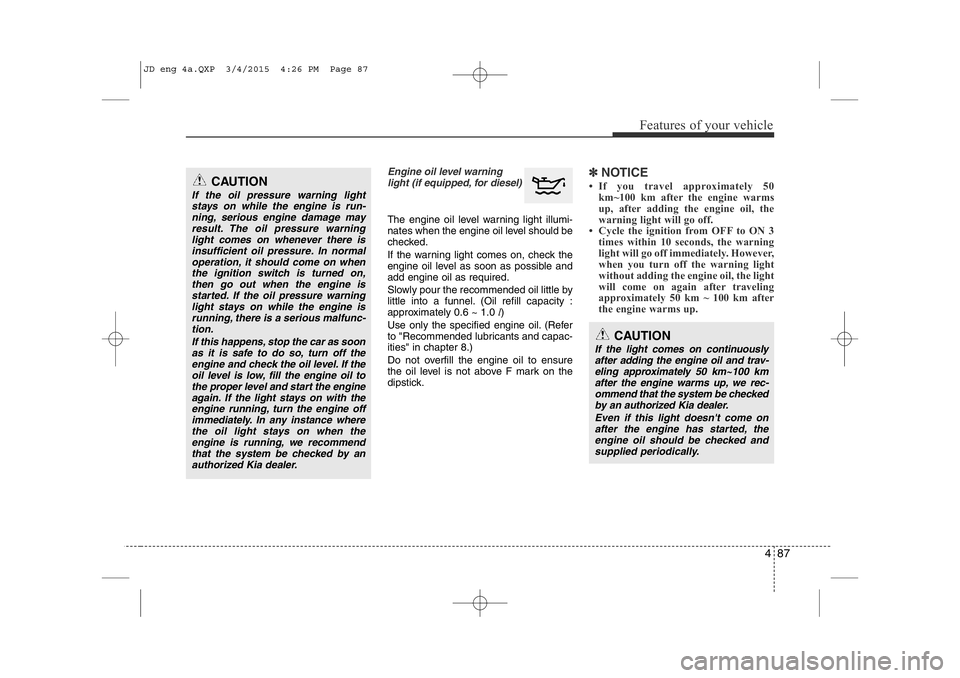
Engine oil level warninglight (if equipped, for diesel)
The engine oil level warning light illumi-
nates when the engine oil level should be
checked.
If the warning light comes on, check the
engine oil level as soon as possible andadd engine oil as required.
Slowly pour the recommended oil little by
little into a funnel. (Oil refill capacity :
approximately 0.6 ~ 1.0 l)
Use only the specified engine oil. (Refer
to "Recommended lubricants and capac-ities" in chapter 8.)
Do not overfill the engine oil to ensure
the oil level is not above F mark on the
dipstick.
✽NOTICE
• If you travel approximately 50 km~100 km after the engine warms
up, after adding the engine oil, the
warning light will go off.
• Cycle the ignition from OFF to ON 3
times within 10 seconds, the warning
light will go off immediately. However,
when you turn off the warning light
without adding the engine oil, the light
will come on again after traveling
approximately 50 km ~ 100 km after
the engine warms up.CAUTION
If the oil pressure warning light
stays on while the engine is run- ning, serious engine damage may result. The oil pressure warninglight comes on whenever there is
insufficient oil pressure. In normal operation, it should come on whenthe ignition switch is turned on,
then go out when the engine is
started. If the oil pressure warning light stays on while the engine is
running, there is a serious malfunc- tion.
If this happens, stop the car as soonas it is safe to do so, turn off theengine and check the oil level. If theoil level is low, fill the engine oil to the proper level and start the engine again. If the light stays on with the
engine running, turn the engine offimmediately. In any instance where the oil light stays on when the engine is running, we recommend
that the system be checked by an
authorized Kia dealer.
CAUTION
If the light comes on continuously after adding the engine oil and trav-eling approximately 50 km~100 km
after the engine warms up, we rec-
ommend that the system be checkedby an authorized Kia dealer.
Even if this light doesn't come onafter the engine has started, the
engine oil should be checked and
supplied periodically.
JD eng 4a.QXP 3/4/2015 4:26 PM Page 87
Page 350 of 1210
Driving your vehicle
4
5
Before entering vehicle
• Be sure that all windows, outside mir-
ror(s), and outside lights are clean.
Check the condition of the tires.
Check under the vehicle for any sign of leaks.
Be sure there are no obstacles behind you if you intend to back up. Necessary inspections
Fluid levels, such as engine oil, engine
coolant, brake fluid, and washer fluid
should be checked on a regular basis,
with the exact interval depending on the
fluid. Further details are provided in
chapter 7, “Maintenance”.
Before starting
Close and lock all doors.
Position the seat so that all controls are
easily reached.
Adjust the inside and outside rearview mirrors.
Be sure that all lights work.
Check all gauges.
Check the operation of warning lights when the ignition switch is turned to the ON position.
Release the parking brake and make sure the brake warning light goes out.
For safe operation, be sure you are famil-
iar with your vehicle and its equipment.
BEFORE DRIVING
WARNING
All passengers must be properly
belted whenever the vehicle is mov-
ing. Refer to “Seat belts” in chapter
3 for more information on their
proper use.
WARNING
Always check the surrounding areas
near your vehicle for people, espe-
cially children, before putting a vehi-
cle into “D (Drive)” or “R (Reverse)”.
WARNING
Driving while distracted can result
in a loss of vehicle control, that
may lead to an accident, severe
personal injury, and death. The dri-
ver’s primary responsibility is in
the safe and legal operation of a
vehicle, and use of any handheld
devices, other equipment, or vehi-
cle systems which take the driver’s
eyes, attention and focus away
from the safe operation of a vehicle
or which are not permissible by law
should never be used during oper-
ation of the vehicle.
JD eng 5.QXP 3/4/2015 2:50 PM Page 4
Page 430 of 1210
What to do in an emergency
4
6
IF THE ENGINE WILL NOT START
If engine doesn't turn over or
turns over slowly
1. If your vehicle has an automatic transaxle, be sure the shift lever is in N
(Neutral) or P (Park) and the emer-
gency brake is set.
2. Check the battery connections to be sure they are clean and tight.
3. Turn on the interior light. If the light dims or goes out when you operate the
starter, the battery is discharged.
4. Check the starter connections to be sure they are securely tightened.
5. Do not push or pull the vehicle to start it. See instructions for "Jump starting". If engine turns over normally but
does not start
1. Check fuel level.
2. With the ignition switch in the LOCK/
OFF position, check all connectors at
ignition, coil and spark plugs.
Reconnect any that may be discon-
nected or loose.
3. Check the fuel line in the engine com- partment.
4. If the engine still does not start, we recommend that you call an author-
ized Kia dealer.
WARNING
If the engine does not start, do not
push or pull the vehicle to start it.This could result in a collision or
cause other damage. In addition,
push or pull starting may cause the
catalytic converter (if equipped) to
be overloaded and create a fire haz-
ard.
JD eng 6.QXP 3/12/2015 3:05 PM Page 4
Page 467 of 1210

Maintenance
8
7
OWNER MAINTENANCE
We recommend that the following lists
are vehicle checks and inspections that
should be performed by the owner or an
authorized Kia dealer at the frequencies
indicated to help ensure safe, depend-
able operation of your vehicle.
If you have any question, we recommend
that you consult an authorized Kia deal-
er.
These Owner Maintenance Checks are
generally not covered by warranties and
you may be charged for labor, parts and
lubricants used. Owner maintenance schedule
When you stop for fuel:
Check the engine oil level.
Check coolant level in coolant reser-
voir.
Check the windshield washer fluid level.
Look for low or under-inflated tires.
Check the radiator and condenser. Check if the front of the radiator and
condenser are clean and not blocked
with leaves, dirt or insects etc.
If any of the above parts are extremely
dirty or you are not sure of their condi-
tion, we recommend that you contact
an authorized Kia dealer.
While operating your vehicle:
Note any changes in the sound of theexhaust or any smell of exhaust fumes
in the vehicle.
Check for vibrations in the steering wheel. Notice any increased steering
effort or looseness in the steering
wheel, or change in its straight-aheadposition.
Notice if your vehicle constantly turns slightly or “pulls” to one side when trav-
eling on smooth, level road.
When stopping, listen and check for unusual sounds, pulling to one side,
increased brake pedal travel or “hard-
to-push” brake pedal.
If any slipping or changes in the oper- ation of your transaxle occurs, check
the transaxle fluid level.
Check manual transaxle operation, including clutch operation.
Check automatic transaxle/double clutch transmission P (Park) function.
Check parking brake.
Check for fluid leaks under your vehicle (water dripping from the air conditioning
system during or after use is normal).
WARNING
Be careful when checking your
engine coolant level when the
engine is hot. Scalding hot coolant
and steam may blow out under
pressure. This could cause burns
or other serious injury.
JD eng 7.QXP 3/4/2015 3:29 PM Page 8
Page 771 of 1210

Features of your vehicle
86
4
Tyre Pressure Monitoring System
(TPMS) indicator (if equipped)
Low tyre pressure telltale/
TPMS malfunction indicator
The low tyre pressure telltale comes on
for 3 seconds after the ignition switch is
turned to the ON position.
The low tyre pressure and position tell- tales illuminates when one or more of
your tyres is significantly underinflated.
The TPMS malfunction indicator will illu-
minate after it blinks for approximately
one minute when there is a problem with
the Tyre Pressure Monitoring System.
If this occurs, we recommend that the
system be checked by an authorised Kia
dealer.
For more details, refer to the TPMS in section 6.
The low tyre pressure position telltale
illuminates on the LCD display.
Engine oil pressure warn-ing
This warning light indicates the engine oil
pressure is low.
If the warning light illuminates whilst driv- ing:
1. Drive safely to the side of the road and stop.
2. With the engine off, check the engine oil level. If the level is low, add oil as required.
If the warning light remains on after
adding oil or if oil is not available, we rec-
ommend that you call an authorised Kia
dealer.
WARNING - Safe stopping
• The TPMS cannot alert you to severe and sudden tyre damage caused by external factors.
• If you notice any vehicle instabili- ty, immediately take your foot offthe accelerator pedal, apply thebrakes gradually and with lightforce, and slowly move to a safeposition off the road.
CAUTION
If the engine does not stop immedi-
ately after the engine oil pressurewarning light is illuminated, severe
damage could result.
JD RHD 4a(~171).QXP 4/14/2015 7:00 PM Page 86
Page 772 of 1210

487
Features of your vehicle
Engine oil level warninglight (if equipped, for diesel)
The engine oil level warning light illumi-
nates when the engine oil level should be
checked.
If the warning light comes on, check the
engine oil level as soon as possible andadd engine oil as required.
Slowly pour the recommended oil little by
little into a funnel. (Oil refill capacity :
approximately 0.6 ~ 1.0 l)
Use only the specified engine oil. (Refer
to "Recommended lubricants and capac-ities" in section 8.)
Do not overfill the engine oil to ensure
the oil level is not above F mark on the
dipstick.
✽NOTICE
• If you travel approximately 50 km~100 km after the engine warms
up, after adding the engine oil, the
warning light will go off.
• Cycle the ignition from OFF to ON 3
times within 10 seconds, the warning
light will go off immediately. However,
when you turn off the warning light
without adding the engine oil, the light
will come on again after travelling
approximately 50 km ~ 100 km after
the engine warms up.CAUTION
If the oil pressure warning light
stays on whilst the engine is run- ning, serious engine damage may result. The oil pressure warninglight comes on whenever there is
insufficient oil pressure. In normal operation, it should come on whenthe ignition switch is turned on,
then go out when the engine is
started. If the oil pressure warning light stays on whilst the engine is
running, there is a serious malfunc- tion.
If this happens, stop the car as soonas it is safe to do so, turn off theengine and check the oil level. If theoil level is low, fill the engine oil to the proper level and start the engine again. If the light stays on with the
engine running, turn the engine offimmediately. In any instance where the oil light stays on when the engine is running, we recommend
that the system be checked by an
authorised Kia dealer.
CAUTION
If the light comes on continuously after adding the engine oil and trav-elling approximately 50 km~100 km
after the engine warms up, we rec-
ommend that the system be checkedby an authorised Kia dealer.
Even if this light doesn't come onafter the engine has started, the
engine oil should be checked and
supplied periodically.
JD RHD 4a(~171).QXP 4/14/2015 7:00 PM Page 87
Page 954 of 1210
Driving your vehicle
4
5
Before entering vehicle
• Be sure that all windows, outside mir-
ror(s), and outside lights are clean.
Check the condition of the tyres.
Check under the vehicle for any sign of leaks.
Be sure there are no obstacles behind you if you intend to back up. Necessary inspections
Fluid levels, such as engine oil, engine
coolant, brake fluid, and washer fluid
should be checked on a regular basis,
with the exact interval depending on the
fluid. Further details are provided in sec-
tion 7, “Maintenance”.
Before starting
Close and lock all doors.
Position the seat so that all controls are
easily reached.
Adjust the inside and outside rearview mirrors.
Be sure that all lights work.
Check all gauges.
Check the operation of warning lights when the ignition switch is turned to the ON position.
Release the parking brake and make sure the brake warning light goes out.
For safe operation, be sure you are famil-
iar with your vehicle and its equipment.
BEFORE DRIVING
WARNING
All passengers must be properly
belted whenever the vehicle is mov-
ing. Refer to “Seat belts” in section
3 for more information on their
proper use.
WARNING
Always check the surrounding areas
near your vehicle for people, espe-
cially children, before putting a vehi-
cle into “D (Drive)” or “R (Reverse)”.
WARNING
Driving whilst distracted can result
in a loss of vehicle control, that
may lead to an accident, severe
personal injury, and death. The dri-
ver’s primary responsibility is in
the safe and legal operation of a
vehicle, and use of any handheld
devices, other equipment, or vehi-
cle systems which take the driver’s
eyes, attention and focus away
from the safe operation of a vehicle
or which are not permissible by law
should never be used during oper-
ation of the vehicle.
JD RHD 5.QXP 2/17/2015 10:32 AM Page 4
Page 1034 of 1210
What to do in an emergency
4
6
IF THE ENGINE WILL NOT START
If engine doesn't turn over or
turns over slowly
1. If your vehicle has an automatic transaxle, be sure the shift lever is in N
(Neutral) or P (Park) and the emer-
gency brake is set.
2. Check the battery connections to be sure they are clean and tight.
3. Turn on the interior light. If the light dims or goes out when you operate the
starter, the battery is discharged.
4. Check the starter connections to be sure they are securely tightened.
5. Do not push or pull the vehicle to start it. See instructions for "Jump starting". If engine turns over normally but
does not start
1. Check fuel level.
2. With the ignition switch in the LOCK/
OFF position, check all connectors at
ignition, coil and spark plugs.
Reconnect any that may be discon-
nected or loose.
3. Check the fuel line in the engine com- partment.
4. If the engine still does not start, we recommend that you call an autho-
rised Kia dealer.
WARNING
If the engine does not start, do not
push or pull the vehicle to start it.This could result in a collision or
cause other damage. In addition,
push or pull starting may cause the
catalytic converter (if equipped) to
be overloaded and create a fire haz-
ard.
JD RHD 6.QXP 2/17/2015 11:15 AM Page 4
Page 1072 of 1210
79
Maintenance
OWNER MAINTENANCE
We recommend that the following lists
are vehicle checks and inspections that
should be performed by the owner or an
authorised Kia dealer at the frequencies
indicated to help ensure safe, depend-
able operation of your vehicle.
If you have any question, we recommend
that you consult an authorised Kia deal-
er.
These Owner Maintenance Checks are
generally not covered by warranties and
you may be charged for labour, parts and
lubricants used. Owner maintenance schedule
When you stop for fuel:
Check the engine oil level.
Check coolant level in coolant reser-
voir.
Check the windscreen washer fluid level.
Look for low or under-inflated tyres.
Check the radiator and condenser. Check if the front of the radiator and
condenser are clean and not blocked
with leaves, dirt or insects etc.
If any of the above parts are extremely
dirty or you are not sure of their condi-
tion, we recommend that you contact
an authorised Kia dealer.
Whilst operating your vehicle:
Note any changes in the sound of theexhaust or any smell of exhaust fumes
in the vehicle.
Check for vibrations in the steering wheel. Notice any increased steering
effort or looseness in the steering
wheel, or change in its straight-aheadposition.
Notice if your vehicle constantly turns slightly or “pulls” to one side when trav-
elling on smooth, level road.
When stopping, listen and check for unusual sounds, pulling to one side,
increased brake pedal travel or “hard-
to-push” brake pedal.
If any slipping or changes in the oper- ation of your transaxle occurs, check
the transaxle fluid level.
Check manual transaxle operation, including clutch operation.
Check automatic transaxle/double clutch transmission P (Park) function.
Check parking brake.
Check for fluid leaks under your vehicle (water dripping from the air conditioning
system during or after use is normal).
WARNING
Be careful when checking your
engine coolant level when the
engine is hot. Scalding hot coolant
and steam may blow out under
pressure. This could cause burns
or other serious injury.
JD RHD 7.QXP 4/14/2015 6:29 PM Page 9