ignition KIA CEED 2016 Manual Online
[x] Cancel search | Manufacturer: KIA, Model Year: 2016, Model line: CEED, Model: KIA CEED 2016Pages: 643, PDF Size: 38.19 MB
Page 392 of 643
519
Driving your vehicle
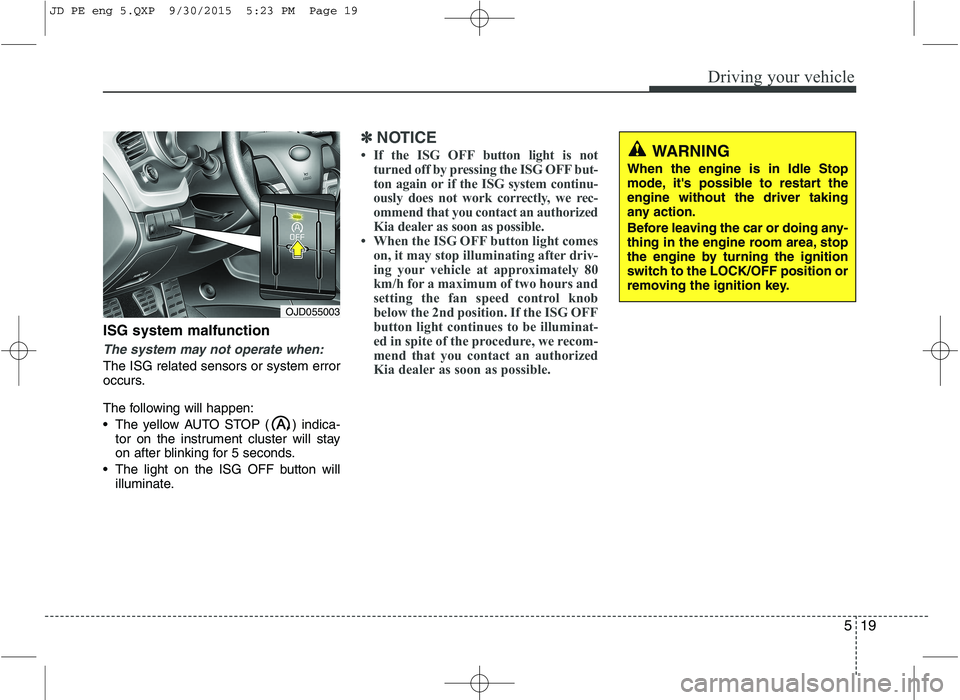
ISG system malfunction
The system may not operate when:
The ISG related sensors or system error
occurs.
The following will happen:
The yellow AUTO STOP ( ) indica-tor on the instrument cluster will stay
on after blinking for 5 seconds.
The light on the ISG OFF button will illuminate.
✽✽ NOTICE
If the ISG OFF button light is not turned off by pressing the ISG OFF but-
ton again or if the ISG system continu-
ously does not work correctly, we rec-
ommend that you contact an authorized
Kia dealer as soon as possible.
When the ISG OFF button light comes on, it may stop illuminating after driv-
ing your vehicle at approximately 80
km/h for a maximum of two hours and
setting the fan speed control knob
below the 2nd position. If the ISG OFF
button light continues to be illuminat-
ed in spite of the procedure, we recom-
mend that you contact an authorized
Kia dealer as soon as possible.WARNING
When the engine is in Idle Stop
mode, it's possible to restart theengine without the driver taking
any action.
Before leaving the car or doing any-
thing in the engine room area, stop
the engine by turning the ignition
switch to the LOCK/OFF position or
removing the ignition key.
OJD055003
JD PE eng 5.QXP 9/30/2015 5:23 PM Page 19
Page 394 of 643
521
Driving your vehicle
During cold weather, shifting may bedifficult until the transaxle lubricant has
warmed up. This is normal and not
harmful to the transaxle.
If you've come to a complete stop and it's hard to shift into 1 (First) or R
(Reverse), put the shift lever in neutral
position and release the clutch. Press
the clutch pedal back down, and then
shift into 1 (First) or R (Reverse) gearposition.Using the clutch
The clutch pedal should be depressed all
the way to the floor before shifting, then
released slowly. The clutch pedal should
always be fully released while driving. Do
not rest your foot on the clutch pedal
while driving. This can cause unneces-
sary wear. Do not partially engage the
clutch to hold the vehicle on an incline.
This causes unnecessary wear. Use the
foot brake or parking brake to hold the
vehicle on an incline. Do not operate the
clutch pedal rapidly and repeatedly.
CAUTION
To avoid premature clutch wear
and damage, do not drive withyour foot resting on the clutchpedal. Also, don’t use the clutch
to hold the vehicle stopped on anuphill grade, while waiting for a traffic light, etc.
Do not use the shift lever as a handrest during driving, as this
can result in premature wear ofthe transaxle shift forks.
To prevent possible damage to the clutch system, do not start with the
2nd (second) gear engaged exceptwhen you start on a slippery road.
WARNING
Before leaving the driver’s seat, always set the parking brake fully
and shut the engine off. Thenmake sure the transaxle is shifted
into 1 (First) gear when the vehi-
cle is parked on a level or uphill
grade, and shifted into R
(Reverse) on a downhill grade.
Unexpected and sudden vehicle
movement can occur if these pre-
cautions are not followed in the
order identified.
If your vehicle has a manual transaxle not equipped with a
ignition lock switch, it may moveand cause a serious accident
when starting the engine without
depressing the clutch pedal whilethe parking brake is released and
the shift lever not in the neutralposition.
CAUTION
When operating the clutch pedal,
depress the clutch pedal down fully.
If you don’t depress the clutch pedal fully, the clutch may be dam-aged or noise may occur.
JD PE eng 5.QXP 9/30/2015 5:23 PM Page 21
Page 397 of 643

Driving your vehicle
24
5
For smooth operation, depress the brake
pedal when shifting from N (Neutral) to aforward or reverse gear.Transaxle ranges
The indicator lights in the instrument clus-
ter displays the shift lever position when
the ignition switch is in the ON position.
P (Park)
Always come to a complete stop before
shifting into P (Park). This position locks
the transaxle and prevents the frontwheels from rotating.
WARNING - Automatic
transaxle
Always check the surrounding areas near your vehicle for peo-
ple, especially children, before
shifting a vehicle into D (Drive) or
R (Reverse).
Before leaving the driver’s seat, always make sure the shift lever
is in the P (Park) position; then
set the parking brake fully and
shut the engine off. Unexpected
and sudden vehicle movementcan occur if these precautions
are not followed in the order iden-tified.
Do not use the engine brake (shifting from a high gear to
lower gear) rapidly on slippery
roads. The vehicle may slip caus-ing an accident.
CAUTION
To avoid damage to your
transaxle, do not accelerate theengine in R (Reverse) or any for- ward gear position with the
brakes on.
When stopped on an upgrade, do not hold the vehicle stationarywith engine power. Use the serv-ice brake or the parking brake.
Do not shift from N (Neutral) or P (Park) into D (Drive), or R(Reverse) when the engine isabove idle speed.
WARNING
Shifting into P (Park) while the vehicle is in motion will cause the
drive wheels to lock which will
cause you to lose control of the
vehicle.
Do not use the P (Park) position in place of the parking brake.
Always make sure the shift lever
is latched in the P (Park) position
and set the parking brake fully.
Never leave a child unattended in a vehicle.
CAUTION
The transaxle may be damaged if
you shift into P (Park) while thevehicle is in motion.
JD PE eng 5.QXP 9/30/2015 5:23 PM Page 24
Page 400 of 643
527
Driving your vehicle
Shift lock system (if equipped)
For your safety, the automatic transaxle
has a shift lock system which prevents
shifting the transaxle from P (Park) or N
(Neutral) into R (Reverse) unless the
brake pedal is depressed.
To shift the transaxle from P (Park) or N
(Neutral) into R (Reverse):
1. Depress and hold the brake pedal.
2. Start the engine or turn the ignitionswitch to the ON position.
3. Move the shift lever.
If the brake pedal is repeatedly depressed and released with the shift
lever in the P (Park) position, a chattering
noise near the shift lever may be heard.
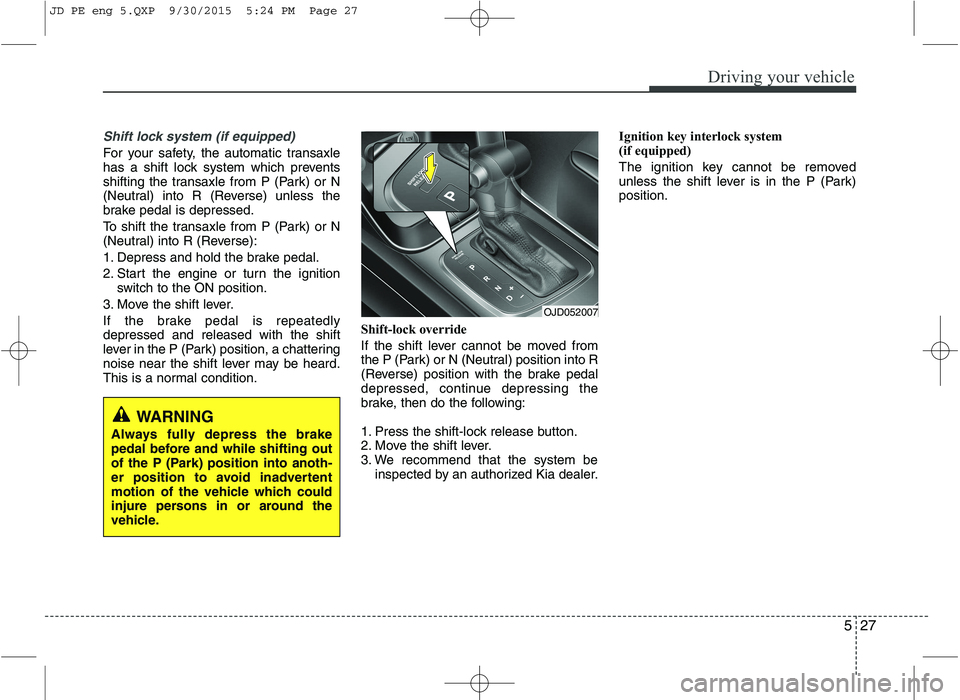
This is a normal condition. Shift-lock override
If the shift lever cannot be moved from
the P (Park) or N (Neutral) position into R
(Reverse) position with the brake pedal
depressed, continue depressing the
brake, then do the following:
1. Press the shift-lock release button.
2. Move the shift lever.
3. We recommend that the system be
inspected by an authorized Kia dealer. Ignition key interlock system
(if equipped)
The ignition key cannot be removed
unless the shift lever is in the P (Park)position.
WARNING
Always fully depress the brake
pedal before and while shifting out
of the P (Park) position into anoth-
er position to avoid inadvertent
motion of the vehicle which could
injure persons in or around the
vehicle.
OJD052007
JD PE eng 5.QXP 9/30/2015 5:24 PM Page 27
Page 404 of 643
531
Driving your vehicle
The Dual Clutch Transmission givesthe driving feel of a manual transmis-
sion, yet provides the ease of a fully
automatic transmission. Unlike a tradi-
tional automatic transmission, the gear
shifting can be felt (and heard) on the
dual clutch transmission
- Think of it as an automatically shiftingmanual transmission.
- Shift into Drive range and get fully automatic shifting, similar to a con-
ventional automatic transmission.
Dual clutch transmission adopts dry- type dual clutch, which is different from
torque converter of automatic trans-
mission, and shows better acceleration
performance during driving. But, initial
launch might be little bit slower than
Automatic Transmission.
The dry-type clutch transfers torque and provides a direct driving feeling
which may feel different from a con-
ventional automatic transmission with
a torque converter. This may be more
noticeable when starting from a stop or
low vehicle speed.
When rapidly accelerating at low vehi- cle speed, engine could rev at high rpm
depending on vehicle drive condition. For smooth launch uphill, press down
the accelerator pedal smoothly
depending on the current conditions.
If you release your foot from the accel- erator pedal at low vehicle speed, you
may feel strong engine brake, which is
similar to manual transmission.
When driving downhill, you may use Sports Mode and press the paddle
shifters to downshift to a lower gear in
order to control your speed without
using the brake pedal excessively.
When you turn the engine on and off, you may hear clicking sounds as the
system goes through a self test. This is
a normal sound for the Dual Clutch
Transmission.
WARNING
To reduce the risk of serious injury or death:
ALWAYS check the surrounding areas near your vehicle for peo-
ple, especially children, before
shifting a vehicle into D (Drive) or
R (Reverse).
Before leaving the driver’s seat, always make sure the shift lever
is in the P (Park) position, then
set the parking brake, and place
the ignition switch in the
LOCK/OFF position. Unexpected
and sudden vehicle movementcan occur if these precautions
are not followed.
Do not use engine braking (shift- ing from a high gear to lower
gear) rapidly on slippery roads.
The vehicle may slip causing anaccident.
JD PE eng 5.QXP 9/30/2015 5:24 PM Page 31
Page 406 of 643
533
Driving your vehicle
The indicator in the instrument cluster
displays the shift lever position when the
ignition switch is in the ON position.
P (Park)
Always come to a complete stop before
shifting into P (Park).
To shift from P (Park), you must depress
firmly on the brake pedal and make sure
your foot is off the accelerator pedal.
The shift lever must be in P (Park) before
turning the engine off.
WARNING
Shifting into P (Park) while the vehicle is in motion may cause
you to lose control of the vehicle.
After the vehicle has stopped, always make sure the shift lever
is in P (Park), apply the parking
brake, and turn the engine off.
Do not use the P (Park) position in place of the parking brake.
(Continued)
At this time, a warning messagewill appear on the LCD display
and driving may not be smooth.
If you ignore this warning, thedriving condition may becomeworse. To return the normal driv-ing condition, stop the vehicle
and apply the foot brake for a fewminutes before driving off.
Gear shifts may be more notice- able than a conventional automat-
ic transmission. This is a normalcharacteristic of this type of dualclutch transmission.
The overheated Dual clutch trans- mission may change the gear
shifting characteristics, and illumi-nate the warning message on theLCD display under the conditionsthat operation of the kickdown
mechanism is repetitively used.
Do not use the kickdown mecha- nism to return to the normal driv-ing condition. Also, temporarily stop the vehicle at a safe location,
when the warning message illu-minates on the LCD display.
(Continued)(Continued) During the first 1,500 km (1,000 miles), you may feel that the vehi-
cle may not be smooth when accelerating at low speed. Duringthis break-in period, the shift qual-ity and performance of your new
vehicle is continuously optimized.
Always come to a complete stop before shifting into D (Drive) or R(Reverse).
Do not put the shift lever in N (Neutral) while driving.
JD PE eng 5.QXP 9/30/2015 5:24 PM Page 33
Page 409 of 643
![KIA CEED 2016 Manual Online Driving your vehicle
36
5
With the shift lever in the D position
The paddle shifter will operate when the
vehicle speed is more than 10km/h. Pull the [+] or [-] paddle shifter once to
shift up or](/img/2/57945/w960_57945-408.png "KIA CEED 2016 Manual Online Driving your vehicle
36
5
With the shift lever in the D position
The paddle shifter will operate when the
vehicle speed is more than 10km/h. Pull the [+] or [-] paddle shifter once to
shift up or")
Driving your vehicle
36
5
With the shift lever in the D position
The paddle shifter will operate when the
vehicle speed is more than 10km/h. Pull the [+] or [-] paddle shifter once to
shift up or down one gear and the system
changes from automatic mode to manual
mode.
When the vehicle speed is lower than
10km/h, if you depress the accelerator
pedal for more than 5 seconds or if you
shift the shift lever from D (Drive) to
sports mode and shift it from sports
mode to D (Drive) again, the system
changes from manual mode to automatic
mode.
With the shift lever in the sports mode Pull the [+] or [-] paddle shifter once to
shift up or down one gear.
✽✽
NOTICE
If you pull the [+] and [-] paddle shifters
at the same time, you cannot shift the
gear.
Shift lock system (if equipped)
For your safety, the Dual clutch transmis-
sion has a shift lock system which pre-
vents shifting the transaxle from P (Park)
or N (Neutral) into R (Reverse) unless
the brake pedal is depressed.
To shift the transaxle from P (Park) or N
(Neutral) into R (Reverse):
1. Depress and hold the brake pedal.
2. Start the engine or turn the ignition switch to the ON position.
3. Move the shift lever.
If the brake pedal is repeatedly depressed and released with the shift
lever in the P (Park) position, a chattering
noise near the shift lever may be heard.
This is a normal condition. Shift-lock override
If the shift lever cannot be moved from
the P (Park) or N (Neutral) position into R
(Reverse) position with the brake pedal
depressed, continue depressing the
brake, then do the following:
1. Press the shift-lock release button.
2. Move the shift lever.
3. We recommend that the system be
inspected by an authorized Kia dealer.
WARNING
Always fully depress the brake
pedal before and while shifting out
of the P (Park) position into anoth-
er position to avoid inadvertent
motion of the vehicle which could
injure persons in or around the car.
OJD052007
JD PE eng 5.QXP 9/30/2015 5:24 PM Page 36
Page 410 of 643
537
Driving your vehicle
Ignition key interlock system
(if equipped)
The ignition key cannot be removed
unless the shift lever is in the P (Park)position.Good driving practices
Never move the shift lever from P
(Park) or N (Neutral) to any other posi-
tion with the accelerator pedaldepressed.
Never move the shift lever into P (Park) when the vehicle is in motion.
Be sure the car is completely stopped before you attempt to shift into R
(Reverse) or D (Drive).
Never take the car out of gear and coast down a hill. This may be
extremely hazardous. Always leave the
car in gear when moving.
Do not "ride" the brakes. This can cause them to overheat and malfunc-
tion. Instead, when you are driving
down a long hill, slow down and shift to
a lower gear. When you do this, engine
braking will help slow the car.
Slow down before shifting to a lower gear. Otherwise, the lower gear maynot be engaged. Always use the parking brake. Do not
depend on placing the transaxle in P
(Park) to keep the car from moving.
Exercise extreme caution when driving on a slippery surface. Be especially
careful when braking, accelerating or
shifting gears. On a slippery surface,
an abrupt change in vehicle speed can
cause the drive wheels to lose traction
and the vehicle to go out of control.
Optimum vehicle performance and economy is obtained by smoothly
depressing and releasing the accelera-tor pedal.
JD PE eng 5.QXP 9/30/2015 5:24 PM Page 37
Page 416 of 643
543
Driving your vehicle
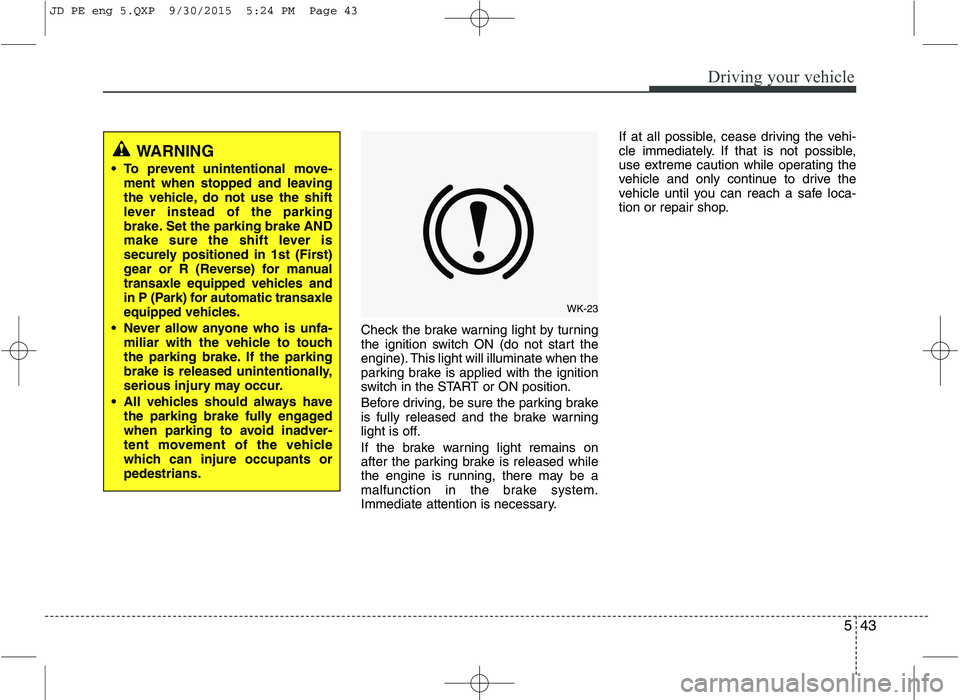
Check the brake warning light by turning
the ignition switch ON (do not start the
engine). This light will illuminate when the
parking brake is applied with the ignition
switch in the START or ON position.
Before driving, be sure the parking brake
is fully released and the brake warning
light is off.
If the brake warning light remains on
after the parking brake is released while
the engine is running, there may be a
malfunction in the brake system.
Immediate attention is necessary.If at all possible, cease driving the vehi-
cle immediately. If that is not possible,
use extreme caution while operating the
vehicle and only continue to drive the
vehicle until you can reach a safe loca-
tion or repair shop.
WARNING
To prevent unintentional move- ment when stopped and leaving
the vehicle, do not use the shift
lever instead of the parking
brake. Set the parking brake AND
make sure the shift lever is
securely positioned in 1st (First)
gear or R (Reverse) for manual
transaxle equipped vehicles and
in P (Park) for automatic transaxle
equipped vehicles.
Never allow anyone who is unfa- miliar with the vehicle to touch
the parking brake. If the parking
brake is released unintentionally,
serious injury may occur.
All vehicles should always have the parking brake fully engaged
when parking to avoid inadver-
tent movement of the vehicle
which can injure occupants orpedestrians.
WK-23
JD PE eng 5.QXP 9/30/2015 5:24 PM Page 43
Page 417 of 643
Driving your vehicle
44
5
Electric parking brake (EPB) (if equipped)
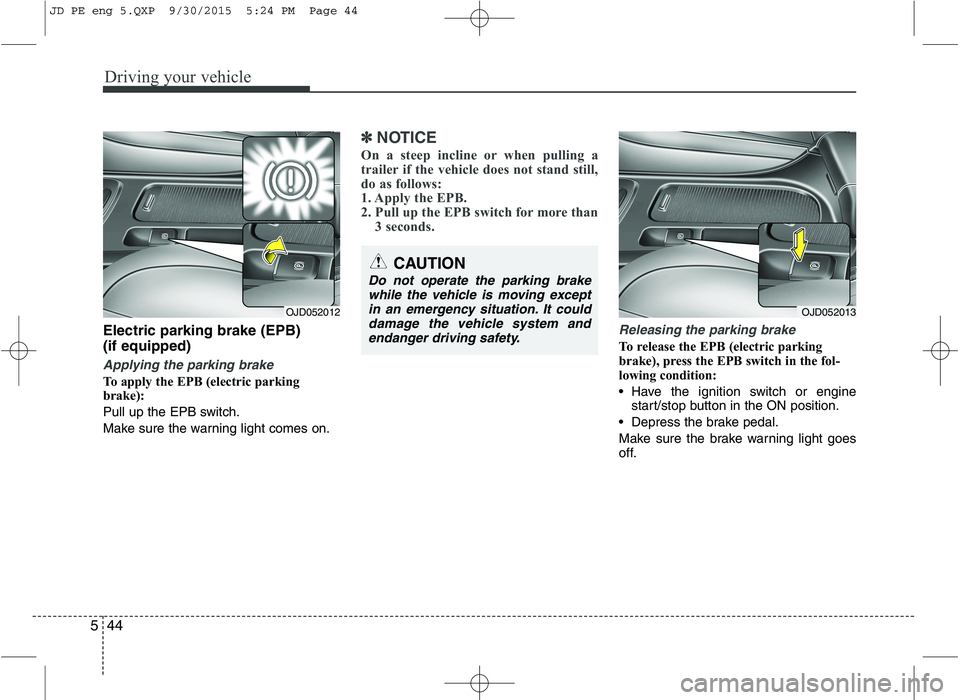
Applying the parking brake
To apply the EPB (electric parking
brake):
Pull up the EPB switch.
Make sure the warning light comes on.
✽✽
NOTICE
On a steep incline or when pulling a
trailer if the vehicle does not stand still,
do as follows:
1. Apply the EPB.
2. Pull up the EPB switch for more than 3 seconds.
Releasing the parking brake
To release the EPB (electric parking
brake), press the EPB switch in the fol-
lowing condition:
Have the ignition switch or enginestart/stop button in the ON position.
Depress the brake pedal.
Make sure the brake warning light goes
off.
OJD052012
CAUTION
Do not operate the parking brake while the vehicle is moving exceptin an emergency situation. It could
damage the vehicle system andendanger driving safety.
OJD052013
JD PE eng 5.QXP 9/30/2015 5:24 PM Page 44