arm rest KIA CEED 2016 Owners Manual
[x] Cancel search | Manufacturer: KIA, Model Year: 2016, Model line: CEED, Model: KIA CEED 2016Pages: 643, PDF Size: 38.19 MB
Page 5 of 643
Introduction
2
1
We want to help you get the greatest
possible driving pleasure from your vehi-
cle. Your Owner’s Manual can assist you
in many ways. We strongly recommend
that you read the entire manual. In order
to minimize the chance of death or injury,
you must read the WARNING and CAU-
TION sections in the manual.
Illustrations complement the words in this
manual to best explain how to enjoy your
vehicle. By reading your manual, you will
learn about features, important safety
information, and driving tips under vari-
ous road conditions.
The general layout of the manual is pro-
vided in the Table of Contents. Use the
index when looking for a specific area or
subject; it has an alphabetical listing of all
information in your manual.
Sections: This manual has eight sections
plus an index. Each section begins with a
brief list of contents so you can tell at a
glance if that section has the information
you want. You will find various WARNINGS, CAU-
TIONS, and NOTICES in this manual.
These were prepared to enhance your
personal safety. You should carefully read
and follow ALL procedures and recom-
mendations provided in these WARN-
INGS, CAUTIONS and NOTICES.
✽✽
NOTICE
A NOTICE indicates interesting or help-
ful information is being provided.
Gasoline engine
Unleaded
For Europe
For the optimal vehicle performance, we
recommend you to use unleaded gaso-
line with an octane rating of RON(Research Octane Number) 95 / AKI (Anti
Knock Index) 91 or higher (Do not use
methanol blended fuels). You may use
unleaded gasoline with an octane rating
of RON 91-94 / AKI 87-90 but it may
result in slight performance reduction of
the vehicle.
Except Europe
Your new vehicle is designed to use only
unleaded fuel having an Octane Rating
of RON (Research Octane Number) 91 /
AKI (Anti-Knock Index) 87 or higher. (Do
not use methanol blended fuels)
Your new vehicle is designed to obtain
maximum performance with UNLEADED
FUEL, as well as minimize exhaust emis-
sions and spark plug fouling.
HOW TO USE THIS MANUAL
WARNING
A WARNING indicates a situation in
which harm, serious bodily injury ordeath could result if the warning isignored.
CAUTION
A CAUTION indicates a situation in which damage to your vehicle couldresult if the caution is ignored.
FUEL REQUIREMENTS
JD PE eng 1.QXP 11/26/2015 10:22 AM Page 2
Page 19 of 643
Safety features of your vehicle
2
3
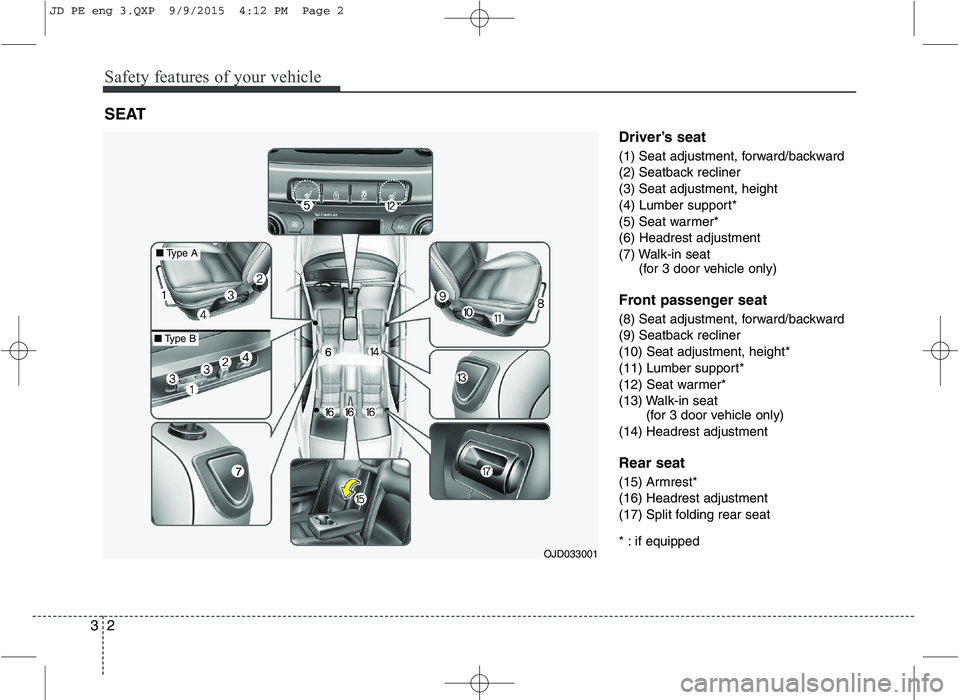
Driver’s seat
(1) Seat adjustment, forward/backward
(2) Seatback recliner
(3) Seat adjustment, height
(4) Lumber support*
(5) Seat warmer*(6) Headrest adjustment
(7) Walk-in seat
(for 3 door vehicle only)
Front passenger seat
(8) Seat adjustment, forward/backward
(9) Seatback recliner(10) Seat adjustment, height*
(11) Lumber support*
(12) Seat warmer*
(13) Walk-in seat (for 3 door vehicle only)
(14) Headrest adjustment Rear seat
(15) Armrest*
(16) Headrest adjustment
(17) Split folding rear seat
* : if equipped
SEAT
OJD033001
■ Type A
■Type B
JD PE eng 3.QXP 9/9/2015 4:12 PM Page 2
Page 32 of 643
315
Safety features of your vehicle
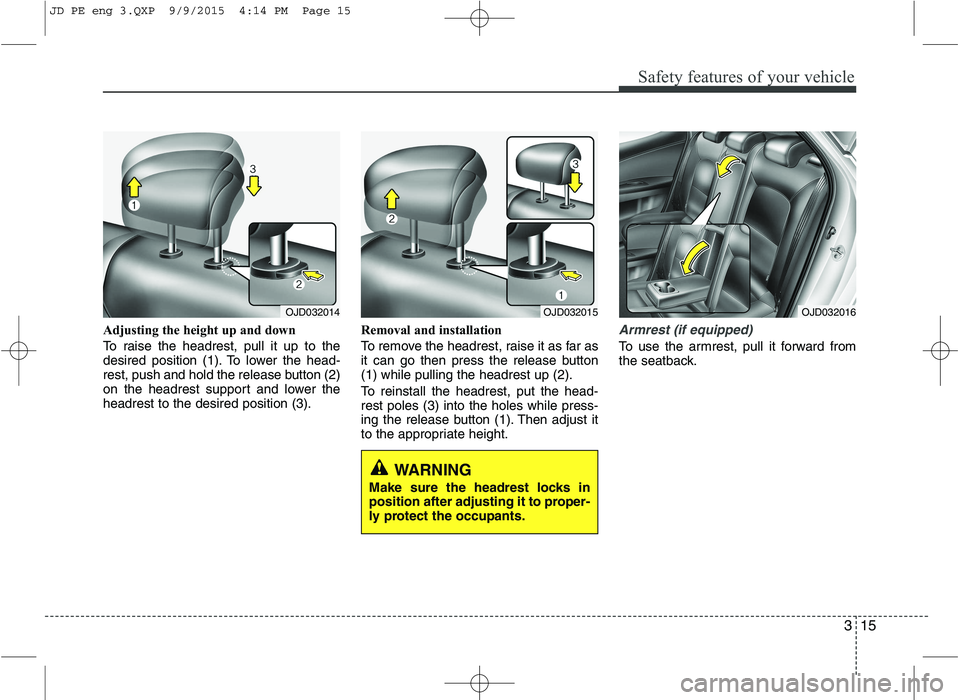
Adjusting the height up and down
To raise the headrest, pull it up to the
desired position (1). To lower the head-
rest, push and hold the release button (2)
on the headrest support and lower theheadrest to the desired position (3).Removal and installation
To remove the headrest, raise it as far as
it can go then press the release button(1) while pulling the headrest up (2).
To reinstall the headrest, put the head- rest poles (3) into the holes while press-
ing the release button (1). Then adjust it
to the appropriate height.Armrest (if equipped)
To use the armrest, pull it forward from
the seatback.
OJD032014OJD032015
WARNING
Make sure the headrest locks in
position after adjusting it to proper-
ly protect the occupants.
OJD032016
JD PE eng 3.QXP 9/9/2015 4:14 PM Page 15
Page 37 of 643
Safety features of your vehicle
20
3
Seat belt restraint system SEAT BELTS(Continued)
Avoid wearing twisted seat belts.
A twisted belt can't do its job as
well. In a collision, it could even
cut into you. Be sure the belt web-bing is straight and not twisted.
Be careful not to damage the belt webbing or hardware. If the belt
webbing or hardware is dam-
aged, replace it.
WARNING
Seat belts are designed to bear
upon the bony structure of the
body, and should be worn low
across the front of the pelvis or the
pelvis, chest and shoulders, as
applicable; wearing the lap section
of the belt across the abdominal
area must be avoided. Seat belts should be adjusted as
firmly as possible, consistent with
comfort, to provide the protection
for which they have been designed.
A slack belt will greatly reduce the
protection afforded to the wearer.
(Continued)
WARNING
For maximum restraint system protection, the seat belts must
always be used whenever the car
is moving.
Seat belts are most effective when seatbacks are in theupright position.
Children age 12 and younger must always be properly restrained in
the rear seat. Never allow children
to ride in the front passenger seat.
If a child over 12 must be seated in
the front seat, he/she must be
properly belted and the seat
should be mo ved as far back as
possible.
Never wear the shoulder belt under your arm or behind your
back. An improperly positionedshoulder belt can cause serious
injuries in a crash. The shoulder
belt should be positioned midway
over your shoulder across your
collarbone.
(Continued)
(Continued)
Care should be taken to avoid con- tamination of the webbing with pol-
ishes, oils and chemicals, and par-
ticularly battery acid.
Cleaning may safely be carried out
using mild soap and water. The beltshould be replaced if webbing
becomes frayed, contaminated or
damaged. It is essential to replace
the entire assembly after it has
been worn in a severe impact even
if damage to the assembly is not
obvious. Belts should not be worn
with straps twisted. Each belt
assembly must only be used by one
occupant; it is dangerous to put a
belt around a child being carried onthe occupant's lap.
JD PE eng 3.QXP 9/9/2015 4:14 PM Page 20
Page 46 of 643
329
Safety features of your vehicle
Infant or small child
You should be aware of the specific
requirements in your country. Child
and/or infant seats must be properly
placed and installed in the rear seat. For
more information about the use of these
restraints, refer to “Child restraint sys-
tem” in this section.✽✽NOTICE
Small children are best protected from
injury in an accident when properly
restrained in the rear seat by a child
restraint system that meets the require-
ments of the Safety Standards of your
country. Before buying any child
restraint system, make sure that it has a
label certifying that it meets Safety
Standards of your country. The restraint
must be appropriate for your child's
height and weight. Check the label on
the child restraint for this information.
Refer to “Child restraint system” in this
section.Larger children
Children who are too large for child
restraint systems should always occupy
the rear seat and use the available
lap/shoulder belts. The lap portion should
be fastened and snugged on the hips
and as low as possible. Check if the belt
fits periodically. A child's squirming could
put the belt out of position. Children are
afforded the most safety in the event of
an accident when they are restrained by
a proper restraint system in the rear seat.
If a larger child (over age 12) must beseated in the front seat, the child should
be securely restrained by the availablelap/shoulder belt and the seat should be
placed in the rearmost position. Children
age 12 and under should be restrained
securely in the rear seat. NEVER place achild age 12 and under in the front seat.
NEVER place a rear facing child seat in
the front seat of a vehicle.
WARNING
Every person in your vehicle needs
to be properly restrained at all
times, including infants and chil-
dren. Never hold a child in yourarms or lap when riding in a vehi-
cle. The violent forces created dur-
ing a crash will tear the child from
your arms and throw the child
against the interior. Always use a
child restraint appropriate for your
child's height and weight.
JD PE eng 3.QXP 9/9/2015 4:15 PM Page 29
Page 48 of 643
331
Safety features of your vehicle
Care of seat belts
Seat belt systems should never be disas-
sembled or modified. In addition, care
should be taken to assure that seat belts
and belt hardware are not damaged by
seat hinges, doors or other abuse.Periodic inspection
It is recommended that all seat belts be
inspected periodically for wear or dam-
age of any kind. Any damaged parts
should be replaced as soon as possible.
Keep belts clean and dry
Seat belts should be kept clean and dry.
If belts become dirty, they can be
cleaned by using a mild soap solution
and warm water. Bleach, dye, strong
detergents or abrasives should not be
used because they may damage and
weaken the fabric.
When to replace seat belts
Entire in-use seat belt assembly or
assemblies should be replaced if the
vehicle has been involved in an accident.
This should be done even if no damage
is visible. We recommend that you con-
sult an authorized Kia dealer.
WARNING
Riding with a reclined seatback
increases your chance of serious
or fatal injuries in the event of a col-
lision or sudden stop. The protec-
tion of your restraint system (seat
belts and air bags) is greatly
reduced by reclining your seat.
Seat belts must be snug against
your hips and chest to work proper-
ly. The more the seatback is
reclined, the greater the chancethat an occupant's hips will slideunder the lap belt causing seriousinternal injuries or the occupant's
neck could strike the shoulder belt.
Drivers and passengers should
always sit well back in their seats,
properly belted, and with the seat-
backs upright.
WARNING
When you return the rear seatback to its upright position after the rear
seatback was folded down, be care-
ful not to damage the seat belt web-
bing or buckle. Be sure that the
webbing or buckle does not get
caught or pinched in the rear seat.
A seat belt with damaged webbing
or buckle will not be as strong and
could possibly fail during a colli-
sion or sudden stop, resulting in
serious injury. If the webbing or
buckles are damaged, get them
replaced immediately.
JD PE eng 3.QXP 9/9/2015 4:15 PM Page 31
Page 50 of 643
333
Safety features of your vehicle
(Continued)
Never leave children unattendedin a vehicle – not even for a short
time. The car can heat up very
quickly, resulting in serious
injuries to children inside. Even
very young children may inadver-
tently cause the vehicle to move,entangle themselves in the win-
dows, or lock themselves or oth-
ers inside the vehicle.
Never allow two children, or any two persons, to use the sameseat belt.
Children often squirm and repo- sition themselves improperly.
Never let a child ride with theshoulder belt under their arm or
behind their back. Always prop-
erly position and secure childrenin the rear seat.
Never allow a child to stand-up or kneel on the seat or floorboard of
a moving vehicle. During a colli-
sion or sudden stop, the child
can be violently thrown against
the vehicles interior, resulting in
serious injury.
(Continued)(Continued)
Never use an infant carrier or achild safety seat that "hooks"
over a seatback, it may not pro-vide adequate security in an acci-dent.
Seat belts can become very hot, especially when the car is parked
in direct sunlight. Always check
seat belt buckles before fasten-
ing them over a child.
After an accident, we recommend that the system be checked by an
authorized Kia dealer.
If there is not enough space to place the child restraint systembecause of the driver's seat,
install the child restraint systemin the rear right seat.WARNING
To reduce a risk of serious or fatal injuries:
Children of all ages are safer when restrained in the rear seat.
A child riding in the front passen-
ger seat can be forcefully struck
by an inflating air bag resulting inserious or fatal injuries.
Always follow the instructions for installation and use of the child
restraint maker.
Always make sure the child seat is secured properly in the car and
your child is securely restrained
in the child seat.
Never hold a child in your arms or lap when riding in a vehicle. The
violent forces created during a
crash will tear the child from your
arms and throw the child against
the car’s interior.
Never put a seat belt over your- self and a child. During a crash,the belt could press deep into the
child causing serious internalinjuries.
(Continued)
JD PE eng 3.QXP 9/9/2015 4:15 PM Page 33
Page 69 of 643
Safety features of your vehicle
52
3
(Continued)
Do not tamper with or disconnect
SRS wiring or other components
of the SRS system. Doing so
could result in injury, due to acci-
dental deployment of the air bags
or by rendering the SRS inopera-
tive.
If the SRS air bag warning light remains illuminated while the
vehicle is being driven, we rec-ommend that the system be
inspected by an authorized Kia
dealer.
Air bags can only be used once – we recommend that the system
be replaced by an authorized Kia
dealer.
The SRS is designed to deploy the front air bags only when an
impact is sufficiently severe andwhen the impact angle is less
than 30° from the forward longitu-
dinal axis of the vehicle.
Additionally, the air bags will only
deploy once. Seat belts must be
worn at all times.
(Continued)(Continued)
Move your seat as far back aspractical from the front air bags,
while still maintaining control of
the vehicle.
You and your passengers should never sit or lean unnecessarily
close to the air bags. Improperly
positioned drivers and passen-
gers can be severely injured by
inflating air bags.
Never lean against the door or center console – always sit in anupright position.
No objects should be placed over or near the air bag modules on
the steering wheel, instrument
panel, and the front passenger's
panel above the glove box,
because any such object could
cause harm if the vehicle is in a
crash severe enough to cause
the air bags to deploy.
(Continued)(Continued)
Front air bags are not intended todeploy in side-impact, rear-
impact or rollover crashes. In
addition, front air bags will not
deploy in frontal crashes below
the deployment threshold.
A child restraint system must never be placed in the front seat.
The infant or child could be
severely injured or killed by an air
bag deployment in case of anaccident.
Children age 12 and under must always be properly restrained in
the rear seat. Never allow chil-
dren to ride in the front passen-
ger seat. If a child over 12 must
be seated in the front seat, he or
she must be properly belted and
the seat should be moved as far
back as possible.
(Continued)
JD PE eng 3.QXP 9/9/2015 4:16 PM Page 52
Page 75 of 643
Safety features of your vehicle
58
3
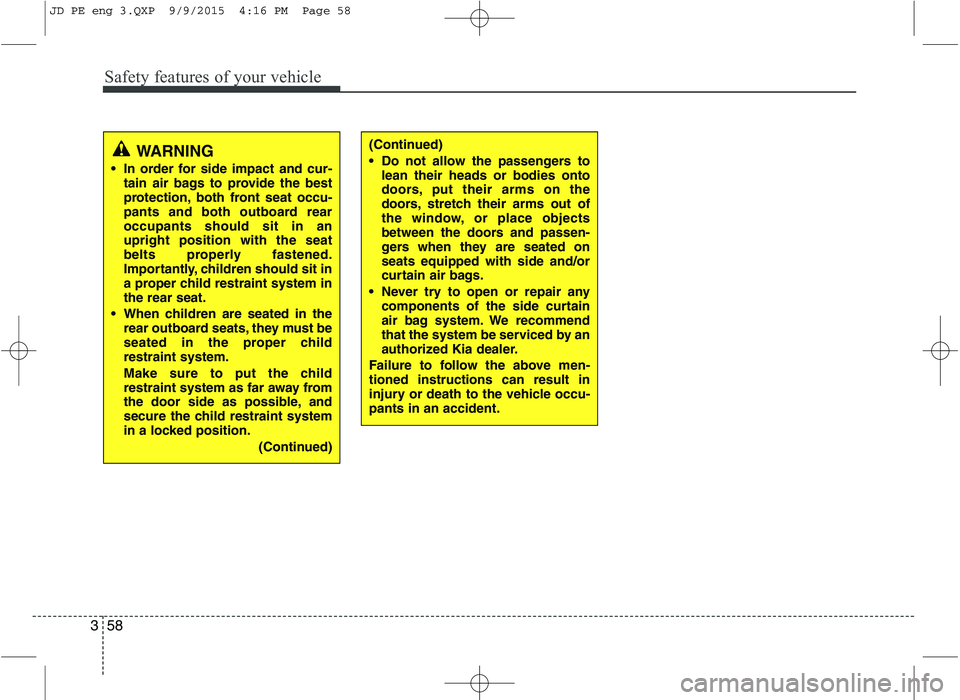
(Continued)
Do not allow the passengers to
lean their heads or bodies onto
doors, put their arms on the
doors, stretch their arms out of
the window, or place objects
between the doors and passen-
gers when they are seated onseats equipped with side and/or
curtain air bags.
Never try to open or repair any components of the side curtain
air bag system. We recommend
that the system be serviced by an
authorized Kia dealer.
Failure to follow the above men-tioned instructions can result in
injury or death to the vehicle occu-pants in an accident.WARNING
In order for side impact and cur- tain air bags to provide the best
protection, both front seat occu-
pants and both outboard rearoccupants should sit in anupright position with the seat
belts properly fastened.
Importantly, children should sit in
a proper child restraint system inthe rear seat.
When children are seated in the rear outboard seats, they must be
seated in the proper childrestraint system.
Make sure to put the child
restraint system as far away from
the door side as possible, and
secure the child restraint system
in a locked position.
(Continued)
JD PE eng 3.QXP 9/9/2015 4:16 PM Page 58
Page 86 of 643
Map lamp . . . . . . . . . . . . . . . . . . . . . . . . . . . . . . . . . . 4-131
Room lamp . . . . . . . . . . . . . . . . . . . . . . . . . . . . . . . . . 4-132
Vanity mirror lamp . . . . . . . . . . . . . . . . . . . . . . . . . . 4-132
Luggage room lamp . . . . . . . . . . . . . . . . . . . . . . . . . 4-133
Glove box lamp . . . . . . . . . . . . . . . . . . . . . . . . . . . . . 4-133
Welcome system . . . . . . . . . . . . . . . . . . . . . . . . . . 4-134 Headlamp welcome . . . . . . . . . . . . . . . . . . . . . . . . . . 4-134
Interior light. . . . . . . . . . . . . . . . . . . . . . . . . . . . . . . . 4-134
Puddle lamp . . . . . . . . . . . . . . . . . . . . . . . . . . . . . . . . 4-134
Defroster . . . . . . . . . . . . . . . . . . . . . . . . . . . . . . . . 4-135 Rear window defroster . . . . . . . . . . . . . . . . . . . . . . . 4-135
Manual climate control system . . . . . . . . . . . . . . 4-136 Heating and air conditioning . . . . . . . . . . . . . . . . . . 4-137
System operation . . . . . . . . . . . . . . . . . . . . . . . . . . . . 4-141
Climate control air filter. . . . . . . . . . . . . . . . . . . . . . 4-143
Checking the amount of air conditioner refrigerant and compressor lubricant . . . . . . . . . . 4-144
Automatic climate control system . . . . . . . . . . . 4-145 Automatic heating and air conditioning . . . . . . . . . 4-146
Manual heating and air conditioning . . . . . . . . . . . 4-148
System operation . . . . . . . . . . . . . . . . . . . . . . . . . . . . 4-153
Climate control air filter. . . . . . . . . . . . . . . . . . . . . . 4-155
Checking the amount of air conditioner refrigerant and compressor lubricant . . . . . . . . . . 4-156
Windshield defrosting and defogging . . . . . . . . . 4-157 Manual climate control system . . . . . . . . . . . . . . . . 4-157
Automatic climate control system . . . . . . . . . . . . . . 4-158 Clean air . . . . . . . . . . . . . . . . . . . . . . . . . . . . . . . . 4-159
Storage compartment . . . . . . . . . . . . . . . . . . . . . . 4-160
Center console storage . . . . . . . . . . . . . . . . . . . . . . . 4-160
Sliding armrest . . . . . . . . . . . . . . . . . . . . . . . . . . . . . 4-160
Glove box . . . . . . . . . . . . . . . . . . . . . . . . . . . . . . . . . . 4-161
Cool box . . . . . . . . . . . . . . . . . . . . . . . . . . . . . . . . . . . 4-161
Sunglass holder . . . . . . . . . . . . . . . . . . . . . . . . . . . . . 4-162
Luggage tray . . . . . . . . . . . . . . . . . . . . . . . . . . . . . . . 4-162
Luggage side tray . . . . . . . . . . . . . . . . . . . . . . . . . . . 4-163
Interior features . . . . . . . . . . . . . . . . . . . . . . . . . . 4-164 Cigarette lighter. . . . . . . . . . . . . . . . . . . . . . . . . . . . . 4-164
Ashtray . . . . . . . . . . . . . . . . . . . . . . . . . . . . . . . . . . . . 4-164
Cup holder . . . . . . . . . . . . . . . . . . . . . . . . . . . . . . . . . 4-164
Bottle holder. . . . . . . . . . . . . . . . . . . . . . . . . . . . . . . . 4-165
Sunvisor . . . . . . . . . . . . . . . . . . . . . . . . . . . . . . . . . . . 4-167
Power outlet . . . . . . . . . . . . . . . . . . . . . . . . . . . . . . . . 4-168
Aux, USB and iPod . . . . . . . . . . . . . . . . . . . . . . . . . . 4-169
Clothes hanger . . . . . . . . . . . . . . . . . . . . . . . . . . . . . . 4-169
Floor mat anchor(s). . . . . . . . . . . . . . . . . . . . . . . . . . 4-170
Luggage net (holder) . . . . . . . . . . . . . . . . . . . . . . . . . 4-171
Cargo area cover . . . . . . . . . . . . . . . . . . . . . . . . . . . . 4-171
Barrier net . . . . . . . . . . . . . . . . . . . . . . . . . . . . . . . . . 4-172
Cargo security screen . . . . . . . . . . . . . . . . . . . . . . . . 4-174
Luggage rail system. . . . . . . . . . . . . . . . . . . . . . . . . . 4-176
Shopping bag holder . . . . . . . . . . . . . . . . . . . . . . . . . 4-177
Exterior features . . . . . . . . . . . . . . . . . . . . . . . . . . 4-178 Mounting bracket for roof carrier . . . . . . . . . . . . . 4-178
Roof rack . . . . . . . . . . . . . . . . . . . . . . . . . . . . . . . . . . 4-179
4
JD PE eng 4.QXP 1/28/2016 5:11 PM Page 3