automatic transmission KIA CEED 2016 Owners Manual
[x] Cancel search | Manufacturer: KIA, Model Year: 2016, Model line: CEED, Model: KIA CEED 2016Pages: 643, PDF Size: 38.19 MB
Page 85 of 643
Dual clutch transmission shift indicator . . . . . . . . . . 4-50
Speed limiter indicator . . . . . . . . . . . . . . . . . . . . . . . . 4-51
Odometer . . . . . . . . . . . . . . . . . . . . . . . . . . . . . . . . . . . 4-51
Trip computer . . . . . . . . . . . . . . . . . . . . . . . . . . . . . . . 4-51
Instrument cluster (Super vision) . . . . . . . . . . . . . 4-59 Instrument panel illumination . . . . . . . . . . . . . . . . . . 4-61
Cluster display mode conversion . . . . . . . . . . . . . . . . 4-61
Gauges . . . . . . . . . . . . . . . . . . . . . . . . . . . . . . . . . . . . . 4-61
Manual transaxle shift indicator . . . . . . . . . . . . . . . . 4-64
Automatic transaxle shift position indicator . . . . . . 4-65
Dual clutch transmission shift indicator . . . . . . . . . . 4-65
Speed limiter indicator . . . . . . . . . . . . . . . . . . . . . . . 4-66
Odometer . . . . . . . . . . . . . . . . . . . . . . . . . . . . . . . . . . . 4-66
Trip computer . . . . . . . . . . . . . . . . . . . . . . . . . . . . . . . 4-67
LCD display information . . . . . . . . . . . . . . . . . . . . . . 4-74
Warnings and indicators. . . . . . . . . . . . . . . . . . . . . . . 4-80
LCD display warnings and indicators (instrument panel display) . . . . . . . . . . . . . . . . . 4-91
Rear parking assist system . . . . . . . . . . . . . . . . . . 4-93 Operation . . . . . . . . . . . . . . . . . . . . . . . . . . . . . . . . . . . 4-93
Non-operational conditions . . . . . . . . . . . . . . . . . . . . 4-95
Precautions . . . . . . . . . . . . . . . . . . . . . . . . . . . . . . . . . . 4-95
Self-diagnosis . . . . . . . . . . . . . . . . . . . . . . . . . . . . . . . . 4-96
Parking assist system . . . . . . . . . . . . . . . . . . . . . . . 4-97 Operation . . . . . . . . . . . . . . . . . . . . . . . . . . . . . . . . . . . 4-98
Non-operational conditions . . . . . . . . . . . . . . . . . . . 4-100
Self-diagnosis . . . . . . . . . . . . . . . . . . . . . . . . . . . . . . . 4-101 Smart Parking Assist System (SPAS) . . . . . . . . . 4-102
Operating condition . . . . . . . . . . . . . . . . . . . . . . . . . 4-103
Non-operating condition . . . . . . . . . . . . . . . . . . . . . . 4-104
How the system works (Parking mode) . . . . . . . . . 4-107
How the system works (Exit mode) . . . . . . . . . . . . . 4-113
Additional instructions (messages). . . . . . . . . . . . . . 4-116
System malfunction . . . . . . . . . . . . . . . . . . . . . . . . . . 4-117
Rearview camera . . . . . . . . . . . . . . . . . . . . . . . . . 4-118
Hazard warning flasher . . . . . . . . . . . . . . . . . . . . 4-118
Lighting . . . . . . . . . . . . . . . . . . . . . . . . . . . . . . . . . 4-119 Battery saver function . . . . . . . . . . . . . . . . . . . . . . . . 4-119
Headlamp delay function . . . . . . . . . . . . . . . . . . . . . 4-119
Headlight (Headlamp) welcome function . . . . . . . . 4-119
Static bending light . . . . . . . . . . . . . . . . . . . . . . . . . . 4-120
Lighting control . . . . . . . . . . . . . . . . . . . . . . . . . . . . . 4-120
High - beam operation . . . . . . . . . . . . . . . . . . . . . . . 4-122
Turn signals and lane change signals . . . . . . . . . . . 4-123
Front fog light . . . . . . . . . . . . . . . . . . . . . . . . . . . . . . 4-124
Rear fog light . . . . . . . . . . . . . . . . . . . . . . . . . . . . . . . 4-124
Daytime running light . . . . . . . . . . . . . . . . . . . . . . . . 4-124
Headlight leveling device . . . . . . . . . . . . . . . . . . . . . 4-125
Adaptive Front Lighting System (AFLS) . . . . . . . . 4-126
Wipers and washers . . . . . . . . . . . . . . . . . . . . . . . 4-127 Windshield wipers (front) . . . . . . . . . . . . . . . . . . . . . 4-127
Windshield washers (front) . . . . . . . . . . . . . . . . . . . 4-129
Rear window wiper and washer switch. . . . . . . . . . 4-130
Interior light . . . . . . . . . . . . . . . . . . . . . . . . . . . . . 4-131 Interior lamp AUTO cut . . . . . . . . . . . . . . . . . . . . . . 4-131
4
JD PE eng 4.QXP 1/28/2016 5:11 PM Page 2
Page 133 of 643
Features of your vehicle
50
4
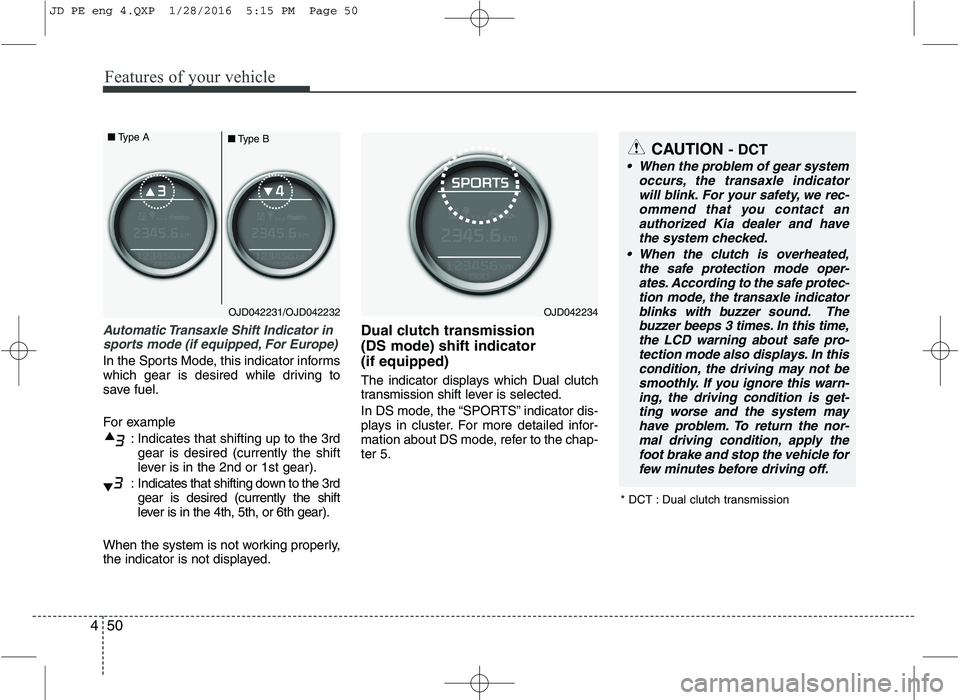
Automatic Transaxle Shift Indicator in
sports mode (if equipped, For Europe)
In the Sports Mode, this indicator informs
which gear is desired while driving to
save fuel.
For example
: Indicates that shifting up to the 3rdgear is desired (currently the shift
lever is in the 2nd or 1st gear).
: Indicates that shifting down to the 3rd gear is desired (currently the shift
lever is in the 4th, 5th, or 6th gear).
When the system is not working properly,
the indicator is not displayed. Dual clutch transmission (DS mode) shift indicator (if equipped)
The indicator displays which Dual clutch
transmission shift lever is selected.
In DS mode, the “SPORTS” indicator dis-
plays in cluster. For more detailed infor-
mation about DS mode, refer to the chap-ter 5.
OJD042234OJD042231/OJD042232
■
Type A
■Type B
* DCT : Dual clutch transmission
CAUTION - DCT
When the problem of gear system
occurs, the transaxle indicatorwill blink. For your safety, we rec-ommend that you contact an
authorized Kia dealer and havethe system checked.
When the clutch is overheated, the safe protection mode oper-ates. According to the safe protec-
tion mode, the transaxle indicator blinks with buzzer sound. The buzzer beeps 3 times. In this time,the LCD warning about safe pro-
tection mode also displays. In this condition, the driving may not besmoothly. If you ignore this warn- ing, the driving condition is get-
ting worse and the system may have problem. To return the nor-mal driving condition, apply the foot brake and stop the vehicle for
few minutes before driving off.
JD PE eng 4.QXP 1/28/2016 5:15 PM Page 50
Page 148 of 643
465
Features of your vehicle
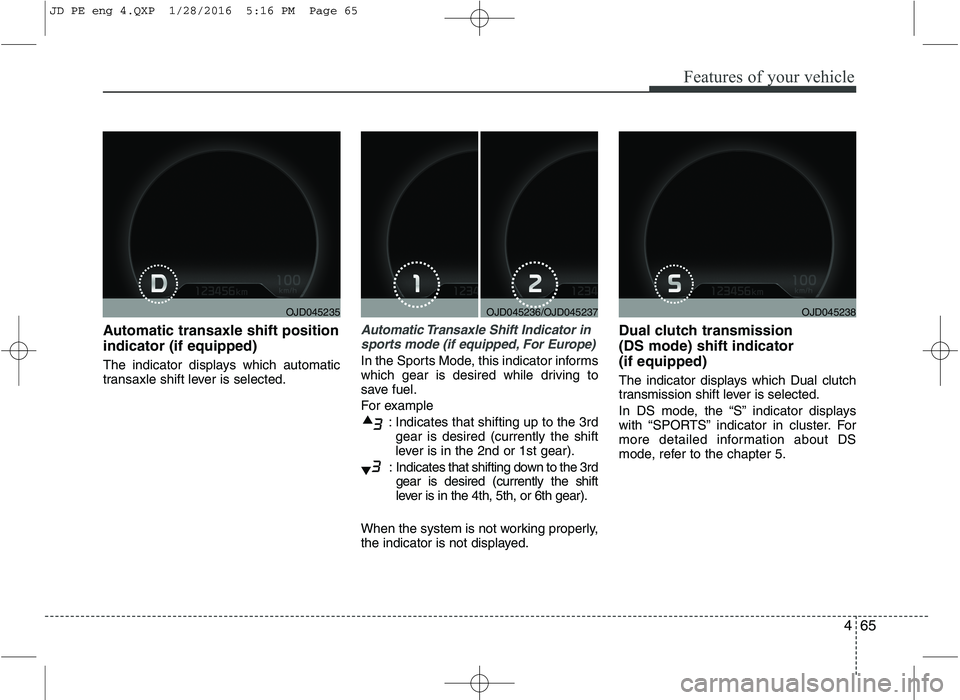
Automatic transaxle shift position indicator (if equipped)
The indicator displays which automatic
transaxle shift lever is selected.Automatic Transaxle Shift Indicator insports mode (if equipped, For Europe)
In the Sports Mode, this indicator informs
which gear is desired while driving to
save fuel.
For example
: Indicates that shifting up to the 3rdgear is desired (currently the shift
lever is in the 2nd or 1st gear).
: Indicates that shifting down to the 3rd gear is desired (currently the shift
lever is in the 4th, 5th, or 6th gear).
When the system is not working properly,
the indicator is not displayed. Dual clutch transmission (DS mode) shift indicator (if equipped)
The indicator displays which Dual clutch
transmission shift lever is selected.
In DS mode, the “S” indicator displays
with “SPORTS” indicator in cluster. For
more detailed information about DS
mode, refer to the chapter 5.
OJD045235OJD045236/OJD045237OJD045238
JD PE eng 4.QXP 1/28/2016 5:16 PM Page 65
Page 374 of 643
Driving your vehicle
Before driving . . . . . . . . . . . . . . . . . . . . . . . . . . . . . . 5-4 Before entering vehicle . . . . . . . . . . . . . . . . . . . . . . . . . 5-4
Necessary inspections . . . . . . . . . . . . . . . . . . . . . . . . . 5-4
Before starting . . . . . . . . . . . . . . . . . . . . . . . . . . . . . . . 5-4
Key positions . . . . . . . . . . . . . . . . . . . . . . . . . . . . . . . 5-5 Illuminated ignition switch . . . . . . . . . . . . . . . . . . . . . . 5-5
Ignition switch position . . . . . . . . . . . . . . . . . . . . . . . . . 5-6
Starting the engine . . . . . . . . . . . . . . . . . . . . . . . . . . . . 5-7
Engine start/stop button . . . . . . . . . . . . . . . . . . . . . 5-9 Illuminated engine start/stop button . . . . . . . . . . . . . . 5-9
Engine start/stop button position. . . . . . . . . . . . . . . . . 5-9
Starting the engine . . . . . . . . . . . . . . . . . . . . . . . . . . . 5-12
ISG (Idle Stop and Go) system . . . . . . . . . . . . . . . 5-15 Auto stop . . . . . . . . . . . . . . . . . . . . . . . . . . . . . . . . . . . 5-15
Auto Start . . . . . . . . . . . . . . . . . . . . . . . . . . . . . . . . . . . 5-17
Condition of ISG system operation . . . . . . . . . . . . . . 5-18
ISG system deactivation . . . . . . . . . . . . . . . . . . . . . . . 5-18
ISG system malfunction . . . . . . . . . . . . . . . . . . . . . . . 5-19
Manual Transaxle . . . . . . . . . . . . . . . . . . . . . . . . . . 5-20 Manual transaxle operation . . . . . . . . . . . . . . . . . . . . 5-20
Good driving practices . . . . . . . . . . . . . . . . . . . . . . . . 5-22
Automatic transaxle . . . . . . . . . . . . . . . . . . . . . . . . 5-23 Automatic transaxle operation. . . . . . . . . . . . . . . . . . 5-23
Good driving practices . . . . . . . . . . . . . . . . . . . . . . . . 5-28 Dual Clutch Transmission (DCT) . . . . . . . . . . . . . 5-30
Dual clutch transmission operation . . . . . . . . . . . . . 5-30
Good driving practices . . . . . . . . . . . . . . . . . . . . . . . . 5-37
Active ECOsystem . . . . . . . . . . . . . . . . . . . . . . . . . 5-39
Active ECO operation . . . . . . . . . . . . . . . . . . . . . . . . . 5-39
When Active ECO is activated . . . . . . . . . . . . . . . . . . 5-39
Limitation of Active ECO operation . . . . . . . . . . . . . 5-39
Brake system . . . . . . . . . . . . . . . . . . . . . . . . . . . . . . 5-40 Power brakes . . . . . . . . . . . . . . . . . . . . . . . . . . . . . . . . 5-40
Parking brake - Hand type. . . . . . . . . . . . . . . . . . . . . 5-42
Electric parking brake (EPB) . . . . . . . . . . . . . . . . . . 5-44
Anti-lock brake system (ABS) . . . . . . . . . . . . . . . . . . 5-48
Electronic stability control (ESC) . . . . . . . . . . . . . . . 5-51
Vehicle stability management (VSM) . . . . . . . . . . . . 5-54
Hill-start assist control (HAC) . . . . . . . . . . . . . . . . . . 5-55
Emergency Stop Signal (ESS) . . . . . . . . . . . . . . . . . . 5-56
Good braking practices. . . . . . . . . . . . . . . . . . . . . . . . 5-56
Cruise Control system . . . . . . . . . . . . . . . . . . . . . . 5-58
Speed limit control system. . . . . . . . . . . . . . . . . . . 5-63
Lane departure warning system (LDWS) . . . . . . 5-66
Speed Limit Information Function (SLIF) . . . . . 5-69 SLIF activation / deactivation . . . . . . . . . . . . . . . . . . 5-69
Operation . . . . . . . . . . . . . . . . . . . . . . . . . . . . . . . . . . . 5-70
Display . . . . . . . . . . . . . . . . . . . . . . . . . . . . . . . . . . . . . 5-70
Warning message . . . . . . . . . . . . . . . . . . . . . . . . . . . . . 5-72
5
JD PE eng 5.QXP 9/30/2015 5:30 PM Page 1
Page 380 of 643
57
Driving your vehicle
Starting the engine
✽✽
NOTICE - Kick down mecha- nism
If your vehicle is equipped with a kick
down mechanism in the accelerator
pedal, it prevents you from driving at
full throttle unintentionally by making
the driver require increased effort to
depress the accelerator pedal. However,
if you depress the pedal more than
approximately 80%, the vehicle can be
at full throttle and the accelerator pedal
will be easier to depress. This is not a
malfunction but a normal condition.
Starting the gasoline engine
1. Make sure the parking brake is applied.
2. Manual Transaxle - Depress the
clutch pedal fully and shift the
transaxle into Neutral. Keep the clutch
pedal and brake pedal depressed
while turning the ignition switch to the
start position.
Automatic Transaxle/DCT* - Place
the transaxle shift lever in P (Park).
Depress the brake pedal fully.
You can also start the engine when the
shift lever is in the N (Neutral) position.
* DCT : Dual clutch transmission
3. Turn the ignition switch to START and hold it there until the engine starts (a
maximum of 10 seconds), then release
the key.
It should be started without depressing
the accelerator pedal.
4. Do not wait for the engine to warm up while the vehicle remains stationary.
Start driving at moderate engine
speeds. (Steep accelerating and decel-
erating should be avoided.)
CAUTION
If the engine stalls while you are in
motion, do not attempt to move theshift lever to the P (Park) position. If traffic and road conditions permit,
you may put the shift lever in the N(Neutral) position while the vehicle is still moving and turn the ignitionswitch to the START position in an
attempt to restart the engine.
CAUTION
Do not engage the starter for more than 10 seconds. If the engine stallsor fails to start, wait 5 to 10 seconds
before re-engaging the starter.Improper use of the starter may dam- age it.
WARNING
Always wear appropriate shoes
when operating your vehicle.
Unsuitable shoes (high heels, ski
boots,etc.) may interfere with yourability to use the brake and acceler-
ator pedal, and clutch (if equipped).
JD PE eng 5.QXP 9/30/2015 5:22 PM Page 7
Page 381 of 643
Driving your vehicle
8
5
Starting the diesel engine
To start the diesel engine when the engine is cold, it has to be pre-heated
before starting the engine and then have
to be warmed up before starting to drive.
1. Make sure the parking brake is
applied.
2. Manual Transaxle - Depress the
clutch pedal fully and shift the
transaxle into Neutral. Keep the clutch
pedal and brake pedal depressed
while turning the ignition switch to the
start position.
Automatic Transaxle / DCT* - Place
the transaxle shift lever in P(park).
Depress the brake pedal fully.
You can also start the engine when the
shift lever is in the N(neutral) position.
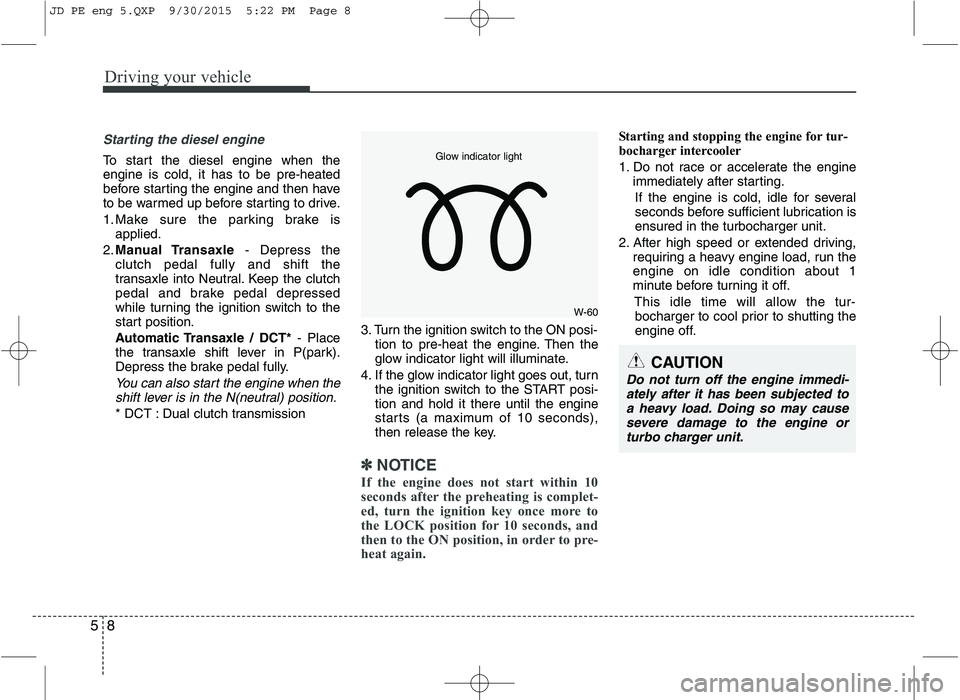
* DCT : Dual clutch transmission 3. Turn the ignition switch to the ON posi-
tion to pre-heat the engine. Then the
glow indicator light will illuminate.
4. If the glow indicator light goes out, turn the ignition switch to the START posi-tion and hold it there until the engine
starts (a maximum of 10 seconds),
then release the key.
✽✽
NOTICE
If the engine does not start within 10
seconds after the preheating is complet-
ed, turn the ignition key once more to
the LOCK position for 10 seconds, and
then to the ON position, in order to pre-
heat again.
Starting and stopping the engine for tur-
bocharger intercooler
1. Do not race or accelerate the engine immediately after starting.
If the engine is cold, idle for several
seconds before sufficient lubrication isensured in the turbocharger unit.
2. After high speed or extended driving, requiring a heavy engine load, run theengine on idle condition about 1
minute before turning it off.
This idle time will allow the tur-bocharger to cool prior to shutting the
engine off.
W-60
Glow indicator light
CAUTION
Do not turn off the engine immedi-
ately after it has been subjected to a heavy load. Doing so may cause
severe damage to the engine orturbo charger unit.
JD PE eng 5.QXP 9/30/2015 5:22 PM Page 8
Page 382 of 643

59
Driving your vehicle
ENGINE START/STOP BUTTON (IF EQUIPPED)
Illuminated engine start/stop but- ton
Whenever the front door is opened, the
engine start/stop button will illuminate for
your convenience. The light will go offafter about 30 seconds when the door is
closed. It will also go off immediately
when the theft-alarm system is armed. Engine start/stop button position
OFF
With manual transaxle
To turn off the engine (START/RUN posi-
tion) or vehicle power (ON position), stop
the vehicle then press the engine
start/stop button.
With automatic transaxle/DCT*
To turn off the engine (START/RUN posi-
tion) or vehicle power (ON position),
press the engine start/stop button with
the shift lever in the P (Park) position.
When you press the engine start/stop
button without the shift lever in the P
(Park) position, the engine start/stop but-ton will not change to the OFF position
but to the ACC position.
* DCT : Dual clutch transmissionVehicles equipped with anti-theft steering
column lock
The steering wheel locks when the
engine start/stop button is in the OFF
position to protect you against theft.
It locks when the door is opened.
If the steering wheel is not locked prop-
erly when you open the driver's door, the
warning chime will sound. Try locking the
steering wheel again. If the problem is
not solved, we recommend that the sys-
tem be checked by an authorized Kia
dealer.
In addition, if the engine start/stop button
is in the OFF position after the driver's
door is opened, the steering wheel will
not lock and the warning chime will
sound. In such a situation, close the door.
Then the steering wheel will lock and the
warning chime will stop.
✽✽
NOTICE
If the steering wheel doesn't unlock
properly, the engine start/stop button
will not work. Press the engine
start/stop button while turning the
steering wheel right and left to release
the tension.
OJD052001
White
JD PE eng 5.QXP 9/30/2015 5:23 PM Page 9
Page 385 of 643
Driving your vehicle
12
5
Starting the engine
✽✽
NOTICE - Kick down mecha- nism (if equipped)
If your vehicle is equipped with a kick
down mechanism in the accelerator
pedal, it prevents you from driving at
full throttle unintentionally by making
the driver require increased effort to
depress the accelerator pedal. However,
if you depress the pedal more than
approximately 80%, the vehicle can be
at full throttle and the accelerator pedal
will be easier to depress. This is not a
malfunction but a normal condition.
Starting the gasoline engine
1. Carry the smart key or leave it inside the vehicle.
2. Make sure the parking brake is firmly applied.
3. Manual Transaxle - Depress the
clutch pedal fully and shift the
transaxle into Neutral. Keep the clutch
pedal and brake pedal depressed
while starting the engine.
Automatic transaxle/DCT* - Place the
transaxle shift lever in P (Park).
Depress the brake pedal fully.
You can also start the engine when the
shift lever is in the N (Neutral) position.
* DCT : Dual clutch transmission
4. Press the engine start/stop button.
It should be started without depressing
the accelerator.
5. Do not wait for the engine to warm up while the vehicle remains stationary.
Start driving at moderate engine
speeds. (Steep accelerating and decel-
erating should be avoided.)
Starting the diesel engine
To start the diesel engine when the engine is cold, it has to be pre-heated
before starting the engine and then have
to be warmed up before starting to drive.
1. Make sure the parking brake is
applied.
2. Manual Transaxle - Depress the
clutch pedal fully and shift the
transaxle into Neutral. Keep the clutch
pedal and brake pedal depressed
while pressing the engine start/stop
button to the START position.
Automatic Transaxle / DCT* - Place
the transaxle shift lever in P (Park).
Depress the brake pedal fully.
You can also start the engine when the
shift lever is in the N (Neutral) position.
WARNING
Always wear appropriate shoes when operating your vehicle.
Unsuitable shoes (high heels, ski
boots,etc.) may interfere with
your ability to use the brake andaccelerator pedal.
Do not start the vehicle with the accelerator pedal depressed. The
vehicle can move and lead to anaccident.
Wait until the engine rpm is normal. The vehicle may suddenly move ifthe brake padel is released whenthe rpm is high.
JD PE eng 5.QXP 9/30/2015 5:23 PM Page 12
Page 404 of 643
531
Driving your vehicle
The Dual Clutch Transmission givesthe driving feel of a manual transmis-
sion, yet provides the ease of a fully
automatic transmission. Unlike a tradi-
tional automatic transmission, the gear
shifting can be felt (and heard) on the
dual clutch transmission
- Think of it as an automatically shiftingmanual transmission.
- Shift into Drive range and get fully automatic shifting, similar to a con-
ventional automatic transmission.
Dual clutch transmission adopts dry- type dual clutch, which is different from
torque converter of automatic trans-
mission, and shows better acceleration
performance during driving. But, initial
launch might be little bit slower than
Automatic Transmission.
The dry-type clutch transfers torque and provides a direct driving feeling
which may feel different from a con-
ventional automatic transmission with
a torque converter. This may be more
noticeable when starting from a stop or
low vehicle speed.
When rapidly accelerating at low vehi- cle speed, engine could rev at high rpm
depending on vehicle drive condition. For smooth launch uphill, press down
the accelerator pedal smoothly
depending on the current conditions.
If you release your foot from the accel- erator pedal at low vehicle speed, you
may feel strong engine brake, which is
similar to manual transmission.
When driving downhill, you may use Sports Mode and press the paddle
shifters to downshift to a lower gear in
order to control your speed without
using the brake pedal excessively.
When you turn the engine on and off, you may hear clicking sounds as the
system goes through a self test. This is
a normal sound for the Dual Clutch
Transmission.
WARNING
To reduce the risk of serious injury or death:
ALWAYS check the surrounding areas near your vehicle for peo-
ple, especially children, before
shifting a vehicle into D (Drive) or
R (Reverse).
Before leaving the driver’s seat, always make sure the shift lever
is in the P (Park) position, then
set the parking brake, and place
the ignition switch in the
LOCK/OFF position. Unexpected
and sudden vehicle movementcan occur if these precautions
are not followed.
Do not use engine braking (shift- ing from a high gear to lower
gear) rapidly on slippery roads.
The vehicle may slip causing anaccident.
JD PE eng 5.QXP 9/30/2015 5:24 PM Page 31
Page 407 of 643
Driving your vehicle
34
5
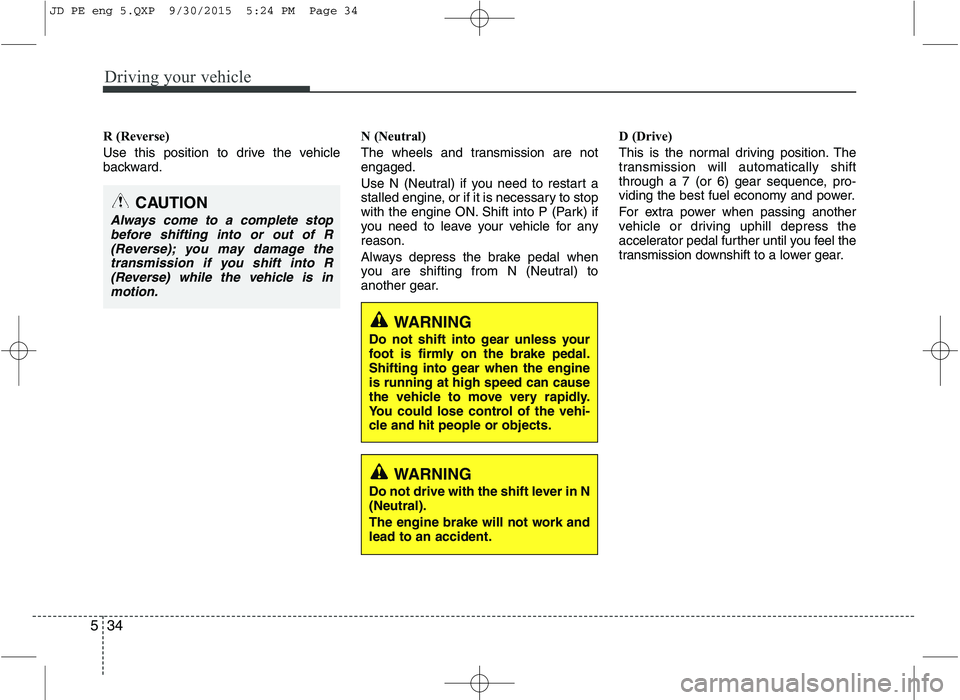
R (Reverse)
Use this position to drive the vehicle
backward. N (Neutral)
The wheels and transmission are not engaged.
Use N (Neutral) if you need to restart a
stalled engine, or if it is necessary to stop
with the engine ON. Shift into P (Park) if
you need to leave your vehicle for anyreason.
Always depress the brake pedal when
you are shifting from N (Neutral) to
another gear.D (Drive)
This is the normal driving position. The
transmission will automatically shift
through a 7 (or 6) gear sequence, pro-
viding the best fuel economy and power.
For extra power when passing another
vehicle or driving uphill depress the
accelerator pedal further until you feel the
transmission downshift to a lower gear.
WARNING
Do not shift into gear unless your
foot is firmly on the brake pedal.
Shifting into gear when the engineis running at high speed can cause
the vehicle to move very rapidly.
You could lose control of the vehi-
cle and hit people or objects.
WARNING
Do not drive with the shift lever in N (Neutral).
The engine brake will not work and lead to an accident.
CAUTION
Always come to a complete stop before shifting into or out of R (Reverse); you may damage thetransmission if you shift into R
(Reverse) while the vehicle is inmotion.
JD PE eng 5.QXP 9/30/2015 5:24 PM Page 34