clutch KIA CEED 2017 Owner's Manual
[x] Cancel search | Manufacturer: KIA, Model Year: 2017, Model line: CEED, Model: KIA CEED 2017Pages: 653, PDF Size: 54.59 MB
Page 398 of 653

Driving your vehicle
20
5
Manual transaxle operation
The manual transaxle has 6 forward
gears.
This shift pattern is imprinted on the
shift knob. The transaxle is fully syn-
chronized in all forward gears so shift-
ing to either a higher or a lower gear iseasily accomplished.
Depress the clutch pedal down fully while shifting, then release it slowly.
If your vehicle is equipped with an igni-
tion lock switch, the engine will not
start when starting the engine withoutdepressing the clutch pedal.
The shift lever must return to the neutral position before shifting into R (Reverse).
The button located immediately below
the shift knob must be pushed upward
(Type A) or the ring located below the
shift knob must be pulled upward (Type
B). while moving the shift lever to the R
(Reverse) position.
Make sure the vehicle is completely stopped before shifting into R(Reverse).
Never operate the engine with thetachometer (rpm) in the red zone.
MANUAL TRANSAXLE (IF EQUIPPED)
CAUTION
When downshifting from 5 (Fifth) gear to 4 (Fourth) gear, caution
should be taken not to inadvertent- ly move the shift lever sideways insuch a manner that second gear isengaged. Such a drastic downshift
may cause the engine speed toincrease to the point that the tachometer will enter the red-zone.
Such over-revving of the engine may possibly cause engine andtransaxle damage.
Do not downshift more than 2 gears or downshift the gear when
the engine is running at highspeed (5,000 RPM or higher). Such a downshifting may damage theengine, clutch and the transaxle.
When shifting between 5th and 6th gear, you should always pushthe gear level all the way to the right. You could otherwise shiftunintentionally into 3rd or 4th
gear and damage the transaxle.
The button (1) must be pushed while
moving the shift lever.
The shift lever can be moved without
pushing the button (1).
■
Type B
■
Type A
The shift lever can be moved without
pulling the ring (1).
The ring (1) must be pulled while
moving the shift lever.
OJD053058
OJD055004
Page 399 of 653

521
Driving your vehicle
During cold weather, shifting may bedifficult until the transaxle lubricant has
warmed up. This is normal and not
harmful to the transaxle.
If you've come to a complete stop and it's hard to shift into 1 (First) or R
(Reverse), put the shift lever in neutral
position and release the clutch. Press
the clutch pedal back down, and then
shift into 1 (First) or R (Reverse) gearposition.Using the clutch
The clutch pedal should be depressed all
the way to the floor before shifting, then
released slowly. The clutch pedal should
always be fully released while driving. Do
not rest your foot on the clutch pedal
while driving. This can cause unneces-
sary wear. Do not partially engage the
clutch to hold the vehicle on an incline.
This causes unnecessary wear. Use the
foot brake or parking brake to hold the
vehicle on an incline. Do not operate the
clutch pedal rapidly and repeatedly.
CAUTION
To avoid premature clutch wear
and damage, do not drive withyour foot resting on the clutchpedal. Also, don’t use the clutchto hold the vehicle stopped on an
uphill grade, while waiting for a traffic light, etc.
Do not use the shift lever as a handrest during driving, as thiscan result in premature wear of
the transaxle shift forks.
To prevent possible damage to the clutch system, do not start with the2nd (second) gear engaged exceptwhen you start on a slippery road.
WARNING
Before leaving the driver’s seat, always set the parking brake fully
and shut the engine off. Thenmake sure the transaxle is shifted
into 1 (First) gear when the vehi-
cle is parked on a level or uphill
grade, and shifted into R
(Reverse) on a downhill grade.
Unexpected and sudden vehicle
movement can occur if these pre-
cautions are not followed in the
order identified.
If your vehicle has a manual transaxle not equipped with a
ignition lock switch, it may moveand cause a serious accident
when starting the engine without
depressing the clutch pedal whilethe parking brake is released and
the shift lever not in the neutralposition.
CAUTION
When operating the clutch pedal,
depress the clutch pedal down fully.
If you don’t depress the clutch pedal fully, the clutch may be dam-aged or noise may occur.
Page 400 of 653

Driving your vehicle
22
5
Downshifting
When you must slow down in heavy traf-
fic or while driving up steep hills, down-
shift before the engine starts to labor.
Downshifting reduces the chance of
stalling and gives better acceleration
when you again need to increase your
speed. When the vehicle is traveling
down steep hills, downshifting helps
maintain safe speed and prolongs brake
life. Good driving practices
Never take the vehicle out of gear and
coast down a hill. This is extremely
hazardous. Always leave the vehicle in
gear.
Don't "ride" the brakes. This can cause them to overheat and malfunction.
Instead, when you are driving down a
long hill, slow down and shift to a lower
gear. When you do this, engine braking
will help slow down the vehicle.
Slow down before shifting to a lower gear. This will help avoid over-revving
the engine, which can cause damage.
Slow down when you encounter cross winds. This gives you much better con-
trol of your vehicle.
Be sure the vehicle is completely stopped before you attempt to shift into
R (Reverse). The transaxle can be dam-
aged if you do not. To shift into R
(Reverse), depress the clutch, move the
shift lever to neutral, wait three seconds,
then shift to the R (Reverse) position.
Exercise extreme caution when driving on a slippery surface. Be especially
careful when braking, accelerating or
shifting gears. On a slippery surface,
an abrupt change in vehicle speed can
cause the drive wheels to lose traction
and the vehicle to go out of control.WARNING
Always buckle-up! In a collision, an unbelted occupant is signifi-
cantly more likely to be seriously
injured or killed than a properlybelted occupant.
Avoid high speeds when corner- ing or turning.
Do not make quick steering wheel movements, such as sharp
lane changes or fast, sharp turns.
The risk of rollover is greatly increased if you lose control of
your vehicle at highway speeds.
Loss of control often occurs if two or more wheels drop off the
roadway and the driver over-
steers to reenter the roadway.
In the event your vehicle leaves the roadway, do not steer sharply.
Instead, slow down before pulling
back into the travel lanes.
Never exceed posted speed lim- its.
Page 408 of 653

Driving your vehicle
30
5
DUAL CLUTCH TRANSMISSION (DCT) (IF EQUIPPED)
Dual clutch transmission opera- tion
The dual clutch transmission has 7 (or 6)
forward speeds and one reverse speed. The individual speeds are selected auto-
matically in the D (Drive) position.
OJD052005
+
+++ ((((UUUUPPPP))))
---- ((((DDDDOOOOWWWWNNNN))))
The shift lever can be shifted freely.
Press the lock release button when shifting.
Depress the brake pedal and the lock release button when shifting.
(If the shift lock system is not equipped, it is not necessary to depress the brake pedal.
However, it is recommended to depress the brake pedal to avoid inadvertent movement
of the vehicle.)
WARNING
To reduce the risk of serious injury or death:
ALWAYS check the surrounding areas near your vehicle for peo-
ple, especially children, before
shifting a vehicle into D (Drive) or
R (Reverse).
Before leaving the driver’s seat, always make sure the shift lever
is in the P (Park) position, then
set the parking brake, and place
the ignition switch in the
LOCK/OFF position. Unexpected
and sudden vehicle movementcan occur if these precautions
are not followed.
Do not use engine braking (shift- ing from a high gear to lower
gear) rapidly on slippery roads.
The vehicle may slip causing anaccident.
Page 409 of 653

531
Driving your vehicle
The Dual Clutch Transmission givesthe driving feel of a manual transmis-
sion, yet provides the ease of a fully
automatic transmission. Unlike a tradi-
tional automatic transmission, the gear
shifting can be felt (and heard) on the
dual clutch transmission
- Think of it as an automatically shifting
manual transmission.
- Shift into Drive range and get fully automatic shifting, similar to a con-
ventional automatic transmission.
Dual clutch transmission adopts dry- type dual clutch, which is different from
torque converter of automatic trans-
mission, and shows better acceleration
performance during driving. But, initial
launch might be little bit slower than
Automatic Transmission.
The dry-type clutch transfers torque and provides a direct driving feeling
which may feel different from a con-
ventional automatic transmission with
a torque converter. This may be more
noticeable when starting from a stop or
low vehicle speed.
When rapidly accelerating at low vehi- cle speed, engine could rev at high rpm
depending on vehicle drive condition. For smooth launch uphill, press down
the accelerator pedal smoothly
depending on the current conditions.
If you release your foot from the accel- erator pedal at low vehicle speed, you
may feel strong engine brake, which is
similar to manual transmission.
When driving downhill, you may use Sports Mode and press the paddle
shifters to downshift to a lower gear in
order to control your speed without
using the brake pedal excessively.
When you turn the engine on and off, you may hear clicking sounds as the
system goes through a self test. This is
a normal sound for the Dual Clutch
Transmission.CAUTION
To hold the vehicle on a hill use
the foot brake or the parkingbrake. If the vehicle is held by
applying the accelerator pedal on a hill the clutch and transmissionwill be overheated resulting in damage.
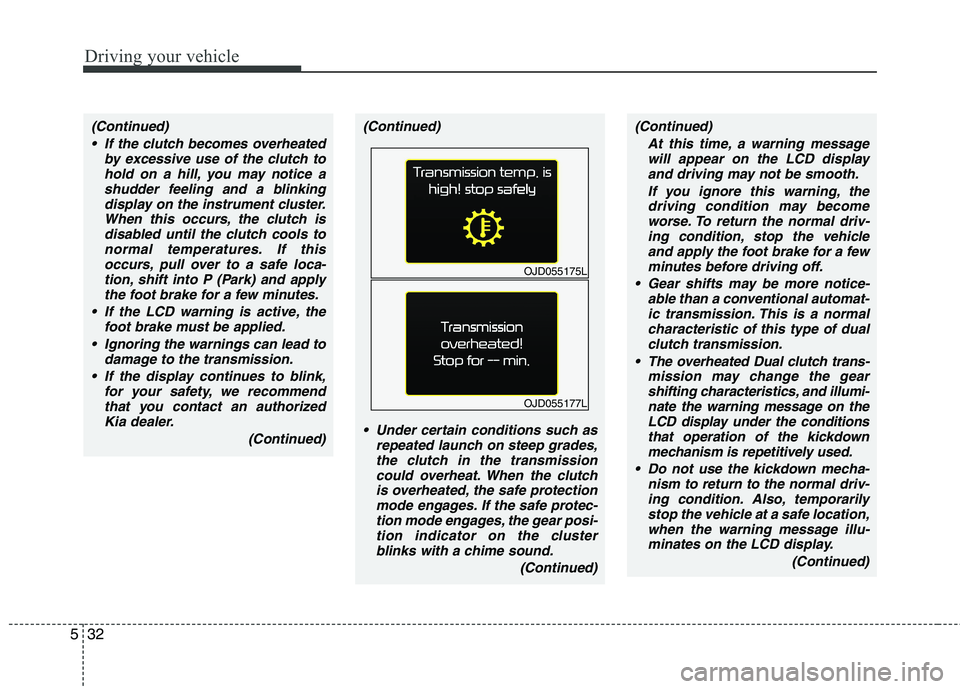
At this time, a warning messagewill appear on the LCD displayand you may feel a vibration.
(Continued)
OJD055176L
Page 410 of 653
Driving your vehicle
32
5
(Continued)
If the clutch becomes overheated by excessive use of the clutch tohold on a hill, you may notice a shudder feeling and a blinking
display on the instrument cluster.When this occurs, the clutch isdisabled until the clutch cools to
normal temperatures. If thisoccurs, pull over to a safe loca- tion, shift into P (Park) and applythe foot brake for a few minutes.
If the LCD warning is active, the foot brake must be applied.
Ignoring the warnings can lead to damage to the transmission.
If the display continues to blink, for your safety, we recommend
that you contact an authorizedKia dealer.
(Continued)(Continued)
Under certain conditions such asrepeated launch on steep grades,the clutch in the transmissioncould overheat. When the clutch
is overheated, the safe protectionmode engages. If the safe protec- tion mode engages, the gear posi-tion indicator on the cluster
blinks with a chime sound.
(Continued)
OJD055175L
OJD055177L
(Continued)At this time, a warning messagewill appear on the LCD display and driving may not be smooth.
If you ignore this warning, thedriving condition may becomeworse. To return the normal driv- ing condition, stop the vehicleand apply the foot brake for a few
minutes before driving off.
Gear shifts may be more notice- able than a conventional automat-ic transmission. This is a normalcharacteristic of this type of dual
clutch transmission.
The overheated Dual clutch trans- mission may change the gearshifting characteristics, and illumi- nate the warning message on the
LCD display under the conditions that operation of the kickdownmechanism is repetitively used.
Do not use the kickdown mecha- nism to return to the normal driv-ing condition. Also, temporarily stop the vehicle at a safe location,when the warning message illu-
minates on the LCD display.
(Continued)
Page 414 of 653
![KIA CEED 2017 Owners Manual Driving your vehicle
36
5
With the shift lever in the D position
The paddle shifter will operate when the
vehicle speed is more than 10km/h. Pull the [+] or [-] paddle shifter once to
shift up or](/img/2/57941/w960_57941-413.png "KIA CEED 2017 Owners Manual Driving your vehicle
36
5
With the shift lever in the D position
The paddle shifter will operate when the
vehicle speed is more than 10km/h. Pull the [+] or [-] paddle shifter once to
shift up or")
Driving your vehicle
36
5
With the shift lever in the D position
The paddle shifter will operate when the
vehicle speed is more than 10km/h. Pull the [+] or [-] paddle shifter once to
shift up or down one gear and the system
changes from automatic mode to manual
mode.
When the vehicle speed is lower than
10km/h, if you depress the accelerator
pedal for more than 5 seconds or if you
shift the shift lever from D (Drive) to
sports mode and shift it from sports
mode to D (Drive) again, the system
changes from manual mode to automatic
mode.
With the shift lever in the sports mode Pull the [+] or [-] paddle shifter once to
shift up or down one gear.
✽✽
NOTICE
If you pull the [+] and [-] paddle shifters
at the same time, you cannot shift the
gear.
Shift lock system (if equipped)
For your safety, the Dual clutch transmis-
sion has a shift lock system which pre-
vents shifting the transaxle from P (Park)
or N (Neutral) into R (Reverse) unless
the brake pedal is depressed.
To shift the transaxle from P (Park) or N
(Neutral) into R (Reverse):
1. Depress and hold the brake pedal.
2. Start the engine or turn the ignition switch to the ON position.
3. Move the shift lever.
If the brake pedal is repeatedly depressed and released with the shift
lever in the P (Park) position, a chattering
noise near the shift lever may be heard.
This is a normal condition. Shift-lock override
If the shift lever cannot be moved from
the P (Park) or N (Neutral) position into R
(Reverse) position with the brake pedal
depressed, continue depressing the
brake, then do the following:
1. Press the shift-lock release button.
2. Move the shift lever.
3. We recommend that the system be
inspected by an authorized Kia dealer.
WARNING
Always fully depress the brake
pedal before and while shifting out
of the P (Park) position into anoth-
er position to avoid inadvertent
motion of the vehicle which could
injure persons in or around the car.
OJD052007
Page 423 of 653

545
Driving your vehicle
To release EPB (electric parking brake)
automatically:
Manual transaxle vehicle1. Start the engine.
2. Fasten the driver's seat belt.
3. Close the driver's door, engine hood and tailgate.
4. Depress the clutch pedal with the gear engaged.
5. Depress the accelerator pedal while releasing the clutch pedal.
Automatic transaxle vehicle 1. Start the engine.
2. Fasten the driver's seat belt.
3. Close the driver's door, engine hood and tailgate.
4. Depress the accelerator pedal while the shift lever is in R (Rear), D (Drive).
Shift lever in P (Park)
With the engine running depress thebrake pedal and shift out of P (Park) to
R (Rear) or D (Drive).
Shift lever in N (Neutral) With the engine running depress the
brake pedal and shift out of N (Neutral)
to R (Rear) or D (Drive).
Make sure the brake warning light goes
off.✽✽ NOTICE
For your safety, you can engage the EPB even though the ignition switch or
engine stop/start button is in the OFF
position, but you cannot release it.
For your safety, depress the brake
pedal and release the parking brake
manually with the EPB switch when
you drive downhill or when backing up
the vehicle.
✽
✽ NOTICE - Manual transaxle
A vehicle towing a trailer on a hill or on
an incline may slightly roll backwards
when starting the vehicle. To prevent the
situation follow the below instructions.
1. Depress the clutch pedal and select a gear.
2. Keep pulling up the EPB switch.
3. Depress the accelerator pedal and slowly release the clutch pedal.
4. If the vehicle starts off with enough driving power release the EPB switch.
Do not follow the above procedure when
driving on a flat level ground. The vehi-
cle may suddenly move forward.
CAUTION
If the parking brake warning light is still on even though the EPB
has been released, we recom- mend that the system be checkedby an authorized Kia dealer.
Do not drive your vehicle with the EPB applied. It may cause exces-sive brake pad and brake rotorwear.
Page 436 of 653

Driving your vehicle
58
5
1. Cruise indicator
2. Cruise set indicator
The cruise control system allows you to
program the vehicle to maintain a con-stant speed without pressing the acceler-ator pedal. This system is designed to function
above approximately 30 km/h (20 mph).
✽✽
NOTICE
During normal cruise control opera- tion, when the SET switch is activated
or reactivated after applying the
brakes, the cruise control will ener-
gize after approximately 3 seconds.
This delay is normal.
To activate cruise control, depress the brake pedal at least once after turning
the ignition switch to the ON position
or starting the engine. This is to check
if the brake switch which is important
part to cancel cruise control is in nor-
mal condition.
CRUISE CONTROL SYSTEM (IF EQUIPPED)
WARNING
If the cruise control is left on, (cruise indicator light is illuminat-
ed), the cruise control can be
switched on accidentally. Keep
the cruise control system off
when the cruise control is not in
use, to avoid inadvertently set-ting a speed.
Use the cruise control system only when traveling on open
highways in good weather.
Do not use the cruise control when it may not be safe to keep
the vehicle at a constant speed,
for instance, driving in heavy or
varying traffic, or on slippery
(rainy, icy or snow-covered) or
winding roads or over 6% up-hill
or down-hill roads.
Pay particular attention to the driving conditions whenever
using the cruise control system.
Be careful when driving downhill using the cruise control system,
which may increase the vehiclespeed.
CAUTION
During cruise-speed driving of a
manual transaxle vehicle, do notshift into neutral without depress-ing the clutch pedal, since the
engine will be overrevved. If thishappens, depress the clutch pedalor release the cruise control ON- OFF switch.
OJD052015/OJD055048L
■ Supervision
■Normal vision
Page 439 of 653

561
Driving your vehicle
To cancel cruise control, do one
of the following:
Depress the brake pedal.
Depress the clutch pedal if equippedwith a manual transaxle.
Shift into N (Neutral) if equipped with an automatic transaxle.
Press the O (Cancel) button located on the steering wheel.
Decrease the vehicle speed lower than the memory speed by 20 km/h (12 mph).
Decrease the vehicle speed to less than approximately 30 km/h (20 mph).
Each of these actions will cancel cruise
control operation (the cruise setindicator
light will go off), but it will not turn the system off. If you wish to resume cruise
control operation, move up the lever (toRES+) located on your steering wheel.You will return to your previously preset speed.
To resume cruising speed at
more than approximately 30 km/h(20 mph):
If any method other than the button
was used to cancel cruising speed and
the system is still activated, the mostrecent set speed will automatically
resume when the +RES switch ispushed.
It will not resume, however, if the vehicle
speed has dropped below approximately30 km/h (20 mph).
OJD053020OJD053019