engine overheat KIA CEED 2017 Owner's Manual
[x] Cancel search | Manufacturer: KIA, Model Year: 2017, Model line: CEED, Model: KIA CEED 2017Pages: 653, PDF Size: 54.59 MB
Page 485 of 653

67
What to do in an emergency
5. Start the engine of the vehicle with thebooster battery and let it run at 2,000
rpm, then start the engine of the vehi-
cle with the discharged battery. If the
first starting attempt is not successful,
wait a few minutes before making
another attempt in order to allow the
discharged battery to recharge.
If the cause of your battery discharging is
not apparent, we recommend that the
system be checked by an authorized Kiadealer.
Push-starting
Your manual transaxle-equipped vehicle
should not be push-started because itmight damage the emission control sys-
tem. Vehicles equipped with automatic
transaxle cannot be push-started. Follow
the directions in this chapter for “Jump-
starting”.
WARNING
Never tow a vehicle to start it
because the sudden surge forward
when the engine starts could cause
a collision with the tow vehicle.
CAUTION - Battery cables
Do not connect the jumper cable
from the negative terminal of the
booster battery to the negative ter-minal of the discharged battery.This can cause the discharged bat- tery to overheat and crack, releas-
ing battery acid.
Make sure to connect one end ofthe jumper cable to the negative ter-minal of the booster battery, and the
other end to a metallic point, faraway from the battery.
Page 486 of 653

What to do in an emergency
8
6
IF THE ENGINE OVERHEATS
If your temperature gauge indicates over-
heating, you will experience a loss of
power, or hear loud pinging or knocking,
the engine is probably too hot. If this hap-
pens, you should:
1. Pull off the road and stop as soon as it is safe to do so.
2. Place the shift lever in P (automatic transaxle) or neutral (manual
transaxle) and set the parking brake. If
the air conditioning is on, turn it off.
3. If engine coolant is running out under the vehicle or steam is coming out
from the hood, stop the engine. Do notopen the hood until the coolant has
stopped running or the steaming has
stopped. If there is no visible loss of
engine coolant and no steam, leave
the engine running and check to be
sure the engine cooling fan is operat-
ing. If the fan is not running, turn the
engine off.
4. Check to see if the water pump drive belt is missing. If it is not missing,
check to see that it is tight. If the drive
belt seems to be satisfactory, check
for coolant leaking from the radiator,
hoses or under the vehicle. (If the air
conditioning had been in use, it is nor-
mal for cold water to be draining from
it when you stop). 5. If the water pump drive belt is broken
or engine coolant is leaking out, stop
the engine immediately and we recom-
mend that you call an authorized Kia
dealer. 6. If you cannot find the cause of the
overheating, wait until the engine tem-
perature has returned to normal. Then,if coolant has been lost, carefully add
coolant to the reservoir to bring the
fluid level in the reservoir up to the
halfway mark.
7. Proceed with caution, keeping alert for further signs of overheating. If over-
heating happens again, we recom-
mend that you call an authorized Kia
dealer.
CAUTION
Serious loss of coolant indicates
there is a leak in the cooling systemand we recommend that the systembe checked by an authorized Kia dealer.
WARNING
While the engine is running, keep
hair, hands and clothing away from
moving parts such as the fan and
drive belts to prevent injury.
WARNING
Do not remove the radiator cap
when the engine is hot. This can
allow coolant to blow out of the
opening and cause serious burns.
Page 499 of 653
621
What to do in an emergency
• Do not use the Tire Mobility Kit if atire is severely damaged by driving
run flat or with insufficient air pres-
sure.
Do not remove any foreign objects such as nails or screws that have
penetrated the tire.
Provided the car is outdoors, leave the engine running. Otherwise
operating the compressor may
eventually drain the car battery.
Never leave the Tire Mobility Kit unattended while it is being used.
Do not leave the compressor run- ning for more than 10 min. at a time
or it may overheat.
Do not use the Tire Mobility Kit if the ambient temperature is below -30°C (-22°F).
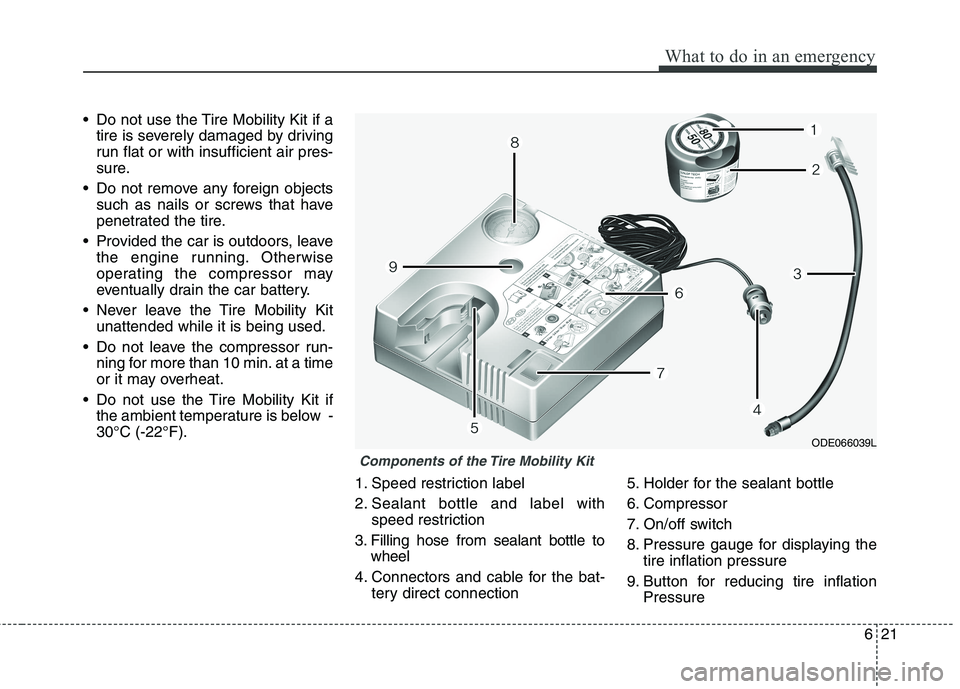
1. Speed restriction label
2. Sealant bottle and label withspeed restriction
3. Filling hose from sealant bottle to wheel
4. Connectors and cable for the bat- tery direct connection 5. Holder for the sealant bottle
6. Compressor
7. On/off switch
8. Pressure gauge for displaying the
tire inflation pressure
9. Button for reducing tire inflation Pressure
Components of the Tire Mobility Kit
ODE066039L
Page 507 of 653
629
What to do in an emergency
Do not use the Tire Mobility Kit if atire is severely damaged by driving
run flat or with insufficient air pres-
sure.
Do not remove any foreign objects such as nails or screws that have
penetrated the tire.
Provided the car is outdoors, leave the engine running. Otherwise
operating the compressor may
eventually drain the car battery.
Never leave the Tire Mobility Kit unattended while it is being used.
Do not leave the compressor run- ning for more than 10 min. at a time
or it may overheat.
Do not use the Tire Mobility Kit if the ambient temperature is below -30°C (-22°F).
Page 547 of 653
729
Maintenance
ENGINE COOLANT
The high-pressure cooling system has a
reservoir filled with year-round antifreeze
coolant. The reservoir is filled at the fac-
tory.
Check the antifreeze protection and
coolant concentration level at least once a
year, at the beginning of the winter season,
and before traveling to a colder climate. Checking the coolant level
WARNING
Removing radiatorcap
Never attempt to remove the radi- ator cap while the engine is oper-
ating or hot. Doing so might leadto cooling system and engine
damage and could result in seri-
ous personal injury from escap-ing hot coolant or steam.
Turn the engine off and wait until it cools down. Use extreme care
when removing the radiator cap.
Wrap a thick towel around it, and
turn it counterclockwise slowly to
the first stop. Step back while the
pressure is released from the cool-
ing system. When you are sure allthe pressure has been released,
press down on the cap, using a
thick towel, and continue turning
counterclockwise to remove it.
(Continued)
(Continued)
Even if the engine is not operat-ing, do not remove the radiator cap or the drain plug while the
engine and radiator are hot. Hot
coolant and steam may still blow
out under pressure, causing seri-
ous injury.
CAUTION
When the engine overheats from
low engine coolant, suddenlyadding engine coolant may causecracks in the engine. To preventdamage, add engine coolant
slowly in small quantities.
Do not drive with no engine coolant. It may cause water pumpfailure and engine seizure, etc.
JD PE eng 7.QXP 03.01.2017 17:17 Page 29
Page 647 of 653
Index
4
I
Engine coolant ..............................................................7-29
Changing the coolant ..................................................7-31
Checking the coolant level..........................................7-29
Engine number ..............................................................8-14
Engine oil ......................................................................7-27 Changing the engine oil and filter ..............................7-28
Checking the engine oil level ....................................7-27
Engine start/stop button ..................................................5-9 Engine start/stop button position ..................................5-9
Illuminated engine start/stop button ............................5-9
Starting the engine ......................................................5-12
Explanation of scheduled maintenance items ..............7-24
Exterior features ..........................................................4-182 Mounting bracket for roof carrier ............................4-182
Roof rack ..................................................................4-183
Exterior overview (Front) ................................................2-2
Exterior overview (Rear) ................................................2-3
Fuel filler lid ..................................................................4-31 Closing the fuel filler lid ............................................4-31
Opening the fuel filler lid ..........................................4-31
Fuel filter (for Diesel)....................................................7-34 Draining water from fuel filter ..................................7-34
Fuel requirements ............................................................1-2 Diesel engine ................................................................1-4
Gasoline engine ............................................................1-2 Fuses ..............................................................................7-56
Fuse/relay panel description ......................................7-61
Gross vehicle weight ......................................................8-5
Hazard warning flasher................................................4-120
Hood ..............................................................................4-29 Closing the hood ........................................................4-30
Opening the hood ........................................................4-29
How to use this manual ..................................................1-2
If the engine overheats ....................................................6-8
If the engine will not start ..............................................6-4 If engine doesn’t turn over or turns over slowly ..........6-4
If engine turns over normally but does not start ..........6-4
If you have a flat tire (with spare tire) ............................6-9 Changing tires ............................................................6-10
EC Declaration of Conformity for Jack......................6-18
Jack and tools ................................................................6-9
Jack label ....................................................................6-17
Removing and storing the spare tire ..........................6-10
Wheel nut tightening torque ......................................6-14
F
G
H
I