trailer KIA CEED 2017 Owner's Manual
[x] Cancel search | Manufacturer: KIA, Model Year: 2017, Model line: CEED, Model: KIA CEED 2017Pages: 653, PDF Size: 54.59 MB
Page 498 of 653
What to do in an emergency
20
6
It is possible that some tires, espe- cially with larger punctures or dam-
age to the sidewall, cannot be sealed
completely.
Air pressure loss in the tire may
adversely affect tire performance.
For this reason, you should avoid
abrupt steering or other driving
maneuvers, especially if the vehicle
is heavily loaded or if a trailer is in
use.
The Tire Mobility Kit is not designed
or intended as a permanent tire
repair method and is to be used for
one tire only. This instruction shows
you step by step how to temporarily
seal the puncture simply and reliably.
Read the section “Notes on the safe
use of the Tire Mobility Kit”.Notes on the safe use of the Tire
Mobility Kit
Park your car at the side of the
road so that you can work with the
Tire Mobility Kit away from moving
traffic.
To be sure your vehicle will not move, even when you're on fairly
level ground, always set your park-
ing brake.
Only use the Tire Mobility Kit for sealing/inflation passenger car
tires. Only punctured areas locatedwithin the tread region of the tirecan be sealed using the tire mobil-ity kit.
Do not use on motorcycles, bicy- cles or any other type of tires.
When the tire and wheel are dam- aged, do not use Tire Mobility Kit
for your safety.
Use of the Tire Mobility Kit may not be effective for tire damage larger
than approximately 6 mm (0.24 in).
If the tire cannot be made roadwor-
thy with the Tire Mobility Kit, we
recommend that you contact an
authorized Kia dealer.
WARNING
Do not use the TMK if a tire is
severely damaged by drivingrun flat or with insufficient air
pressure.
Only punctured areas located within the tread region of thetire can be sealed using theTMK.
Page 506 of 653
What to do in an emergency
28
6
It is possible that some tires, espe- cially with larger punctures or dam-
age to the sidewall, cannot be sealed
completely.
Air pressure loss in the tire may
adversely affect tire performance.
For this reason, you should avoid
abrupt steering or other driving
maneuvers, especially if the vehicle
is heavily loaded or if a trailer is in
use.
The Tire Mobility Kit is not designed
or intended as a permanent tire
repair method and is to be used for
one tire only. This instruction shows
you step by step how to temporarily
seal the puncture simply and reliably.
Read the section “Notes on the safe
use of the Tire Mobility Kit”.Notes on the safe use of the Tire
Mobility Kit
Park your car at the side of the
road so that you can work with the
Tire Mobility Kit away from moving
traffic.
To be sure your vehicle will not move, even when you're on fairly
level ground, always set your park-
ing brake.
Only use the Tire Mobility Kit for sealing/inflation passenger car
tires. Only punctured areas locatedwithin the tread region of the tirecan be sealed using the tire mobil-ity kit.
Do not use on motorcycles, bicy- cles or any other type of tires.
When the tire and wheel are dam- aged, do not use Tire Mobility Kit
for your safety.
Use of the Tire Mobility Kit may not be effective for tire damage larger
than approximately 6 mm (0.24 in).
If the tire cannot be made roadwor-
thy with the Tire Mobility Kit, we
recommend that you contact an
authorized Kia dealer.
WARNING
Do not use the TMK if a tire is
severely damaged by drivingrun flat or with insufficient air
pressure.
Only punctured areas located within the tread region of thetire can be sealed using theTMK.
Page 514 of 653
What to do in an emergency
36
6
TOWING
Towing service
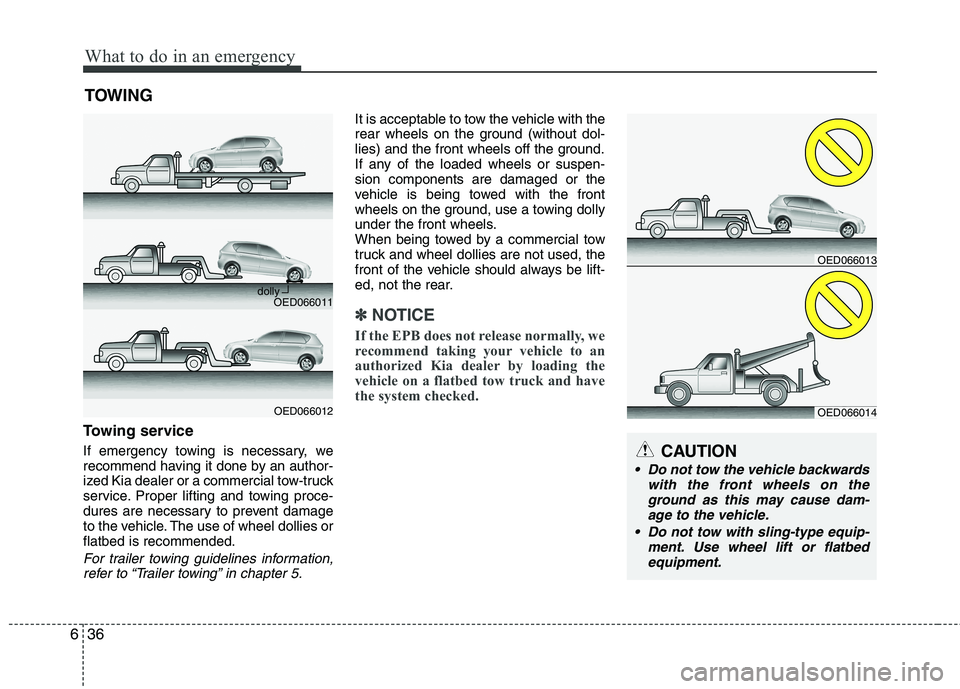
If emergency towing is necessary, we
recommend having it done by an author-
ized Kia dealer or a commercial tow-truck
service. Proper lifting and towing proce-
dures are necessary to prevent damage
to the vehicle. The use of wheel dollies orflatbed is recommended.
For trailer towing guidelines information, refer to “Trailer towing” in chapter 5.
It is acceptable to tow the vehicle with the
rear wheels on the ground (without dol-
lies) and the front wheels off the ground.
If any of the loaded wheels or suspen-sion components are damaged or the
vehicle is being towed with the front
wheels on the ground, use a towing dolly
under the front wheels.
When being towed by a commercial tow
truck and wheel dollies are not used, the
front of the vehicle should always be lift-
ed, not the rear.
✽✽ NOTICE
If the EPB does not release normally, we
recommend taking your vehicle to an
authorized Kia dealer by loading the
vehicle on a flatbed tow truck and have
the system checked.
CAUTION
Do not tow the vehicle backwards with the front wheels on the
ground as this may cause dam- age to the vehicle.
Do not tow with sling-type equip- ment. Use wheel lift or flatbed
equipment.
OED066011
OED066012
dolly
OED066014
OED066013
Page 529 of 653
711
Maintenance
SCHEDULED MAINTENANCE SERVICE
Follow Normal Maintenance Schedule
if the vehicle is usually operated where
none of the following conditions apply. If
any of the following conditions apply, fol-
low Maintenance Under Severe Usage
Conditions.
Repeated driving short distance of less than 8 km (5 miles) in normal tempera- ture or less than 16 km(10 miles) in
freezing temperature
Extensive engine idling or low speed driving for long distances
Driving on rough, dusty, muddy, unpaved, graveled or salt-spreadroads
Driving in areas using salt or other cor- rosive materials or in very cold weath-er
Driving in heavy dust condition
Driving in heavy traffic area
Driving on uphill, downhill, or mountain road repeatedly
Towing a trailer or using a camper, or roof rack
Driving as a patrol car, taxi, other com- mercial use of vehicle towing
Driving over 170 km/h (106 mile/h)
Frequently driving in stop-and-go con- dition
If your vehicle is operated under the
above conditions, you should inspect,replace or refill more frequently than the
following Normal Maintenance Schedule.After the periods or distance shown inthe chart, continue to follow the pre-
scribed maintenance intervals.
JD PE eng 7.QXP 03.01.2017 17:16 Page 11
Page 535 of 653
717
Maintenance
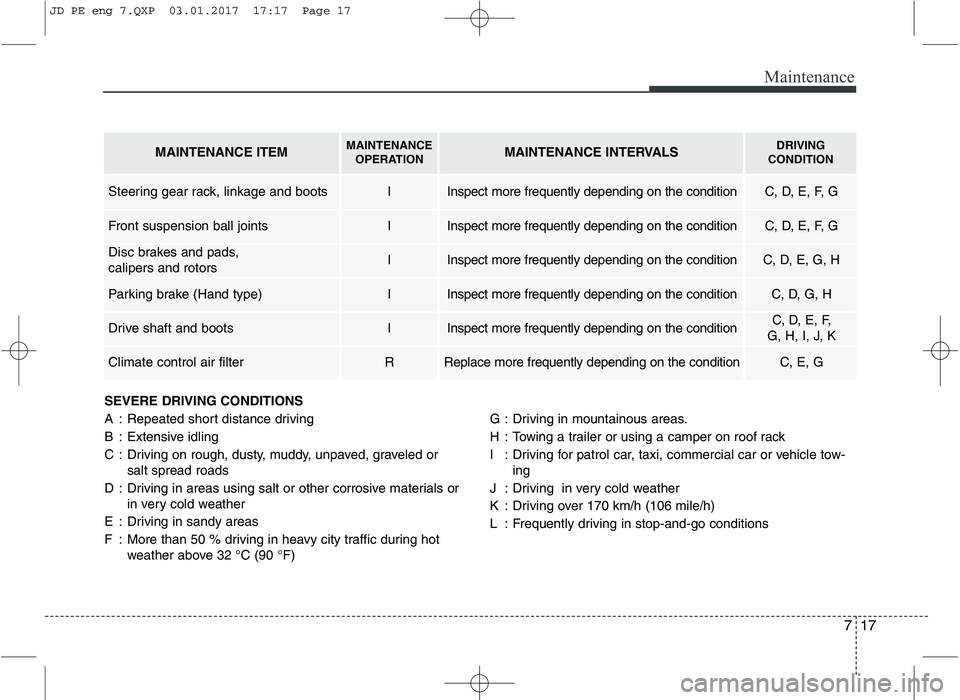
SEVERE DRIVING CONDITIONS
A : Repeated short distance driving
B : Extensive idling
C : Driving on rough, dusty, muddy, unpaved, graveled or salt spread roads
D : Driving in areas using salt or other corrosive materials or in very cold weather
E : Driving in sandy areas
F : More than 50 % driving in heavy city traffic during hot weather above 32 °C (90 °F) G : Driving in mountainous areas.
H : Towing a trailer or using a camper on roof rack
I : Driving for patrol car, taxi, commercial car or vehicle tow-
ing
J : Driving in very cold weather
K : Driving over 170 km/h (106 mile/h)
L : Frequently driving in stop-and-go conditions
MAINTENANCE ITEMMAINTENANCE OPERATIONMAINTENANCE INTERVALSDRIVING
CONDITION
Steering gear rack, linkage and bootsIInspect more frequently depending on the conditionC, D, E, F, G
Front suspension ball jointsIInspect more frequently depending on the conditionC, D, E, F, G
Disc brakes and pads, calipers and rotorsIInspect more frequently depending on the conditionC, D, E, G, H
Parking brake (Hand type)IInspect more frequently depending on the conditionC, D, G, H
Drive shaft and bootsIInspect more frequently depending on the conditionC, D, E, F,
G, H, I, J, K
Climate control air filter RReplace more frequently depending on the conditionC, E, G
JD PE eng 7.QXP 03.01.2017 17:17 Page 17
Page 541 of 653
723
Maintenance
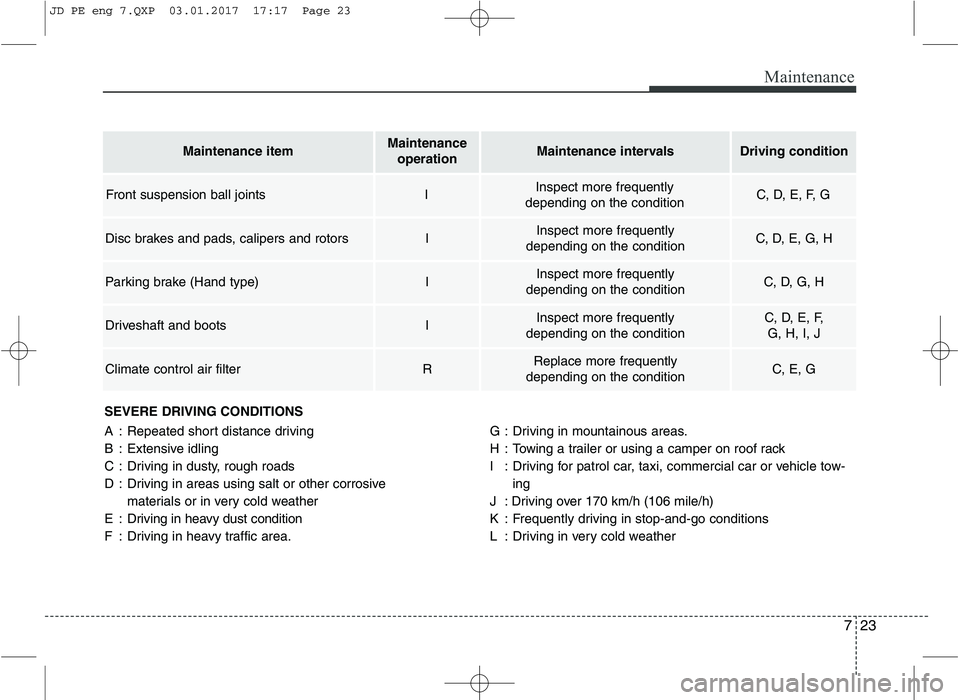
SEVERE DRIVING CONDITIONS
A : Repeated short distance driving
B : Extensive idling
C : Driving in dusty, rough roads
D : Driving in areas using salt or other corrosive materials or in very cold weather
E : Driving in heavy dust condition
F : Driving in heavy traffic area. G : Driving in mountainous areas.
H : Towing a trailer or using a camper on roof rack
I : Driving for patrol car, taxi, commercial car or vehicle tow-
ing
J : Driving over 170 km/h (106 mile/h)
K : Frequently driving in stop-and-go conditions
L : Driving in very cold weather
Maintenance itemMaintenance operationMaintenance intervalsDriving condition
Front suspension ball jointsIInspect more frequently
depending on the conditionC, D, E, F, G
Disc brakes and pads, calipers and rotorsIInspect more frequently
depending on the conditionC, D, E, G, H
Parking brake (Hand type)IInspect more frequently
depending on the conditionC, D, G, H
Driveshaft and bootsIInspect more frequently
depending on the conditionC, D, E, F, G, H, I, J
Climate control air filterRReplace more frequently
depending on the conditionC, E, G
JD PE eng 7.QXP 03.01.2017 17:17 Page 23
Page 652 of 653

I9
Index
Tailgate ..........................................................................4-22
Closing the tailgate ....................................................4-22
Emergency tailgate safety release ..............................4-23
Opening the tailgate ....................................................4-22
Theft-alarm system ........................................................4-14 Armed stage ................................................................4-14
Disarmed stage ............................................................4-16
Theft-alarm stage ........................................................4-15
Tire Pressure Monitoring System (TPMS) ....................6-30 Changing a tire with TPMS ........................................6-33
Tire specification and pressure label ............................8-14
Tires and wheels ....................................................7-45, 8-8 Checking tire inflation pressure ..................................7-47
Low aspect ratio tire ..................................................7-55
Recommended cold tire inflation pressures................7-45
Tire care ......................................................................7-45
Tire maintenance ........................................................7-51
Tire replacement ........................................................7-49
Tire rotation ................................................................7-48
Tire sidewall labeling..................................................7-51
Tire traction ................................................................7-51
Wheel alignment and tire balance ..............................7-49
Wheel replacement ....................................................7-51 Towing ..........................................................................6-36
Emergency towing ......................................................6-37
Removable towing hook ............................................6-37
Towing service ............................................................6-36
Trailer Towing ..............................................................5-90 Driving with a trailer ..................................................5-92
Hitches ........................................................................5-91
If you do decide to pull a trailer ................................5-97
Maintenance when trailer towing ..............................5-96
Safety chains ..............................................................5-92
Trailer brakes ..............................................................5-92
Vehicle break-in process ..................................................1-5
Vehicle certification label ..............................................8-13
Vehicle identification number (VIN) ............................8-13
Vehicle weight ............................................................5-100 Base curb weight ......................................................5-100
Cargo weight ............................................................5-100
GAW (Gross axle weight) ........................................5-100
GAWR (Gross axle weight rating) ..........................5-100
GVW (Gross vehicle weight) ..................................5-100
GVWR (Gross vehicle weight rating) ......................5-100
Overloading ..............................................................5-100
Vehicle curb weight ..................................................5-100
T
V