heating KIA CERATO 2004 User Guide
[x] Cancel search | Manufacturer: KIA, Model Year: 2004, Model line: CERATO, Model: KIA CERATO 2004Pages: 315, PDF Size: 68.16 MB
Page 187 of 315
475
1 23456789
Driving your vehicle
System operation
Ventilation
1. Set the mode to the position.
2. Set the air intake control to theoutside (fresh) air position.
3. Set the temperature control to the desired position.
4. Set the fan speed control to the desired speed.
Heating
1. Set the mode to the position.
2. Set the air intake control to theoutside (fresh) air position.
3. Set the temperature control to the desired position.
4. Set the fan speed control to the desired speed.
5. If dehumidified heating is desired, turn the air conditioning system on.
If cool air is desired at face level for bi-level operation, set the mode tothe position.
If the windshield fogs up, set the mode to the , position.
Air conditioning
All Kia Air Conditioning Systems are
filled with environmentally friendly
R-134a refrigerant which is not dam-
aging to the ozone layer.
1. Start the engine. Push the air con-
ditioning button.
2. Set the mode to the position.
3. Set the air intake control to the outside air or recirculated air posi- tion.
4. Set the temperature control to the desired position.
5. Set the fan speed control to the desired speed.
6. Adjust the fan speed control and temperature control to maintain
maximum comfort.
Page 188 of 315
Driving your vehicle
76
4
1 23456789
level for bi-level operation, set the
mode to the position and
adjust the temperature control to
maintain maximum comfort.
maximum cooling is desired, set the temperature con-
trol to the minimum 17°C/62°F
and set the air intake to the recir-culated air position, then set the
fan speed control to the highestspeed.✽✽NOTICE
When using the air conditioning sys-
tem, monitor the temperature gauge
closely while driving up hills or inheavy traffic when outside tempera-
tures are high. Air conditioning sys-tem operation may cause engineoverheating. Continue to use the
blower fan but turn the air condi-
tioning system off if the temperaturegauge indicates engine overheating. Air conditioning system oper- ation tips
If the vehicle has been parked in direct sunlight during hot weather,
open the windows for a short time
to let the hot air inside the vehicle
escape.
To help reduce moisture inside of windows on rainy humid days,decrease the humidity inside the
vehicle by operating the air condi-tioning system.
During air conditioning system operation, you may occasionallynotice a slight change in enginespeed at idle as the air condition-
ing compressor cycles on. This is
a normal system operation charac-
teristics.
Page 189 of 315
477
1 23456789
Driving your vehicle
Use the air conditioning systemevery month if only for a few min-
utes to ensure maximum system
performance.
When using the air conditioning system, you may notice clear water
dripping (or even pudding) on the
ground under the passenger side
of the vehicle. This is a normal sys-
tem operation characteristics.
The air conditioning system includes a function that automati-
cally turns the air conditioningcompressor off if engine coolant
temperature approaches an over
heating level. The air conditioning
compressor operation will resume
once engine coolant temperature
returns to the normal range. Also,the air conditioning compressor is
automatically turned off for a few
seconds when the accelerator isfully depressed (wide open throt-tle). When operating the air condition-
ing system use the outside (fresh)air position.
Operating the air conditioning sys- tem in the recirculated air position
does provide maximum cooling,
however, continual operation in this
mode may cause the air inside the
vehicle to become stale. Checking the amount of air
conditioner refrigerant andcompressor lubricant
When the amount of refrigerant is
low, the performance of the air con-
ditioning is reduced. Overfilling alsohas a bad influence on the air condi-tioning system.
Therefore, if abnormal operation is
found, have the system inspected by
an authorized Kia dealer.
Page 204 of 315
57
Driving tips
SPECIAL DRIVING CONDITIONS
Hazardous driving conditions
When hazardous driving conditions
are encountered such as water,
snow, ice, mud, sand, or similar haz-
ards, follow these suggestions:
Drive cautiously and allow extra distance for braking.
Avoid sudden movements in brak- ing or steering.
When braking, pump the brake pedal with a light up-and-down
motion until the vehicle is stopped.
✽✽ NOTICE
Do not pump the brake pedal on a
vehicle equipped with ABS.
If stalled in snow, mud, or sand, use second gear. Accelerate slow-
ly to avoid spinning the drive
wheels.
Use sand, rock salt, tire chains, or other non-slip material under the
drive wheels to provide traction
when stalled in ice, snow, or mud. Rocking the vehicle
If it is necessary to rock the vehicle
to free it from snow, sand, or mud,
first turn the steering wheel right and
left to clear the area around your
front wheels. Then, shift back and
forth between 1 (First) and R
(Reverse) in vehicles equipped with
a manual transaxle or R (Reverse)
and any forward gear in vehiclesequipped with an automatic
transaxle. Do not race the engine,and spin the wheels as little as pos-
sible. If you are still stuck after a few
tries, have the vehicle pulled out by a
tow vehicle to avoid engine overheat-
ing and possible damage to the
transaxle.
✽✽
NOTICE
Prolonged rocking may cause engine
over-heating, transaxle damage or
failure, and tire damage.
1 23456789
WARNING - Downshifting
Downshifting with an automatic
transaxle, while driving on slip-
pery surfaces can cause an
accident. The sudden change intire speed could cause the tires
to skid. Be careful when down-
shifting on slippery surfaces.
Page 216 of 315
519
Driving tips
1 23456789
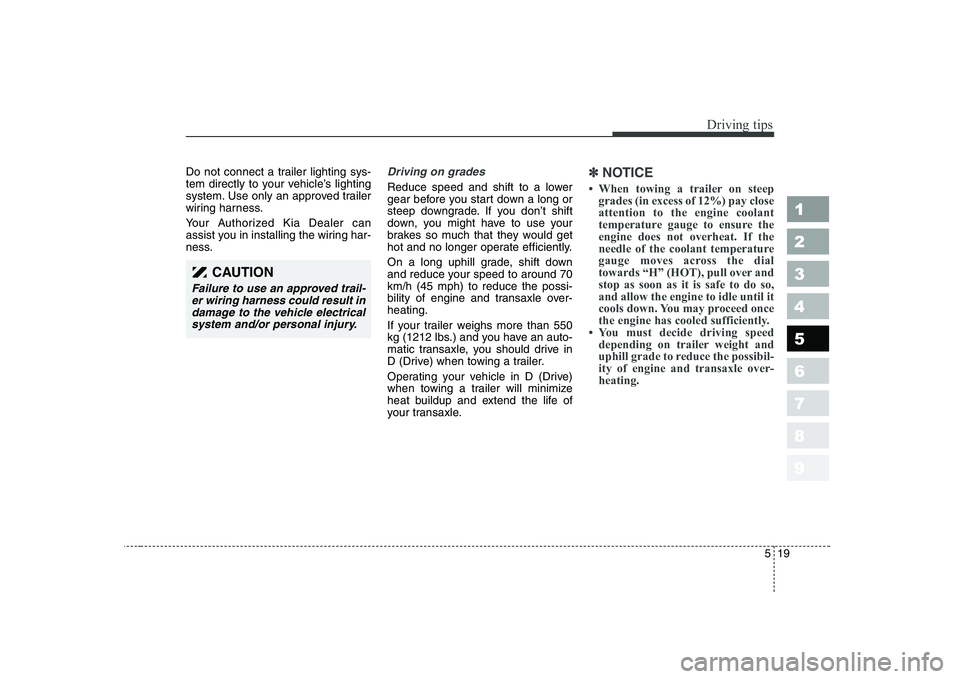
Do not connect a trailer lighting sys-
tem directly to your vehicle’s lighting
system. Use only an approved trailer
wiring harness.
Your Authorized Kia Dealer can
assist you in installing the wiring har-
ness.Driving on grades
Reduce speed and shift to a lower
gear before you start down a long or
steep downgrade. If you don’t shift
down, you might have to use your
brakes so much that they would get
hot and no longer operate efficiently.
On a long uphill grade, shift down
and reduce your speed to around 70km/h (45 mph) to reduce the possi-
bility of engine and transaxle over-heating.
If your trailer weighs more than 550
kg (1212 lbs.) and you have an auto-
matic transaxle, you should drive in
D (Drive) when towing a trailer.
Operating your vehicle in D (Drive)
when towing a trailer will minimize
heat buildup and extend the life of
your transaxle.
✽✽NOTICE
Page 221 of 315
1 234567891 23456789Road warning / 6-2 Overheating / 6-3Emergency starting / 6-4
Electrical circuit protection / 6-7
Towing / 6-14
If you have a flat tire / 6-19Emergency commodity / 6-24
In case of an emergency
Page 223 of 315
63
In case of an emergency
OVERHEATING
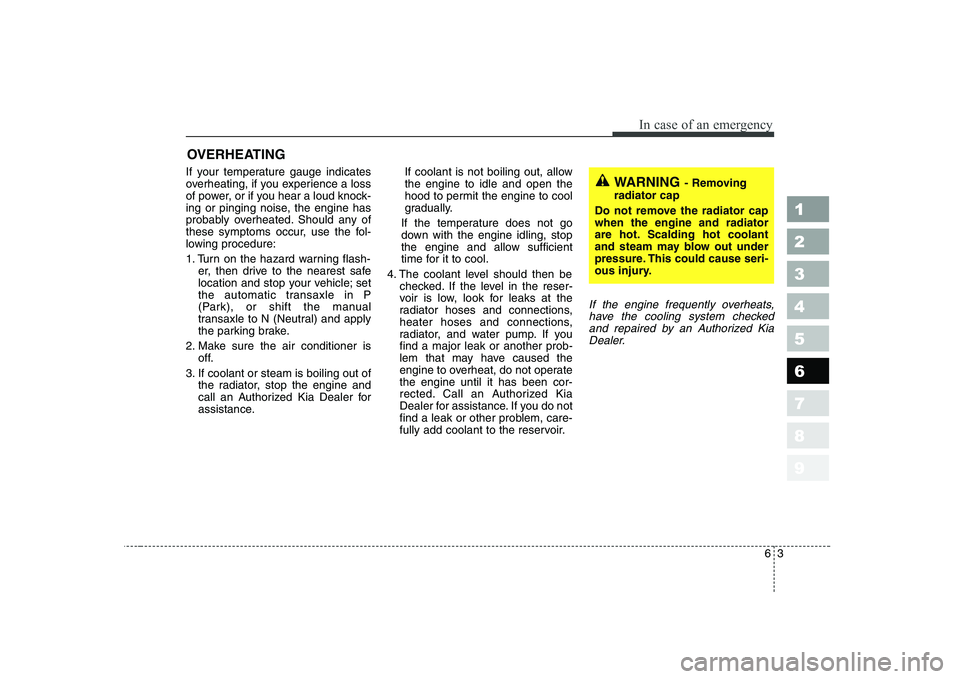
If your temperature gauge indicates
overheating, if you experience a loss
of power, or if you hear a loud knock-
ing or pinging noise, the engine has
probably overheated. Should any of
these symptoms occur, use the fol-
lowing procedure:
1. Turn on the hazard warning flash- er, then drive to the nearest safe
location and stop your vehicle; set
the automatic transaxle in P
(Park), or shift the manual
transaxle to N (Neutral) and apply
the parking brake.
2. Make sure the air conditioner is off.
3. If coolant or steam is boiling out of the radiator, stop the engine and
call an Authorized Kia Dealer for
assistance. If coolant is not boiling out, allowthe engine to idle and open the
hood to permit the engine to cool
gradually.
If the temperature does not go
down with the engine idling, stop
the engine and allow sufficient
time for it to cool.
4. The coolant level should then be checked. If the level in the reser-
voir is low, look for leaks at the
radiator hoses and connections,
heater hoses and connections,
radiator, and water pump. If youfind a major leak or another prob-
lem that may have caused the
engine to overheat, do not operatethe engine until it has been cor-
rected. Call an Authorized Kia
Dealer for assistance. If you do not
find a leak or other problem, care-
fully add coolant to the reservoir.
If the engine frequently overheats,
have the cooling system checkedand repaired by an Authorized Kia Dealer.
1 23456789
WARNING - Removing
radiator cap
Do not remove the radiator cap when the engine and radiator
are hot. Scalding hot coolant
and steam may blow out under
pressure. This could cause seri-
ous injury.
Page 228 of 315
In case of an emergency
8
6
Fuse replacement
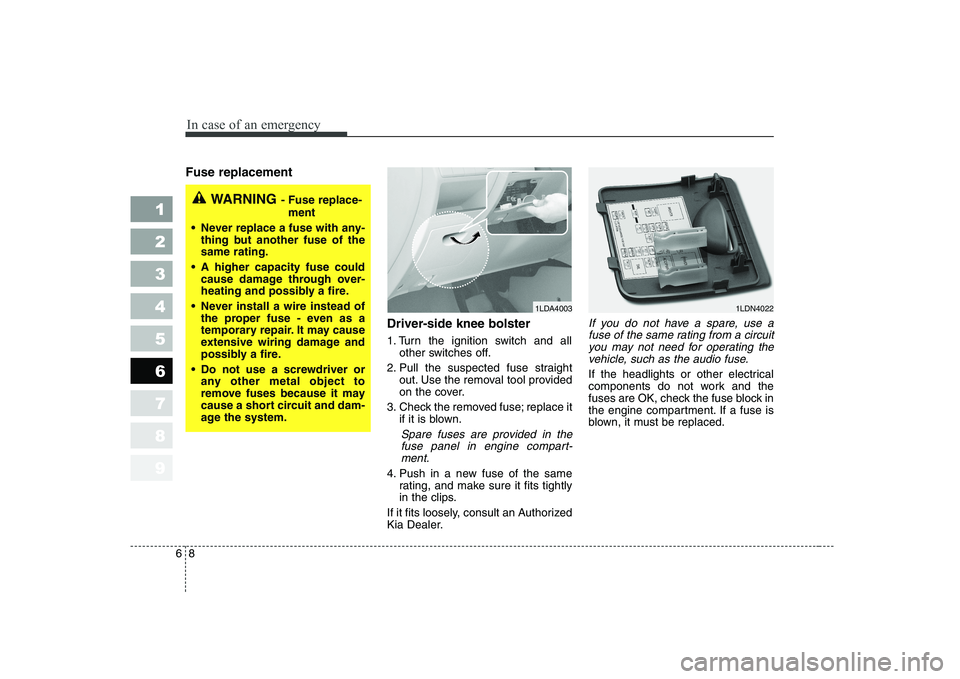
Driver-side knee bolster
1. Turn the ignition switch and allother switches off.
2. Pull the suspected fuse straight out. Use the removal tool provided
on the cover.
3. Check the removed fuse; replace it if it is blown.
Spare fuses are provided in the
fuse panel in engine compart-ment.
4. Push in a new fuse of the same rating, and make sure it fits tightly
in the clips.
If it fits loosely, consult an Authorized
Kia Dealer.
If you do not have a spare, use a fuse of the same rating from a circuityou may not need for operating thevehicle, such as the audio fuse.
If the headlights or other electrical
components do not work and the
fuses are OK, check the fuse block in
the engine compartment. If a fuse is
blown, it must be replaced.
1 23456789
1LDA40031LDN4022
WARNING - Fuse replace-
ment
Never replace a fuse with any- thing but another fuse of the same rating.
A higher capacity fuse could cause damage through over-
heating and possibly a fire.
Never install a wire instead of the proper fuse - even as a
temporary repair. It may cause
extensive wiring damage and
possibly a fire.
Do not use a screwdriver or any other metal object to
remove fuses because it may
cause a short circuit and dam-
age the system.
Page 280 of 315
735
Maintenance
1 23456789
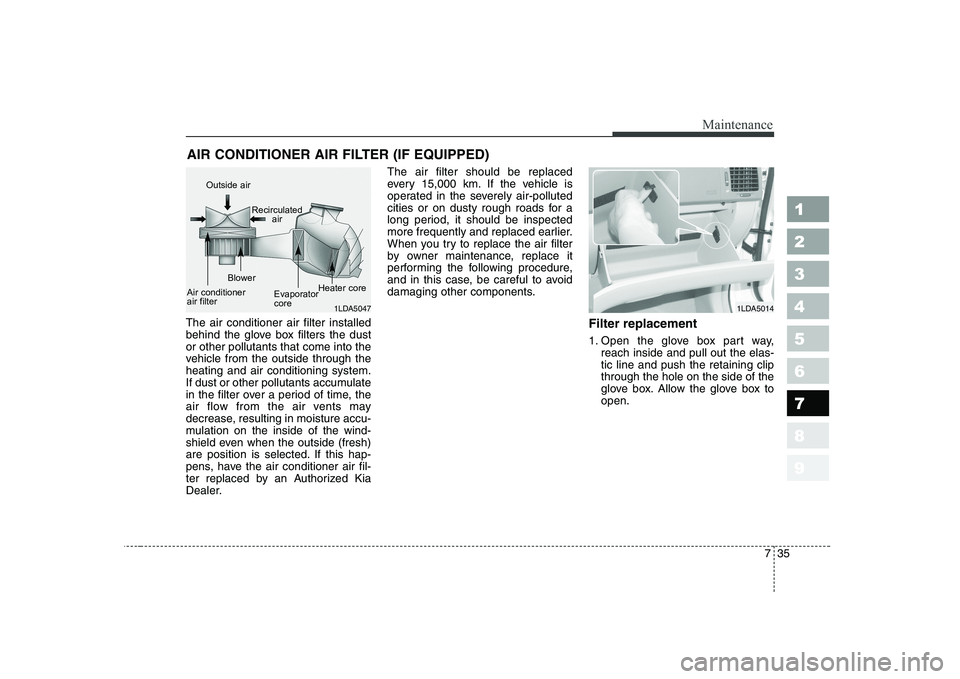
AIR CONDITIONER AIR FILTER (IF EQUIPPED)
The air conditioner air filter installed
behind the glove box filters the dustor other pollutants that come into the
vehicle from the outside through theheating and air conditioning system.
If dust or other pollutants accumulate
in the filter over a period of time, the
air flow from the air vents may
decrease, resulting in moisture accu-
mulation on the inside of the wind-
shield even when the outside (fresh)
are position is selected. If this hap-
pens, have the air conditioner air fil-
ter replaced by an Authorized Kia
Dealer. The air filter should be replaced
every 15,000 km. If the vehicle is
operated in the severely air-polluted
cities or on dusty rough roads for a
long period, it should be inspected
more frequently and replaced earlier.
When you try to replace the air filter
by owner maintenance, replace it
performing the following procedure,
and in this case, be careful to avoid
damaging other components.
Filter replacement
1. Open the glove box part way,reach inside and pull out the elas- tic line and push the retaining clipthrough the hole on the side of the
glove box. Allow the glove box toopen.
1LDA50141LDA5047
Outside air
Recirculatedair
Air conditioner air filter Blower
EvaporatorcoreHeater core
Page 314 of 315

93
1 23456789
Index
If you have a flat tire . . . . . . . . . . . . . . . . . . . . . . . . 6-19
Ignition switch . . . . . . . . . . . . . . . . . . . . . . . . . . . . . . 4-2
Immobilizer system . . . . . . . . . . . . . . . . . . . . . . . . . . 3-7
Instrument cluster . . . . . . . . . . . . . . . . . . . . . . . . . . 4-33
Instrument panel overview . . . . . . . . . . . . . . . . . . . . 2-5
Interior care . . . . . . . . . . . . . . . . . . . . . . . . . . . . . . . 7-62
Interior features . . . . . . . . . . . . . . . . . . . . . . . . . . . . 3-91
Interior lights . . . . . . . . . . . . . . . . . . . . . . . . . . . . . . 3-86
Interior overview . . . . . . . . . . . . . . . . . . . . . . . . . . . . 2-4
Keys . . . . . . . . . . . . . . . . . . . . . . . . . . . . . . . . . . . . . . 3-2
Label information . . . . . . . . . . . . . . . . . . . . . . . . . . 5-22
Lighting . . . . . . . . . . . . . . . . . . . . . . . . . . . . . . . . . . 4-46
Lubricant specifications . . . . . . . . . . . . . . . . . . . . . . 7-56
Lubricants and fluids . . . . . . . . . . . . . . . . . . . . . . . . 7-31
Luggage net . . . . . . . . . . . . . . . . . . . . . . . . . . . . . . . 3-99
Maintenance services . . . . . . . . . . . . . . . . . . . . . . . . . 7-3
Maintenance under severe usage conditions . . . . . . . 7-8Manual climate control system . . . . . . . . . . . . . . . . 4-57
Manual transaxle . . . . . . . . . . . . . . . . . . . . . . . 4-7, 7-26
Mirrors . . . . . . . . . . . . . . . . . . . . . . . . . . . . . . . . . . . 3-82
Normal maintenance schedule . . . . . . . . . . . . . . . . . . 7-5
Overheating . . . . . . . . . . . . . . . . . . . . . . . . . . . . . . . . 6-3
Overloading . . . . . . . . . . . . . . . . . . . . . . . . . . . . . . . 5-21
Owner maintenance . . . . . . . . . . . . . . . . . . . . . . . . . 7-10
Parking brake. . . . . . . . . . . . . . . . . . . . . . . . . . . . . . 7-23
Power steering . . . . . . . . . . . . . . . . . . . . . . . . . . . . . 7-25
Remote keyless entry . . . . . . . . . . . . . . . . . . . . . . . . . 3-4
Road warning . . . . . . . . . . . . . . . . . . . . . . . . . . . . . . . 6-2
Safety belts . . . . . . . . . . . . . . . . . . . . . . . . . . . . . . . . 3-30
Seat . . . . . . . . . . . . . . . . . . . . . . . . . . . . . . . . . . . . . . 3-16
I
K
L
M
N
O
P
R
S