wheel KIA CERATO 2004 Workshop Manual
[x] Cancel search | Manufacturer: KIA, Model Year: 2004, Model line: CERATO, Model: KIA CERATO 2004Pages: 315, PDF Size: 68.16 MB
Page 291 of 315
Maintenance
46
7
1 23456789
Tire size designation
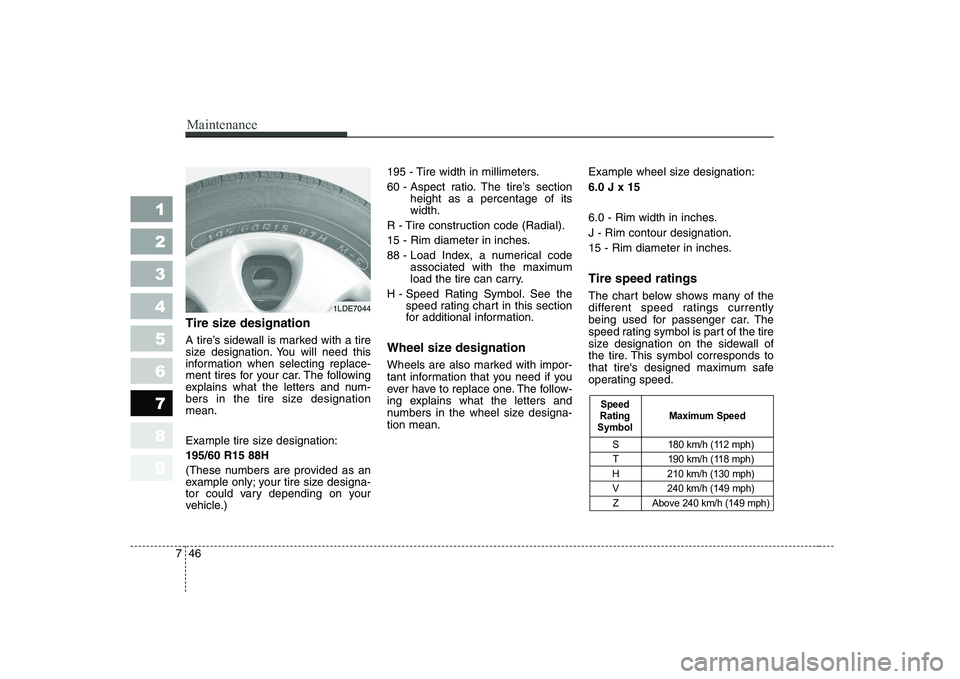
A tire’s sidewall is marked with a tire
size designation. You will need this
information when selecting replace-
ment tires for your car. The following
explains what the letters and num-
bers in the tire size designationmean.
Example tire size designation: 195/60 R15 88H
(These numbers are provided as an
example only; your tire size designa-
tor could vary depending on your
vehicle.) 195 - Tire width in millimeters.
60 - Aspect ratio. The tire’s section
height as a percentage of its width.
R - Tire construction code (Radial).
15 - Rim diameter in inches.
88 - Load Index, a numerical code associated with the maximum
load the tire can carry.
H - Speed Rating Symbol. See the speed rating chart in this section
for additional information.
Wheel size designation
Wheels are also marked with impor-
tant information that you need if you
ever have to replace one. The follow-
ing explains what the letters and
numbers in the wheel size designa-tion mean. Example wheel size designation: 6.0 J x 15
6.0 - Rim width in inches. J - Rim contour designation.
15 - Rim diameter in inches. Tire speed ratings
The chart below shows many of the
different speed ratings currently
being used for passenger car. The
speed rating symbol is part of the tire
size designation on the sidewall of
the tire. This symbol corresponds to
that tire's designed maximum safe
operating speed.
S 180 km/h (112 mph)
T 190 km/h (118 mph)
H 210 km/h (130 mph) V 240 km/h (149 mph)
Z Above 240 km/h (149 mph)
Maximum Speed
Speed
Rating
Symbol
1LDE7044
Page 292 of 315
747
Maintenance
1 23456789
Uniform tire quality grading
Tread wear
The tread wear grade is a compara-
tive rating based on the wear rate ofthe tire when tested under controlled
conditions on a specified govern-
ment test course. For example, a tire
graded 150 would wear one-and-a-
half times as well on the government
course as a tire graded 100.The relative performance of tiresdepends upon the actual conditions
of their use. However, performance
may differ from the norm because of
variations in driving habits, service
practices and differences in road
characteristics and climate.
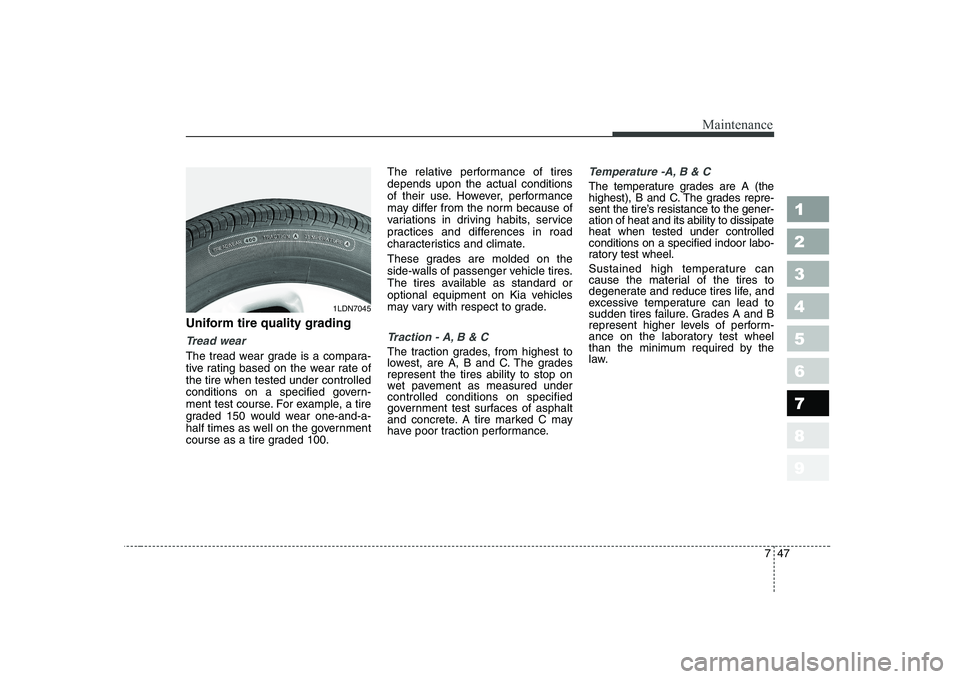
These grades are molded on the
side-walls of passenger vehicle tires.
The tires available as standard or
optional equipment on Kia vehicles
may vary with respect to grade.
Traction - A, B & C
The traction grades, from highest to
lowest, are A, B and C. The gradesrepresent the tires ability to stop on
wet pavement as measured undercontrolled conditions on specified
government test surfaces of asphalt
and concrete. A tire marked C may
have poor traction performance.
Temperature -A, B & C
The temperature grades are A (the
highest), B and C. The grades repre-
sent the tire’s resistance to the gener-ation of heat and its ability to dissipateheat when tested under controlledconditions on a specified indoor labo-
ratory test wheel.
Sustained high temperature can
cause the material of the tires to
degenerate and reduce tires life, and
excessive temperature can lead to
sudden tires failure. Grades A and B
represent higher levels of perform-
ance on the laboratory test wheel
than the minimum required by the
law.
1LDN7045
Page 293 of 315
Maintenance
48
7
1 23456789
Checking a tire life
Tire strength and performance
decline with age. Any tires that are
over 6 year old, including the spare
(determined by the tire manufacturedate), should be replaced regardless
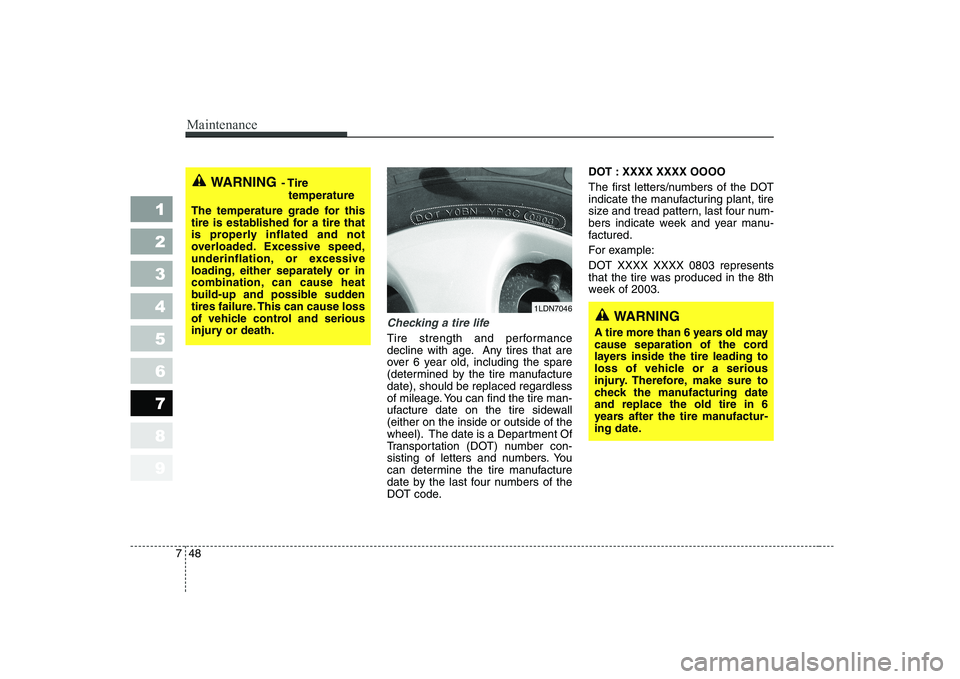
of mileage. You can find the tire man-
ufacture date on the tire sidewall(either on the inside or outside of the
wheel). The date is a Department Of
Transportation (DOT) number con-
sisting of letters and numbers. You
can determine the tire manufacture
date by the last four numbers of the
DOT code. DOT : XXXX XXXX OOOO
The first letters/numbers of the DOT
indicate the manufacturing plant, tire
size and tread pattern, last four num-
bers indicate week and year manu-
factured.
For example:
DOT XXXX XXXX 0803 represents
that the tire was produced in the 8th
week of 2003.
WARNING
A tire more than 6 years old may
cause separation of the cord
layers inside the tire leading to
loss of vehicle or a serious
injury. Therefore, make sure to
check the manufacturing dateand replace the old tire in 6
years after the tire manufactur-
ing date.
WARNING - Tire
temperature
The temperature grade for this
tire is established for a tire that
is properly inflated and not
overloaded. Excessive speed,
underinflation, or excessive
loading, either separately or in
combination, can cause heat
build-up and possible sudden
tires failure. This can cause loss
of vehicle control and serious
injury or death.
1LDN7046
Page 305 of 315
Maintenance
60
7
1 23456789
Bright-metal maintenance
To remove road tar and insects,
use a tar remover, not a scraper or
other sharp object.
To protect the surfaces of bright- metal parts from corrosion, apply a
coating of wax or chrome preser-
vative and rub to a high luster.
During winter weather or in coastal areas, cover the bright metal parts
with a heavier coating of wax or
preservative. If necessary, coat the
parts with non-corrosive petroleum
jelly or other protective compound. Underbody maintenance
Corrosive materials used for ice and
snow removal and dust control may
collect on the underbody. If these
materials are not removed, acceler-
ated rusting can occur on underbody
parts such as the fuel lines, frame,
floor pan and exhaust system, even
though they have been treated with
rust protection.
Thoroughly flush the vehicle under-
body and wheel openings with luke-
warm or cold water once a month,
after off-road driving and at the end
of each winter. Pay special attentionto these areas because it is difficult
to see all the mud and dirt. It will do
more harm than good to wet down
the road grime without removing it.
The lower edges of doors, rocker
panels, and frame members have
drain holes that should not be
allowed to clog with dirt; trapped
water in these areas can cause rust-ing.WARNING
After washing the vehicle, test
the brakes while driving slowly
to see if they have been affected
by water. If braking performance
is impaired, dry the brakes by
applying them lightly while
maintaining a slow forwardspeed.
Page 306 of 315
761
Maintenance
1 23456789
Aluminum wheel maintenance
The aluminum wheels are coated
with a clear protective finish.
Do not use any abrasive cleaner,polishing compound, solvent, or
wire brushes on aluminum wheels.
They may scratch or damage thefinish.
Use only a mild soap or neutral detergent, and rinse thoroughly
with water. Also, be sure to clean
the wheels after driving on salted
roads. This helps prevent corro-sion.
Avoid washing the wheels with high-speed car wash brushes.
Do not use any acid detergent. It may damage and corrode the alu-
minum wheels coated with a clear
protective finish.
Page 309 of 315
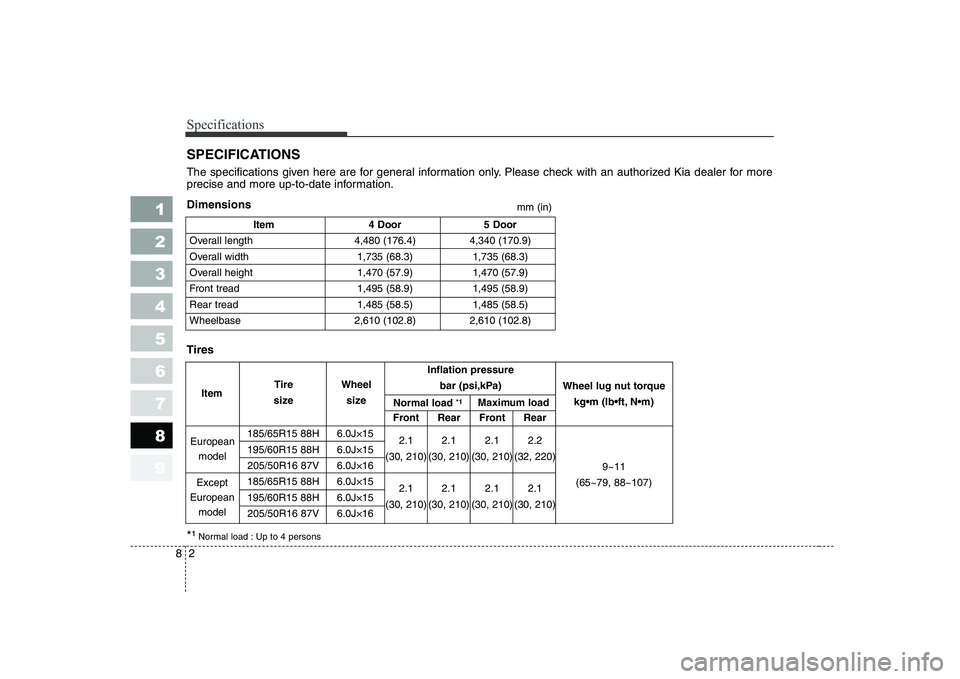
Inflation pressure bar (psi,kPa)
Front Rear Front Rear
185/65R15 88H 6.0J×15 2.1 2.1 2.1 2.2
195/60R15 88H 6.0J×15 (30, 210) (30, 210) (30, 210) (32, 220)
205/50R16 87V 6.0J×16
185/65R15 88H 6.0J×15 2.1 2.1 2.1 2.1
195/60R15 88H 6.0J×15 (30, 210) (30, 210) (30, 210) (30, 210)
205/50R16 87V 6.0J×16
Specifications
2
8
1 23456789
Item 4 Door 5 Door
Overall length 4,480 (176.4) 4,340 (170.9)
Overall width 1,735 (68.3) 1,735 (68.3)
Overall height 1,470 (57.9) 1,470 (57.9)
Front tread 1,495 (58.9) 1,495 (58.9)
Rear tread 1,485 (58.5) 1,485 (58.5)
Wheelbase 2,610 (102.8) 2,610 (102.8)
SPECIFICATIONS
The specifications given here are for general information only. Please check with an authorized Kia dealer for more
precise and more up-to-date information.
European model
Except
European model Normal load
*1
Maximum load Wheel lug nut torque
9~11
(65~79, 88~107)
Dimensions
mm (in)
Tires *¹ Normal load : Up to 4 personsItem
Tire
size Wheel
size
Page 315 of 315

Index
4
9
1 23456789
Special driving conditions . . . . . . . . . . . . . . . . . . . . . 5-7
Specifications . . . . . . . . . . . . . . . . . . . . . . . . . . . . . . . 8-2
Starting the engine . . . . . . . . . . . . . . . . . . . . . . . . . . . 4-4
Steering wheel . . . . . . . . . . . . . . . . . . . . . . . . . 4-22, 7-26
Storage compartment . . . . . . . . . . . . . . . . . . . . . . . . 3-88
Suggestions for economical operation . . . . . . . . . . . . 5-6
Sunroof . . . . . . . . . . . . . . . . . . . . . . . . . . . . . . . . . . . 3-96
Theft-alarm system . . . . . . . . . . . . . . . . . . . . . . . . . 4-84
Tires and wheels . . . . . . . . . . . . . . . . . . . . . . . . . . . . 7-42
Towing . . . . . . . . . . . . . . . . . . . . . . . . . . . . . . . . . . . 6-14
Traction control system . . . . . . . . . . . . . . . . . . . . . . 4-30
Trailer towing . . . . . . . . . . . . . . . . . . . . . . . . . . . . . . 5-13
Trunk . . . . . . . . . . . . . . . . . . . . . . . . . . . . . . . . . . . . 3-75
Vehicle break-in process . . . . . . . . . . . . . . . . . . . . . . 1-3 Warnings and indicators . . . . . . . . . . . . . . . . . . . . . 4-38
Window. . . . . . . . . . . . . . . . . . . . . . . . . . . . . . . . . . . 3-13
Windshield defrosting and defogging . . . . . . . . . . . 4-79
Wiper blades. . . . . . . . . . . . . . . . . . . . . . . . . . . . . . . 7-37
Wipers and washers . . . . . . . . . . . . . . . . . . . . . . . . . 4-52
T
W
V