climate control KIA CERATO 2006 User Guide
[x] Cancel search | Manufacturer: KIA, Model Year: 2006, Model line: CERATO, Model: KIA CERATO 2006Pages: 315, PDF Size: 11.29 MB
Page 193 of 315
481
1 23456789
Driving your vehicle
For maximum defrosting, set the
temperature control to the extreme
right/hot position and the fan speedcontrol to the highest speed.
If warm air to the floor is desired
while defrosting or defogging, setthe mode to the floor-defrost posi-tion.
Before driving, clear all snow andice from the windshield, rear win-
dow, outside rear view mirrors, and
all side windows.
Clear all snow and ice from the
hood and air inlet in the cowl grill to
improve heater and defroster effi-ciency and to reduce the probabili-
ty of fogging up inside of the wind-shield. Defogging logic
Manual climate control system
To reduce the probability of fogging up the inside of the windshield, the
air intake control is set to the outside(fresh) air position automatically if
any of following occur.
The mode is selected to the ,
or while the system is acti-
vated.
The ignition switch is turned on while the mode is selected to the
, or .
In this case, the air conditioning will
automatically operate if the mode is
selected to the or .
If you don ’t want the air-conditioning
or outside (fresh) air position, press
the corresponding button to cancel
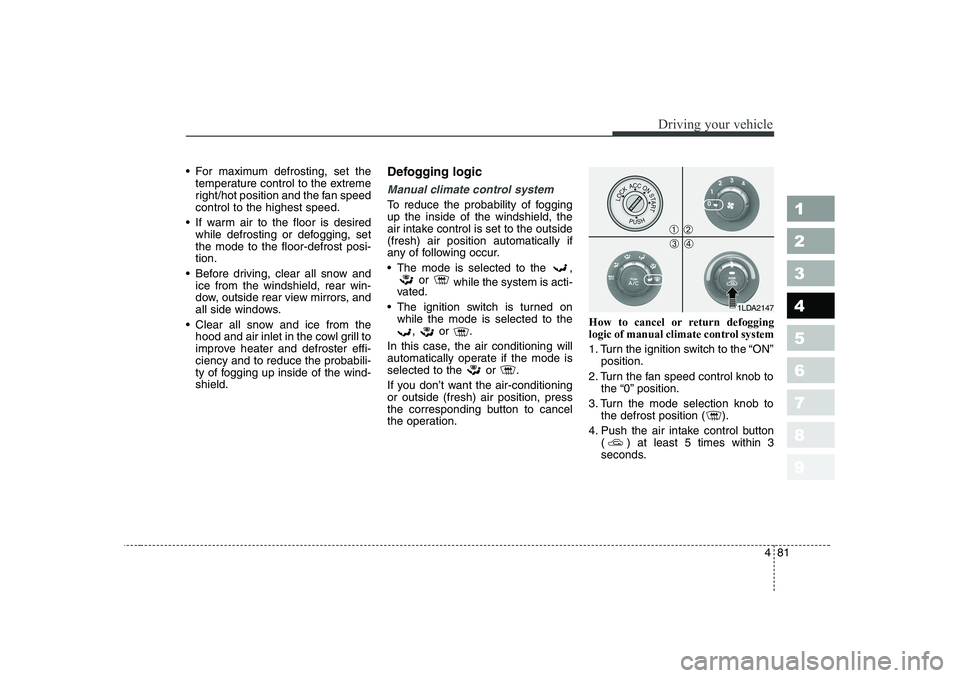
the operation. How to cancel or return defogging
logic of manual climate control system
1. Turn the ignition switch to the
“ON ”
position.
2. Turn the fan speed control knob to the “0”position.
3. Turn the mode selection knob to the defrost position ( ).
4. Push the air intake control button ( ) at least 5 times within 3
seconds.
1LDA2147
➀➁
➂➃
Page 194 of 315
Driving your vehicle
82
4
1 23456789
Then the indicator light in the air
intake control button will blink 3 times
with 0.5 second of interval. It indi-
cates that the defogging logic is can-
celed or returned to the programmed
status.
If the battery has been discharged or
disconnected, it is reset as the defog
logic status.Automatic climate control system
To reduce the probability of fogging up inside of the windshield, the air
intake control is set to outside (fresh)
air position automatically if any of fol-
lowing occur. The ignition switch is turned on.
The OFF button is pushed.
The mode is selected to the or
position.
In this case, the air conditioning will
automatically operate if the mode is
selected to the or .
If you don ’t want the air-conditioning
or outside (fresh) air position, press
the corresponding button to cancel
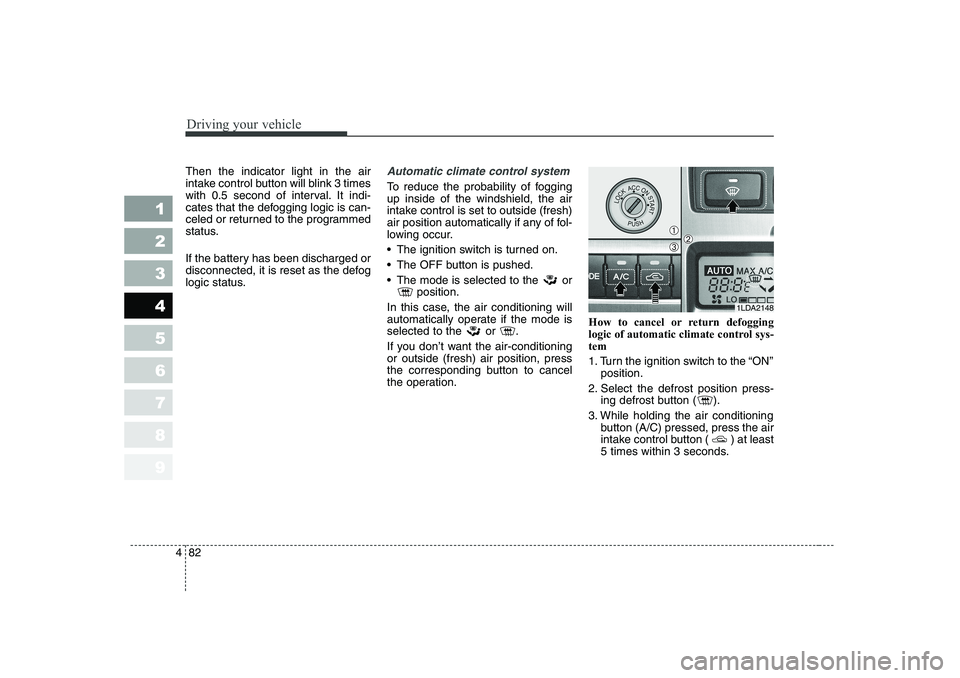
the operation. How to cancel or return defogging
logic of automatic climate control sys-tem
1. Turn the ignition switch to the
“ON ”
position.
2. Select the defrost position press- ing defrost button ( ).
3. While holding the air conditioning button (A/C) pressed, press the air
intake control button ( ) at least
5 times within 3 seconds.
1LDA2148
➀➁➂
Page 246 of 315
1 234567891 23456789
10
Maintenance services / 7-3 Normal maintenance schedule / 7-5
Maintenance under severe usage conditions / 7-8
Owner maintenance / 7-10Engine compartment / 7-13
Engine oil and oil filter / 7-16Engine cooling system / 7-19Brakes and clutch / 7-22Parking brake / 7-23Drive belts / 7-24
Power steering / 7-25
Steering wheel / 7-26Manual transaxle / 7-26Automatic transaxle / 7-28Lubricants and fluids / 7-31
Fuel filter / 7-32
Air cleaner / 7-33
Climate control air filter / 7-35
Wiper blades / 7-37
Maintenance
Page 252 of 315
1 23456789
77
Maintenance
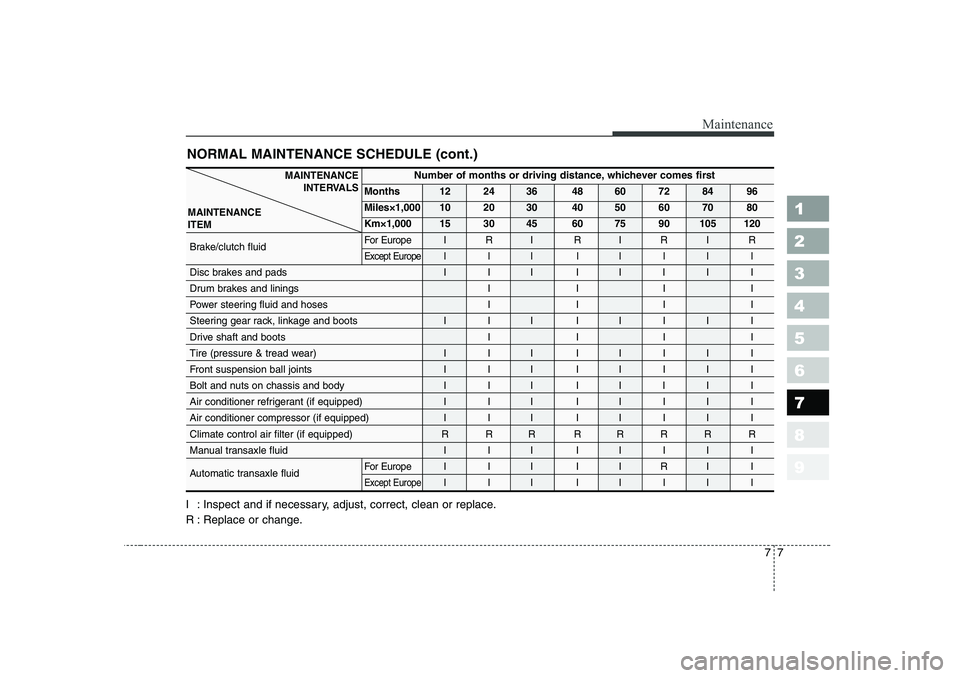
NORMAL MAINTENANCE SCHEDULE (cont.)
I : Inspect and if necessary, adjust, correct, clean or replace.
R : Replace or change.
Number of months or driving distance, whichever comes first
Months 12 24 36 48 60 72 84 96
Miles×1,000 10 20 30 40 50 60 70 80
Km×1,000 15 30 45 60 75 90 105 120
Brake/clutch fluid
For EuropeIRI RIRIR
Except Europe I I I I I I I I
Disc brakes and pads I I I I I I I I
Drum brakes and linings I I I I
Power steering fluid and hoses I I I I
Steering gear rack, linkage and boots I I I I I I I I
Drive shaft and boots I I I I
Tire (pressure & tread wear) I I I I I I I I
Front suspension ball joints I I I I I I I I
Bolt and nuts on chassis and body I I I I I I I I
Air conditioner refrigerant (if equipped) I I I I I I I I
Air conditioner compressor (if equipped) I I I I I I I I
Climate control air filter (if equipped) R R R R R R R R
Manual transaxle fluid I I I I I I I I
Automatic transaxle fluid
For Europe III IIRII
Except EuropeIII IIIII
MAINTENANCE INTERVALS
MAINTENANCE ITEM
Page 254 of 315
79
Maintenance
1 23456789
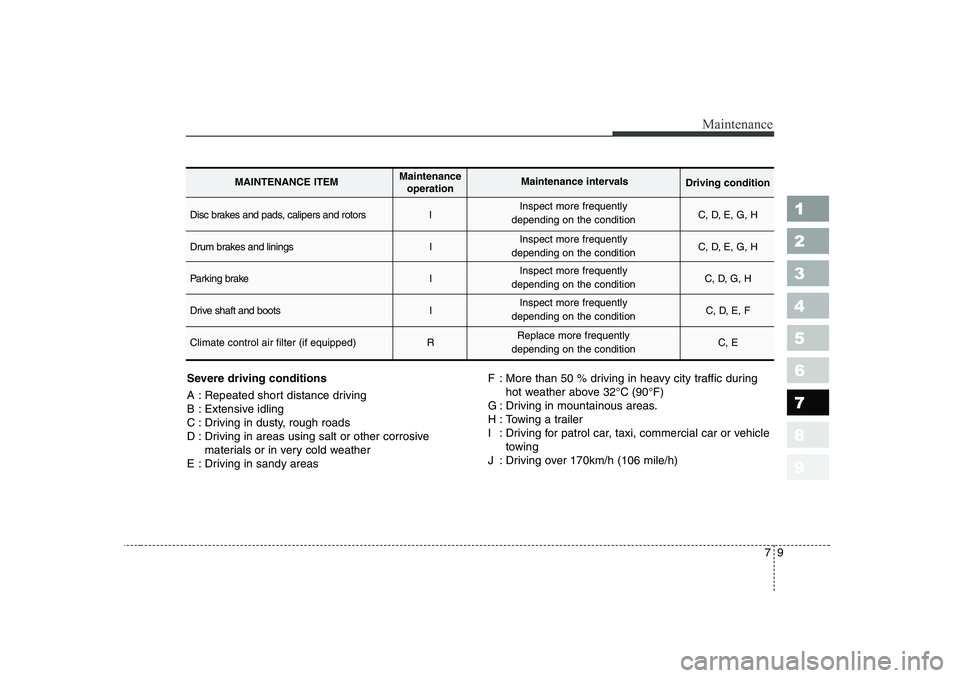
Severe driving conditions
A : Repeated short distance driving
B : Extensive idling
C : Driving in dusty, rough roads
D : Driving in areas using salt or other corrosive materials or in very cold weather
E : Driving in sandy areas F : More than 50 % driving in heavy city traffic during
hot weather above 32°C (90°F)
G : Driving in mountainous areas.
H : Towing a trailer
I : Driving for patrol car, taxi, commercial car or vehicle towing
J : Driving over 170km/h (106 mile/h)
Disc brakes and pads, calipers and rotors I C, D, E, G, H
Drum brakes and linings I C, D, E, G, H
Parking brake I C, D, G, H
Drive shaft and boots I C, D, E, F
Climate control air filter (if equipped) R C, E
MAINTENANCE ITEMMaintenance
operation Maintenance intervals
Driving condition
Inspect more frequently
depending on the condition
Inspect more frequently
depending on the condition
Inspect more frequently
depending on the condition
Inspect more frequently
depending on the condition
Replace more frequently
depending on the condition
Page 280 of 315
735
Maintenance
1 23456789
CLIMATE CONTROL AIR FILTER (IF EQUIPPED)
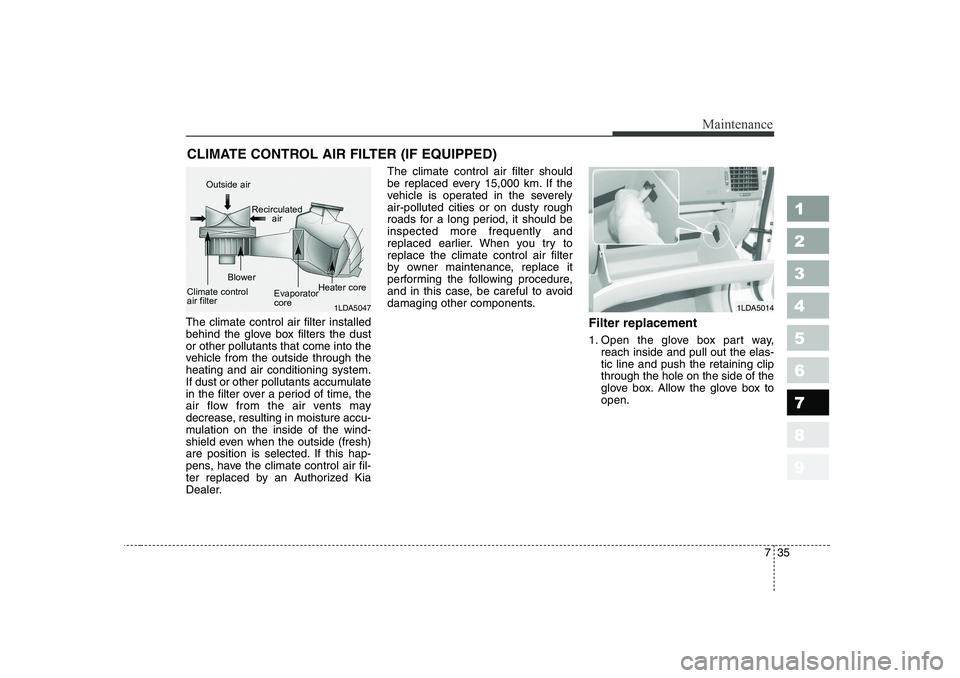
The climate control air filter installed
behind the glove box filters the dustor other pollutants that come into the
vehicle from the outside through theheating and air conditioning system.
If dust or other pollutants accumulate
in the filter over a period of time, the
air flow from the air vents may
decrease, resulting in moisture accu-
mulation on the inside of the wind-
shield even when the outside (fresh)
are position is selected. If this hap-
pens, have the climate control air fil-
ter replaced by an Authorized Kia
Dealer. The climate control air filter should
be replaced every 15,000 km. If the
vehicle is operated in the severelyair-polluted cities or on dusty rough
roads for a long period, it should beinspected more frequently and
replaced earlier. When you try toreplace the climate control air filter
by owner maintenance, replace it
performing the following procedure,
and in this case, be careful to avoid
damaging other components.
Filter replacement
1. Open the glove box part way,reach inside and pull out the elas- tic line and push the retaining clipthrough the hole on the side of the
glove box. Allow the glove box toopen.
1LDA50141LDA5047
Outside air
Recirculatedair
Climate control air filter Blower
EvaporatorcoreHeater core
Page 281 of 315
Maintenance
36
7
1 23456789
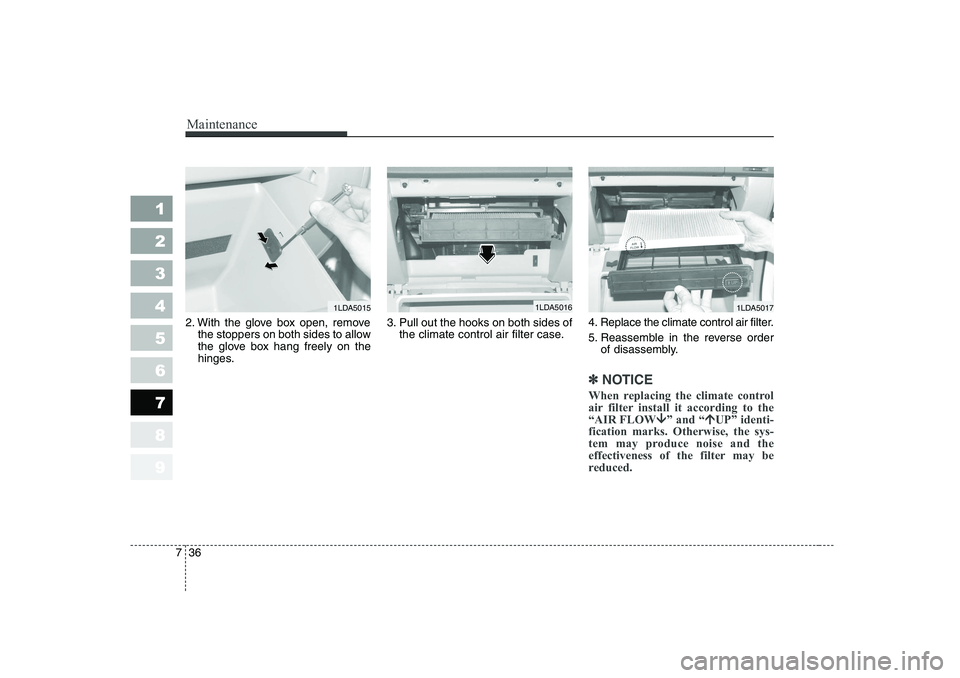
2. With the glove box open, remove
the stoppers on both sides to allow
the glove box hang freely on the
hinges. 3. Pull out the hooks on both sides of
the climate control air filter case. 4. Replace the climate control air filter.
5. Reassemble in the reverse order
of disassembly.
✽✽ NOTICE
When replacing the climate control
air filter install it according to the
“AIR FLOW
È ” and “ÇUP” identi-
fication marks. Otherwise, the sys-
tem may produce noise and the
effectiveness of the filter may be
reduced.
1LDA50161LDA50171LDA5015
Page 285 of 315
Maintenance
40
7
1 23456789
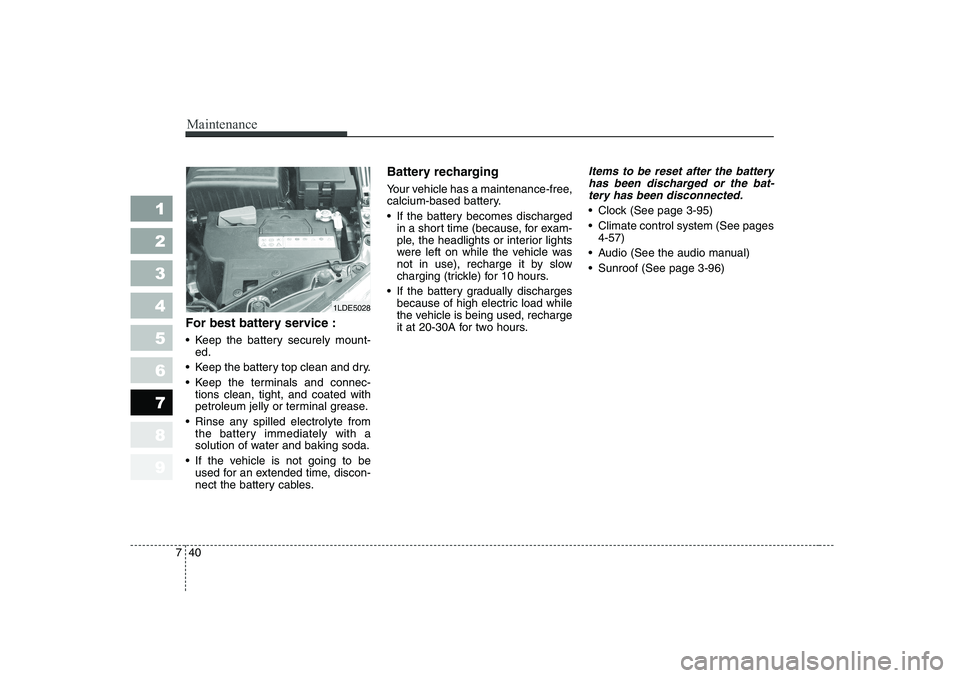
For best battery service :
Keep the battery securely mount-
ed.
Keep the battery top clean and dry.
Keep the terminals and connec- tions clean, tight, and coated with
petroleum jelly or terminal grease.
Rinse any spilled electrolyte from the battery immediately with a
solution of water and baking soda.
If the vehicle is not going to be used for an extended time, discon-
nect the battery cables. Battery recharging
Your vehicle has a maintenance-free,
calcium-based battery.
If the battery becomes discharged
in a short time (because, for exam-
ple, the headlights or interior lights
were left on while the vehicle was
not in use), recharge it by slow
charging (trickle) for 10 hours.
If the battery gradually discharges because of high electric load while
the vehicle is being used, recharge
it at 20-30A for two hours.
Items to be reset after the battery
has been discharged or the bat-tery has been disconnected.
Clock (See page 3-95)
Climate control system (See pages 4-57)
Audio (See the audio manual)
Sunroof (See page 3-96)
1LDE5028
Page 292 of 315
747
Maintenance
1 23456789
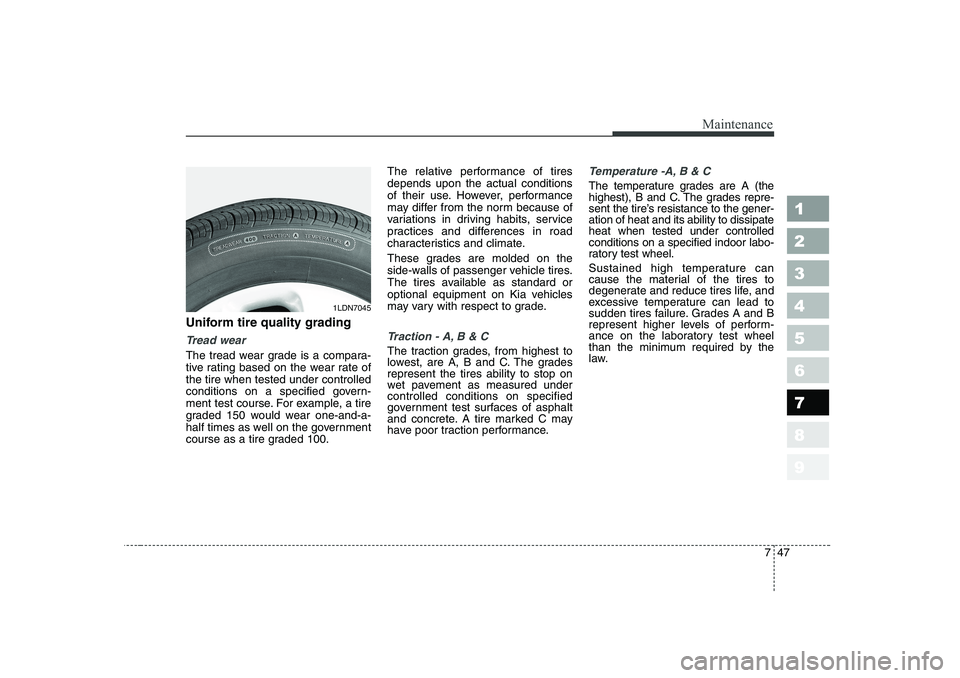
Uniform tire quality grading
Tread wear
The tread wear grade is a compara-
tive rating based on the wear rate ofthe tire when tested under controlled
conditions on a specified govern-
ment test course. For example, a tire
graded 150 would wear one-and-a-
half times as well on the government
course as a tire graded 100.The relative performance of tiresdepends upon the actual conditions
of their use. However, performance
may differ from the norm because of
variations in driving habits, service
practices and differences in road
characteristics and climate.
These grades are molded on the
side-walls of passenger vehicle tires.
The tires available as standard or
optional equipment on Kia vehicles
may vary with respect to grade.
Traction - A, B & C
The traction grades, from highest to
lowest, are A, B and C. The gradesrepresent the tires ability to stop on
wet pavement as measured undercontrolled conditions on specified
government test surfaces of asphalt
and concrete. A tire marked C may
have poor traction performance.
Temperature -A, B & C
The temperature grades are A (the
highest), B and C. The grades repre-
sent the tire’s resistance to the gener-ation of heat and its ability to dissipateheat when tested under controlledconditions on a specified indoor labo-
ratory test wheel.
Sustained high temperature can
cause the material of the tires to
degenerate and reduce tires life, and
excessive temperature can lead to
sudden tires failure. Grades A and B
represent higher levels of perform-
ance on the laboratory test wheel
than the minimum required by the
law.
1LDN7045
Page 313 of 315
Index
2
9
1 23456789
Air cleaner . . . . . . . . . . . . . . . . . . . . . . . . . . . . . . . . 7-33
Airbags-supplemental restraint system . . . . . . . . . . 3-56
Antenna . . . . . . . . . . . . . . . . . . . . . . . . . . . . . . . . . 3-100
Automatic climate control system . . . . . . . . . . . . . . 4-66
Automatic transaxle . . . . . . . . . . . . . . . . . . . . . 4-8, 7-28
Battery . . . . . . . . . . . . . . . . . . . . . . . . . . . . . . . . . . . 7-39
Before driving. . . . . . . . . . . . . . . . . . . . . . . . . . . . . . . 5-5
Brake system . . . . . . . . . . . . . . . . . . . . . . . . . . . . . . 4-15
Brakes and clutch. . . . . . . . . . . . . . . . . . . . . . . . . . . 7-22
Bulb replacement . . . . . . . . . . . . . . . . . . . . . . . . . . . 7-49
Cruise control . . . . . . . . . . . . . . . . . . . . . . . . . . . . . . 4-25
Climate control air filter . . . . . . . . . . . . . . . . . . . . . 7-35
Defroster . . . . . . . . . . . . . . . . . . . . . . . . . . . . . . . . . . 4-55
Door locks. . . . . . . . . . . . . . . . . . . . . . . . . . . . . . . . . . 3-8
Drive belts . . . . . . . . . . . . . . . . . . . . . . . . . . . . . . . . 7-24 Electrical circuit protection . . . . . . . . . . . . . . . . . . . . 6-7
Emergency commodity. . . . . . . . . . . . . . . . . . . . . . . 6-24
Emergency starting . . . . . . . . . . . . . . . . . . . . . . . . . . 6-4
Emission control system. . . . . . . . . . . . . . . . . . . . . . . 5-3
Engine compartment . . . . . . . . . . . . . . . . . . . . . . . . 7-13
Engine cooling system . . . . . . . . . . . . . . . . . . . . . . . 7-19
Engine oil and oil filter . . . . . . . . . . . . . . . . . . . . . . 7-16
Exterior care. . . . . . . . . . . . . . . . . . . . . . . . . . . . . . . 7-58
Exterior overview . . . . . . . . . . . . . . . . . . . . . . . . . . . . 2-2
Fuel filler lid . . . . . . . . . . . . . . . . . . . . . . . . . . . . . . . 3-79
Fuel filter . . . . . . . . . . . . . . . . . . . . . . . . . . . . . . . . . 7-32
Fuel requirements . . . . . . . . . . . . . . . . . . . . . . . . . . . 5-2
Gauges . . . . . . . . . . . . . . . . . . . . . . . . . . . . . . . . . . . 4-34
Hazard warning flasher . . . . . . . . . . . . . . . . . . . . . . 4-56
Hood . . . . . . . . . . . . . . . . . . . . . . . . . . . . . . . . . . . . . 3-77
How to use this manual . . . . . . . . . . . . . . . . . . . . . . . 1-2
A
B
C
D
F
E
G
H