Drive belt KIA CERATO 2007 Owners Manual
[x] Cancel search | Manufacturer: KIA, Model Year: 2007, Model line: CERATO, Model: KIA CERATO 2007Pages: 329, PDF Size: 34.09 MB
Page 27 of 329
317
1 23456789
Knowing your vehicle
(Continued)
your seatback upright and the
lap portion of the safety belt,
or lap belt, snug and low
across the hips. This position
puts your safety belts in the
best position to protect you incase of an accident.
In order to avoid unnecessary airbag injuries including the
possibility of severe injury or
death, always sit as far back
as possible from the steering
wheel so that your chest is
away at least 250 mm (10 inch-
es) away from the steeringwheel.WARNING
Loose objects in the driver’s foot area could interfere with
the operation of the foot ped-
als, possibly causing an acci-
dent. Loose objects might
interfere with the seat slide
mechanism. Do not place any-
thing under the front seats.
Children should never be left unattended in the car.WARNING - Driver’s seat
Never attempt to adjust seat while the vehicle is moving. This could result in loss of
control, and an accident caus-
ing death, serious injury, or
property damage.
fere with the normal position
of the seatback. Storing items
against a seatback or in any
other way interfering with
proper locking of a seatbackcould result in serious or fatal
injury in a sudden stop or col-lision.
(Continued)
Page 29 of 329
319
1 23456789
Knowing your vehicle
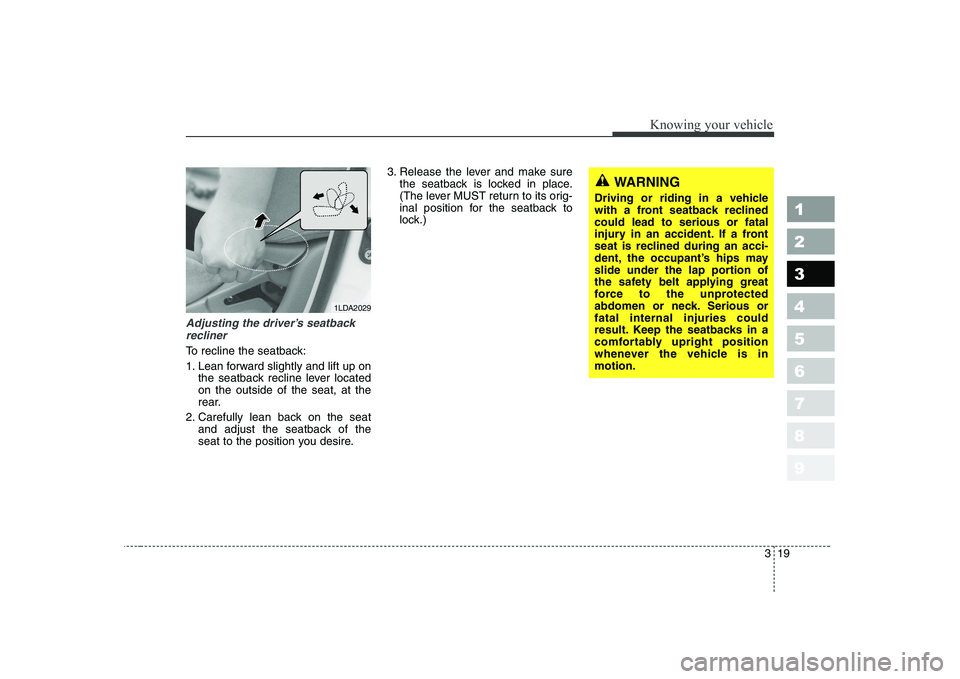
Adjusting the driver’s seatbackrecliner
To recline the seatback:
1. Lean forward slightly and lift up on the seatback recline lever located on the outside of the seat, at the
rear.
2. Carefully lean back on the seat and adjust the seatback of the
seat to the position you desire. 3. Release the lever and make sure
the seatback is locked in place.
(The lever MUST return to its orig-
inal position for the seatback to
lock.)
1LDA2029
WARNING
Driving or riding in a vehicle
with a front seatback reclinedcould lead to serious or fatal
injury in an accident. If a front
seat is reclined during an acci-
dent, the occupant’s hips may
slide under the lap portion of
the safety belt applying great
force to the unprotected
abdomen or neck. Serious orfatal internal injuries could
result. Keep the seatbacks in a
comfortably upright position
whenever the vehicle is inmotion.
Page 40 of 329
Knowing your vehicle
30
3
1 23456789
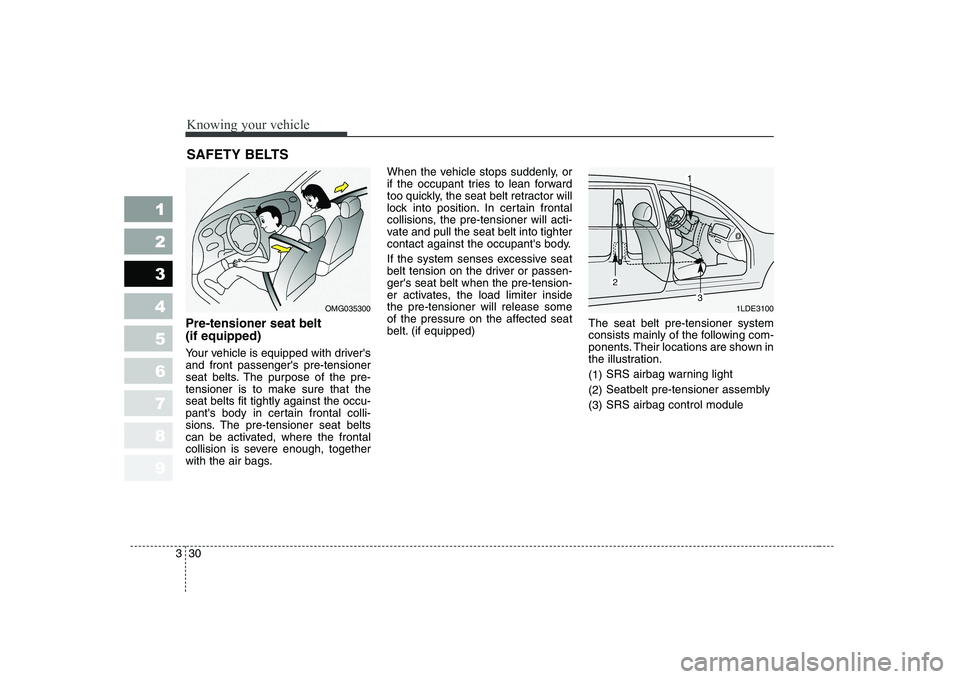
Pre-tensioner seat belt (if equipped)
Your vehicle is equipped with driver's and front passenger's pre-tensioner
seat belts. The purpose of the pre-
tensioner is to make sure that theseat belts fit tightly against the occu-
pant's body in certain frontal colli-
sions. The pre-tensioner seat belts
can be activated, where the frontal
collision is severe enough, together
with the air bags. When the vehicle stops suddenly, or
if the occupant tries to lean forward
too quickly, the seat belt retractor will
lock into position. In certain frontal
collisions, the pre-tensioner will acti-
vate and pull the seat belt into tighter
contact against the occupant's body.
If the system senses excessive seat
belt tension on the driver or passen-ger's seat belt when the pre-tension-
er activates, the load limiter insidethe pre-tensioner will release some
of the pressure on the affected seat
belt. (if equipped)
The seat belt pre-tensioner system
consists mainly of the following com-
ponents. Their locations are shown in
the illustration. (1)
SRS airbag warning light
(2) Seatbelt pre-tensioner assembly
(3) SRS airbag control module
SAFETY BELTS
1LDE3100OMG035300
1
2
3
Page 43 of 329

333
1 23456789
Knowing your vehicle
Safety belt restraint system We strongly recommend that the
driver and all passengers be proper-
ly restrained at all times by using the
safety belts provided with the vehi-
cle. Proper use of the safety belts
decreases the risk of severe injury or
death in accidents or sudden stops.
All seats (including or except the
center rear seat) have lap/shoulder
belts. Inertial locks in the safety belt
retractors allow all of the lap/shoul-
der safety belts to remain unlocked
during normal vehicle operation. This
allows the occupants some freedom
of movement and increased comfort
while using the safety belts. If a force
is applied to the vehicle, such as a
strong stop, a sharp turn, or a colli-
sion, the safety belt retractors will
automatically lock the safety belts.Since the inertial locks do not require
a collision in order to lock up, you
may become aware of the safety
belts locking while braking or going
around sharp corners.
Always use the rear seat position(s)
to install your child restraint(s).
Never install a child restraint system in the front passenger position, as an
inflating airbag could cause serious
or fatal injury to a child in that posi-tion.
WARNING
- Safety belts
To minimize the risk of serious
or fatal injury in an accident, the
driver and all passengers
should use the appropriate
safety restraints for their age
and size. The presence of
airbags does not change the
need to be properly restrained
by a safety belt or size-appropri-
ate child restraint. In fact,
airbags are designed to work
the best when passengers are
correctly restrained in the vehi-
cle. Be sure you are familiar
with the information in this sec-
tion, including the information
on infant and child restraints.
Read the safety warnings on the
sun visors of your vehicle also.
Page 44 of 329
Knowing your vehicle
34
3
1 23456789
Safety belts provide the best restraint when:
The seatback is upright.
The occupant is sitting upright (not
slouched).
The lap belt is snug across the hips.
The shoulder belt is snug across the chest.
The knees are straight forward.
To help you remember to fasten your
safety belt, a warning light will comeon and a chime will sound.WARNING - After a colli-
sion
Lap/shoulder belt assemblies may be stretched or damaged when subjected to the stress
and forces of a collision.
The entire restraint system should be inspected following
any collision. All belts, retrac-
tors, anchors and hardware
damaged by a collision should
be replaced before the vehicle
is operated again.WARNING - Cargo area (if equipped)
Passengers should never be
allowed to ride in the cargo area
of a vehicle. No safety belts are
provided for the cargo area.
Persons riding in the vehicle
without a fastened safety belt
are much more likely to suffer
serious bodily injury or deathduring an accident.
WARNING - Twisted belts
A twisted or jammed safety belt
cannot restrain you properly. If
you cannot untwist or unjam the
safety belt, have an authorized
Kia dealer it immediately. Neverdrive or ride with a twisted or
jammed safety belt.
Page 46 of 329

Knowing your vehicle
36
3
1 23456789
Safety belt warning light and
chime
Ty p e A
As a reminder to the driver and pas-
senger, safety belt warning light will
blink for approximately 6 seconds
each time you turn the ignition switchON.
If the driver’s lap/shoulder belt is not
fastened when the key is turned ON,
the safety belt warning chime sounds
and the safety belt warning light
blinks for approximately 6 seconds. Ty p e B
As a reminder to the driver, safety
belt warning light will blink or illumi-
nate for approximately 6 seconds
each time you turn the ignition switchON.
If the driver's lap/shoulder belt is not
fastened when the key is turned ON
or if it is disconnected after the key is
turn ON, the safety belt warning light
will blink or illuminate until the belt is
fastened.
If the driver's lap/shoulder belt is not
fastened when the key is turned ON
and you drive over 9km/h, the safety
belt warning chime will sound for
approximately 100 seconds after the
warning light blinks for approximately
one minute.
If the driver's lap/shoulder belt is dis-
connected after the key is turn ON
and you drive over 9km/h, the safety
belt warning chime will sound for
approximately 100 seconds.
But, if the driver's lap/shoulder belt is connected and disconnected twice
within 9 seconds after the belt is fas-
tened, the safety belt warning light
and chime will not operate.
1GQA2083
CAUTION
Never close the doors on any
part of the lap or shoulder belt. It can damage the safety belt orbuckle which could increase therisk of injury in case of an acci- dent.
Page 48 of 329

Knowing your vehicle
38
3
1 23456789
(Continued)
Never drive or ride with a
twisted or jammed safety belt.
If you cannot untwist or unjam
the safety belt, see the nearest
Kia dealer immediately.
Never use a single belt to restrain more than one person
at a time.
Failure to follow these warnings
will increase the risk and sever-
ity of injury in an accident.
To unfasten the lap/shoulder belt:
Press the release button on the
buckle and allow the belt to slowly
retract.
WARNING
The seatbacks should always remain in a comfortable, upright position while the
vehicle is in motion. The safe-
ty belt system will provide the
most protection with the seat-
backs in an upright position.
Never wear the shoulder por- tion of the safety belt underthe outside arm or behind the
back.
Never wear the shoulder por- tion of the safety belt across
the neck or face.
Wear the lap portion of the safety belt as low on the hips
as possible. Be sure the lap
belt fits snugly around the
hips. Never wear the lap belt
over your waist.
(Continued)
B210A01NF
Page 65 of 329

355
1 23456789
Knowing your vehicle
SRS components and func- tions
The SRS consists of the following components:
1. SRS "AIR BAG" warning light*
2. Passenger's Air bag Module*
3. Driver's Air Bag Module*
4. Side Impact Sensors*
5. SRS Control Module (SRSCM)*
6. Retractor Pre-tensionerAssemblies*
7. Side Air Bag Modules*
8. Curtain Air bag Modules*
9. Passenger’s front air bag OFF indicator*
10. Passenger’s front air bag ON/OFF switch*
* : If equipped The SRSCM continually monitors all SRS components while the ignition
switch is ON to determine if a crash
impact is severe enough to require
air bag deployment or pre-tensioner
seat belt deployment.
The SRS AIR BAG warning light on
the instrument panel will blink or illu-
minate for about 6 seconds after the
ignition switch is turned to the ON
position, after which the AIR BAG
warning light should go out.
If any of the following conditions
occurs, this indicates a malfunetion
of the SRS. Have an authorized Kiadealer inspect the air bag system as
soon as possible.
The light does not turn on briefly
when you turn the ignition ON.
The light stays on after illuminating for approximately 6 seconds.
The light comes on while the vehi- cle is in motion. What your airbag system does
Driver’s airbag and front passenger’s airbag are designed to supplement
the protection offered by the safety
belt in certain frontal collisions.
Likewise, side airbag and curtainairbags are designed to supplement
the protection offered by the safety
belt in side collisions. Safety belts
are designed to reduce the injury of
the driver or passengers in case of
light impact or collision. However, to
help reduce impact on driver or pas-
sengers in a serious collision, seat
belts must also be correctly worn.
What your airbag system does not do The air bag system is designed to
supplement the protection offered by
the safety belt system. IT IS NOT A
SUBSTITUTE FOR THE SAFETY
BELT.
Page 66 of 329
Knowing your vehicle
56
3
1 23456789
The importance of using
safety belts
There are four very important rea-
sons to use safety belts even with an
airbag supplemental restraint sys-
tem. They:
help keep you in the proper posi-
tion (away from the airbag) when it
inflates.
reduce the risk of harm in rollover, side impact (vehicles not equipped
with side and curtain airbags) or
rear impact collisions, because anairbag is not designed to inflate in
such situations and even a side
curtain airbag is designed to inflate
only in certain side impact colli-
sions.
reduce the risk of harm in frontal or side collisions which are not
severe enough to actuate the
airbag supplemental restraint sys-tem.
reduce the risk of being thrown from your vehicle.WARNING - Airbags &
safety belts
Even in vehicles with air bags, you and your passengers
must always wear the safety
belts provided in order to min-
imize the risk and severity of
injury in the event of a colli-
sion or rollover.
Always wear your safety belt. It can help keep you away
from the air bags during heavy
braking just before a collision.
If occupants are not fastened or correctly seated, they can-
not be protected, and thus
face serious injury or death.
(Continued)(Continued)
Driver’s and front passenger’sairbag are designed to inflate
only in certain frontal colli-
sions, and side and curtain
airbags (if equipped) are
designed to inflate in certain
side impacts. They will gener-
ally not provide protection in
side impacts (vehicles not
equipped with side and curtain
airbags) or rear impacts,
rollovers, less severe frontal
collisions. They will not pro-
vide protection from later
impacts in a multi-impact colli-sion.
(Continued)
Page 70 of 329
Knowing your vehicle
60
3
1 23456789
WARNING
The front seat passenger’s airbag is much larger than the
steering wheel airbag and
inflates with considerably
more force. It can seriously
hurt or kill a passenger who is
not in the proper position and
wearing the safety belt proper-
ly. The front passengers
should always move their seat
as far back as practical and sit
back in their seat.
It is essential that the front passengers always wear their
safety belts, even when the
vehicle is moving in a parking
lot or up a driveway into
garage. (Continued)WARNING
The driver is responsible for the proper position of the pas-
senger’s front air bag ON/OFF
switch.
Deactivate the passenger's front air bag only when the
ignition switch is switched off,
or the malfunction may occur
in the SRS Control Module.
And there may be a danger
that the driver's and/or front
passenger’s and/or side and
curtain air bag may fail to trig-
ger, or not trigger correctlyduring a collision.
Never install a rearward facing child seat on the front passen-
ger's seat unless the passen-
ger's front air bag has been
deactivated. The infant or child
could be severely injured or
killed by an air bag deploy-ment in case of an accident.
(Continued)(Continued)
Even though your vehicle isequipped with the passen-
ger's front air bag ON/OFF
switch, do not install a child
restraint system in the front
passenger's seat. A child
restraint system must never
be placed in the front seat.
Children who are too large for
child restraint systems should
always occupy the rear seat
and use the available
lap/shoulder belts. Children
are afforded the most safety in
the event of an accident when
they are restrained by a prop-er restraint system in the rearseat.
As soon as the child seat is no longer needed on the front
passenger's seat, reactivate
the front passenger's air bag.