adjust KIA FORTE 2017 Repair Manual
[x] Cancel search | Manufacturer: KIA, Model Year: 2017, Model line: FORTE, Model: KIA FORTE 2017Pages: 595, PDF Size: 11.5 MB
Page 454 of 595
617
What to do in an emergency
10. To install the wheel, hold it on the
studs, put the wheel nuts on the
studs and tighten them finger
tight. Jiggle the tire to be sure it is
completely seated, then tighten
the nuts as much as possible
with your fingers again.
11. Lower the vehicle to the ground
by turning the wheel nut wrench
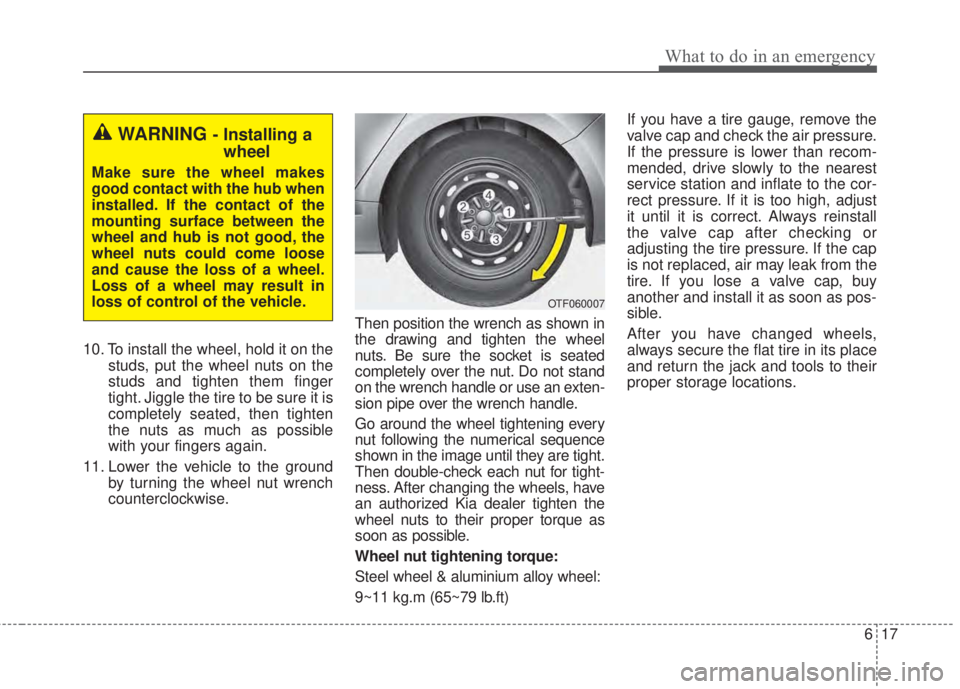
counterclockwise.Then position the wrench as shown in
the drawing and tighten the wheel
nuts. Be sure the socket is seated
completely over the nut. Do not stand
on the wrench handle or use an exten-
sion pipe over the wrench handle.
Go around the wheel tightening every
nut following the numerical sequence
shown in the image until they are tight.
Then double-check each nut for tight-
ness. After changing the wheels, have
an authorized Kia dealer tighten the
wheel nuts to their proper torque as
soon as possible.
Wheel nut tightening torque:
Steel wheel & aluminium alloy wheel:
9~11 kg.m (65~79 lb.ft)If you have a tire gauge, remove the
valve cap and check the air pressure.
If the pressure is lower than recom-
mended, drive slowly to the nearest
service station and inflate to the cor-
rect pressure. If it is too high, adjust
it until it is correct. Always reinstall
the valve cap after checking or
adjusting the tire pressure. If the cap
is not replaced, air may leak from the
tire. If you lose a valve cap, buy
another and install it as soon as pos-
sible.
After you have changed wheels,
always secure the flat tire in its place
and return the jack and tools to their
proper storage locations.
WARNING - Installing a
wheel
Make sure the wheel makes
good contact with the hub when
installed. If the contact of the
mounting surface between the
wheel and hub is not good, the
wheel nuts could come loose
and cause the loss of a wheel.
Loss of a wheel may result in
loss of control of the vehicle.
OTF060007
Page 455 of 595
What to do in an emergency
18 6
Note that most lug nuts do not have
metric threads. Be sure to use
extreme care in checking for thread
style before installing aftermarket lug
nuts or wheels. If in doubt, consult an
authorized Kia dealer.To prevent the jack, jack handle,
wheel lug nut wrench and spare tire
from rattling while the vehicle is in
motion, store them properly.
Check the inflation pressures as
soon as possible after installing the
spare tire. Adjust it to the specified
pressure, if necessary. Refer to
“Tires and wheels” in section 8.
Important - use of compact spare
tire (if equipped)
Your vehicle is equipped with a com-
pact spare tire. This compact spare
tire takes up less space than a regu-
lar-size tire. This tire is smaller than a
conventional tire and is designed for
temporary use only.
You should drive carefully when the
compact spare is in use. The com-
pact spare should be replaced by the
proper conventional tire and rim at
the first opportunity.
The operation of this vehicle is not
recommended with more than one
compact spare tire in use at the
same time.
CAUTION - Replacing
lug nuts
Make certain during wheel
removal that the same nuts that
were removed are reinstalled -
or, if replaced, that nuts with
metric threads and the same
chamfer configuration are used.
Your vehicle has metric threads
on the wheel studs and nuts.
Installation of a non-metric
thread nut on a metric stud will
not secure the wheel to the hub
properly and will damage the
stud so that it must be replaced.
WARNING- Wheel studs
Do not drive your vehicle with
damaged wheel studs. If the
studs are damaged, they may
lose their ability to retain the
wheel. This could lead to the
loss of the wheel and a collision.
Page 456 of 595
619
What to do in an emergency
The compact spare should be inflat-
ed to 420 kPa (60 psi).
Check the inflation pressure after
installing the spare tire. Adjust it to
the specified pressure, as necessary.When using a compact spare tire,
observe the following precautions:
• Under no circumstances should you
exceed 80 km/h (50 mph); a higher
speed could damage the tire.
• Ensure that you drive slowly enough
for the road conditions to avoid all
hazards. Any road hazard, such as a
pothole or debris, could seriously
damage the compact spare.
• Any continuous road use of this tire
could result in tire failure, loss of
vehicle control, and possible per-
sonal injury.
• Do not exceed the vehicle’s maxi-
mum load rating or the load-carry-
ing capacity shown on the sidewall
of the compact spare tire.• Avoid driving over obstacles. The
compact spare tire diameter is
smaller than the diameter of a con-
ventional tire and reduces the
ground clearance approximately
25 mm (1 inch), which could result
in damage to the vehicle.
• Do not take this vehicle through an
automatic car wash while the com-
pact spare tire is installed.
• The compact spare tire should not
be installed on the front axle if the
vehicle must be driven in snow or
on ice.
WARNING - Spare tire
Do not operate your vehicle on
this compact spare at speeds
over 80 km/h (50 mph). The
compact spare tire is for emer-
gency use only. The original tire
should be repaired or replaced
as soon as possible to avoid
failure of the spare.
Page 467 of 595
75
Maintenance
MAINTENANCE SERVICES
You should exercise the utmost care
to prevent damage to your vehicle
and injury to yourself whenever per-
forming any maintenance or inspec-
tion procedures.
Should you have any doubts con-
cerning the inspection or servicing of
your vehicle, we strongly recom-
mend that you have an authorized
Kia dealer perform this work.
An authorized Kia dealer has factory-
trained technicians and genuine Kia
parts to service your vehicle proper-
ly. For expert advice and quality serv-
ice, see an authorized Kia dealer.
Inadequate, incomplete or insuffi-
cient servicing may result in opera-
tional problems with your vehicle that
could lead to vehicle damage, an
accident, or personal injury.Owner’s responsibility
✽NOTICE
Maintenance Service and Record
Retention are the owner's responsi-
bility.
You should retain documents that
show proper maintenance has been
performed on your vehicle in accor-
dance with the scheduled mainte-
nance service charts shown on the
following pages. You need this infor-
mation to establish your compliance
with the servicing and maintenance
requirements of your vehicle war-
ranties.
Detailed warranty information is
provided in your Warranty &
Consumer Information manual.
Repairs and adjustments required as
a result of improper maintenance or
a lack of required maintenance are
not covered.
We recommend you have your vehi-
cle maintained and repaired by an
authorized Kia dealer. An authorized
Kia dealer meets Kia’s high service
quality standards and receives tech-
nical support from Kia in order to pro-
vide you with a high level of service
satisfaction.
Maintenance
Page 472 of 595
Maintenance
10 7
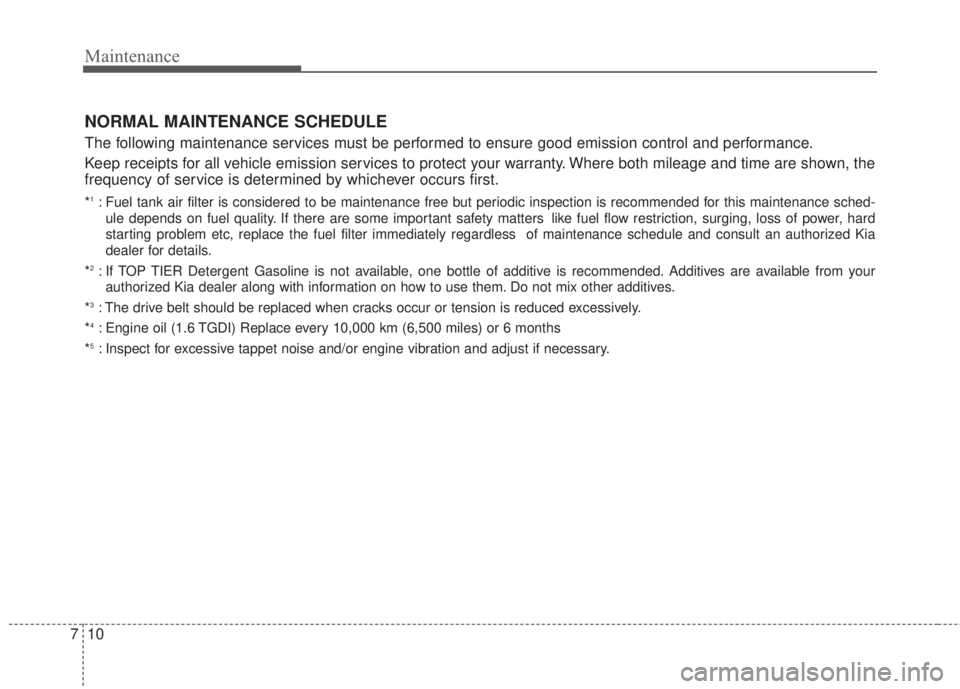
NORMAL MAINTENANCE SCHEDULE
The following maintenance services must be performed to ensure good emission control and performance.
Keep receipts for all vehicle emission services to protect your warranty. Where both mileage and time are shown, the
frequency of service is determined by whichever occurs first.
*1: Fuel tank air filter is considered to be maintenance free but periodic inspection is recommended for this maintenance sched-
ule depends on fuel quality. If there are some important safety matters like fuel flow restriction, surging, loss of power, hard
starting problem etc, replace the fuel filter immediately regardless of maintenance schedule and consult an authorized Kia
dealer for details.
*
2: If TOP TIER Detergent Gasoline is not available, one bottle of additive is recommended. Additives are available from your
authorized Kia dealer along with information on how to use them. Do not mix other additives.
*
3: The drive belt should be replaced when cracks occur or tension is reduced excessively.
*
4: Engine oil (1.6 TGDI) Replace every 10,000 km (6,500 miles) or 6 months
*
5: Inspect for excessive tappet noise and/or engine vibration and adjust if necessary.
Page 473 of 595
711
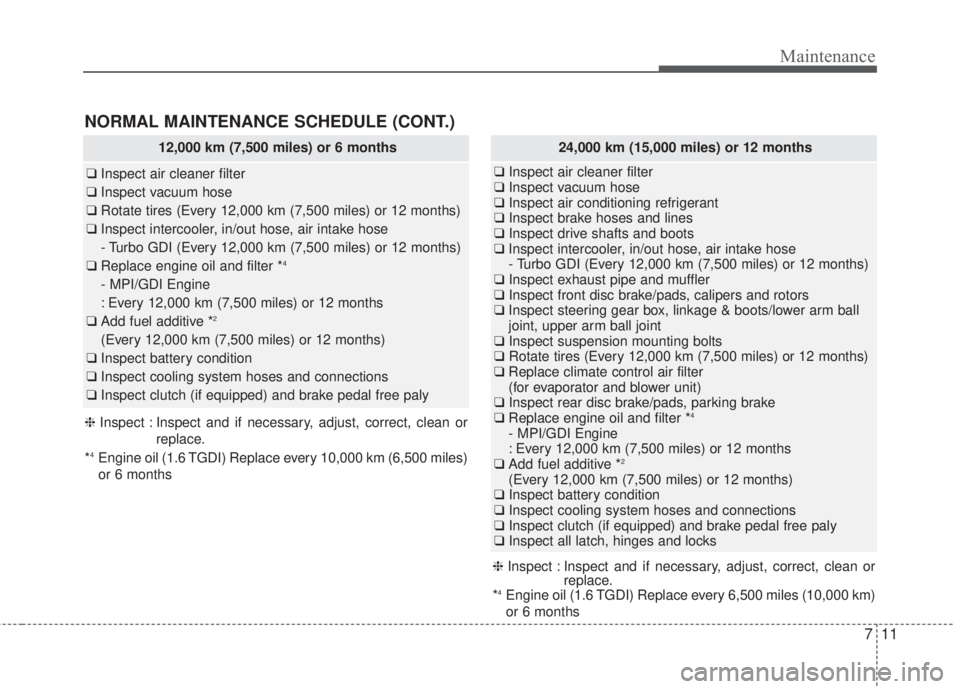
Maintenance
12,000 km (7,500 miles) or 6 months
❑Inspect air cleaner filter
❑Inspect vacuum hose
❑Rotate tires (Every 12,000 km (7,500 miles) or 12 months)
❑Inspect intercooler, in/out hose, air intake hose
- Turbo GDI (Every 12,000 km (7,500 miles) or 12 months)
❑Replace engine oil and filter *
4
- MPI/GDI Engine
: Every 12,000 km (7,500 miles) or 12 months
❑Add fuel additive *
2
(Every 12,000 km (7,500 miles) or 12 months)
❑Inspect battery condition
❑Inspect cooling system hoses and connections
❑Inspect clutch (if equipped) and brake pedal free paly
❈Inspect : Inspect and if necessary, adjust, correct, clean or
replace.
*
4Engine oil (1.6 TGDI) Replace every 10,000 km (6,500 miles)
or 6 months
24,000 km (15,000 miles) or 12 months
❑Inspect air cleaner filter
❑Inspect vacuum hose
❑Inspect air conditioning refrigerant
❑Inspect brake hoses and lines
❑Inspect drive shafts and boots
❑Inspect intercooler, in/out hose, air intake hose
- Turbo GDI (Every 12,000 km (7,500 miles) or 12 months)
❑Inspect exhaust pipe and muffler
❑Inspect front disc brake/pads, calipers and rotors
❑Inspect steering gear box, linkage & boots/lower arm ball
joint, upper arm ball joint
❑Inspect suspension mounting bolts
❑Rotate tires (Every 12,000 km (7,500 miles) or 12 months)
❑Replace climate control air filter
(for evaporator and blower unit)
❑Inspect rear disc brake/pads, parking brake
❑Replace engine oil and filter *
4
- MPI/GDI Engine
: Every 12,000 km (7,500 miles) or 12 months
❑Add fuel additive *
2
(Every 12,000 km (7,500 miles) or 12 months)
❑Inspect battery condition
❑Inspect cooling system hoses and connections
❑Inspect clutch (if equipped) and brake pedal free paly
❑Inspect all latch, hinges and locks
NORMAL MAINTENANCE SCHEDULE (CONT.)
❈Inspect : Inspect and if necessary, adjust, correct, clean or
replace.
*
4Engine oil (1.6 TGDI) Replace every 6,500 miles (10,000 km)
or 6 months
Page 474 of 595
Maintenance
12 7
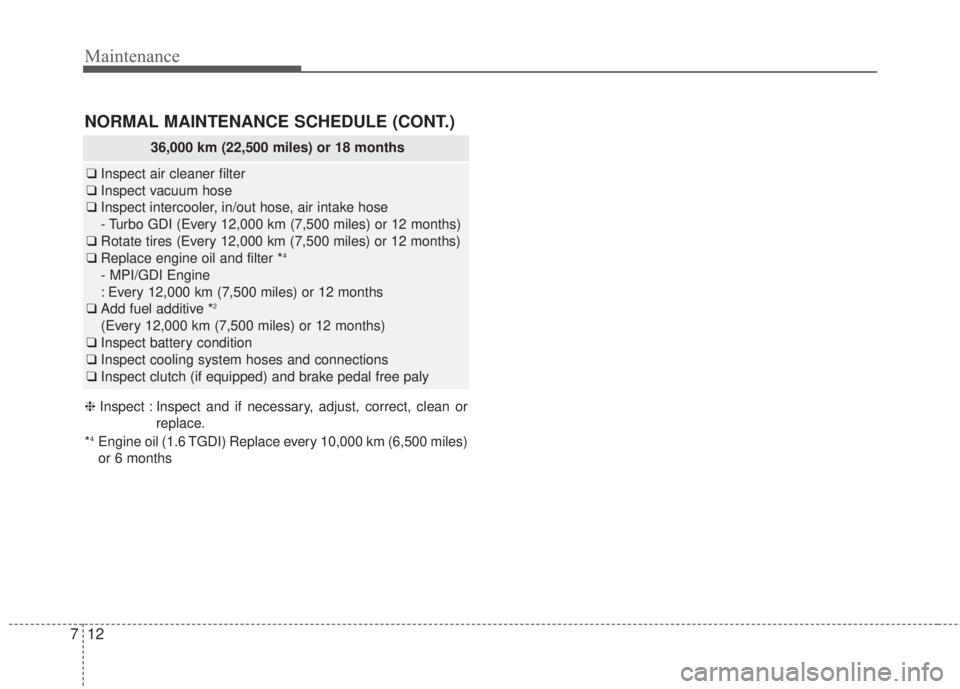
NORMAL MAINTENANCE SCHEDULE (CONT.)
36,000 km (22,500 miles) or 18 months
❑Inspect air cleaner filter
❑Inspect vacuum hose
❑Inspect intercooler, in/out hose, air intake hose
- Turbo GDI (Every 12,000 km (7,500 miles) or 12 months)
❑Rotate tires (Every 12,000 km (7,500 miles) or 12 months)
❑Replace engine oil and filter *
4
- MPI/GDI Engine
: Every 12,000 km (7,500 miles) or 12 months
❑Add fuel additive *
2
(Every 12,000 km (7,500 miles) or 12 months)
❑Inspect battery condition
❑Inspect cooling system hoses and connections
❑Inspect clutch (if equipped) and brake pedal free paly
❈Inspect : Inspect and if necessary, adjust, correct, clean or
replace.
*
4Engine oil (1.6 TGDI) Replace every 10,000 km (6,500 miles)
or 6 months
Page 475 of 595
713
Maintenance
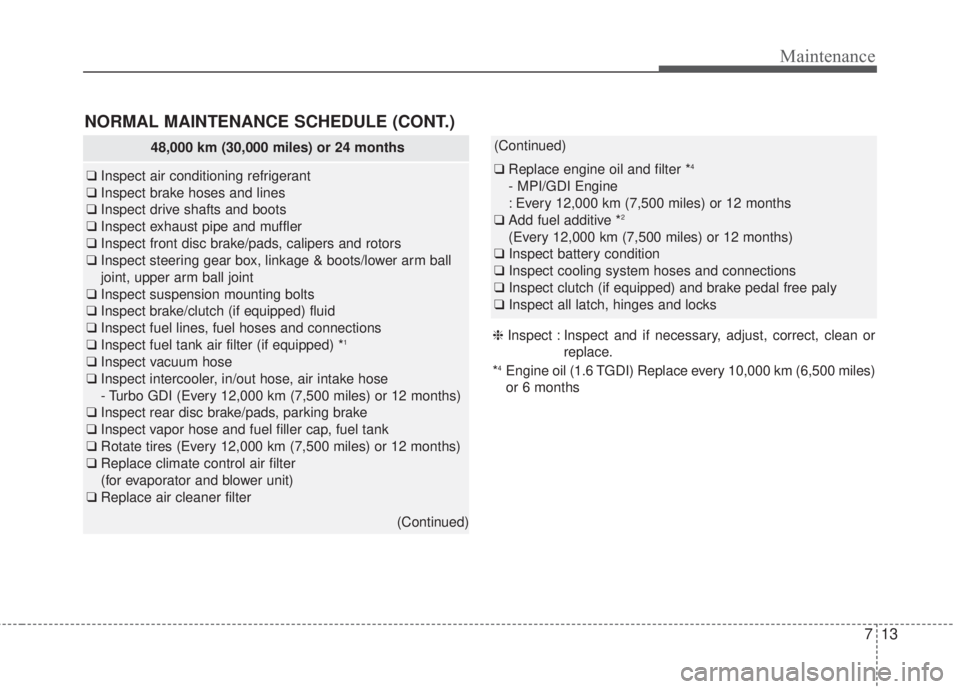
NORMAL MAINTENANCE SCHEDULE (CONT.)
48,000 km (30,000 miles) or 24 months
❑Inspect air conditioning refrigerant
❑Inspect brake hoses and lines
❑Inspect drive shafts and boots
❑Inspect exhaust pipe and muffler
❑Inspect front disc brake/pads, calipers and rotors
❑Inspect steering gear box, linkage & boots/lower arm ball
joint, upper arm ball joint
❑Inspect suspension mounting bolts
❑Inspect brake/clutch (if equipped) fluid
❑Inspect fuel lines, fuel hoses and connections
❑Inspect fuel tank air filter (if equipped) *
1
❑Inspect vacuum hose
❑Inspect intercooler, in/out hose, air intake hose
- Turbo GDI (Every 12,000 km (7,500 miles) or 12 months)
❑Inspect rear disc brake/pads, parking brake
❑Inspect vapor hose and fuel filler cap, fuel tank
❑Rotate tires (Every 12,000 km (7,500 miles) or 12 months)
❑Replace climate control air filter
(for evaporator and blower unit)
❑Replace air cleaner filter
(Continued)
(Continued)
❑Replace engine oil and filter *4
- MPI/GDI Engine
: Every 12,000 km (7,500 miles) or 12 months
❑Add fuel additive *
2
(Every 12,000 km (7,500 miles) or 12 months)
❑Inspect battery condition
❑Inspect cooling system hoses and connections
❑Inspect clutch (if equipped) and brake pedal free paly
❑Inspect all latch, hinges and locks
❈Inspect : Inspect and if necessary, adjust, correct, clean or
replace.
*
4Engine oil (1.6 TGDI) Replace every 10,000 km (6,500 miles)
or 6 months
Page 476 of 595
Maintenance
14 7
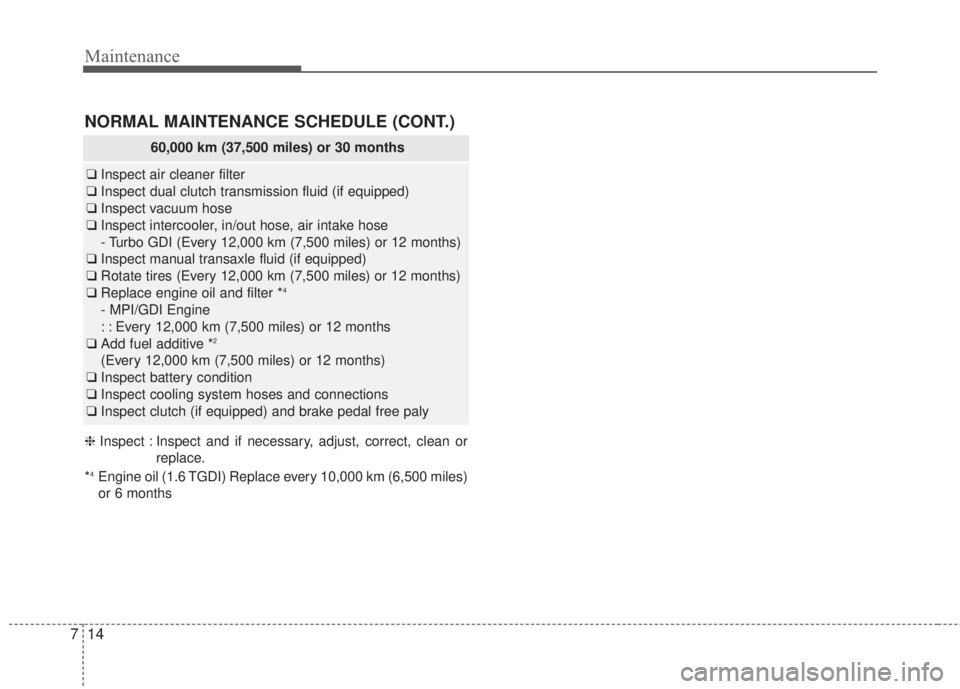
NORMAL MAINTENANCE SCHEDULE (CONT.)
❈Inspect : Inspect and if necessary, adjust, correct, clean or
replace.
*
4Engine oil (1.6 TGDI) Replace every 10,000 km (6,500 miles)
or 6 months
60,000 km (37,500 miles) or 30 months
❑Inspect air cleaner filter
❑Inspect dual clutch transmission fluid (if equipped)
❑Inspect vacuum hose
❑Inspect intercooler, in/out hose, air intake hose
- Turbo GDI (Every 12,000 km (7,500 miles) or 12 months)
❑Inspect manual transaxle fluid (if equipped)
❑Rotate tires (Every 12,000 km (7,500 miles) or 12 months)
❑Replace engine oil and filter *
4
- MPI/GDI Engine
: : Every 12,000 km (7,500 miles) or 12 months
❑Add fuel additive *
2
(Every 12,000 km (7,500 miles) or 12 months)
❑Inspect battery condition
❑Inspect cooling system hoses and connections
❑Inspect clutch (if equipped) and brake pedal free paly
Page 477 of 595
715
Maintenance
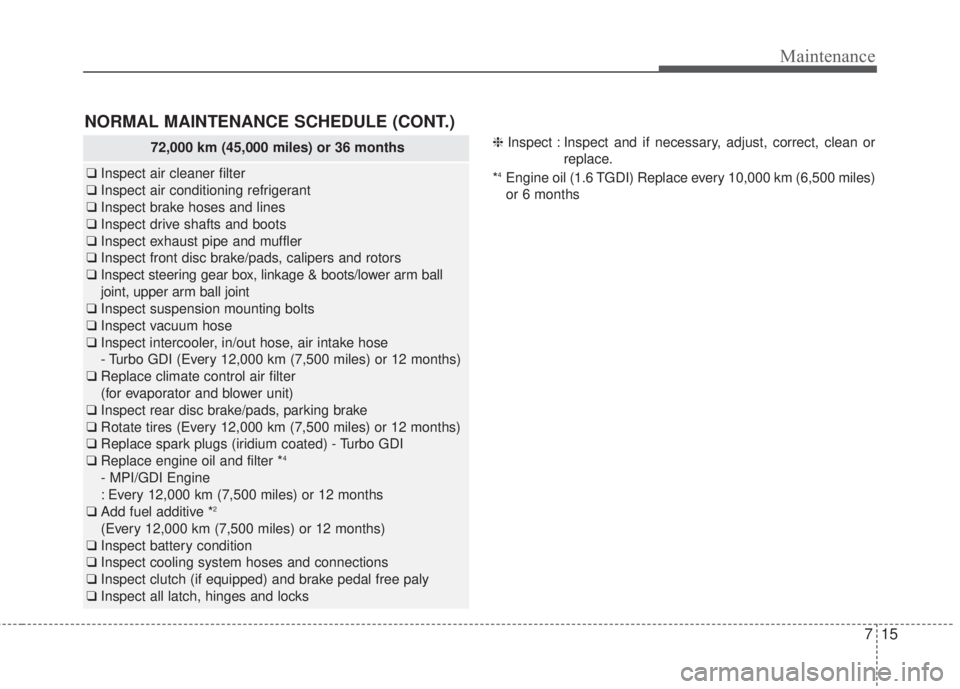
NORMAL MAINTENANCE SCHEDULE (CONT.)
❈Inspect : Inspect and if necessary, adjust, correct, clean or
replace.
*
4Engine oil (1.6 TGDI) Replace every 10,000 km (6,500 miles)
or 6 months
72,000 km (45,000 miles) or 36 months
❑Inspect air cleaner filter
❑Inspect air conditioning refrigerant
❑Inspect brake hoses and lines
❑Inspect drive shafts and boots
❑Inspect exhaust pipe and muffler
❑Inspect front disc brake/pads, calipers and rotors
❑Inspect steering gear box, linkage & boots/lower arm ball
joint, upper arm ball joint
❑Inspect suspension mounting bolts
❑Inspect vacuum hose
❑Inspect intercooler, in/out hose, air intake hose
- Turbo GDI (Every 12,000 km (7,500 miles) or 12 months)
❑Replace climate control air filter
(for evaporator and blower unit)
❑Inspect rear disc brake/pads, parking brake
❑Rotate tires (Every 12,000 km (7,500 miles) or 12 months)
❑Replace spark plugs (iridium coated) - Turbo GDI
❑Replace engine oil and filter *
4
- MPI/GDI Engine
: Every 12,000 km (7,500 miles) or 12 months
❑Add fuel additive *
2
(Every 12,000 km (7,500 miles) or 12 months)
❑Inspect battery condition
❑Inspect cooling system hoses and connections
❑Inspect clutch (if equipped) and brake pedal free paly
❑Inspect all latch, hinges and locks