Lka KIA FORTE 2018 User Guide
[x] Cancel search | Manufacturer: KIA, Model Year: 2018, Model line: FORTE, Model: KIA FORTE 2018Pages: 584, PDF Size: 15.14 MB
Page 414 of 584
573
Driving your vehicle
LKAS function change
The driver can change LKAS to Lane
Departure Warning System (LDWS)
or change the LKAS mode between
Standard LKA and Active LKA by
selecting 'User Settings', 'Driving
Assist', and ‘Lane Keeping Assist
System’ on the LCD display. The sys-
tem is automatically set to Standard
LKA.
Lane Departure Warning (LDWS)
The system can be converted toLKA to LDW at the User setting
mode.
Refer to User setting in section 4.
LDWS alerts the driver with a visu- al and audible warning when the
system detects the vehicle straying
from its lane.
If the LDWS is operating the indi- cator green/white will illuminate.
The steering wheel will not be con- trolled.
Standard LKA
LKAS only starts intervention whenthe vehicle is predicted to cross the
line.
It's useful to a driver who dislikes frequent intervention by LKAS
LDW is generated when the vehi- cle is about to cross the line.
Active LKA
LKAS operates for a vehicle tokeep the region of lane center
more efficiently.
The steering assistance is activat- ed more frequently and earlier than
standard LKA.
LDW is generated when the vehi- cle is about to cross the line.
Page 556 of 584
Maintenance
94
7
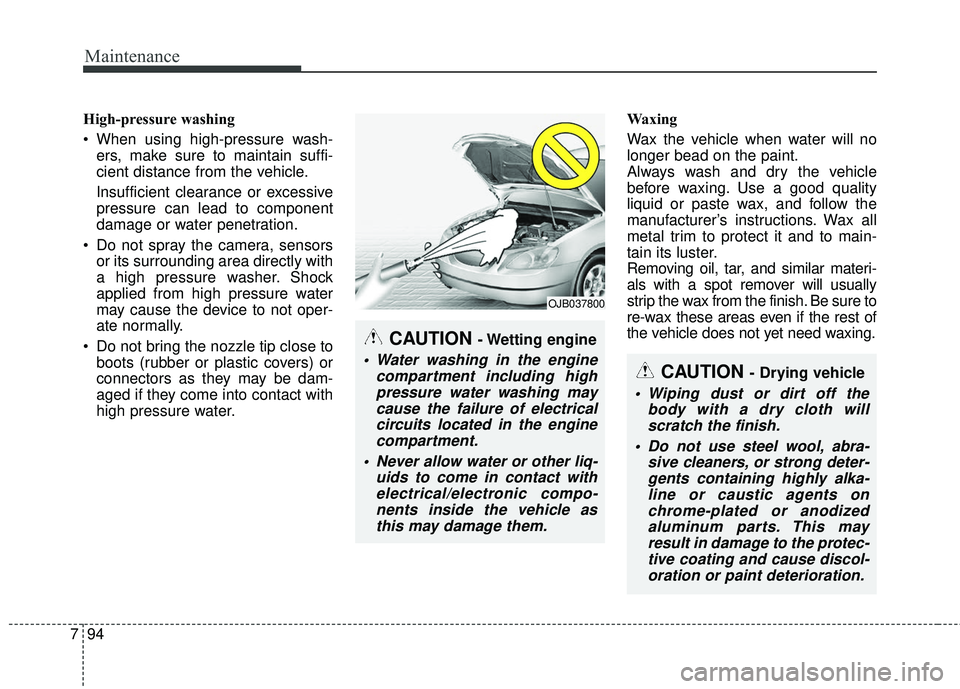
High-pressure washing
When using high-pressure wash-
ers, make sure to maintain suffi-
cient distance from the vehicle.
Insufficient clearance or excessive
pressure can lead to component
damage or water penetration.
Do not spray the camera, sensors or its surrounding area directly with
a high pressure washer. Shock
applied from high pressure water
may cause the device to not oper-
ate normally.
Do not bring the nozzle tip close to boots (rubber or plastic covers) or
connectors as they may be dam-
aged if they come into contact with
high pressure water. Waxing
Wax the vehicle when water will no
longer bead on the paint.
Always wash and dry the vehicle
before waxing. Use a good quality
liquid or paste wax, and follow the
manufacturer’s instructions. Wax all
metal trim to protect it and to main-
tain its luster.
Removing oil, tar, and similar materi-
als with a spot remover will usually
strip the wax from the finish. Be sure to
re-wax these areas even if the rest of
the vehicle does not yet need waxing.
CAUTION - Wetting engine
Water washing in the engine
compartment including highpressure water washing maycause the failure of electricalcircuits located in the enginecompartment.
Never allow water or other liq- uids to come in contact withelectrical/electronic compo-nents inside the vehicle asthis may damage them.
OJB037800
CAUTION - Drying vehicle
Wiping dust or dirt off the body with a dry cloth willscratch the finish.
Do not use steel wool, abra- sive cleaners, or strong deter-gents containing highly alka-line or caustic agents onchrome-plated or anodizedaluminum parts. This mayresult in damage to the protec-tive coating and cause discol-oration or paint deterioration.
Page 557 of 584
795
Maintenance
Finish damage repair
Deep scratches or stone chips in the
painted surface must be repaired
promptly. Exposed metal will quickly
rust and may develop into a major
repair expense.
✽ ✽NOTICE
If your vehicle is damaged and
requires any metal repair or
replacement, be sure the body shop
applies anti-corrosion materials to
the parts repaired or replaced.
Bright-metal maintenance
To remove road tar and insects,
use a tar remover, not a scraper or
other sharp object.
To protect the surfaces of bright- metal parts from corrosion, apply a
coating of wax or chrome preser-
vative and rub to a high luster.
During winter weather or in coastal areas, cover the bright metal parts
with a heavier coating of wax or
preservative. If necessary, coat the
parts with non-corrosive petroleum
jelly or other protective compound.
Underbody maintenance
Road salt and other corrosive chemi-
cals are used in cold weather states to
melt snow and prevent ice accumula-
tion. If these chemicals are not regu-
larly removed, they will corrode the
vehicle underbody and over time dam-
age fuel lines, the fuel tank retention
system, the vehicle suspension, the
exhaust system, and even the body
frame. The National Highway Traffic
Safety Administration has warned all
vehicle owners of all brands of the
need to take the following steps:
Wash the undercarriage of yourvehicle regularly during the winter
and whenever your vehicle has
been exposed to such salts or
chemicals.
Do a thorough washing of the undercarriage at the end of the
winter.
Use professional service techni- cians or governmental inspection
stations to annually inspect for cor-
rosion. Immediately seek an inspection of
your vehicle if you become visually
aware of corrosion flaking or scal-
ing or if you become aware of a
change in vehicle performance,
such as soft or spongey brakes,
fluids leaking, impairment of direc-
tional control, suspension noises
or rattling metal straps.
Aluminum wheel maintenance
The aluminum wheels are coated with
a clear protective finish.
Do not use any abrasive cleaner, pol-ishing compound, solvent, or wire
brushes on aluminum wheels. They
may scratch or damage the finish.
Clean the wheel when it has cooled.
Use only a mild soap or neutral deter- gent, and rinse thoroughly with water.
Also, be sure to clean the wheels
after driving on salted roads. This
helps prevent corrosion.
Avoid washing the wheels with high- speed car wash brushes.
Do not use any alkaline or acid deter- gent. It may damage and corrode the
aluminum wheels coated with a clear
protective finish.
Page 560 of 584
Maintenance
98
7
Interior care
Interior general precautions
Prevent chemicals such as perfume,
cosmetic oil, sun cream, hand cleaner,
and air freshener from contacting the
interior parts because they may cause
damage or discoloration. If they do
contact the interior parts, wipe them
off immediately. See the instructions
for the proper way to clean vinyl.
Taking care of leather seats
Vacuum the seat periodically to
remove dust and sand on the seat.
It will prevent abrasion or damage of
the leather and maintain its quality.
Wipe the natural leather seat cover often with dry or soft cloth.
Sufficient use of a leather protec- tive may prevent abrasion of the
cover and helps maintain the color.
Be sure to read the instructions
and consult a specialist when
using leather coating or protective
agents.
Leather with bright colors(beige, cream beige) is easily contaminat-
ed and clear in appearance. Clean
the seats frequently.
Avoid wiping with wet cloth. It may cause the surface to crack.
Cleaning the leather seats
Remove all contaminations instant-ly. Refer to instructions below for
removal of each contaminant.
Cosmetic products(sunscreen, foundation, etc.)
- Apply cleansing cream on a clothand wipe the contaminated point.
Wipe off the cream with a wet
cloth and remove water with a dry
cloth.
Beverages(coffee, soft drink, etc.) - Apply a small amount of neutraldetergent and wipe until contami-
nations do not smear.
Oil - Remove oil instantly withabsorbable cloth and wipe with
stain remover for natural leather
only.
Chewing gum - Harden the gum with ice andremove gradually.
CAUTION- Electrical
components
Never allow water or other liq-uids to come in contact withelectrical/electronic compo-nents inside the vehicle as thismay damage them.
CAUTION - Leather
When cleaning leather products(steering wheel, seats etc.), useneutral detergents or low alco-hol content solutions. If you usehigh alcohol content solutionsor acid/alkaline detergents, thecolor of the leather may fade orthe surface may get stripped off.
Page 581 of 584
Index
6I
Lane Keeping Assist System (LKAS). . . . . . . . . . . . . . 5-66LKAS function change . . . . . . . . . . . . . . . . . . . . . . 5-73
LKAS malfunction . . . . . . . . . . . . . . . . . . . . . . . . . . 5-72
LKAS operation . . . . . . . . . . . . . . . . . . . . . . . . . . . . 5-67
LCD window . . . . . . . . . . . . . . . . . . . . . . . . . . . . . . . . . 4-62 LCD Modes . . . . . . . . . . . . . . . . . . . . . . . . . . . . . . . 4-67
Over view . . . . . . . . . . . . . . . . . . . . . . . . . . . . . . . . . 4-62
Trip information (Trip computer) . . . . . . . . . . . . . . . 4-62
Light bulbs. . . . . . . . . . . . . . . . . . . . . . . . . . . . . . . . . . . 7-\
80 Front lights replacement . . . . . . . . . . . . . . . . . . . . . . 7-80
High mounted stop lamp replacement . . . . . . . . . . . 7-89
Interior lamp bulb replacement . . . . . . . . . . . . . . . . 7-92
License plate lamp bulb replacement . . . . . . . . . . . 7-91
Outside Mirrors with Turn Signal Indicators . . . . . 7-84
Rear combination lamp bulb replacement . . . . . . . . 7-84
Lighting . . . . . . . . . . . . . . . . . . . . . . . . . . . . . . . . . . . . \
. 4-94 AFLS (Adaptive Front Lighting System) . . . . . . . . . 4-99
Battery saver function . . . . . . . . . . . . . . . . . . . . . . . . 4-94
Daytime running light. . . . . . . . . . . . . . . . . . . . . . . . 4-94
Front fog light . . . . . . . . . . . . . . . . . . . . . . . . . . . . . . 4-98
Headlight escort function . . . . . . . . . . . . . . . . . . . . . 4-94
High beam operation . . . . . . . . . . . . . . . . . . . . . . . . 4-96
Lighting control . . . . . . . . . . . . . . . . . . . . . . . . . . . . 4-95
Turn signals and lane change signals . . . . . . . . . . . . 4-97 Maintenance services . . . . . . . . . . . . . . . . . . . . . . . . . . . 7-5
Owner maintenance precautions . . . . . . . . . . . . . . . . . 7-6
Owner’s responsibility . . . . . . . . . . . . . . . . . . . . . . . . 7-5
Manual climate control system . . . . . . . . . . . . . . . . . . 4-109 Checking the amount of air conditionerrefrigerant and compressor lubricant . . . . . . . . . . 4-118
Climate control air filter . . . . . . . . . . . . . . . . . . . . . 4-117
Heating and air conditioning . . . . . . . . . . . . . . . . . 4-110
System operation. . . . . . . . . . . . . . . . . . . . . . . . . . . 4-115
Manual Transaxle . . . . . . . . . . . . . . . . . . . . . . . . . . . . . 5-14 Good driving practices . . . . . . . . . . . . . . . . . . . . . . . 5-17
Manual transaxle operation . . . . . . . . . . . . . . . . . . . 5-14
Mirrors . . . . . . . . . . . . . . . . . . . . . . . . . . . . . . . . . . . . \
. . 4-51 Inside rearview mirror . . . . . . . . . . . . . . . . . . . . . . . 4-51
Outside rearview mirror . . . . . . . . . . . . . . . . . . . . . . 4-52
Owner maintenance . . . . . . . . . . . . . . . . . . . . . . . . . . . . . 7-7 Owner maintenance schedule . . . . . . . . . . . . . . . . . . 7-7
Parking brake. . . . . . . . . . . . . . . . . . . . . . . . . . . . . . . . . 7-39 Checking the parking brake . . . . . . . . . . . . . . . . . . . 7-39
LM
O
P
YDM CAN (ENG) Index.qxp 9/11/2017 12:44 PM Page 6