engine control KIA FORTE 2018 Repair Manual
[x] Cancel search | Manufacturer: KIA, Model Year: 2018, Model line: FORTE, Model: KIA FORTE 2018Pages: 584, PDF Size: 15.14 MB
Page 497 of 584
735
Maintenance
ENGINE COOLANT
The high-pressure cooling system
has a reservoir filled with year-round
antifreeze coolant. The reservoir is
filled at the factory.
Check the antifreeze protection and
coolant level at least once a year, at
the beginning of the winter season,
and before traveling to a colder cli-
mate.Checking the coolant level
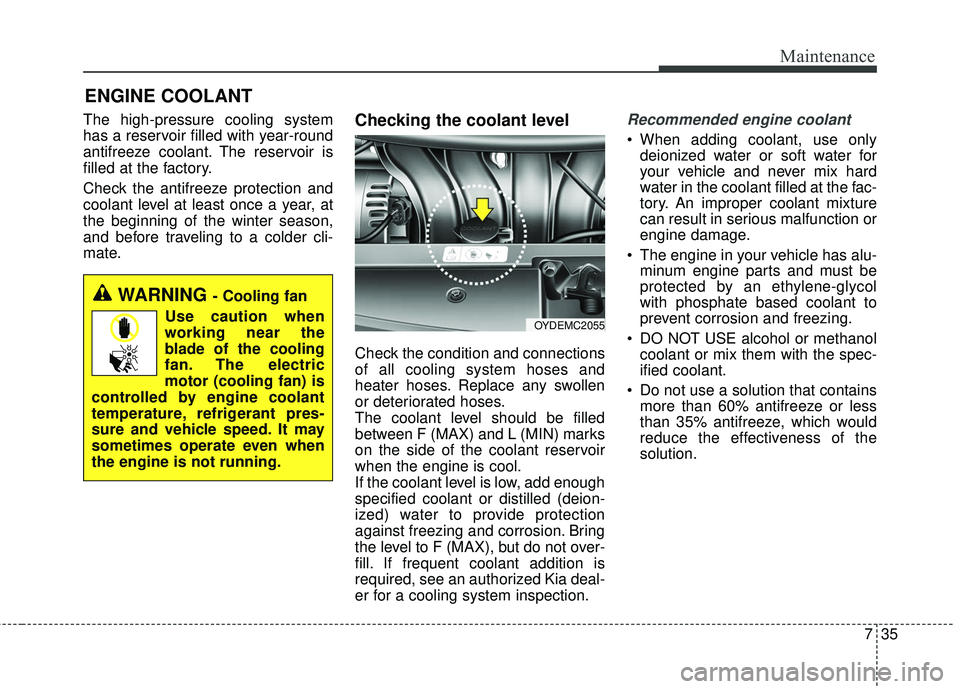
Check the condition and connections
of all cooling system hoses and
heater hoses. Replace any swollen
or deteriorated hoses.
The coolant level should be filled
between F (MAX) and L (MIN) marks
on the side of the coolant reservoir
when the engine is cool.
If the coolant level is low, add enough
specified coolant or distilled (deion-
ized) water to provide protection
against freezing and corrosion. Bring
the level to F (MAX), but do not over-
fill. If frequent coolant addition is
required, see an authorized Kia deal-
er for a cooling system inspection.
Recommended engine coolant
When adding coolant, use onlydeionized water or soft water for
your vehicle and never mix hard
water in the coolant filled at the fac-
tory. An improper coolant mixture
can result in serious malfunction or
engine damage.
The engine in your vehicle has alu- minum engine parts and must be
protected by an ethylene-glycol
with phosphate based coolant to
prevent corrosion and freezing.
DO NOT USE alcohol or methanol coolant or mix them with the spec-
ified coolant.
Do not use a solution that contains more than 60% antifreeze or less
than 35% antifreeze, which would
reduce the effectiveness of the
solution.
WARNING - Cooling fan
Use caution when
working near the
blade of the cooling
fan. The electric
motor (cooling fan) is
controlled by engine coolant
temperature, refrigerant pres-
sure and vehicle speed. It may
sometimes operate even when
the engine is not running.
OYDEMC2055
Page 511 of 584
749
Maintenance
When recharging the battery,
observe the following precautions:
The battery must be removed fromthe vehicle and placed in an area
with good ventilation.
Watch the battery during charging, and stop or reduce the charging
rate if the battery cells begin
gassing (boiling) violently or if the
temperature of the electrolyte of
any cell exceeds 49°C (120°F).
Wear eye protection when check- ing the battery during charging.
Disconnect the battery charger in the following order.
1. Turn off the battery charger main switch.
2. Unhook the negative clamp from the negative battery terminal.
3. Unhook the positive clamp from the positive battery terminal.
Before performing maintenance or recharging the battery, turn off all
accessories and stop the engine.
The negative battery cable must be removed first and installed last
when the battery is disconnected.Reset items
Items should be reset after the bat-
tery has been discharged or the bat-
tery has been disconnected.
Auto down window (See chapter 4)
Sunroof (See chapter 4)
Trip computer (See chapter 4)
Climate control system (See chapter 4)
Clock (See chapter 4)
Audio (See chapter 4)
Page 526 of 584
Maintenance
64
7
FUSES
A vehicle's electrical system is protect-
ed from electrical overload damage by
fuses.
This vehicle has 2 fuse panels, one
located in the driver's side panel bol-
ster, others in the engine compart-
ment near the battery.
If any of your vehicle's lights, acces-
sories, or controls do not work, check
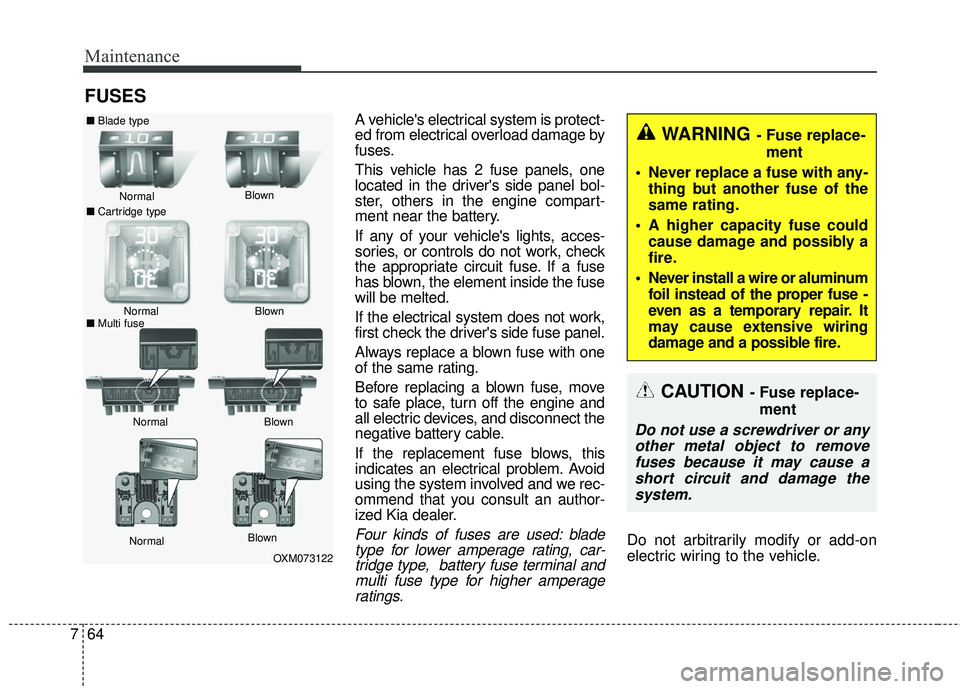
the appropriate circuit fuse. If a fuse
has blown, the element inside the fuse
will be melted.
If the electrical system does not work,
first check the driver's side fuse panel.
Always replace a blown fuse with one
of the same rating.
Before replacing a blown fuse, move
to safe place, turn off the engine and
all electric devices, and disconnect the
negative battery cable.
If the replacement fuse blows, this
indicates an electrical problem. Avoid
using the system involved and we rec-
ommend that you consult an author-
ized Kia dealer.
Four kinds of fuses are used: blade
type for lower amperage rating, car-tridge type, battery fuse terminal andmulti fuse type for higher amperageratings.Do not arbitrarily modify or add-on
electric wiring to the vehicle.
WARNING - Fuse replace-
ment
Never replace a fuse with any- thing but another fuse of the
same rating.
A higher capacity fuse could cause damage and possibly a
fire.
Never install a wire or aluminum foil instead of the proper fuse -
even as a temporary repair. It
may cause extensive wiring
damage and a possible fire.
CAUTION - Fuse replace-
ment
Do not use a screwdriver or anyother metal object to removefuses because it may cause ashort circuit and damage thesystem.
OXM073122
Normal
Normal
■
Blade type
■ Cartridge type
■ Multi fuse Blown
Blown
Normal Blown
Normal Blown
Page 536 of 584
Maintenance
74
7
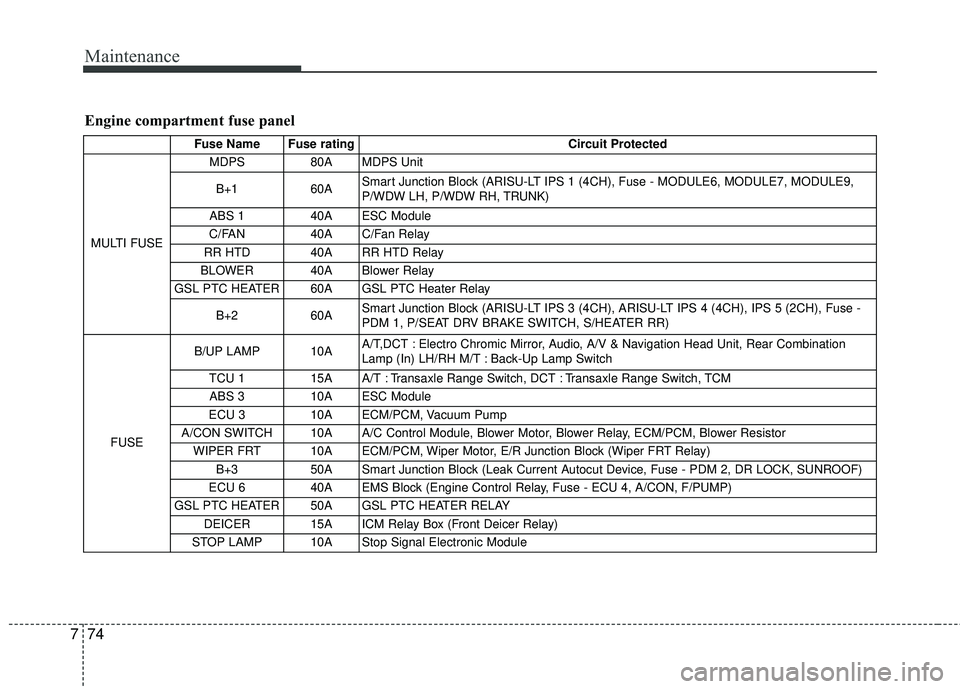
Engine compartment fuse panel
Fuse Name Fuse rating Circuit Protected
MULTI FUSE MDPS 80A MDPS
Unit
B+1 60A Smart Junction Block (ARISU-LT IPS 1 (4CH), Fuse - MODULE6, MODULE7, MODULE9,
P/WDW LH, P/WDW RH, TRUNK)
ABS 1 40A ESC Module
C/FAN 40A C/Fan Relay
RR HTD 40A RR HTD Relay
BLOWER 40A Blower Relay
GSL PTC HEATER 60A GSL PTC Heater Relay
B+2 60A Smart Junction Block (ARISU-LT IPS 3 (4CH), ARISU-LT IPS 4 (4CH), IPS 5 (2CH), Fuse -
PDM 1, P/SEAT DRV BRAKE SWITCH, S/HEATER RR)
FUSE B/UP LAMP 10A
A/T,DCT : Electro Chromic Mirror, Audio, A/V & Navigation Head Unit, Rear Combination
Lamp (In) LH/RH M/T : Back-Up Lamp Switch
TCU 1 15A A/T : Transaxle Range Switch, DCT : Transaxle Range Switch, TCM
ABS 3 10A ESC Module
ECU 3 10A ECM/PCM, Vacuum Pump
A/CON SWITCH 10A A/C Control Module, Blower Motor, Blower Relay, ECM/PCM, Blower Resistor WIPER FRT 10A ECM/PCM, Wiper Motor, E/R Junction Block (Wiper FRT Relay) B+3 50A Smart Junction Block (Leak Current Autocut Device, Fuse - PDM 2, DR LOCK, SUNROOF)
ECU 6 40A EMS Block (Engine Control Relay, Fuse - ECU 4, A/CON, F/PUMP)
GSL PTC HEATER 50A GSL PTC HEATER RELAY DEICER 15A ICM Relay Box (Front Deicer Relay)
STOP LAMP 10A Stop Signal Electronic Module
Page 539 of 584
777
Maintenance
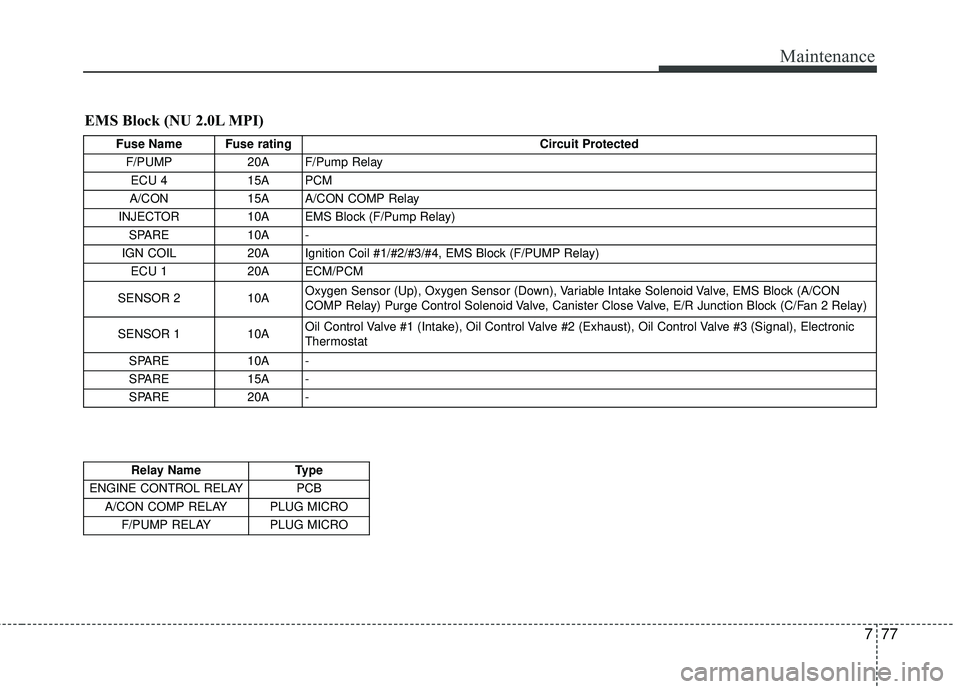
EMS Block (NU 2.0L MPI)
Fuse Name Fuse ratingCircuit Protected
F/PUMP 20A F/Pump Relay
ECU 4 15A PCM
A/CON 15A A/CON COMP Relay
INJECTOR 10A EMS Block (F/Pump Relay)
SPARE 10A -
IGN COIL 20A Ignition Coil #1/#2/#3/#4, EMS Block (F/PUMP Relay)
ECU 1 20A ECM/PCM
SENSOR 2 10A Oxygen Sensor (Up), Oxygen Sensor (Down), Variable Intake Solenoid Valve, EMS Block (A/CON
COMP Relay) Purge Control Solenoid Valve, Canister Close Valve, E/R Junction Block (C/Fan 2 Relay)
SENSOR 1 10A Oil Control Valve #1 (Intake), Oil Control Valve #2 (Exhaust), Oil Control Valve #3 (Signal), Electronic
Thermostat
SPARE 10A -
SPARE 15A -
SPARE 20A -
Relay Name Type
ENGINE CONTROL RELAY PCB A/CON COMP RELAY PLUG MICRO F/PUMP RELAY PLUG MICRO
Page 540 of 584
Maintenance
78
7
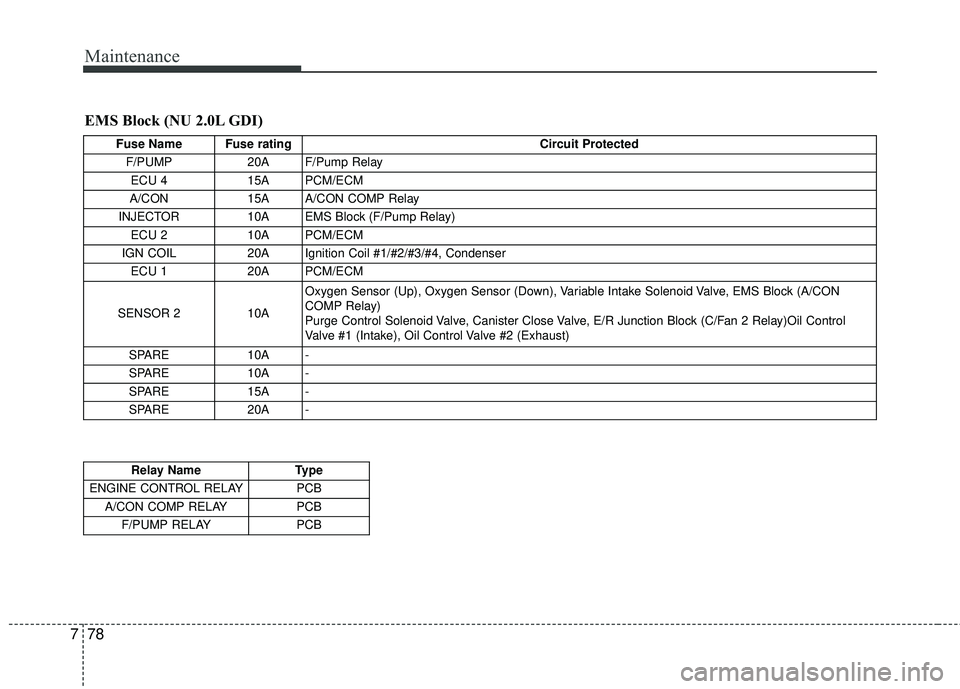
EMS Block (NU 2.0L GDI)
Fuse Name Fuse rating Circuit Protected
F/PUMP 20A F/Pump Relay
ECU 4 15A PCM/ECM
A/CON 15A A/CON COMP Relay
INJECTOR 10A EMS Block (F/Pump Relay)
ECU 2 10A PCM/ECM
IGN COIL 20A Ignition Coil #1/#2/#3/#4, Condenser
ECU 1 20A PCM/ECM
SENSOR 2 10A Oxygen Sensor (Up), Oxygen Sensor (Down), Variable Intake Solenoid Valve, EMS Block (A/CON
COMP Relay)
Purge Control Solenoid Valve, Canister Close Valve, E/R Junction Block (C/Fan 2 Relay)Oil Control
Valve #1 (Intake), Oil Control Valve #2 (Exhaust)
SPARE 10A -
SPARE 10A -
SPARE 15A -
SPARE 20A -
Relay Name Type
ENGINE CONTROL RELAY PCB A/CON COMP RELAY PCB
F/PUMP RELAY PCB
Page 541 of 584
779
Maintenance
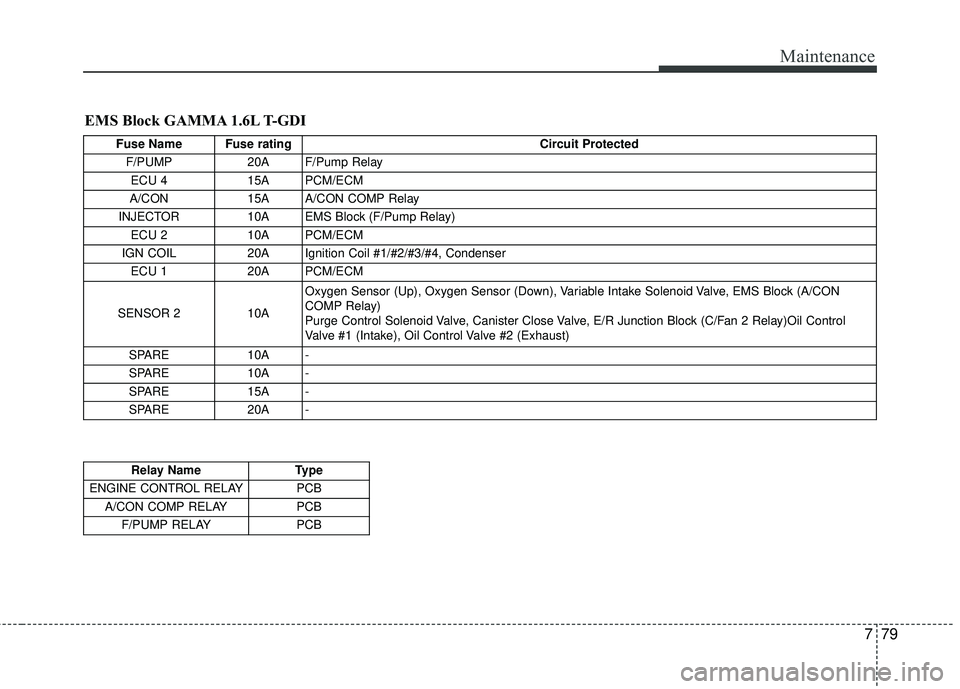
EMS Block GAMMA 1.6L T-GDI
Fuse Name Fuse ratingCircuit Protected
F/PUMP 20A F/Pump Relay
ECU 4 15A PCM/ECM
A/CON 15A A/CON COMP Relay
INJECTOR 10A EMS Block (F/Pump Relay)
ECU 2 10A PCM/ECM
IGN COIL 20A Ignition Coil #1/#2/#3/#4, Condenser
ECU 1 20A PCM/ECM
SENSOR 2 10A Oxygen Sensor (Up), Oxygen Sensor (Down), Variable Intake Solenoid Valve, EMS Block (A/CON
COMP Relay)
Purge Control Solenoid Valve, Canister Close Valve, E/R Junction Block (C/Fan 2 Relay)Oil Control
Valve #1 (Intake), Oil Control Valve #2 (Exhaust)
SPARE 10A -
SPARE 10A -
SPARE 15A -
SPARE 20A -
Relay Name Type
ENGINE CONTROL RELAY PCB A/CON COMP RELAY PCB
F/PUMP RELAY PCB
Page 563 of 584

7101
Maintenance
Canister
Fuel vapors generated inside the fuel
tank are absorbed and stored in the
onboard canister. When the engine is
running, the fuel vapors absorbed in
the canister are drawn into the surge
tank through the purge control sole-
noid valve.
Purge Control Solenoid Valve(PCSV)
The purge control solenoid valve is
controlled by the Engine Control
Module (ECM); when the engine
coolant temperature is low during
idling, the PCSV closes so that evap-
orated fuel is not taken into the
engine. After the engine warms up
during ordinary driving, the PCSV
opens to introduce evaporated fuel to
the engine.
3. Exhaust emission control system
The Exhaust Emission Control
System is a highly effective system
which controls exhaust emissions
while maintaining good vehicle per-
formance.
Vehicle modifications
This vehicle should not be modified.
Modification of your vehicle could
affect its performance, safety or
durability and may even violate gov-
ernmental safety and emissions reg-
ulations.
In addition, damage or performance
problems resulting from any modifi-
cation may not be covered under
warranty.
If you use unauthorized electronic
devices, it may cause the vehicle to
operate abnormally, wire damage,
battery discharge and fire. For your
safety, do not use unauthorized
electronic devices.
Engine exhaust gas precautions
(carbon monoxide)
Carbon monoxide can be present with other exhaust fumes.
Therefore, if you smell exhaust
fumes of any kind inside your vehi-
cle, have it inspected and repaired
immediately. If you ever suspect
exhaust fumes are coming into
your vehicle, drive it only with all
the windows fully open. Have your
vehicle checked and repaired
immediately.
WARNING - Exhaust
Engine exhaust gases contain
carbon monoxide (CO). Though
colorless and odorless, it is
dangerous and could be lethal if
inhaled. Follow the instructions
on this page to avoid CO poi-
soning.
Page 564 of 584

Maintenance
102
7
Do not operate the engine in con-
fined or closed areas (such as
garages) any more than what is
necessary to move the vehicle in or
out of the area.
When the vehicle is stopped in an open area for more than a short
time with the engine running,
adjust the ventilation system (as
needed) to draw outside air into the
vehicle.
Never sit in a parked or stopped vehicle for any extended time with
the engine running.
When the engine stalls or fails to start, excessive attempts to restart
the engine may cause damage to
the emission control system.Operating precautions for catalyt-
ic converters (if equipped)
Your vehicle is equipped with a cat-
alytic converter emission control
device.
Therefore, the following precautions
must be observed: Use only UNLEADED FUEL for
gasoline engines.
Do not operate the vehicle when there are signs of engine malfunc-
tion, such as misfire or a noticeable
loss of performance.
Do not misuse or abuse the engine. Examples of misuse are
coasting with the ignition off and
descending steep grades in gear
with the ignition off.
Do not operate the engine at high idle speed for extended periods (5
minutes or more).
Do not modify or tamper with any part of the engine or emission con-
trol system. All inspections and
adjustments must be made by an
authorized Kia dealer.
Avoid driving with an extremely low fuel level. Running out of fuel could
cause the engine to misfire, dam-
aging the catalytic converter.
Failure to observe these precautions
could result in damage to the catalyt-
ic converter and to your vehicle.
Additionally, such actions could void
your warranties.
WARNING- Fire
Do not park, idle or drive the vehicle over or near flamma-
ble objects, such as grass,
vegetation, paper, leaves, etc.
A hot exhaust system can
ignite flammable items under
your vehicle.
Also, do not remove the heat sink around the exhaust sys-
tem, do not seal the bottom of
the vehicle or do not coat the
vehicle for corrosion control.
It may present a fire risk under
certain conditions.
WARNING- Catalytic
converter
Keep away from the catalytic
converter and exhaust system
while the vehicle is running or
immediately thereafter. The
exhaust and catalytic systems
are very hot and may burn you.
Page 579 of 584
Index
4I
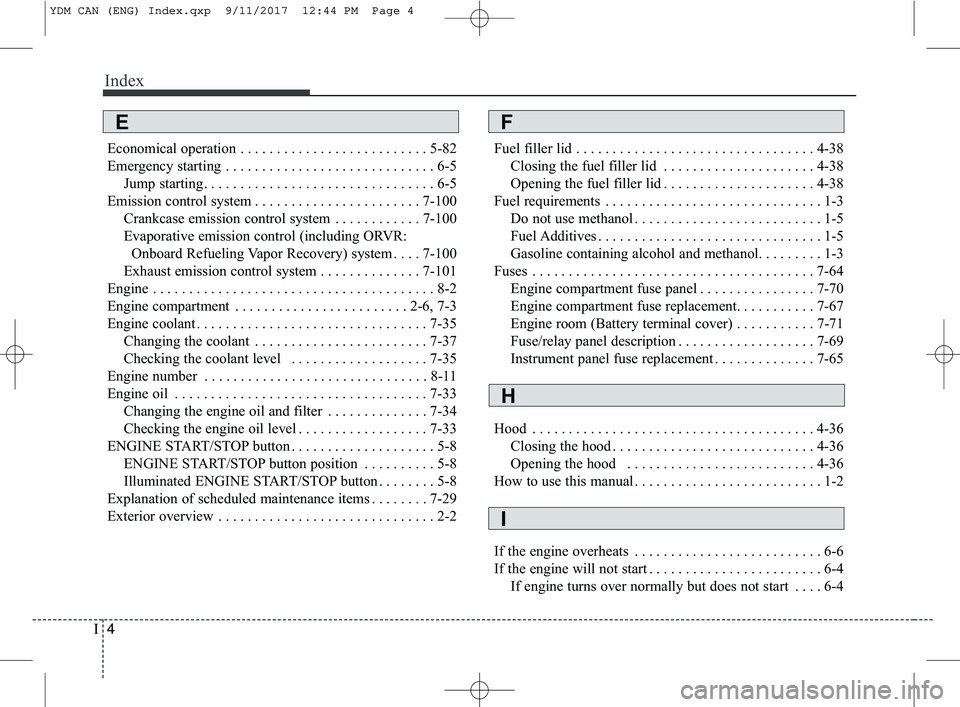
Economical operation . . . . . . . . . . . . . . . . . . . . . . . . . . 5-82
Emergency starting . . . . . . . . . . . . . . . . . . . . . . . . . . . . . 6-5Jump starting. . . . . . . . . . . . . . . . . . . . . . . . . . . . . . . . 6-5
Emission control system . . . . . . . . . . . . . . . . . . . . . . . 7-100 Crankcase emission control system . . . . . . . . . . . . 7-100
Evaporative emission control (including ORVR: Onboard Refueling Vapor Recovery) system . . . . 7-100
Exhaust emission control system . . . . . . . . . . . . . . 7-101
Engine . . . . . . . . . . . . . . . . . . . . . . . . . . . . . . . . . . . . \
. . . 8-2
Engine compartment . . . . . . . . . . . . . . . . . . . . . . . . 2-6, 7-3
Engine coolant . . . . . . . . . . . . . . . . . . . . . . . . . . . . . . . . 7-35 Changing the coolant . . . . . . . . . . . . . . . . . . . . . . . . 7-37
Checking the coolant level . . . . . . . . . . . . . . . . . . . 7-35
Engine number . . . . . . . . . . . . . . . . . . . . . . . . . . . . . . . 8-11
Engine oil . . . . . . . . . . . . . . . . . . . . . . . . . . . . . . . . . . . 7-\
33 Changing the engine oil and filter . . . . . . . . . . . . . . 7-34
Checking the engine oil level . . . . . . . . . . . . . . . . . . 7-33
ENGINE START/STOP button . . . . . . . . . . . . . . . . . . . . 5-8 ENGINE START/STOP button position . . . . . . . . . . 5-8
Illuminated ENGINE START/STOP button . . . . . . . . 5-8
Explanation of scheduled maintenance items . . . . . . . . 7-29
Exterior overview . . . . . . . . . . . . . . . . . . . . . . . . . . . . . . 2-2 Fuel filler lid . . . . . . . . . . . . . . . . . . . . . . . . . . . . . . . . . 4-38
Closing the fuel filler lid . . . . . . . . . . . . . . . . . . . . . 4-38
Opening the fuel filler lid . . . . . . . . . . . . . . . . . . . . . 4-38
Fuel requirements . . . . . . . . . . . . . . . . . . . . . . . . . . . . . . 1-3 Do not use methanol . . . . . . . . . . . . . . . . . . . . . . . . . . 1-5
Fuel Additives . . . . . . . . . . . . . . . . . . . . . . . . . . . . . . . 1-5
Gasoline containing alcohol and methanol. . . . . . . . . 1-3
Fuses . . . . . . . . . . . . . . . . . . . . . . . . . . . . . . . . . . . . \
. . . 7-64 Engine compartment fuse panel . . . . . . . . . . . . . . . . 7-70
Engine compartment fuse replacement. . . . . . . . . . . 7-67
Engine room (Battery terminal cover) . . . . . . . . . . . 7-71
Fuse/relay panel description . . . . . . . . . . . . . . . . . . . 7-69
Instrument panel fuse replacement . . . . . . . . . . . . . . 7-65
Hood . . . . . . . . . . . . . . . . . . . . . . . . . . . . . . . . . . . . \
. . . 4-36 Closing the hood . . . . . . . . . . . . . . . . . . . . . . . . . . . . 4-36
Opening the hood . . . . . . . . . . . . . . . . . . . . . . . . . . 4-36
How to use this manual . . . . . . . . . . . . . . . . . . . . . . . . . . 1-2
If the engine overheats . . . . . . . . . . . . . . . . . . . . . . . . . . 6-6
If the engine will not start . . . . . . . . . . . . . . . . . . . . . . . . 6-4 If engine turns over normally but does not start . . . . 6-4
EF
H
I
YDM CAN (ENG) Index.qxp 9/11/2017 12:44 PM Page 4