Battery KIA FORTE 2018 Manual PDF
[x] Cancel search | Manufacturer: KIA, Model Year: 2018, Model line: FORTE, Model: KIA FORTE 2018Pages: 584, PDF Size: 15.14 MB
Page 511 of 584
749
Maintenance
When recharging the battery,
observe the following precautions:
The battery must be removed fromthe vehicle and placed in an area
with good ventilation.
Watch the battery during charging, and stop or reduce the charging
rate if the battery cells begin
gassing (boiling) violently or if the
temperature of the electrolyte of
any cell exceeds 49°C (120°F).
Wear eye protection when check- ing the battery during charging.
Disconnect the battery charger in the following order.
1. Turn off the battery charger main switch.
2. Unhook the negative clamp from the negative battery terminal.
3. Unhook the positive clamp from the positive battery terminal.
Before performing maintenance or recharging the battery, turn off all
accessories and stop the engine.
The negative battery cable must be removed first and installed last
when the battery is disconnected.Reset items
Items should be reset after the bat-
tery has been discharged or the bat-
tery has been disconnected.
Auto down window (See chapter 4)
Sunroof (See chapter 4)
Trip computer (See chapter 4)
Climate control system (See chapter 4)
Clock (See chapter 4)
Audio (See chapter 4)
Page 522 of 584
Maintenance
60
7
Intended Outboard Sidewall: The
side of an asymmetrical tire, that
must always face outward when
mounted on a vehicle.
Kilopascal (kPa): The metric unit for
air pressure.
Light truck (LT) tire: A tire designat-
ed by its manufacturer as primarily
intended for use on lightweight trucks
or multipurpose passenger vehicles.
Load ratings: The maximum load
that a tire is rated to carry for a given
inflation pressure.
Load Index: An assigned number
ranging from 1 to 279 that corre-
sponds to the load carrying capacity
of a tire.
Maximum Inflation Pressure: The
maximum air pressure to which a
cold tire may be inflated. The maxi-
mum air pressure is molded onto the
sidewall.
Maximum Load Rating: The load
rating for a tire at the maximum per-
missible inflation pressure for that tire. Maximum Loaded Vehicle Weight:
The sum of curb weight; accessory
weight; vehicle capacity weight; and
production options weight.
Normal Occupant Weight:
The
number of occupants a vehicle is
designed to seat multiplied by 68 kg
(150 pounds).
Occupant Distribution: Designated
seating positions.
Outward Facing Sidewall: The side
of a asymmetrical tire that has a par-
ticular side that faces outward when
mounted on a vehicle. The outward
facing sidewall bears white lettering
or bears manufacturer, brand, and/or
model name molding that is higher or
deeper than the same moldings on
the inner facing sidewall.
Passenger (P-Metric) Tire: A tire
used on passenger cars and some
light duty trucks and multipurpose
vehicles.
Ply: A layer of rubber-coated parallel
cords. Pneumatic tire:
A mechanical
device made of rubber, chemicals,
fabric and steel or other materials,
that, when mounted on an automo-
tive wheel, provides the traction and
contains the gas or fluid that sustains
the load.
Production options weight: The
combined weight of installed regular
production options weighing over 2.3
kg (5 lb.) in excess of the standard
items which they replace, not previ-
ously considered in curb weight or
accessory weight, including heavy
duty brakes, ride levelers, roof rack,
heavy duty battery, and special trim.
Recommended Inflation Pressure:
Vehicle manufacturer's recommend-
ed tire inflation pressure and shown
on the tire placard.
Radial Ply Tire: A pneumatic tire in
which the ply cords that extend to the
beads are laid at 90 degrees to the
centerline of the tread.
Rim: A metal support for a tire and
upon which the tire beads are seated.
Page 526 of 584
Maintenance
64
7
FUSES
A vehicle's electrical system is protect-
ed from electrical overload damage by
fuses.
This vehicle has 2 fuse panels, one
located in the driver's side panel bol-
ster, others in the engine compart-
ment near the battery.
If any of your vehicle's lights, acces-
sories, or controls do not work, check
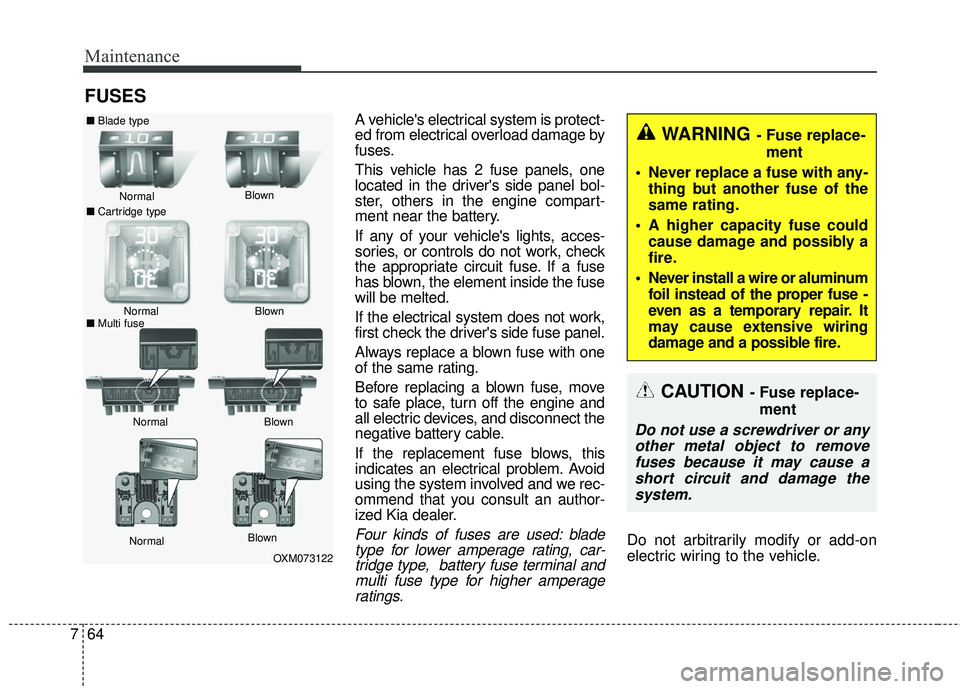
the appropriate circuit fuse. If a fuse
has blown, the element inside the fuse
will be melted.
If the electrical system does not work,
first check the driver's side fuse panel.
Always replace a blown fuse with one
of the same rating.
Before replacing a blown fuse, move
to safe place, turn off the engine and
all electric devices, and disconnect the
negative battery cable.
If the replacement fuse blows, this
indicates an electrical problem. Avoid
using the system involved and we rec-
ommend that you consult an author-
ized Kia dealer.
Four kinds of fuses are used: blade
type for lower amperage rating, car-tridge type, battery fuse terminal andmulti fuse type for higher amperageratings.Do not arbitrarily modify or add-on
electric wiring to the vehicle.
WARNING - Fuse replace-
ment
Never replace a fuse with any- thing but another fuse of the
same rating.
A higher capacity fuse could cause damage and possibly a
fire.
Never install a wire or aluminum foil instead of the proper fuse -
even as a temporary repair. It
may cause extensive wiring
damage and a possible fire.
CAUTION - Fuse replace-
ment
Do not use a screwdriver or anyother metal object to removefuses because it may cause ashort circuit and damage thesystem.
OXM073122
Normal
Normal
■
Blade type
■ Cartridge type
■ Multi fuse Blown
Blown
Normal Blown
Normal Blown
Page 528 of 584
Maintenance
66
7
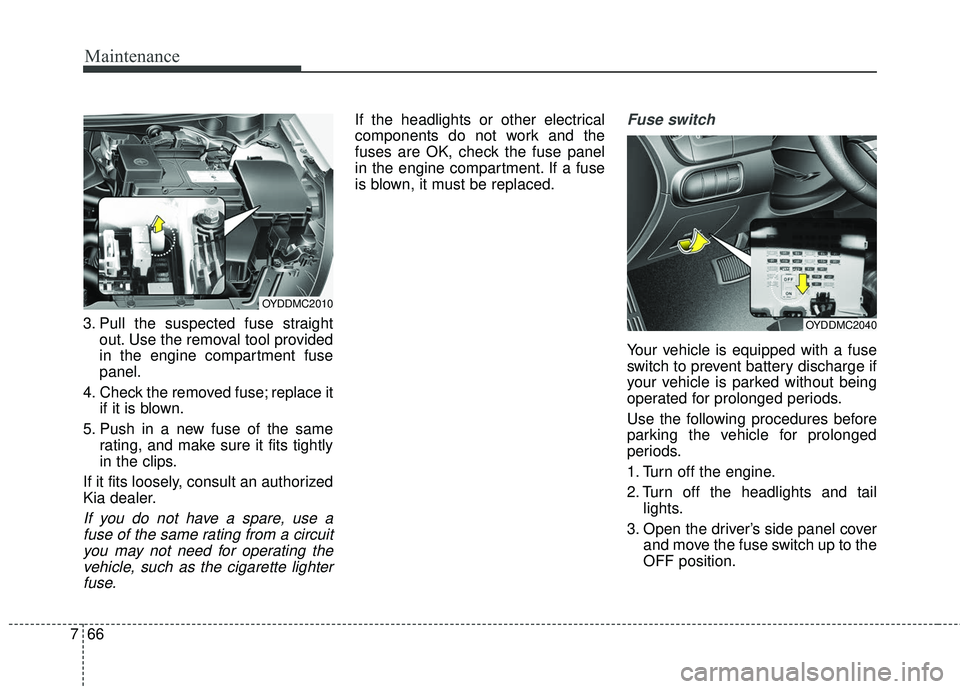
3. Pull the suspected fuse straight
out. Use the removal tool provided
in the engine compartment fuse
panel.
4. Check the removed fuse; replace it if it is blown.
5. Push in a new fuse of the same rating, and make sure it fits tightly
in the clips.
If it fits loosely, consult an authorized
Kia dealer.
If you do not have a spare, use a fuse of the same rating from a circuityou may not need for operating thevehicle, such as the cigarette lighterfuse.
If the headlights or other electrical
components do not work and the
fuses are OK, check the fuse panel
in the engine compartment. If a fuse
is blown, it must be replaced.Fuse switch
Your vehicle is equipped with a fuse
switch to prevent battery discharge if
your vehicle is parked without being
operated for prolonged periods.
Use the following procedures before
parking the vehicle for prolonged
periods.
1. Turn off the engine.
2. Turn off the headlights and tail lights.
3. Open the driver’s side panel cover and move the fuse switch up to the
OFF position.
OYDDMC2040
OYDDMC2010
Page 529 of 584
767
Maintenance
✽ ✽NOTICE
• If the fuse switch is in the OFF
position, the warning chime,
audio, clock and interior lamps,
etc., will not operate. Some items
must be reset after replacement.
Refer to “Battery” in this chapter.
• Even when the fuse switch is in the OFF position, the battery can still
be discharged by operation of the
headlights or other electrical
devices.
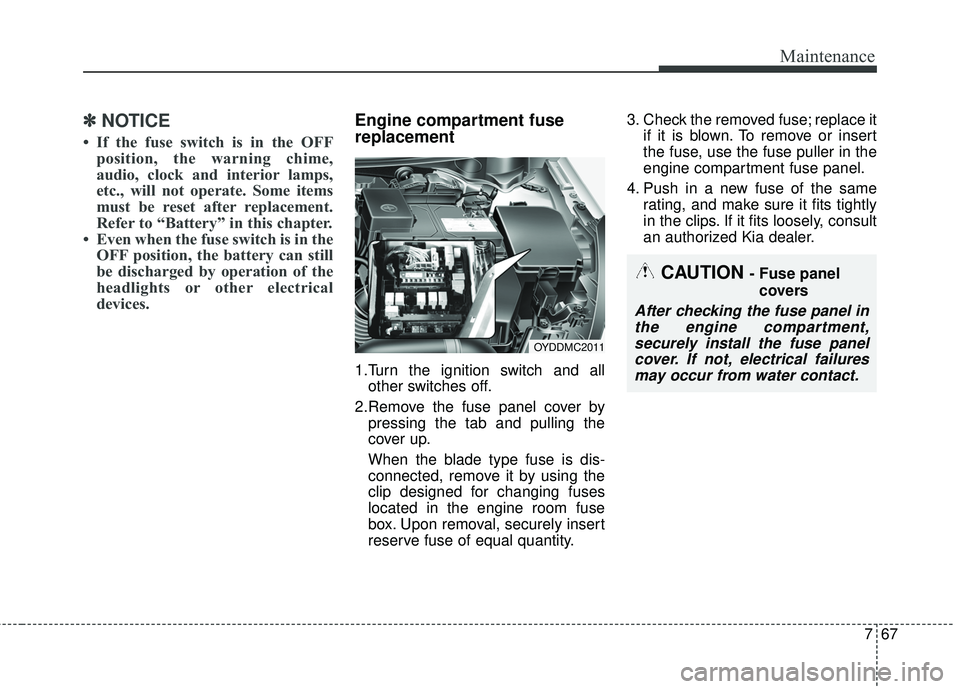
Engine compartment fuse
replacement
1.Turn the ignition switch and all
other switches off.
2.Remove the fuse panel cover by pressing the tab and pulling the
cover up.
When the blade type fuse is dis-
connected, remove it by using the
clip designed for changing fuses
located in the engine room fuse
box. Upon removal, securely insert
reserve fuse of equal quantity. 3. Check the removed fuse; replace it
if it is blown. To remove or insert
the fuse, use the fuse puller in the
engine compartment fuse panel.
4. Push in a new fuse of the same rating, and make sure it fits tightly
in the clips. If it fits loosely, consult
an authorized Kia dealer.
CAUTION - Fuse panel
covers
After checking the fuse panel inthe engine compartment,securely install the fuse panelcover. If not, electrical failuresmay occur from water contact.
OYDDMC2011
Page 530 of 584
Maintenance
68
7
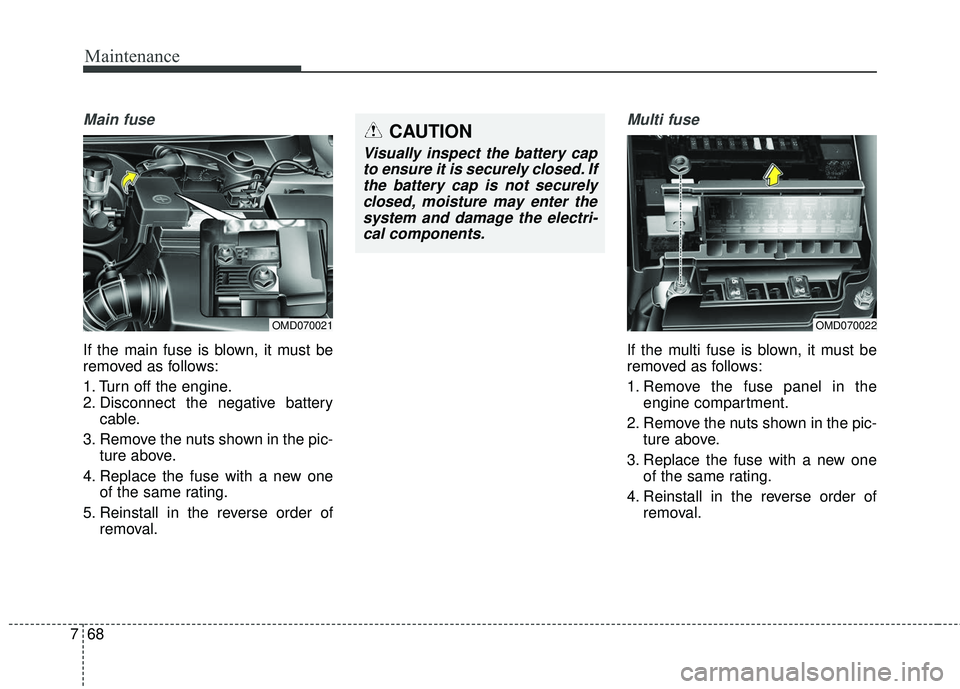
Main fuse
If the main fuse is blown, it must be
removed as follows:
1. Turn off the engine.
2. Disconnect the negative battery
cable.
3. Remove the nuts shown in the pic- ture above.
4. Replace the fuse with a new one of the same rating.
5. Reinstall in the reverse order of removal.
Multi fuse
If the multi fuse is blown, it must be
removed as follows:
1. Remove the fuse panel in theengine compartment.
2. Remove the nuts shown in the pic- ture above.
3. Replace the fuse with a new one of the same rating.
4. Reinstall in the reverse order of removal.
OMD070022OMD070021
CAUTION
Visually inspect the battery capto ensure it is securely closed. Ifthe battery cap is not securelyclosed, moisture may enter thesystem and damage the electri-cal components.
Page 533 of 584
771
Maintenance
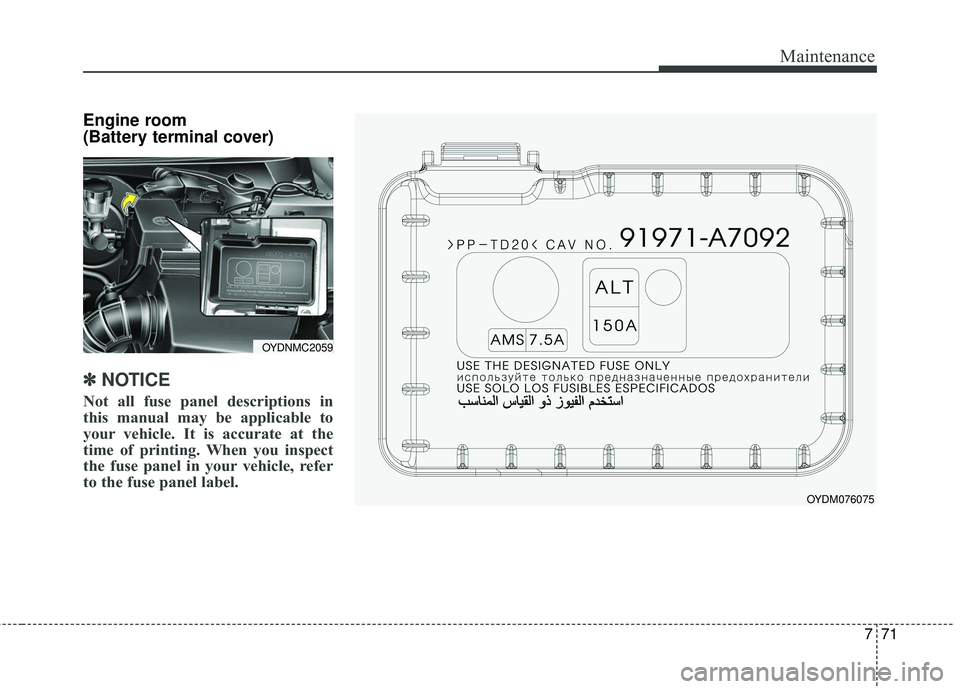
Engine room
(Battery terminal cover)
✽ ✽NOTICE
Not all fuse panel descriptions in
this manual may be applicable to
your vehicle. It is accurate at the
time of printing. When you inspect
the fuse panel in your vehicle, refer
to the fuse panel label.
OYDM076075
OYDNMC2059
Page 544 of 584

Maintenance
82
7
If the headlight aiming adjustment is
necessary after the headlight
assembly is reinstalled, consult an
authorized Kia dealer.Front side marker/Front turn sig-
nal light
1. Open the hood.
2. Disconnect the negative battery cable.
3. Loosen the retaining bolts and remove the headlamp assembly
from the body of the vehicle. If you
can reach to the bulb without
removing the headlamp assembly,
you don’t need to do step 3.
4. Disconnect the power connec tor(s) from the back of the head
lamp assembly. Front side marker
5. Remove the socket from the
assembly by turning the socket
counterclockwise until the tabs on
the socket align with the slots on
the assembly.
6. Pull the bulb out of the socket.
7. Insert a new bulb.
8. Install the socket in the assembly by aligning the tabs on the socket
with the slots in the assembly.
Push the socket into assembly
and turn the socket clockwise.
9. Reinstall the headlamp assembly, bumper to the body of the vehicle.
OYDDMC2043
OYDM076073
Page 563 of 584

7101
Maintenance
Canister
Fuel vapors generated inside the fuel
tank are absorbed and stored in the
onboard canister. When the engine is
running, the fuel vapors absorbed in
the canister are drawn into the surge
tank through the purge control sole-
noid valve.
Purge Control Solenoid Valve(PCSV)
The purge control solenoid valve is
controlled by the Engine Control
Module (ECM); when the engine
coolant temperature is low during
idling, the PCSV closes so that evap-
orated fuel is not taken into the
engine. After the engine warms up
during ordinary driving, the PCSV
opens to introduce evaporated fuel to
the engine.
3. Exhaust emission control system
The Exhaust Emission Control
System is a highly effective system
which controls exhaust emissions
while maintaining good vehicle per-
formance.
Vehicle modifications
This vehicle should not be modified.
Modification of your vehicle could
affect its performance, safety or
durability and may even violate gov-
ernmental safety and emissions reg-
ulations.
In addition, damage or performance
problems resulting from any modifi-
cation may not be covered under
warranty.
If you use unauthorized electronic
devices, it may cause the vehicle to
operate abnormally, wire damage,
battery discharge and fire. For your
safety, do not use unauthorized
electronic devices.
Engine exhaust gas precautions
(carbon monoxide)
Carbon monoxide can be present with other exhaust fumes.
Therefore, if you smell exhaust
fumes of any kind inside your vehi-
cle, have it inspected and repaired
immediately. If you ever suspect
exhaust fumes are coming into
your vehicle, drive it only with all
the windows fully open. Have your
vehicle checked and repaired
immediately.
WARNING - Exhaust
Engine exhaust gases contain
carbon monoxide (CO). Though
colorless and odorless, it is
dangerous and could be lethal if
inhaled. Follow the instructions
on this page to avoid CO poi-
soning.
Page 577 of 584
Index
2I
Air bag-supplemental restraint system . . . . . . . . . . . . . 3-34Adding equipment to or modifying your airbag- equipped vehicle . . . . . . . . . . . . . . . . . . . . . . . 3-57
Air bag warning label . . . . . . . . . . . . . . . . . . . . . . . . 3-58
Air bag warning light . . . . . . . . . . . . . . . . . . . . . . . . 3-38
Curtain air bag . . . . . . . . . . . . . . . . . . . . . . . . . . . . . 3-51
Driver's and passenger's front air bag. . . . . . . . . . . . 3-46
How does the air bag system operate . . . . . . . . . . . 3-35
Occupant detection system . . . . . . . . . . . . . . . . . . . . 3-41
Side air bag . . . . . . . . . . . . . . . . . . . . . . . . . . . . . . . . 3-49
SRS Care. . . . . . . . . . . . . . . . . . . . . . . . . . . . . . . . . . 3-57\
SRS components and functions . . . . . . . . . . . . . . . . 3-38
Why didn’t my air bag go off in a collision? (Inflation and non-inflation conditions of the air bag) . . . . . . 3-52
Air cleaner . . . . . . . . . . . . . . . . . . . . . . . . . . . . . . . . . . . 7-\
40 Filter replacement . . . . . . . . . . . . . . . . . . . . . . . . . . . 7-40
Air conditioning system . . . . . . . . . . . . . . . . . . . . . . . . . 8-6
Appearance care . . . . . . . . . . . . . . . . . . . . . . . . . . . . . . 7-93 Exterior care . . . . . . . . . . . . . . . . . . . . . . . . . . . . . . . 7-93
Interior care. . . . . . . . . . . . . . . . . . . . . . . . . . . . . . . . 7-98
Audio system . . . . . . . . . . . . . . . . . . . . . . . . . . . . . . . . 4-147
AUX, USB and iPod
®port . . . . . . . . . . . . . . . . . . . 4-149
Glass antenna . . . . . . . . . . . . . . . . . . . . . . . . . . . . . 4-147
How vehicle audio works . . . . . . . . . . . . . . . . . . . . 4-150
Steering wheel audio controls. . . . . . . . . . . . . . . . . 4-148
Automatic climate control system . . . . . . . . . . . . . . . . 4-119 Automatic heating and air conditioning . . . . . . . . . 4-120
Manual heating and air conditioning . . . . . . . . . . . 4-121
System operation . . . . . . . . . . . . . . . . . . . . . . . . . . 4-127
Automatic transaxle. . . . . . . . . . . . . . . . . . . . . . . . . . . . 5-18 Automatic transaxle operation . . . . . . . . . . . . . . . . . 5-18
Good driving practices . . . . . . . . . . . . . . . . . . . . . . . 5-23
Autonomous emergency braking (AEB) / Forward collision warning (FCW) . . . . . . . . . . . . . . . 5-47 AEB warning message and system control . . . . . . . 5-49
Brake operation. . . . . . . . . . . . . . . . . . . . . . . . . . . . . 5-50
Limitation of the system . . . . . . . . . . . . . . . . . . . . . . 5-53
Recognizing pedestrians . . . . . . . . . . . . . . . . . . . . . . 5-56
Sensor to detect the distance from the vehicle in front (front radar) . . . . . . . . . . . . . . . . . . . . . . . . . . 5-51
System malfunction . . . . . . . . . . . . . . . . . . . . . . . . . 5-52
System setting and activation . . . . . . . . . . . . . . . . . . 5-47
Battery . . . . . . . . . . . . . . . . . . . . . . . . . . . . . . . . . . . . \
. . 7-47 Battery recharging . . . . . . . . . . . . . . . . . . . . . . . . . 7-48
For best battery service . . . . . . . . . . . . . . . . . . . . . . . 7-47
Reset items . . . . . . . . . . . . . . . . . . . . . . . . . . . . . . . . 7-49
Before driving . . . . . . . . . . . . . . . . . . . . . . . . . . . . . . . . . 5-4 Before entering vehicle . . . . . . . . . . . . . . . . . . . . . . . . 5-4
Before starting . . . . . . . . . . . . . . . . . . . . . . . . . . . . . . 5-4
Necessary inspections . . . . . . . . . . . . . . . . . . . . . . . . . 5-4
Blind spot detection system (BSD) . . . . . . . . . . . . . . . . 5-74
A
B
YDM CAN (ENG) Index.qxp 9/11/2017 12:44 PM Page 2