ESP KIA FORTE 2019 Repair Manual
[x] Cancel search | Manufacturer: KIA, Model Year: 2019, Model line: FORTE, Model: KIA FORTE 2019Pages: 550, PDF Size: 11.66 MB
Page 429 of 550
Maintenance
67
WARNING- Maintenancework
Do not wear jewelry or loose
clothing while working under
the hood of your vehicle with
the engine running. These can
become entangled in moving
parts, if you must run the
engine while working under the
hood, make certain that you
remove all jewelry (especially
rings, bracelets, watches, and
necklaces) and all neckties,
scarves, and similar loose
clothing before getting near the
engine or cooling fans.Owner maintenance precau-
tions
Improper or incomplete service may
result in problems. This section gives
instructions only for the maintenance
items that are easy to perform.
As explained earlier in this section,
several procedures can be done only
by an authorized Kia dealer with spe-
cial tools.
✽ ✽ NOTICE
Improper owner maintenance dur-
ing the warranty period may affect
warranty coverage. For details, read
the separate Warranty & Consumer
Information manual provided with
the vehicle. If you're unsure about
any servicing or maintenance proce-
dure, have it done by an authorized
Kia dealer.
BDm CAN (ENG) 7.qxp 7/4/2018 10:23 AM Page 6
Page 443 of 550
Maintenance
20
7
CHECKING FLUID LEVELS
Steering gear box, linkage &
boots/lower arm ball joint
With the vehicle stopped and engine
off, check for excessive free-play in
the steering wheel.
Check the linkage for bends or dam-
age. Check the dust boots and ball
joints for deterioration, cracks, or
damage. Replace any damaged
parts.
Drive shafts and boots
Check the drive shafts, boots and
clamps for cracks, deterioration, or
damage. Replace any damaged
parts and, if necessary, repack the
grease.
Air conditioning refrigerant
Check the air conditioning lines and
connections for leakage and damage. When checking engine oil, engine
coolant, brake fluid, and washer fluid,
always be sure to clean the area
around any filler plug, drain plug, or
dipstick before checking or draining
any lubricant or fluid. This is espe-
cially important in dusty or sandy
areas and when the vehicle is used
on unpaved roads. Cleaning the plug
and dipstick areas will prevent dirt
and grit from entering the engine and
other mechanisms that could be
damaged.
BDm CAN (ENG) 7.qxp 7/4/2018 10:24 AM Page 20
Page 463 of 550
Maintenance
40
7
TIRES AND WHEELS
Tire care
For proper maintenance, safety, and
maximum fuel economy, you must
always maintain recommended tire
inflation pressures and stay within
the load limits and weight distribution
recommended for your vehicle.
Recommended cold tire infla-
tion pressures
All tire pressures (including the
spare) should be checked when the
tires are cold. “Cold Tires” means the
vehicle has not been driven for at
least three hours or driven less than
1.6 km (one mile).
Recommended pressures must be
maintained for the best ride, top vehi-
cle handling, and minimum tire wear.
For recommended inflation pressure
refer to “Tire and wheels” in chapter
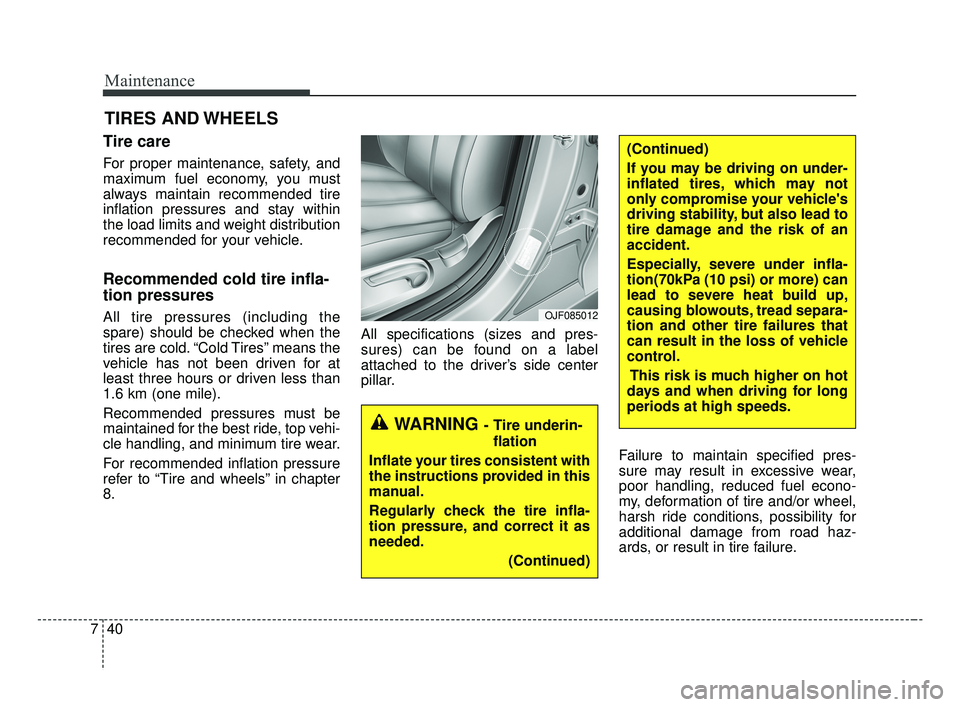
8. All specifications (sizes and pres-
sures) can be found on a label
attached to the driver’s side center
pillar.
Failure to maintain specified pres-
sure may result in excessive wear,
poor handling, reduced fuel econo-
my, deformation of tire and/or wheel,
harsh ride conditions, possibility for
additional damage from road haz-
ards, or result in tire failure.OJF085012
WARNING - Tire underin-flation
Inflate your tires consistent with
the instructions provided in this
manual.
Regularly check the tire infla-
tion pressure, and correct it as
needed. (Continued)
(Continued)
If you may be driving on under-
inflated tires, which may not
only compromise your vehicle's
driving stability, but also lead to
tire damage and the risk of an
accident.
Especially, severe under infla-
tion(70kPa (10 psi) or more) can
lead to severe heat build up,
causing blowouts, tread separa-
tion and other tire failures that
can result in the loss of vehicle
control.This risk is much higher on hot
days and when driving for long
periods at high speeds.
BDm CAN (ENG) 7.qxp 7/4/2018 10:25 AM Page 40
Page 469 of 550
Maintenance
46
7
2. Tire size designation
A tire’s sidewall is marked with a tire
size designation. You will need this
information when selecting replace-
ment tires for your car. The following
explains what the letters and num-
bers in the tire size designation
mean.
Example tire size designation:
(These numbers are provided as an
example only; your tire size designa-
tor could vary depending on your
vehicle.)
P205/55R16 89H
P - Applicable vehicle type (tires
marked with the prefix “P’’ are
intended for use on passenger
vehicles or light trucks; however,
not all tires have this marking).
205 - Tire width in millimeters.
55 - Aspect ratio. The tire’s section height as a percentage of its
width.
R - Tire construction code (Radial).
16 - Rim diameter in inches. 89 - Load Index, a numerical code
associated with the maximum
load the tire can carry.
H - Speed Rating Symbol. See the speed rating chart in this section
for additional information.
Wheel size designation
Wheels are also marked with impor-
tant information that you need if you
ever have to replace one. The follow-
ing explains what the letters and
numbers in the wheel size designa-
tion mean.
Example wheel size designation:
6.0JX16
6.0 - Rim width in inches.
J - Rim contour designation.
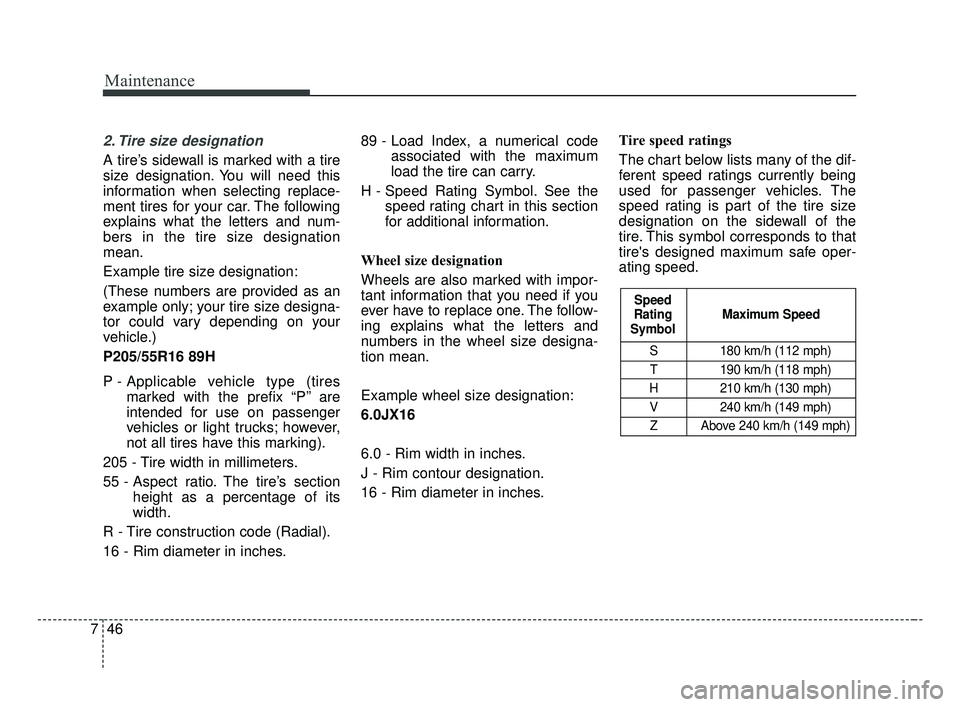
16 - Rim diameter in inches. Tire speed ratings
The chart below lists many of the dif-
ferent speed ratings currently being
used for passenger vehicles. The
speed rating is part of the tire size
designation on the sidewall of the
tire. This symbol corresponds to that
tire's designed maximum safe oper-
ating speed.
S 180 km/h (112 mph)
T 190 km/h (118 mph)
H 210 km/h (130 mph) V 240 km/h (149 mph)Z Above 240 km/h (149 mph)
Maximum Speed
Speed
Rating
Symbol
BDm CAN (ENG) 7.qxp 7/4/2018 10:25 AM Page 46
Page 471 of 550
Maintenance
48
7
Tread wear
The tread wear grade is a compara-
tive rating based on the wear rate of
the tire when tested under controlled
conditions on a specified govern-
ment test course. For example, a tire
graded 150 would wear one-and-a-
half times (1½) as well on the gov-
ernment course as a tire graded 100.
The relative performance of tires
depends upon the actual conditions
of their use, however, and may
depart significantly from the norm
due to variations in driving habits,
service practices and differences in
road characteristics and climate. Tires degrade over time, even when
they are not being used. Regardless
of the remaining tread, we recom-
mend that tires be replaced after
approximately six (6) years of normal
service. Heat caused by hot climates
or frequent high loading conditions
can accelerate the aging process.
These grades are molded on the
side-walls of passenger vehicle tires.
The tires available as standard or
optional equipment on your vehicles
may vary with respect to grade.
Traction - AA, A, B & C
The traction grades, from highest to
lowest, are AA, A, B and C. Those
grades represent the tires ability to
stop on wet pavement as measured
under controlled conditions on spec-
ified government test surfaces of
asphalt and concrete. A tire marked
C may have poor traction perform-
ance.
The traction grade assigned to this
tire is based on straight-ahead brak-
ing traction tests, and does not
include acceleration, cornering,
hydroplaning, or peak traction char-
acteristics.
BDm CAN (ENG) 7.qxp 7/4/2018 10:25 AM Page 48
Page 480 of 550
757
Maintenance
✽ ✽NOTICE- Remodeling
Prohibited
Do not rewire your vehicle in any
way as doing so may affect the per-
formance of several safety features
in your vehicle. Rewiring your vehi-
cle may also void your warranty and
cause you to be responsible for any
subsequent vehicle damage which
may result.
✽ ✽ NOTICE- Window tinting pre-
caution
Window tint (especially metallic
film) might cause communication
errors or poor radio reception, and
malfunctioning automatic lighting
system due to reflections from the
mirror tint inside the vehicle. The
solution used might also leak into
the electronic components, causing
malfunctions or damage.
Inner panel fuse replacement
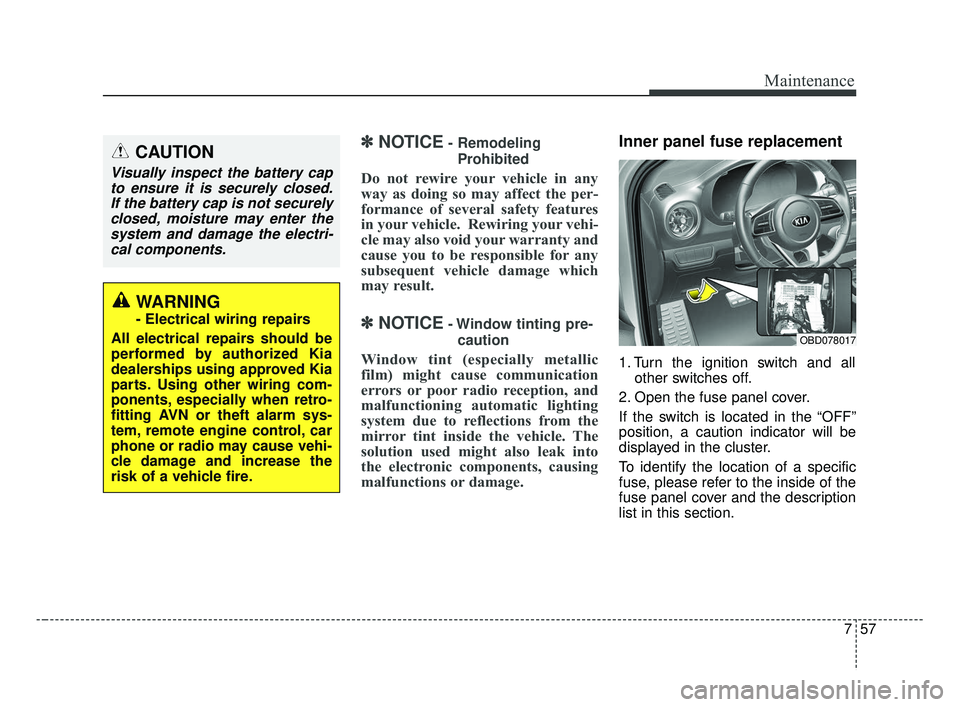
1. Turn the ignition switch and all other switches off.
2. Open the fuse panel cover.
If the switch is located in the “OFF”
position, a caution indicator will be
displayed in the cluster.
To identify the location of a specific
fuse, please refer to the inside of the
fuse panel cover and the description
list in this section.
CAUTION
Visually inspect the battery cap to ensure it is securely closed.If the battery cap is not securelyclosed, moisture may enter thesystem and damage the electri-cal components.
WARNING
- Electrical wiring repairs
All electrical repairs should be
performed by authorized Kia
dealerships using approved Kia
parts. Using other wiring com-
ponents, especially when retro-
fitting AVN or theft alarm sys-
tem, remote engine control, car
phone or radio may cause vehi-
cle damage and increase the
risk of a vehicle fire.
OBD078017
BDm CAN (ENG) 7.qxp 7/4/2018 10:25 AM Page 57
Page 495 of 550
Maintenance
72
7
✽ ✽
NOTICE
• If the light bulb or lamp connector
is removed while the lamp is still
on, the fuse box's electronic sys-
tem may log it as a malfunction.
Therefore, a lamp malfunction
incident may be recorded as a
Diagnostic Trouble Code (DTC) in
the fuse box.
• It is normal for an operating lamp to flicker momentarily. This is due
to a stabilization function of the
vehicle’s electronic control device.
If the lamp lights up normally
after momentarily blinking, then
it is functioning as normal.
However, if the lamp continues to
flicker several times or turns off
completely, there may be an error
in the vehicle’s electronic control
device. Please have the vehicle
checked by an authorized Kia
dealer immediately.
✽ ✽ NOTICE
We recommend that the headlight
aiming be adjusted after an accident
or after the headlight assembly is rein-
stalled at an authorized Kia dealer.
✽ ✽NOTICE
After driving in heavy rain or wash-
ing, headlamp and taillight lenses
could appear frosty. This condition
is caused by the temperature differ-
ence between the lamp inside and
outside. This is similar to the con-
densation on your windows inside
your vehicle during the rain and
doesn’t indicate a problem with
your vehicle. If the water leaks into
the lamp bulb circuitry, we recom-
mend that you have the vehicle
checked by an authorized Kia deal-
er.
If you don’t have the necessary tools,
the correct bulbs and the expertise,
consult an authorized Kia dealer. In
many cases, it is difficult to replace
vehicle light bulbs because other
parts of the vehicle must be removed
before you can get to the bulb. This is
especially true if you have to remove
the headlamp assembly to get to the
bulb(s).
Removing/installing the headlamp
assembly can result in damage to
the vehicle.
If non-genuine parts or substandard
bulbs are used, it may lead to blow-
ing a fuse or other wiring damages.
Do not install extra lamps or LEDs to
the vehicle. If additional lights are
installed, it may lead to lamp mal-
functions and flickering. Additionally,
the fuse box and other writing may
be damaged.
BDm CAN (ENG) 7.qxp 7/4/2018 10:26 AM Page 72
Page 545 of 550
Index
10I
Owner maintenance . . . . . . . . . . . . . . . . . . . . . . . . . . 7-8
Scheduled maintenance service . . . . . . . . . . . . . . . . 7-10
Tire maintenance . . . . . . . . . . . . . . . . . . . . . . . . . . . 7-45
Maintenance schedule. . . . . . . . . . . . . . . . . . . . . . . . . . 7-10 Maintenance under severe usage conditions - Non turbo models . . . . . . . . . . . . . . . . . . . . . . . . 7-14
Normal maintenance schedule - Non turbo models . . . . . . . . . . . . . . . . . . . . . . . . 7-11
Maintenance services . . . . . . . . . . . . . . . . . . . . . . . . . . . 7-5 Owner maintenance precautions . . . . . . . . . . . . . . . . 7-6
Owner’s responsibility . . . . . . . . . . . . . . . . . . . . . . . . 7-5
Manual climate control system . . . . . . . . . . . . . . . . . . 4-115 Checking the amount of air conditioner refrigerant and compressor lubricant . . . . . . . . . . 4-124
Climate control air filter. . . . . . . . . . . . . . . . . . . . . 4-123
Heating and air conditioning . . . . . . . . . . . . . . . . . 4-116
System operation . . . . . . . . . . . . . . . . . . . . . . . . . . 4-121
Manual transmission . . . . . . . . . . . . . . . . . . . . . . . . . . . 5-18 Good driving practices . . . . . . . . . . . . . . . . . . . . . . . 5-20
Manual transmission operation . . . . . . . . . . . . . . . . 5-18
Map lamp . . . . . . . . . . . . . . . . . . . . . . . . . . . . . . . . . . 4-110
Map lamp (Bulb type) bulb replacement . . . . . . . . . . . 7-86
Map lamp (LED type) bulb replacement . . . . . . . . . . . 7-87
Mirrors . . . . . . . . . . . . . . . . . . . . . . . . . . . . . . . . . . . . \
. 4-51 Day/night rearview mirror . . . . . . . . . . . . . . . . . . . . 4-51
ElectroChromic Mirror (ECM) . . . . . . . . . . . . . . . . 4-51
Folding the outside rearview mirror . . . . . . . . . . . . 4-54
Inside rearview mirror . . . . . . . . . . . . . . . . . . . . . . . 4-51 Outside rearview mirror . . . . . . . . . . . . . . . . . . . . . . 4-52
Remote control . . . . . . . . . . . . . . . . . . . . . . . . . . . . . 4-53
Non-inflation conditions (Air bags) . . . . . . . . . . . . . . . 3-66
Occupant Detection System . . . . . . . . . . . . . . . . . . . . . 3-50
Odometer . . . . . . . . . . . . . . . . . . . . . . . . . . . . . . . . . . . 4-\
60
Oil (Engine) . . . . . . . . . . . . . . . . . . . . . . . . . . . . . . . . . 7-21
Opening the trunk . . . . . . . . . . . . . . . . . . . . . . . . . . . . . 4-24
Outside rearview mirror . . . . . . . . . . . . . . . . . . . . . . . . 4-52
Outside Temperature . . . . . . . . . . . . . . . . . . . . . . . . . . . 4-60
Overheats . . . . . . . . . . . . . . . . . . . . . . . . . . . . . . . . . . . . \
6-7
Owner maintenance . . . . . . . . . . . . . . . . . . . . . . . . . . . . 7-8 Owner maintenance schedule. . . . . . . . . . . . . . . . . . . 7-8
Parking & Tail light . . . . . . . . . . . . . . . . . . . . . . . . . . 4-101
Parking brake . . . . . . . . . . . . . . . . . . . . . . . . . . . . . . . . 5-33
Parking brake . . . . . . . . . . . . . . . . . . . . . . . . . . . . . . . . 7-28 Checking the parking brake . . . . . . . . . . . . . . . . . . . 7-28
N
O
P
BDm CAN (ENG) Index.qxp 6/30/2018 2:03 PM Page 10