oil change KIA FORTE 2020 User Guide
[x] Cancel search | Manufacturer: KIA, Model Year: 2020, Model line: FORTE, Model: KIA FORTE 2020Pages: 568, PDF Size: 8.58 MB
Page 453 of 568
Maintenance
16
7
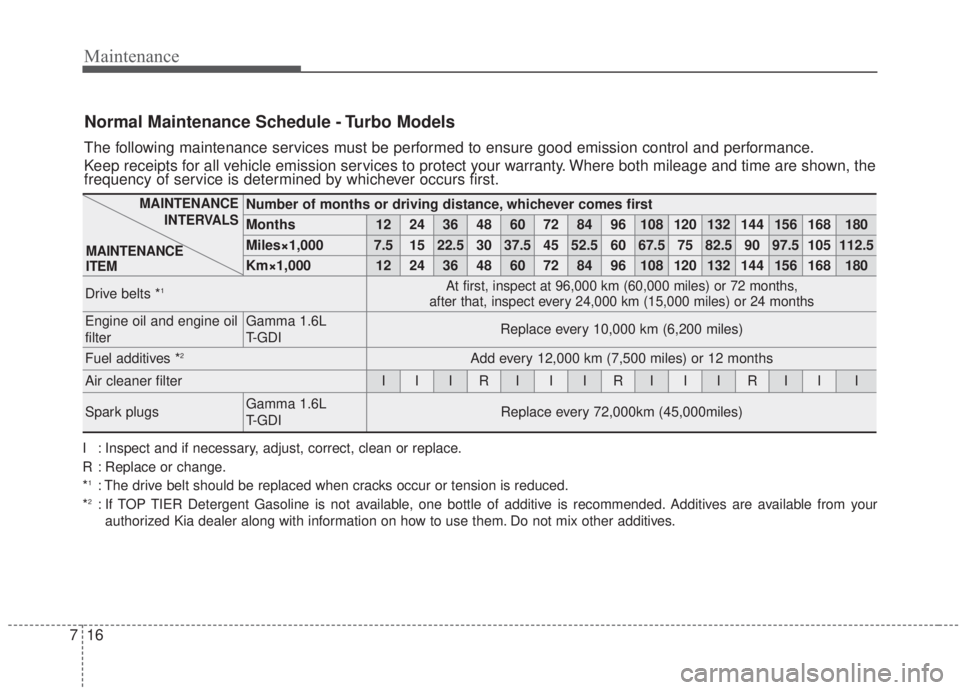
Normal Maintenance Schedule - Turbo Models
The following maintenance services must be performed to ensure good emission control and performance.
Keep receipts for all vehicle emission services to protect your warranty. Where both mileage and time are shown, the
frequency of service is determined by whichever occurs first.
Number of months or driving distance, whichever comes first
Months1224364860728496108120132144156168180
Miles×1,0007.51522.530 37.5 45 52.5 60 67.5 75 82.5 90 97.5 105 112.5
Km×1,00012 24 36 48 60 72 84 96 108 120 132 144 156 168 180
Drive belts *1At first, inspect at 96,000 km (60,000 miles) or 72 months,
after that, inspect every 24,000 km (15,000 miles) or 24 months
Engine oil and engine oil
filterGamma 1.6L
T-GDIReplace every 10,000 km (6,200 miles)
Fuel additives *2Add every 12,000 km (7,500 miles) or 12 months
Air cleaner filterIIIRIIIRIIIRIII
Spark plugsGamma 1.6L
T-GDIReplace every 72,000km (45,000miles)
MAINTENANCE
INTERVALS
MAINTENANCE
ITEM
I : Inspect and if necessary, adjust, correct, clean or replace.
R : Replace or change.
*
1: The drive belt should be replaced when cracks occur or tension is reduced.
*2: If TOP TIER Detergent Gasoline is not available, one bottle of additive is recommended. Additives are available from your authorized Kia dealer along with information on how to use them. Do not mix other additives.
Page 458 of 568
721
Maintenance
EXPLANATION OF SCHEDULED MAINTENANCE ITEMS
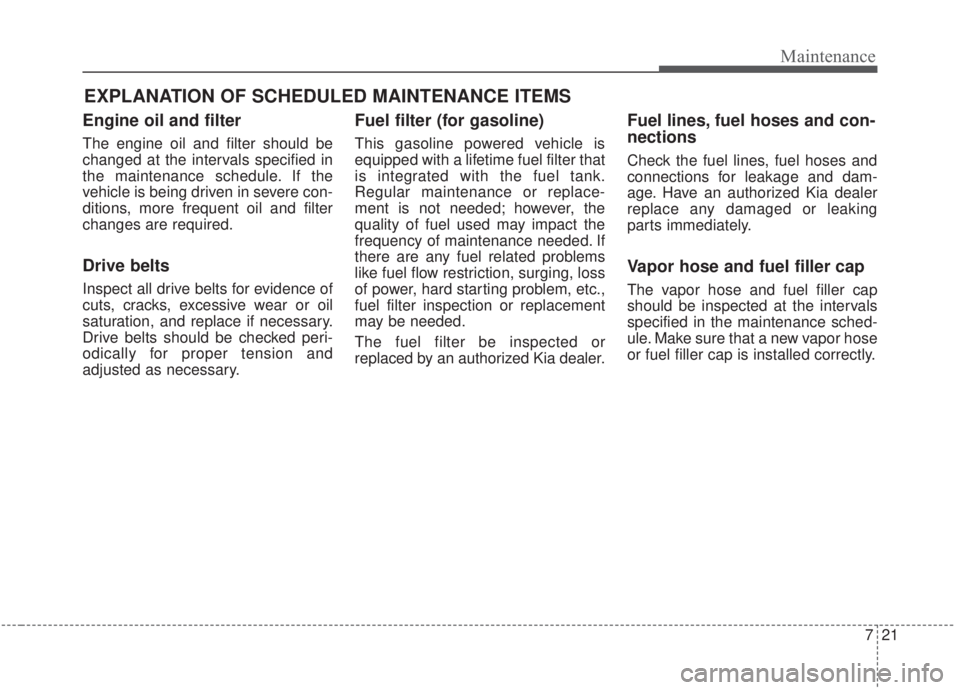
Engine oil and filter
The engine oil and filter should be
changed at the intervals specified in
the maintenance schedule. If the
vehicle is being driven in severe con-
ditions, more frequent oil and filter
changes are required.
Drive belts
Inspect all drive belts for evidence of
cuts, cracks, excessive wear or oil
saturation, and replace if necessary.
Drive belts should be checked peri-
odically for proper tension and
adjusted as necessary.
Fuel filter (for gasoline)
This gasoline powered vehicle is
equipped with a lifetime fuel filter that
is integrated with the fuel tank.
Regular maintenance or replace-
ment is not needed; however, the
quality of fuel used may impact the
frequency of maintenance needed. If
there are any fuel related problems
like fuel flow restriction, surging, loss
of power, hard starting problem, etc.,
fuel filter inspection or replacement
may be needed.
The fuel filter be inspected or
replaced by an authorized Kia dealer.
Fuel lines, fuel hoses and con-
nections
Check the fuel lines, fuel hoses and
connections for leakage and dam-
age. Have an authorized Kia dealer
replace any damaged or leaking
parts immediately.
Vapor hose and fuel filler cap
The vapor hose and fuel filler cap
should be inspected at the intervals
specified in the maintenance sched-
ule. Make sure that a new vapor hose
or fuel filler cap is installed correctly.
Page 464 of 568
727
Maintenance
Use a funnel to help prevent oil
from being spilled on engine com-
ponents.
Use only the specified engine oil.(Refer to the “Recommended lubri-cants and capacities” section inChapter 8.)
Changing the engine oil and
filter
Have engine oil and filter changed by
an authorized Kia dealer according
to the Maintenance Schedule at the
beginning of this chapter.
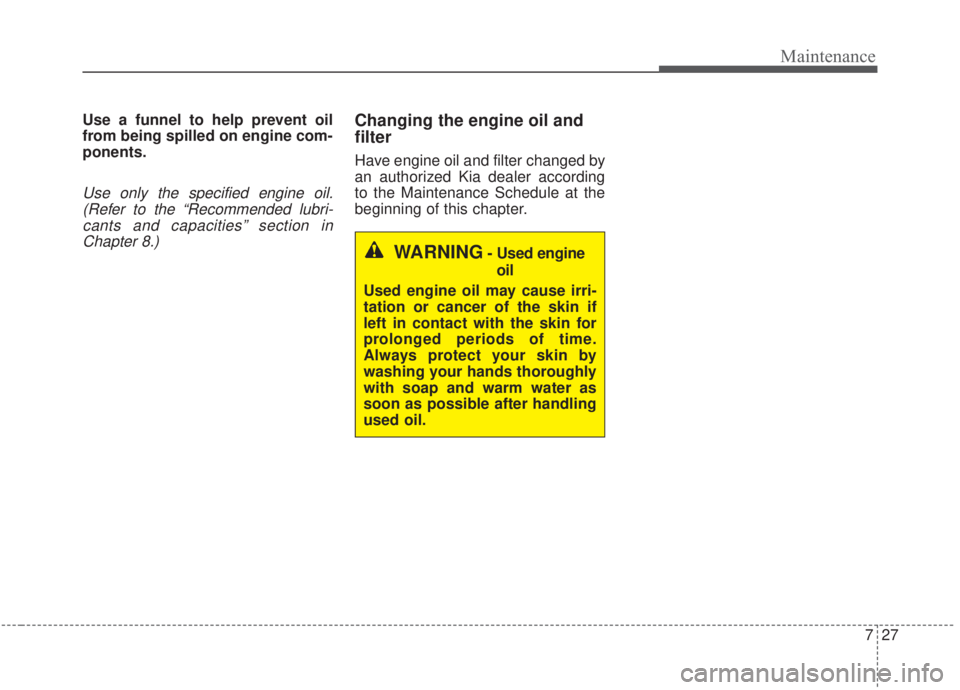
WARNING- Used engine
oil
Used engine oil may cause irri-
tation or cancer of the skin if
left in contact with the skin for
prolonged periods of time.
Always protect your skin by
washing your hands thoroughly
with soap and warm water as
soon as possible after handling
used oil.
Page 555 of 568
Specifications & Consumer information
10
8
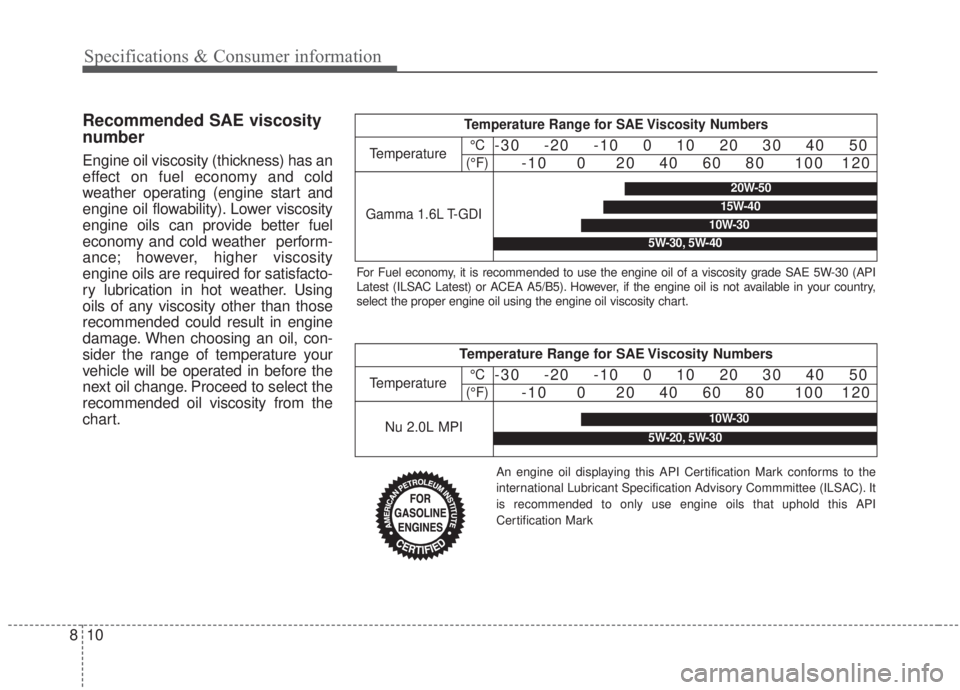
Recommended SAE viscosity
number
Engine oil viscosity (thickness) has an
effect on fuel economy and cold
weather operating (engine start and
engine oil flowability). Lower viscosity
engine oils can provide better fuel
economy and cold weather perform-
ance; however, higher viscosity
engine oils are required for satisfacto-
ry lubrication in hot weather. Using
oils of any viscosity other than those
recommended could result in engine
damage. When choosing an oil, con-
sider the range of temperature your
vehicle will be operated in before the
next oil change. Proceed to select the
recommended oil viscosity from the
chart.
Temperature Range for SAE Viscosity Numbers
An engine oil displaying this API Certification Mark conforms to the
international Lubricant Specification Advisory Commmittee (ILSAC). It
is recommended to only use engine oils that uphold this API
Certification Mark
Temperature°C
(°F)-30 -20 -10 0 10 20 30 40 50 -10 0 20 40 60 80 100 120
Nu 2.0L MPI10W-30
5W-20, 5W-30
Temperature Range for SAE Viscosity Numbers
Temperature°C
(°F)-30 -20 -10 0 10 20 30 40 50 -10 0 20 40 60 80 100 120
Gamma 1.6L T-GDI
For Fuel economy, it is recommended to use the engine oil of a viscosity grade SAE 5W-30 (API
Latest (ILSAC Latest) or ACEA A5/B5). However, if the engine oil is not available in your country,
select the proper engine oil using the engine oil viscosity chart.
10W-30
20W-50
15W-40
5W-30, 5W-40
Page 567 of 568
Index
10I
Wheel alignment and tire balance ..............................7-49
Wheel replacement ....................................................7-51
Towing ........................................................................\
..6-33 Emergency towing ......................................................6-35
Removable towing hook ............................................6-35
Towing service ............................................................6-33
Trailer towing ..............................................................5-147
Trunk ........................................................................\
......4-24 Closing the trunk ........................................................4-25
Emergency trunk safety release ..................................4-25
Opening the trunk ......................................................4-24
Vehicle break-in process ..................................................1-6
Vehicle certification label ..............................................8-11
Vehicle data collection and event data recorders ............1-7
Vehicle identification number (VIN) ............................8-11
Vehicle load limit ........................................................5-148 Certification label......................................................5-152
Tire and loading information label ..........................5-148
Vehicle modifications ......................................................1-6
Vehicle weight ............................................................5-153 Base curb weight ......................................................5-153
Cargo weight ............................................................5-153
GAW (Gross Axle Weight) ......................................5-153
GAWR (Gross Axle Weight Rating) ........................5-153
GVW (Gross Vehicle Weight) ..................................5-153 GVWR (Gross Vehicle Weight Rating) ....................5-153
Vehicle curb weight ..................................................5-153
Warning and indicator lights..........................................4-80 Indicator lights ............................................................4-90
Warning lights ............................................................4-80
Washer fluid ..................................................................7-33 Checking the washer fluid level..................................7-33
Welcome system ..........................................................4-113 Headlight (Headlamp) escort function......................4-113
Interior light ..............................................................4-113
Pocket light ..............................................................4-113
Windows ........................................................................\
4-30 Power windows ..........................................................4-31
Windshield defrosting and defogging..........................4-137 Automatic climate control system ............................4-138
Defogging logic ........................................................4-139
Manual climate control system ................................4-137
Winter driving ..............................................................5-145 Carry emergency equipment ....................................5-147
Change to "winter weight" oil if necessary ..............5-146
Check battery and cables ..........................................5-146
Check spark plugs and ignition system ....................5-146
Don’t let your parking brake freeze..........................5-147
Don't let ice and snow accumulate underneath ........5-147
Snowy or icy conditions ..........................................5-145
V
W