trailer KIA FORTE 2020 User Guide
[x] Cancel search | Manufacturer: KIA, Model Year: 2020, Model line: FORTE, Model: KIA FORTE 2020Pages: 568, PDF Size: 8.58 MB
Page 396 of 568

Driving your vehicle
150
5
Steps For Determining Correct
Load Limit -
1. Locate the statement “The com- bined weight of occupants and
cargo should never exceed XXX
kg or XXX lbs.” on your vehicle's
placard.
2. Determine the combined weight of the driver and passengers that will
be riding in your vehicle.
3. Subtract the combined weight of the driver and passengers from
XXX kg or XXX lbs.
4. The resulting figure equals the available amount of cargo and lug-
gage load capacity. For example, if
the "XXX" amount equals 635 kg
(1400 lbs.) and there will be five 68
kg (150 lb) passengers in your
vehicle, the amount of available
cargo and luggage load capacity
is 295 kg (650 lbs).
(635-340 (5 x 68) = 295 kg or
1400-750 (5 x 150) = 650 lbs.) 5. Determine the combined weight of
luggage and cargo being loaded
on the vehicle. That weight may
not safely exceed the available
cargo and luggage load capacity
calculated in Step 4.
6. If your vehicle will be towing a trail- er, load from your trailer will be
transferred to your vehicle. Consult
this manual to determine how this
reduces the available cargo and
luggage load capacity of your
vehicle.
WARNING - Loose cargo
Do not travel with unsecured
blunt objects in the passenger
compartment of your vehicle
(e.g. suit cases or unsecured
child seats). These items may
strike occupants during a sud-
den stop or crash.
Page 420 of 568
621
What to do in an emergency
When using a compact spare tire,
observe the following precautions:
Under no circumstances shouldyou exceed 80 km/h (50 mph); a
higher speed could damage the
tire.
Ensure that you drive slowly enough for the road conditions to
avoid all hazards. Any road hazard,
such as a pothole or debris, could
seriously damage the compact
spare.
Any continuous road use of this tire could result in tire failure, loss of
vehicle control, and possible per-
sonal injury.
Do not exceed the vehicle’s maxi- mum load rating or the load-carry-
ing capacity shown on the sidewall
of the compact spare tire.
Avoid driving over obstacles. The compact spare tire diameter is
smaller than the diameter of a con-
ventional tire and reduces the
ground clearance approximately
25 mm (1 inch), which could result
in damage to the vehicle. Do not take this vehicle through an
automatic vehicle wash while the
compact spare tire is installed.
Do not use the compact spare tire on any other vehicle because this
tire has been designed especially
for your vehicle.
The compact spare tire’s tread life is shorter than a regular tire.
Inspect your compact spare tire
regularly and replace worn com-
pact spare tires with the same size
and design, mounted on the same
wheel.
The compact spare tire should not be used on any other wheels, nor
should standard tires, snow tires,
wheel covers or trim rings be used
with the compact spare wheel. If
such use is attempted, damage to
these items or other vehicle com-
ponents may occur.
Do not use more than one compact spare tire at a time.
Do not tow a trailer while the com- pact spare tire is installed.
Page 423 of 568
What to do in an emergency
24
6
Introduction
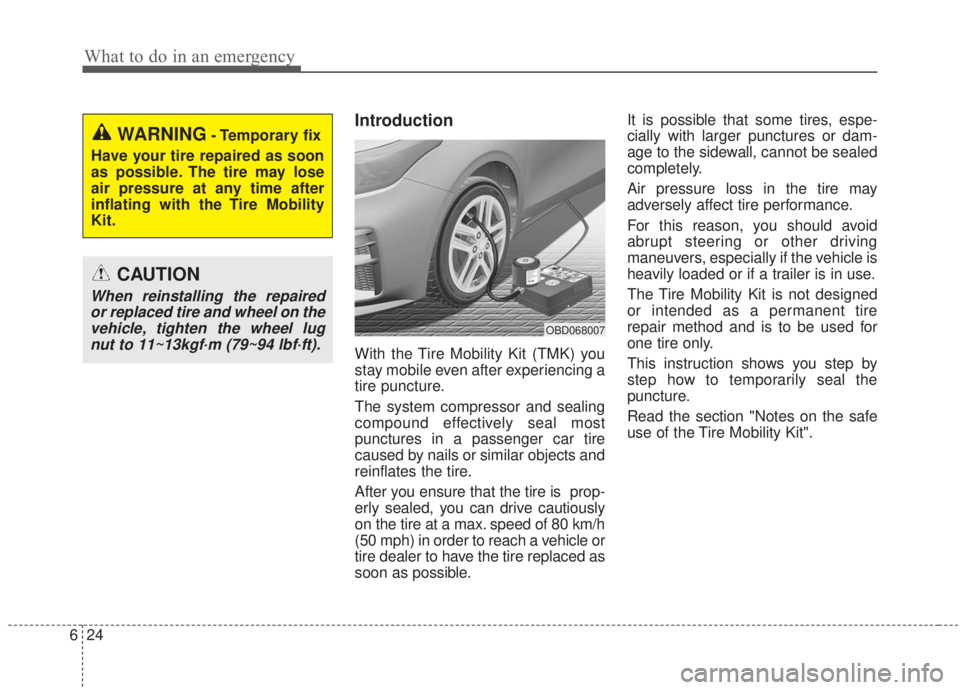
With the Tire Mobility Kit (TMK) you
stay mobile even after experiencing a
tire puncture.
The system compressor and sealing
compound effectively seal most
punctures in a passenger car tire
caused by nails or similar objects and
reinflates the tire.
After you ensure that the tire is prop-
erly sealed, you can drive cautiously
on the tire at a max. speed of 80 km/h
(50 mph) in order to reach a vehicle or
tire dealer to have the tire replaced as
soon as possible. It is possible that some tires, espe-
cially with larger punctures or dam-
age to the sidewall, cannot be sealed
completely.
Air pressure loss in the tire may
adversely affect tire performance.
For this reason, you should avoid
abrupt steering or other driving
maneuvers, especially if the vehicle is
heavily loaded or if a trailer is in use.
The Tire Mobility Kit is not designed
or intended as a permanent tire
repair method and is to be used for
one tire only.
This instruction shows you step by
step how to temporarily seal the
puncture.
Read the section "Notes on the safe
use of the Tire Mobility Kit".
WARNING- Temporary fix
Have your tire repaired as soon
as possible. The tire may lose
air pressure at any time after
inflating with the Tire Mobility
Kit.
CAUTION
When reinstalling the repaired or replaced tire and wheel on thevehicle, tighten the wheel lugnut to 11~13kgf·m (79~94 lbf·ft).
OBD068007
Page 447 of 568

Maintenance
10
7
SCHEDULED MAINTENANCE SERVICE
Follow the Normal Maintenance
Schedule if the vehicle is usually
operated where none of the following
conditions apply. If any of the following
conditions apply, follow the
Maintenance Under Severe Usage
Conditions.
Repeatedly driving short distances
of less than 8 km (5 miles) in nor-
mal temperature or less than 16
km (10 miles) in freezing tempera-
ture
Extensive engine idling or low speed driving for long distances
Driving on rough, dusty, muddy, unpaved, graveled or salt-spread
roads
Driving in areas using salt or other corrosive materials or in very cold
weather
Driving in heavy dust conditions
Driving in heavy traffic areas
Driving on uphill, downhill, or mountain roads repeatedly Towing a trailer or using a camper,
or roof rack
Driving as a patrol car, taxi, other commercial use, or vehicle towing
Driving over 170 km/h (106 mph)
Frequently driving in stop-and-go conditionIf your vehicle is operated in any ofthe prior listed conditions, you shouldinspect, replace or refill more fre-quently, using the severe usagemaintenance schedule instead of thenormal usage maintenance sched-ule.
Page 452 of 568
715
Maintenance
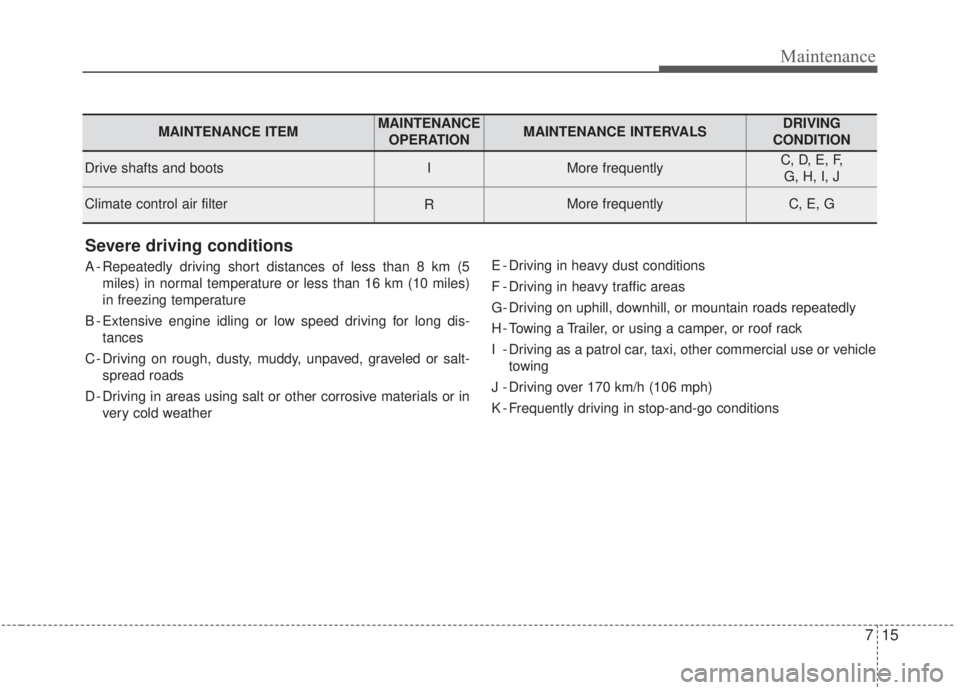
Severe driving conditions
A - Repeatedly driving short distances of less than 8 km (5miles) in normal temperature or less than 16 km (10 miles)
in freezing temperature
B - Extensive engine idling or low speed driving for long dis- tances
C - Driving on rough, dusty, muddy, unpaved, graveled or salt- spread roads
D - Driving in areas using salt or other corrosive materials or in very cold weather E - Driving in heavy dust conditions
F - Driving in heavy traffic areas
G- Driving on uphill, downhill, or mountain roads repeatedly
H - Towing a Trailer, or using a camper, or roof rack
I - Driving as a patrol car, taxi, other commercial use or vehicle
towing
J - Driving over 170 km/h (106 mph)
K - Frequently driving in stop-and-go conditions
MAINTENANCE ITEMMAINTENANCE OPERATIONMAINTENANCE INTERVALSDRIVING
CONDITION
Drive shafts and bootsIMore frequentlyC, D, E, F, G, H, I, J
Climate control air filterRMore frequentlyC, E, G
Page 457 of 568
Maintenance
20
7
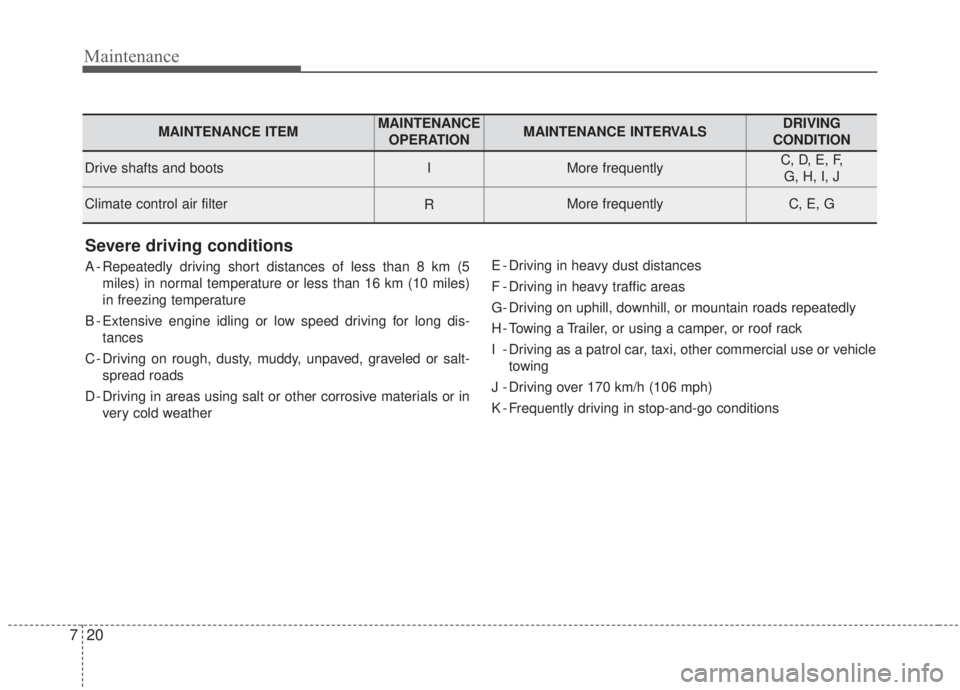
Severe driving conditions
A - Repeatedly driving short distances of less than 8 km (5
miles) in normal temperature or less than 16 km (10 miles)
in freezing temperature
B - Extensive engine idling or low speed driving for long dis- tances
C - Driving on rough, dusty, muddy, unpaved, graveled or salt- spread roads
D - Driving in areas using salt or other corrosive materials or in very cold weather E - Driving in heavy dust distances
F - Driving in heavy traffic areas
G- Driving on uphill, downhill, or mountain roads repeatedly
H - Towing a Trailer, or using a camper, or roof rack
I - Driving as a patrol car, taxi, other commercial use or vehicle
towing
J - Driving over 170 km/h (106 mph)
K - Frequently driving in stop-and-go conditions
MAINTENANCE ITEMMAINTENANCE OPERATIONMAINTENANCE INTERVALSDRIVING
CONDITION
Drive shafts and bootsIMore frequentlyC, D, E, F, G, H, I, J
Climate control air filterRMore frequentlyC, E, G
Page 567 of 568
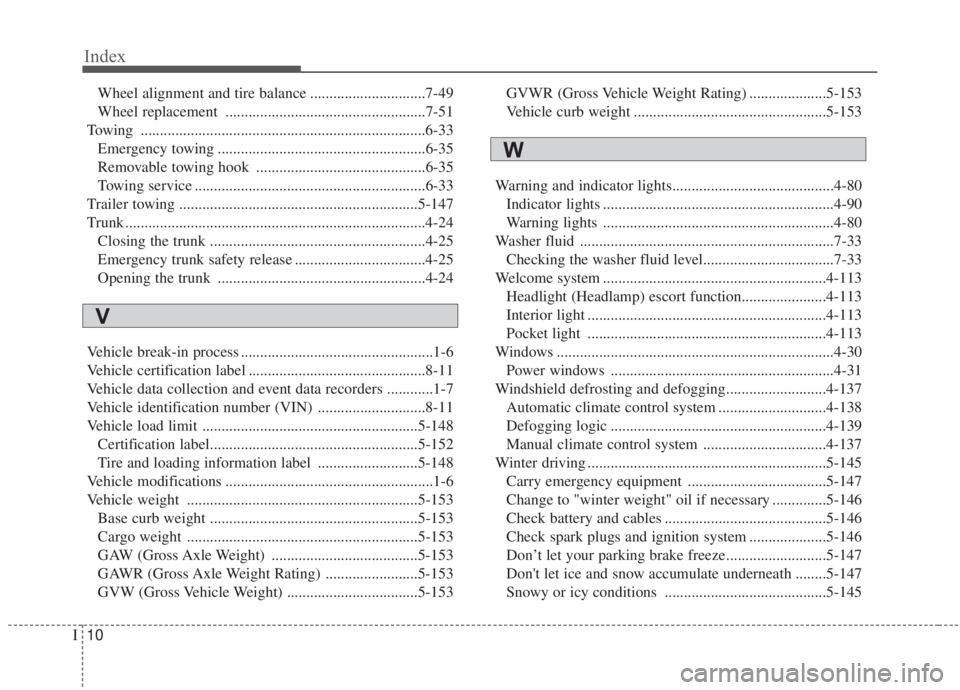
Index
10I
Wheel alignment and tire balance ..............................7-49
Wheel replacement ....................................................7-51
Towing ........................................................................\
..6-33 Emergency towing ......................................................6-35
Removable towing hook ............................................6-35
Towing service ............................................................6-33
Trailer towing ..............................................................5-147
Trunk ........................................................................\
......4-24 Closing the trunk ........................................................4-25
Emergency trunk safety release ..................................4-25
Opening the trunk ......................................................4-24
Vehicle break-in process ..................................................1-6
Vehicle certification label ..............................................8-11
Vehicle data collection and event data recorders ............1-7
Vehicle identification number (VIN) ............................8-11
Vehicle load limit ........................................................5-148 Certification label......................................................5-152
Tire and loading information label ..........................5-148
Vehicle modifications ......................................................1-6
Vehicle weight ............................................................5-153 Base curb weight ......................................................5-153
Cargo weight ............................................................5-153
GAW (Gross Axle Weight) ......................................5-153
GAWR (Gross Axle Weight Rating) ........................5-153
GVW (Gross Vehicle Weight) ..................................5-153 GVWR (Gross Vehicle Weight Rating) ....................5-153
Vehicle curb weight ..................................................5-153
Warning and indicator lights..........................................4-80 Indicator lights ............................................................4-90
Warning lights ............................................................4-80
Washer fluid ..................................................................7-33 Checking the washer fluid level..................................7-33
Welcome system ..........................................................4-113 Headlight (Headlamp) escort function......................4-113
Interior light ..............................................................4-113
Pocket light ..............................................................4-113
Windows ........................................................................\
4-30 Power windows ..........................................................4-31
Windshield defrosting and defogging..........................4-137 Automatic climate control system ............................4-138
Defogging logic ........................................................4-139
Manual climate control system ................................4-137
Winter driving ..............................................................5-145 Carry emergency equipment ....................................5-147
Change to "winter weight" oil if necessary ..............5-146
Check battery and cables ..........................................5-146
Check spark plugs and ignition system ....................5-146
Don’t let your parking brake freeze..........................5-147
Don't let ice and snow accumulate underneath ........5-147
Snowy or icy conditions ..........................................5-145
V
W