brake KIA FORTE 2020 Owner's Guide
[x] Cancel search | Manufacturer: KIA, Model Year: 2020, Model line: FORTE, Model: KIA FORTE 2020Pages: 568, PDF Size: 8.58 MB
Page 268 of 568

Driving your vehicle
22
5
Dual clutch transmission oper-
ation
The dual clutch transmission has 7
forward speeds and one reverse
speed.
The individual speeds are selected
automatically in the D (Drive) posi-
tion.
DUAL CLUTCH TRANSMISSION (DCT) (IF EQUIPPED)
OBD058005
The shift lever can be shifted freely. Press the lock release button when shifting. Depress the brake pedal and the lock release button when shifting.
❈ To move the shift lever from/to P(Parking) or between R(Reverse) and D(Drive), you
must depress the brake pedal for the vehicle to stand still.
Page 269 of 568

523
Driving your vehicle
The Dual Clutch Transmissiongives the driving feel of a manual
transmission, yet provides the
ease of a fully automatic transmis-
sion. Unlike a traditional automatic
transmission, the gear shifting can
be felt (and heard) on the dual
clutch transmission
- Think of it as an automaticallyshifting manual transmission.
- Shift into Drive mode and get fully automatic shifting, similar to a con-
ventional automatic transmission.
Dual clutch transmission adopts a dry-type dual clutch, which is dif-
ferent from the torque converter of
a automatic transmission, and
shows better acceleration perform-
ance during driving, but the initial
launch might be little bit slower
than an Automatic Transmission.
The dry-type clutch transfers torque and provides a direct driving feeling
which may feel different from a con-
ventional automatic transmission
with a torque converter. This may be
more noticeable when starting from
a stop or low vehicle speed. When rapidly accelerating at low
vehicle speed, the engine may rev
at a higher rpm depending on vehi-
cle drive condition.
For a smooth launching uphill, press down the accelerator pedal
smoothly depending on the current
conditions.
If you release your foot from the accelerator pedal at low vehicle
speed, you may feel strong engine
braking, which is similar to a man-
ual transmission.
When driving downhill, you may use Sports Mode to downshift to a
lower gear in order to control your
speed without using the brake
pedal excessively.
When you turn the engine on and off, you may hear clicking sounds
as the system goes through a self
test. This is a normal sound for the
Dual Clutch Transmission.
WARNING
To reduce the risk of serious
injury or death:
ALWAYS check the surround-ing areas near your vehicle for
people, especially children,
before shifting a vehicle into
D (Drive) or R (Reverse).
Before leaving the driver’s seat, always make sure the
shift lever is in the P (Park)
position, then set the parking
brake, and place the ignition
switch in the LOCK/OFF posi-
tion. Unexpected and sudden
vehicle movement can occur
if these precautions are not
followed.
Do not use engine braking (shifting from a high gear to
lower gear) rapidly on slip-
pery roads. The vehicle may
slip causing an accident.
Page 271 of 568
525
Driving your vehicle
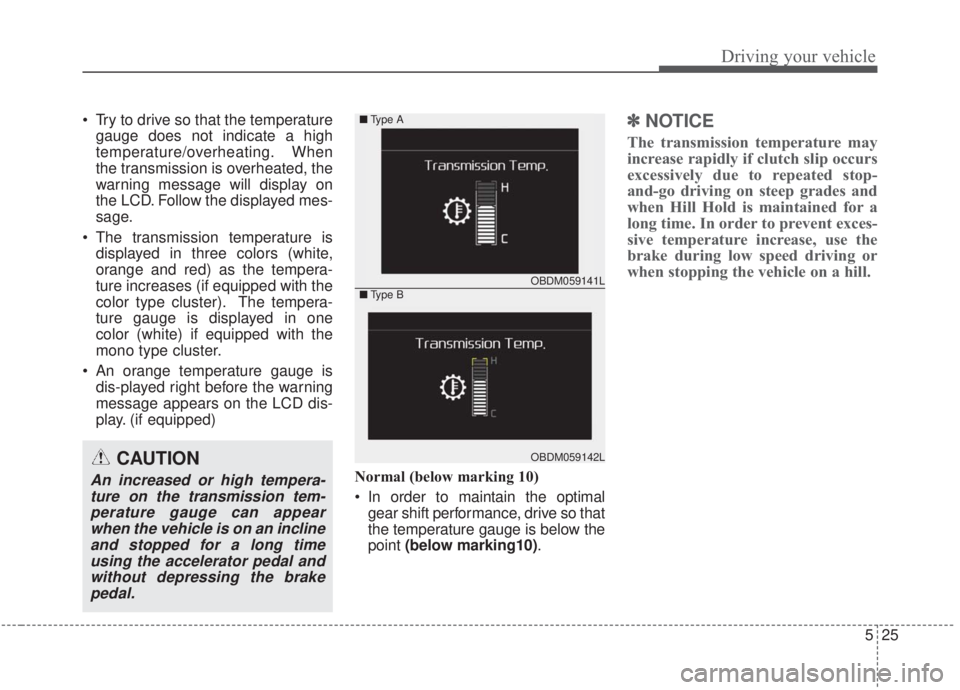
Try to drive so that the temperaturegauge does not indicate a high
temperature/overheating. When
the transmission is overheated, the
warning message will display on
the LCD. Follow the displayed mes-
sage.
The transmission temperature is displayed in three colors (white,
orange and red) as the tempera-
ture increases (if equipped with the
color type cluster). The tempera-
ture gauge is displayed in one
color (white) if equipped with the
mono type cluster.
An orange temperature gauge is dis-played right before the warning
message appears on the LCD dis-
play. (if equipped)
Normal (below marking 10)
In order to maintain the optimalgear shift performance, drive so that
the temperature gauge is below the
point (below marking10) .✽ ✽
NOTICE
The transmission temperature may
increase rapidly if clutch slip occurs
excessively due to repeated stop-
and-go driving on steep grades and
when Hill Hold is maintained for a
long time. In order to prevent exces-
sive temperature increase, use the
brake during low speed driving or
when stopping the vehicle on a hill.
CAUTION
An increased or high tempera-
ture on the transmission tem-perature gauge can appearwhen the vehicle is on an inclineand stopped for a long timeusing the accelerator pedal andwithout depressing the brakepedal.
OBDM059141L
OBDM059142L
■ Type A
■Type B
Page 273 of 568
527
Driving your vehicle
The DCT warning alarm sounds,
the warning message is displayed
on the cluster and the temperature
gauge disappears from the cluster.
Follow the displayed warning
message.
To check the temperature status of the dual clutch when overheated,
move to the temperature gauge
screen by selecting the trip com-
puter mode. Then, you can check
the temperature status of the dual
clutch.DCT warning messages
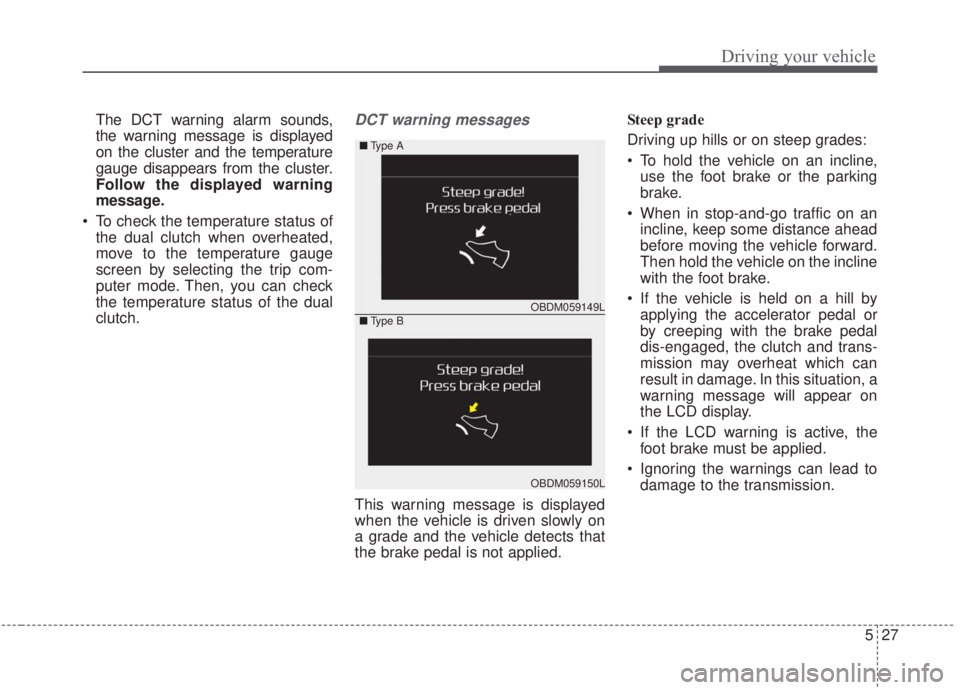
This warning message is displayed
when the vehicle is driven slowly on
a grade and the vehicle detects that
the brake pedal is not applied. Steep grade
Driving up hills or on steep grades:
To hold the vehicle on an incline,
use the foot brake or the parking
brake.
When in stop-and-go traffic on an incline, keep some distance ahead
before moving the vehicle forward.
Then hold the vehicle on the incline
with the foot brake.
If the vehicle is held on a hill by applying the accelerator pedal or
by creeping with the brake pedal
dis-engaged, the clutch and trans-
mission may overheat which can
result in damage. In this situation, a
warning message will appear on
the LCD display.
If the LCD warning is active, the foot brake must be applied.
Ignoring the warnings can lead to damage to the transmission.
OBDM059149L
OBDM059150L
■ Type A
■Type B
Page 274 of 568
Driving your vehicle
28
5
Transmission high temperature
Under certain conditions, such as
repeated stop-and-go launches on
steep grades, sudden take off or
acceleration, or other harsh driving
conditions, the transmission clutch
temperatures will increase exces-
sively. Eventually, the clutch in the
transmission could become over-
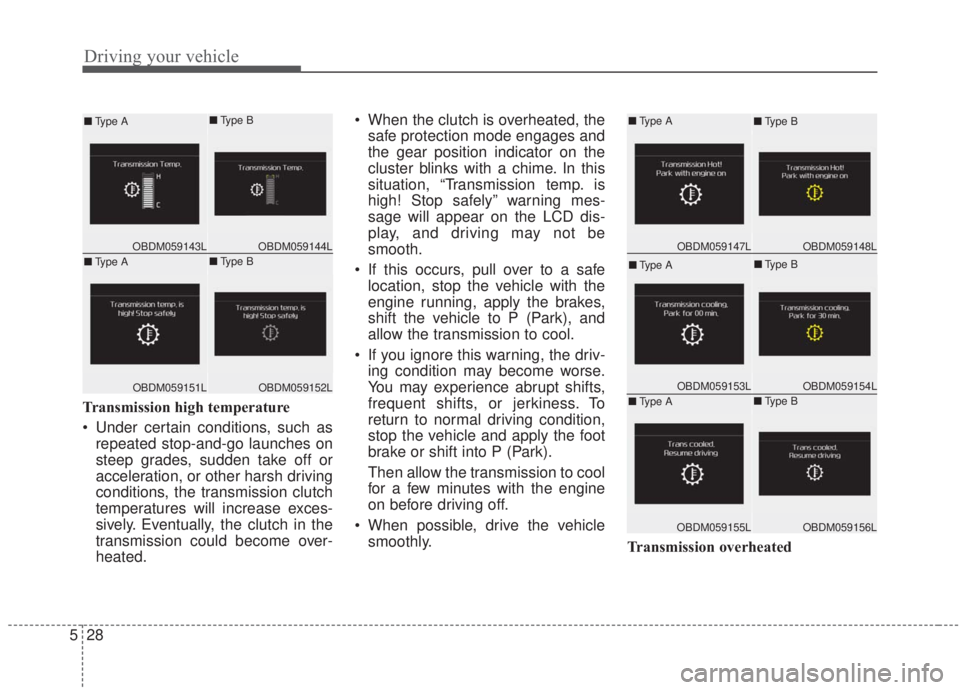
heated. When the clutch is overheated, the
safe protection mode engages and
the gear position indicator on the
cluster blinks with a chime. In this
situation, “Transmission temp. is
high! Stop safely” warning mes-
sage will appear on the LCD dis-
play, and driving may not be
smooth.
If this occurs, pull over to a safe location, stop the vehicle with the
engine running, apply the brakes,
shift the vehicle to P (Park), and
allow the transmission to cool.
If you ignore this warning, the driv- ing condition may become worse.
You may experience abrupt shifts,
frequent shifts, or jerkiness. To
return to normal driving condition,
stop the vehicle and apply the foot
brake or shift into P (Park).
Then allow the transmission to cool
for a few minutes with the engine
on before driving off.
When possible, drive the vehicle smoothly. Transmission overheated
OBDM059144LOBDM059143L
■Type A■Type B
OBDM059152LOBDM059151L
■Type A■Type BOBDM059148LOBDM059147L
■Type A■Type B
OBDM059154LOBDM059153L
■Type A■Type B
OBDM059156LOBDM059155L
■Type A■Type B
Page 275 of 568
529
Driving your vehicle
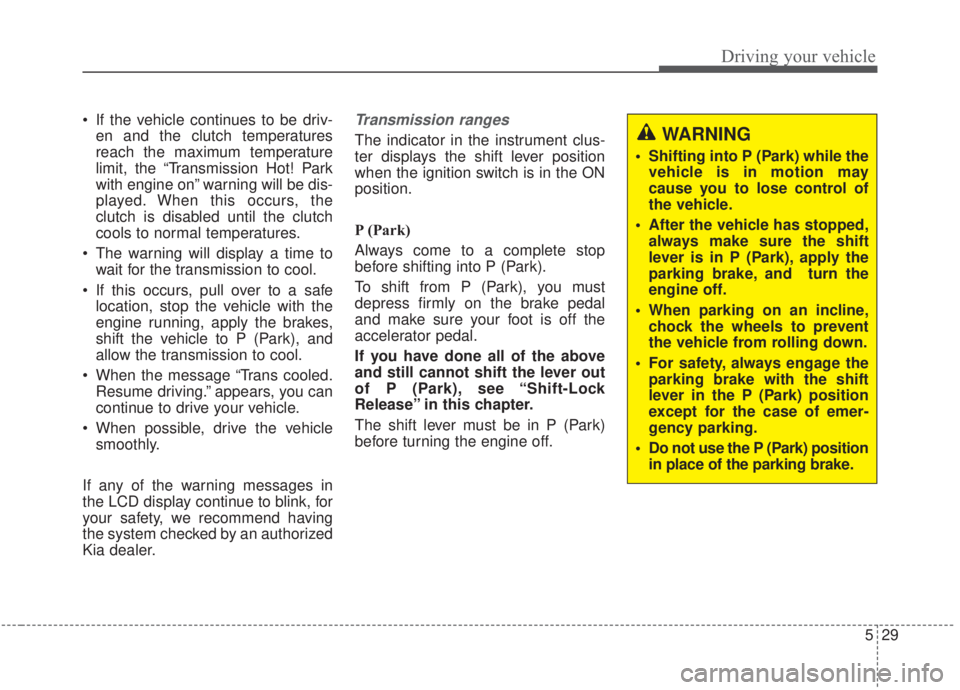
If the vehicle continues to be driv-en and the clutch temperatures
reach the maximum temperature
limit, the “Transmission Hot! Park
with engine on” warning will be dis-
played. When this occurs, the
clutch is disabled until the clutch
cools to normal temperatures.
The warning will display a time to wait for the transmission to cool.
If this occurs, pull over to a safe location, stop the vehicle with the
engine running, apply the brakes,
shift the vehicle to P (Park), and
allow the transmission to cool.
When the message “Trans cooled. Resume driving.” appears, you can
continue to drive your vehicle.
When possible, drive the vehicle smoothly.
If any of the warning messages in
the LCD display continue to blink, for
your safety, we recommend having
the system checked by an authorized
Kia dealer.Transmission ranges
The indicator in the instrument clus-
ter displays the shift lever position
when the ignition switch is in the ON
position.
P (Park)
Always come to a complete stop
before shifting into P (Park).
To shift from P (Park), you must
depress firmly on the brake pedal
and make sure your foot is off the
accelerator pedal.
If you have done all of the above
and still cannot shift the lever out
of P (Park), see “Shift-Lock
Release” in this chapter.
The shift lever must be in P (Park)
before turning the engine off.WARNING
Shifting into P (Park) while the vehicle is in motion may
cause you to lose control of
the vehicle.
After the vehicle has stopped, always make sure the shift
lever is in P (Park), apply the
parking brake, and turn the
engine off.
When parking on an incline, chock the wheels to prevent
the vehicle from rolling down.
For safety, always engage the parking brake with the shift
lever in the P (Park) position
except for the case of emer-
gency parking.
Do not use the P (Park) position in place of the parking brake.
Page 276 of 568
Driving your vehicle
30
5
R (Reverse)
Use this position to drive the vehicle
backward. N (Neutral)
The wheels and transmission are not
engaged.
Use N (Neutral) if you need to restart
a stalled engine, or if it is necessary
to stop with the engine ON. Shift into
P (Park) if you need to leave your
vehicle for any reason.
Always depress the brake pedal
when you are shifting from N
(Neutral) to another gear.
WARNING
Do not shift into gear unless
your foot is firmly on the brake
pedal. Shifting into gear when
the engine is running at high
speed can cause the vehicle to
move very rapidly. You may lose
control of the vehicle and cause
accidents.
WARNING
Do not drive with the shift lever
in N (Neutral).
The engine brake may not work,
which may lead to an accident.
CAUTION
Always come to a complete stop
before shifting into or out of R(Reverse); you may damage thetransmission if you shift into R(Reverse) while the vehicle is inmotion.
Page 277 of 568
531
Driving your vehicle
- Parking in N (Neutral) gear
Follow the steps below when parking
and you want the vehicle to move
when pushed.
1.After parking your vehicle, step onthe brake pedal and move the shift
lever to [P] with the engine
start/stop button in [ON] or while the
engine is running.
2.If the parking brake is applied, unlock the parking brake.
- For EPB (Electronic ParkingBrake) equipped vehicles, push
the brake pedal with the engine
start/stop button in [ON] or while
the engine is running to disen-
gage the parking brake. If [AUTO
HOLD] function is used while
driving (If [AUTO HOLD] indicator
is on in the cluster), press [AUTO
HOLD] switch and [AUTO HOLD]
function should turn off.
3.While pressing the brake pedal, turn the engine start/stop button
[OFF].
- For smart key equipped vehicles,the ignition switch can be moved
to [OFF] only when the shift lever
is in [P]. 4.Change the gear shift lever to [N]
(Neutral) while pressing the brake
pedal and pushing [SHIFT LOCK
RELEASE] button or inserting,
pressing down a tool (e.g. flathead
screw-driver) into the [SHIFT LOCK
RELEASE] access hole at the same
time. Then, the vehicle will move
when external force is applied.CAUTION
With the exception of parking in neutral gear, always park thevehicle in [P] (Park) for safetyand engage the parking brake.
Before parking in [N] (Neutral) gear, first make sure the park-ing ground is level and flat. Donot park in [N] gear on anyslopes or gradients.
If parked and left in [N], thevehicle may move and causeserious damage and injury.
After the ignition switch has been turned off, the electronicparking brake cannot be dis-engaged.
For EPB (Electronic Parking Brake) equipped vehicles with[AUTO HOLD] function usedwhile driving, if the enginestart/stop button has beenturned [OFF], the electronicparking brake will be engagedautomatically. Therefore,[AUTO HOLD] function shouldbe turned off before the enginestart/stop button is turned off.
Page 278 of 568
Driving your vehicle
32
5
D (Drive)
This is the normal driving position.
The transmission will automatically
shift through a seven-gear
sequence, providing the best fuel
economy and power.
For extra power when passing anoth-
er vehicle or driving uphill, depress
the accelerator pedal further until
you feel the transmission downshift
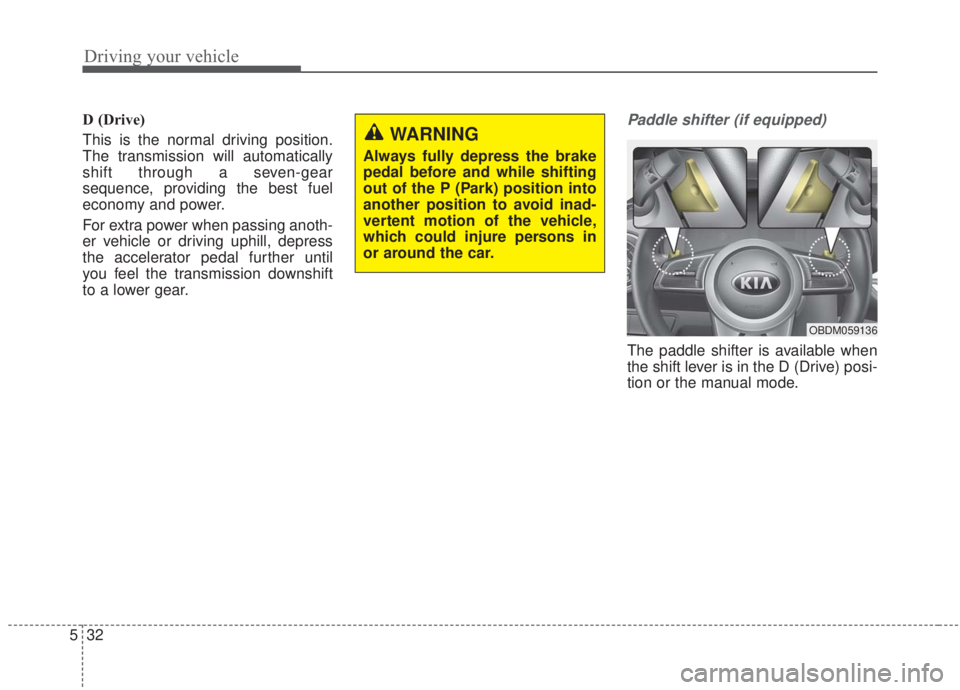
to a lower gear.Paddle shifter (if equipped)
The paddle shifter is available when
the shift lever is in the D (Drive) posi-
tion or the manual mode.
WARNING
Always fully depress the brake
pedal before and while shifting
out of the P (Park) position into
another position to avoid inad-
vertent motion of the vehicle,
which could injure persons in
or around the car.
OBDM059136
Page 279 of 568
![KIA FORTE 2020 Owners Guide 533
Driving your vehicle
With the shift lever in the D position
The paddle shifter will operate when
the vehicle speed is more than 10
km/h (6.2 mph).
Pull the [+] or [-] paddle shifter once
to shift](/img/2/40395/w960_40395-278.png "KIA FORTE 2020 Owners Guide 533
Driving your vehicle
With the shift lever in the D position
The paddle shifter will operate when
the vehicle speed is more than 10
km/h (6.2 mph).
Pull the [+] or [-] paddle shifter once
to shift")
533
Driving your vehicle
With the shift lever in the D position
The paddle shifter will operate when
the vehicle speed is more than 10
km/h (6.2 mph).
Pull the [+] or [-] paddle shifter once
to shift up or down one gear and the
system changes from automatic
mode to manual mode.
When the vehicle speed is lower than
10 km/h (6.2 mph), if you depress the
accelerator pedal for more than 5
seconds or if you move the shift lever
from D (Drive) to manual Mode and
move it from manual Mode to D
(Drive) again, the system changes
from manual mode to automatic
mode.
With the shift lever in the sports mode
Pull the [+] or [-] paddle shifter once
to shift up or down one gear.
✽ ✽NOTICE
If the [+] and [-] paddle shifters are
pulled at the same time, gear shift
may not occur.
Shift-lock override
If the shift lever cannot be moved
from the P (Park) position into the R
(Reverse) position with the brake
pedal depressed, continue depress-
ing the brake, then do the following: 1. Place the ignition switch in the
LOCK/OFF position.
2. Apply the parking brake.
3. Carefully remove the cap (1) cov- ering the shift-lock release access
hole.
4. Insert a tool (e.g. flathead screw- driver) into the access hole and
press down on the tool.
5. Move the shift lever.
6. Remove the tool from the shiftlock override access hole then install
the cap.
7. Have the system inspected by a professional workshop. Kia recom-
mends to visit an authorized Kia
dealer/service partner.
Ignition key interlock system
(if equipped)
The ignition key cannot be removed
unless the shift lever is in the P
(Park) position.
OBDM059006
■Type A
■Type B
OBDM059157