climate control KIA FORTE 5 2017 User Guide
[x] Cancel search | Manufacturer: KIA, Model Year: 2017, Model line: FORTE 5, Model: KIA FORTE 5 2017Pages: 595, PDF Size: 11.53 MB
Page 198 of 595
Features of your vehicle
126 4
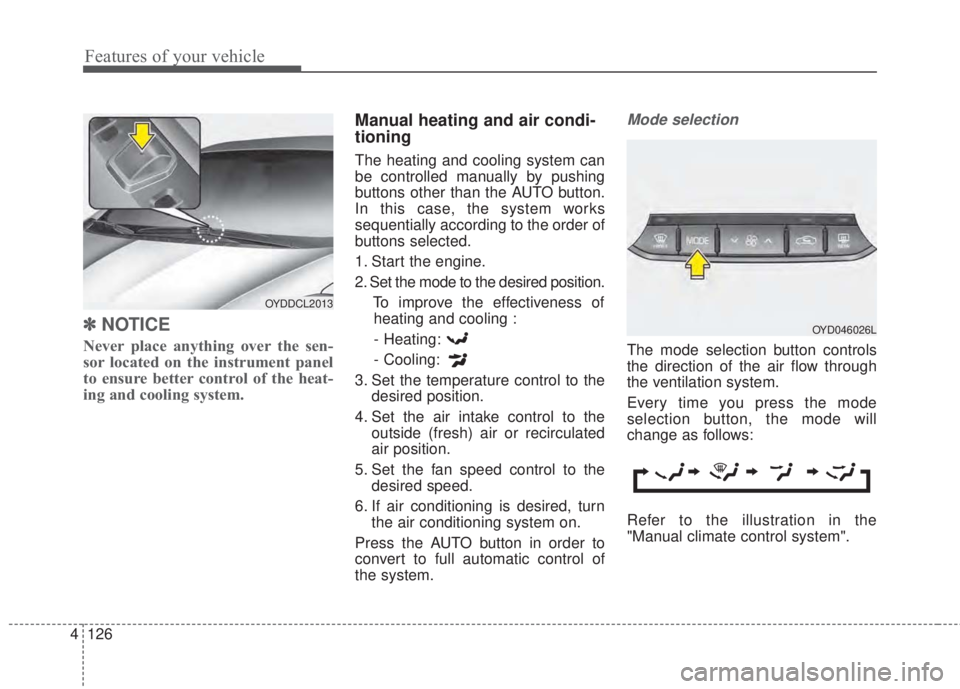
✽NOTICE
Never place anything over the sen-
sor located on the instrument panel
to ensure better control of the heat-
ing and cooling system.
Manual heating and air condi-
tioning
The heating and cooling system can
be controlled manually by pushing
buttons other than the AUTO button.
In this case, the system works
sequentially according to the order of
buttons selected.
1. Start the engine.
2. Set the mode to the desired position.
To improve the effectiveness of
heating and cooling :
- Heating:
- Cooling:
3. Set the temperature control to the
desired position.
4. Set the air intake control to the
outside (fresh) air or recirculated
air position.
5. Set the fan speed control to the
desired speed.
6. If air conditioning is desired, turn
the air conditioning system on.
Press the AUTO button in order to
convert to full automatic control of
the system.
Mode selection
The mode selection button controls
the direction of the air flow through
the ventilation system.
Every time you press the mode
selection button, the mode will
change as follows:
Refer to the illustration in the
"Manual climate control system".
OYDDCL2013
OYD046026L
Page 202 of 595
Features of your vehicle
130 4
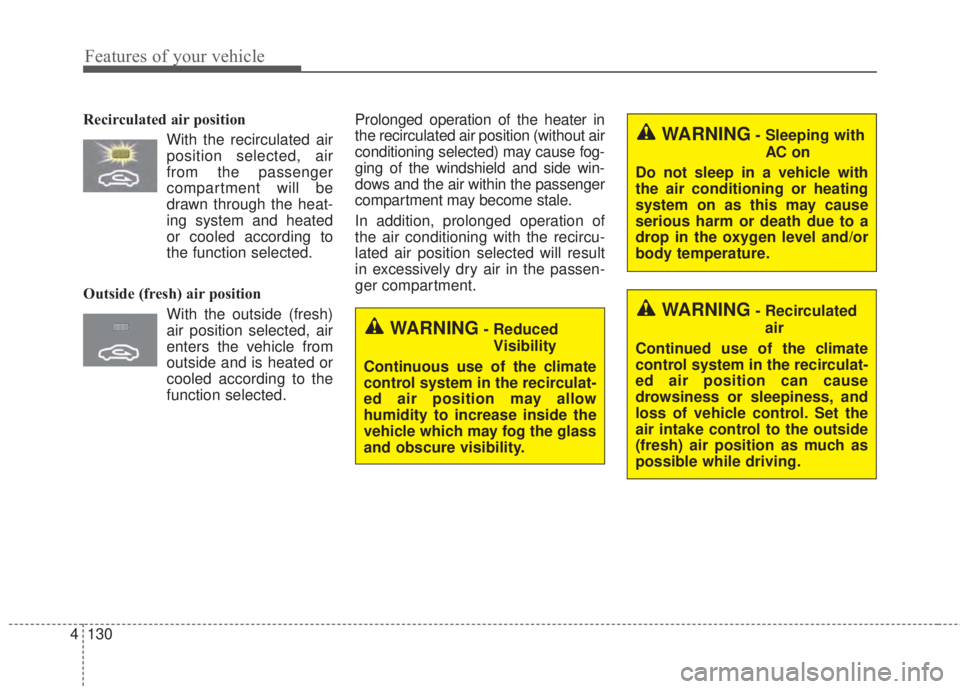
Recirculated air position
With the recirculated air
position selected, air
from the passenger
compartment will be
drawn through the heat-
ing system and heated
or cooled according to
the function selected.
Outside (fresh) air position
With the outside (fresh)
air position selected, air
enters the vehicle from
outside and is heated or
cooled according to the
function selected.Prolonged operation of the heater in
the recirculated air position (without air
conditioning selected) may cause fog-
ging of the windshield and side win-
dows and the air within the passenger
compartment may become stale.
In addition, prolonged operation of
the air conditioning with the recircu-
lated air position selected will result
in excessively dry air in the passen-
ger compartment.
WARNING- Reduced
Visibility
Continuous use of the climate
control system in the recirculat-
ed air position may allow
humidity to increase inside the
vehicle which may fog the glass
and obscure visibility.
WARNING- Sleeping with
AC on
Do not sleep in a vehicle with
the air conditioning or heating
system on as this may cause
serious harm or death due to a
drop in the oxygen level and/or
body temperature.
WARNING- Recirculated
air
Continued use of the climate
control system in the recirculat-
ed air position can cause
drowsiness or sleepiness, and
loss of vehicle control. Set the
air intake control to the outside
(fresh) air position as much as
possible while driving.
Page 203 of 595
4 131
Features of your vehicle
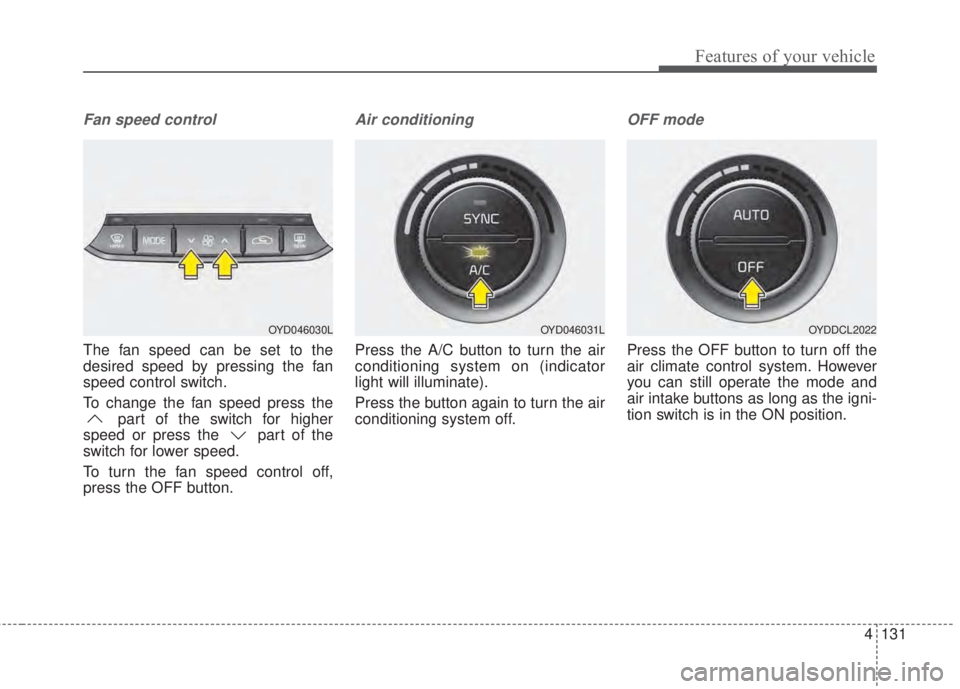
Fan speed control
The fan speed can be set to the
desired speed by pressing the fan
speed control switch.
To change the fan speed press the
part of the switch for higher
speed or press the part of the
switch for lower speed.
To turn the fan speed control off,
press the OFF button.
Air conditioning
Press the A/C button to turn the air
conditioning system on (indicator
light will illuminate).
Press the button again to turn the air
conditioning system off.
OFF mode
Press the OFF button to turn off the
air climate control system. However
you can still operate the mode and
air intake buttons as long as the igni-
tion switch is in the ON position.
OYDDCL2022OYD046031LOYD046030L
Page 206 of 595
Features of your vehicle
134 4
WINDSHIELD DEFROSTING AND DEFOGGING
• For maximum defrosting, set the
temperature control to the extreme
right/hot position and the fan speed
control to the highest speed.
• If warm air to the floor is desired
while defrosting or defogging, set the
mode to the floor-defrost position.
• Before driving, clear all snow and
ice from the windshield, rear win-
dow, outside rear view mirrors, and
all side windows.
• Clear all snow and ice from the
hood and air inlet in the cowl grill to
improve heater and defroster effi-
ciency and to reduce the probabili-
ty of fogging up the inside of the
windshield.Manual climate control system
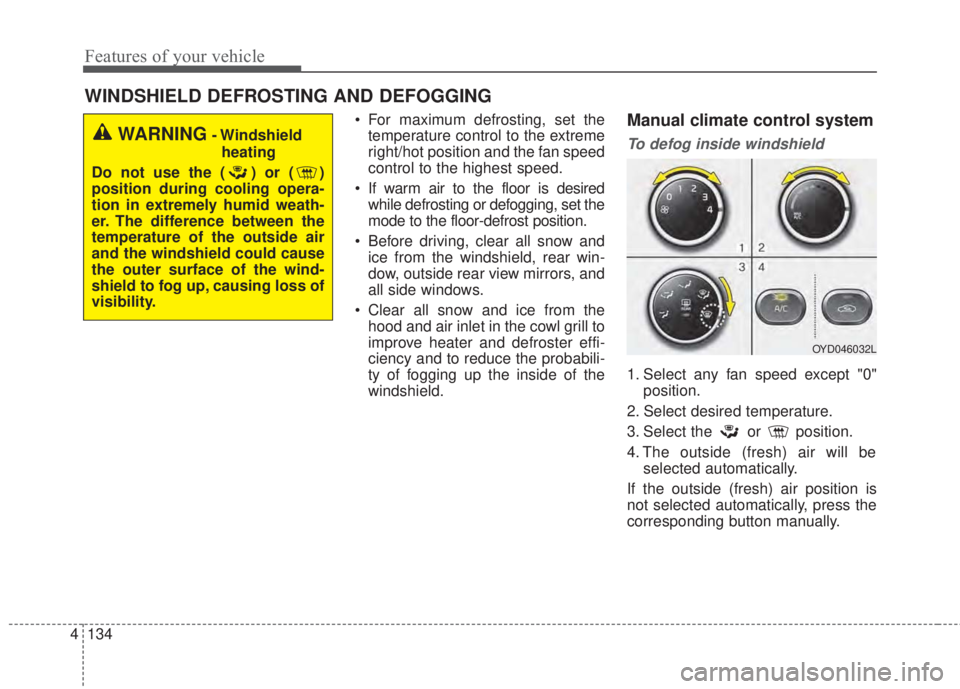
To defog inside windshield
1. Select any fan speed except "0"
position.
2. Select desired temperature.
3. Select the or position.
4. The outside (fresh) air will be
selected automatically.
If the outside (fresh) air position is
not selected automatically, press the
corresponding button manually.
WARNING- Windshield
heating
Do not use the ( ) or ( )
position during cooling opera-
tion in extremely humid weath-
er. The difference between the
temperature of the outside air
and the windshield could cause
the outer surface of the wind-
shield to fog up, causing loss of
visibility.
OYD046032L
Page 207 of 595
4 135
Features of your vehicle
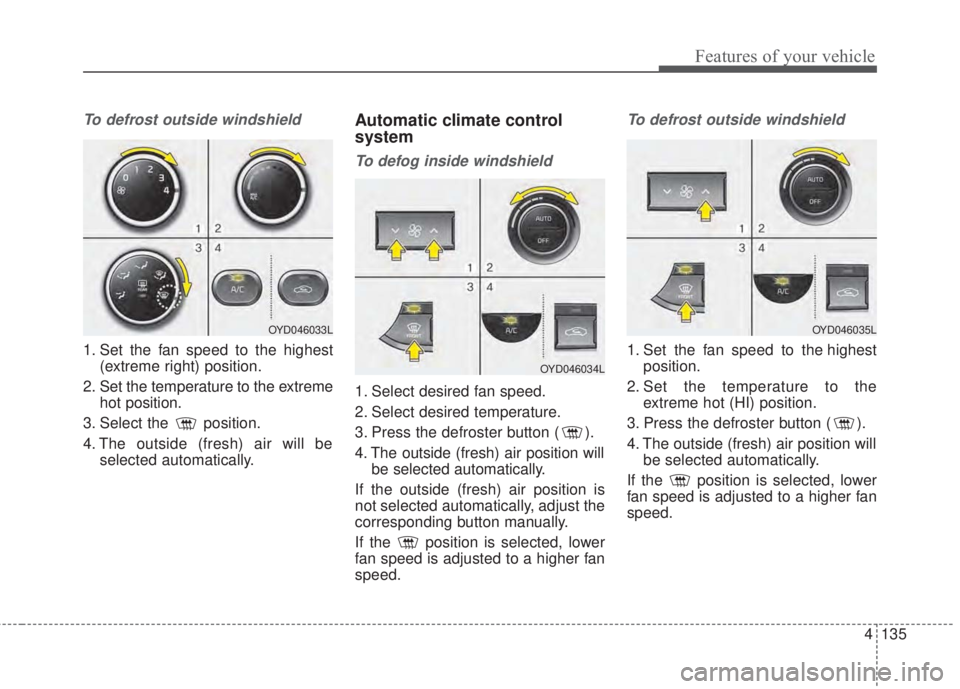
To defrost outside windshield
1. Set the fan speed to the highest
(extreme right) position.
2. Set the temperature to the extreme
hot position.
3. Select the position.
4. The outside (fresh) air will be
selected automatically.
Automatic climate control
system
To defog inside windshield
1. Select desired fan speed.
2. Select desired temperature.
3. Press the defroster button ( ).
4. The outside (fresh) air position will
be selected automatically.
If the outside (fresh) air position is
not selected automatically, adjust the
corresponding button manually.
If the position is selected, lower
fan speed is adjusted to a higher fan
speed.
To defrost outside windshield
1. Set the fan speed to the highest
position.
2. Set the temperature to the
extreme hot (HI) position.
3. Press the defroster button ( ).
4. The outside (fresh) air position will
be selected automatically.
If the position is selected, lower
fan speed is adjusted to a higher fan
speed.
OYD046033L
OYD046034L
OYD046035L
Page 208 of 595
Features of your vehicle
136 4
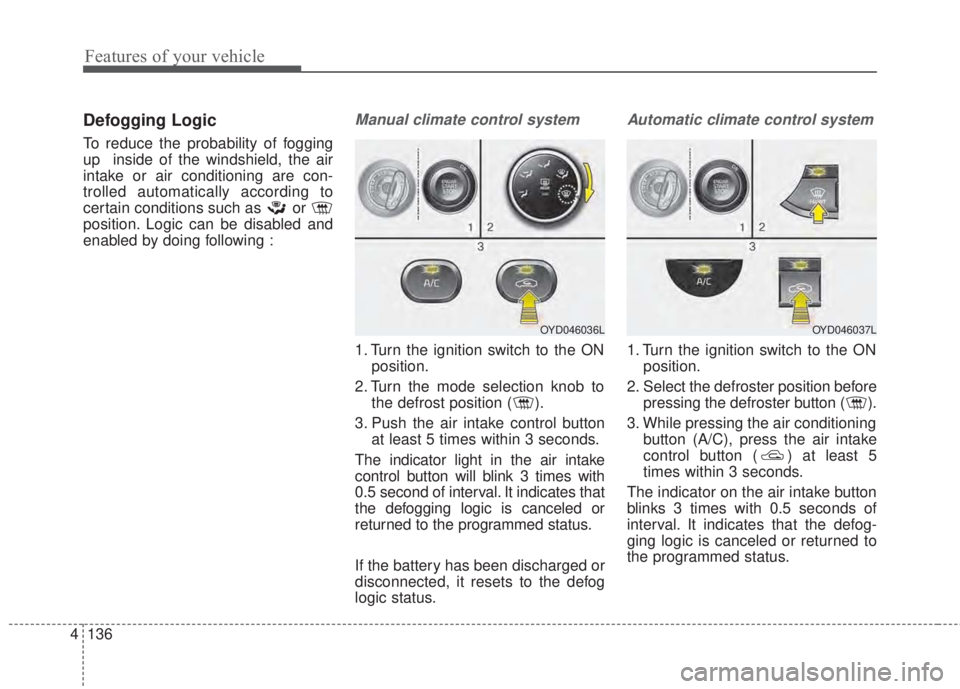
Defogging Logic
To reduce the probability of fogging
up inside of the windshield, the air
intake or air conditioning are con-
trolled automatically according to
certain conditions such as or
position. Logic can be disabled and
enabled by doing following :
Manual climate control system
1. Turn the ignition switch to the ON
position.
2. Turn the mode selection knob to
the defrost position ( ).
3. Push the air intake control button
at least 5 times within 3 seconds.
The indicator light in the air intake
control button will blink 3 times with
0.5 second of interval. It indicates that
the defogging logic is canceled or
returned to the programmed status.
If the battery has been discharged or
disconnected, it resets to the defog
logic status.
Automatic climate control system
1. Turn the ignition switch to the ON
position.
2. Select the defroster position before
pressing the defroster button ( ).
3. While pressing the air conditioning
button (A/C), press the air intake
control button ( ) at least 5
times within 3 seconds.
The indicator on the air intake button
blinks 3 times with 0.5 seconds of
interval. It indicates that the defog-
ging logic is canceled or returned to
the programmed status.
OYD046036LOYD046037L
Page 217 of 595
4 145
Features of your vehicle
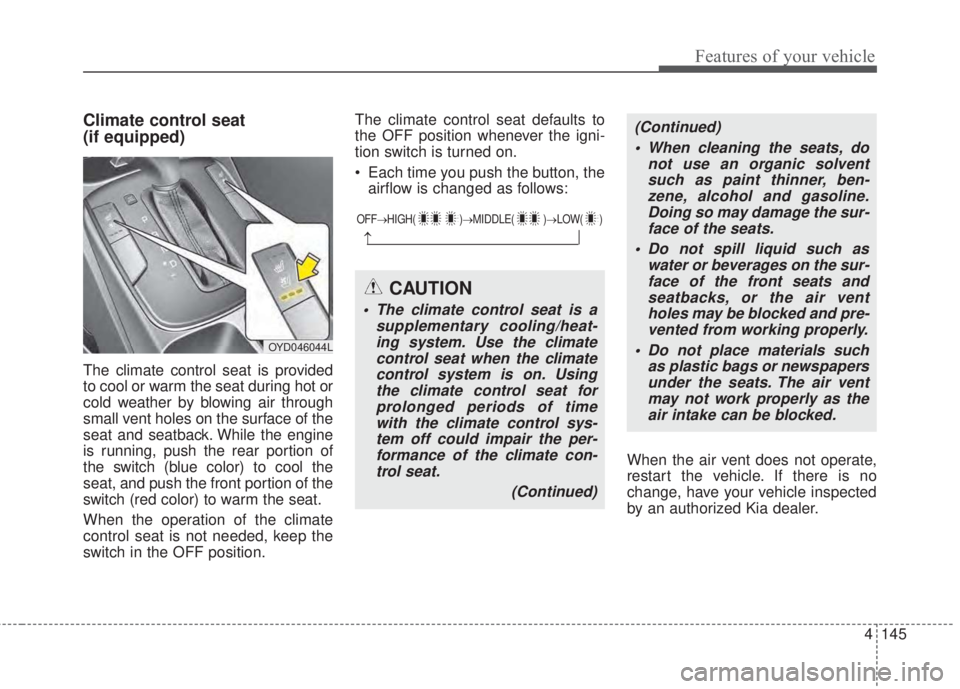
Climate control seat
(if equipped)
The climate control seat is provided
to cool or warm the seat during hot or
cold weather by blowing air through
small vent holes on the surface of the
seat and seatback. While the engine
is running, push the rear portion of
the switch (blue color) to cool the
seat, and push the front portion of the
switch (red color) to warm the seat.
When the operation of the climate
control seat is not needed, keep the
switch in the OFF position.The climate control seat defaults to
the OFF position whenever the igni-
tion switch is turned on.
• Each time you push the button, the
airflow is changed as follows:
When the air vent does not operate,
restart the vehicle. If there is no
change, have your vehicle inspected
by an authorized Kia dealer.
OYD046044L
OFF→HIGH( )→MIDDLE( )→LOW( )
→
CAUTION
• The climate control seat is a
supplementary cooling/heat-
ing system. Use the climate
control seat when the climate
control system is on. Using
the climate control seat for
prolonged periods of time
with the climate control sys-
tem off could impair the per-
formance of the climate con-
trol seat.
(Continued)
(Continued)
• When cleaning the seats, do
not use an organic solvent
such as paint thinner, ben-
zene, alcohol and gasoline.
Doing so may damage the sur-
face of the seats.
• Do not spill liquid such as
water or beverages on the sur-
face of the front seats and
seatbacks, or the air vent
holes may be blocked and pre-
vented from working properly.
• Do not place materials such
as plastic bags or newspapers
under the seats. The air vent
may not work properly as the
air intake can be blocked.
Page 463 of 595
Maintenance
Engine compartment . . . . . . . . . . . . . . . . . . . . . . . . 7-3
Maintenance services . . . . . . . . . . . . . . . . . . . . . . . . 7-5
• Owner’s responsibility . . . . . . . . . . . . . . . . . . . . . . . . . 7-5
• Owner maintenance precautions . . . . . . . . . . . . . . . . . 7-6
Owner maintenance . . . . . . . . . . . . . . . . . . . . . . . . . 7-7
• Owner maintenance schedule. . . . . . . . . . . . . . . . . . . . 7-7
Scheduled maintenance service. . . . . . . . . . . . . . . . 7-9
Explanation of scheduled maintenance items . . . 7-32
Engine oil. . . . . . . . . . . . . . . . . . . . . . . . . . . . . . . . . 7-36
• Checking the engine oil level . . . . . . . . . . . . . . . . . . . 7-36
• Changing the engine oil and filter . . . . . . . . . . . . . . . 7-37
Engine coolant . . . . . . . . . . . . . . . . . . . . . . . . . . . . 7-38
• Checking the coolant level . . . . . . . . . . . . . . . . . . . . . 7-38
• Changing the coolant . . . . . . . . . . . . . . . . . . . . . . . . . 7-41
Brake/clutch fluid . . . . . . . . . . . . . . . . . . . . . . . . . . 7-42
• Checking the brake/clutch* fluid level . . . . . . . . . . . 7-42
Washer fluid . . . . . . . . . . . . . . . . . . . . . . . . . . . . . . 7-43
• Checking the washer fluid level . . . . . . . . . . . . . . . . . 7-43
Parking brake . . . . . . . . . . . . . . . . . . . . . . . . . . . . . 7-43
• Checking the parking brake. . . . . . . . . . . . . . . . . . . . 7-43
Air cleaner. . . . . . . . . . . . . . . . . . . . . . . . . . . . . . . . 7-44
• Filter replacement . . . . . . . . . . . . . . . . . . . . . . . . . . . . 7-44
Climate control air filter . . . . . . . . . . . . . . . . . . . . 7-46
• Filter inspection . . . . . . . . . . . . . . . . . . . . . . . . . . . . . . 7-46• Filter replacement . . . . . . . . . . . . . . . . . . . . . . . . . . . . 7-46
Wiper blades . . . . . . . . . . . . . . . . . . . . . . . . . . . . . . 7-48
• Blade inspection . . . . . . . . . . . . . . . . . . . . . . . . . . . . . . 7-48
• Blade replacement . . . . . . . . . . . . . . . . . . . . . . . . . . . . 7-48
Battery . . . . . . . . . . . . . . . . . . . . . . . . . . . . . . . . . . . 7-52
• For best battery service . . . . . . . . . . . . . . . . . . . . . . . 7-52
• Battery recharging . . . . . . . . . . . . . . . . . . . . . . . . . . . 7-54
• Reset items . . . . . . . . . . . . . . . . . . . . . . . . . . . . . . . . . . 7-54
Tires and wheels . . . . . . . . . . . . . . . . . . . . . . . . . . . 7-55
• Tire care . . . . . . . . . . . . . . . . . . . . . . . . . . . . . . . . . . . . 7-55
• Recommended cold tire inflation pressures . . . . . . . 7-55
• Checking tire inflation pressure. . . . . . . . . . . . . . . . . 7-56
• Tire rotation . . . . . . . . . . . . . . . . . . . . . . . . . . . . . . . . 7-57
• Wheel alignment and tire balance . . . . . . . . . . . . . . . 7-58
• Tire replacement . . . . . . . . . . . . . . . . . . . . . . . . . . . . . 7-59
• Wheel replacement . . . . . . . . . . . . . . . . . . . . . . . . . . . 7-60
• Tire traction . . . . . . . . . . . . . . . . . . . . . . . . . . . . . . . . . 7-60
• Tire maintenance . . . . . . . . . . . . . . . . . . . . . . . . . . . . 7-60
• Tire sidewall labeling . . . . . . . . . . . . . . . . . . . . . . . . . 7-60
• All season tires . . . . . . . . . . . . . . . . . . . . . . . . . . . . . . 7-66
• Summer tires . . . . . . . . . . . . . . . . . . . . . . . . . . . . . . . . 7-66
• Snow tires . . . . . . . . . . . . . . . . . . . . . . . . . . . . . . . . . . . 7-67
• Radial-ply tires . . . . . . . . . . . . . . . . . . . . . . . . . . . . . . 7-67
• Low aspect ratio tire . . . . . . . . . . . . . . . . . . . . . . . . . . 7-67
7
Page 473 of 595
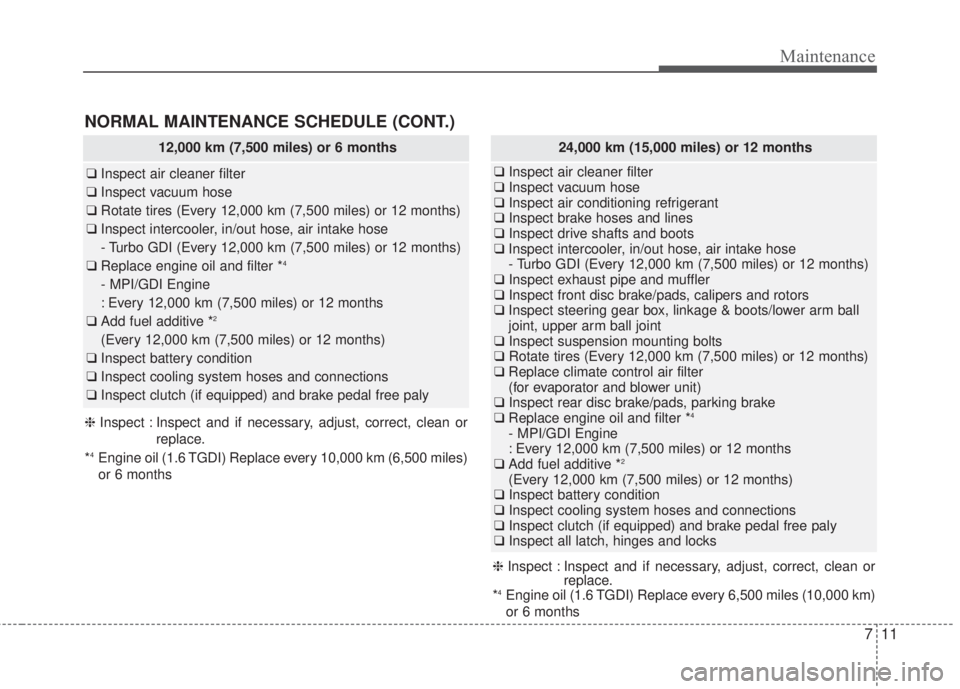
711
Maintenance
12,000 km (7,500 miles) or 6 months
❑Inspect air cleaner filter
❑Inspect vacuum hose
❑Rotate tires (Every 12,000 km (7,500 miles) or 12 months)
❑Inspect intercooler, in/out hose, air intake hose
- Turbo GDI (Every 12,000 km (7,500 miles) or 12 months)
❑Replace engine oil and filter *
4
- MPI/GDI Engine
: Every 12,000 km (7,500 miles) or 12 months
❑Add fuel additive *
2
(Every 12,000 km (7,500 miles) or 12 months)
❑Inspect battery condition
❑Inspect cooling system hoses and connections
❑Inspect clutch (if equipped) and brake pedal free paly
❈Inspect : Inspect and if necessary, adjust, correct, clean or
replace.
*
4Engine oil (1.6 TGDI) Replace every 10,000 km (6,500 miles)
or 6 months
24,000 km (15,000 miles) or 12 months
❑Inspect air cleaner filter
❑Inspect vacuum hose
❑Inspect air conditioning refrigerant
❑Inspect brake hoses and lines
❑Inspect drive shafts and boots
❑Inspect intercooler, in/out hose, air intake hose
- Turbo GDI (Every 12,000 km (7,500 miles) or 12 months)
❑Inspect exhaust pipe and muffler
❑Inspect front disc brake/pads, calipers and rotors
❑Inspect steering gear box, linkage & boots/lower arm ball
joint, upper arm ball joint
❑Inspect suspension mounting bolts
❑Rotate tires (Every 12,000 km (7,500 miles) or 12 months)
❑Replace climate control air filter
(for evaporator and blower unit)
❑Inspect rear disc brake/pads, parking brake
❑Replace engine oil and filter *
4
- MPI/GDI Engine
: Every 12,000 km (7,500 miles) or 12 months
❑Add fuel additive *
2
(Every 12,000 km (7,500 miles) or 12 months)
❑Inspect battery condition
❑Inspect cooling system hoses and connections
❑Inspect clutch (if equipped) and brake pedal free paly
❑Inspect all latch, hinges and locks
NORMAL MAINTENANCE SCHEDULE (CONT.)
❈Inspect : Inspect and if necessary, adjust, correct, clean or
replace.
*
4Engine oil (1.6 TGDI) Replace every 6,500 miles (10,000 km)
or 6 months
Page 475 of 595
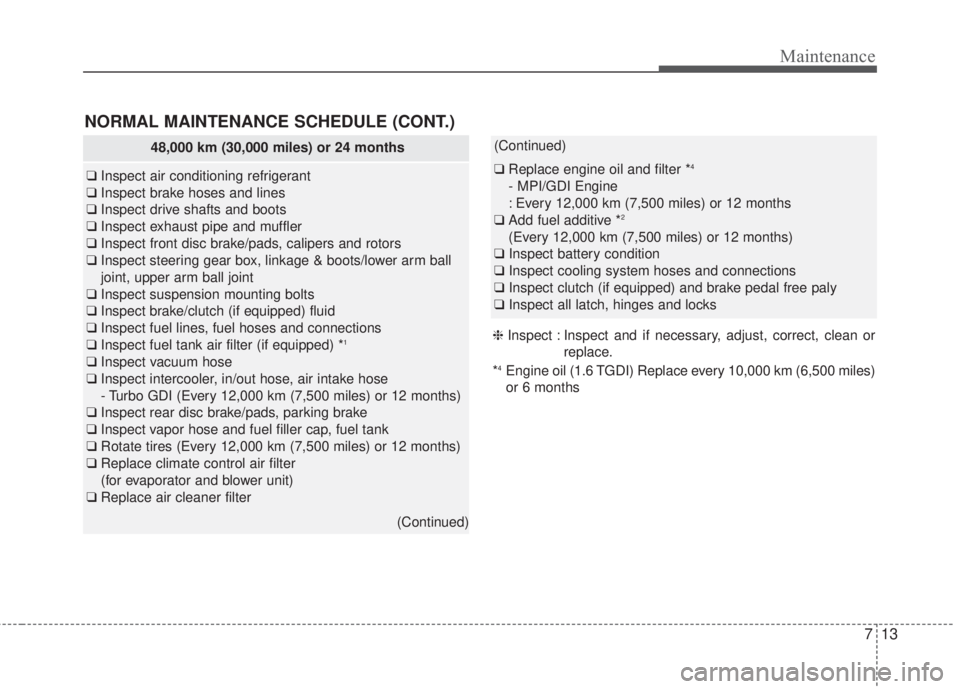
713
Maintenance
NORMAL MAINTENANCE SCHEDULE (CONT.)
48,000 km (30,000 miles) or 24 months
❑Inspect air conditioning refrigerant
❑Inspect brake hoses and lines
❑Inspect drive shafts and boots
❑Inspect exhaust pipe and muffler
❑Inspect front disc brake/pads, calipers and rotors
❑Inspect steering gear box, linkage & boots/lower arm ball
joint, upper arm ball joint
❑Inspect suspension mounting bolts
❑Inspect brake/clutch (if equipped) fluid
❑Inspect fuel lines, fuel hoses and connections
❑Inspect fuel tank air filter (if equipped) *
1
❑Inspect vacuum hose
❑Inspect intercooler, in/out hose, air intake hose
- Turbo GDI (Every 12,000 km (7,500 miles) or 12 months)
❑Inspect rear disc brake/pads, parking brake
❑Inspect vapor hose and fuel filler cap, fuel tank
❑Rotate tires (Every 12,000 km (7,500 miles) or 12 months)
❑Replace climate control air filter
(for evaporator and blower unit)
❑Replace air cleaner filter
(Continued)
(Continued)
❑Replace engine oil and filter *4
- MPI/GDI Engine
: Every 12,000 km (7,500 miles) or 12 months
❑Add fuel additive *
2
(Every 12,000 km (7,500 miles) or 12 months)
❑Inspect battery condition
❑Inspect cooling system hoses and connections
❑Inspect clutch (if equipped) and brake pedal free paly
❑Inspect all latch, hinges and locks
❈Inspect : Inspect and if necessary, adjust, correct, clean or
replace.
*
4Engine oil (1.6 TGDI) Replace every 10,000 km (6,500 miles)
or 6 months